




Abstract
In the field of educational leadership, there is some work around the preferred theories of scholars, but little to no research on how the chosen theories are subsequently applied. Better understanding the purpose, role, and depth of how theory is used in educational leadership can help inform the teaching and mentorship of aspiring leaders and scholars. To examine the nature of theory use in educational leadership, we applied Dressman’s typology of theory use in literacy (2007), to 47 policy and practice-oriented articles in Educational Administration Quarterly. We found similar patterns to Dressman’s typology, but also important differences. Implications are discussed.
Across the United States, doctoral students (EdD and/or PhD) in educational leadership preparation programs are typically required to locate and apply theory and frameworks to their own research and dissertations (Boote & Beile, 2005; Holley & Harris, 2019). Although doctoral students may have varying levels of institutional, programmatic, and individualized support to assist them, there is a dearth of literature available to aid them in understanding how theories and frameworks can be applied (H. E. Green, 2014). Holley and Harris (2019) note that, “some [doctoral] students struggle to identify a framework of any sort, while others struggle to integrate the framework as part of the literature review” (p. 71). While doctoral students may worry about locating the most appropriate theory or framework for their research questions, they may also overlook a related and subsequent issue—purposefully considering how they might actually use their identified theory or frame (H. E. Green, 2014). This is problematic because the purpose for, role of, and depth at which we use a particular theory in a given study can have implications for both empirical knowledge and theory development. This challenge mirrors an undersubstantiated, historical critique of the field—namely, that educational leadership scholars may not use theory as rigorously as scholars of other disciplines due to a shorter theoretical history and varied approaches to working with theory in the field (see, for example, Eacott, 2017; Hoy, 1982; Hyung, 2001; Oplatka, 2009).
While scholars have periodically explored the bodies of theory often integrated into the education and educational leadership field (see, for example, Irby et al., 2013; Oplatka, 2009; Wang, 2018)—in other words, which theories (e.g., social capital; organizational theory, etc.)—there is little to no educational leadership scholarship that examines how and to what end the chosen theory is then applied (e.g., extent to which the chosen theory is aligned to findings or shaped the study design, analysis, implications, or write-up). We seek to examine the following question: How do scholars of educational leadership use theory? Rather than create an inventory of the names of theories that have been used in educational leadership, our intent is to begin to explore the purpose, role, and depth of how theories, after they are chosen, are then used in educational leadership scholarship. Our aim is to begin to work toward a typology of theory use in educational leadership scholarship. We hope to not only contribute to the research field, but to also help guide educational leadership preparation programs and the teaching and mentoring of aspiring educational leaders and scholars.
Educational Leadership and Theory
Educational leadership is an applied field where the broader context is often the world of practice. Today, educational leaders are tasked with improving classroom-level teaching and learning, meeting policy demands, and serving an increasingly diverse student body. In response, educational leadership scholars may aim to provide timely research to inform the daily work of practitioners and policymakers, while contending with the confines of the slower moving academy. Likewise, educational leadership programs have only limited time to prepare the next generation of administrators and scholars. These pressures may seem to suggest that theory is by default sidelined in educational leadership and preparation; however, a clear use of theory may actually allow for a more impactful translation of research into practice. As Suppes (1974) historically outlined, theory can allow education scholars to interpret and make sense of data, help explain complicated phenomena, and shape how we view the world. Scholars in adjacent fields like curriculum and instruction and education psychology work closely with theory—for example, social constructivism (Vygotsky, 1978)—to inform both the preparation of future teachers in the university setting and the instructional practices that will inform student learning in the K–12 classroom setting (e.g., Jones & Vesilind, 1996; Rodriguez & Berryman, 2002). Thus, in the context of educational leadership, theory use may not only contribute to the production of scholarly knowledge but also aid in better understanding the world of practice.
Because there is limited scholarly work on how scholars use theory in educational leadership (i.e., the role, purpose, or depth), we begin our review by providing a chronological overview of which theories educational leadership scholars have drawn on and developed in their own research. In this historical review, we describe the academic and policy contexts that informed the shifts in the development of the dominant theories and frameworks used in educational leadership. Building upon this foundation, we then begin to examine how educational leadership scholars have used these theories in their research by presenting our results from an exploratory study on the empirical scholarship from a flagship journal in educational leadership. Our discussion brings these sections together; we explore the relationship between the nature of the specific theories that are available to educational leadership scholars (which theories) as well as how scholars then use these theories in their work.
Educational Leadership Theories: A Historical Review
Recognizing that current educational leadership may draw from many perspectives, here we provide a historical review of broad theoretical developments over time: (a) the 1950s–1960s and organizational frameworks; (b) the 1970s and contingency theories; (c) the 1980s–1990s school reform and schools as organizations; and (d) the 2000s and critical perspectives. Understanding these theoretical developments provides the background needed to understand how theories are used in educational leadership. Furthermore, this review illuminates the inherent and ongoing connection between theory and practice in educational leadership scholarship as evidenced through various types of theories and frameworks that scholars in educational leadership have used over time. The multiplicity of frameworks in educational leadership is not the result of haphazard or random engagement with theory, but is illustrative of the liminal work that educational leadership scholars engage in: research situated between theory and policy-informed practice. We address each development in turn.
The 1950s–1960s and Organizational Frameworks
Prior to the 1950s, the theoretical grounding of educational leadership was almost nonexistent; the field’s knowledge base was substantially derived from stories and experiences taught by senior practitioners rather than from empirical research. As a result, it was saturated with “normative concerns” about administration while lacking a solid conceptual understanding—a valid paradigm that addresses core problems of the field (Heck & Hallinger, 2005; Oplatka, 2009, p. 10; Wang, 2018). Yet, between the 1950s and the 1960s, some scholars began what was later called the “theory movement in educational administration,” which aimed to build a generalizable knowledge base and overarching theory for educational leadership (Heck & Hallinger, 2005; Oplatka, 2009). Rising amid the logical positivist orientation, scholars in what was then called educational administration borrowed, adapted, and applied theories and concepts from the social and behavioral sciences to their work. One of the most influential theoretical groundings of educational administration during this initial period came from organizational sociology—a research area that also emerged as a recognized field of social scientific study during the 1950s (Scott, 2004). Using organizations as units of analysis, pioneer organizational sociologists focused on studying the determinants of an organization’s structure such as the distinctive features of organizations and forces that shape these characteristics (Scott, 2004).
Considering educational units as organizations, scholars in educational administration (and later educational leadership) drew on concepts and frameworks that helped them examine and explain phenomena specific to the daily work of educational leaders in schools and districts. Over time, these frameworks gave rise to a newer set of concepts that were more applied to the realities educational leadership scholars were studying in the field. Reviewing educational leadership literature during this period, Griffiths (1959) categorized the field’s dominant theories in four groups: (a) social system and role theory, (b) leadership theory, (c) decision-making theory, and (d) organizational theory. As these four distinct groups of theories suggest, the promise of the theory movement to develop a grand theory for educational leadership was not met (Wang, 2018). Many scholars critiqued the social psychological behaviorist approaches, including the dominance of quantitative and deductive methods that were borrowed by most educational leadership studies, for failing to understand the “social constructions of the school life” as well as the “contextual, moral, and ethical issues” that educational leaders face in their everyday practices (Heck & Hallinger, 2005, p. 231).
The 1970s and Contingency Theory
In the 1970s, the field’s conceptual orientation shifted from closed-system to open-system, as well as from grand theories to contingency theories (Wang, 2018). This shift was informed by the transformation in the field of organizational sociology, which began to adapt open-system models in organizational studies (Scott, 2004). Whereas the closed-system model focused on the technical aspects of work solely within the organization, the general or open-system model allowed scholars to consider the broader environment itself. With the introduction and later dominance of contingency theory—an approach that recognizes the complexity and uncertainty of technical environments that shape the structures of organizations (Donaldson, 2001; Galbraith, 1973; Lawrence & Lorsch, 1967; Scott, 2004)—organizational sociology and accordingly, to educational leadership, scholars developed a better way to capture the complexity of educational leadership in practice (see, for example, Bossert et al., 1982; Hallinger, 2003).
However, many dominant framing concepts were borrowed from other social and behavioral science disciplines—and subsequently, methodological approaches remained chiefly quantitative and positivist (Wang, 2018). This fueled the long-standing debate on the orientation of scientific and theoretical driven research versus the applied and practical nature of the field (Heck & Hallinger, 2005). Many scholars of the time warned against the practice of uncritically borrowing social scientific concepts (e.g., Hills, 1978; Hoy, 1982). They suggested that educational leadership research and teaching should be more attentive to the problems encountered by practitioners. The push toward pragmatic research gained strength.
The 1980s–1990s, School Reform, and Schools as Organizations
During the 1980s, growing interest in education reform and school effectiveness led to a new set of theories that sought to understand leadership from an organizational standpoint. From this perspective, the dominant framing concepts at the time included organizational culture, organizational climate, organizational theory, motivation, efficacy, and loose coupling (see, for example, Hallett, 2010; Hoy et al., 2006; Oplatka, 2009, 2010; Spillane & Louis, 2002; Wang, 2018). Instructional leadership was also first conceptualized and introduced to educational leadership. By the late 1980s, a small number of empirical studies began to undertake theoretical perspectives that were different from a rational, positivist paradigm (Heck & Hallinger, 2005), fueling “the big bang” in educational leadership scholarship (Oplatka, 2009, p. 15).
During “the big bang” period (which extended into the 1990s), the field expanded in various directions. New contrasting perspectives, such as critical theory, postmodernism, and feminism, were first included in educational leadership research (see, for example, Bates, 1980; Capper, 1998; Dillard, 1995; Evers & Lakomski, 1991, 1996; Heck & Hallinger, 2005; Lakomski, 1987; Park, 1999). Concomitantly, while organizational frameworks remained popular (e.g., instructional leadership, transformational leadership, distributed leadership, moral leadership, democratic leadership, and participative leadership), frameworks focused on aspects of leadership practice in schools (e.g., bureaucracy, empowerment) were also developing (Wang, 2018).
“Instructional leadership” emerged from the effective schools movement in the 1980s (Edmonds, 1979). The term asserted a logic (rather than a conceptual framework) about effective schools; specifically, that these schools were led by principals who engaged in strong instructional leadership practice (Hallinger, 2005). Although various scholars have contributed to its conceptualizations (e.g., Edmonds, 1979; Hall & Hord, 1987; Leithwood & Montgomery, 1982), as a construct, instructional leadership lacks a uniform description in the research literature (Murphy, 1988). However, its tenets include a focus on the role of the formal school leader in establishing the mission and vision of the school community, the active supervision of the curricular and instructional foci of the school, and developing and attaining measurable goals—which typically draw on student academic outcomes as benchmarks (see, for example, Boyce & Bowers, 2018; Hallinger & Murphy, 1986; Marks & Printy, 2003; Witziers et al., 2003).
Transformational leadership, which was initially developed in the field of leadership studies (Bass, 1985; Burns, 1978), also entered the educational leadership arena (Hallinger, 2003; Leithwood, 1992; Leithwood & Jantzi, 1999, 2000) As external policymakers and educational reformers focused on school restructuring, the transformational leadership approach emerged in school leadership practice as a way to address key structures within the school, termed “second-order changes,” that allow growth toward instructional goals (Leithwood, 1994, p. 500). The transformational leadership framework prioritized a focus on teachers’ professional development needs by structuring the school environment into a learning organization for students and teachers (Leithwood et al., 1998).
The massive expansion in conceptual and methodological directions of the field accelerated the debate over diluted versus grand theories. Some scholars claimed that greater diversity in scholarship did not result in greater accumulative knowledge (Heck & Hallinger, 2005). With diluted theories, the field had become so fragmented that it was difficult to identify any unified and unique set of theories for educational leadership (see Eacott, 2017; Wang, 2018). However, another group of scholars argued that diversity in theoretical and methodological approaches was necessary to investigate the complexity and richness of leadership work in practice (Heck & Hallinger, 2005). They went further to assert that “it was futile to search for a grand theory of educational leadership” (Wang, 2018, p. 7) as it may not be appropriate or applicable to the field.
While scholars at the time may have conducted empirical research with a perception that specific theories had to be aligned to specific methodological approaches, that stance on the relationship between theory and methods is no longer a defining feature (see, for example, Kincheloe & Tobin, 2009; Pallas, 2001). For example, scholars have applied theories such as Marxism and feminism, which frame how power operates in society through socioeconomic status and gender respectively, to inform the development of the research design, analyze data, and interpret findings from both qualitative and quantitative studies (see, for example, Carter Andrews et al., 2019; Cunningham, 2017; Else-Quest & Hyde, 2016; Sosa-Provencio, 2019). 1
The 2000s and Critical Perspectives
Considered “a time of critical reflection” (Oplatka, 2009, p. 23), the early 2000s were a period when scholars of educational leadership reflected on the history of the field and questioned its theoretical groundings. Many scholars argued that the focus of traditional research on the administrative process and improvement was too narrow and ignored unjust issues inherited within the school system (Heck & Hallinger, 2005). As a result, the field shifted toward a social justice direction with the rise of social justice leadership, distributed leadership, moral leadership, transformational leadership, democratic leadership, trust, and school culture (Capper, 2015; Oplatka, 2009, 2010; Wang et al., 2017). This shift in the field was ushered in through earlier theoretical work focused on critical ways of examining and understanding inquiry and practice in other sub-disciplines of educational research; particularly in the area of curriculum and instruction (e.g., Anyon, 2009; Ladson-Billings, 1999).
Critical scholars in educational research
In education and the social sciences more broadly, Gloria Ladson-Billings and William F. Tate (1995) developed critical race theory (CRT) from legal scholarship in the 1990s following its initial development as a framework in critical legal studies by Delgado (1989), Crenshaw (1988) and Bell (1979). However, the origins of the framework extend back to W.E.B. DuBois (1903) and as many scholars have asserted, the framework did not develop in a strictly linear manner (Capper, 2015). While Ladson-Billings and Tate introduced the CRT framework to education research in 1995 (e.g., Ladson-Billings, 1995, 1998, 1999), it is not until the early 2000s that we see scholarship in educational leadership that draws upon the framework in empirical analysis (e.g., López, 2003). Relatedly, Jean Anyon’s scholarship on curriculum and “critical social theory” (p. 2, 2009), is one example of how social theory has developed over time to examine and explain how power and societal structures shape what counts as knowledge in schools (see, for example, Anyon, 1981, 1997, 2005; Calhoun, 1995; Cornbleth, 2017). Both Ladson-Billings and Anyon’s scholarship underscores the role of social justice in the daily practice of school educators (Anyon, 2006; Ladson-Billings & Tate, 2006). The application of a social justice lens served to reframe existing concepts and advance new frameworks toward a more critical social justice perspective that reflected the needs of school communities.
Critical perspectives in educational leadership scholarship
Educational leadership scholars, who drew on social justice frameworks called for a shift away from traditional objective-oriented stances that scholars are often expected to take in their research, toward an ideological embrace of a social justice framework that would intentionally transform research, policy, and practice in educational leadership and thereby better serve the field (Marshall, 2004). In both conceptual and empirical work, critical 2 and social justice frameworks were developed, advanced, and applied (e.g., Bertrand & Rodela, 2018; Gooden & Dantley, 2012; Shields, 2010).
In addition, scholars in educational leadership are drawing on critical frameworks to analyze leadership practice as it intersects with policy and policy implementation in education. Critical theory encompasses several newer formations of theory in the field of educational leadership which include CRT, critical Latin studies (LatCrit), queer theory in education, feminist theory, Marxist theory, critical policy analysis, muxerista framework, DisCrit, critical discourse analysis, and more recently, critical whiteness studies (e.g., Carpenter, 2019; Diem & Carpenter, 2013; Diem et al., 2019; Grogan & Simmons, 2012; Horsford, 2019; Koyama & Chang, 2019; Oliva & Alemán, 2019; Parker & Stovall, 2004; Sampson, 2019; Tabron & Ramlackhan, 2019). Found in both educational leadership and education policy journals, this line of scholarship may focus explicitly on aspects of leadership practice, or center on various components of schooling.
Currently, educational leadership scholarship drawing on CRT has focused on how the framework can be directly connected to leadership practice at both the district and building levels (e.g., Alemán Jr., 2007; Capper, 2015; Horsford, 2010, 2019). For example, in a retrospective on the application of CRT to scholarship in educational leadership, Capper (2015) examined the six tenets of CRT and identified the rich educational leadership scholarship aligned to (a) racism in the United States (e.g., Khalifa et al., 2014), (b) Whiteness as property (e.g., C. I. Harris, 1993; Pollack & Zirkel, 2013), (c) counter and majoritarian narratives (e.g., Santamaría, 2014; Theoharis & Haddix, 2011), (d) interest convergence (e.g., Gooden, 2012), (e) critique of various forms of liberalism (e.g., Khalifa et al., 2014), and (f) intersectionality (e.g., Cho et al., 2013; Crenshaw, 1989; Santamaría, 2014).
In their examination of the scholarship on social justice in educational leadership, Bertrand and Rodela (2018) drew on CRT and activity theory to advance their concept of collective transformative agency. In describing its tenets, the authors noted its parallels to the distributed leadership conceptual framework (Spillane et al., 2001, 2004), which also draws on activity theory (Engeström, 2001) and distributed cognition. For their analysis, the collective transformative agency framework is informed by CRT to better examine how social justice leadership can expand beyond the school to include leadership from young people, parents, and community members of color from historically marginalized groups (Bertrand & Rodela, 2018). Thus, educational leadership scholars who have used a social justice framework—or “under the same umbrella,” community organizing and grassroots leadership (Welton & Freelon, 2018, p. 82)—have developed a range of theoretical and empirical work that examines how leadership for social justice and equity-minded practices are carried out within schools and across communities (e.g., Brooks et al., 2007; Brown, 2006; T. L. Green, 2017; Ishimaru & Galloway, 2014; Mavrogordato & White, 2019; McKenzie et al., 2008; Murtadha & Watts, 2005; Santamaría, 2014; Shields, 2010; Shields & Hesbol, 2019; Theoharis, 2007).
According to Wang (2018), the incremental knowledge of educational leadership has accumulated and developed through a prolonged process of evolution, rather than revolution. Without a drastic shift in theoretical paradigm, the field has grown to include various conceptual perspectives, shaping the pluralistic nature of educational leadership research (see Eacott, 2017; Wang, 2018). In addition, as empirical scholarship in educational leadership has increasingly focused on practices that define leadership work in schools and districts (A. Harris, 2013), scholars have taken up a range of theoretical and conceptual frameworks to make sense of the particular phenomena under analysis. The pluralistic nature of theory in educational leadership makes it all the more important that we examine how theory is used in our scholarship and deeply consider how we train future scholars and practitioners on how to apply these varied frameworks to their work.
Framing Our Typology on the Hows of Theory
While there is some limited work around which theories educational leadership scholars have drawn on (Oplatka, 2009; Wang, 2018), including a typology of knowledge domains in educational leadership based on British scholarship (Ribbins & Gunter, 2002), and a handbook of educational theories (see Irby et al., 2013), there is little to no work on how educational scholars in the United States have used theories. Fortunately, Dressman (2007) engaged in a similar task—exploring the purpose, role, and depth of theory use in the field of literacy. Because other education-related fields have not engaged in similar tasks (to our knowledge), we chose to examine the applicability of his typology to educational leadership, serving to extend Dressman’s (2007) work.
To develop his typology of how theory is used, Dressman (2007) reviewed 69 articles on social theory in three literacy journals. As shown in Figure 1, Dressman (2007) posits four classifications for how scholars’ use theory in literacy: (a) Theoretical frame as foundational platform, (b) Theoretical frame as focal apparatus, (c) Theoretical frame as discursive scaffold, and (d) Theoretical frame as dialectical scaffold (p. 345). These classifications focus on the purpose, role, and depth in which theory is integrated into the research. Elaborating on Figure 1, theoretical frame as foundational platform does not extend or “play” with theory, but uses theory in cursory ways to inform and support research studies. Here, theory supports the research project but is not the core consideration. In theoretical frame as focal apparatus, theory directs the reader. In this classification, scholars often begin with theory and then return to it toward the end. However, theory remains largely absent from the methods and findings sections. In discursive scaffold, scholars typically use coding systems that are connected to the theory and the findings are largely in-line with the theory. The scholars do not critique the theory. Finally, in contrast to discursive scaffold, in dialectical scaffold, there are some disconnects between the scholarship and the theory. Here, scholars push back on theory, critiquing it or suggesting the need for refinements or extensions (see Figure 1). While Dressman (2007) explored the purpose, role, and depth in which scholars used theory in literacy, this study is the first, as we are aware of, to consider the applicability of Dressman (2007)’s typology on how theory is used within educational leadership.
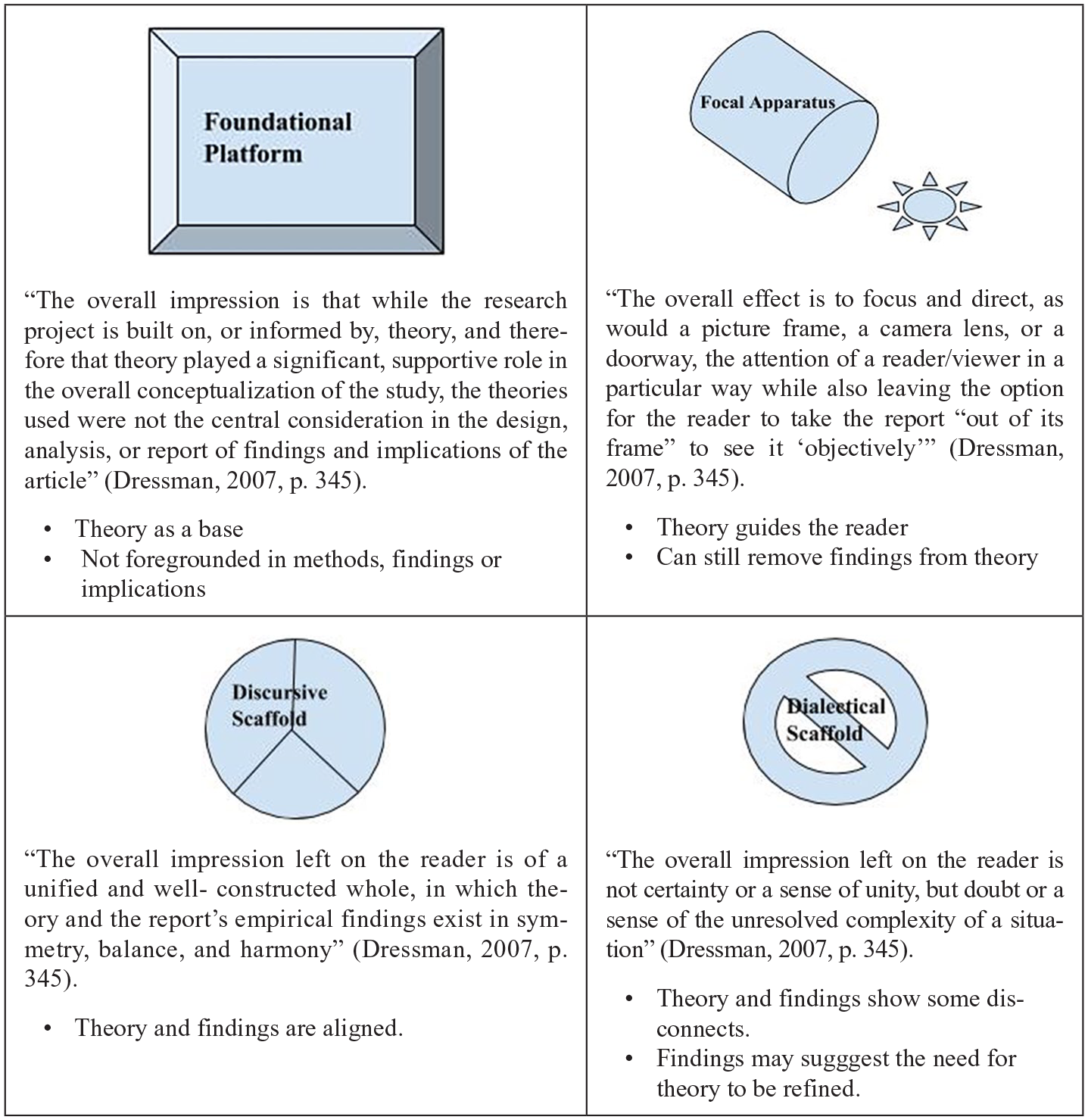
Dressman’s literacy typology of how theory is used.
Research Team and Positionality
Our research team consisted of two assistant professors and two graduate students. Drs. Modeste and Pavlakis are former K–12 practitioners and current assistant professors in separate Educational Leadership programs/departments where they both teach and mentor doctoral (EdD/PhD) and masters students. Both authors completed their doctoral studies at the same research university where they first grappled with the challenges and potential of finding and applying theory in their own educational leadership scholarship. Although most of their exposure to theory in their doctoral program was sprinkled throughout coursework or taught as it related to distinct content areas (e.g., school–community relations) or specific theoretical topics (e.g., organizational theory), they were also part of a research program that provided them access to a unique one-credit elective course on finding and applying theory. This study emerged from their lived experiences, as both students and faculty, with theory in educational leadership.
Dr. Modeste is a research scholar who uses qualitative and quantitative methods to examine the nature of leadership practice in the context of district policy and the school environment. During her doctoral studies she sought out courses that informed her understanding of the role of theory in educational research. For example, in a class that examined multicultural perspectives on education, the Foucauldian concept of the regime of truth was one of several organizing frameworks that served to highlight the importance of epistemological stance in empirical research. In an introduction to qualitative methods class, the significance of the research question was consistently underscored because it is tied to the remaining sections of the inquiry work. The core objectives and formative activities for this course included class discussion focused on the components of a qualitative study (i.e., the types of epistemologies, theoretical perspectives, types of theories, theoretical and conceptual frameworks, types of methodologies, and types of methods), along with opportunities to practice using qualitative methods for data collection. As a faculty member, Dr. Modeste teaches educational leadership courses to graduate students (doctoral and masters) with content areas focused on theory, specifically applied concepts from organizational theory, local school district policy, and leadership practices oriented toward district-level change. In all of these courses, serving students with a range of degree and programmatic foci, Dr. Modeste incorporates theory-rich instruction, activities, discussion, reflection, and practice. While her use of theory for her dissertation research aligned with focal apparatus, her ensuing scholarship most closely aligns with discursive scaffold.
Dr. Pavlakis is a qualitative researcher who examines the social context of education and often draws from sociological theories in her work. She found theoretical insights for her dissertation, in which she classified her use of theory most closely as dialectical scaffold, by reading extensively and engaging in ongoing conversations with many faculty in her department. As a faculty member at her current institution, she created modules for her qualitative methods courses to teach the application of theory. For instance, in her PhD-level introduction to qualitative methods course, first-year students co-define theory-related vocabulary then compare their definitions to those of scholars. Afterwards, students read and debate the value of arguments around the purpose of theory (e.g., Suppes, 1974). Students also study Dressman (2007) and apply the typology to empirical course readings and consider, hypothetically, how the study could change if theory was used in a different way. The modules allow time for discussion of useful strategies for locating appropriate theories. Through a course assignment, students also identify some theories used in the literature related to their own broad research areas and then consider the relevance of each theory or framework to their emerging research questions to date. Class discussions provide a space to consider what role(s) the theory or frame could also play in their future work.
Dr. Nguyen was a doctoral candidate in educational leadership at Dr. Modeste’s institution. In a 6-week period, she provided roughly 20 hr of support to the data analysis process. She was exposed to theory through her discipline-based courses, where instructors covered the prominent theories of that particular scholarly field in education. Through her own exploration of academic scholarship, she was also aware of the various approaches scholars take in applying theory to their work, but struggled with the process of applying theory. Through continued engagement with theory, she has grown to see the importance of theories that are specifically relevant to educational leadership. An additional doctoral candidate, also at The Pennsylvania State University, provided supplemental support (roughly 6 hr over the course of data analysis) to the study and likewise noted that the process of theory application in educational leadership was “ . . . enshrouded in mystery.” The diversity of the team’s researchers in terms of institution, career development, and academic training provides different perspectives to the data analysis process. These diverse perspectives augmented the rigor of our analysis; and, through the in-depth, probing conversations, functioned as an additional learning opportunity throughout our research process.
Method
To address our research question, we aimed to explore theory use in a sample of scholarly K–12 U.S. educational leadership literature. Our study design drew on the tradition of document and content analysis to systematically review, evaluate, organize, and categorize data from our sample (Bowen, 2009; Dressman, 2000; see also, Dressman, 2007). As this work was exploratory, we structured our sample in a number of ways: by journal, content area, method, date, and geographic location. Our aim was to produce a subset of theory-rich educational leadership literature—our “documents”—to which we could then thoroughly analyze for how theory was used. This approach could subsequently be replicated using different journals, methodological focuses, content areas, dates, and/or geographic locations.
Sample of Articles
First, we limited our sample to empirical research articles published in Educational Administration Quarterly (EAQ), a leading U.S.-based peer reviewed journal on educational leadership, with an impact factor of 1.851 (2017). We chose EAQ because it is a flagship journal for the University Council for Educational Administration, which is a consortium of higher educational institutions that prepare educational leaders. Thus, it is a leading academic journal disseminating empirical research that is also grounded in practice. We also chose EAQ because it explicitly requires the use of theory, theoretical frameworks, or conceptual frameworks in the analysis; which, not all academic journals do, making it an appropriate focus for our study. By examining one journal, we were able to control for variations across journals in their expectations and norms around theory.
Within EAQ, we included only qualitative studies because qualitative and quantitative research can approach the use of theory from different epistemological stances (Dressman, 2009). Furthermore, we included only publications that were relevant to U.S. K–12 school leadership practice in the areas of policy implementation and distributed leadership. While Spillane and colleagues (2001, 2004) have developed a conceptual framework of distributed leadership, which asserts that leadership work is distributed in schools, scholarship on educational leadership has also embraced the term more broadly, as another approach to leadership, for its implications for leadership practice (see Modeste, in press). We used distributed leadership to capture the scholarly shift from a focus on leadership traits to leadership practice. Because we are interested in policy implementation at the intersection of school leadership practice, we included distributed leadership in our search terms to focus on this scholarly shift.
Search terms
Following the initial development and introduction of the distributed leadership concept and conceptual framework (Gronn, 2002; Spillane et al., 2001, 2004), the field engaged in both research and scholarly discussion around its meaning and practical application in K–12 settings (e.g., A. Harris, 2004; Woods, 2004). In 2006, the first book on distributed leadership and its contribution to educational leadership was published (see Spillane, 2006). Following its release, Harris reflected on the conceptual framework and normative practice in the first of several pieces examining distributed leadership (see A. Harris, 2008; A. Harris & DeFlaminis, 2016; A. Harris et al., 2007; A. Harris & Spillane, 2008). Therefore, we decided to examine scholarship after 2006, when scholars began to retrospectively summarize and reflect on a shared understanding on the concept. Taken together, we used the search term “distributed leadership AND policy implementation” and focused on empirical qualitative research after 2006. Using these parameters, our search yielded 47 research articles.
Limitations
We recognize the limitations of our methodological decisions. Although EAQ is a leading journal of educational administration in the United Staes, it may be that a broader or international sweep of the literature would suggest different findings. Second, we only examined qualitative studies; this methodological focus is important to note because there can be an unease in qualitative research around how theory is used in relation to data analysis. On the one hand, qualitative scholars may try to avoid aligning their coding too closely to theory (such as through a heavy use of a priori codes) due to concerns over restricting the emergent analysis (see Glaser & Strauss, 2017). On the other hand, focusing exclusively on open and emerging themes may suggest the work is undertheorized (see Sanchez & Kresyman, 2019). Thus, the qualitative coding process requires purposeful and careful reflection based on the scholar’s paradigms, research questions, experiences, and theory (see Blair, 2015). We do not have insight, through this study, on how scholars use theory across methodological orientations or geographic contexts. Finally, we focused on one subset of educational leadership scholarship—policy implementation and distributed leadership—between 2006 and 2018. Findings could be different for educational leadership with different content foci or a different period of time. However, to encourage exploration in other subsets of educational leadership literature, we aim to be transparent in how we located our sample of research articles for analysis.
Analysis
In our analysis, we examined the extent to which our sample of 47 articles aligned to Dressman’s (2007) typology of theory use. We started by examining how scholars of these articles used theory. We developed a rubric in Microsoft Excel to track the elements of Dressman’s typology that were evident in each piece and created a formula to help us align each article. In addition to the formula, we independently confirmed whether or not the article fit Dressman’s typology and, where appropriate, indicated the category to which it best aligned, if any. With this initial round of analysis, we also began the process of analytical memoing (Creswell, 2007) whereby we documented our observations, comments, and questions about the article and its relationship to Dressman’s typology.
At the beginning of the initial analysis process, Dr. Modeste and Dr. Pavlakis both reviewed and coded six articles together, side-by-side, to ensure agreement on our understanding of the underlying constructs in Dressman’s typology and how they can be traced in educational leadership scholarship (Miles et al., 2014). After completing the six initial articles together, Dr. Modeste and Dr. Pavlakis worked independently on the remaining articles. We used Excel to document and share our initial memos and notes for the articles we reviewed. Once we finished our initial coding of these articles, we held a conference to discuss our questions and observations from the first round of coding. After this stage of analysis, we used our memos, notes, rubric, and discussions to identify issues, questions, features, and concerns that arose in our independent review of the articles.
Interrater reliability
We also discussed the importance of establishing interrater reliability (Miles et al., 2014) by including external reviewers who would read a sample of the 47 articles, independently assess their alignment to Dressman’s typology, and assist in any misalignments between previous reviews. For this part of the analysis, Dr. Nguyen served as Secondary Reviewer—she read and coded 33 randomly selected articles from the original 47. An additional doctoral candidate on our team served as the Tertiary Reviewer. Before beginning their work, the Secondary and Tertiary Reviewers studied Dressman (2007) and were trained in use of the Excel rubric we created.
Using the rubric, the Secondary Reviewer coded the 33 articles, aligning with our initial analysis on 15 of them. The Tertiary Reviewer then coded the remaining 16 articles from the sample of 33. The results from the review of the 16 articles showed alignment between the Original Reviewer (Dr. Modeste or Dr. Pavlakis) and the Tertiary Reviewer on eight articles. Dr. Modeste and Dr. Pavlakis then closely reviewed the memos from each of the reviewers for the remaining eight articles, and found that there was meaningful agreement between the Original Reviewer and the Secondary Reviewer on two of the articles, such that the original decision should be maintained. Dr. Modeste and Dr. Pavlakis then re-read the six outstanding articles and had a discussion about the coding for each article. In this discussion we shared our reasoning for our decisions, whereby we resolved any outstanding articles (Miles et al., 2014).
Systematic reflection
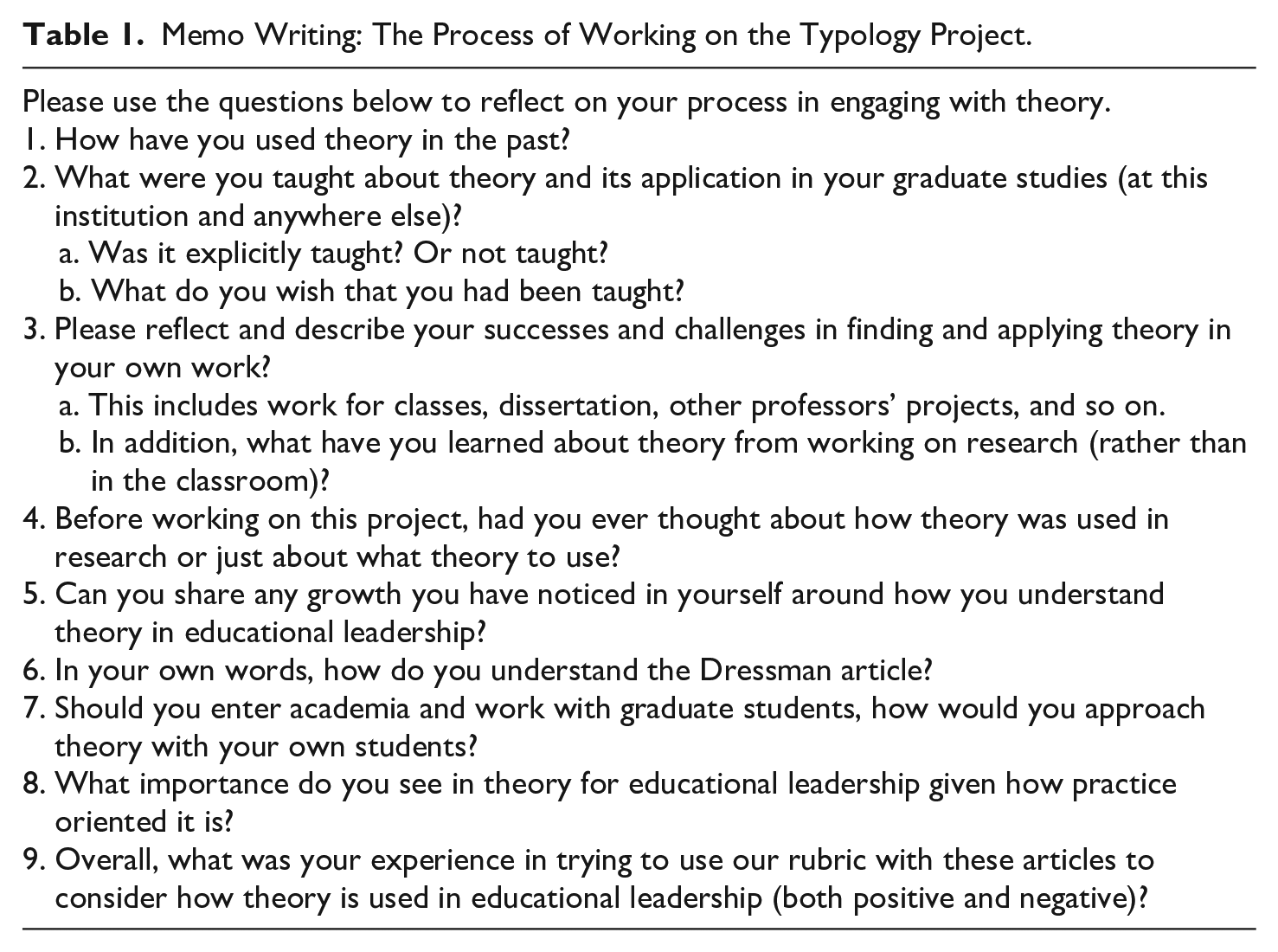
To connect our research process and analysis back to our origins as graduate students grappling with theory and its place in our work, we invited Dr. Nguyen, the Secondary Reviewer, and the Tertiary Reviewer to reflect on the process they engaged in as part of their work on this study team, their understanding of Dressman’s typology and the articles they reviewed, and their lived experiences (as graduate students) with theory through a series of prompts (see Table 1). The memos consisted of two components: an analytical memo (Creswell, 2007) that served as technical documentation of the research process they engaged in for this study, and a self-reflective memo (Creswell, 2007) of their experiences and intended future use of theory in their research and teaching. The resulting memos (see Table 2), thoughtfully and thoroughly prepared, allowed us to better understand the nature of interrater reliability in our study; and, more importantly, to contextualize our study beyond the applicability of Dressman’s typology.
Memo Writing: The Process of Working on the Typology Project.
Excerpts From the Memos.

Coding process
Both reviewers shared a similar approach to the coding process for this study. One reviewer specifically described using the initial reading of an article as an opportunity to assess their own understanding of the use of theory in the study and how theory contributed to the purpose and significance of the study. Following their initial reading and reflection of a given article, both reviewers then examined the components of the rubric and Dressman’s typology to determine where it was best aligned. After defining key terms relevant to our study, we detail and discuss our findings.
Conceptualizing Our Terms
Theoretical and conceptual frameworks are terms commonly mentioned in scholarship, but often not explained—making it challenging for emerging scholars to recognize how these terms can assist them when they are engaging in their own research (H. E. Green, 2014; Holley & Harris, 2019). Although many scholars use the terms “theory,” “theoretical framework,” and “conceptual framework” interchangeably and in various ways (Glesne & Peshkin, 1992; Holley & Harris, 2019; Merriam, 2009; see also, H. E. Green, 2014), for the purposes of this study, we distinguish across the three. We draw on the scholarly work of Miles and Huberman (1994) as well as Maxwell (2013) and define conceptual framework as a distinct construct developed through the application of one or more theories or theoretical frameworks. The conceptual framework itself will comprise and posit a concept or idea about the nature of a given phenomenon (Maxwell, 2012). Even though these frameworks are conceptual and lack a distinct theoretical component, they may undoubtedly function in the capacity of a theory or theoretical framework when applied or used in the research process. For example, in the field of educational leadership, Spillane and colleagues (2004) developed a conceptual framework that described leadership as a set of tasks, practices, and work that people engage in throughout organizations like schools, irrespective of a given person’s formal position within the organization. Their conceptual framework (Spillane et al., 2004) was informed by Engeström’s (2001) activity theory and distributed cognition. Through their conceptual framework, Spillane and colleagues (2004) posit that leadership practice is distributed in schools and requires the work of a leader and a follower in response to a given context or situation.
In the field of nursing research, another area of applied scholarship, scholars have similarly sought out a common understanding of both the types of frameworks that can be applied in empirical work and how they are used (see, for example, Fain, 2004; H. E. Green, 2014; Parahoo, 2006). While there are nuances across this work regarding specific definitions, substantively these scholars assert that conceptual frameworks are oriented around concepts, and theoretical frameworks arise from one or more theories (Fain, 2004; H. E. Green, 2014; Parahoo, 2006). In our study, theoretical frameworks comprise two or more theories which together help explain or provide perspective for a given phenomenon. For example, in the field of organizational sociology, a range of theoretical frameworks were developed and advanced by scholars following the emergence of the open system models approach to understanding organizations broadly (Scott, 2004). The resulting frameworks included several that informed the scholarship in educational leadership: contingency theory (Galbraith, 1973; Lawrence & Lorsch, 1967; Woodward, 1958), network theory (White et al., 1976), organizational ecology (Hannan & Freeman, 1977), and institutional theory (DiMaggio & Powell, 1983; Meyer & Rowan, 1977). An example of a theoretical framework in education can be found in Stinson’s (2008) application of three theories in his study examining African American males’ achievement in mathematics. Specifically, Stinson draws on poststructural theory, CRT, and critical theory.
A theory provides a specific explanation for how a construct or phenomenon is oriented in the world (see, for example, Fain, 2004). For example, CRT (Ladson-Billings & Tate, 1995; Ladson-Billings, 1998), explains how race operates in the United States, specifically that racism is endemic; and, through its critique of liberalism, CRT demonstrates how legal victories from the Civil Rights movement of the 1960s and education reform initiatives in the latter part of the 20th century have largely reinforced structures of inequity and white supremacy in the United States. Theories change, evolve, and are amended over time as research findings add to our collective knowledge about the subject. For consistency, we applied these definitions to our analysis, irrespective of how each scholar(s) identified their work. In other words, if scholars noted that they used a “conceptual framework” but then went on to describe what we identify as a “theoretical framework,” we classified the piece as using a theoretical, rather than conceptual, framework. Doing so simply allowed us to apply a common vocabulary across the individual studies and should not be extended to imply the scholars were in error.
Findings
To set the groundwork for our findings, we first examine the themes that emerged across the graduate students’ (the Secondary Reviewer/third author and Tertiary Reviewer) memos on theory use. Afterwards, we turn to our analysis of the articles in relation to Dressman (2007).
Reflections on Theory Use
Three themes emerged across the graduate students’ memos concerning their reflections on experiences with theory use. First, both students expressed a frustration with theory and applications of theory that has been taught to them in graduate school. Second, they discussed difficulties they faced in finding and applying theories to their own work. Finally, they discussed the impact of feedback they received on their theoretical decisions and thought-processes and, despite obstacles, articulated a belief in the importance of theory in educational leadership scholarship (see Table 2). These three themes were also, remarkably relatable to Drs. Modeste and Pavlakis’ doctoral experiences with theory use.
In the beginning of their graduate studies, both students learned about classic, overarching theories in education research; these included reading “the original text from theorists” and exposure to “‘umbrella’ theories” such as functionalism, conflict theory, and human capital, for example. However, they soon realized that these theories alone would not be helpful for their own work. For example, the Secondary Reviewer argued that while these grand theories helped her establish fundamental knowledge about theory, “they seemed too broad.” In the same vein, because many of these grand theories are considered classic, the Tertiary Reviewer found that the theories were sometimes too outdated to apply to his more contemporary research; he stated: “It was disheartening to find a new theory, want to use it, and then realize that it was considered antiquated.” Both students wished that theories were taught in a more thorough or in-depth manner across their coursework.
In their own work as graduate students, both the Secondary and Tertiary Reviewers have struggled with “finding the correct theory to use.” As they began to narrow down their research interests, their approaches to theories have also shifted away from classroom-oriented coursework. For example, to find a theory that could be applicable to her study, the Secondary Reviewer searches broadly until she finds the “best fit” to her study, or if not, “a theoretical gap” where her study can contribute. For the Tertiary Reviewer, because his research interests are in the social-psychological realm, he argues for the need of a “theory blending” approach, which, as he says, “has been seen as unfavorable by some professors.”
The graduate students also discussed the feedback they have received from editors, reviewers, and professors about their theoretical choices in their own work. The Secondary Reviewer credited the outsiders’ feedback for helping her “develop a new perspective of [her] own work and [introducing her] to theories that [she has] never heard about or considered.” On the contrary, the Tertiary Reviewer mentioned that the feedback he received often directed him away from the “theory blending” approach in order to target a more focused audience. He argued that this type of feedback can lead emerging scholars toward an a-theoretical approach to their research. Notably, and despite these challenges, both graduate students emphasized the important role of theory in educational leadership, even given the practice-orientation of the field. Interestingly, while the memo prompts asked the graduate students to consider their prior engagement with, current use of, and intended future application of theory in their work, the majority of their reflections focused on the foundational aspect of finding the appropriate theory, rather than the application of said theories in their academic work. This focus may not be surprising given that graduate students must first select a theory before they consider how they might actually use it. However, it may also signal that graduate students, such as the Secondary and Tertiary Reviewers, are struggling so much to select which theory that they devote less attention than may be needed to the subsequent application of the theory.
Alignment to Dressman
Our findings suggest that the pattern for the typology of theory use in our sample of educational leadership articles generally align to the distribution of theory use in Dressman’s (2007) study. However, we also unearthed some important differences between the two typologies—which we believe are helpful in translating Dressman into the educational leadership area of scholarship. In particular, there is an interesting point of contrast between the two typologies when examining the categories or types of frameworks used by scholars in the different fields. Specifically, scholars in our educational leadership sample drew on a more varied or nuanced structure of frameworks in their application of theory as part of their scholarly research. We coined the term ephemeral application, to explain a way to use theory that may be unique to educational leadership. Furthermore, we also found that scholars in our sample of educational leadership articles drew from several types of frameworks to establish, conduct, and interpret data from their studies. In addition to using theory, theoretical frameworks and conceptual frameworks, we found that scholars in educational leadership also used what we call “empirical-based frameworks” and “theory-of-action frameworks” as types of theoretical devices in their empirical research studies (see Figure 2). We first discuss the distribution of theory use and then examine how our data may suggest the need to extend Dressman (2007) in the contexts of educational leadership.
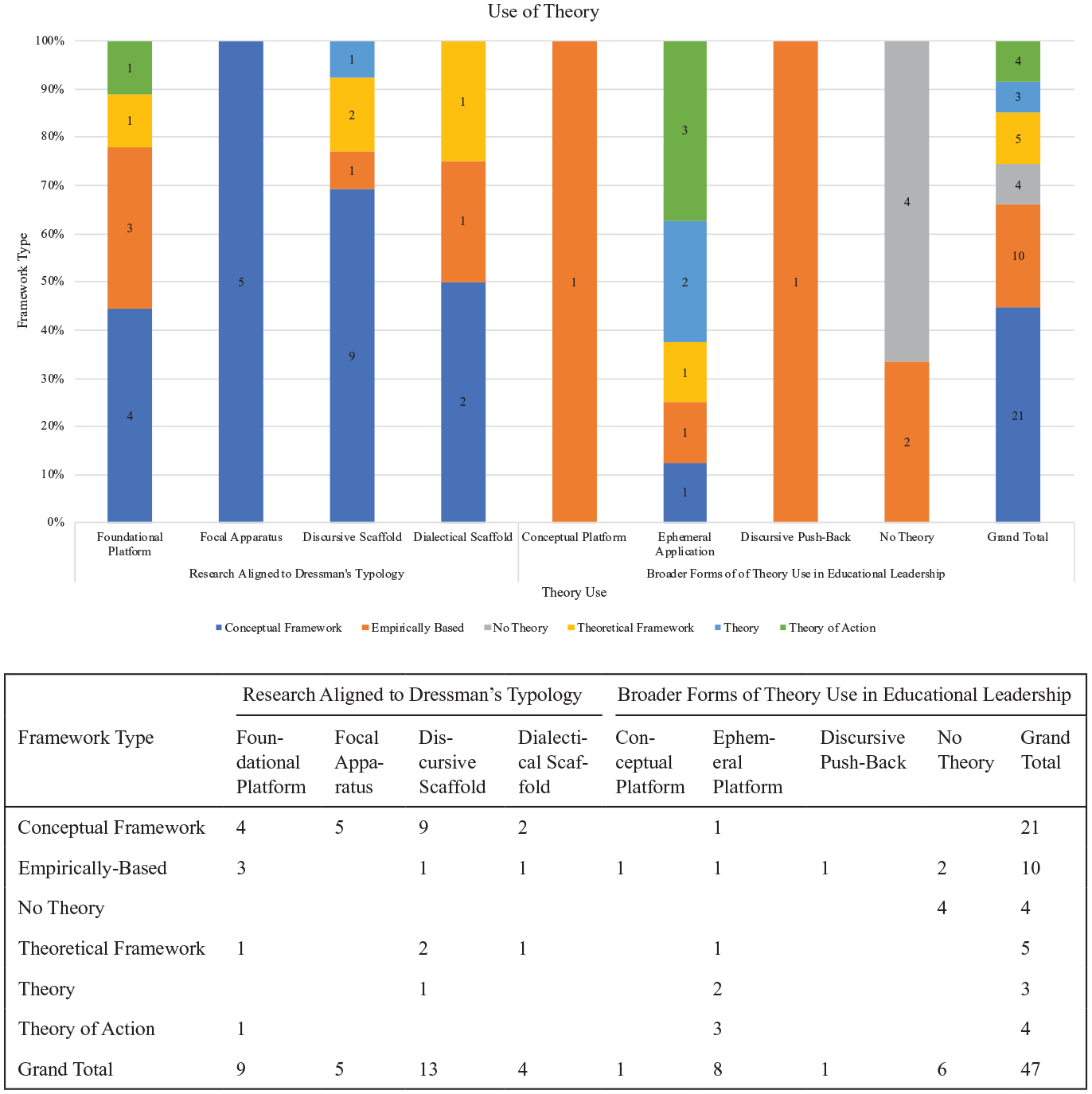
Use of theory.
Distribution of Theory Use
We asked, how do scholars of educational leadership use theory? To address this question, we found it helpful to examine the types of frameworks used along with how theory was applied. Overall, 31 of 47 articles (66%), aligned to Dressman’s (2007) typology of theory use (see Figure 2). Furthermore, the spread of our sample was in many ways similar to Dressman’s distribution. First, in both our sample and in Dressman’s literacy sample, discursive scaffold was the most common. Discursive scaffold describes scholars who use theory throughout most sections of their paper and analysis so that you cannot separate the theory from the findings. Furthermore, the authors do not critique the theory or try to expand it in any way (see Figures 1 and 2). However, Dressman excluded pieces that did not use theory extensively, while, because of the applied nature of educational leadership, we felt this would be too restrictive. Partly reflecting this methodological difference, 50.7% (35/69) of Dressman’s sample was discursive while only 27.7% (13/47) of our total sample was discursive. Likewise, the next most common category—in both Dressman’s sample and our own was foundational platform. Here our percentages are more similar; Dressman found that 20.3% (14/69) of his sample matched foundational platform while we classified 19.1% of our sample (9/47) in a similar fashion. Following foundational platform, focal apparatus captured 15.9% of Dressman’s sample (11/69) and 10.6% of our sample (5/47). Finally—the least common category, “dialectical scaffold”—was used to describe 13% of Dressman’s sample (9/69) and only 8.5% of our sample (4/47). Figure 3 presents a comparison of the distribution between the two samples.
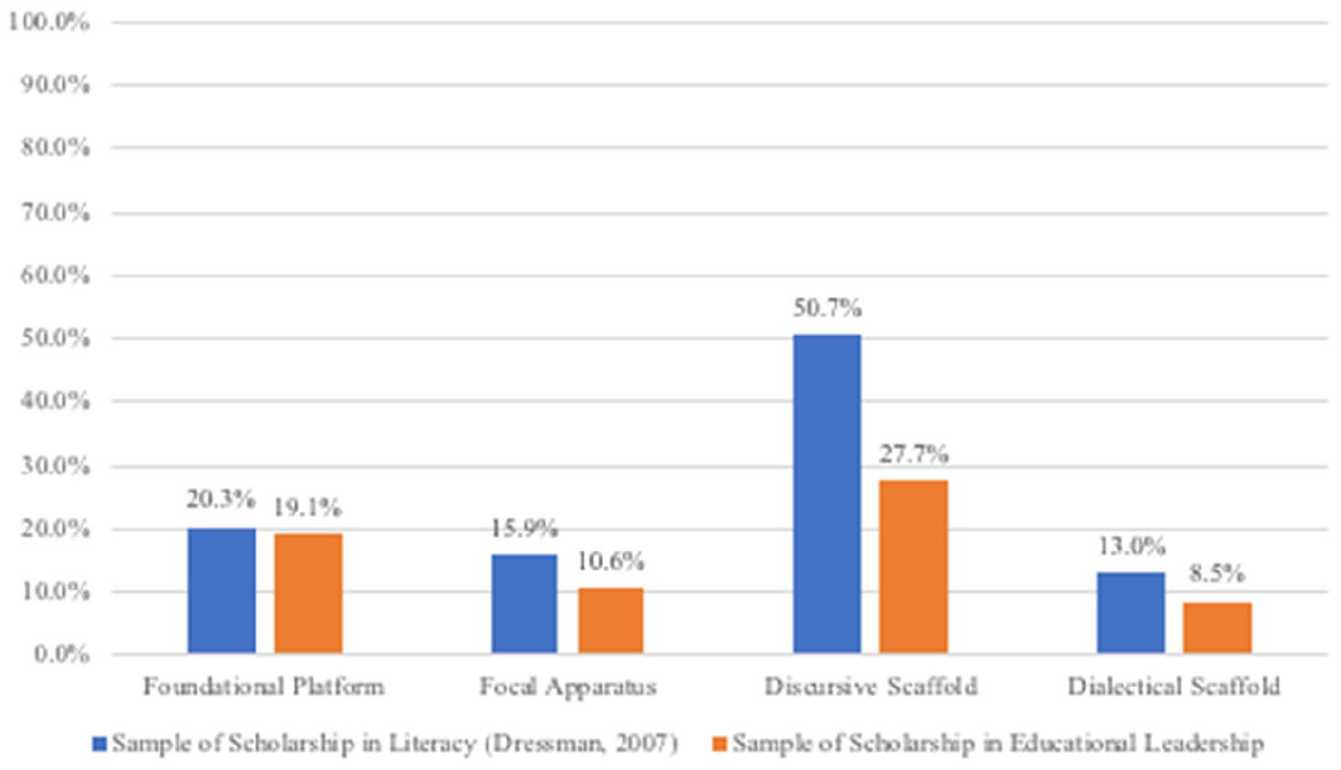
Comparison: typology of theory use across disciplinary samples.
Extending Dressman
Extending Dressman’s (2007) work on literacy, we also identified some important differences in how scholars use theory in our sample of educational leadership articles. We used ephemeral application to refer to scholarship where the framework (conceptual or otherwise) is lightly applied in a type of perfunctory nod or exercise in theory use (perhaps because there is an expectation for some degree of theory application in empirical research). We found that 17.0% of our sample (8/47) exemplified the concept of an ephemeral application. Likewise, we found that, according to our definition, two studies did not apply theory at all.
There was also diversity in the type of frameworks scholars of educational leadership used in their research. In addition to using theory, theoretical frameworks, and conceptual frameworks, scholars of educational leadership also use what we are calling “empirical-based framework” and “theory of action framework” as a theoretical device in their work (see Figure 2). We define “empirical-based framework” as a framework that scholars use to guide their methods, analysis and interpretation (similar to how they would use theory, theoretical frameworks or a conceptual framework). The tenets of the empirical-based framework are fundamentally grounded in empirical research, not theory. In developing these empirical-based frameworks, scholars may synthesize the content of their preceding literature review and label and use it as their conceptual framework. However, while it may be labeled as the conceptual framework, there is no clear theory, theoretical framework, or concepts undergirding it.
We define “theory of action framework” as a framework where the scholars use a theory of action as their theoretical device based on their own description in the conceptual framework section. It is important to note that the majority of these pieces had a section where the scholars attempted to define their use of theory in the study, typically in a section labeled “conceptual framework.” However, scholars varied in the type of framework that was included under the label “conceptual framework” and how it was used in the research and paper. We use the term to describe those instances where scholars use a theory of action as their theoretical device to establish, conduct, and interpret results from an empirical study. “Theory of action” comes to us from Argyris and Schön’s logic model of how individuals behave in interpersonal relationships (see Argyris & Schön, 1974, 1978). In their work, the authors distinguish “theories created to understand and predict [from] theories [of action] created to help people make events come about” (Argyris & Schön, 1978, p. 5). Theories of action can function in several ways such as problem-solving or problem identification at the individual level, organizational level and/or societal level (Argyris, 1997; Argyris & Schön, 1978; see also, Friedman & Rogers, 2009; Fuhrman & Elmore, 2004; Hatch, 1998; Malen et al., 2002). Argyris and Schön (1974, 1978) developed their theories of action models as part of their broader work focused on organizational learning.
In education leadership scholarship, policymakers and practitioners have engaged with concepts from organizational learning to bring about change in schools and districts. Organizations may adopt or develop a theory of action to articulate both prospective challenges in the school or district and the components and actions required for specific improvement and change. While a theory of action represents a model that is grounded in a particular organization oriented toward change, when it is used in empirical research as a theoretical device, we see it as distinct from empirical-based frameworks and other traditional frameworks.
Discussion and Implications
In this section, we bring together the which and the how of theory use. Namely, we use this space to foreground the relationship between the specific theories chosen by educational leadership scholars and the purpose, role, and depth in which the chosen theories were used. In other words, here we provide specific examples from our sample and discuss not only which theory the authors’ chose, but also how they used the chosen theory. Afterwards, we discuss the implications of our work for teaching, mentorship, and leadership preparation. We conclude with implications for educational leadership scholars.
Research into Practice and Policy
The distribution of how theory was used in our educational leadership sample was quite similar to the distribution in Dressman’s literacy-based sample. Although more research is needed, this may suggest that in many ways, educational leadership scholars, at least in our sample, are using theory in a similar fashion to literacy scholars. Yet, while the majority of articles we reviewed aligned to Dressman’s typology of theory use, the ways in which the authors used or defined their particular framework may have a degree of fluidity to it.
While we chose to include empirical-based frameworks and theory of action frameworks as part of our analysis, one can argue that they should be removed, since they are not grounded in theory. For example, in her article “From a managerial imperative to a learning imperative: Experiences of urban, public school principals,” Terosky’s (2013) use of theory aligns to Dressman’s (2007) dialectical scaffold. However, Terosky (2013) describes the conceptual framework as “the concept of instructional leadership” (p. 6), which she defines through the empirical research base in educational leadership, not theory. This approach highlights the effective schools movement (Edmonds, 1979; Hallinger & Murphy, 1986) as part of the origins of instructional leadership in the scholarship of educational leadership. However, another approach could involve grounding instructional leadership in both the effective schools movement along with some of the broader learning theories in education (e.g., Ylimaki, 2012). In their article, “Can principals promote teacher development as evaluators: A case study of principals’ views and experiences,” Kraft and Gilmour (2016) use a theory of action framework in what we define as ephemeral application. In this piece, the theory of action has its own section and is included in the literature review. While Kraft and Gilmour (2016) use the theory of action framework in the methods section, overall the framework is not used in a way consistent with Dressman’s (2007) typology.
When it comes to theory use, scholars in educational leadership may tend to engage in a “liminal practice.” They may try to attend to expectations from academia, to include and use theory in empirical research, while simultaneously responding to the realities of school leadership practice. One example of this is a case study of a charter school where Karanxha (2013) uses a theory of action framework to inform the study in a way we define as ephemeral application. In the piece, the theory of action framework is described under a section heading titled “Theoretical Framework” (Karanxha, 2013, p. 579). Furthermore, the theory of action framework consists of two components related to charter school accountability and a theory of governance. While this theory of action framework does not contain theory, it is marshaled as a theoretical framework (Karanxha, 2013). In this way, Karanxha (2013) uses a theoretical device that simultaneously responds to academic standards for empirical research and is grounded in the applied field of charter schools. This seems to be a logical extension of the fact that education, and educational leadership in particular, are applied fields.
In fact, our findings suggest that the context of school leaders’ daily practice in schools may influence the use of theory in scholars’ work in educational leadership. The relationship between scholars’ use of theory and the context of school leaders’ daily practice may be informed by school leaders and the problems of practice they face in their daily work. Scholars’ use of “empirical-based frameworks” and “theory of action frameworks” suggest that they may be trying to examine different types of questions or foci in their inquiry. While we have some conventions in our work, specifically to address how our empirical findings are related to the domains of research, policy, and practice, it may be that these relationships in educational leadership scholarship function in a type of synergistic manner, such that practice and policy can directly and indirectly impact how scholars of educational leadership conduct their work.
As discussed, “theory of action” (see Argyris & Schön, 1974, 1978) stems from organizational learning and describes how the organization may pursue a set of steps to bring about fundamental change. In the U.S. context of public education, theories of action have been a key feature for many schools and districts engaging in reform. As a function of education policy and school reform, the theory of action is used to organize a group of individuals around a shared problem narrative and plan for change. For four articles included in our sample, scholars of educational leadership used a theory of action framework to justify, guide, and interpret the results of their research. This may highlight how a rapidly changing context for school leaders, informed by external policy demands, can inform how scholars make sense of their own data.
Similarly, the empirical-based framework may also be a way through which scholars allow the context of school leadership practice to inform their research—albeit more indirectly. By side-stepping theory in a substantive way, they create a conceptual framework that adheres to the convention of theory use in some form while using empirical findings from the field to populate their framework. Rather than wait for a theory to develop, from theorists or the theoretical scholarship, they can use empirical findings to guide and interpret their studies.
It is important to note that five of the six studies that used an empirical-based framework aligned to Dressman. This demonstrates that scholars are able to use these nontheory frameworks to conduct rigorous analyses and perhaps thereby indirectly advance theory. However, three of the four articles that used a theory of action framework fall into what we have identified as an ephemeral application of theory, which is outside of Dressman’s typology.
Implications for Teaching, Mentoring, and Leadership Preparation
One reason we embarked on this study was to further the teaching, mentorship, and preparation of aspiring educational leaders and scholars around theory application. This aim is likewise supported by accreditation standards for educational leadership preparation programs, such as the National Educational Leadership Preparation (NELP) standards. Developed with the principalship and the superintendency in mind, the NELP standards have been used as a guide to educational leadership program design, accreditation review, and state program approval for beginning level building and district leaders (National Policy Board for Educational Administration [NPBEA], 2018a). Throughout these standards, theory, theoretical knowledge, theoretical understanding, and/or theoretical implication are repeatedly mentioned as a standard component for educational leadership programs’ content knowledge and as a required element to assess program completers’ performance (e.g., NELP Standard Component 1.2, NPBEA, 2018b, p. 11; NPBEA, 2018c, p. 12). Moreover, “theory” is frequently listed on the Assessment Rubric Guidance—the NELP standards’ tool to evaluate candidates’ performance. Thus, through accreditation processes, educational leadership programs are encouraged to attend to theory.
Beyond the standards, our study also suggests the importance of finding curricular space for students to contend not only with the questions of “which theories” but also with how theory is used. This space could be in addition to other strategies students could use to locate and become familiar with theory for their work, such as reading extensively and engaging in informal conversations with faculty (see Holley & Harris, 2019). It could be in the format of a “special topics” elective, integrated into dissertation-related coursework or independent studies, discussed in methods classes, or designed as a workshop or training. University faculty who teach graduate students in educational leadership should consider sharing their own triumphs and tribulations in applying theoretical frameworks to their dissertations, early career research, and posttenure scholarship. Doing so may foster relationships with students and help to unpack the black box of theory application. Faculty members could also consider having students write a reflective memo on their experiences with theory to date—such as we did in this project. This approach could also be used with entire classes to allow for common themes to emerge. These themes could shape class discussion topics or topic sequence.
Our emerging typology can also serve as a toolbox for students—providing examples and spurring conversations to aid them in theory application. Students could locate literature that uses a theory and then map those articles onto the typology. Students could also map key research in their literature area to the typology—deepening their understandings of the nuanced ways in which theory is used. In fact, Dr. Modeste and Dr. Pavlakis engaged in a similar exercise with Dressman (2007) during our own doctoral studies, which served as the inspiration for this study and a springboard for purposefully thinking about how we teach and mentor around theory. To guide students in gaining a deeper and more nuanced view of theory in relation to their research interests or problems of practice, we must strategically and thoughtfully create both formal and informal opportunities for learning around theory application.
Implications for Educational Leadership Scholars
Our findings also have implications for scholarship. First, we recommend that scholars specifically define their use of theory-related words, such as theory, theoretical framework, and conceptual framework (see H. E. Green, 2014). While there may still be variations across definitions (based for instance, on scholars’ epistemological stances), increased transparency in the vocabulary chosen will improve clarity, strengthen the field, and better enable us to identify and track patterns in theory use in educational leadership over time. In addition, future research should consider extending this work to other samples of educational leadership scholarship.
Furthermore, while scholars draw on theories to help us understand and make sense of our empirical work, we may all have a role to play in considering what theories we end up using, how we use them, what they mean for our work, and more importantly, how they impact the field. Given the frequent use of the discursive scaffold framework, it may be that we strengthen the theories we use by explicitly exploring what type of practice-related inquiries remain after we have thoroughly addressed our research questions. Even when we use the discursive framework, we should attend to the context of school leaders’ practice by exploring how the particular theoretical device may better address some aspect of practitioners’ leadership work in the field.
Footnotes
Acknowledgements
We would like to express our sincere thanks to Brian Huff for his support on this project. His thoughtful questions and genuine engagement with our study were an important part of this effort.
Declaration of Conflicting Interests
The author(s) declared no potential conflicts of interest with respect to the research, authorship, and/or publication of this article.
Funding
The author(s) received no financial support for the research, authorship, and/or publication of this article.
