




Abstract
This pedagogical case focuses on the online mentoring of educational leadership doctoral candidates in a protracted crisis. Relevant theories and problems of practice in doctoral education are reviewed. The COVID-19 Dyadic Online Mentoring Intervention was a faculty mentor’s dyadic mentoring initiative for guiding 19 mentees’ social justice-oriented dissertations. Beneficiaries’ responses spanning 2020 to 2021 indicated that effective academic mentoring, progress, and success resulted from 10 online strategies they identified. The research-based support strategies and six-step intervention suggest positive impacts with electronically delivered mentoring that is culturally responsive. Takeaways and possibilities for university leadership faculties, doctoral students, and institutions are included.
Keywords
Introduction, Rationale, and Purpose
The extent to which the coronavirus pandemic has affected doctoral mentoring in educational leadership (EDLE) degree programs is currently unknown. Online faculty mentoring in a crisis attracts scant attention in the scholarship examining the dissertation phase of programs (Pollard & Kumar, 2021). While emergency remote mentoring trends are yet to be revealed, some early research in EDLE (Lasater et al., 2020; Mullen, 2020a) and other disciplines (Börgeson et al., 2021; Pollard & Kumar, 2021) indicates that higher education’s move “to online interactions due to the COVID-19 crisis has led to graduate student mentoring increasingly occurring online” (Pollard & Kumar, p. 268). With the self-sequestering of doctoral candidates, guidance on dissertations may have increased, decreased, or remained the same (Börgeson et al., 2021).
For example, a survey of medical programs probed doctoral faculty mentoring at eight universities in Sweden during the pandemic (Börgeson et al., 2021). For 185 mentees, “supervision” remained steady or got better, whereas it “worsened” for 69 others. Satisfied mentees were guided by their program mentors via technology platforms, email, or phone. Frequency of mentorship and varied ways of communicating were mentoring strengths. Because halted progress can affect satisfaction, retention, and graduation, it was concluded that doctoral students need the best possible mentorship during challenging times, specifically frequent contact, flexible connectivity, and emotional care. If not thoughtfully orchestrated, crisis-inflicted disturbances could have unintended effects on doctoral programs and institutions. But “culturally responsive mentorship” can influence the “academic persistence” of both students and faculty, especially African Americans (Gooden et al., 2020; Johnson, 2016; Thomas et al., 2014, p. 551). Gains include learning how to navigate academies, experiencing belonging within environments valuing diversity, and seeing a place for oneself in the profession.
Even in the best of times, though, doctoral attrition is stark. Pre-pandemic, attrition as high as 50% plagued US doctoral programs, with inadequate mentoring and advising a leading cause (Jameson & Torres, 2019). A University of California study reported that students in candidacy (n = 144) were less likely to find their advisors supportive than those at the coursework stage (n = 172), which signaled a decline in dyadic support. With EDLE candidates embarking on dissertation research while employed full-time, COVID-19 amplified their vulnerability to receiving less guidance (Lasater et al., 2020). However, productively bridging threats to student progress on dissertations is possible, even in a crisis (Mullen, 2020a). To avoid disruption to mentee timelines during university closure over coronavirus concerns, some faculty have worked miracles in their mentoring performances (Geesa et al., 2021; Lasater et al., 2020).
An empirical case grounded in mentoring as pedagogical practice is pertinent to this discussion. Orienting it is a lens—online doctoral student mentoring—from studies that direct attention to the quality of mentorship in the dissertation phase (Jameson & Torres, 2019; Kumar & Coe, 2017; Pollard & Kumar, 2021). With the online mentoring intervention under study, a faculty mentor and committee chair whom I name “Celeste” intended to support pandemic-fraught EDLE mentees facing the daunting challenge of dissertation research. (All names are pseudonymous.) The rationale for exploring faculty mentorship in this leadership journal is that mentoring online is important in the EDLE field for preparing generations of K-12 education leaders and higher education instructors, particularly in times of pandemic, when online graduate programs are proliferating and antiracist education is hotly debated. Audiences for this article are EDLE faculty, graduate students, and university administrators grappling with changing trends.
The purpose of this paper is to communicate the structures, strategies, and outcomes associated with a crisis-induced, research-supported mentoring initiative that enabled EDLE candidates to continue their social justice inquiries, with success. The activity-based inquiry question was, How effective was the COVID-19 Dyadic Online Mentoring Intervention (C-19 DOMI) from the perspective of participating doctoral mentees? This pedagogical practice was created to offer a viable solution and mentoring alternative to ensure that the strain inflicted by the global crisis would not thwart students’ goals. As signs of success, 11 doctorates were conferred within the 3 years of the mentees’ start date, and 8 others were on track for writing the full dissertation. The latter group, which more recently (2020 and 2021) became advisees, wrote and defended their dissertation proposal, benefitting from remote access to the C-19 DOMI. The help-centric, personalized online mentorship was tailored to each mentee’s research and goals.
Features of this literature-supported case are the structure of the activity and mentee learning and outcomes. Through mentor description and mentee feedback, documentation of the initiative substantiates the processes described and claims made about mentee learning. Effective mentoring pedagogy and practice are linked in ways that EDLE doctoral mentors may find useful for their own student-centered pedagogical practices. The empirical case and interventionist framework are next described, followed by a review of mentoring and online literature. The conclusion conveys ideas for leadership faculties, doctoral mentors, and academic institutions.
Empirical Case and Interventionist Framework
The heart of this discussion—the case featuring the C-19 DOMI—reflects a real-life situation and global crisis (the pandemic). Crisis refers to situations that disrupt educational processes, making them “inoperable,” like mentoring in difficult circumstances (Brion, 2021). The coronavirus can be viewed as an event rupturing entrenched practices and beliefs and revealing new ways of thinking and acting (Mullen, 2020a). Cultivating doctoral mentoring in catastrophes “forces” faculty to take charge and adapt, and improvise and innovate.
Online doctoral mentoring—meant to influence student motivation to persist with the dissertation process—is paramount in this writing. Applicable research and initial outcomes informed the 16-month dyadic online mentoring initiative, which relied on mentee engagement and assessment. This exploratory evidence-based intervention is one mentor’s attempt to guide justice-oriented dissertations and EDLE professional attitudes, values, knowledge, and skills. Ethics reflecting social justice values (Tanner & Welton, 2021) infused the C-19 DOMI. Applicable doctoral mentoring studies relayed institutional injustices and promising prospects for EDLE programs geared around intervention, equity, advocacy, and change (e.g., Geesa et al., 2021; Gooden et al., 2020; Lasater et al., 2020; Sellers et al., 2021).
Doctoral Mentees
When the emergency disrupted the university’s routines and mentoring norms in spring 2020, Celeste’s EDLE mentees contacted her about potential delays in their degree completion. These doctoral candidates were parents as well as full-time assistant principals, principals, consultants, and division coordinators in rural and suburban preK-12 school divisions. Fifteen of the C-19 DOMI participants were female and 4 male; 16 were white and 3 African American; and 7 were first-generation college students. At the intervention’s outset, all had completed their coursework and qualifying examination, except for the late addition of five mentees for whom the dissertation proposal loomed. This anxiety-producing hurdle was magnified for those with a decade invested in the doctoral program under another’s advisement. All 19 mentees were navigating chaos as leaders tasked with mitigating COVID-19’s effects that forced virtual instruction and added the burden of learning new technology (Brion, 2021). Like other leaders, they had not been prepared for a crisis of this scale. Gaps in expertise, professional development (PD), diverse learning needs, and systems functions were obstacles for Celeste’s mentees.
Program Specifics
At this predominantly white institution (PWI) in the US mid-Atlantic region, doctoral candidacy status follows courses and an exam (overseen by the committee chair), which precedes the dissertation proposal. All 19 mentees were working on their proposal or dissertation and anticipating the verbal defense. Dissertation writers had to undergo an ethics review, analyze the data, and defend their work. In this EDLE program, well-designed, rigorous studies that inform knowledge and practice are expected. With the main campus far from its satellite campuses, a round trip of 2 to 10 hours by car was a problem Celeste inherited.
Faculty Mentor
Celeste was a white, tenured veteran female professor. Her mentoring accolades included a university award in 2020 for excellence in technology-assisted teaching and learning, supported with design and development grants. She earned quality-assurance credentials in online pedagogy, having completed four semesters of PD in adapting graduate curriculum for remote delivery. Her redesigned graduate courses utilized online synchronous modalities for real-time connectivity. One of only two tenured doctoral supervisors in the EDLE program, her assigned workload was 40% teaching/40% research/20% service. This program reflected a culture that valued degree completion but did not compensate for high advising loads. Confounding dynamics in the pandemic were the addition of cohorts, faculty transitions (a death resulting in the redistribution of a mentor’s advisees), and program review.
Situational Dynamics
Mentoring in crisis
Effectively guiding these doctoral candidates in a global crisis posed a dilemma for Celeste. Academic rhythms and schedules were destabilized with the closure of the university and K-12 divisions, forcing a rapid transition to online education. The university’s announcement that collecting human participant data was prohibited alarmed her mentees, who feared a hold on their exams and defenses. In February 2020, a flurry of emails to Celeste and meetings ensued as concerns were aired about disruption to dissertation timelines.
Being called on
Celeste’s mentees wanted to stay on track for graduation and avoid delays due to timeline adjustments or extensions. She became preoccupied with developing a personalized solution for bridging the crisis: synchronous online mentoring guidance without trading off rigor. She was absorbed with creatively solving problems in a technology-consumed world that was in lockdown. Attuned to the psychosocial aspect of mentoring, she monitored signs of mentee disengagement and burnout and expressed care about their well-being. For the career aspect of mentoring, she generated opportunities aligned with their goals and interests.
While empathetic about the pressures on mentees, and committed to resolving threats to their health, research plans, and degree completion, Celeste called on mentees to keep going with their projects to the extent possible. When the university Institutional Review Board (IRB) system closed, some of her mentees had yet to submit their applications for review of their methods. She encouraged them to move to the non-data considerations of the work (reviewing and updating pertinent literature, analyzing relevant policies and local documents, etc.). Interactions with mentees who had gathered data before the shutdown allowed for prioritizing data analysis, interpretation, and implications of the work. Later in 2020, the university permitted electronic-only data collection involving participants. Mentees who would be conducting interviews adapted to the Zoom interface. In real time, Celeste demonstrated its features (teleconferencing, transcription, etc.), allowing time for practice and developing skills.
C-19 DOMI
Culturally responsive mentoring (defined and explained later) was implementable through Celeste’s modeling of socially just inquiry. Mentee research completed with the support of the C-19 DOMI—itself an expression of mentoring in culturally responsive ways—centered disparities like race, disability, and poverty. The intervention nurtured social justice topics of dissertations like Black education legacy and influence through oral stories of southern segregated schools; equitable access to science, technology, engineering, and mathematics across groups; instructional strategies used to achieve desired outcomes for students with disabilities; principals’ responsibility for helping impoverished students succeed in rural areas; teacher beliefs about students in poverty and addressing biases through PD; and equitable education for Black adolescents via early college access initiatives (Mullen, 2020a).
Celeste scrutinized obstacles to mentees’ progress (e.g., missed deadlines, emotional overwhelm) and applauded headway (e.g., satisfactory defense, adjusted methodology). She similarly supported their PD to the extent that they chose to accept her invitations for academic networking, conference presentation, and research publication. A major influence in their lives, she not only mobilized timely degree completion and important dissertation research but also invested in mentee learning within, and contribution to, the broader EDLE community.
Inundated with pandemic-associated demands, Celeste returned to the question of whether mentees wanted to stick with their timeline or seek an extension. Complexities were profound—guiding mentees on producing their studies while attending to their psychosocial and career needs in a global emergency was, simply put, not enough. Other USA-based pandemics had been unleashed. In the fight against white supremacy and systemic racism, EDLE race-based mentoring researchers like Gooden et al. (2020) and Tanner and Welton (2021) voiced advocacy for anti-Black racism to combat whiteness in educational systems. By expressing solidarity, the C-19 DOMI made it apparent through mentor–mentee dialog that opposing racism and other oppressions in education was a leadership ethic and shaping force for dissertations.
These weighty considerations were connected to the C-19-DOMI and Celeste’s work, specifically in that the diverse group she was mentoring was being guided to conduct dissertation research on topics of social justice in education. Moreover, the mentees were encouraged to cite the critical literature in EDLE and raise complicated questions around consciousness-raising. For example, a dissertation on early college access programming as an equitable pathway for Black adolescents documented the racial inequality of certain academic pipelines. The mentee was guided to review research on the college access problem around Black student access to quality education and mentoring, and to go further by documenting initiatives. The analysis of early college access programs like Achievable Dream Middle and High School in Newport News, Virginia, identified ways to support those enrolled. During the pandemic, the mentee held Zoom interviews with participants and wrote a case that shed light on postsecondary students’ experiences of a pipeline program and developing identities. Also examined were obstacles to their achievement and adaptation in college (e.g., imposter syndrome). Suggestions in the dissertation advanced strategies for high schools that can reduce barriers to equity and success.
Celeste’s mentoring intervention arose as a means for successfully developing 19 dissertations, regulating the mentoring dyads during institutional closure, and facilitating student progress through frequent teleconferences. These were augmented with email, text messaging, and the phone, and tools in Zoom and Microsoft Word were used for planning, writing, and editing. Mentees entered/exited Zoom conferences as convenient while the mentor stayed online and available. Entire weeks were set aside for personalized advising and in-depth consultation.
Six steps for delivering the C-19 DOMI, holding constructive meetings, and analyzing outcomes were followed.
Invitation. Mentees in doctoral candidacy were invited to partake in the intervention. A graduate assistant initiated communications to avoid coercive supervisory tactics and the impression of compulsory involvement (see Calabrese et al., 2007).
Outcome. All 19 candidates agreed to participate in the working sessions.
Commitment. Scheduling online synchronous one-to-one sessions, including email and phone calls, depended on preferences. Creatively adapting technology facilitated progress and met immediate goals. New goals were set as mutually desirable and in concert with progress. Career transitions were discussed along with expectations and preparations.
Outcome. While Zoom sessions were set for 1 hour, some lasted up to 4 hours due to the volume of tasks and exploratory nature of conversation, with understanding and knowledge being developed. Emails, texts, and phone calls increased. Accommodating preferences and the unexpected, schedules and technologies were adapted. Transitioning to district leadership or higher education positions advanced new targets like publication.
Preparation. Mentee preparation was expected, with queries and drafts sent ahead of sessions. (Flexibility was built in as needed.) Overview statements and tracking features in software allowed for mentor precision in responding to mentees’ files.
Outcome. Mentees were mostly ready for sessions. If unprepared, instead of canceling sessions, the mentor gave feedback spontaneously. In a timely manner, Celeste replied to mentee documents (e.g., revised drafts, IRB applications, and instruments) using tracking features and explaining feedback via Zoom, and she located materials (e.g., topical research instruments) for brainstorming on the spot.
Process. Schedules were updated as mentees confirmed their availability. Synchronous Zoom consultations enabled video exchanges and real-time exchanges. Software features were activated to document key information, clarify meaning, and mobilize progress.
Outcome. Weekly schedules changed in response to mentees’ requests, even at the last minute. Mentoring consultations took advantage of Zoom’s tools for showing files and working on drafts together; changes were documented as part of the feedback. The mentor forwarded marked-up copies for reflective follow-through, along with recorded meeting transcriptions when requested. In response to Celeste’s creative exercises (proposal snapshot writing, mentor–mentee notes in drafts, etc.), mentees liked the (a) one-page snapshot of their proposal that promoted idea generation and motivated ongoing development and (b) conversational approach to writing occurring directly in files.
Exercise. Mentee participation extended to the C-19 DOMI reflection exercise to gauge perceptions of, and feedback on, the intervention and reliance on technology for progressing in a crisis (Table 1, derived from Mullen, 2020a). The activity addressed their experiences, challenges, and goals.
Outcome. Mentees completed the activity following their program defense. (The third party removed identifiers from the responses sent to Celeste.) Voice was conveyed through mentee feedback on the intervention, program, progress, and milestones.
Methods. Processes were presented as sequences that readers can consider for championing student growth, success, and research, preferably on social justice issues.
C-19 DOMI Reflection Exercise: Mentee Progress and Mentoring Gauge.
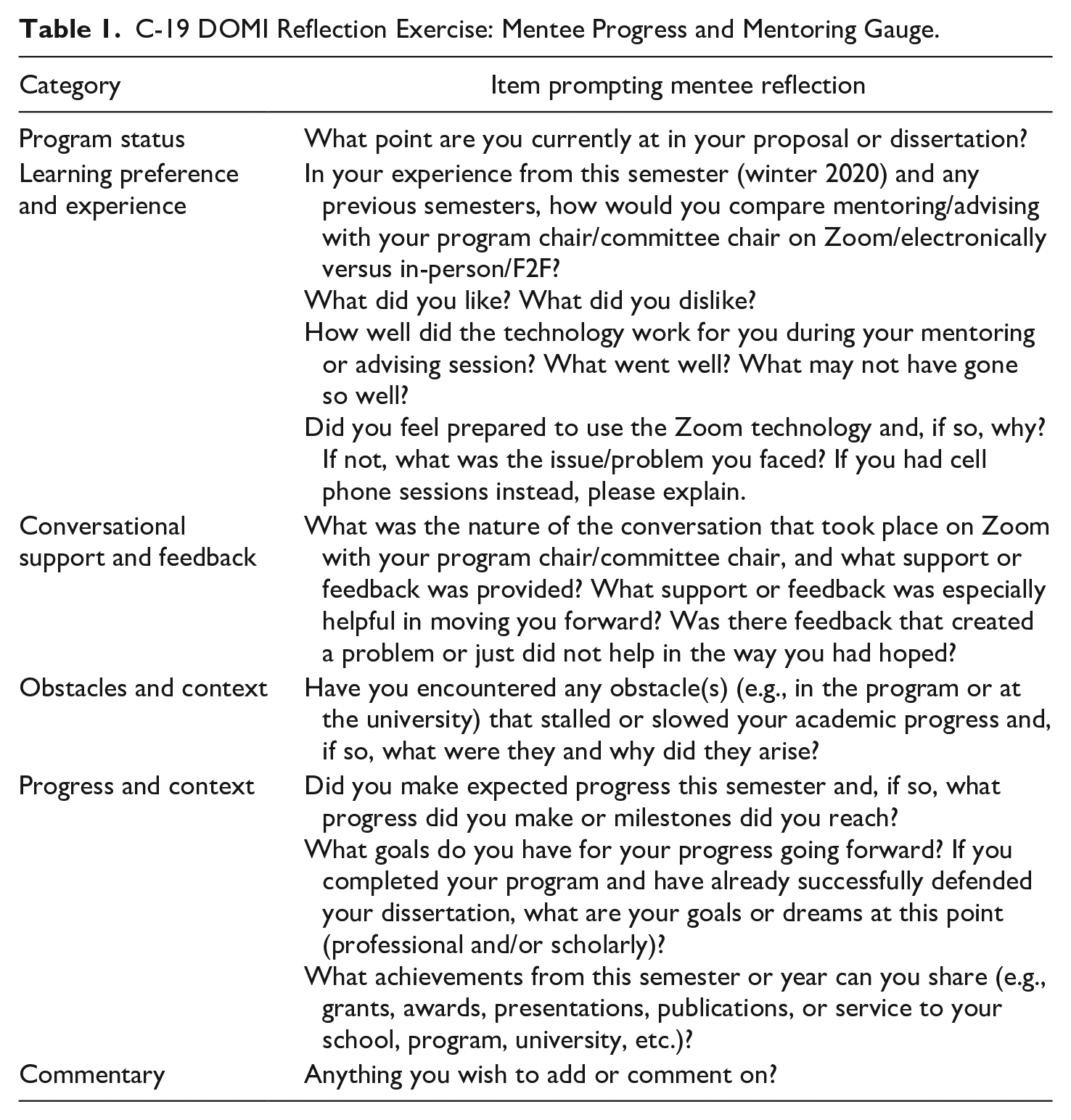
Celeste enacted these analytical processes. Relevant peer-reviewed research and documents (policies, reports, etc.) were located through databases. Germane EDLE studies were from leadership and mentoring journals, namely the University Council for Educational Administration’s (UCEA) journals. Search terms (e.g., online mentoring) were extracted from the inquiry, C-19 DOMI reflection exercise (Table 1), and studies.
The architecture of literature reviewed reflects the priority given to the 2020 to 2021 pandemic timeframe and journals featuring pedagogical theories and practices in doctoral education (Firestone et al., 2021; Geesa et al., 2021; Paufler et al., 2020). Publications were narrowed to EDLE contexts that speak to doctoral mentoring remotely in a crisis (Lasater et al., 2020; Mullen, 2020a; Sellers et al., 2021) and in other disciplines (Börgeson et al., 2021; Pollard & Kumar, 2021). Additional sources were included.
By documenting the learning process via the mentor’s notes and email messages, Celeste generated contextual detail: (a) In the notetaking, a notation accompanied each communication (e.g., “[mentee] described the one-page proposal exercise as a breakthrough in seeing the whole of her study and agreed that her logic supports qualitative methods”). (b) Email exchanges covered many issues; a persistent concern was how to make sense of committee feedback in a revision; changes made were arranged in charts for committee review. (Celeste recorded highlights in her notes.)
Keywords were used to analyze and code the data in Excel. Deductive keyword usages from the exercise (e.g., feedback) and inductive codes (e.g., helpful–HELP) were tracked. Coding phrases near keywords addressed context and nuance. Online strategies applied in the C-19 DOMI from the mentee viewpoint were identified.
Learning processes, activities, prompts, and feedback produced results, pointing to this initiative as a mentoring lifeline. The pilot, lasting 4 months in 2020, was assessed with open-ended questions (Table 1). It had originated as an end-of-semester survey of Celeste’s for gauging doctoral candidates’ experiences of online mentoring in a crisis and their satisfaction and feedback on technology reliance for addressing dissertation research (Mullen, 2020a). Survey items were drawn from the University of California’s (2017) Graduate Student Well-Being Survey.
Online pedagogical strategies
Mentee responses to the C-19 DOMI reflection exercise, analyzed by Celeste and a graduate assistant, identified 10 online strategies: mentor feedback, individualized sessions, scheduled appointments, mentor availability, mentor attention, progressive challenges, technology efficiency, Zoom interaction, writing diagnostic, and scholarly development. Because the strategies named and implicitly credited had not been prompted on the activity, independent thinking and real learning were indicated (Table 2; stemming from Mullen, 2020a).
Ten Online Strategies Mentees Associated With the C-19 DOMI.

Amid the chaos, Celeste did not expect her mentees to recognize the gradual increase in complexity, yet they progressively assumed more challenging tasks, thereby moving toward a demonstrably competent proposal or dissertation. Taken together, the online pedagogical strategies mentees pinpointed affirmed that the lengthy sessions, with individualized attention from the mentor, met their needs; the technologies worked well for both parties; dissertation-related topics and matters of substance were noted; progress occurred; and goals were satisfied.
An unexpected outcome was that in their experience of the C-19 DOMI, being mentored electronically was not a sticking point. Some even said that the live video encounters felt as though they were in their mentor’s actual presence. While they had mentoring previously via technology and face-to-face (F2F), the interaction was more time limited or cohort dependent. Mentees also noted differences in attention, access, and configuration (dyadic), and liked the advising focus on their dissertation and self. Not the modality but the conditions of mentorship seemed to matter. The comments and attitude brought to the virtual encounters were reassuring.
Milestones reached
Beyond expectations, mentees presented at conferences and published, and some were promoted into school and division leadership positions (Table 3).
Mentee Milestones—Scholarly, Promotional, and Program (02/2020–06/2021).
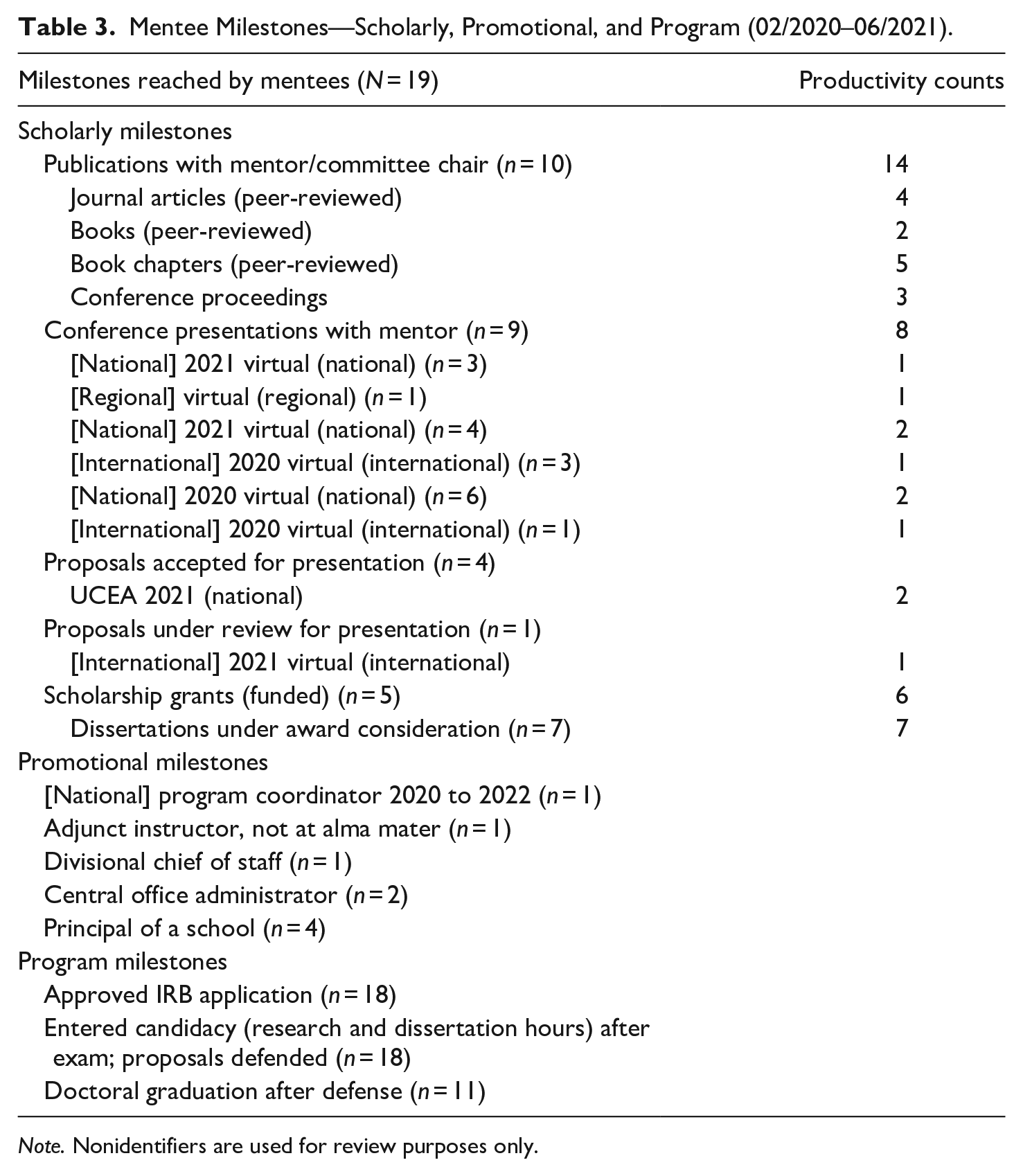
Note. Nonidentifiers are used for review purposes only.
Mentoring activities and prompts
The 6 steps and 10 online pedagogical strategies can be adopted by anyone interested in experimenting with the C-19 DOMI. To contextualize and imbue it with meaning, besides learning mentees’ needs, preferences, and goals, feedback is valued. For gauging the initiative’s utility from the mentee viewpoint, faculty can ask purposeful questions (derived from Table 1). Just as mentors can reimagine this process-based scheme for their mentoring dyads or groups, mentees can think about how to contribute to it.
Based on mentee feedback, four outcomes follow from the reflection exercise (Table 1). Each is matched with a strategy (Table 2) that facilitated desirable results and propelled the mentoring: (1) progress was made on proposals/dissertations (strategy example: mentor feedback); (2) online mentoring felt like F2F mentoring (strategy example: Zoom interaction); (3) conversation was strategic and productive (strategy example: writing diagnostic); and (4) an erudite aspect of identity was claimed (strategy example: scholarly development) (Mullen, 2020a).
Reflection
Before the C-19 DOMI launch, an online pedagogy for doctoral mentoring that utilized synchronous and asynchronous technologies (see Gray & Crosta, 2019) was evident in Celeste’s augmented F2F world. Her relationships with mentees had developed over 3 years using hybrid and online modalities. As Sellers et al. (2021) found, familiarity, trust, and a working rhythm supported the transference to mentorship delivered remotely in the pandemic.
However, e-mentoring is not only for mature relationships. Five of the mentees who began working with Celeste were new to her, yet they progressed despite having not met in person. With the support of the C-19 DOMI their doctoral experience was recentered as an opportunity to explore their topic within a collegial distance mentoring environment and they attained candidacy status. An explanation for this accelerated headway comes from examining “authenticity” in lived encounters of “managerial relationships.” Analogously, workers (mentees) who perceive leaders (mentors) “as authentic”—or, in the present context, student-centered in that authenticity was not scrutinized herein—benefits their “psychological experience of work” and “facilitates their own authentic expression” (Bradley-Cole, 2021, p. 401).
Given that candidates are typically beyond the structure of courses and cohorts, well-developed, effective strategies can promote their talent, productivity, connectedness, and capacity to “conduct practical research” (Firestone et al., 2021, p. 81). Strategies used with success during online mentorship address mentees’ challenges and advance their research in difficult circumstances (Kumar & Coe, 2017; Pollard & Kumar, 2021). “Culturally responsive mentoring” within inclusive learning contexts and mentor–mentee matches with differences (in culture, epistemology, etc.) are expectations (Gooden et al., 2020, p. 400).
Emerging as a “first responder.”
Attuned to mentees’ stressors, Celeste adopted an educational “first-responder” role to monitor threats to their progress and health. Mentoring for social justice means that mentorship persists in the face of hardship, like the commitment to leading for social justice in workplaces (Hayes & Angelle, 2021). Culturally responsive mentoring, an intervention for overcoming challenges and creating opportunities for African American individuals, involves target populations of students (Gooden et al., 2020) and faculty in purposeful mentoring and processes of becoming. In Celeste’s EDLE program wherein doctoral cohorts are a blend of minoritized and majoritarian cultures, she brought her protective, nurturing spirit to the C-19 DOMI. Just like in pre-pandemic times, African American students were engaged in particular ways to safeguard their career progression, use equity and other lenses in research, facilitate their peer leadership, and navigate environmental threats (e.g., hostility toward race-based identity studies). Non-Black students’ learning in cohorts involved consciousness raising, teamwork, and listening to their African American peers.
Culturally responsive mentoring
These approaches to “culturally responsive mentoring” (Gooden et al., 2020, p. 400) describe how Celeste navigated her program context. During the crisis, her teleconferencing-based, time-intensive dyads were met with the progress and completion of all mentees. The mentoring was culturally responsive, not only caring and convenient, and she applied her knowledge and skills to mentee needs (cognitive, emotional, and developmental). Like the Gooden team, she viewed cultural responsiveness as social justice that targets anti-racist change and a method for facilitating developmental learning; she, too, believed that mentoring “pairings may be the strongest predictor of success in the academy” (p. 400).
While the Gooden et al. (2020) involved a “same-race” configuration (Black mentor and mentee), the C-19 DOMI’s mentoring context was different. Dyad formation was mixed relative to race and gender, and it reflected program pressures and student needs. Celeste’s organizing principle of mentoring for social justice attracted African American and diversity-minded white students committed to equity and opportunity in education. She fostered two-way learning around “cultivating a critical consciousness, decoding the hidden curriculum, and developing cultural awareness as mentors and mentees” (Gooden et al., 2020, p. 400). These tenets of culturally responsive mentoring postulated by the Gooden team are next illustrated.
First, cultivating a critical consciousness in the C-19 DOMI context involved raising awareness of racial and other oppressions and the need for a systems view that situates minoritized populations in particular ways relative to power, privilege, and oppression. Exploring programs, practices, or strategies that can empower learners and others was the other main thrust. These two aspects (critique and pathways forward) were addressed in the dissertations under Celeste’s care. An example, previously given, highlighted her mentee’s study of Black education relative to issues and possibilities in the context of early college access.
Second, decoding the hidden curriculum occurred through Celeste’s recognition that as a culturally responsive mentor she was responsible for mentoring that is more one-way and directive. She advised, demonstrated, and taught skills for conducting studies and developing interpersonally within the academy. She shared knowledge and resources pertinent to social justice to cultivate each student’s dissertation topic, and she showed how to design a rigorous study, do a literature review, conduct research ethically, and approach sensitive topics and vulnerable populations. She would explain myriad details around what needs to be done when and with which parties. Mentee accountability was also expected, such as by communicating effectively with committees, staying on top of the literature, and revisiting timelines.
Third, developing cultural awareness as mentors and mentees involved sharing experiences, deepening trust, and openly dialoguing. Celeste set a tone that normalized the provoking of each other’s thinking, and writing around ideas in dissertation drafts and during Zoom sessions. For instance, she described her research on settler identities in education and engaged mentees in thinking about how their identities may be shaping their assumptions and the direction of their research. One mentee was invited to ponder how her advocacy of students with disabilities would benefit from an analysis of intersectionality with regard to race and gender, which served to disrupt the static portrayal of their identities. Celeste revealed operating assumptions to model academic processes. She acknowledged when mentees’ ideas inspired her.
What also made Celeste’s mentoring culturally responsive was that it built upon elements like purposeful intent, educational innovation, active listening, and cultural bridging. As confirmed by Vlady (2016), such sensitivity work as mentors can promote “cultural competency” and “innovation in mentoring”; further, “culturally competent pedagogical strategies” like “active listening” can bridge mentor and mentee cultural differences (pp. 168, 174). Caring and responsive to her mentees’ desire to continue with the dissertation in a global emergency meant that Celeste was persisting with and on their behalf. She believed in them as leaders whose dissertations could empower them to have influence as social justice advocates.
Case-Infused Mentoring and Online Literature
In traditional mentoring settings, experts foster novices’ motivation, development, skills, and knowledge within voluntary relationships. These one-to-one, F2F arrangements are hierarchical, implying power, privilege, and one-way learning (Geesa et al., 2021). In contrast, mentoring between equals empowers mentees to commit to their own learning within a partnership that is purposeful and beneficial. A developmental alliance, this mentorship is shaped around values like relational learning, self-awareness, closeness, growth, advocacy, collegiality, power sharing, and two-way communication (Geesa et al., 2021). Online mentoring augments or even replaces F2F mentoring with hosted sites, digital tools, the Internet, and social media. Exclusive reliance on technology for mentoring in EDLE doctoral programs was a response to the pandemic (Lasater et al., 2020; Mullen, 2020a). As mentoring deepens with relational care and trust, rigid binaries (expert/novice, etc.) change or dissolve. Even in a crisis, caring of the self and other propelled “success, motivation, and generativity” (Sellers et al., 2021, p. 28).
Influences on Mentorship
The Celeste case departs from traditional mentoring’s F2F encounter within authoritarian contexts while retaining the dyadic arrangement. Advisees had been trained for remote learning through the mentor’s hybrid and online course modalities, but they had to further adapt. Pre-pandemic, technology was changing her interactions with mentees. In the crisis, adjusting to the rapid acceleration of technologies within a world prohibiting mentoring in person was a demand placed upon survival of this relationship for which so much is at stake. Celeste’s mentorship and faculty committees’ willingness to hold proposal/dissertation defenses via Zoom advanced mentees in a distance environment. Mentees’ primary mentoring relationship was the essential support and connector to academic culture, which is the norm (Pollard & Kumar, 2021).
As further evidenced in the case, Celeste’s advocacy of mentee research on social justice continued in a challenging time of health and racial pandemics (Brion, 2021). Her “expertise in social justice leadership” (Hayes & Angelle, 2021, p. 298) and culturally responsive mentoring skills shaped mentor–mentee conversations and dissertation research in a fear-based world fighting for survival. Celeste listened closely to her mentees and expressed interest in and value for their cultural backgrounds and social identities. She encouraged them to exhibit cultural responsiveness, such as by exploring social identity in relation to their focus on Black education, student disability, rural poverty, and so forth. She also guided design study components that “storied” their target group’s backgrounds and identities (beyond surface demographics). Attesting to diversity, culture, climate, and context as powerful influences on mentorship (Gooden et al., 2020; Vlady, 2016), with access to and benefits afforded by the C-19 DOMI, mentees navigated new situations and systems. They recognized their identities as evolving, appraised goals, reached milestones, assessed new learning, and contributed to the field.
Mentoring in a crisis has sparked new insights and emergent initiatives within US-based EDLE programs (Geesa et al., 2021; Gooden et al., 2020; Lasater et al., 2020). Doctoral students’ responsibilities and challenges uniquely influence mentoring in that those studying part time manage jobs and courses while experiencing a learning curve, particularly with dissertation research. Geesa et al. (2021) shared the value of F2F peer mentorship through a “mentoring pathways” model that gave students in doctoral courses access to the presentations of program alumni. The current discussion offers a different kind of initiative through which faculty mentoring is animated via a custom-designed, student-centered model.
Literature on leadership and PD in EDLE doctoral studies frequently situates initiatives within a formal university program undergoing redesign or change (Firestone et al., 2021; Geesa et al., 2021; Paufler et al., 2020). Informal ventures, like online mentoring in post-coursework contexts, offer a different vantage point in our field while building capacity for research-based pedagogical strategies and cultural competence. Mentoring gains are for diverse populations and research cultures via dissertations on cultural/social/political issues. Faculty contributions link new research with online mentoring and cultural awareness in EDLE doctoral contexts, whether examined as an integral program issue or initiated by individuals (Geesa et al., 2021; Gooden et al., 2020; Lasater et al., 2020). Non-EDLE academics (Gray & Crosta, 2019; Kumar & Coe, 2017; Pollard & Kumar, 2021) also illuminate conditions and dynamics that make online mentoring feasible and beneficial to participants and institutions.
Opportunities and Challenges of Mentorship
In the global crisis, interactive technologies for delivering pedagogy helped to make mentoring “intentional” (Johnson, 2016), cultivate mentor–mentee relationships, and support dissertation research and PD opportunities (Mullen, 2020a). A discovery was that COVID-19 actually “freed up psychological space to consider alternative paths,” which allowed EDLE mentoring relationships to unfold using technology differently (Sellers et al., 2021, p. 23). Fresh insights emerged from the work of Sellers and colleagues as a three-way mentorship on common projects. A doctoral student, faculty mentor, and mentored graduate’s video conferencing supported reflection, leading to a deepened relationship and cocreated narrative. This pedagogical space-making enabled the graduate in their triad to “consider what a life dedicated to the professoriate might be like” (p. 23). While they began their project “aiming to illuminate certain paths to more caring and efficacious mentoring,” they found that by writing their narratives together, they understood mentoring engagement from a fresh perspective (e.g., “caring mentoring relationships” are a conduit for improving “the professoriate”) (pp. 27–28).
Concerns understandably target the rush to technology for teaching (and presumably mentoring) and expectation for distance education that lacks adequate support. Stressors and fears of teaching or mentoring remotely, exacerbated by the pandemic, can unfortunately rationalize emotional and intellectual distance in key relationships. Some faculty in higher education may feel unqualified to teach electronically, let alone mentor and in a crisis without administrative support, a well-functioning infrastructure, and specialists and assistants. Thus, when it comes to managing the extra responsibility of mentorship, university faculty commonly do not feel prepared, supported, or rewarded (Johnson, 2016). Universities may “value quality supervision of doctoral students,” but structures are infrequently sufficient (Roumell & Bolliger, 2017, p. 86). Additionally, the pressure to publish in institutions that assess output—grants and publications—leaves less time for laborious mentorship. While mentoring online in contexts of “distance doctoral studies” is challenging (Roumell & Bolliger, 2017, p. 84), culturally responsive mentoring must be prized if graduates are to lead as ethical, equity-minded, anti-racist persons.
With the “tsunami” effect of COVID-19, faculty at Celeste’s university were charged with immediately transitioning to a distance format in 2020. Yet, mentoring responsibilities in doctoral programs were not in website announcements. Given the ubiquity of doctoral attrition, the omission of mentorship was noticeable. My Google searches in 2020 to 2021 of 10 comparable US research institutions reinforced this impression—directives for instructors to shift courses fully online in the pandemic did not include mentorship. (An exception is the University of California, Davis; https://health.ucdavis.edu/ctsc/area/education/mentoring-academy/covid-19-resources.html.) Even though accountabilities for mentoring encompass university campus leaders (Johnson, 2016), Celeste had to depend on computer supports. She saw the C-19 DOMI as a way to leverage dyadic mentoring, protect mentees, and navigate institutional disruption.
Online Mentoring Strategies and Advocacy Orientations
Strategies identified
In research on mentoring remotely, points of interest are “successful strategies used by online mentors during the dissertation process,” “challenges” mentees endure, and strategies for supporting mentoring parties (Kumar & Coe, 2017, p. 128). Besides “regular contact” and synchronous meetings that use online tools, “effective strategies” include integrating asynchronous communications, “explain[ing] expectations,” “assign[ing] students’ responsibilities,” and “shar[ing] scholarly resources” (Roumell & Bolliger, 2017, pp. 88–89). Strategies culled from Pollard and Kumar (2021) specify supports for mentoring parties: (a) “fostering trust and care, availability of mentor, cultural sensitivity, frequent, timely, and clear communication/feedback, providing structure and setting expectations, flexibility to address individual needs, creation of cohorts or communities, use of videoconferencing for interaction, and technological competence”; (b) “incentives for increased workload, PD, mentoring communities, and standardized templates and resources” (pp. 276–277).
Based on participant feedback, the C-19 DOMI demonstrated not only the online strategies for supporting mentees in Pollard and Kumar’s list but also three more: progressive challenges, writing diagnostic, and scholarly development. Adult learning principles like relational learning were enacted as well through the C-19 DOMI and mentoring encounters.
Advocacy practiced
Nurturing relationships based on care, support, equity, justice, and inclusion is a unique aspect of graduate education. School administrators, too, must act ethically to promote student success and well-being. Heeding this for adult students is the parallel.
Pressures on doctoral faculty to fully transition their pedagogies online without the needed support could worsen student attrition and disparities in mentoring. Concerned about these trends, Celeste’s mentorship actions resembled a “first-responder’s,” despite the relentless onslaught of the pandemic. Lasater et al. (2020) also acted on the responsibility they felt to live out “compassionate mentoring” by inviting closeness in EDLE doctoral relationships and creating mentoring constellations. These faculty members who work at a PWI examined their collective practices through self-study, leading to a retheorizing of care as integral to mentoring in adverse times. The epidemic had intensified their mentees’ need for understanding and support in highly personalized ways. Another discovery was that as boundaries weakened, relational openings emerged. Navigating the crisis, they prioritized mentoring relationships while wrestling with sense-making, compassion, and wellness (like Sellers et al., 2021).
Caring, attentiveness, empowerment, and modeling in mentoring relationships have led to positive dissertation relationships (Calabrese et al., 2007). High-quality mentors—characterized by Calabrese and colleagues as “relentless, deep thinkers, unafraid of public opinion, and taking the high road, and expecting others to do the same”—demonstrate being “attentive” in ways that make “growth” possible (pp. 16, 24). “Small acts of compassion” by faculty—time spent with mentees, value expressed of them as individuals, and interest shown in their research—mattered to the authors, EDLE doctoral students and alumni at three universities (p. 24).
When mentoring is racial justice focused, doctoral engagement can champion mentees by “validating,” “advocating,” and “educating them, including about life beyond academe” (Gooden et al., 2020, p. 400). Adopting a Black feminist theory (BFT) take on mentoring, both Gooden et al. (2020) and Jones et al. (2013) theorized supports needed for African American female students in educational contexts of at-riskness. Insights from “#Blackintheivory” at a PWI (Gooden et al.) conveyed that cultural responsiveness is fundamental for steering mentorship theory and practice in just ways. Operationalizing their mentorship within the BFT tradition, they addressed Jones et al.’s ethics of advising model, incorporating other sources on mentoring Black people in PWI settings. Illustrating culturally responsive mentoring, Gooden (Black male mentor) and Devereaux and Hulse (Black female doctoral mentees) storied interpersonal dynamics and tensions within racially stressed systems. An experience these mentees want is affinity and fulfillment with Black female faculty to whom they can best relate.
Takeaways for Leadership Faculties and Campus Administrations
Thinking Anew
About implications for mentoring practice when life is back to “normal,” based on the literature reviewed and case findings, a demand and opportunity seem present for thinking anew how we enact mentoring in changing contexts. Providing direction to institutions for structurally enacting equity, for one thing, validating, advocating for, and educating minoritized groups should be valued. In the work of thoughtfully challenging white dominant practices and academic norms, for another thing, the “dismally” small number of African American mentors must be remedied (Gooden et al., 2020). Further, we need to know more about what minoritized students seek from academic mentoring and what post-COVID conditions (like strategic hiring) entail for well-matched, successful matches to happen.
Online mentoring in higher education deserves exploration beyond COVID-19 for practical and ethical reasons so minoritized candidates do not falter or disappear, in effect weakening leadership pipelines. Dissertations undertaken with the aid of a personalized intervention for advancing social justice topics undergird Celeste’s mentoring style. As demonstrated by the emergent research and featured case, faculty mentors modified their pedagogies for remote instruction in the emergency, signaling agility, responsiveness, focus, and care. The time seems ripe for studying mentoring adaptations, learning from applications bearing insights, and calling on administrations for strong support.
Sustaining Online Mentoring
C-19 DOMI’s online mentoring strategies, implemented remotely, sustained justice-oriented inquiry into controversies such as negative teacher bias affecting schools. According to candidates’ reports of their firsthand experience of the intervention and given the overall productivity, effective mentoring and academic success ensued. Milestones were reached and even exceeded. The C-19 DOMI—which enabled learning online and progress—bridged social distancing mandates and physical distances. Beyond the timeframe of the studied practice, this initiative is benefitting from ongoing reflection on real-time mentoring. Improvements are aimed at enriching learning and outcomes, expanding PD enrichment, diversifying technological capability, and boosting feedback loops. Championing mentees’ progress, growth, and feats by way of proactive guidance, PD enrichment, promotions, and awards contributed to high C-19 DOMI participant satisfaction. Accordingly, the intervention could be picked up elsewhere to explore possibilities for sustaining the best of online mentoring. Candidate satisfaction and success, the feeling of presence and care that connectivity can stimulate, and culturally responsive mentoring necessitate sustainability.
A current literature review (Pollard & Kumar, 2021) is among those justifying the sustaining of mentoring remotely. Arguably, they wrote, online mentoring can be “just as effective” as F2F mentoring—virtual connectivity offers more frequent communication and contact, “convenience and flexibility,” and guidance around student research and PD. Importantly, mentoring at a distance “enhance[s] student diversity and access to education” (p. 272). On the other hand, “challenges of online mentoring” indicate that despite their “commitment to supporting their online graduate students, a lack of institutional incentives for faculty time spent advising can impact how much mentoring they [give]” (p. 273); also, “feeling limited” in online contexts suggests a need for PD and other instructional support.
Visibilizing Invisibility
Although institutions depend on remote instruction, the invisible labor that faculty members take on when they mentor thoughtfully may go unnoticed. In the pandemic, then, it is likely that many EDLE faculty who have been mentoring online did not benefit from much support, recognition, or compensation. Unfortunately, the complex (and demanding) practice of doctoral mentorship can be mistaken for incidental learning. Yet, positive faculty mentoring influences student recruitment, progress, and completion (Johnson, 2016), and strengthens as well as diversifies the school leadership pipeline.
Next Steps
Further action in this line of practice and research that can potentially transform faculty doctoral mentoring from an obligation to a fully compensated professional endeavor warrants incentives on a broader scale (Johnson, 2016; Roumell & Bolliger, 2017). Professionalizing doctoral mentoring through compensation and sustainability, and championing culturally responsive mentoring and matches (race, gender, etc.) (Gooden et al., 2020) provide direction. Valuing effective online mentoring is key to leadership and reform, just as is supporting equity-minded faculty and mentors of color who mentor effectively.
Policy guidelines that recognize the hidden work of mentoring and for social justice could be impactful if used to stipulate incentives and supports, and educate the campus community. Types of mentorship (online versus F2F, etc.), when explained, distinguish mentoring from teaching and service. Compensation for mentoring productivity and accomplishments would acknowledge this time-intensive commitment and increased faculty workload (Pollard & Kumar, 2021). Adjustments in loads and other rewards (course releases, etc.), which signal value, boost morale, and foster retention and promotion, could attract more faculty to doctoral mentoring. This responsibility involves technology-adapted guidance, advisee numbers/student committees, and degree completions, in addition to PD (e.g., presenting and publishing with mentees), postgraduate development, and competitive awards. Guidance or even training around culturally responsive mentoring and effective online pedagogy is advisable.
Institutions can enlist program mentors in shaping sound mentoring policy and affirming faculty expertise, and recognizing what we do. Enacting quality mentoring, benefitting minoritized and majoritarian students as mentees, cultivating social justice-oriented dissertations, and making academic cultures welcoming and inclusive warrant a collective rally around this message—doctoral mentorship is important, equity-oriented, and valued at all levels. Recognition would also acknowledge quality doctoral mentoring in times of crises and the work of adapting advisement to distance environments. Some faculty have transitioned advisees online owing to the crisis and institutional mandates to continue remotely. Technology-mediated mentoring also calls for ownership from mentees and support from faculty and administrators. University administrations that reward mentoring “count” it and build organizational capacity for success. Administrations may endeavor to encourage online doctoral mentoring, yet fall short of offsetting faculty workloads within reward structures. While the C-19 DOMI facilitated progress and degree completion at an unusual pace and in a crisis, it required a 24/7 call to duty.
More research on the e-mentoring of EDLE doctoral students is encouraged. How faculty mentors guide mentees and grapple with challenges to success and well-being is compelling in difficult circumstances or at any time. Pedagogical frameworks and strategies like the C-19 DOMI facilitate the mentoring of diverse students on their research and in their careers. Another takeaway involves addressing social justice comprehensively in relationships, dissertations, programs, policies, and professions (Gooden et al., 2020; Vlady, 2016). To restate, formal recognition of faculty mentoring with associated incentives seems timely with the increase in overall workloads, and given the importance of mentoring support and inclusive cultures.
Research Utilization
A limited number of recent online doctoral mentoring implementations describe ways to make program mentorship accessible, effective, and equitable (Geesa et al., 2021; Kumar & Coe, 2017; Lasater et al., 2020; Sellers et al., 2021). The C-19 DOMI (see Mullen, 2020a) is among the practices studied that highlight the value mentoring dyads can bring to complex work and academic priorities. Creating and renewing mentoring relationships online can strengthen institutional cultures and enrich professions. This initiative offers but one flexible opportunity for fostering culturally responsive mentoring relationships that benefit from research-informed pedagogies and evidence-based, technologically supported strategies. Readers are welcome to adapt the C-19 DOMI to their contexts. Cultural responsiveness in mentoring (Gooden et al., 2020; Vlady, 2016), an ethic guiding leadership situations, calls for further study.
Acknowledging Complexity
A question is, how might faculty reimagine the intervention presented to mentor individuals or groups? While Celeste and her mentees turned to a practical solution for working together toward successful defenses, they ended up somewhere even better. Not only did they gain from meaningful scholarly opportunities, but they also shared in one another’s humanness. Like other pandemic-induced EDLE initiatives (e.g., Lasater et al., 2020), the C-19 DOMI reveals complexity and renewal. In one EDLE doctoral setting, the rethinking of mentoring conditions enacted change, redistributed power, and unraveled hierarchy (Mullen et al., 2020b).
Ambiguity and complexity must be further recognized. Doctoral candidacy is a time when students are expected to work independently on their dissertations, vetting ideas with mentors and peers. An emergency-response mentoring intervention could summon handholding, as with the C-19 DOMI. A direct or help-centric style may not always be welcomed, even when candidates are struggling. Type of institution is another complicating factor. Research universities’ weighty expectations can turn mentoring and advising into an afterthought. Help-centric mentoring consumes energy and demand problem-solving, and the effort may not be remunerated. Yet candidates benefit from the support and attention. Quality mentoring online can serve as a lifeline, but universities differ in regard to valuing faculty mentorship.
Parting Words
This discussion is a response to the need for firsthand accounts of online doctoral mentoring as an antidote to inhibiting environments, circumstances, and dynamics. Returning to the inquiry question, based on mentee feedback, the C-19 DOMI supported dissertation progress, milestones, and contribution to the field.
Many of us are preoccupied with the uncertainties of institutional life as Delta variants leave behind turmoil. Pre-pandemic, crises were common in graduate schools, but in the face of COVID-19, faculty had to adapt their pedagogies entirely online, which hints at the potential of mentoring electronically. Without question, energy reserves, technological aids, and institutional resources are not limitless. Mentoring and advising are uneven across faculties, underscoring the need for institutional support that makes being held to account agreeable.
Finally, mentoring remotely has unrealized generative capacity. Not only is this applicable to developing relationships with integrity and in new ways, but also closing opportunity gaps that perpetuate bias, inequity, and isolation. Powerful dyads produce valuable knowledge and diversify contexts, with multiplying effects. Graduate mentoring could benefit from new theories and models for giving direction to the transformational work, given the ubiquity of distance education and increase in student diversity. Leading in hard times and being responsive to culture, trends, and needs is an imperative for the EDLE scholarly community.
Footnotes
Acknowledgements
Anonymous reviewers’ constructive feedback improved the paper.
Declaration of Conflicting Interests
The author(s) declared no potential conflicts of interest with respect to the research, authorship, and/or publication of this article.
Funding
The author(s) received no financial support for the research, authorship, and/or publication of this article.
