




Abstract

In the summer of 2020, which was the height of the COVID-19 pandemic, when professors and universities were just about gasping from the fatigue of transition to online teaching, I received Brent McCusker's email sent to a very inter-generational group, enquiring if we would all like to join an academic Zoom chat discussing nature, production of nature, and geography with Phil O’ Keefe. Phil had written to me a couple of months ago letting me know that he was very unwell and was “preparing for his death.” To which I had responded “…but comrades don't die because they represent joy and happiness, and joy and happiness never end in this world.” Like the true comrade and academic-humanist that he is, Phil, for the next couple of months, the last few of his life, plunged into the purging medicine and the healing elixir of life, that is, the exchange of ideas with friends, critics, and loved ones. He dug out half-written papers from his computer and finished them, rewrote poems, recorded music and songs, send paintings of “sunset in Kenya” to my son (Figure 1), had painters paint him, and opened himself up to academic comrades picking his mind about geographies of justice, nature, commodification, and alienation. This symposium emerged out of a series of chats some of us had over Zoom emplaced in very different time zones over cups of tea, coffee, and other enticing beverages. Brent organized the whole thing, chaperoned us, steered us, dealt with technological challenges, and organized the themes. This was a very hard thing to do because the world was still adapting to Zoom life, we were all reeling under the COVID-19 fatigue of isolation, social distancing, and general lack of zeal for life. If it was not for Brent's always dignified, respectful, mellow, yet firm steering hand, the papers that follow would not see the light of day. I am calling this summarizing introduction “First conversation” because although, it is the last many of us had with Phil, we had all agreed with Phil's command that “we would keep going.” The group read Neil Smith and Phil's 1980 article: Geography, Marx and the concept of nature and brought to the zoom window our thoughts on the article, but our group discussions were not limited to that article and we made long winding journeys to many other related topics. Everyone found a way to connect with some aspect of the article, but each one of us had our own musings. Some used nature to talk about COVID-19 and the spread of infectious disease, others veered toward the politics of nature, many of us reflected on how and why we became interested in nature and how that seeped into our academic work. There was a lot of lively debate on whether Marx and Marxism does theoretical justice to nature and how dialectics as a way of life can explicate nature in its complexity. Some of the conversations was around the false dichotomy created by empiricist sciences between nature and environment and nature and ecology, and others, were about development and nature and its contradictory inflection. It is in that spirit of beautiful, free-flowing conversation that we have organized the following papers as a salute to comrade Phil, he lives in these papers. In our last meeting, we shared with Phil our specific topics for this symposium, and provided a brief narrative of what we were going to write, by then, it was hard for Phil to swallow or speak, but his eyes twinkled, and his passion for knowledge was so palpable that even cancer could not diminish it. Knowledge cannot be suppressed by bodily ailments, thoughts cannot be stymied by the limitations of embodied senses, ideas flow through conversations as death dissipates, and lives lived blend into other lives that are being lived. The following is a brief summary of Neil Smith and Phil O’ Keefe's 1980 article that inspired our “first conversation” and the papers of this symposium.
The 1980 article is a brilliant synthesis and a deft simplification of the concept of nature within social sciences and the problems of dualism that plague it, the historical materialist approach as an alternative explication of nature within capitalism, and why this explication is important for science and the human condition.
Positivist conception of nature in social science
Smith and O’ Keefe begin critiquing the much accepted and yet, reductionist dichotomization of nature as bio-physical (external to human) versus social (humanized by society). Smith and O’Keefe argue that as social sciences echo logical empiricism, they implicitly accept this dichotomy as the starting point of their analysis. Academically, we have found multiple ways of “dealing with” this duality, for example, strategy one: natural sciences will study “nature,” social sciences will study social, which is deemed outside nature, strategy two: social sciences may study nature, but this is a different kind of nature as it has been socially reproduced, strategy three: different flavors of Social Darwinism can be adopted where human societies adopt natural laws albeit in more complex ways. The article contends that Geography on the whole, has been careful about this duality, trying to avoid it topically and methodologically by going for more of a hyphenated approach as “human-nature relationship.”
Historical materialist science
Smith and O’Keefe then argue that an alternative to this above dualistic lens, which is essentially a reductionist template imposed on reality, rather than, letting the complexity of reality guide us, is Marx's historical materialism. Historical materialism offers a non-dualistic view of life, and hence, nature where human/social/society is in synthesis with nature, we cannot know nature as external to ourselves, we can only know nature in relationship with it, there is no nature outside humans and there is no humans outside nature—the food digesting in our tummy is as much a historical natural artifact as it is a human artifact, the pristine nature preserve is already humanized through our admiring eyes, through pictures, photographs, and hiking trips. A non-dualistic thinking requires the replacement of logical empiricism with dialectics. In the former, nature is a system, boxes, Venn diagrams to be connected externally component-wise through flows like, energy, mineral, and nutrition, while the dialectical view sees no classification and cataloguing, here city cannot be boxed off as “urban system” from the Redwood forests in the vicinity as “eco system.” Reality exists in complex, internal relationality. Dialectics explicates the “soul” of reality, which is human nature in synthesis, while analysis hacks at limbs, organs, and digestive tracks as externally connected appendages of only the ephemeral body of reality. This is a mistake; empiricism is therefore an ideological-philosophical act of simplification which separates science from real life where the former is fiction, rather than, being a rich exploration of reality.
Smith and O’Keefe also argue that a critique of capitalism following Marx's historical materialism, help unite nature and unite nature with history. However, they acknowledge that Marx never himself provides an explicit conceptualization of nature, and therefore, the article discusses various readings of Marx's historical materialism (often critically) from Schmidt to, Less, to Marcuse pointing out that some of these readings themselves sink into the duality trap even as they attempt to demonstrate unity. In the last section, Smith and O’Keefe delve into Marx's value theory, that is, the production process and its metabolization of nature to produce use values and their realization through political economy of exchange and distribution achieved through the transmutation of use value as exchange value. The article now veers toward “commodification” as the process of conversion of first nature (labor process and metabolization of nature into congealed labor or commodity form) into second nature (realization of congealed labor through the exchange process). This I think would have been a great moment to talk about alienation, that is alienation of labor from nature, and nature from itself through the “de”valuation that proceeds with the commodification of nature and human nature, but Smith and O’Keefe stop short of that.
The final section of the article argues for a unified science or a science of history where the natural science subsumes the social sciences and the social sciences subsume the natural sciences, for reality does not self-classify into neat parcels of investigative realms called, “nature” as separate from “society.” A holistic approach to reality is the scientific approach to reality as it explicates reality in its relational complexity, such holistic science is already abhorrent of simple dualities and is inherently dialectical in its conceptualization of nature as history, society, and geography. In such a science, there is no room for empty abstraction, elegant conceptual boxes, superfluous formulae that do not explicate the concreteness of the human natural condition, which is under capitalism inherently exploitative of nature, labor, and science.
The collection of short papers that follow, emerged from our many conversations around the themes summarized above, but this 2017 article was just a “perch” for all of us in our tiny little Zoom boxes, the boxes or the article could not entrap us, and I think, it will be apparent as the readers go through the papers, that we soared high and away from our “perching moment” into vistas that Phil willed us into with his infectious smile and enthusiasm.
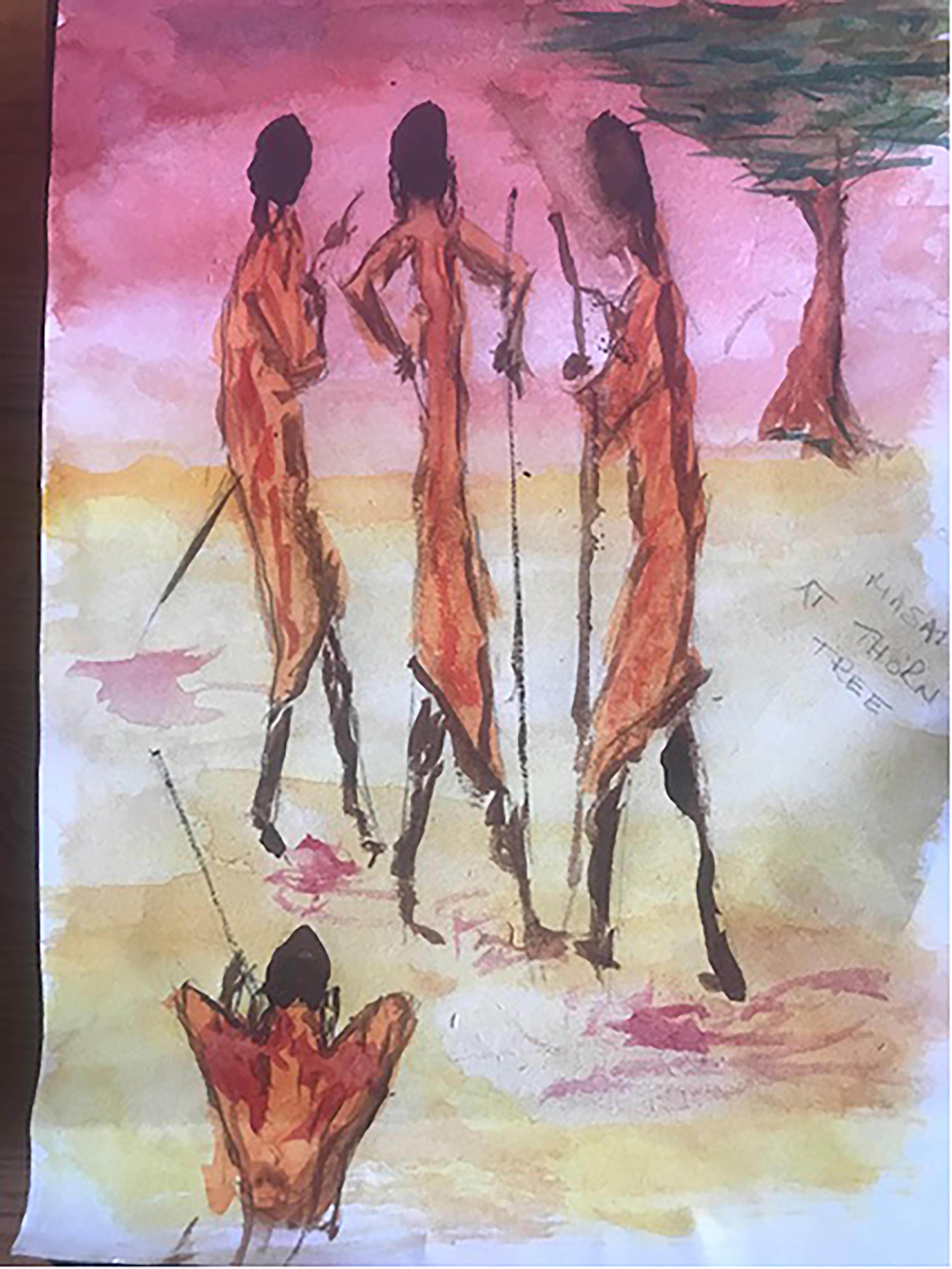
“How Masai women communally occupy space” water color by Phil O' Keefe