



Abstract
In 2019, the Bharatiya Janata Party (BJP) won the general elections in India with a thumping majority for the second consecutive term. The BJP government has undertaken controversial policies which have been interpreted as flowing from its ideology of Hindutva, an ideology of aggressive Hindu nationalism. As a result of pursuing these policies, there has been a hollowing out of democracy in India according to scholars and reputed international organizations. On the other hand, in the last 8 years, the Indian economy has gone through major slowdowns and policy-induced crises, which the pandemic has further intensified. The paper tries to look at these political and economic processes under the Modi government simultaneously. It shows that the conditions of the Indian people have deteriorated during BJP rule. However, this has not affected the political fortunes of the government. The paper tries to answer how one can view the economic stagnation witnessed during the last 8 years together with the rise of Hindu nationalism in India. We argue that BJP wants to redefine the Indian nation in its Hindutva image. Such a re-imagination backed by state power has postponed the political blowback resulting from the economic crisis. Additionally, the BJP has articulated a new politics for the poor (without redistribution) and a new politics of caste to sustain its hegemony. The enduring dominance of BJP in the political domain of India even after a below-average economic performance during the last 8 years is therefore a result of multiple factors pertaining to Hindutva, nationalism and a new politics of caste and the poor.
Introduction
In 2014, the Bharatiya Janata Party (BJP) won a massive victory in India's General Elections. For the first time since 1984, a single political party won a decisive majority in India's Parliament winning 282 seats out of 543 with a vote share of 31%. This is also the first time that a non-Congress party won a majority in India. 1 This huge victory by the BJP was primarily attributed to the popularity of their Prime Ministerial candidate Mr Narendra Modi who was the Chief Minister of Gujarat. The main poll plank of BJP and Mr Modi was ‘vikas’ or development which was promised to the people. As a track record of Mr Modi's commitment to ‘vikas’ his home state Gujarat under his dispensation was thrown up as the ‘model’ that needs to be emulated across the country. 2 The people of the country believed in the BJP's narrative and voted for their vision of converting the entire country into Gujarat. This is not without a sense of irony and an example of BJP's master tactics of projecting Gujarat. This is because Gujarat was not only economic success, as claimed by BJP, but it was the laboratory where Hindutva politics was practised and sharpened at the cost of the secular constitution of India and the Muslim minorities. 3 By projecting Gujarat, Mr Modi and BJP gave clear indications about which direction India will move in the future.
After 5 years of running the central government, the Modi government was re-elected in office with even a larger majority in 2019. BJP's tally in the Parliament increased to 303, with a 37.4% vote share. 4 The National Election Survey conducted by Lokniti under the Centre for the Study of Developing Societies (CSDS) reports that while in 2014, 36% of Hindus voted for BJP, in 2019, the proportion increased to 44% with the National Democratic Alliance (NDA) winning 51% of Hindu votes. 5 This consolidation of Hindu votes was achieved in the backdrop of the terrorist attack in Pulwama Kashmir, and India's response through the air strikes in Balakot, Pakistan. Additionally, reservation for economically weaker sections and cash transfer schemes for the farmers benefited the BJP. 6
Since regaining power in 2019, BJP government has taken upon an aggressive Hindutva politics through successive laws in Parliament. The criminalization of Triple Talaq Act (August 2019), the abolition of Article 370 (August 2019), the passing of the Citizenship Amendment Act (December 2019), the completion of the National Register of Citizens (NRC) in Assam to identify and evict illegal immigrants, the Supreme Court judgment awarding the Babri Masjid site for building a Ram temple (November 2019) was all core agenda of the Hindutva politics of BJP, which were fulfilled.
At the same time, different international organizations like the Economist Intelligence Unit, V-Dem Institute of Stockholm and Freedom House USA have downgraded India's ranking in their respective democracy index. 7 According to these studies, the government has put curbs on press and internet freedom, right to protest has been limited, the government has persecuted dissenters and civil society organizations who are opposed to the government's policies. Simultaneously, there has been an increased assault on rights of the minorities in India. Incidents of mob lynching, laws aimed at hurting the traditional occupations of Muslims (like banning beef or meat shops near temples) have been passed. Most importantly, through the passing of the Citizenship Amendment Act (CAA) 2019, for the first time in the history of the country citizenship has been defined in terms of religion with Muslims from neighbouring countries explicitly denied citizenship rights who have come to India as refugees. Additionally, the government has planned to conduct the exercise of identifying illegal immigrants through the National Population Register and NRC. Through the CAA, the government has kept open the door for the non-Muslims to become Indian citizens even if they are identified as illegal immigrants. But such a route is closed for the Muslims.
Against the backdrop of all these curbs on democracy and an increased communal polarization aimed at cornering the Muslim community in India, scholars are now debating the decay that has been set in Indian democracy. Palshikar (2021) attributes this downslide of Indian democracy to the long-term ‘sub-democratic’ politics practised by political parties in India. According to him, this long-term problem has made Indian democracy vulnerable to erosion and capture as in the current regime. Jaffrelot (2021) argues that the current phase of Indian democracy can be christened as ‘ethnic democracy’ which is characterized by a Hindu definition of the nation as opposed to secularism as envisaged in the Indian constitution and by its opposition to minorities, particularly Muslims. Jaffrelot (2021) also points out that the Modi government has unleashed a new form of authoritarianism where the government has weakened the institutions of the state and targeted minorities. All these are transiting India ‘from a de facto Hindu Rashtra to an authoritarian Hindu Raj’. 8 In a similar, though theoretically different approach, Roy (2021) argues that India has become an ‘ethnocracy’ where ‘the dominant ethnos, Hindus in this case, [form] the core of the Indian nation’. The last 8 years of the BJP government have, therefore, marked a significant departure from the Nehruvian ideals on which the Indian state was built since independence. Rather, India is making a transition where democracy has been reduced to the act of voting while religious majoritarianism has become the dominant ideology of the state apparatus.
This transformation is also marked by an economic regression which is almost unprecedented in the history of independent India. Even before COVID-19 pandemic struck the Indian economy, the growth rates were plummeting down, employment generation became stagnant and poverty did not decline (these points will be discussed later). The government's economic policy has ranged between the absurd (demonetization), hurried and unplanned (implementation of goods and services tax (GST)) and shocking (unplanned lockdown during the pandemic). As a result of these policies and an inability on the part of the government to increase the growth rate and employment in the Indian economy, large majority of the people, particularly the informal sector and agriculture have suffered.
The paper contributes to the existing literature on the relationship between India's political decline in terms of democracy and secularism and the economic conditions of the people. The aim of the paper is twofold. First, the paper tries to provide an overview of the economic performance and policies of the Modi government through the exploration of publicly available data. In this context, the paper tries to understand the politics of Hindutva, degradation of democracy and secularism. The paper tries to provide an understanding of how the regime is maintaining its popularity even though the economic conditions of the people have worsened. In this context, Patnaik (2020) suggests that the rise of communal forces itself is a result of the economic crisis, with no major political party having an alternative of how to get out of the crisis. We think that while this analysis of Patnaik (2020) is important, there is a need to go beyond it. Therefore, the paper further adds to the points mentioned by Patnaik (2020) in two ways. First, we argue that the BJP has tried to redefine the Indian nation itself, through its aggressive Hindutva politics and pursuance of neoliberal economic policies. Second, it has used a changed caste politics and a different pro-poor rhetoric to gain the support of a large section of the people.
The rest of the paper is organized as follows. The section Indian economy under Modi government will summarize the main economic indicators of the last 8 years showing the worsening condition of the Indian economy. The section Economic policies under Modi government analyses policy responses of the government. The section Dialectics of economics and politics binds together the economics and politics of the Modi regime. The final section provides some concluding remarks. The paper uses publicly available published data and no primary survey was conducted. Therefore, the issue of clearance from ethics committee is not relevant to the paper.
Indian economy under Modi government
Economic growth
In its manifesto published before the 2014 Lok Sabha elections, the BJP said, “Through consistent long-term policies, we will not just spur the process of economic growth but also ensure that it is stable as well as balanced” (emphasis in the original). 9 In its manifesto for the 2019 Lok Sabha elections, the BJP claimed that their government had achieved the highest rate of average gross domestic product (GDP) growth among all governments in the post-1991 period. 10 However, these claims or promises of the BJP have turned out to be wrong. Rather than ushering in a new era of growth, the BJP regime has witnessed a steady decline in the growth rate of GDP even before the pandemic (Figure 1).

Quarterly growth rate of GDP for India. Source: CEIC Database for India. Note: Dotted line denotes the 3 year moving average.
From Figure 1, it is seen that the quarterly growth rate of GDP stagnated at around 5% in the later years of the United Progressive Alliance (UPA) government and increased between 2014 and 2016, with some blips in between. However, since 2016, the quarterly growth rate of GDP has been declining with the exception of one or two quarters in 2017. From 2018 to the first quarter of 2020 (Jan–Mar), the growth rate of quarterly GDP has been on a steady decline. This decline in the growth rate of quarterly GDP in India is unprecedented in its recent history (Table 1).
Time, duration and severity of economic slowdowns in India since 1991.

Source: State of Working India 2021, Azim Premji University.
Table 1 enumerates the various episodes of slowdown witnessed in India over the last three decades. It is clearly seen from the table that during the years of Modi government the slowdown in the growth rate has been the most prolonged, lasting for 3 years with total of 10 quarters witnessing a slowdown while eight quarters witnessed slowdown for consecutive periods even before the COVID-19 pandemic and the concomitant lockdown struck India.
With the lockdown, the situation worsened even further, with the growth rate of GDP in the year 2020–2021 crashing to −7.3%, where the first quarter of the financial year witnessed a negative growth of 23.9%. 11 The extent of the slowdown and loss of output can be gauged from the fact that in constant prices, the GDP in 2020–2021 is only 2.8% higher than what it was in the year 2017–2018, and lower than both 2018–2019 and 2019–2020. 12 In other words, India lost almost 2 years of GDP growth as a result of the pandemic. The GDP data for the last quarter of the financial year 2021–2022 has been published by the government. It shows that the growth rate of GDP in this quarter is 3.9% in constant prices, 13 which is still much lower than what was achieved during the UPA or even before the pandemic. The growth rate for the first quarter of 2022–2023 has been 13.5%, but compared to the pre-pandemic year GDP has increased only by around 4%. 14
A fuller picture of the Modi government with respect to growth can be obtained if we compare the sectoral growth rates in the Indian economy between the UPA (2004–2005 to 2013–2014) years and the Modi years (2014–2015 to 2020–2021). This is shown in Figure 2.
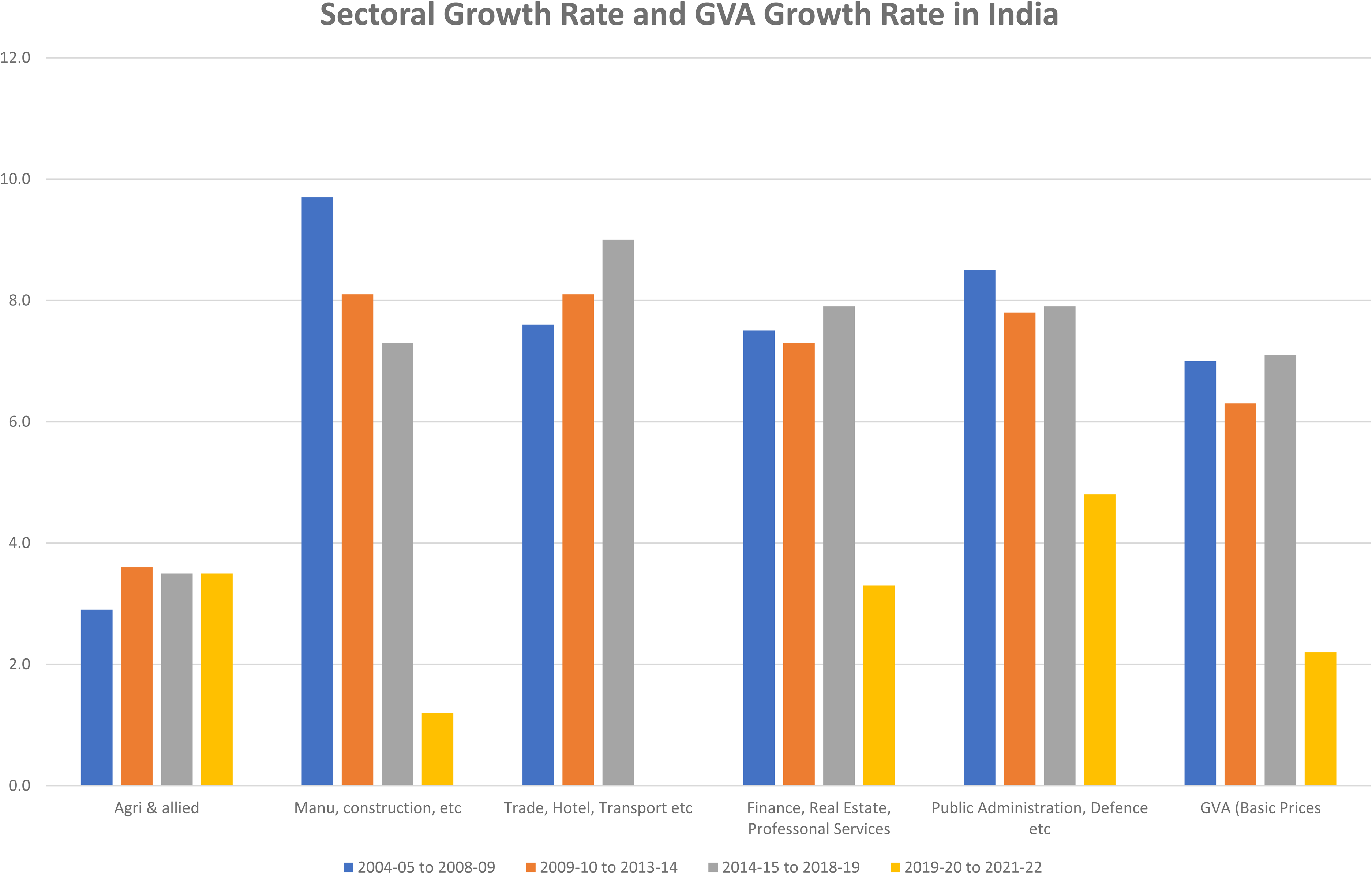
Sectoral growth rate and GVA growth in the Indian economy. Source: Calculated from Statistical Appendix, Economic Survey 2021–2022, Government of India.
Figure 2 shows that the growth rate of agriculture has been stagnant between the UPA and Modi years while that of manufacturing and construction witnessed a steady fall. Trade, Hotel and Transport is the only sector which has increased its growth in the initial Modi years, but in the last 3 years (2019–2020 to 2021–2022) the growth rate of this sector has been zero. The fall in the growth rate of Agriculture and Trade, Hotel and Transport sectors is important because these sectors are predominantly informal in nature and provide employment to the major share of the population in India. The stagnation in these sectors, therefore, also point to the job crisis in India, a point to which we will return to.
Therefore, far from the promises made in the successive election manifestos of BJP, the growth rate of GDP has been on a prolonged slowdown trajectory since they assumed office. The question is what the causes behind such a prolonged slowdown are? While a detailed analysis of the causes behind the growth slowdown is outside the scope of this paper, some important issues can be mentioned based on the existing literature. 15 The Indian economy since the adoption of the policies of globalization has tried to maintain a sound finance policy, which aims at reducing the fiscal deficit and thereby any role of the government to stimulate demand in the economy. Rather, the reliance of the government has been on using the banks to supply credit to the industrialists, whereby the industrialists were expected to invest and thereby make investment and growth. Second, successive governments relied on the export market to provide the growth stimulus. This worked for the UPA between 2003 and 2008 when there was a boom in the world market. With the global financial crisis of 2008, this boom ended and the problems in the Indian economy started. The government went in for some fiscal stimulus initially which was prematurely withdrawn. With the BJP government coming to power, the policy thrust did not change. However, the slowdown in the world economy continued which also afflicted India. In the meantime, there was a pile up of non-performing assets in the banking sector and a problem of debt in the corporate sector. Both these resulted in a drying up of bank credit and corporate investment in the economy. The government continued to adhere to the sound finance policy and did not take upon itself the job of stimulating demand. Rather, its policy focus shifted to providing concessions to the corporate sector, opening up various sectors for FDI, announcing disinvestment of public sector assets and introducing labour market flexibility in the economy.
This underperformance of the Modi government at the centre can be contrasted with the performance of the Gujarat government under Mr Modi, which was projected by the BJP as the ‘Gujarat Model of Development’. Ghatak and Roy (2014) show that while Gujarat was ahead of the rest of the country in terms of per-capita income growth, there is no evidence of a differential acceleration in the growth rate in 2000s, when Mr Modi was in office. Further, in terms of developmental indicators, Gujarat has lagged behind most of the Indian states, in spite of the fact that the growth rate was pretty high in the state (Dreze 2014; Roychaudhuri & Kotwal, 2014). Jaffrelot (2021) shows how the policies undertaken by Modi benefitted capital at the cost of the labour to the extent that Gujarat has one of the lowest wage rates for daily casual workers in urban areas despite being a fast-growing state.
In spite of the mediocre performance of Gujarat under Mr Modi, it was paraded by the BJP as a ‘model’ and economic success story. One of the reasons for the acceptance and the popularity of the so-called Gujarat Model stemmed from the fact that the UPA government's economic record in the latter part of the regime worsened. There was a slowdown in the growth rate from 2011–2012 and inflation was also on the rise. Additionally, the corruption scandals plaguing the UPA provided oxygen to the BJP's narrative of projecting the ‘Gujarat Model’.
In this context, however, the role of the corporate media cannot be ignored. The corporate media and the ruling classes of the country not only agreed to this story but used it as propaganda for Mr Modi. The rise of the ‘Gujarat Model’ basically shows the change in the discourse of what development actually is. With all its faults the Indian state adopted a developmental discourse where people's welfare was at the centre stage. However, the rise of the Gujarat Model marks the turning point where profit and benefits for the rich and capitalists become the criteria for judging development. In the case of India under Modi, the economy has not managed to register a high growth rate, nor have the developmental indicators improved.
Employment situation in India
As the growth rate of the economy witnessed a significant slowdown under the Modi regime, the employment situation in the country also worsened, even before the pandemic (Table 2).
Labour force, employment and unemployment in India.

Source: Same as Table 1.
Note: Figures are for individuals aged 25 years and above to exclude those who are generally enrolled in educational institutions.
Table 2 shows that between 2011–2012 and 2017–2018, the number of employed actually declined in India, which then increased in 2018–2019. As compared with 2011–2012, the increase in employment in 2018–2019 is only 2.1 million. In other words, hardly any jobs were created in India even before the pandemic. As a result, the unemployment rate rose from 2.2% in 2011–2012 to 6.1% in 2017–2018 and 5.8% in 2018–2019. The unemployment rate registered in 2017–2018 is the highest ever recorded in India. The other interesting observation from Table 2 is that both the labour force participation rate and the workforce participation rate have fallen between 2011–2012 and 2017–2018. This indicates that with decreasing job opportunities and rising unemployment many people are actually withdrawing themselves from the workforce.
The Periodic Labour Force Survey report for 2019–2020 shows that there has been a decline in the unemployment rate in the year 2019–2020, which is counter-intuitive given the severity of the lockdown measures implemented in India during that particular time. Anand and Thampi (2021) show that there has been an increase in LFPR for men and women above 60 years of age in 2019–2020 as compared with 2018–2019. Additionally, the most significant increase in employment between 2018–2019 and 2019–2020 has been for the self-employed category with the sectoral share of agriculture witnessing the sharpest increase. All this points to the fact that agriculture and self-employment acted as the residual sector for those who lost employment, even the senior citizens had to look for jobs to supplement the job loss in the family. Anand and Thampi (2021) show that real wages and earnings for self-employed, regular salaried as well as casual workers decreased significantly during the April–June quarter of 2020 as compared with the April–June quarter of 2019. They also point out that the fall in the wages for regular and casual workers started even before the pandemic hit India. Similar results of fall in food consumption, earnings and employment have been reported by primary surveys conducted by Azim Premji University. They report that between 2019 and 2020, the earnings of casual workers fell by 13%, that of self-employed by 18%, temporary salaried by 17% and permanent salaried by 5%. 16 These problems of growth slowdown, employment decline impacted on the other indicators like poverty and rural wellbeing. We discuss these in the next section.
Agriculture, poverty and human development
In India, poverty is calculated on the basis of the consumption expenditure survey conducted by the National Sample Survey Organization (NSSO) on a quinquennial basis. However, the last official survey report came out in 2011–2012, after which there is no official data on poverty in India. The report of the survey conducted in 2017–2018 was not published by the government. But the report was leaked in the media. 17 On the basis of the leaked report, it is observed that there has been an increase in headcount poverty ratio in rural India between 2011–2012 and 2017–2018 while the mean real consumption expenditure as a whole and on food has declined (Table 3).
Consumption expenditure and poverty in rural India.

Source: Subramanian (2019).
It must be noted that such an absolute decline in real consumption expenditure has never been reported since the NSSO started collecting this data. The government has rejected this report citing data quality issues. However, if we look at certain other indicators, it becomes clear that this increase in poverty as reported in the rejected report of 2017–2018 is clearly a part of a larger picture of rural stagnation and income decline.
There has been a fall in the growth rate of rural wages for both agriculture and non-agricultural sectors (wages for men considered here) since 2017. The growth rate turned negative in 2019 and then recovered only after the lockdown was lifted. But again in 2021, the growth rate of rural wages has turned negative (Figure 3).

Growth rate of rural wages. Source: Database on Indian Economy, Reserve Bank of India.
This fall in the rural wages is accompanied by a meagre income that agricultural households are able to get out of agriculture. The Situation Assessment Survey of Agricultural Households conducted by the NSSO in 2018–2019 shows that the average monthly income of an agricultural household is Rs 10,218 only. There has been an increase in real income of agricultural households, which is mainly because of an increase in wage income. For income from crop cultivation, the real income declined by 1.3% per annum (as compared with 2013), which has been experienced by all farmers, large or small. 18 Since most of the people in rural India are dependent on agriculture and crop cultivation, decline in real income from cultivation and a fall in rural real wage (as cited above) makes it difficult for a significant number of people to be above the poverty line.
The government in the face of an acute agrarian crisis has claimed that it has significantly increased the minimum support price (MSP) for the farmers. Figure 4 shows that this claim is not supported by data. The growth of real MSP (nominal MSP deflated by the Wholesale Price Index for Food Articles) has been negative for 4 years from 2013–2014. The average growth rate during the period has been less than 1% for both paddy and wheat. Only in the year 2018–2019 there was a significant increase in the real MSP of paddy and moderate rise for wheat. In other words, with the MSP announced by the government, the real purchasing power of food for the farmers has been almost constant, signifying no major gains for them. This can also be corroborated from the data on the terms of trade between farmers and non-farmers. The terms of trade has moved against the farmers since 2011–2012. 19

Real MSP growth for paddy and wheat. Source: Database on Indian Economy, RBI.
The data on rural poverty and agriculture show that income for a majority of the rural households has either stagnated or fallen. This has had an adverse effect on the health outcomes of the people. The National Family Health Survey (NFHS) has published preliminary data for 22 states and union territories for the year 2019–2020. Table 4 categorizes the states showing improvement, deterioration or stagnation for some key indicators of malnutrition for women and children, as compared with 2015–2016 survey.
States’ performance in certain health indicators.

Source: NFHS 2019–21.
Note: A state or categorized Stagnant if the change in the relevant indicator is less than or equal to 0.5 in the positive direction.
Table 4 shows that for a significant number of states, there has been a deterioration with respect to important indicators like stunting, under-weight, wasted children or anaemia within children and women. This is for the first time since NFHS data is being collected that so many states witnessed a deterioration in these important indicators of health and nutrition. This only further strengthens the point that the overall condition of the people has worsened in the last 7 years.
Inequality, wealth and profit
The preceding sub-sections showed that there has been a deterioration of the living conditions of the people in the last 8 years. This deterioration for a majority of the people has been accompanied by a rise in inequality resulting from a huge increase in wealth and profit of the capitalists of the country. The number of dollar billionaires in India has witnessed a steady increase between 2014 and 2020. In 2014, the total number of dollar billionaires in the country was 109, which has increased to 140 in 2021 with a total net worth of $596 billion, an addition of $283 billion during the pandemic year of 2020. 20 In 2020, the GDP of India was $2.62 trillion. In other words, the wealth of the 140 billionaires in 2020 was 23% of India's GDP.
Chancel and Piketty (2017) has already shown that there has been a massive increase in income inequality in India. According to their calculation, the richest top 1% of India had an income share of 15.5% in 2000, which increased to 22% in 2014 and remained constant at that level upto 2019. 21 If we look at the wealth inequality, then it is seen that there has been a rise in this parameter between 2000 and 2020. This is shown in Figure 5, where we compare India's wealth inequality with Brazil, China, Russia and the United States. India's wealth inequality as shown in this figure is lower than Brazil and Russia but higher than the USA and China. What is noteworthy is that in the pandemic year, wealth inequality increased in all countries, including India.

Wealth share of top 1% for selected countries. Source: Global Wealth Report 2021, Credit Suisse.
This increase in wealth inequality and income inequality has been accompanied by a significant growth of profits. Even during the pandemic year, when the growth rate of the economy became negative, the corporate sector earned a huge amount of profit. As the Business Standard reports, “listed companies’ net profit as a percentage of GDP has hit a 4 year high at 2.6% for the financial year 2020–2021”. 22
In short, therefore, the economic trajectory of the Modi government of the last 8 years has been one where the living conditions of a large section of the people have worsened even before the pandemic. With the pandemic the situation has deteriorated even further. On the other hand, the growth of wealth and income for the richest Indians has continued unabated. Let us now look at how the Indian government under Mr Modi tried to deal with the crisis.
Economic policies under Modi government
As has been argued earlier, the prolonged slowdown in the Indian economy is a result of a number of factors including a tapering off of the global growth after the crisis of 2008. In the absence of such a stimulus to growth, what was needed was a fiscal expansionary policy of the government to inject demand into the economy. The Modi government's policy however steered clear of this route. 23
Instead the government adopted a set of policies which were aimed at inducing the capitalists to invest through various means. There were at least three alternative ways of doing this. First, the government gave large scale tax-concessions to the corporate sector. As a result, the corporate-tax to GDP ratio in the Indian economy has declined (Figure 6). This decline becomes even more significant for the pandemic year, where even though the GDP declined by more than 7%, the corporate tax-GDP ratio fell, signifying that corporate tax fell more than the GDP, while we have just seen that the profits of the corporate sector increased in 2020–2021.

Corporate tax GDP ratio in India. Source: Budget Documents, Government of India (Various years).
With this huge amount of tax concessions provided to the corporate sector proving to be ineffective in increasing the growth rate, the government announced a massive disinvestment program. As a matter of principle, the Modi government has decided to divest its share from the public sector units (PSU), barring a few in the strategic sector. The Prime Minister himself argued in a webinar that ‘the government has no business to be in business’. 24 With the pandemic hitting the economy, the earlier plans of disinvestment could not materialize. Therefore, the government has now decided to ‘monetise government assets’ whereby such assets will be given to the private sector on lease. The message is clear. Modi government is going to sell-off the profit-making PSUs to the private sector. The government while giving tax concessions to the rich wants to collect money through the sale of PSUs to reduce the fiscal deficit. The second idea is premised on the assumption that by giving concessions to the private sector and withdrawing the government from economic activity growth can be revived in the economy. Both these arguments are wrong.
First argument of reduction of fiscal deficit is wrong because in an economy characterized by unemployment and unutilized capacity, a fiscal deficit finances itself through the generation of an equal amount of savings. This savings is gained not by the government but by the rich and the corporate sector. The sale of PSUs is just another way of getting this savings back to the government while handing over the PSUs to the corporate sector. However, in the initial situation, the corporate sector did not have the required savings to buy the PSUs. It is only with the fiscal deficit that the corporate sector has the requisite savings to buy the PSUs, either through borrowing from other savers or from the savings accrued in their pockets through the fiscal deficit. In short, therefore, in a macroeconomic sense, the corporate sector gets the PSUs actually for free. 25
Secondly, the slowdown in the economy is a result of a host of factors which has curtailed the inducement to invest by the capitalists. Simply giving tax concessions to them will not make them invest in an uncertain future where the prospects of growth are not bright. The government needs to invest through government expenditure to deal with the problem, which the Modi government has steadfastly refused to do. Therefore, the prospects of growth and employment generation do not look very promising.
The second route that the Modi government has taken aiming to revive growth is to introduce a high degree of labour market flexibility in India. The government passed four labour codes in the Parliament, which has combined more than 40 labour laws into four codes. A detailed analysis of these codes is beyond the scope of this paper. 26 We will instead focus on just one law, the Industrial Relations Code (IRC) 2020.
According to IRC, the threshold limit for seeking permission from government for retrenching workers has been increased from 100 to 300. Fact of the matter is that 89.13% of factories in India employ less than 200 workers. 27 Therefore, by increasing the threshold limit to 300, the government has essentially implemented hire and fire policy for the entire factory sector. Currently, 36% of the workers are employed as contractual workers in the organized factory sector in India. 28 On top of this, the government has introduced fixed term employment where workers will be employed for a particular period and then their term can be terminated or extended. This will only ensure more contractualization and decrease in the bargaining power of the workers. Lastly, the Act specifically states that government can unilaterally withdraw all provisions of the Act if it thinks it necessary for public purpose. This makes labour laws completely flexible and most of the rights of the workers severely curtailed. The organized sector workers of the country are being asked to be at the mercy of the capitalists, with the state decisively shifting in favour of the latter. The government believes that by curtailing the rights of workers, more foreign investment will come into the economy and India will witness high growth. However, reducing the bargaining power of workers and their real wage through labour market flexibility does not necessarily mean that such high investment and growth will be achieved. 29
This tilt of the Modi government in favour of the corporate sector is also visible in case of the changed farm laws which have resulted in a long-drawn struggle by the farmers. The government has allowed the private corporate sector entry into the market for purchasing and distributing food grains bypassing the existing framework of Agricultural Produce Marketing Committees (APMC). It has also diluted the Essential Commodities Act removing the restrictions of stocking of essential commodities. At the same time it has allowed contract farming in the agriculture sector in a big way.
Lastly, in 2017 the government implemented the goods and services tax (GST) which has curbed the power of states to levy commodity taxes and brought the entire country under a single tax jurisdiction for purchase and sale of commodities and services. The provisions of this Act aim to convert the informal sector into a formal sector of the economy. The informal sector however is the largest employer, employing more than 90% of the employed. This cash use intensive sector suffered a huge set back because of the policy of demonetization by the government. 30
While this deterioration of the condition of the farmers, informal workers, organized workers continue, the government has announced a plethora of schemes for the apparent benefit of the masses. The monthly cash transfers to the farmers, the government financed health insurance scheme of Ayushman Bharat providing Rs 500,000 yearly health insurance to the beneficiaries, the Ujjwala scheme for providing cooking gases to the poor, are some of the schemes that the government has been implementing for the people. However, a simple calculation shows that even with this plethora of schemes, the development expenditure as a share of GDP has been stagnant during the Modi regime (pre-pandemic) 31 . In other words, while the concessions to the capitalists have been substantial, there has not been much gain for the people in spite of the schemes of the government.
Dialectics of economics and politics
In the last section, two crucial features of the economic policies of the Modi government were discussed. First, the government has given significant concessions to the capitalists through various routes, including dilution of the labour laws. Second, the government has orchestrated an assault on the informal sector and agriculture, which is comprised of a majority of people in this country.
Naturally, this raises the important question of political management of the economic crisis that we have outlined above. For a government to win elections, it needs support from a significant section of the people, who in India, mainly belong to the informal sector, agriculture and rural areas. However, the government's policy has been to assimilate the informal sector as well as agriculture into the formal economy through the policies of GST and farm laws, while at the same time it has diluted the workers’ rights in the organized sector. Nonetheless, the government's popularity has not been significantly dented, as evident from various state-level elections and other opinion polls. This apparent puzzle has to be explained. We will do so in two ways. First, we provide a political-economic interpretation of the economic policies of the Modi government. Second, we focus on the primary political mobilization strategy of the BJP, which is Hindutva.
Politics of economic policy
It has been argued in the previous section that most of the economic policies of the Modi government favours the rich and not the poor. However, there are a set of policies undertaken by the Modi government which has been directed to the poor and which have been hugely popular – Jan Dhan Yojana, Swacha Bharat Abhiyan and Ujjwala Yojana. In addition to this, the cash transfer scheme to the farmers is also appreciated.
The Jan Dhan Yojana basically allows the poor to open a bank account in public sector banks. It is a fact that no other government before Modi thought about this. The poor having a bank account is a sign of empowerment for them. Second, the Swacha Bharat Abhiyan with the promise of building a toilet in every household is again a scheme aimed at overcoming the age-old practice of open defecation in India. A poor household having a toilet in its house is again a sure sign of empowerment for them. Similarly, to put a cooking gas cylinder in the kitchen of a poor lady is a step in the right direction.
However, as Jaffrelot (2021) points out, all these schemes while symbolically important for the poor have no resource transfer involved. These are not poverty alleviation schemes or schemes which will increase the income of the household. To use the words of Jaffrelot (2021): In contrast with redistributive schemes, this abhiyaan (mission) and these yojanas (schemes) do not seek to alter social balances or even to combat inequality, but they send the people an identity oriented message…. In the case of these three programs women's dignity has been especially highlighted.
Even when the Modi government is spending less for the poor in the aggregate as a share of GDP, it has identified schemes and policies, which tries to enhance the sense of dignity within the poor. At the same time, the government has maintained the social and economic status quo of inequality, where the rich on the one hand is given tax concession to fill their coffers, the Prime Minister says that we should not criticize the capitalists or the wealth creators, but on the other hand, a policy like demonetization is sold to the poor by projecting it as an anti-rich policy.
The Modi government has openly criticized the National Rural Employment Guarantee Act, it has been unresponsive to the demands of the farmers to increase the MSP and was adamant to implement the farm laws (revoked after an intense struggle by the farmers), it has tried to dilute the new Land Acquisition and Rehabilitation Act 2013. We have already seen that under the Modi government the condition of the people has worsened. But at the same time, the pro-poor rhetoric and politics of dignity materially do not benefit them much but induces a sense of closeness to the regime through the abovementioned politics. These schemes are important structures which have helped in maintaining the popularity of Modi and his government. However, the kernel of the political messaging is Hindutva.
Politics of Hindutva
BJP has institutionalized a politics of aggressive Hindutva-based nationalism and communalism targeting the minority community of the country. The rise to dominance of the BJP signifies, therefore, a rise of Hindutva brand of communal politics in India.
Patnaik (2020) argues that such rise of communal nationalist forces is a result of three sets of factors. First, existence of an economic crisis, which the people want to break out of. Patnaik (2020) argues that this is the case in India right now. Second, other bourgeois formations have no alternative vision of coming out of the crisis, because of their adherence to neoliberal dogma, which has caused the crisis in the first place. Third, the left is not a decisive force in the polity. One can argue that all these conditions are satisfied in the current conjuncture of India and hence the existence of an economic crisis goes hand in hand with the dominance of Hindutva.
However, it needs to be unpacked why the people in spite of the deteriorating economic conditions continue to vote for a deeply neoliberal formation as well as a votary of sectarian politics of Hindutva. We argue that this phenomenon, in addition to the pro-poor rhetoric of the government and the diagnosis of Patnaik (2020) is a result of two important political moves of the BJP. First, the idea of redefining the Indian nation itself. Second, a changed caste politics has been practised by the BJP.
Neoliberal reforms in India were a part of the global process of the rise to dominance of international finance capital. Since capital is globally mobile, each nation-state has to ensure that the investors’ confidence is retained, otherwise capital can move from one state to the other seamlessly. This in turn makes nation-states undertake policies which are mainly in favour of financial capital, rather than their own people. 32 The curtailment of government expenditure aimed at the poor, in the name of reducing fiscal deficit, the narrowing of workers’ rights, the clamour for labour market flexibility all are part of the attempts by nation-states to woo international capital.
Such a change in the class outlook of the state has to be managed through a politics where the consent of the governed is important in a democratic polity. But globalization in the meantime has increased inequality, reduced the real wage of workers in India and has made agriculture practically unviable. In the early 2000s, there was an increase in the growth rate of the Indian economy, the government also undertook some redistributive programs and constituted some legal rights for the people. But this did not change the trend of inequality and agrarian crisis afflicting the Indian economy. The Congress party, which had led the freedom struggle and carried its legacy was in an impasse, unable to decide how to move out of the crisis, created by its own policies of neoliberal globalization.
In this milieu, the BJP staked claim to power with an aggressive attack on the Congress economic policies but also making it clear that it will adhere to the norms of neoliberal globalization. The rising inequality and stagnating income for large sections of the people was a reality that BJP had to deal with. It dealt with this in two alternative ways.
First, the BJP and the government went for an all-out attack on the Nehruvian policies. The personal attacks against Jawaharlal Nehru, the decimation of the Planning Commission, the valorization of the corporate sector were aimed at giving signals to the corporate sector that BJP was here to serve their interests. This was followed by giving concessions to the corporates while opening up newer areas for their infiltration. But this only worsened the condition of the people who wanted things to change for the better.
In these circumstances, the BJP through its decade old politics of Hindutva derived from the Rashtriya Sawamsevak Sangh (RSS) started to unfold its aim of redefining the concept of the Indian nation itself. The Prime Minister argued that wealth-creators or the capitalists should not be insulted in the country. They create wealth for the nation. The idea of nation and national interest was bestowed upon the corporate sector and capitalists, who should be beyond criticism since they create wealth. With this definition, giving concessions to the capitalists or handing over PSUs to them is by definition not against the national interest.
Secondly, and more importantly, it was made clear that a true nationalist in India must believe in Hindutva. The Prime Minister himself said after coming to power in 2014, that India had suffered 1200 years of slavery, clearly alluding to the Muslim rulers in the country. 33 In other words, Muslims were foreigners and the true Indian must be a Hindu. Interestingly a Pew survey on religion has echoed the same sentiment, where 64% of Hindus believed that being Hindu is very important for being Indian. 34 At the same time, the RSS–BJP has created the ‘other’ in terms of the Muslims. The attacks on Muslim cow traders, the remarks from the highest leaders of BJP that Muslim infiltrators are destroying jobs for Indian youths only propagates the notion that most of problems in India are because of Muslims.
This political rhetoric and practice have been practised by RSS–BJP for decades. However, this did not give them enough political dividend. Therefore, the question is how did the same rhetoric bring more votes to the BJP. We think that in addition to the Hindutva rhetoric, the RSS–BJP seriously negotiated with the politics of caste. The BJP has tried to mobilize the socially marginalized castes in two alternative ways. First, they have articulated local or regional myths about marginal caste icons and attracted the masses. Second and more important, in states like Uttar Pradesh and Bihar the BJP has tried to mobilize the non-dominant OBC and SCs 35 . As a result, the composition of OBCs within the Lok Sabha has changed with decrease in dominant caste representation. But even now, the dominance of some particular castes continue due to the numerical weakness of the marginal castes. However, through its rhetoric of Hindutva and non-dominant castes even within the fold of OBCs or SCs, the BJP has garnered their support. 36
The BJP's politics, therefore, is not about a challenge to the existing power structure. Rather, the BJP has been successful in convincing people to agitate against others of the same economic category in the name of religion. Even in terms of caste, while the hegemony of upper castes continues in the Parliament, particularly among BJP's members, they have successfully curbed the number of dominant OBC castes. 37 Additionally, through the policy of reservation for economically weaker sections, the BJP has effectively opened up the door of reservation for the upper castes through the backdoor. This has helped the BJP to win the support of the upper caste who see in this policy a road to gain privileged position through reservation which was denied to them. 38 Both in terms of class and in terms of caste, BJP has been successful in protecting the upper layers of the social pyramid while the bottom layers are engaged in a bitter horizontal battle against each other. This battle at the bottom is assuaged through a string of policies as mentioned above which gives the poor a sense of dignity and, therefore, belonging to the Government. This mixture of aggressive Hindutva and a pro-poor rhetoric devoid of any redistribution can explain the popularity of the regime.
This process has been aided by the neoliberal policies themselves. The ideology of neoliberalism based on methodological individualism also propagates that collective organizations and efforts, like trade unions or political interference in economic policies, are a hindrance to economic progress. What is important is that the markets should function based on private property rights, where individuals maximizing their own profit or utility will automatically lead the system towards an efficient allocation of resources. In this view, therefore, there is practically no social welfare role of the government other than being facilitator. The government assumes the role of facilitator through schemes like Jan Dhan Yojana, etc. But the economic logic of the system continues to increase inequality, and worsens the condition of the people as explained above. Hindutva fills this frustration with an easy identification of the Muslims as the ‘other’. The massive social and physical infrastructure created by the RSS over the years and a faithful media further amplify the Hindutva politics and converts it into a popular movement.
At the same time, neoliberalism being premised on a strengthening of capital over labour weakens all kinds of democratic collective bodies like trade unions or social movements. In India, ever since the policies of neoliberalism have become dominant, there has been no powerful mass movement based on secular ideals. Either there has been the Hindutva movement or there had been a revolt of the middle class against the UPA government led by so-called India against corruption (IAC). Real mass movement has been absent till the protests against CAA 2019 and the farm bills in 2020–2021. It is interesting to note that even these two mass movements were not started or led by political parties or politicians. In fact, the movements deliberately kept out political representatives from their arena. This shows the deep distrust that opposition political parties have created within the people.
This again is a result of neoliberal politics where almost every political party follows the same set of policies aimed at pleasing capitalists. As a result, most political parties are cut-off from the masses. The poor vote for this political party or the other purely for transactional purposes with the political parties maintaining the status quo having no agenda of social transformation. Palshikar (2021) goes to the extent of saying that there are no social forces who are invested in democracy in the country today. Democracy, beyond elections, is the arena of popular struggles and mass mobilization. In today's India, with a congruence of economic policies based on neoliberalism, democracy is only about votes not a discussion of how to govern the country for social transformation.
In this vacuum created as a result of failure of the political parties to create a space for participative mass politics, socio-cultural and religious organizations like the RSS have entered in a big way. As Narayan (2021) argues, the RSS through its socio-religious-cultural appeal and a medium of communication rooted in the ancient oral traditions of India is penetrating various social groups including Dalits in an unprecedented manner, particularly in North Indian states. This lack of a secular public sphere, which is close to the lives and aspirations of the common people and the rise of a socio-religious public sphere in the form of RSS networked organizations gives the main support base both in terms of logistics and votes to the BJP.
As a result of all these, what we are witnessing is a reversal of the ideals of the Indian constitution which promised equality and co-existence to the diverse population of India. What RSS–BJP is doing is to build an alternative conception of Indian society based on a monolithic Hindu identity, which is not premised on the ideals of social justice or equality but a cultivation of hate against minorities through state apparatus as well as that of the RSS network. This political project of re-constituting India is sustaining the government and BJP's popularity where the promised benefits will come after the ‘New India’ free from influences of non-Hindu ideologies is born. The economic problems of the people under these circumstances do not go away. Rather the self-aggrandizing nationalism and the trope of Muslims provide the signifier where the people start believing that their situation will improve under a Hindu Nation. This hope and its associated politics of cruelty sustain the BJP.
Conclusion
The discussion of the paper focuses on the economic outcomes and policies of the Modi government over the last 8 years in the context of the politics that BJP has been articulating in the country. We argue that pursuance of neoliberalism has given rise to processes which are helping the BJP, which by using state power is re-writing the concept of converting India to a Hindu nation. The paper tries to explain the apparent puzzle whereby the conditions of the people are worsening but the popularity of the regime seems to be unaffected, barring a few state-level elections. The paper tries to find a solution to this puzzle in two alternative ways. It suggests that while in the aggregate the expenditures of the government earmarked for the poor has not increased, certain policies have been directed towards the poor. Additionally, a new caste-based mobilization of marginal castes challenging the hegemony of dominant castes within the category of SCs and OBCs, has helped the BJP garner newer support bases. This has been effective in sustaining BJP's votes. However, these policies do not explain BJP's dominance completely. The paper argues that Hindutva remains the core ideology and political mobilization strategy of the BJP, which has been further facilitated by neoliberalism. The paper, therefore, while providing a critique of the economic performance of the BJP government through a rigorous analysis of data, tries to simultaneously analyze the politics which sustains the regime going beyond the analysis of Patnaik (2020) and others.
Footnotes
Acknowledgment
The author would like to thank the Editor of the journal for his support and comments. I would also like to thank three anonymous referees for their extensive comments which have helped in improving the article.
Declaration of Conflicting Interests
The author declared no potential conflicts of interest with respect to the research, authorship, and/or publication of this article.
Funding
The author received no financial support for the research, authorship, and/or publication of this article.
