




Abstract
This paper reviews critical demography, revisiting its initial invocation as a paradigm focusing on the interweaving of power relations and demographic outcomes. Building on earlier critiques about demography's proclivity to positivist epistemology, I contribute to the initial proposition by framing demography as a power-knowledge, exposing the politics of demographic knowledge production. While critical demography remains marginal in demography, interdisciplinary demographers from allied fields have provided important contributions. Given the contemporary moment characterized by social and ecological upheavals, I argue for a recalibration—Critical Demography 2.0—which seriously reflects on the “critical” and works toward emancipatory politics, addressing issues of social justice and plight of marginalized populations. In moving forward, I argue for the need to think of praxis (demography for marginalized populations), epistemological diversity (mixed methods, critical quantification, and interdisciplinarity), and sustained engagement on critical themes. Critical geographers can offer an important role in recalibrating critical demography, by our emphasis on spatial politics and spatial justice, critical quantification, and community-engaged countermapping.
Introduction
It has been 24 years since Hayward Horton proffered the term critical demography, which he defines as “a paradigm that makes explicit which the social structure differentiates dominant and subordinate in society” (363–364). Against a “conventional” demography that has largely ignored racism as a topic, critical demography was positioned as a promising paradigm that focuses on the “nature of power in society” (364). While critical demography has not made significant strides, evidenced by a general lack of a formidable community of scholars or a conspicuous body of work under its umbrella, the topics and perspectives that it promised to grapple with have become front and center of major discussions in various contemporary platforms. It is from this conjuncture where I locate this paper in which I review critical demography's intellectual landscape, including themes emerging in allied fields, and identify possible trajectories from which critical demographic work can be forged, particularly re-alignments with population geography
In this paper, I argue that at the core of critical demography's limited expansion as a paradigm is its uneasy relationship with “conventional” demography, given the latter's positivist proclivity and relationships with institutions, organizations, and structures of power, typically associated with the state. As a demographer, I received my demographic training at one of the first demographic institutions in Asia, which was funded by the Ford Foundation. One of the required readings in our core demography courses was former Population Association of America (PPA) President Donald Bogue's book, Principles of Demography (1969), which defined demography as the “statistical and mathematical study of the size, composition, and spatial distribution of human populations, and of changes over time in these aspects through the operation of the five processes of fertility, mortality, marriage, migration, and social mobility” (Bogue, 1969, 1). From this definition, demographers tend to distinguish formal demography, which analyzes the population processes, from population studies, which is concerned with population composition and its underlying dynamics (see Xie, 2000). Such undertaking necessitates disciplinary engagement with various disciplines, mainly sociology, which demography has been historically associated with. But what is quite telling in Bogue's definition is the emphasis on “statistical” and “mathematical.” Similarly, the IUSSP (International Union for the Scientific Study of Population) through its former officials all describe demography as “scientific,” and “statistical,” primarily concerned with “numbering of the people” (IUSSP, 2021).
Such descriptions are instructive to demography's proclivity to positivism as an epistemology, which runs through its relationship with allied disciplines, including geography. While themes and approaches have shifted and pivoted over the decades—from “traditional” tendencies to work with aggregated data to focus on micro-demographic analyses (see Voss, 2007)—a fundamental commitment to a positivist epistemology continues to dominate demographic knowledge production, teaching, and associated practices. Furthermore, at the heart of demography is its essential focus on population, a concept that is founded upon particular political assumptions that necessitate expressions through quantitative terms. I will discuss this contingent relationship between population and quantification in the next section.
For the most part, unlike other disciplines in the social sciences, particularly compared with geography, demography as a field has remained insulated from epistemological crises and revolutions that scrutinize its methodologies and assumptions (see Riley, 1999). The discipline's scholarly body of work has sustained its cozy relationship with structures of power, particularly the state. This relationship is critical in maintaining its proclivity to positivism and inability to reflect on its approaches to analyzing population. This power-knowledge has configured the epistemic landscape of demography and to a certain extent, I contend, constrained critical demography's initial promise.
Critical demography—Initial inroads
For decades, leading figures in demography have lamented on how the discipline have been “all methods and no theory” (Greenhalgh, 1996, 26) and that the discipline's long-held theories and paradigms are “still wedded to many of the assumptions of the mid-20th century modernization theory (27). Important inroads were paved in anthropology and sociology, particularly those who make space for feminist perspectives in demography (see Greenhalgh and Li, 1995; McDaniel, 1996; Riley, 1999). Hayward Horton proposed critical demography as a paradigm that will address the need for critical perspectives in the discipline.
It is worthwhile to revisit a few details of Horton's proposition. According to him, critical demography distinguishes itself from the so-called “conventional” demography by its direct engagement with power, primarily power relations that undergird societal dynamics and hierarchies (Horton, 1999). Citing demography's relative silence on racism and related social-political movements (e.g. civil rights movements), Horton lays out the key features that distinguish critical demography from the “conventional”, namely: (a) explanatory/predictive versus descriptive; (b) theory-driven versus data-driven; (c) challenging the Social Order versus Tacit Acceptance of the Status Quo; and (d) reflective versus assumptive. While I will not have enough space in this paper to elucidate on each feature describing critical demography, I do contend that these distinctions are not necessarily mutually exclusive, since they merely describe tendencies and dominant practices in “conventional” demography versus possible trajectories of critical demography. One distinction presents demography as data-driven as opposed to theory-driven. While I understand that such an assertion stems from demography's inclination to quantitative data analysis or its reflexive association to producing accurate “demographics,” it tends to oversimplify the disciplinary landscape and overlooks a plethora of demographic studies wrestling with various theories on the major population processes, such as the theory of planned behavior that seeks to explain fertility intentions (see Ajzen and Klobas, 2013) and the cumulative causation theory in migration that explicates the initiation and sustenance of migration flows (see Massey, 1990), to name a few. Another distinction that was set forth was conventional demography being descriptive versus critical demography's explanatory nature. This assertion skims over a multitude of multivariate studies that have attempted to explain and relate a variety of socio-economic, political, and cultural factors behind demographic processes. Nevertheless, what needs to be emphasized in this initial assertion is the centrality of power in critical demographic analysis and the need to address conventional demography's relative lack of engagement with socio-political issues and movements.
Acknowledging the initial attempts to define critical demography, I re-parse its engagement with power. While Horton initially alludes to power that underpins societal processes as the main point of critical demography, I expand its analytical domains to include an understanding of how demography operates in society as a power-knowledge (see Foucault, 1991). Viewing demography as a power-knowledge enables us to turn our gaze onto the politics of demographic knowledge production, tracing the power-laden interconnections between demographic research, bodies of work, institutions, actors, and the state, and contingently exposing the assumptions and biases of long-held demographic measures. It helps critique the hegemony of positivism in demography and argue for its provincialization, as just one of the many ways of analyzing population.
At the heart of demography is population, a key concept that is intimately linked to government and nation-state politics. As a bounded and territory-based reality, population serves as the “end of government,” an object from which government's “rationality” is exercised and from which governance considers all its observations, calculations, and actions (Foucault, 1991, 97). To demonstrate rational governance and legitimize itself to its constituents, the state discursively frames the population as a denominator from which services are provided to citizens. Framing it as such involves a quantitative expression of the population, entailing the aggregation and categorization of constituent individuals, in accordance with state-mandated narratives. Consequently, population characteristics and attributes are analyzed through statistics, whereby measures of central tendency and rates of growth are calculated. In this sense, the quantitative framing of the population is a form of “seeing like a state” (Scott, 1998), and the consequent statistical analyses truly becomes “state-istics” (Shaw and Miles, 1979), in the service of the state.
It is no wonder that within this population-governance schema, the methods and materials of demography—borrowing from the classic text that demographic training traditionally relies on (Shryock and Siegel, 1980)—are firmly anchored in positivist epistemology. The general disciplinary preference for “statistical analysis,” “scientific,” and “neutrality” is crucial in the serial reproduction of modern governmental logic, effectively secures demography as part of statecraft and concomitantly acts as a mode of persuasion for state legitimacy. By casting demographic knowledge as objective, neutral, and rational, state interests are “depoliticized,” and politics are obscured (Rose, 1999: 674), rendering issues over who is counted or how certain groups are categorized as mere scientific and neutral activities.
In explicating and clarifying the ways in which power is directed and reproduced through demography, I identify and distinguish two forms of power from which demography is situated: (a) institutional power and (b) discursive power (see Figure 1). The first is institutional power as exerted on demographic knowledge, effectively linking research projects, studies, and academic endeavors with structures of power. From the state to the church, institutional power structures typically initiate bureaucratic projects that involve counting and enumeration of the population, concomitantly producing a database from which demographic analyses and information are generated. Perhaps one of the most enduring examples is the national census, a state-mandated enumeration of individuals that constitute a population. As a state apparatus (see Anderson, 1991), a census reinforces dominant national narratives regarding how the population is organized and structured. Censuses are critical to statecraft as they facilitate multiple ways for the state to express its power, from the bureaucratic downloading of policies to the management of resources.
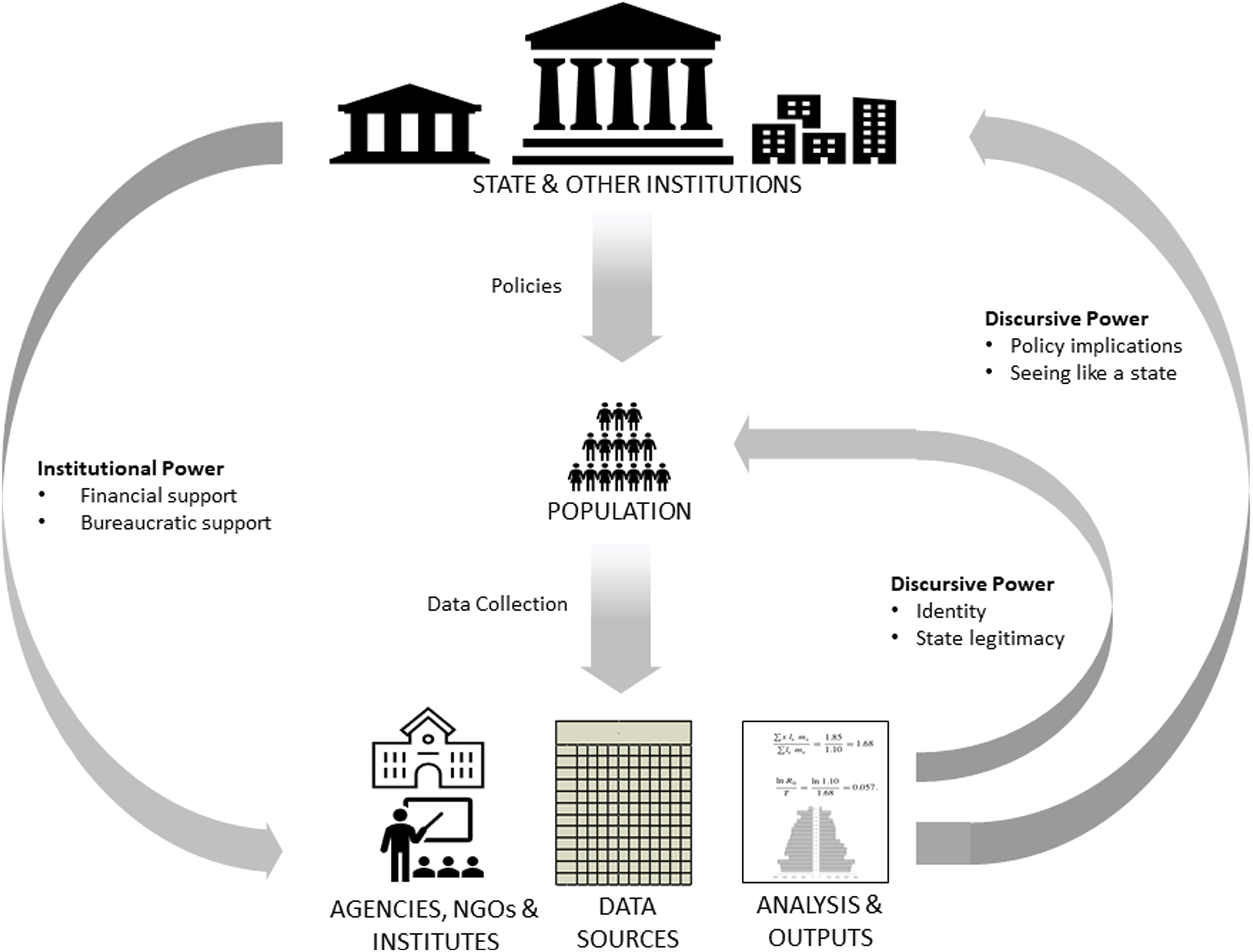
Power and demographic knowledge production.
Aside from censuses, states and other institutions fund, support, or even commission studies and research in which demographers and other academic actors are involved in the collection and analysis of demographic data. These studies touch on various population themes, from reproductive health to migration, and receive research funding from a variety of institutions, from government agencies to international organizations. What emerges is a power-laden network of organizations and institutions serving as patrons to research projects, which are executed by academic institutions. For example, the University of the Philippines Population Institute (UPPI), the Philippines’ leading demographic institution, has been conducting the Young Adult Fertility Survey (YAFS) for several decades. The YAFS is a national survey that gathers data on sexual and non-sexual risk behavior of young Filipino youth (UPPI, 2023). The survey has become a major source of information on various demographic, health, and social indicators about the Filipino youth. Given its importance, the study has been funded by various state and international institutions, such as the United Nations Population Fund (UNFPA), the Australian Government, the Philippine Department of Health (DOH) (see UPPI, 2023). Over the years, a number of reports, press releases, journal articles, presentations, and student theses have used YAFS data in calculating various demographic measures specific to young adults (e.g., age-specific fertility rates) and in identifying significant factors explaining sexual and non-sexual risk behavior.
Given these institutional relationships, it is no wonder that many demographic and population-related research centers are intimately linked with both state and non-governmental organizations. Underlying these entanglements are enduring paradigms, ideologies, and frameworks that are championed in research projects. Many of the most influential population organizations and institutions have been funded and supported by a host of interest groups and enterprises. In the United States, for example, population-focused professional organizations and research councils are supported by or linked with a whole host of actors and interest groups, including the Eugenics movement, the Rockefeller family, the Milbank Fund, and the United Nations (e.g. PAA, 2023). Across the globe, various demographic research institutions have been set-up with the essential support of international organizations (see Bogue, 1969 for a listing of institutions and allied organizations).
Second, demographic knowledge is embedded in societal power relations by means of its discursive power. By this, I mean the set of rules and systems from which demographic knowledge is organized, produced, and analyzed. As such, the methods and materials of demography serve as arbiters of power in how they reinforce particular ways of viewing the world, typically “seeing like the state” (Scott, 1998). State narratives are discursively inscribed into various modes of demographic data collection, from the categories and classifications that organize populations into groups to the territories and scales from which populations are located. This organization of the population and its reconfiguration into data sets is in accordance with the realities promulgated by the state. This is the case for the national census. As a state project, the census is essential in the construction and serial reproduction of the nation-state (see Anderson, 1991). It serves as a reflection of the changing priorities and values of a nation as demonstrated by the varying questions included on census forms and the consequent variables for analysis. Census categories, from racial and ethnic definitions to shifts in administrative units, all constitute the ways in which the census serves as a means for the state to “know” its population (Anderson, 1991). As such, narratives that contest the nation-state are often absent from the census. For example, in the case of Myanmar, despite the government and the UNFPA's contention that the 2014 census was “purely statistical,” various ethnic communities and people's organizations contest the use of ethnic categories in the census (see Ferguson, 2015). Among the ethnic groups who were excluded were the Rohingya Muslims, who were listed as Bengalis and consequently categorized as foreigners.
The quantitative rendering of the population and the statistical calculations employed in its analyses have important political ramifications for constituent individuals and families and the nation-state. Using state-defined social markers and territorialities, individuals are classified, quantitatively aggregated, and located. Within these groups and territories, counts are conducted and various demographic measures expressed in the form of averages and calculated rates. The outcome is what Foucault would refer to as “aggregate effects” (1991), whereby aggregated data are not irreducible to individuals and families. Against measures of central tendency and calculated vital statistics, the complexities of individual identities and their material realities are quantitatively reduced and effectively blurred. In calculating measures of central tendency, extreme values are folded into the calculation, in favor of generating the “central” value. Calculated values and counts, consequently, become the basis of policies, surveillance, and regulations, which will impact individuals and families, despite their distinct characteristics being reduced in calculations. These critical examinations of the social and political underpinnings of official statistics can be traced to a broader intellectual tradition that analyzes the interlinkages between statecraft, statistics, and knowledge production (see Cullen, 1975; Hindess, 1973; Radical Statistics Group, n.d.).
The framework detailing demography as power-knowledge complements Horton's (1999) initial definition of critical demography as one that focuses on the power structures of society. Even prior to Horton's pronouncement, several demographers had already identified demography's epistemological inadequacies in explaining demographic outcomes and their associated social phenomena amid a restlessly turbulent and interconnected world (see Keyfitz, 1993; McNicoll, 1993; Preston, 1993). Critical demography offered an opportunity to address the lacuna in the field. The initial buzz regarding critical demography coalesced around Hayward Horton's efforts—the Critical Demography Conference at SUNY Albany, critical demography session at the PAA, and an NSF Grant that aimed to support critical demography as a paradigm. A special issue on critical demography was published in Sociological Forum journal, featuring Horton's lead article defining critical demography, as well as several other papers that touched on key issues associated with population processes, such as feminism, racism, African marital fertility, and homicide. Interestingly enough, the special issue was not published in a demography or population studies journal. Plans were under way to establish a Critical Demography Association, a special section for critical demography at the PAA, a regular conference, and a regular scholarly series (see Global Center for Critical Demography and Public Sociology, 2007). I attended the 1st Critical Demography Conference in Albany in 2009 where I presented a paper on the neo-Malthusian politics in making Philippine demography. Unfortunately, I have not received any updates about succeeding editions of the Critical Demography Conference nor has there been any progress in the establishment of a Critical Demography Association.
Over the years, the creative potentials offered by the critical demography paradigm had not been fully realized. The enduring epistemological and theoretical issues raised by demographers and other scholars remain, and typically relegated to the margins (see Sigle, 2021). Nevertheless, there have been significant inroads that have raised critical points that are at the core of critical demography. Arguably, the most influential publication was Nancy Riley and James McCarthy's book, Demography in the Age of Postmodern (2003), which re-assessed the discipline and argued for new ways of studying population. Their turn to postmodernism, I argue, is understandable given the disciplinary recalcitrance to critical perspectives. Riley and McCarthy (2003) draw from postmodernism in such a way that it “questions totalizing theories, the universal, and the possibility of a “God's eye” view of the world” (Riley and McCarthy, 2003: 15) and how it gives value to difference and local knowledge. As such, it enables scrutiny of demography's hard-lined allegiance to a positivist epistemology and consequently allows consideration of diverse ways of analyzing various issues concerning population. Through the years, a majority of research that speaks to critical demography have been mostly forged in allied fields, such as anthropology and sociology. I will discuss the role of geography in the latter section of this paper. For now, I will focus on three major research strands involving scholars directly connected to critical demography's initial emergence: (a) data; (b) race and ethnicity; and (c) gender. However, these discussions are far from exhaustive but they present some key touchstones that lay important threads that are relevant to the concerns of critical demography.
Data: Census, surveys, and other sources
One of the key aspects of critical demography is exposing power that undergirds the production of demographic data. There have been plenty of efforts to interrogate the politics of the census and surveys, casting these data collection procedures as modes of state power from which the population is organized, categorized, and tabulated in accordance with national discourses or ideological persuasions (see Coghe and Widmer, 2015; Kertzer and Hogan, 2002). The census, in particular, is a mechanism by which the state makes society “legible,” counting those that matter and classifying residents according to particular groupings (see Anderson, 1991). During colonialism, the census was an enterprise from which colonial governments made sense of the colony's complex social landscape, distinguishing “peoples, regions, religions, languages” (Anderson, 1991, 184). Through the census, the colonial gaze that racially classified residents was rendered scientific and technical, as distinctions based on skin color or religion or language become the basis of technical classifications among groups. After independence, many former colonies carried over census classifications, which have shaped the distribution of wealth and resources across populations, and in some cases facilitated violence and genocide (see the case of Rwanda in Uvin, 2002).
Aside from the census, demographers rely on surveys for analysis. Arguably, the most widely used survey by demographers is the Demographic Health Surveys (DHS), a series of surveys conducted in 90 countries, mostly in the Global South. Funded by the USAID along with several international organizations and local agencies, the DHS typically focuses on married women of reproductive age and covers various questions that touch on fertility, reproductive health, maternal health, and child health, among others (see DHS website, n.d.). For Chatterjee and Riley (2018), the DHS is a neo-colonial mechanism that promotes neoliberal ideology and developmentalism through control and management of women's fertility and health. In a sense, it carries over demography's enduring commitment to fertility reduction and control of women's bodies. Despite this, the DHS can still provide important information regarding women's lives in many parts of the world, from experiences with domestic violence in Egypt (Yount and Li, 2009) to maternal and newborn health in East Africa (Ruklanonchai et al., 2016).
Race and ethnicity
Engaging with issues of race and ethnicity is not uncommon in demographic analysis. There is plenty of demographic research analyzing various themes associated with race and ethnicity, such as racial and ethnic compositions of populations (e.g. Frey et al., 2001), and racial differentials of specific demographic outcomes, from fertility (e.g. Wildsmith and Raley, 2006) to mortality (e.g. Lariscy et al., 2015). There is also a long tradition of analyzing racial segregation in the United States, using varying measures (e.g. Grigoryeva and Ruef, 2015; Massey, 2012; Massey and Denton, 1988) and linking these patterns with various social and demographic outcomes, such as education and health (see Wang et al., 2022; Yang et al., 2017). Hayward Horton's initial work on critical demography stemmed from his disappointment with the discipline's lack of engagement with racism as an operative concept (see Horton, 1999, 2002). He argued that demographers have largely evaded the “R” word in their analyses. Given this lack of engagement with racism, Horton sees the potential for demographers to be at the forefront of measuring the multifaceted dimensions of racism (Horton, 2002). However, there have been a handful of attempts to bring up racism as an operative term, linking it with demographic outcomes. For example, Chiquita Collins and David Williams’ work (1999) examines racial segregation as manifestations of racism and links it with health. In particular, they found that black social isolation was a predictor higher rates of mortality among African Americans.
As social constructs, race and ethnicity are context-specific, dynamic, and relational. This presents methodological challenges for demographers who tend to use fixed racial and ethnic categories in their analysis, usually from the census. Amidst an increasingly diverse world, categories must be revised and resorted. From a critical demographic perspective, such re-categorization based on race and ethnicity is a political intervention (Waters, 2002). Various states across the globe employ different strategies in setting racial and ethnic categories, which has implications on who is acknowledged and othered, and who will receive land, services, and other resources (Kertzer and Hogan, 2002). In some cases, particular racial or ethnic identities are meant to be hidden, which is reflected in their discursive absence from the census and official documents. For example, as previously mentioned, Myanmar's 2014 Census was a juridical project that acknowledges and legitimizes ethnic groups as “national races” (taingyintha), and concomitantly denies other groups as members of the nation (see Cheesman, 2017; Ferguson, 2015). At its core, the assignment of racial and ethnic categories reflects power-laden encounters between individuals and the state. In Brazil, the imposition of the white and non-white binary category has led to inaccurate self-identification among respondents, particularly among those who exhibit both black and white features (Haris et al., 1993). In the United States, census respondents have the option of marking multiple racial categories in order to account for multiracial identities (see Strmic-Pawl et al., 2018). In contrast, the French census does not collect data related to race and ethnic categories, reflecting France's color-blind national discourse (Léonard, 2014).
Gender
Gender is a staple in demographic analysis. It is a key theme that underpins all the major demographic processes. Analysis of fertility, for example, needs to account for the different ways gender is constructed across societies and conversely, an understanding of gender and women's lives must consider fertility and reproduction. However, demography traditionally incorporates gender, specifically women, into its analysis by means of what Nancy Riley (1999) calls “feminist empiricism.” This traditional approach casts gender as a trait of an individual, often reduced to a variable to consider in demographic models. While such analysis has been useful to analyze the relationship of gender with various demographic outcomes, demography's penchant for such empiricism has narrowed the disciplinary analysis of gender. Nevertheless, gender as it relates to demographic processes of fertility, mortality, and migration has been extensively analyzed.
However, feminist demographers have been emphasizing how gender is a social construction that is enmeshed with social relations across varied contexts (Riley, 1999) Gendered societal pressures and power relations serve as major forces influencing decisions and practices that have impacts on demographic outcomes. Foregrounding women's lives and experiences has provided nuanced clarity on how demographic outcomes came to be. To illustrate this, I feature a few projects within and beyond demography. For example, qualitative studies on women and their decisions about children and marriage are very much shaped by their contexts. Edin and Kefalas’s (2007) work involving young women in Philadelphia demonstrates the role of context in configuring patterns of fertility and marriage. Living in poor neighborhoods that offer limited opportunities for upward social mobility, young women who give birth at a young age and practice motherhood without support from their male partners often consider their children to be a saving grace, relieving them from a life of loneliness and misery. Women's experiences of violence also have repercussions on demographic outcomes. Shireen Jejeebhoy's (1998) study on married women in rural India demonstrates the connection of wife beating with higher rates of infant and fetal mortality. Based on a survey and grounded accounts, Jejeebhoy (1998) explained how battered women tend to have less power to advance the welfare and wellness needs of themselves and their infants. In terms of the role of gender on migration, Rachel Parreñas's (2005) work on Filipina women shows how familial responsibilities, particularly motherhood, shape the transnational mobilities of mothers. Situated within a gendered international labor market, Filipina women migrate overseas to provide economic support to their children back in the Philippines. As such, migration for them is a necessity to be good mothers and provide a better life for their children.
Recalibrating toward critical demography 2.0
As a coherent paradigm, critical demography is in the margins of demography. While one can argue that numerous studies have critically engaged with various social issues that impact demographic outcomes, from domestic violence to racial segregation, both an explicit invocation of critical demography and an unequivocal engagement with power in demographic analysis remain relatively limited. The promise of epistemological creativity or sustained critique of structures of power that critical demography (see Global Center for Critical Demography and Public Sociology, 2007; Horton, 1999) initially offered needs to be revived, particularly in the contemporary moment as the world grapples with the ravages of COVID-19, fake news, and continued accumulation by dispossession. I push for Critical Demography 2.0 as a provisional call to reinvigorate critical demography as a paradigm, one that works with demographic concepts and methods in such a way that it scrutinizes structural forces, opens up to engaging with diverse audiences and actors, and be upfront about social justice. This entails a reflection on what constitutes as critical in critical demography.
In the following paragraphs, I will lay out some key points from which critical demography may move forward. Given the current scheme of things in demography (see Sigle, 2021), I envision critical demography to be an inclusive community of scholars, many of whom wear multiple disciplinary hats, from anthropology to humanities. My propositions come from my partial perspective as a critical geographer who is passionate about social justice and concerned with the plight of marginalized populations in the global south. I am motivated by questions that allude to how demography can be of service to social justice concerns.
“Critical” demography, emancipation, and praxis
In reflecting on what makes critical demography critical, I turn to critical theory, an approach to philosophy that critiques and challenges structures of power and is geared toward emancipation. Critical theory's interest in social and cultural analysis is anchored on “the emancipation of humanity from enslaving conditions” (Horkheimer, 1982, 244). Its radical roots resonate with Marx’ famous adage that the rationale of studying society is “to change it” (Marx, 1845). How can we practice critical demography for emancipatory purposes? I argue for the need to clearly espouse a social justice orientation, expand beyond the positivist orthodoxy, and consider engagement with marginalized communities.
The initial turn to postmodernism (Riley and McCarthy, 2003) in critical demography was an attempt to scrutinize demography's totalizing discourse and positivist epistemology with the hope of foregrounding local experiences and voices. It was a useful entry point from which to argue for demography opening up to multiple approaches. However, moving forward toward emancipatory politics requires it to promote social justice and engage in action. Within demography, the habitus is to suggest policy implications or recommendations stemming from research findings. Such knee-jerk reactions reflect the intimate role of demography in statecraft. Perhaps a key move for critical demography is toward working for and/or with marginalized populations and communities. Such community-engaged work can potentially mean working against state interests. If so, what would demography look like if its materials and methods do not jive with national conventions (classifications, territories)? What kinds of outputs might we expect from these community-engaged works? Several case studies allude to demographic possibilities in working with activist organizations and communities who are either seeking recognition or struggling against dispossession and violence. In the Philippines, several human rights organizations and communities have collaborated to record counts of deaths from the government's drug war campaigns, which as of date totaled around12,000 (Human Rights Watch, 2023). Several of these organizations worked closely with urban poor communities and provided support to families of those who were killed during drug raids. Meanwhile, in India, urban poor communities have taken on self-census and counter-counting practices in order to legitimize claims to their homes and lands (see (Appadurai, 2002; Johnston, 2012). In both contexts, demographers can provide expertise in research design or quantitative data analysis that might involve small area estimations, imputations, and other technical skills, more so in situations where measurements have to be made on characteristics and spaces not acknowledged by the state. From this vantage point, engagement with states and influential international organizations (e.g. United Nations) must be approached with caution, where demands for data accessibility and policies that attend to the needs of marginalized populations must be made.
Decolonization, epistemological diversity, and interdisciplinarity
With the recent emphasis on decolonization of knowledge, Critical Demography 2.0 should expose the enduring (neo)colonial legacies of demographic knowledge production. Doing so may build on previous critiques on the role of colonialism in shaping census projects (Anderson, 1991; Coghe and Widmer, 2015; Kertzer and Hogan, 2002; Uvin, 2002) and exposing the ideological underpinnings (neo-Malthusian, neoliberal, and neocolonial) of demographic data sources (see Chatterjee and Riley, 2018). Decolonization must also entail the provincialization of dominant demographic methodologies. This means openness to diverse methodologies. While powerful, quantitative analysis in demography can potentially overlook structural forces that influence demographic outcomes and silence experiences of minority populations. Perhaps an important question to ask is how to build demographic sources that can be built with local communities, attentive to indigenous knowledges. Also, similar to the examples in the previous section, in what ways can critical demography work with marginalized communities in confronting structures of oppression. In the spirit of methodological openness, it is instructive to reference qualitative work that explicates the contextual complexities that undergird calculated demographic outcomes. For example, Nancy Scheper-Hughes’ work among mothers in Brazil demonstrates her methodological intervention, “demography without or beyond numbers” (Scheper-Hughes, 1997, 201). Through her ethnography, she was able to reveal contextual particularities concerning infant mortality rates in Northeast Brazil, where mothers facilitate the deaths of their children who had been diagnosed with terminal illness (see Scheper-Hughes, 1993). Similarly, mixed methods approaches pair quantitative and qualitative methods that provide social, cultural, and political-economic dynamics that situate demographic processes. In Susan Greenhalgh and Jiali Li's (1995, 611) compelling article that pushes for a “feminist demography of reproduction,” they conducted a mixed-method “ethnographic-cum-demographic field research” where ethnography is carried out alongside a local survey of fertility, archival work, and interviews. One key finding in their project is the role of the state in encouraging male preference in reproduction.
It should be emphasized, however, that quantitative methods are still very much relevant and powerful in exposing structures of oppression and pushing for social justice concerns. It is worthwhile mentioning the Radical Statistics Group or Radstats, which was founded in 1975, to bring to light the political implications of statistics and advocate for the responsible use of statistics for social change (see Radical Statistics Group, n.d.). In the contemporary moment, amidst the spread of fake news and enduring disagreements about numbers, from electoral results to estimates of COVID-19 infections, accuracy regarding counting has become a major issue (e.g. Ioannidis, 2021; Kiang et al., 2020). Cognizant of the politics inherent in counting, projects that expose the hidden demographies of structural violence can be useful interventions to expose systemic issues confronting marginalized populations. For example, Fatal Encounters, a nonprofit project led by journalist Brian Bughart and supported by various sectors, gathers data on deaths due to police encounters in the United States since 2000 (Fatal Encounters (2023). The website of the project has a database of deaths that is available for use in analyzing the scale and patterns of death and criminalization of race and poverty. The availability of such data for demographic analysis demonstrates how the Internet and the growing popularity of Big Data are new digital platforms from which new sources for critical demographic analysis can be done. The task at hand is to develop new analytical techniques in using and analyzing these new data sources (see Bohon, 2018; Kashyap, 2021).
Critical themes, interdisciplinarity, and population geography
In moving forward, Critical Demography 2.0 must confront the multiple social and ecological challenges that grip various populations across the world. Doing so should seriously re-engage with demographic processes and the usual social markers (e.g. race, gender), building on previous critical demographic work that foreground the biopolitical underpinnings of demographic outcomes (see previous sections). For example, the Black Lives Matter and the LGBTQ movements have launched campaigns that could be supported by demographic analyses that are informed by interdisciplinary work on race, gender, and sexuality. Meanwhile, recent issues on border control and women's access to reproductive health services impel scrutiny of the socio-political dynamics behind the demographic processes of fertility and migration. Furthermore, the increasing political polarizations and governmental shifts across the globe can be analyzed by considering the role of demographic transitions (see Wilson and Dyson, 2017).
Engaging with these contemporary challenges entails continuing the interdisciplinary work of critical demography. The task at hand for Critical Demography 2.0 is to facilitate interdisciplinary conversation and collaborations among various scholars and practitioners. From this interdisciplinary constellation, geographers offer critical analyses in relation to the socio-spatiality of population issues.
For human geographers, a critical treatment of space and place is key, one that is socially produced and lived (see Lefebvre, 1991; Massey, 2005). With demographic tendencies to define space as bounded territories, typically defined by state delineations, critical geographers tend to expose the spatial discourse of an “overpopulated” or “empty” space to justify colonial pursuits or war (see Reinecke, 2015). Furthermore, a rich body of work in human geography has interrogated biopolitics and vital geographies in examining the intertwined relationships between the production of population, state power, territoriality, and capital (see Elden, 2013; Kearns, 2014; Kearns and Reid-Henry, 2009). This literature provides key insights in bringing to fore the entanglements of state power and demographic outcomes and markers.
Methodologically, while critical geographic research mostly relies on qualitative methods, efforts have been made to make space for critical quantitative analysis (Kwan and Schwanen, 2009) that can work on issues of gender (Mattingly and Falconer-Al-Hindi, 1995) and race (Carter, 2009). Furthermore, community-engaged counter-mapping efforts (e.g. Collective et al., 2012; Maharawal and McElroy, 2018) from which geographers organize and work with communities and marginalized populations provide an instructive template from which critical demographic praxis can be done.
Work on population issues is not foreign to geographers. In fact, just like demography, the sub-field of population geography, has been subjected to numerous calls for “(re)theorizations” and for serious engagement with social theory (Graham, 2000; White and Jackson, 1995;). This is not surprising given the critical turn in human geography, from which population geography is embedded in. As such, population geographers have been pushing for a variety of creative research agenda that attend to advances in demographic analyses and conceptual innovations in social theory (see Findlay and Mulder, 2015). From the use of lifecourse approach (Findlay et al., 2015) to a more Foucauldian analysis of population issues (Legg, 2005), geographers have advocated for the rethinking of key demographic processes (mortality, fertility, and migration). In mortality, for example, James Tyner (2015) suggests a bio-logics (biopolitical) reframing that interrogates how surplus populations are rendered disposable or precarious. Similarly, Kristian Sziarto (2017) uses a Foucauldian approach to discuss the racialized biopolitics of an infant mortality reduction campaign that lays blame on “failing” black parents. In fertility, conceptual innovations have been influenced by feminist theory. Case in point is Yvonne Underhill-Sem's (2001) attempt to rethink fertility by using embodiment theory to problematize the nature of motherhood and the ways in which fertility patterns is analyzed across space. In migration, population geographers have extensively proposed multiple approaches and conceptualizations, from considering the role of gender in configuring transnational networks and mobilities (see Walton-Roberts, 2004) to emphasis on context in analyzing migrant experiences and local places of social encounters (Phillips and Robinson, 2015). These efforts by population geographers to emphasize the spatial politics of population issues and processes provide important conceptual and methodological avenues from which Critical Demography 2.0 may undertake.
Conclusion
In this paper, I reviewed critical demography, revisiting its initial pronouncement as a paradigm that interrogates “the nature of power in society” (Horton, 1999, 364). I add into this initial proposition by framing demography as a power-knowledge, exposing the politics undergirding demographic knowledge production. In doing so, I build on critiques (e.g. Greenhalgh, 1996; Riley, 1999; Riley and McCarthy, 2003) scrutinizing the hegemony of positivist epistemology in an effort to open demography to multiple approaches that account for situated knowledges and structural forces. In short, invocations of “scientific” in demography do not equate to the discipline's neutrality. Its knowledge production is political, grounded upon assumptions connected with interests and agendas of structures of power (e.g. state).
While the initial excitement in building critical demography did not lead to a thriving community of scholars or a coherent body of knowledge, several of its themes have been carried forward by scholars in sociology and anthropology. In moving forward, especially in a world beset by ongoing struggles, accumulation by dispossession, violence, and fake news, I argue for a recalibration, a Critical Demography 2.0, which proposes an agenda that moves beyond critique and toward an emancipatory politics, particularly addressing issues of social justice and the plight of marginalized populations. Doing so, I argue for the need to consider working with and for marginalized communities and populations, and exploring possibilities of community-engaged work that deviates from state narratives. A re-launching of critical demography to address the multiple issues we grapple with today must continue advocating for diverse epistemologies while strengthening and producing democratic quantitative data and techniques in the service of the people. How can we envision a demography for the people and by the people? This also entails interdisciplinary work, given that much of the energy around critical demography has been fueled by scholarship in allied fields (e.g. sociology and anthropology). Critical geographers have a lot to offer in pushing for Critical Demography 2.0, particularly in the ways in which we have theorized space and place, argued for critical quantitative work, and advocated for spatial justice.
Footnotes
Declaration of conflicting interests
The author declared no potential conflicts of interest with respect to the research, authorship, and/or publication of this article.
Funding
The author received no financial support for the research, authorship, and/or publication of this article.