




Abstract
Research on hydrogen – embraced as a cornerstone of the so-called global ‘energy transition’ – has mushroomed in recent years and has expanded into new disciplinary, empirical and conceptual terrains. Geographers and geographical thought have been at the forefront of an incipient yet thriving body of social science scholarship on the topic, enriching understandings of spatial, societal, (geo)political and (geo)economic dimensions of hydrogen in decarbonized development and beyond. In this article, we systematically review this literature and pursue three aims. First, we situate the evolution of geographical research on hydrogen by reference to historical and contemporary trends in the hydrogen economy. Second, we dissect key empirical and conceptual approaches in the literature along five themes: (a) geopolitics and geoeconomics, (b) territoriality, spatiality and infrastructural politics, (c) socio-ecological risks and energy justice, (d) coloniality and extractivism in North–South relations and (e) fossil capitalism. Third, we identify lacunas in existing scholarship and suggest ways forward by advancing a call to critically rethink the notion of a ‘hydrogen transition’. In outlining the current state of geographical debates on hydrogen, this article further highlights the potential of geographical perspectives to foster critical thinking and reflexivity on a rapidly evolving yet still uncertain industry with multi-faceted implications across spatial scales.
Introduction
Touted as a key pillar of industrial decarbonization, hydrogen has driven a rise in research that continues to expand in new directions. The peer-reviewed Anglophone literature offers a useful snapshot of hydrogen's growing popularity as a field of academic inquiry. References to ‘green hydrogen’, ‘clean hydrogen’, ‘renewable hydrogen’ or ‘low-carbon hydrogen’ across disciplines have increased sharply, with a notable surge in publications since the 2020s (Figure 1). This mirrors the boom in hydrogen strategies, policies and project announcements, buoyed by net-zero pledges, corporate lobbying, government subsidies and geopolitical disruptions to fossil energy flows (Griffiths et al., 2021; IEA, 2025). By and large, this research has been dominated by the energy, engineering and chemistry sciences, primarily focused on the technical and economic feasibility of hydrogen pathways (Figure 2).

The rise of hydrogen in ‘energy transition’ research across disciplines. Number of publications in Scopus mentioning the terms ‘green hydrogen’, ‘clean hydrogen’, ‘renewable hydrogen’, or ‘low-carbon hydrogen’ in their title, abstract, and/or keywords (2000–2025). Source: Scopus ‘Keyword Search’, prompted by authors.
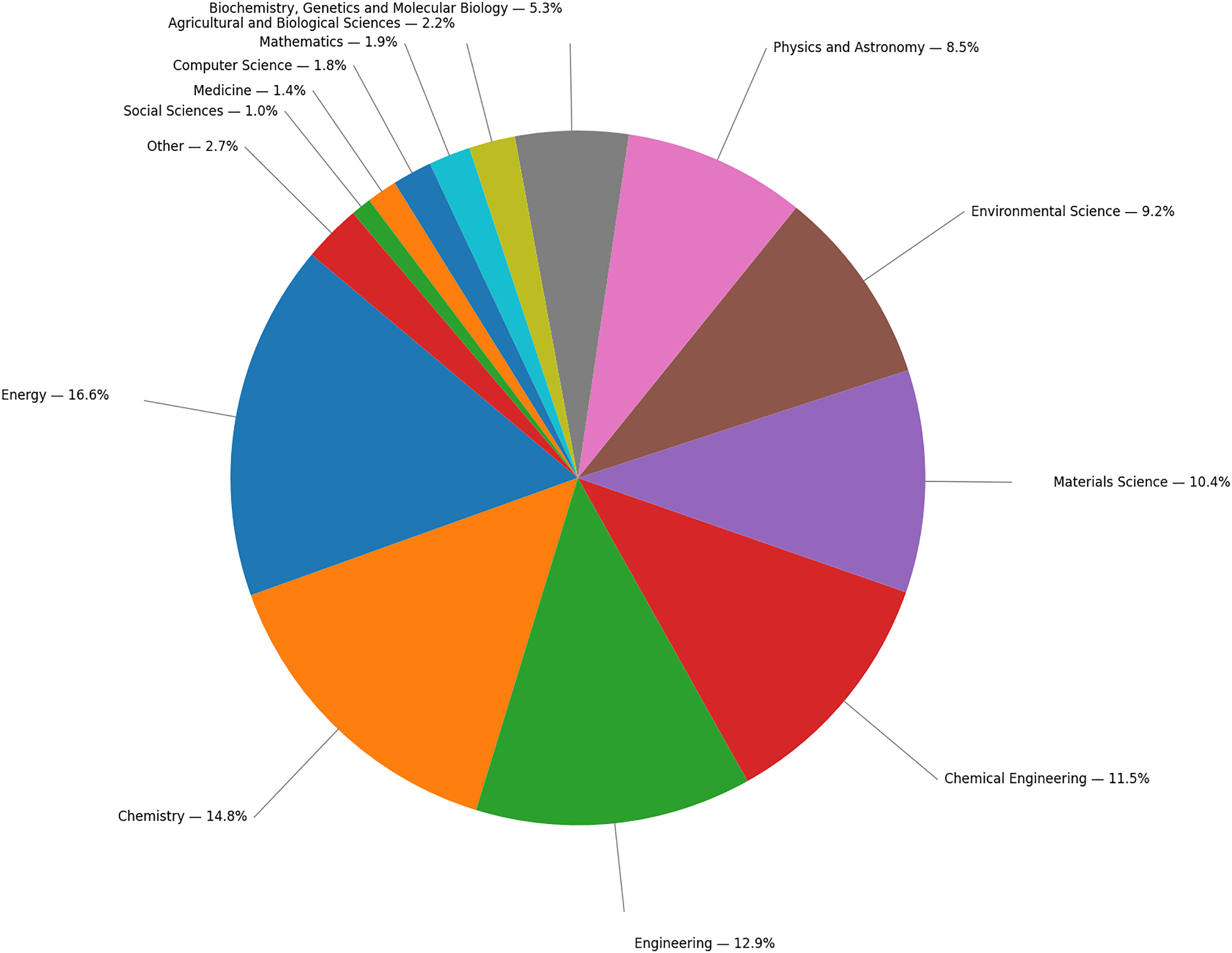
Breakdown of hydrogen research by disciplinary fields. Based on publications in Scopus mentioning the terms ‘green hydrogen’, ‘clean hydrogen’, ‘renewable hydrogen’, or ‘low-carbon hydrogen’ in their title, abstract, and/or keywords (2000–2025). Source: Authors’ own elaboration based on data in Scopus ‘Keyword Search’.
In countering prevalent ‘technocratic’ approaches (Hanusch and Schad, 2021; Kalt and Tunn, 2022), geographers and geographical thought have been at the forefront of an incipient but thriving body of social science research on hydrogen. Relative to hydrogen's growing momentum, this literature remains on the fringes of mainstream academic engagement with only 1% of hydrogen research coming from the social sciences (see Figure 2). Yet, by examining power relations, territorial entanglements and socio-economic interactions shaping hydrogen systems across spaces, geographical scholarship has crucially explored previously neglected dimensions in hydrogen research. This has enriched the field with critical reflexivity, bottom-up assessments and epistemological pluralism, equipping scholars to address the distinct, uneven and messy (geo)political, (geo)economic and socio-environmental dynamics of hydrogen developments.
This review extends Gibson and Kay's (2025) recent review on critical geographies of green hydrogen and Vallejos-Romero et al.'s (2022) early review of emerging social science literature by providing a broader review of the geographical literature on hydrogen. We examine works that explore the (emergent) geographies of hydrogen as ‘energy geographies’ (Calvert, 2016; see also Bridge et al., 2013; Bridge and Gailing, 2020) assembled through the co-constitution of hydrogen production, distribution and consumption with place-making activities, geographical imaginaries, spatial identities and spatial representations. Despite varied approaches and accentuations, this literature generally recognizes the uneven, power-laden geographies of hydrogen within a ‘green’ economy that reproduces prevailing practices and inequalities of global capitalism (see McEwan, 2017; Dunlap, 2020; Tornel, 2023). In line with Bridge (2025), we adopt a ‘horizontal’ understanding of energy geographies by including hydrogen-related works from other social science disciplines, rather than staying strictly within the ‘vertical’ disciplinary boundaries of human geography. This enables our review to trace wider political, economic and socio-cultural factors shaping the relationships between energy and space in the context of hydrogen.
This literature reveals how hydrogen developments are never neutral or purely technical but complex and messy geo-economic and socio-material arrangements that connect people, things, and ideas across space and scales. We complement Gibson and Kay's (2025) recent review by situating the evolution of geographical research on hydrogen within historical context, by covering a wider range of available geographical works on the topic, including Global South and grassroots literatures, and by highlighting additional empirical, conceptual and interpretative angles. We move beyond an exclusive focus on ‘green’ hydrogen to consider more broadly the geographies of ‘multi-color’ (Dorn, 2024) hydrogen pathways and the blurred boundaries between types of hydrogen energy. Ultimately, our review leads us to argue that critical geographical scholarship contributes to scrutinize the narrative of a ‘hydrogen transition’ by showing how the notion of ‘transition’ obscures the complex material reality of processes that straddle both conventional and ‘green’ supply-chains and are far more intertwined than commonly thought.
In this endeavor, our review covers a range of hydrogen-focused geographical works, from leading disciplinary journals (e.g., Geoforum; Journal of Economic Geography; Political Geography; Environment and Planning journals) to interdisciplinary outlets at the intersection of energy and societal questions (e.g., Energy Research & Social Sciences), to less visible, smaller Global South-based platforms (e.g., Namibian Journal of Social Justice; South African Journal of Social and Economic Policy). It also extends to publications in related fields like history, political ecology, political economy, international relations, development studies, anthropology, cultural studies and science and technology studies, alongside scholar-activist and grassroots contributions. We draw primarily on Anglophone sources, since most academic and policy discussions on hydrogen take place in English, while recognizing that this focus reflects issues of privilege and unequal access, which exacerbate power-knowledge asymmetries and lead to crucial gaps in hydrogen scholarship – a point that we come back to in our concluding remarks.
This review has three aims and proceeds as follows. After revisiting definitions, uses and roles of hydrogen in the so-called ‘energy transition’, we (1) situate the evolution of geographical research on hydrogen within a historical frame, linking earlier trends and waves of enthusiasm about hydrogen to the industry's unprecedented momentum today. Subsequently, we (2) provide an overview of empirical and conceptual contributions in existing geographical literature, including key themes, arguments, and debates. In conclusion, we suggest (3) under-explored avenues for further research, underscoring how critical research on hydrogen can help us to fundamentally rethink the concept and practice of ‘energy transition’. In doing so, we highlight and advance the potential of this scholarship to bring critical, multi-layered perspectives to relationships between energy and space.
Hydrogen: Definitions, uses and roles in the transformation of energy systems
Hydrogen is one of the lightest and most abundant elements on Earth and carries high amounts of energy on a mass basis (US Department of Energy, n.d.). Although invisible, hydrogen is classified through color codes, e.g., ‘grey’, ‘green’ and ‘blue’ hydrogen. In academic literature, these color codes are analytically deployed to distinguish hydrogen according to production pathways and associated emissions profiles (Incer-Valverde et al., 2023). By contrast, industry and policy conceptualizations often use these terms more flexibly and strategically. For example, the European Union uses the category ‘low-carbon hydrogen’ to encompass multiple production pathways, including ‘green’, ‘blue’ and ‘pink’ (i.e., nuclear-based) hydrogen. Today, more than 99% of global hydrogen production relies on fossil fuels and its by-products – mainly fossil gas (‘grey’ hydrogen) and coal (‘black’ hydrogen) – processes that lead to large amounts of carbon emissions (IEA, 2025, p. 80). These fossil variants are deployed as fuel and industrial feedstock, with historical and current applications concentrated in petroleum refining, fertilizer production and steelmaking (IEA, 2025).
Hydrogen's appeal in decarbonization efforts stems from so-called ‘clean’ hydrogen solutions. ‘Green’ hydrogen, produced by splitting water with solar and wind energy, is promoted by industry and policymakers as the most sustainable pathway to net-zero (IEA, 2025). However, its full life cycle is far from emission-free once upstream and downstream operations are considered (Osman et al., 2024). In addition, drawing on critiques of ‘renewable energies’ as part of a system of ‘total extractivism’ (Verweijen and Dunlap, 2021), hydrogen production also entails socio-ecological harms, particularly from mining the materials needed for hydrogen technologies, such as platinum. ‘Blue’ hydrogen, made from fossil fuels with carbon capture, utilization and storage (CCUS), is backed as a cheaper interim option. Yet, blue hydrogen faces problems in terms of the lack of low-cost, market-ready large-scale CCUS technologies and is estimated to have a higher global warming potential than burning coal and gas directly (Howarth and Jacobson 2021). Key applications for so-called ‘clean’ hydrogen are in heat-intensive industries that are difficult to decarbonize through direct electrification (e.g., steelmaking), synthetic fuels in aviation and maritime sectors, and fertilizer production via hydrogen derivatives like ammonia, among others (Eicke and de Blasio, 2022). ‘Green’ hydrogen in particular is also touted as a means to ‘bottle renewables’ (Gomollón-Bel & García-Martínez, 2023) or ‘shipping the sunshine’ (Johnston et al., 2022), namely through the conversion of wind and solar power into hydrogen molecules that can be stored, transported by ship or pipeline and distributed globally.
Geographical hydrogen research: Historical context and evolution
While often regarded as a new field of research, hydrogen has a longue durée as both an energy carrier and industrial feedstock. This section provides a brief historical context, tracing past trends and waves of enthusiasm up to the industry's recent resurgence in order to better account for the evolution and significance of geographical research on hydrogen. We distinguish between two phases: an earlier period in which hydrogen remained largely a niche topic, approached as a technocratic ideal and challenge; and a recent phase characterized by hydrogen's growing momentum in decarbonization efforts and expanding scholarly interest across disciplines.
The hydrogen technocracy
Far from being a new phenomenon, hydrogen has long been the subject of scientific inquiry. The energetic properties and potentials of hydrogen have been known for centuries and a specialized scientific community formed in the 1960s and 1970s, following advancements in oil refining, ammonia production, fuel cell technologies, 1 and the space industry (Veziroǧlu, 2000; Züttel et al., 2008). The first moment of high expectations and increased scholarly interest, known as the ‘first hydrogen wave’ (Frowijn et al., 2025; Yap and McLellan, 2023), was driven by the oil crises of the 1970s. Hydrogen became regarded as a potential alternative to fossil fuels and, similarly to nuclear power, was connected to visions of clean and abundant energy (Bockris and Appleby, 1972). With the passing of the oil shocks and increasing safety concerns, interest in hydrogen declined in the 1980s (Scita et al., 2020). In the early 2000s, a ‘second wave’ emerged, spearheaded by automobile companies promoting hydrogen-powered fuel cell vehicles (Bakker, 2010; Hultman and Nordlund, 2013). Enthusiasts like Rifkin (2003) even heralded such developments as a step toward a ‘third industrial revolution’ centered on hydrogen. But high costs, technical hurdles, infrastructural challenges and reliance on fossil hydrogen production – coupled with the rise of hybrid-electric vehicles – stalled the momentum (Bakker, 2010; Bakker and Budde, 2012).
From the 1970s to the late 2010s, hydrogen research was largely confined to chemistry, physics, engineering, and specialized agencies, with most research and development (R&D) in the United States (US), Japan and Europe (Frowijn et al., 2025). Academic debates concentrated around technical issues, such as design, efficiency and safety, and were mostly limited to specialized niche outlets like the International Journal of Hydrogen Research. During the first wave, social and geographical perspectives were mostly absent and only indirectly appeared when, throughout the 1970s–1980s, anti-nuclear and counterculture movements in Western countries linked opposition to hydrogen with critiques of techno-utopian narratives and called attention to ethical, political, and environmental risks of the ‘Atomic Age’ (Hultman, 2009; Kaiser and McCray, 2016). In the 2000s, one of the few analyses that centered geographical questions of scale and place was conducted by Eames et al. (2006), who examined the case of London to explore divergent collective expectations surrounding plans for hydrogen fuel-cell buses and hydrogen refuelling infrastructures.
From climate silver bullet to disillusionment?
Amid global net-zero pledges, cost declines of solar and wind energy, and energy security concerns (especially in Europe after Russia's invasion of Ukraine), hydrogen gained renewed and unparalleled prominence in the early 2020s (Frowijn et al., 2025). This time, it was embraced as a cornerstone of the global ‘energy transition’, following growing recognition about the potential of ‘clean’ hydrogen variants for the decarbonization of hard-to-electrify industries and sectors (Kovač et al., 2021; IRENA, 2022; IEA, 2025). By most metrics (i.e., funding, project announcements, policy initiatives), hydrogen boomed, though mostly in ambition rather than implementation and uptake. By 2050, ‘clean’ hydrogen has been projected to account for 12% of global energy use and reach a market value of USD 700 billion, with over 2500 projects announced and hydrogen strategies launched in more than 60 countries, supported by policy initiatives like the REPowerEU Plan, European Hydrogen Bank, Germany's H2Global program and the US Inflation Reduction Act (IEA, 2025). Once an unfamiliar topic to many, hydrogen became integral to global and regional governance fora like the Conference of the Parties (COP) international climate conferences, the G20 and the European Union (EU). This surge was fueled by wide-ranging anticipatory enthusiasm – or hype – emanating from academic, media and policy communities, which promoted hydrogen as a key solution to climate, energy and geopolitical crises (Romm, 2025).
This hype has generated a research boom in academia, businesses, and industries to advance technological developments, resolve scale-up issues, design cost-effective deployment models, stimulate market adoption and tap into generous public subsidies for hydrogen R&D (Griffiths et al., 2021). Social scientists began to enter the debate and critiqued research tendencies of putting ‘technology first, society second’ (Hanusch and Schad, 2021). Early work by Scott and Powells (2020) called for a social science research agenda for hydrogen attentive to public perceptions and everyday practices, with a geographical focus on social practice, energy justice and place attachment. Van de Graaf et al. (2020), Pflugmann and De Blasio (2020) and Noussan et al. (2020) were among the first to explore how hydrogen value chains may re-shape the geopolitics of energy, while Scita et al. (2020) were the first to caution about ‘green colonialism’.
Building on insights from the wider geographical scholarship on the socio-spatialities of solar and wind energy systems and landscapes (see, e.g., Bridge et al., 2013; Jenkins et al., 2016; Dunlap, 2018; Sovacool et al., 2021), subsequent work outlined the contours of a critical social science research agenda on hydrogen that highlights distributional injustices, power relations, coloniality, socio-ecological costs, land conflicts and infrastructural harms. Kalt and Tunn (2022) and Brannstrom and Gorayeb (2022) evoked geographical notions of ‘frontier’, ‘green extractivism’, ‘territoriality’ and ‘relational space’, while Müller et al. (2022) and Dillman and Heinonen (2022) drew on energy justice frameworks to offer conceptual starting points for critical inquiry into the uneven spatial dynamics of hydrogen developments, particularly in the Global South. With ‘clean’ hydrogen projects still in early stages, these initial critical works remained limited in empirical scope, relying mainly on literature reviews and content analysis of few, often vague policy or project documents. Importantly, however, they opened the technical field of hydrogen studies to social sciences and introduced analytical tools to interpret what the advent of hydrogen might mean for socio-ecological relations across spaces and societies.
More recently, the rollout of funding schemes (e.g., European Hydrogen Bank pilot auctions), new policy and regulatory schemes (e.g., the EU's Clean Industrial Deal), the intensification of (pre-)feasibility studies and the launch of initial pilot projects in the Global North and South have incrementally provided researchers with a larger and more diverse pool of empirical material and cases. Meanwhile, activists, grassroots groups and affected communities began to expose and oppose risks and injustices emanating from initial hydrogen projects (Corporate Europe Observatory, 2023, 2024; Re:Common, 2022; Ecologistas en acción and Observatori del Deute en la Globalització, 2021), including through the establishment of regular ‘watchdog’ and reporting initiatives (e.g., the Namibian Institute for Public Policy Research's (2025) Green Hydrogen Monitor series), hydrogen-focused activist networks (e.g., H2Watch in South Africa), transnational dialogues ‘from below’ (Tjipura and Shingnege, 2024) and field-based accounts of environmental threats and landscape changes (Cabaña and Balcázar, 2025). All of this has allowed for more comprehensive investigations into the (uneven and contested) institutional, economic-financial and socio-material arrangements characterizing the (envisioned) deployment of hydrogen across places, territories and scales, inspiring an uptick of hydrogen-focused publications in geography and related disciplines, particularly over the last two years. This research has been central to the advancement and consolidation of the field of critical hydrogen studies, bringing in ground-level perspectives, conceptual and methodological diversity, and comparative approaches, as we discuss in the next chapter.
At the same time, the hydrogen hype is giving way to gradual disillusionment, characterized by unmet expectations, suspended and delayed projects and waning public, political and investor interest. Despite ambitious targets, in 2025 ‘clean’ hydrogen still accounted for only 1% of total global hydrogen production, technologies were still relatively immature, and most projects were still pilots or demonstrations (IEA, 2025, p. 80). Analysts highlight gaps between ambition and implementation (Odenweller and Ueckerdt, 2025), problematize the consequences of technological hype (De Leeuw and Vogl, 2024) and increasingly question the viability of ‘clean’ hydrogen as a key pillar of the ‘energy transition’ (Johnson et al., 2025). This places hydrogen at a critical juncture, as scholars revisit the reality that the ‘hydrogen transition’ – mirroring the ebb and flow of past hydrogen waves and familiar cycles of ‘boom and bust’ for energy commodities – is neither a given nor a linear progression.
Researching the (uneven) geographies of hydrogen: Key themes, findings and concepts
This section outlines empirical and conceptual contributions across five key themes that have offered analysts primary entry points and distinct scales for researching the geographies of hydrogen: (1) geopolitics and geoeconomics, (2) territoriality, spatiality, and infrastructural politics, (3) socio-ecological risks and energy justice, (4) coloniality and extractivism in North–South relations and (5) fossil capitalism. While, for structural purposes, such themes are presented separately here, many works reflect varied juxtapositions between them.
(1) Geopolitics and geoeconomics
Economic and political geographers, political economists and international relations scholars have observed how hydrogen as a ‘clean’ energy solution might (re-)shape geopolitical and geoeconomic relations and global geographies of energy production, distribution and consumption (Van de Graaf et al., 2020; Boretti, 2025c; Eicke and De Blasio, 2022; Dejonghe et al., 2023; Goldthau et al. 2025; Pflugmann and De Blasio, 2020; Noussan et al., 2020; Pepe et al., 2023; Quitzow and Zabanova, 2024, 2025; Lentschig et al., 2025; Scita et al., 2020; Weko et al., 2023; Weko and Quitzow, 2025). Debates focus on which economic pathways to pursue, implications for geoeconomic rivalry, new dependencies and unequal exchange between regions and countries, whether hydrogen perpetuates or displaces incumbent energy systems, and the (global) governance arrangements underpinning these processes.
Though still in its early stages and marked by uncertainties, it is posited that the geopolitics of hydrogen already shows signs of a reorganization of the global energy trade away from traditional oil and gas trade networks, with new energy exporters and trade corridors, new alliances and conflicts, and new competitive dynamics and interdependencies (Dejonghe et al., 2023; Pflugmann and De Blasio, 2020; Scita et al., 2020; Van de Graaf et al., 2020; Weko et al., 2023). Key concerns include increasing geopolitical tensions linked to the Russian invasion of Ukraine, intensifying US-China rivalry, and pressures on the increasingly fragile US-Europe transatlantic alliance which, according to Herranz-Surralles (2024), are driving the ‘geopoliticization’ and ‘securitization’ of hydrogen trade and investment (see also Boretti 2025c).
Some scholars argue that the emerging hydrogen trade will resemble the fossil gas trade, since hydrogen can be transported over short and medium distances via retrofitted gas pipelines or new hydrogen pipelines, and over long distances by ship, similarly to liquid natural gas (LNG) (Dejonghe et al., 2023). Yet, hydrogen trade might develop in a different manner because, unlike the concentrated and uneven geographical distribution of fossil resources, ‘green’ hydrogen can be produced in a broader range of localities with high solar and wind endowments, enabling the emergence of a new class of energy producers and exporters. Van de Graaf et al. (2020) and Dejonghe et al. (2023) suggest this could make the global hydrogen market less asymmetric, less concentrated and less centralized than oil and gas markets.
To examine the actors and networks that shape the emerging hydrogen economy, economic geographers in particular apply the lens of ‘global production networks’ (GPN) to analyze the institutional frameworks, industrial relations and economic trends configuring global hydrogen value chains (Dorn, 2024; Kalvelage and Tups, 2024; Kalvelage and Walker, 2024; Vezzoni, 2024a, 2024b). A key focus is the role of the state in the hydrogen GPN. As ‘clean’ hydrogen is a new commodity without a viable business case in the absence of state support, public funding and incentives are crucial for hydrogen to scale up. Research highlights how states use industrial policy to foster the development of national and regional hydrogen clusters with financial subsidies, policy incentives, regulatory frameworks, enabling infrastructures and protectionist trade policies (Bacil et al., 2026; Ewers et al., 2025; Gong et al., 2024; Kraushaar-Friesen et al., 2025; Vezzoni, 2024a). It also shows how states relying on hydrogen imports shape hydrogen sectors in third countries through extra-territorial state agency (Kalvelage and Walker, 2024). To conceptualize state-business relations in ‘green’ hydrogen, Schorr et al. (2026) propose a fourfold typology: (a) a ‘cooperative’ relationship with high alignment between states and businesses; (b) a ‘contentious’ dynamic, where state ambitions meet resistance from business; (c) a ‘business-driven’ configuration with absent state leadership and the private sector in the lead and (d) ‘non-alignment’ and ‘non-development’, where neither state nor business support hydrogen development.
Intensified geoeconomic competition over technologies and industrial production is another key aspect of the global hydrogen economy. Core technologies for producing hydrogen (i.e., electrolyzers) and its derivatives (e.g., Haber-Bosch for ammonia), along with end-use technologies (e.g., fuel cells, direct reduction) are subject to intense geoeconomic competition over intellectual property, standards, manufacturing capabilities and critical minerals. By aspiring to the role of technology leaders, countries such as Germany aim to export hydrogen technologies to a growing global market and capture important segments of the ‘clean-tech’ value chain (Van de Graaf et al., 2020; Nuñez and Quitzow, 2024).
Geoeconomic competition extends beyond technologies to the restructuring of global industrial production (Eicke and De Blasio, 2022; Goldthau et al., 2025; Quitzow and Zabanova 2024, 2025). The ‘renewables pull’ hypothesis suggests that the availability of abundant and untapped solar and wind resources in the Global South enables the generation of cheap ‘green’ energy, which in turn allows for cost-effective hydrogen production. This would create a competitive advantage for attracting energy-intensive industries, such as steel or chemicals, effectively ‘pulling’ them away from the Global North (Samadi et al., 2023; Goldthau et al., 2025). However, critical voices point out the lack of empirical evidence for this hypothesis and the unevenly distributed potentials for hydrogen-based industries, with countries like the US and China emerging as frontrunners (Eicke and de Blasio, 2022). Research also shows how powerful governments in the Global North use industrial and trade policy to prevent industry relocation, a trend expected to intensify under US President Trump's second administration (Quitzow and Zabanova, 2025). While governments in the Global South likewise pursue industrial policies to take advantage of the ‘renewables pull’ effect, they do so from subordinate and dependent positions and with a severely restricted policy space (Mazzucato and Monaco, 2024; Scholvin, 2025; see the section on North–South relations below).
Territoriality, spatiality and infrastructural politics
Hydrogen projects involve large-scale industrial facilities that require a lot of land for solar and wind farms, water for electrolysis, desalination facilities for seawater processing and additional infrastructure such as processing facilities, deep seawater ports and pipelines. Consequently, the implications of hydrogen development extend to the territories where these investments and infrastructures are implemented, affecting existing ecosystems and livelihoods. A growing body of geographical works – drawing on political, economic, environmental and cultural geography and especially political ecology – seeks to ‘ground’ hydrogen value chains in socio-spatial contexts and analyze territorial transformations (Brannstrom and Gorayeb, 2022; Cezne and Otsuki, 2025; Chigbu and Nweke-Eze, 2023; DeBoom, 2025a; Ewers et al., 2025; Fladvad, 2023;Flores Fernández, 2026; Hine et al., 2024; Kraushaar-Friesen et al., 2025; Lehmann and Wiertz, 2025; Monteith and Bäumer Escobar, 2025; Tunn et al., 2024, 2025a). This literature broadly conceptualizes hydrogen as a ‘space-making process’ (Bridge and Gailing, 2020), addressing spatial development, socio-technical processes, territorially situated power relations and struggles, multi-scalar dynamics and cultural, social and ecological impacts.
In terms of conceptual developments, Cezne and Otsuki (2025) introduce the concept of the ‘H2-scape’, defined as energy landscapes shaped by the material expressions of hydrogen value chains and their various social, political, cultural and environmental regimes and practices. H2-scapes reflect forms of ‘territoriality’ (the use of political and economic power to partition or bound space for hydrogen expansion), ‘cross-spatiality’ and ‘multi-scalarity’ (how hydrogen systems traverse diverse spatial localities and geographical scales), and ‘articulation of old and new’ (how ‘new’ hydrogen sectors are layered onto ‘old’ energy systems, particularly fossil fuel infrastructures). In theorizing the uneven spatialities of hydrogen, DeBoom (2025a) deploys the framework of ‘climate necropolitics’ to highlight how the production of hydrogen-exporting territories in post-colonial settings like Namibia is premised on forms of climate change-related violence against particular people and embedded within situated histories of colonial oppression.
Empirical research on the spatialities of hydrogen faces the methodological challenge that most projects remain at the planning stage. What can be observed are preparatory activities, such as policy strategies, feasibility studies and memoranda of understanding, through which various space-making claims and hydrogen futures are established. To tackle this methodological challenge, researchers draw on concepts of ‘hype’ (De Leeuw and Vogl, 2024; Flores Fernández, 2026), ‘energy futures’ (Beasy, 2022; Virens, 2024; Zumbraegel, 2025), ‘future-making’ (Klagge et al., 2025), ‘path creation ex-ante’ (Scholvin and Kalvelage, 2025) and ‘performative techno-optimism’ (Janasik et al., 2025). Relatedly, the proliferation of textual sources on hydrogen like media stories, pre-feasibility reports, and national roadmaps has offered analysts crucial insights into the ‘discourse networks’ (Belova et al., 2023), ‘legitimation discourses’ (Brannstrom et al., 2026) and ‘narratives of imminence’ (Ariztía et al., 2026) shaping landscape, territory and development ideas connected to hydrogen futures. Others use event ethnography to examine the uneven geographies of hydrogen at major fairs like the World Hydrogen Summit, reflecting on how such spaces enact, stage and spectacularize hydrogen futures, and the power relations and exclusions behind them (Ariztía and Undurraga, 2026; Cezne, 2025).
A key concept for capturing these preparatory dynamics is ‘socio-technical imaginaries’, which refers to the ideational, discursive and anticipatory dimensions underpinning economic and political strategies to territorialize hydrogen systems, often by foreclosing alternative energy futures (Ariztía et al., 2026; Baasch et al., 2024; Dorn, 2024; Kraushaar-Friesen et al., 2025; Virens, 2024). Empirical studies examine how such imaginaries shape the making of ‘hydrogen valleys’ (Upham and Maristany, 2025), ‘hydrogen hubs’ (Brannstrom et al., 2026; Ewers et al., 2025; Flores Fernández, 2026; Zumbraegel and Kegel, 2025), ‘hydrogen clusters’ (Kraushaar-Friesen et al., 2025; Lai and Devine-Wright, 2024), ‘hydrogen regions’ (Hine et al., 2024; Ewers et al., 2025) and a ‘hydrogen society’ (Trencher and van der Heijden, 2019). Research shows that hydrogen imaginaries are commonly pervaded by ecomodern ideologies that link capitalist expansion to climate goals (e.g., Beasy, 2022, Fladvad, 2023; Virens, 2024). Studies also show how power relations and actor interests are inscribed into hydrogen imaginaries, with fossil fuel incumbents playing a key role (Dorn, 2024; Kraushaar-Friesen et al., 2025; Vezzoni, 2024b), and how the making of hydrogen landscapes is a contested process, with conflicts over competing imaginaries across governance scales (e.g., Dietz et al., 2025; Eadson and De Leeuw, 2025; Flores Fernández, 2026; Hine et al., 2024; Schorr et al., 2026).
Another strand of research examines the infrastructures that connect distant hydrogen production zones with consumption areas. Fladvad (2023) introduces the lens of ‘infrastructuring’ to grasp how infrastructure planning and designing link local territorial transformations with global imaginaries. In a similar vein, Upham and Maristany (2025) draw on the concept of ‘glocalization’ to examine how global transition agendas intersect with local transformation processes. Zumbraegel and Kegel (2025) analyze the role of the Suez Canal as a ‘green shipping corridor’ and as a contested energy space where different actors and networks intersect and geopolitical players compete over future shipping routes. Ports also emerge as crucial nodes in hydrogen landscapes, which are theorized through conceptualizations of ‘terraqueous territoriality’ (i.e., the production of space at the intersection of terrestrial and aquatic environments) (Monteith and Bäumer Escobar, 2025) and ‘power geometries’ (i.e., how and by whom power and authority are exercised at port-based hydrogen hubs) (Cezne and Otsuki, 2025). Research on port authorities highlights their overlooked role in discursively constructing ‘speculative connections’ that link places of hydrogen production and consumption through shipping corridors (Monteith and Bäumer Escobar, 2025).
Socio-ecological risks and energy justice
The high demand for land, water and energy for hydrogen production leads to local socio-ecological risks and impacts as well as multi-scalar distributional conflicts. By extending energy justice frameworks, Müller et al. (2022) developed the concept of ‘hydrogen justice’ to address questions of distributive justice (i.e., who gains and who loses access to land, who benefits and who pays the costs), procedural justice (i.e., who sits at the table, who sets the terms of the projects) and epistemic and recognitional justice (i.e., whose knowledge, identities and needs are recognized). Subsequent studies have examined the risks, injustices and potential trade-offs in the emerging hydrogen economy, and have shown how hydrogen projects, especially in the Global South and other resource peripheries, risk exacerbating existing inequalities and injustices (Baasch et al., 2024; Bindi et al., 2025; Borchardt, 2025; Caiafa et al., 2025; Cantoni, 2025; Dejonghe and Van de Graaf, 2025; Dillman and Heinonen, 2022; Fladvad, 2023; Hussein et al., 2024; Kalt et al., 2023; Kohrs, 2023 Lindner, 2023; Patonia, 2025; Rischer, 2025; Scott and Powells, 2020; Tunn et al., 2024; Virens, 2024).
Distributional justice aspects of uneven hydrogen geographies have been most explored. In a broad study, Tunn et al. (2024) analyze socio-ecological risks related to green hydrogen projects in 28 countries in the Global South and identify mechanisms of exclusion, enclosure and externalization. They map major risks related to energy (e.g., exacerbating energy poverty through the diversion of energy investments from social needs to hydrogen production, risks of delaying domestic energy transitions), water (e.g., worsening water scarcity in arid regions, environmental impacts from desalination activities on coastal ecosystems) and land (e.g., enclosure of land for hydrogen megaprojects which builds on colonial legacies of land dispossession and intensifies land use conflicts – see also Cantoni, 2025; Chigbu and Nweke-Eze, 2023, Melber et al., 2025). Research further indicates that economic benefits and financial risks are likely to be distributed very unevenly at the global scale due to neocolonial and extractivist North–South relations (e.g., Gabor and Sylla, 2023), a pattern that is compounded by evidence that hydrogen projects in the Global South often generate fewer and lower-quality jobs than expected (Irarrazaval et al., 2025).
Distributional justice concerns also appear in the Global North, though often marginalized or depoliticized under ecological modernization paradigms, as Virens (2024) illustrates for New Zealand. Still, even within such paradigms, justice claims surface around local job preservation in hydrogen end-use sectors, such as the steel industry, where hydrogen-based ‘green’ steel raises both hopes and fears about future employment (Baasch et al., 2024; Swennenhuis et al., 2022). Global justice concerns, in contrast, are largely absent, as Baasch et al. (2024) show for the steel industry in Northern Germany, and Sadat-Razavi et al. (2025) for German media discourses. Other research has examined the links between hydrogen and fuel poverty in the United Kingdom (UK), where low-income communities in northern England fear rising heating and cooking costs (Scott and Powells, 2020; Gordon et al. 2023).
Research has also explored issues of procedural justice. It shows how hydrogen planning and implementation is largely elite-driven, with negotiations taking place between international investors and governmental representatives behind closed doors (for a general overview, see Lindner, 2023). Scholars also show that social and environmental impact assessments are mostly consultative in nature and offer few possibilities for real participation (Mercer 2025). National energy and development imperatives in many cases override environmental regulations to fast-track hydrogen projects, curtailing democratic debate and public participation in project implementation (Wagner et al., 2025). This particularly affects marginalized social groups in liberal democracies such as indigenous populations, women, and racial minorities (Achugar et al., 2026; Fladvad, 2023, Gómez and Rehage, 2024; Tunn et al., 2024, 2025a), while under authoritarian regimes public participation is often entirely obstructed (Hussein et al. 2024; Zumbraegel, 2025).
Focusing on Tunisia, Djerbi (2025) dissects specific civil society strategies used to contest ‘green’ hydrogen, including the mobilization of historical memory, oppositional knowledge practices, and collective action. Wagner et al. (2025) show how civil society groups may not only engage in resistance but also in collaboration with state and business actors, thereby seeking to shape hydrogen projects but also legitimizing state and corporate agendas. For example, despite being the subject of contention (Dietz et al., 2025; Djerbi, 2025), the German development agency (GIZ) – a major player in hydrogen diplomacy – actively funds positions, consultancies and networks devised to foster civil society involvement in hydrogen developments and to address potential risks (see GIZ, 2025). While engendering modes of ‘soft contestation’, such dynamics also limit prospects for more radical change in hydrogen programs.
Research on recognition justice highlights the risk of hydrogen developments disregarding indigenous cultures and rights (Cantoni, 2025; Fladvad, 2023; Patonia, 2025). For example, Fladvad (2023) shows how hydrogen infrastructures can generate conflicts over environmental justice and indigenous sovereignty in Canada and Colombia, while also suggesting that there are opportunities for decolonizing hydrogen infrastructures by embedding indigenous worldviews and knowledges into the ecological modernization paradigm. In discussing the potential of hydrogen to support a just transition in industrial regions in Northern England, Cotton et al. (2025) stress the importance of recognizing ‘regional post-industrial and re-industrializing identities’. In the US, Ewers et al. (2025) examine the ambivalent effects of public hydrogen investments in disadvantaged communities. They show that, while 40% of total subcontracted finance goes to minority or disadvantaged business enterprises and developers must follow labor standards, communities are nonetheless exposed to the negative socio-ecological impacts of new energy-intensive industries. Almassry (2026) demonstrates how European hydrogen plans in Palestine reinforce Israeli occupation through a ‘recognition failure’ that bypasses Palestinian institutions.
Going beyond single country cases, Dillman and Heinonen (2022) provide a systematic overview of risks along the whole hydrogen value chain and show how injustices can emerge at multiple points in the value chain. Other researchers stress the need to integrate justice and equity considerations throughout the global value chain to ensure a fairer global distribution of benefits and costs (Bindi et al., 2025; Kennedy et al. 2024). Activist scholarship has likewise monitored hydrogen plans and investments, particularly in the Global South, and has drawn attention to expected risks and injustices, including those that arise long before projects materialize (Coalition for Human Rights in Development, 2025; Corporate Europe Observatory, 2024; H2Watch, 2024, 2025; Institute for Public Policy Research, 2025; Konzeptwerk Neue Ökonomie, 2022; Transnational Institute, 2022). For example, in a South–South transnational dialogue ‘from below’, Namibian and South African activists warn that hydrogen's speculative processes are already driving land enclosures and interfere with biodiversity hotspots, fishing and tourism (Tjipura and Shingnege, 2024).
Coloniality and extractivism in North–South relations
Energy injustices in the Global South stem from asymmetric North–South relations and uneven development in the global hydrogen economy. While many regions in the Global South possess abundant solar and wind resources, prospective demand for globally-traded hydrogen is concentrated in industrialized regions in the Global North, particularly Europe and Japan. Foreign investors and governments therefore seek to establish and legitimize hydrogen export zones in the Global South. In an already uneven global political economy, such dynamics threaten to perpetuate colonial patterns of dependency and resource extraction.
Research on North–South relations and coloniality in the global hydrogen economy has engaged with and expanded upon notions of ‘green colonialism’ (Hamouchene, 2023; Dejonghe and Van de Graaf, 2025), ‘energy colonialism’ (Müller, 2024), ‘eco-colonialism’ (Cantoni, 2025), ‘green extractivism’ (Kalt et al., 2023), ‘green imperialism’ (Boretti, 2025b), ‘climate necropolitics’ (DeBoom, 2025a) and ‘green division of labour’ (Behuria, 2025). Together, these concepts highlight how energy, land and water resources in the Global South are appropriated to sustain decarbonization and economic growth in the Global North. The making of ‘green hydrogen frontiers’ (Monteith and Bäumer Escobar, 2025) or ‘green tech frontiers’ (Lehmann and Wiertz, 2025) – through processes that render hydrogen technical and tangible, capture future value and construct ‘cheap’ export territories – perpetuates existing patterns of extractivism, neocolonialism, violence and unequal ecological exchange. The effects have been discussed in terms of an increasing ‘decarbonization divide’ (Caiafa et al., 2025), the externalization of risks to ‘green sacrifice zones’ (Cabaña and Balcázar 2025), ‘green grabs’ (Klingler et al., 2024), the establishment of ‘hydrogen enclaves’ (Cezne and Otsuki, 2025) and a ‘hydrogen-curse’ (Sadik-Zada et al., 2025). While most of the research on coloniality and extractivism focuses on North–South relations, the literature also documents cases of internal colonialism in settler-colonial contexts. Examples include the role of hydrogen development in Morocco's occupation of Western Sahara (Allan et al., 2023), in the Israeli occupation of Palestine (Almassry, 2026), in European overseas territories like French Guiana (Cantoni, 2025), and implications for struggles over self-determination and sovereignty among First Nations in Canada (Fladvad, 2023).
Related work examines the economic, technological and political dependencies that subordinate countries in the Global South in global markets and constrain access to finance, technology and infrastructure. These include dependencies on foreign capital and external markets, reliance on foreign technology and knowledge, exposure to standards set in the Global North, and constraints imposed by donor conditionalities and trade agreements (Almassry, 2026; Dagnachew et al., 2025; Eder and Rammer, 2025; Gabor and Sylla, 2023; Kalt et al., 2023; Scholvin et al., 2025). Together, these dependencies restrict policy space and fiscal autonomy. In response, some Global South governments adopt what Gabor and Sylla (2023) term ‘derisking developmentalism’: a strategy of attracting foreign direct investment by shifting investor risks onto the state. While framed as ‘green development’, this approach often reinforces dependencies on foreign capital and external control (on hydrogen and financialization, see also Smith, 2025). In addition, research shows how these dependencies are reproduced through the imperial and extra-territorial strategies of European states and corporations (Banet and Hoepfner, 2025; Boretti, 2025a; Kalt et al., 2023; Kalvelage and Walker, 2024; Lindner, 2023; Tunn et al., 2025a), as well as through the persistence of colonial discourses and imaginaries, such as ‘terra nullius’, technological salvation and paternalism, and epistemic violence (Allan et al., 2023; Müller, 2024; Tunn et al., 2025a).
A key focus of research on North–South relations is on the global governance of hydrogen. Governments in the Global North use hydrogen diplomacy as a foreign policy tool and establish bilateral partnerships and trade agreements with potential supplier countries that include technical, regulatory and financial cooperation to secure access to hydrogen (e.g., Dejonghe 2023). Governance of the global hydrogen economy thus relies less on multilateral agreements and a liberal global trade regime, and more on powerful states or supranational trading blocs like the EU (Weko and Quitzow, 2025) forging bilateral partnerships. This shift, amid intensifying geopolitical rivalry, signals a departure from global free trade and exemplifies what Franziska Müller has termed ‘expansive bilateralism’ (in Tunn et al. (2025a: 2).
Critical governance research also examines power asymmetries in hydrogen partnerships and highlights how technical and market-driven approaches sideline considerations of justice and sovereignty. For instance, Lindner (2023) and Galan and Lindner (2025) trace the significant increase in North–South hydrogen partnerships involving both governments and the private sector in the forms of pilot projects, feasibility studies and scientific collaboration. They argue that power asymmetries prioritize the economic priorities of donor countries over sustainable development and justice considerations in partner countries. Brauner et al. (2023) surveyed stakeholders in Southern and Western Africa and revealed conflicts between their preferences for energy access and domestic industrialization and the export orientation of hydrogen partnerships.
Other studies show how hydrogen diplomacy plays a role in stabilizing authoritarian regimes and colonial occupation. In this regard, Zumbraegel (2025) discusses how hydrogen partnerships function as instruments of ‘technopolitics’, where top-down governance approaches with a focus on technology and expertise strengthens authoritarian regimes in the Arab Gulf. Allan et al. (2023) demonstrate how Morocco, in complicity with Western partners, uses hydrogen diplomacy to secure international support for legitimizing its colonial occupation of the Western Sahara and obscuring settler-colonial violence.
Yet, research also shows that a neocolonial and extractivist hydrogen economy is not inevitable. Hydrogen pathways are contested and shaped by power struggles, for example between export-oriented and domestic industrialization models (Diaz, 2024; Dorn, 2024; Kalt et al., 2023). Mirroring trends in earlier hydrogen waves (Eames et al., 2006; see also above), these struggles occur across different scales, from transnational and national conflicts over policy formulation to local conflicts about project planning and implementation and socio-ecological impacts (Dietz et al., 2025; Djerbi, 2025; Eadson and De Leeuw, 2025; Schorr et al., 2026; Walker et al., 2025). Some researchers emphasize possible developmental benefits from hydrogen developments in the Global South. Rather than reinforcing (neo)colonial patterns, they highlight the developmental benefits of the ‘renewables pull’ effect (Walker and Kalvelage, 2025, Samadi et al., 2023). The hypothesis, though yet lacking empirical evidence, is that hydrogen offers unique opportunities for solar- and wind-rich nations in the Global South to produce cheap, ‘green’ energy that could attract energy-intensive industries, technology transfers, jobs and value creation.
Critical researchers remain skeptical of these developmental promises and stress power asymmetries and structural dependencies that constrain prospects for sovereign ‘green’ industrialization. Behuria (2025), for instance, points to the continued dominance of investor-driven approaches to hydrogen, exemplified by the Just Energy Transition Partnerships, and observes ‘few signs that African governments have leveraged that interest for industrial policy in green hydrogen’ (p. 5). Gabor and Sylla (2023) analyze the limits of ‘green’ developmentalism under a derisking paradigm, under which foreign investors and governments ‘write the new green rules’ (p. 1172) (see also Scholvin et al., 2025). Tunn et al. (2025b) argue that such dynamics illustrate how patterns of coloniality persist in countries of the Global South targeted by hydrogen investments.
Rather than outright rejecting hydrogen in the face of coloniality, other scholars call for systemic transformations through a ‘just hydrogen transition’, sovereign ‘green’ industrialization and decolonization (Allan et al., 2023; Dagnachew et al., 2025; Dejonghe and Van de Graaf, 2025; Diaz, 2024; Dietz et al., 2025; Dyantyi-Gwanya et al. 2025; Eicke and De Blasio, 2022; Hamouchene, 2023; Jolly et al., 2025; Kalt et al., 2023; Lema et al., 2020; Scholvin, 2025). These approaches envision countries in the Global South building industrial linkages with hydrogen to overcome the resource export trap, generate employment and revenue and gain geoeconomic power by moving up global value chains. For instance, Dagnachew et al. (2025) identify key requirements for sovereign ‘green’ industrialization, such as African governments demanding equitable partnerships and technology transfers, creating local demand for green hydrogen and building regional and South–South cooperation. Scholvin (2025) adds that opportunities for green industrialization via hydrogen in resource peripheries are highly context-dependent, involving specific investment project details, institutional capacities, technological characteristics and features of the host region and Bacil et al. (2026) emphasize the need for tailored and adaptive policy designs instead of universal prescriptions for ‘green’ industrialization.
By the same token, Dejonghe and Van de Graaf (2025) outline three strategies for Global South countries, which include ‘ensuring voice’ of local communities, ‘obtaining a stake’ through local content requirements and public ownership, and ‘fostering autonomy’ through technology transfers and building downstream industries. At the global level, Claar (2025) highlights initiatives for a renewed ‘New International Economic Order’ that aims at justice-centered global partnerships and systemic change. Radical proposals come from Allan et al. (2023), who put decolonization front and center in just transitions, and Hamouchene (2023) who calls for fundamentally restructuring the global economic architecture to end colonial relations, which includes the payment of ecological and climate debt by the Global North.
Fossil capitalism
A final theme that has attracted attention is the role of fossil fuel interests, materialities, and finances in the global hydrogen economy. Studies show that global oil and gas industries, facing the risk of stranded assets, are major proponents of hydrogen. This push seeks to preserve existing fossil fuel infrastructures and accumulation patterns while opening new markets (Llavero-Pasquina et al., 2025; Vezzoni, 2024b; Szabo, 2021). Activist and scholarly research both reveal the industry's lobbying influence and ‘greenwashing’ tactics, which have effectively shaped policy and regulatory frameworks. These efforts include securing favorable definitions, standards, and subsidies for hydrogen. For example, industry lobby groups like Hydrogen Europe and the Hydrogen Council have successfully positioned ‘blue’ hydrogen as a ‘bridge technology’ despite its high carbon emissions profile, diluted definitions of ‘green’ hydrogen and institutionalized inflated hydrogen demand targets that require rapid scale up of both ‘green’ and ‘blue’ hydrogen (Corporate Europe Obsevatory, 2020, 2023; Global Witness, 2021; Szabo, 2021; Ueckerdt et al., 2021; Vezzoni, 2024b).
‘Blue’ hydrogen, produced from fossil fuels with CCUS, is central to strategies of fossil capital to valorize assets and maintain accumulation patterns. Research traces a shift over time from ‘green’ to ‘blue’ hydrogen and shows how fossil capital has driven CCUS as a techno-fix (Brad et al., 2024; Cheng, 2023; Dorn, 2024; Haas, 2024; Weko et al., 2023). Yet, the role of fossil capital extends beyond ‘blue’ hydrogen to ‘green’ hydrogen and the wider hydrogen economy. Studies reveal the pivotal influence of fossil fuel incumbents in shaping hydrogen value chains in the US (Ewers et al., 2025), Argentina (Dorn, 2024), Namibia (DeBoom 2025b), the Netherlands and Spain (Upham and Maristany, 2025), the EU (Szabo, 2021), Germany (Corporate Europe Observatory, 2023), Peru (Schorr et al., 2026) and the UK (Kraushaar-Friesen et al., 2025). This research shows how the dominance of fossil capital creates fossil lock-ins and path dependencies that obstruct energy transitions. On this account, Vezzoni (2024b) argues that hydrogen and fossil fuels are inextricably linked, as the fossil fuel industry is nowadays the major producer of hydrogen – responsible for 99% of all hydrogen, mostly ‘grey’ hydrogen – and a major consumer, with 42% of hydrogen used in oil refining. Thus, this strand of research problematizes the notion of a ‘hydrogen transition’ and shows that hydrogen today serves less as a climate solution than as a key pillar for the prolongation of the fossil fuel economy.
Adding historical context, Hollenhorst (2023) shows how ‘hydrogen's carbon past’ matters, as fossil fuel knowledge and infrastructures constitutively shape hydrogen futures, while Gosselink (2002) note that fossil fuel majors like Shell have been doing research and development on ‘green’ hydrogen for decades. Cezne (2025) adds that Shell and other fossil fuel giants like Repsol and Total Energies are the main sponsors of the World Hydrogen Summit and exert important agenda-setting influences in hydrogen diplomacy and governance. With fossil fuel companies spearheading some of the world's largest and most visible hydrogen investments (e.g., Shell's electrolyzer at the Port of Rotterdam) and retrofitting fossil fuel infrastructures for the hydrogen economy (e.g., gas pipelines and LNG terminals), Cezne and Otsuki (2025) suggest that hydrogen landscapes often emerge on top of existing ‘carbonscapes’.
In addition, research highlights how governments and corporations often adopt ‘hedging strategies’ by simultaneously pursuing ‘green’ and ‘blue’ hydrogen pathways (Hunt and Tilsted, 2025). DeBoom (2025b) shows how the speculative nature of the hydrogen industry paradoxically drives lower-income governments to leverage fossil fuel extraction as a hedge against the multi-faceted risks of uncertain green futures. Studies on the fossil capitalism-hydrogen nexus thus reveal no clear-cut opposition between ‘green’ and ‘grey’ strategies (Szabo, 2021). Instead, what emerges is a hybridization or convergence of the two – what Haas (2019) calls, in Gramscian terms, a ‘passive revolution’ of fossil capitalism, what Llavero-Pasquina et al. (2025) characterize as the ‘prolongation of fossil fuel hegemony’ or, what Dunlap (2021) describes as ‘fossil fuel+’.
Conclusion and future research directions
This review has demonstrated that geographical research is essential for understanding hydrogen as a socio-spatial and political project rather than a purely technical solution. First, studies on geopolitics and geoeocnomics show that hydrogen is reconfiguring global energy trade, industrial competition and state-business relations and how this reproduces new dependencies, rivalries and uneven development across regions and scales. Second, research on territoriality, spatiality and infrastructural politics reveals how hydrogen materializes through contested processes of space-making which transforms local territories, infrastructures and energy landscapes. Third, studies on socio-ecological risks and energy justice highlight how hydrogen projects lead to unevenly distributed socio-ecological risks and benefits, which often exacerbate existing inequalities through land, water and energy conflicts. Fourth, research on coloniality and extractivism in North-South relations shows how hydrogen expansion risks reproducing neocolonial dependencies, green extractivism and ecologically unequal exchange between the Global North and South. Finally, research on fossil capitalism exposes the deep entanglements of hydrogen with fossil fuel interests, infrastructures and accumulation strategies, challenging narratives of hydrogen as a silver bullet for the climate crisis.
Still, many avenues remain open for research. In terms of regional focus, several geographies of concern such as China, India and the Asian continent more broadly as well as Pacific Islands have so far received little attention. In terms of thematic scope, most studies have concentrated on the production side or on specific nodes of the hydrogen economy (e.g., ports, industrial clusters), while wider global value chains and production networks remain underexplored. Future work could examine upstream linkages with mining and technology manufacturing, as well as downstream linkages to transport and key user industries such as oil refining, fertilizer, steel and chemicals.
Research on North–South relations is yet to critically and empirically assess the promises of a ‘renewables pull’ effect and industrial relocation to the Global South. Such work would bring attention to the structural barriers, power struggles and strategies for sovereign ‘green’ industrialization that could reconfigure global geographies of industrial production. At the same time, future research should move beyond a purely North–South framing and examine how extractivist dynamics also unfold within the Global North, particularly in marginalized rural and peripheral regions. Beyond North–South relations, more attention is needed on South–South relations and regional collaboration, both ‘from above’ between states and businesses and ‘from below’ among civil society, affected communities and indigenous populations. These transnational alliances have the potential to build collective power, challenge extractivist dynamics and push for alternative energy futures.
On the social dimension, much research has examined the socio-ecological risks of hydrogen projects and their impacts on local communities and ecosystems. This work could be extended through intersectional and feminist analysis of gendered effects on communities and labor markets, as well as studies of how gender, race, class and other hierarchies are reproduced in dominant hydrogen discourses. Labor geographers could also focus on the role of labor in hydrogen by exploring how hydrogen production networks influence labor regimes, the workplace, and worker identities (see Irarrazaval et al., 2025). They could further examine the role of workers and trade unions in shaping emergent hydrogen production networks.
As geopolitical disputes are intensifying and political support for ecological and climate policies is declining, hydrogen's momentum is weakening. Authoritarian-populist ideologies, protectionist and deglobalization policies, and climate denialism are shifting attention and resources away from decarbonization in general and hydrogen in particular. This may reinforce emergent patterns of ‘hydrogen as failure’ (Cezne & Otsuki, 2025; Gibson & Kay, 2025), which analysts could compare to the ebb and flow of past hydrogen waves. More broadly, such trends can also shed new light on processes of ‘green backlash’ (Bosetti et al., 2025), looking at how climate policies and commitments are weakened or reversed in the face of heightened nationalism and fascisation, concerns over rising living costs, and competing militarization priorities, e.g., in the EU, where the centrality of the REPowerEU plan is giving way to the ReArm Europe plan (Vezzoni, 2025). Yet, these dynamics may not be mutually exclusive, as there are also potentials for synergies – e.g., plans by European arms manufacturers to use ‘green’ hydrogen in military operations (Martin, 2025). Future research could explore how these shifting configurations influence post-hype hydrogen development pathways (see Flores Fernández, 2026) and their political, spatial and social consequences in specific countries and places.
From an epistemic standpoint, this review's focus on Anglophone sources, though practically and methodologically necessary, risks to sideline other valuable scholarly and grassroots works. This particularly entails perspectives from the Global South, where linguistic and structural barriers often prevent representation in ‘mainstream’ academic debates taking place in institutions and platforms in the Global North. We sought to partially mitigate these constraints by incorporating literatures from Global South-based outlets and grassroots groups (e.g., from Namibia and South Africa) and by drawing on works that translate and make accessible research and perspectives from outside of English-speaking contexts. Still, our efforts remain limited in depth, breadth and inclusivity, complicated by issues of (hegemonic) language brokering in academic discourse and the resulting exclusion of a wide array of other regional and grassroots perspectives. As such, future work could engage with hydrogen-related insights and conversations across diverse linguistic communities. This should be complemented by more inclusive and plural citation practices, attentive not only to different languages but also other forms of knowledge production, such as indigenous knowledges. It can also extend to transdisciplinary efforts of fostering direct (transnational) exchanges between hydrogen-affected communities, as evidenced through incipient efforts to establish South–South dialogues ‘from below’ on hydrogen (see ASCL, 2025; Tjipura and Shingnege, 2024). Such formats and practices would be an important step for advancing greater ‘epistemic justice’ in and on the geographies of hydrogen.
Beyond hydrogen, this review provides lessons for broader debates on the ‘energy transition’. It unsettles conventional beliefs and understandings about the ‘transition’ for three reasons. First, with the hydrogen hype fizzling out and large-scale production still largely speculative, we can hardly speak of a ‘transition’ in the sense of a sustained shift away from fossil fuel energy systems. Second, our review highlights how hydrogen geographies often reinforce extractivist logics that have long underpinned global capitalist development, thus hardly representing a transition away from socio-ecologically harmful forms of (green) growth. Third, the widespread use of the term ‘hydrogen transition’, often uncritically adopted (a narrative we have also reproduced in earlier works), obscures the deep historical and material continuities and entanglements that tie emerging energy technologies to fossil-based and ‘older’ energy systems (Fressoz, 2024). As demonstrated, far from replacing fossil energy systems, ‘clean’ hydrogen in many cases develops – not in spite of or in competition with – but usually thanks to fossil finances, materialities and production networks. In conclusion, we call for scholarship to rethink ‘transitionist’ narratives on hydrogen in favor of conceptual and analytical frameworks that are attuned to the close entanglements between hydrogen (and other ‘green’ energy) geographies and existing energy systems, materials and infrastructures, while also remaining sensitive to the novel configurations, practices and power relations that emerge with hydrogen development.
Footnotes
Acknowledgements
We are extremely grateful for the valuable insights and constructive feedback from three anonymous reviewers, which greatly improved the article. A special thanks goes to Human Geography's review editor Xander Dunlap for his generous guidance and support throughout the publication process and for prompting us to develop this piece.

Ethical approval and informed consent statements
Not applicable, as this is a review article premised on secondary research materials.
Funding
The authors acknowledge financial support from fellowships and/or research projects that facilitated their work on the geographies of hydrogen: postdoctoral fellowships with the ‘Inside Investment Frontiers of Sustainability Transitions (inFRONT)’ project at the Department of Human Geography and Spatial Planning, Utrecht University, and with the African Studies Centre, Leiden University (Eric Cezne).
Declaration of conflicting interests
The authors declared no potential conflicts of interest with respect to the research, authorship and/or publication of this article.