



Abstract
Preventable readmissions represent a significant opportunity to improve quality and reduce healthcare costs, with approximately 26% of Medicare medicine readmissions considered preventable. However, evidence on the effectiveness of post-discharge interventions at scale remains mixed, and implementing evidence-based practices consistently across large, diverse health systems is a challenge. To address these concerns, the Mass General Brigham Population Health Services Organization (MGB PHSO) developed and implemented a novel, multidisciplinary, system-wide post-discharge intervention aimed at reducing 30-day readmissions within its Medicare Shared Savings Program (MSSP) Accountable Care Organization (ACO). It was hypothesized that standardizing delivery through a high-fidelity workflow would reduce readmissions. A standardized, multidisciplinary program was created involving: (1) a coordinator conducting chart review and obtaining records; (2) a pharmacist performing medication reconciliation; and (3) a registered nurse completing a post-discharge assessment. A prospective cohort study was conducted comparing the outcomes of patients at pilot intervention sites with those of a propensity-matched control group. The intervention cohort showed a directional reduction in 30-day readmission rates compared to the matched controls (13.5% vs. 16.3%, P = 0.07) but no significant difference in 30-day emergency department presentations. The intervention group also had a significantly higher rate of 14-day follow-up appointments (70.0% vs. 65.3%, P = 0.025). These findings support the effectiveness of a centralized, standardized post-discharge strategy for reducing readmissions within an ACO setting. This study demonstrates that structured, system-level interventions can improve care transitions and outcomes in value-based care models.
Keywords
Reducing 30-day hospital readmissions is a key strategy for health systems and Accountable Care Organizations (ACOs) to improve the quality of care, patient experience, and financial performance. Hospitals and ACOs are incentivized in value-based arrangements by the Center for Medicare and Medicaid Services (CMS) to reduce readmissions through risk-sharing models such as the Medicare Shared Savings Program (MSSP), quality incentives such as Medicare Advantage STAR Ratings, and financial penalties in the Hospital Readmissions Reduction Program. 1 Successfully reducing readmissions requires coordinated improvement activities across the health care continuum.
The likelihood of readmission may be impacted by characteristics of the index admission, such as acuity, length of stay, and recent utilization patterns; the inpatient and ambulatory environment of the health system; and patient characteristics, such as chronic illness, social drivers of health, and neighborhood disadvantage.2–9 It is estimated that 26% of general medicine readmissions in the Medicare population are potentially preventable. Reasons for preventable hospital readmissions include inappropriate discharge location, inadequate disease monitoring, lack of social support, and inability to self-manage due to poor understanding of post-discharge plans.10,11
There are multiple evidence-based strategies to reduce readmissions that can be implemented by inpatient, ambulatory, and wrap-around teams.12,13 In the inpatient setting, evidence-based frameworks such as the Re-Engineered Discharge program and Project Better Outcomes for Older Adults through Safe Transitions focus on patient education, medication review, and transition communication by inpatient teams.14,15 In the ambulatory setting, a suite of readmission reduction activities, including care plans, standardized medication reconciliation, follow-up visits, and social needs screening, has been associated with decreased readmission rates in the Medicare population. 13 Transitions of care pharmacist interventions, including counseling, medication reconciliation, and arranging early follow-up in primary care, have shown promise in previous evaluations, with a broad range of impact observed (0.8–65.3% relative reductions in risk of 30-day readmissions).16–22 However, evaluations of efficacy for post-discharge programs at scale are mixed, and questions remain on how to implement evidence-based practices in a consistent and integrated manner across large, diverse health systems and ACOs.23,24
The Mass General Brigham Population Health Services Organization (MGB PHSO) developed a novel, multidisciplinary, system-wide post-discharge program to prevent 30-day readmissions for its MSSP ACO by ensuring high-quality, high-fidelity ambulatory follow-up after discharge (MGB PHSO post-discharge program). In this study, a retrospective observational analysis of the intervention was conducted at pilot sites compared to a propensity-matched control cohort in the same ACO population to understand (1) the effect on 30-day readmission rates as the primary outcome and, secondarily, (2) impact on 30-day Emergency Department (ED) presentation and (3) scheduled primary care office visits.
Methods
Setting
MGB is a large, academic health system in Massachusetts, comprised of 2 large quaternary academic hospitals, several community hospitals, a large network of academic and community primary care practices, and a large Medicare ACO comprised of over 145,000 members. MGB primary care practices participating in the Medicare ACO are both owned by and affiliated with the health system. In the year prior to the intervention, the ACO had a risk-adjusted median 30-day readmission rate of 12% and an unadjusted median 30-day readmission rate of 15.9% (MSSP calendar year 2023 data). MGB PHSO supports ACO strategic and operational efforts across the MGB health system to ensure optimal clinical and financial outcomes and is comprised of multidisciplinary team members leading programs across the network. 25
The PHSO team interviewed primary practice leaders across the ACO to understand the current state of readmission prevention activities, including ambulatory post-discharge assessments (PDAs) and follow-up visits. There was substantial variation in the quality and fidelity of workflows, including (1) standard PDA phone calls from a registered nurse (RN) using a call list, (2) standard PDA phone calls from a medical assistant (MA) using a call list, or (3) sporadic phone calls from either RNs or MAs at the practice. In addition, practices typically received lists of recently discharged patients from a limited number of inpatient facilities, either those within the health system’s electronic health record (EHR) or those with whom the practice had an established relationship to receive faxed census lists. Scheduling of post-discharge follow-up visits within 14 days of discharge varied based on the visit capacity of the practice. (Supplementary Table S1)
Risk stratification
To reduce 30-day readmissions in the ACO, the PHSO team hypothesized that readmissions could be prevented by standardizing the delivery of evidence-based interventions. To ensure that interventions were matched based on patient complexity and need, all inpatient hospital discharges were reviewed, and patients were stratified based on the risk of unplanned readmission. Patients were identified on a daily cadence through the Admission, Discharge, Transfer (ADT) vendor solution, Bamboo Health, which was integrated with EHR data to determine the risk of readmission. Patients discharged from an inpatient facility owned by the ACO health system (“in-network”) were risk stratified using the Epic Unplanned Risk of Readmission Score V2, which includes demographic, diagnosis, and utilization data.26,27 Patients discharged from an inpatient facility external to the health system (“out-of-network”) were risk stratified using a list of the top 30 admitting diagnoses associated with high rates of readmission for the ACO patient population over the previous calendar year. Patients were identified as “high-risk” (vs “low-risk”) if they had a higher than median risk of readmission score (≥13%) or a qualifying admitting diagnosis at an out-of-network facility.
Multidisciplinary program interventions
A multidisciplinary program (MGB PHSO post-discharge program) was implemented to support patients identified as high-risk or low-risk for 30-day readmission (Fig. 1). Patients at high-risk of 30-day readmission received a phone call within 2 business days of discharge, during MGB business hours (Monday-Friday 8a-5p, excluding holidays), from an RN, who conducted a structured PDA that included medication reconciliation, assistance in obtaining home services and durable medical equipment (DME), social service referral(s), and assistance in making a primary care follow-up visit within 14 days. Patients who had previously consented to text messages during an MGB registration update received a text message prior to the call alerting them that a member of the care team would be calling to review their hospital discharge. The content for the text message read as follows: “MGB: Hello, we are outreaching on behalf of [Practice name]. We were recently notified of a hospital stay. Within the next 2 business days you may be contacted by your care team for follow-up. We have some helpful info we want to share with you about your hospital stay (click on this link to a PDF).”

Mass General Brigham Population Health Services Organization Post-Discharge Program Outreach Process Workflow. 1Developed by Epic Systems Corporation (2021). 26 2Developed by T. Nyugen and T. Spracklin (2025). 28 Criteria noted in Supplementary Table S2. The “1” and “2” superscripts are referencing the “1” and “2” noted in Figure 1.
A pharmacy-specific risk score was used to identify patients discharged from an in-network facility to highlight specific intervention opportunities for the pharmacist to intervene; this Rx Discharge Acuity Score included 10 risk factors with a score of 0–50 (Personal communication: Nguyen T, Spracklin T, 2025) 28 (Supplementary Table S2). Patients with an Rx Discharge Acuity Score ≥25 received a call from a licensed pharmacist to review and reconcile their medication list. For patients discharged from an out-of-network facility, the Rx Discharge Acuity Score was applied manually to help the RN identify those who may benefit from pharmacist intervention.
A coordinator was available to obtain outside hospital discharge summaries and facilitate community-based resource referrals. If any needs were identified during the PDA call or if a patient asked for follow-up, then the RN (for clinical follow-up, e.g., new or worsening symptoms) or coordinator (for nonclinical follow-up, e.g., follow-up on DME) would make another phone call to the patient. The primary care follow-up visits were scheduled by either the RN (direct scheduling) or the coordinator (coordinating with front desk staff) based on practice workflows.
Patients at low risk of 30-day readmission received a text message within 24 hours of hospital discharge stating: “We were recently notified of a hospital stay and are following up to make sure you obtained the correct medications. Do you have all the medications your doctor prescribed for you at discharge? Please reply 1 for Yes or 2 for No. (1) Yes: Thank you for letting us know. Please ensure that you have an appointment scheduled 7–14 days after leaving the hospital. If you have a medical emergency, please call 911 or go to the emergency department. (2) No: A Pharmacist from our care team will call you to help. If you have a medical emergency, please call 911 or go to the Emergency department.” If patients replied “2,” indicating “No,” then they would also receive a call from a licensed pharmacist for medication review and reconciliation.
Practice selection
Practices were identified as pilot intervention sites to study efficacy before potential expansion across the health system. Potential practices were identified based on 2 criteria: (1) practices did not already have a high-fidelity PDA workflow performed by an RN and (2) were associated with a 30-day readmission rate higher than the ACO average. Participating practices were able to have local staff continue to perform PDA calls for low-risk patients using census lists shared by the intervention team.
Patient inclusion criteria
All MSSP ACO patients attributed to practices participating in the intervention were included, and daily lists of MSSP ACO patients discharged from an inpatient facility were obtained from the ADT feed. Discharges eligible for inclusion included medical discharges to home or home with services with a length of stay of at least 1 day. Patients discharged to a skilled nursing facility, acute rehabilitation, long-term care, or hospice were excluded. Any surgical or psychiatric discharges identified by the ADT feed were excluded. Only patients with an established primary care provider in the ACO were eligible. The ACO had an existing complex care management program for the highest complexity patients that performed a structured PDA by longitudinal care managers; any participating patient was excluded from this intervention.
Outcomes
The primary outcome of the analysis was 30-day readmission rates, and secondary outcomes included 30-day ED presentations and completed 14-day follow-up visits. Readmission and ED presentation rates were calculated using ADT data. Follow-up visits were obtained from the EHR and included a completed visit to any health system primary care provider or specialist. Scheduled visits that were not completed were excluded.
Analysis
The study was performed primarily for quality and operational improvement and, therefore, met MGB Brigham Institutional Review Board (IRB) criteria for IRB review exemption. Data from 3 months prior to the launch of the intervention to 30 days after the end of the pilot period were analyzed, and the intervention period was 7/26/24–5/04/25.
A retrospective observational analysis was conducted using a propensity-matched control cohort to assess the efficacy of the intervention and its suitability for scaling across the ACO. The primary analysis used an intention-to-treat approach. Subgroup analyses, stratified by risk group, were conducted using an as-treated approach; a subgroup analysis limited to high-risk patients who received RN and pharmacist interventions was conducted and compared to propensity-matched controls.
Patients in the intervention cohort included all those eligible for risk stratification and PDA outreach based on ADT feed, discharge to home, length of stay ≥1 day, and not participating in complex care management, regardless of whether patients received RN or pharmacist intervention. Eligible patients may not have received an RN or pharmacist intervention if they were determined to have a primary surgical or psychiatric admission, were readmitted within 48 hours, were discharged to a post-acute facility after discharge, or were already outreached by the practice; however, these patients did receive EHR review and coordinator outreach, as appropriate. The first discharge that received an intervention was included if a patient had more than one admission during the pilot period; all subsequent admissions were excluded from analysis. The control cohort included patients who would have been eligible for intervention based on these criteria and who received primary care at an ACO practice not participating in the pilot intervention.
Propensity matching was 1:1 based on criteria including age, sex, race and ethnicity, preferred language, Johns Hopkins adjusted clinical group (ACG) risk score, and Area Deprivation Index (ADI), with exact matching on the factors that were highly correlated with readmission risk (risk strata determined by risk score or admitting diagnosis, Medicaid status on the day of hospital discharge, and number of inpatient admissions in the preceding 6 months). 29 Patient demographic information, including race, ethnicity, and language, was obtained from self-reported data in the health system EHR. ADI was obtained using the census tract or 9-digit zip code level, depending on availability. No missing data were inputted. Patients with missing ACG or ADI data were matched to others missing that data component. Inpatient admissions were grouped into categorical variables of 0, 1, or 2+. Chi-square tests were used to compare 30-day readmission rates, 30-day ED presentations, and 14-day follow-up completion rates between the intervention group and matched control group. SAS version 9.4 (Cary, NC) was utilized for all statistical analyses.
Results
Study population
Of the 1484 discharges identified using ADT data, 212 discharges were excluded due to the following reasons: practice did not opt-in to the program (151), patient did not have an established primary care provider (PCP) in the ACO (43), patient participated in a complex care management program providing post-discharge services (12), and patient was discharged to a site other than the patient’s home address (10). The remaining 1272 discharges were eligible for intervention across 1,010 patients in the MSSP ACO. Of the 1,010 patients, 796 (78.8%) were identified as high-risk for readmission and 214 (21.2%) were identified as low-risk based on the risk score or diagnosis-based criteria. Of the high-risk patient group, 512 (64.3%) patients received the RN intervention; 173 (33.8%) high-risk patients also received the pharmacist intervention in addition to the RN intervention (Fig. 2).
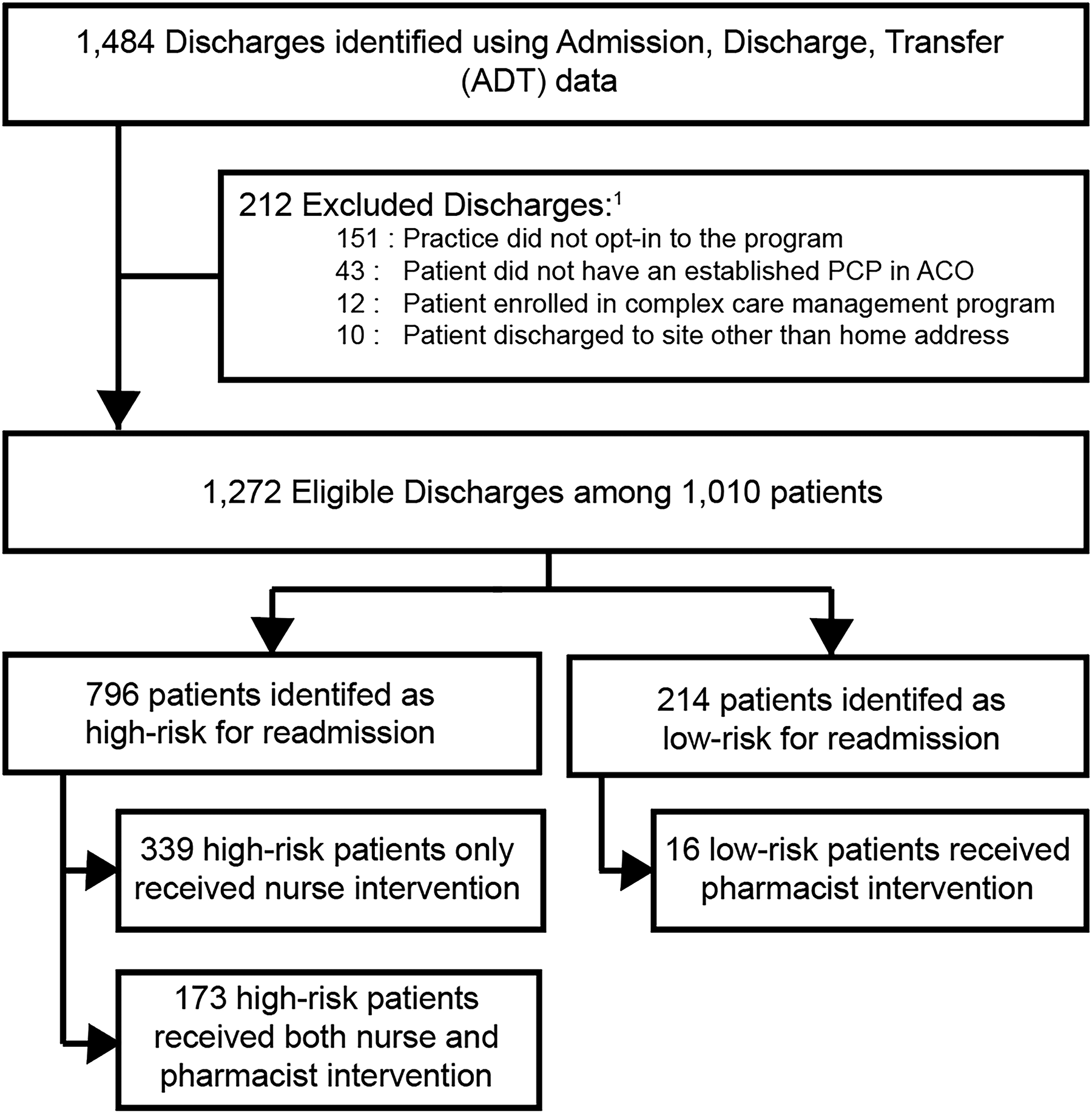
Eligibility criteria and patient identification for intervention. 1Non-mutually exclusive criteria.
A propensity-matched control cohort was identified from 17,758 discharges identified using ADT across 7,276 patients. Discharges were excluded for the following reasons: practice did not opt-in to the program (5760), participation in a complex care management program that provided post-discharge services (3570), no established PCP (627), incomplete data on time of hospital discharge (476), and discharge to a site other than the patient’s home address (165). The control cohort was well matched to the pilot population with a standardized mean difference of <0.05 for all variables included in the propensity score model (Table 1).
Demographic, Clinical and Risk of Readmission Characteristics of Intervention and Matched Control Cohorts
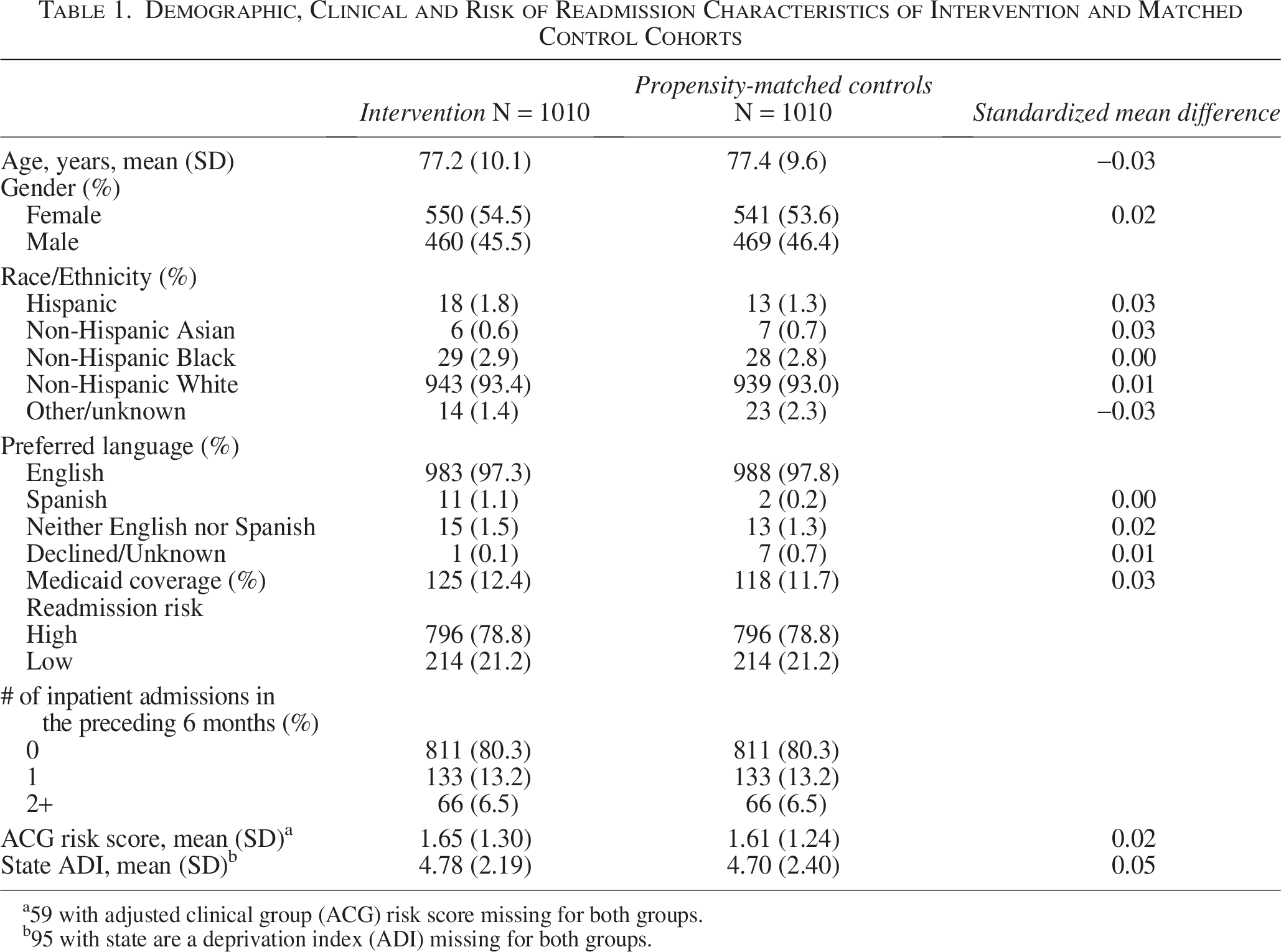
59 with adjusted clinical group (ACG) risk score missing for both groups.
95 with state are a deprivation index (ADI) missing for both groups.
Impact on 30-day readmission and clinical outcomes
The intervention cohort had a trend toward a lower rate of 30-day readmission compared to propensity-matched controls,13.5% vs. 16.3%, −2.9% absolute difference, and 18% relative difference (P = 0.07). There was no significant difference in the rate of 30-day ED presentation rates. The intervention cohort had a significantly higher rate of 14-day follow-up appointments (70.0% vs. 65.3%, P = 0.025) (Table 2).
Overall Impact of the MGB PHSO Post-Discharge Program on 30-Day Readmissions, 30-Day ED Presentation, and Follow-Up Visits

Although the relative difference of 18% was notable, statistical significance was determined based on absolute differences using a chi-square test. With a sample size of 1,010 participants per group, the study had 80% power to detect a 3.9% absolute difference at a significance level of 0.1, or a 4.4% absolute difference at a significance level of 0.05. Therefore, the study was underpowered to detect the 2.9% observed absolute difference. From a clinical operations perspective, however, a 10% relative reduction (1.6% absolute reduction) in readmission rates was considered to be clinically meaningful and provided a threshold for scaling of the pilot program within the health system.
Subgroup analysis
The high-risk patient population had a trend toward lower 30-day inpatient readmissions (17.0% vs. 19.5%, P = 0.29), which was not statistically significant. The low-risk patient population also had a trend toward lower readmission that was not statistically significant (18.5% vs. 19.7%, P = 0.78). There was a trend toward an absolute 2.5% reduction in 30-day readmission rate among those who received the nurse intervention (17.0% vs. 19.5%), but this trend was not statistically significant. Similarly, there was a nonsignificant trend toward increased 14-day follow-up in the intervention cohort (3.9% absolute increase, P = 0.09). Notably, among high-risk patients who only received an RN intervention, there was a statistically significant 5.5% absolute increase (P = 0.047) in 14-day follow-up visits, and among low-risk patients there was a statistically significant 7% (P = 0.046) decrease in 30-day ED presentation (Table 3).
Subgroup Analysis of Impact of the MGB PHSO Post-discharge Program on 30-day Readmissions, 30-day ED Presentation, and Follow-Up Visits Among Stratified High-Risk and Low-Risk Patients

Discussion
The MGB PHSO post-discharge program demonstrated a meaningful, directional reduction in 30-day readmissions approaching statistical significance for patients in an MSSP ACO across varied practice settings compared to a propensity-matched cohort who received usual care. The intervention effect was stronger in the high-risk cohort who were eligible for a more intensive intervention (phone call from RN and/or pharmacist), showing that this active intervention is the likely driver of the effect. In addition, the intervention cohort had a significantly higher rate of 14-day follow-up appointments, which demonstrates the impact of this multidisciplinary program on recognized higher quality care shown to mitigate readmissions. Notably, the intervention used risk stratification to focus more intensive interventions from licensed staff for those higher risk patients who were most likely to benefit. The trend toward overall reduction in readmissions for this cohort shows the likely benefit of using this approach to best align multidisciplinary interventions with patients who need and are more likely to have improved outcomes from tailored support, rather than outreach to all patients regardless of risk. This prioritization of staff outreach allows for better scaling of value-based care programming.
Compared to usual care, the post-discharge program implemented a high-fidelity approach to collating in-network and out-of-network discharges, stratifying patients by risk of readmission, and performing a standardized outreach that included medication reconciliation, assessing adequacy of home and community resources, providing patient education, and assisting in scheduling primary care follow-up. The reduction in readmission rate suggests a benefit of a standardized and centralized approach to conducting these activities in an ACO. Importantly, the intervention was implemented in close coordination with each primary care practice and adapted to meet the local practice environment to ensure that the program was well accepted and provided value, which included regular communication and data exchange with practices. This approach to primary care practice collaboration is consistent with literature findings demonstrating better quality and readmission rates in health systems that achieve higher functional and social integration. 30 Patients who received the specific RN-based intervention of a PDA had a higher rate of completed follow-up visits, which indicates that the PDA itself, and associated higher rate of follow-up, potentially contributed to reduction in readmissions.
Large database analyses have demonstrated mixed impact from ACO participation on decreasing readmission rates, in part because there remain significant challenges coordinating care for at-risk patients.31–33 Few health systems and ACOs have standardized and centralized transitions of care interventions; however, centralized population health programs have been noted to reduce readmission rates.34,35 Integration of pharmacist interventions into transitional care management (TCM) reduces readmissions and improves outcomes.35–37 In this study, the interventions performed included nurse PDA calls, pharmacist medication reconciliation and education, and facilitating follow-up visits in primary care, which are coordination activities that have previously been shown to be associated with reduced 30-day readmission rate. 13 Our study expands on this body of work by showing the benefit of implementing these activities in a highly consistent, structured, and centralized manner across an ACO. Other studies of TCM services in large ACOs showed a reduction in 30-day readmissions from centralized services, including post-discharge phone calls and primary care follow-up.34,35,38 However, these studies did not specifically compare these interventions delivered by an integrated, system-wide program to supplement variable processes at the local practice level. The present study adds to this literature by specifically showing the impact of a standardized intervention at the ACO level when implemented consistently to drive operational improvement.
Health systems are continuing to shift toward value-based care given federal, state, and payor pressures on traditional fee-for-service reimbursements and capacity constraints. 39 Value-based care aims to improve quality while lowering costs to advance the “value proposition” of health care. 40 Reducing unnecessary utilization and associated costs that do not improve the clinical trajectory of patients creates value, and 30-day readmission reduction is an unambiguous, patient-centered area of opportunity. This study demonstrated close to a 3% reduction in 30-day readmissions potentially resulting from the implementation of this program. The program is currently being scaled across the ACO health system. If extrapolated across the ACO, the program would yield an anticipated reduction of 369 admissions within 30 days with an associated savings of ∼$6.31 million for patients that meet current inclusion criteria. From a policy perspective, these findings highlight the potential for meaningful cost savings and improved patient outcomes across the Medicare population nationally. By focusing on reducing preventable readmissions with standardized implementation of evidence-based interventions, policymakers can improve quality and patient experience while also mitigating rising health care expenditures.
This study had several potential limitations. First, the ADT data received from a third-party vendor may not have included all possible inpatient discharges, as some facilities may not participate in data sharing with this vendor. There also may be mis-categorization of the discharge as a medical discharge or discharge to home if these data were inaccurately coded to the vendor. Second, because the study compared the intervention to existing standard of care in primary care practices, the control group included patients who received varied, inconsistent types of post-discharge services depending on practice. Propensity matching could not account for the types of discharge service a patient may have received at a non-pilot practice site due to variation and lack of consistency. This could have created a control population that received more or less robust services than those offered in the pilot intervention. Finally, although conducted in a large and diverse health system, the results may not be applicable to other care delivery settings or to patient populations outside of an MSSP ACO, and subgroup analyses were limited by sample size.
Key strengths of this study include the use of propensity score matching to create a well-matched control cohort that aligned with the intervention group on key predictors of outcomes. The study also began with a comprehensive assessment of existing readmission workflows in primary care practices to document usual care, including the lack of standardized post-discharge processes. In addition, the study used a rigorous intention-to-treat design with consistent inclusion criteria to minimize selection bias. Those patients who were more likely to engage with the RN or pharmacist may also have had different readmission risks, and the intention-to-treat model minimized engagement bias by evaluating all eligible patients in the ACO rather than only those who were able to be reached or willing to engage.
In conclusion, this prospective propensity-matched cohort study noted that a system-wide, evidence-based, multidisciplinary approach to mitigating 30-day readmissions (MGB PHSO post-discharge program) may have impacted the observed meaningful reduction in 30-day readmissions. These findings offer guidance for other large health systems that embrace value-based care approaches to improve clinical outcomes and support patients across the care continuum.
Authors’ Contributions
Dr. Schiavoni, Mr. Hall, Dr. Garalis, Mr. Teng, and Dr. Eliopoulos: Conceptualization, methodology, investigation, project administration, visualization, and writing; Dr. Chang.: Methodology, formal analysis and data curation; Dr. Chaudhry: Visualization and writing; Ms. Chan and Dr. Mendu: Conceptualization, methodology, investigation, project administration, visualization, writing, and supervision.
Footnotes
Acknowledgements
The authors acknowledge TuTran Nguyen, PharmD, and Tasleem Spracklin, PharmD, for the development of the Rx Discharge Acuity Score, which is detailed in  , and acknowledge Whitney Haney, MHA, for the development of the financial impact model for readmission reduction.
The authors thank the dedicated Mass General Brigham (MGB) nursing, pharmacy, population health, and clinic team members who contributed to this pilot intervention.
Author Disclosure Statement
The authors have no known conflicts of interest to disclose.
Funding Information
No external funding was received for this study. The intervention was supported by internal operational funds.
Supplemental Material
References
Supplementary Material
Please find the following supplemental material available below.
For Open Access articles published under a Creative Commons License, all supplemental material carries the same license as the article it is associated with.
For non-Open Access articles published, all supplemental material carries a non-exclusive license, and permission requests for re-use of supplemental material or any part of supplemental material shall be sent directly to the copyright owner as specified in the copyright notice associated with the article.
