




Abstract
Not all pro-environmental behaviors are equally effective in fostering sustainable habits. Psychological mechanisms, such as moral licensing, can paradoxically reduce the positive impact of well-intentioned actions. In this preregistered quasi-experimental study (N = 514), we examined how curtailment behaviors (e.g., recycling) and efficiency behaviors (e.g., adopting a vegan/vegetarian diet) differently influence moral credentials and subsequent pro-environmental actions. Results showed that salient curtailment behaviors lowered guilt and perceived environmental impact after unsustainable actions, creating a potential licensing effect, whereas efficiency behaviors mitigated this effect and promoted further sustainable behavior. Crucially, feelings of guilt and perceived environmental impact predicted later pro-environmental engagement. These findings highlight that encouraging high-impact efficiency behaviors may prevent moral licensing and support more consistent, sustainable choices, offering actionable insights for interventions aimed at fostering lasting environmental behavior change.
Introduction
Research on environmental issues has grown considerably in recent years, as environmental problems have become increasingly urgent. Climate change is largely driven by human activities, with greenhouse gas emissions reaching historical highs (IPCC, 2022). Consequently, individual behaviors play a critical role in mitigating these effects and avoiding severe environmental consequences. Although people report high concern about climate change (Capstick, Whitmarsh, Poortinga, Pidgeon, and Upham, 2015)—for example, 75.3% of the Spanish population reports being very or fairly concerned (CIS, 2025)—this concern does not always translate into concrete pro-environmental behaviors. Psychological barriers may prevent individuals from adopting more sustainable lifestyles (Gifford, 2011). Among these barriers, moral licensing and biased perceptions of environmental impact are particularly relevant, as they can influence whether initial pro-environmental actions lead to further positive behaviors or to compensatory, unsustainable behaviors.
The present study aims to examine how different types of pro-environmental behaviors—curtailment behaviors (low-cost, frequent actions such as recycling) and efficiency behaviors (high-cost, one-off actions such as adopting a vegan/vegetarian diet)—affect moral licensing, perceived environmental impact, and subsequent pro-environmental engagement.
Moral licensing
Moral licensing refers to the phenomenon whereby performing a positive or morally valued action allows individuals to subsequently engage in behaviors that might otherwise be considered undesirable (Monin and Miller, 2001; Miller and Effron, 2010). The moral credentials model explains this effect by suggesting that initial positive actions alter the perception of subsequent behaviors, making them seem less morally or socially problematic (Merritt, Effron, and Monin, 2010). For example, someone who drives an environmental-friendly car might feel less guilty about taking a flight, perceiving the flight as having a smaller environmental impact.
Research also shows that engaging in pro-environmental behaviors can reduce feelings of guilt associated with subsequent environmentally harmful actions (Burger, Schuler, and Eberling, 2022; Hope, Jones, Webb, Watson, and Kaklamanou, 2018). Since guilt is a key motivator for pro-environmental behavior (Adams, Hurst, and Sintov, 2020; Mallett, 2012; Pasca, 2022; Rees, Klug, and Bamberg, 2015), reducing guilt through initial actions may paradoxically discourage further sustainable behaviors.
Therefore, studies on the phenomenon of moral license consider the fact that engaging in pro-environmental behavior can have negative consequences later on. Consequently, this article aims to highlight the importance of the initial pro-environmental behavior, specifically the behavior that may trigger future unsustainable actions.
Individual pro-environmental behavior: Curtailment versus efficiency
There exists a wide variety of individual pro-environmental behaviors, each varying in effectiveness (Gardner and Stern, 2008). While Psychology has predominantly focused on curtailment behaviors, which have immediate albeit small effects on emissions (Nielsen et al., 2021), there is another type of pro-environmental behavior—efficiency behaviors—that could influence phenomena like moral licensing differently. Curtailment behaviors have a modest mitigating effect that accumulates with frequent performance (Ivanova et al., 2020; Wynes and Nicholas, 2017). Examples include actions such as recycling or turning off the lights, which are performed regularly and require minimal effort. In contrast, efficiency behaviors involve lifestyle changes and occur at specific times, also known as “infrequent” or “one-off” behaviors, marking a significant turning point in environmental impact. Although the performance of such behaviors involves repeated actions, the decision to adopt them often constitutes a single, high-commitment lifestyle choice. Examples include installing solar panels or adopting a vegetarian or vegan diet.
In the present research, the distinction between curtailment and efficiency behaviors is not intended as a strict or exhaustive taxonomy. Rather, these terms are used as analytically convenient labels to contrast behaviors that typically differ along with several correlated dimensions, such as effort and frequency (e.g., Diekmann and Preisendörfer, 2003; Karlin et al., 2014). We acknowledge that these dimensions may vary continuously and independently across behaviors, and that individual actions do not always fit neatly into discrete categories.
These two kinds of behaviors may be driven by different psychological factors (Andersson and von Borgstede, 2010). One key distinction lies in the effort involved: efficiency behaviors generally require greater effort than curtailment behaviors (Karlin et al., 2014). According to the low-cost hypothesis, individuals are more inclined to engage in behaviors that demand minimal effort (Diekmann and Preisendörfer, 2003), which may explain why curtailment behaviors are more widely performed. Similarly, the defensive denial hypothesis suggests that people consider problems less severe when pro-environmental actions involve high effort, using this bias as a justification for avoiding costly behaviors (Tyler, Orwin, and Schurer, 1982).
Effort has also been proposed as a possible explanation for whether an initial moral behavior leads to subsequent consistent or inconsistent behavior. Gneezy, Imas, Brown, Nelson, and Norton (2012) found that individuals who undertook costly pro-social behaviors were more likely to engage in further prosocial actions, whereas those who performed low-cost behaviors initially displayed moral licensing. Following this reasoning, we hypothesize that making the performance of a curtailment pro-environmental behavior (e.g., recycling) salient will lead individuals to feel less guilty when engaging in environmentally damaging behavior (H1a). Consistent with Gneezy et al. (2012), we further propose that individuals performing an efficiency pro-environmental behavior (e.g., a vegan/vegetarian diet) will show a smaller reduction in guilt for environmentally damaging behavior (H1b).
Environmental impact perception
Perception of environmental impact also plays a key role in moral licensing. Individuals often struggle to estimate the consequences of their unsustainable behaviors accurately (Wynes, Zhao, and Donner, 2020), leading to compensatory green beliefs—the idea that performing a green action offsets the negative impact of another behavior (Holmgren, Andersson, and Sörqvist, 2018; Kaklamanou, Jones, Webb, and Walker, 2015; Gorissen and Weijters, 2016; Pasca and Poggio, 2023).
Thus, compensatory beliefs have been related to moral licensing, as they are based on the balance between right and wrong (Dolan and Galizzi, 2015; Kaklamanou, Jones, Webb, and Walker, 2015; Knäuper, Rabiau, Cohen, and Patriciu, 2004). Consequently, performing pro-environmental behaviors may justify a less environmentally friendly lifestyle, as actions like recycling are considered harmless to the environment (Pasca and Poggio, 2023), even serving as a common rationalization for harmful actions to the environment (Byrka and Kaminska, 2015). Therefore, we hypothesize that salient curtailment behaviors will reduce the perceived environmental impact of subsequent unsustainable actions (H2a), while efficiency behaviors will counteract this effect (H2b). Furthermore, perceived environmental impact, together with guilt, is expected to predict engagement in subsequent pro-environmental behaviors (H3).
Consistency versus inconsistency
Initial pro-environmental behaviors can lead to either behavioral consistency (positive spillover) or inconsistency (negative spillover, e.g., moral licensing) (Nilsson, Bergquist, and Schultz, 2017). Factors such as effort, environmental identity, regulatory focus, and goal commitment can influence whether initial actions promote further pro-environmental engagement (Meijers, Noordewier, Verlegh, Willems, and Smit, 2019; Lalot, Falomir-Pichastor, and Quiamzade, 2022; Susewind and Hoelzl, 2014).
Rather than treating pro-environmental behaviors as functionally equivalent, the present study focuses on two widely discussed behaviors—recycling and dietary choice—to examine whether they generate different self-regulatory consequences in terms of behavioral consistency.
In line with this, we hypothesize that curtailment behaviors may lead to lower subsequent pro-environmental engagement, particularly when efficiency behaviors are not performed (H4). Conversely, performing efficient behaviors is expected to promote subsequent pro-environmental actions.
Methods
Participants
G*Power software (Faul, Erdfelder, Lang, and Buchner, 2007) was used to calculate the required sample size. To achieve a power of 0.85 in the analyses (f = 0.15), the recommended sample size would be about 489 participants, so the final sample consisted of 514 people recruited by Prolific. The mean age of the participants was 28.77 (SD = 9.42), with 50.9% being female, 44.5% male, and 4.6% nonbinary.
Descriptive statistics for age and climate change concern across the four experimental groups can be observed in Table 1. While minor variations across groups were observed, these variables were not the focus of the experimental manipulation, and climate change concern was statistically controlled for in subsequent analyses.
Means and Standard Deviations of Age and Climate Change Concern Across Dietary Groups (Vegans/Vegetarians vs. Meat Eaters) and Recycling Salience Conditions

Design
A quasi-experimental design with two intergroup factors was carried out: efficiency behavior (vegans/vegetarians vs. meat eaters) and curtailment behavior (salient vs. nonsalient recycling). Participants were randomly assigned to a condition based on the “curtailment behavior” factor. Thus, four groups of participants were formed: vegans/vegetarians with salient recycling (n = 121), vegans/vegetarians with nonsalient recycling (n = 125), meat eaters with salient recycling (n = 143), and meat eaters with nonsalient recycling (n = 125).
Instrument
Four versions of the online questionnaire were developed based on the quasi-experimental conditions.
Efficiency behavior: Vegan/vegetarian diet
Two of the questionnaires were sent through Prolific to people who adhered to a vegan or vegetarian diet. In these groups, a preliminary message emphasizing their pro-environmental behavior was included before the questions. Specifically, participants were informed that their selection for the study was based on their vegan/vegetarian diet, which contributes significantly to mitigating climate change. This introductory message was intended to ensure that the dietary choice was cognitively salient as a pro-environmental behavior, given that vegetarian and vegan diets may be adopted for diverse reasons (e.g., health or animal welfare) and are not always spontaneously framed as environmentally motivated. Conversely, participants in the other two groups were included if they had no dietary restrictions, and no initial message was provided in their questionnaire versions.
Because dietary choice was not experimentally manipulated, differences between vegans/vegetarians and meat eaters may reflect preexisting individual differences, such as environmental concern or moral consistency. To address this, climate change concern was measured and included as a covariate in all relevant analyses, and its interaction with dietary group was tested. Participants were asked, “To what extent do you feel concerned about climate change?”, with response options ranging from “not at all” to “extremely” on a 9-point continuum.
Curtailment behavior: Recycling
Participants in the salient recycling condition (two of the groups: one vegetarian/vegan and one meat-eating group) were asked whether they recycle. Considering previous literature (e.g., Truelove and Parks, 2012), it was expected that most people would respond affirmatively. Participants who checked “no” ended the questionnaire, as the aim was to highlight the fact that they recycle. The exclusion rate was similar for both vegans/vegetarians (19.4%) and meat eaters (19.1%).
Subsequently, after the procedure of Burger, Schuler, & Eberling. (2022), a series of questions were formulated about the behavior intended to be highlighted. Specifically, two items addressed the importance of recycling to reduce climate change, one item about the effort involved in recycling, and one item about their pride when recycling. The four items were answered on a 7-point scale ranging from “strongly disagree” to “strongly agree.” Although these items did not constitute explicit external feedback, they prompted participants to reflect on the importance of recycling and on feelings of pride associated with this behavior, thereby providing an indirect form of positive moral self-appraisal.
The two groups in the nonsalient recycling condition were not asked these questions about recycling.
Unsustainable behavior: Buying packaged products
First, an item about the estimated environmental impact of buying packaged products was included. Specifically, it was asked “When you buy packaged products, to what extent do you consider that you exert a negative impact on the environment?,” with the response being one point on a 9-point continuum from “not at all” to “I exert a very high impact.” Next, the adaptation of Bissing-Olson, Fielding, and Iyer (2016) of The State Shame and Guilt Scale was included. This measure included the instruction “When you buy packaged products to what extent do you feel…?,” subsequently having to respond to six emotions on a 7-point scale from “not at all” to “completely.”
Pro-environmental behavior
After the completion of the questionnaire, participants were given the option to collaborate with an environmental organization. To do so, they had to choose the option “I wish to collaborate” to be redirected to a new page including links to websites for volunteering in environmental issues. Alternatively, if participants preferred to solely complete the questionnaire, they should select the option “send questionnaire.”
Data analysis
To control the pro-environmental motivation affecting the adoption of a vegan/vegetarian diet, we carried out two analyses of covariance to examine the impact of efficiency and curtailment behavior on guilt feelings when buying packaged products and the perceived impact (H1 and H2). Climate change concern was included as a covariate, and its interaction with the quasi-experimental factor (vegan/vegetarian vs. meat eaters) was analyzed.
Next, a binary logistic regression analysis was conducted to study whether guilt for the purchase of packaged products and the perceived impact contribute to explaining subsequent pro-environmental behavior (H3).
Finally, a chi-square test using the Mantel–Haenszel statistic was conducted to contrast the conditional independence hypothesis. This hypothesis tests for independence between “salient recycling” and subsequent pro-environmental behavior, while controlling the effect of following a vegan/vegetarian diet or not (H4).
Results
Moral credentials
First, we conducted a 2 (vegan/vegetarian vs. meat eaters) × 2(salient recycling vs. nonsalient recycling) analysis of covariance of guilt for the purchase of packaged products, with climate change concern as covariate. The results showed a statistically significant effect of the interaction between the two factors (F(2,508) = 12.753, p < 0.001,
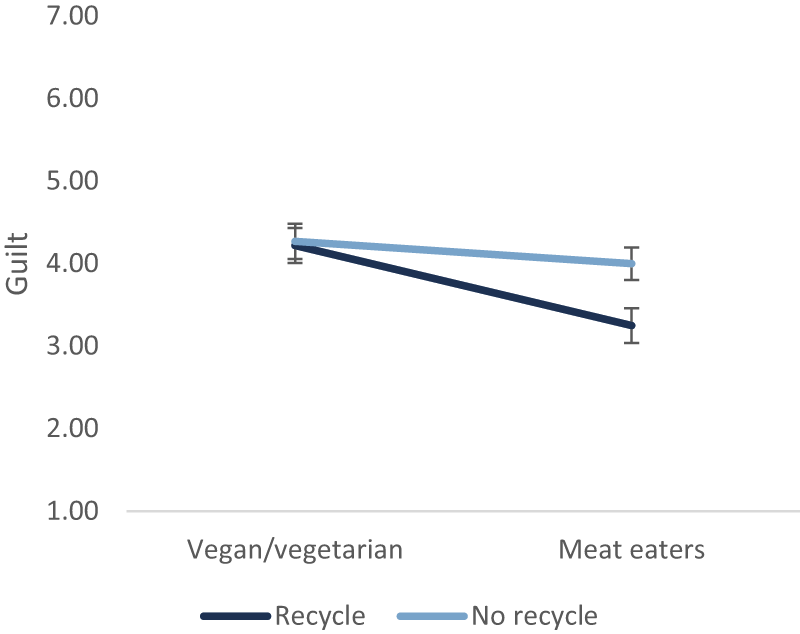
Guilt when buying packaged products based on vegan/vegetarian diet versus meat eaters and salient versus no salient recycling, with 95% confidence intervals.
Subsequently, we conducted another 2 × 2 Analysis of Covariance (ANCOVA) of the perception of the environmental impact of buying packaged products, with climate change concern as a covariate. Results showed a statistically significant effect of the interaction between the two factors (F(2,508) = 6.445, p = 0.002,
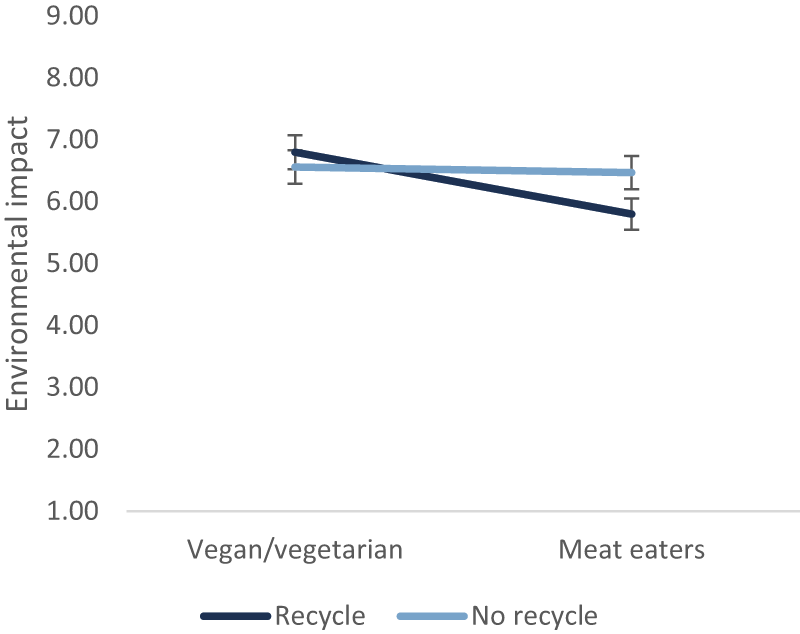
Environmental impact perception when buying packaged products based on veganism/vegetarianism-meat consumption and salient-no salient recycling, with 95% confidence intervals.
Subsequent pro-environmental behavior
A binary logistic regression analysis was conducted to study whether guilt for the purchase of packaged products contributes to explaining subsequent pro-environmental behavior. The results showed that guilt was significantly related to subsequent pro-environmental behavior (Wald = 11.087, B = 0.277, p < 0.001), indicating that individuals were more likely to engage in a subsequent pro-environmental behavior when experiencing higher levels of guilt (OR = 1.319, 95% CI: 1.121, 1.552). Similarly, the role of perceived environmental impact was studied. The results showed that the likelihood of engaging in subsequent pro-environmental behavior was higher when people considered having a high impact on the environment by engaging in unsustainable behavior (OR = 1.248, 95% CI: 1.089, 1.430; Wald = 10.134, B = 0.221, p = 0.001). Therefore, hypothesis 3 was supported. These results suggested that guilt and perceived environmental impact are not merely emotional or cognitive byproducts of unsustainable behavior but key motivational drivers of subsequent pro-environmental engagement. Together, they pointed to a self-regulatory process through which the appraisal of one’s own environmental harm shapes the likelihood of corrective or compensatory action.
Finally, hypothesis 4 addressed whether subsequent pro-environmental engagement depends on the type of initial pro-environmental behavior. A Mantel–Haenszel chi-square test examining the association between recycling salience and subsequent pro-environmental behavior while controlling for dietary group did not reach statistical significance (
Taken together, these findings indicated that behavioral consistency depends on the nature of the initial pro-environmental action. Whereas curtailment behaviors showed no systematic relationship with subsequent pro-environmental engagement, efficiency behaviors were associated with higher behavioral consistency. This pattern suggested that efficiency behaviors may operate as commitment signals that promote sustained engagement, while curtailment behaviors lack this structuring effect on subsequent action.
Discussion
People are broadly aware that their behavior has environmental consequences, and many recognize that their personal environmental footprint may exceed acceptable thresholds (Pasca and Poggio, 2023). Yet, despite this awareness and concern, a substantial proportion of individuals do not translate that concern into a more sustainable lifestyle. This gap suggests that psychological mechanisms, beyond simple awareness, act as barriers.
One mechanism that may undermine long-term behavior change is moral licensing—the tendency for a single pro-environmental action to create a sense of having “done enough,” thereby making later unsustainable choices feel acceptable. Our findings suggested that this mechanism should be carefully considered in environmental communication and behavioral interventions.
Differential effects of curtailment versus efficiency behaviors
Consistent with prior work (Nielsen et al., 2021), environmental psychology has often focused primarily on curtailment behaviors (e.g., recycling or reducing electricity use). However, previous research has highlighted the differentiation between two types of individual pro-environmental behavior: curtailment and efficiency (Andersson and von Borgstede, 2010; Karlin et al., 2014). These behaviors involve different characteristics and psychological drivers (De Nardo, Brooks, Klinsky, and Wilson, 2017; Umit, Poortinga, Jokinen, and Pohjolainen, 2019). Our results were consistent with this distinction: in the specific behaviors examined here, engaging in recycling was associated with reduced guilt and lower perceived environmental impact—indicators of moral licensing—whereas adopting a vegetarian or vegan diet did not produce the same effect.
This distinction aligns with findings suggesting that higher-cost behaviors tend to reinforce identity and promote consistency, whereas low-cost behaviors are more vulnerable to compensatory effects (Gneezy et al., 2012). Recent studies further confirm that low-effort pro-environmental actions may inadvertently signal to individuals that they have “done enough,” thereby reducing motivation for more substantial behavioral change (Lalot, Falomir-Pichastor, and Quiamzade, 2022; Truelove and Parks, 2012). Together, these findings suggest that interventions emphasizing only “easy” behaviors may unintentionally encourage justification for subsequent unsustainable choices if the risk of moral licensing is not addressed.
Although the present study focused on diet as an efficiency behavior and recycling as a curtailment behavior, the underlying mechanisms identified here may extend to other pro-environmental actions with similar characteristics. For instance, other high-impact efficiency behaviors, such as installing solar panels or reducing car ownership, involve substantial upfront commitment and may similarly constrain moral licensing. In contrast, low-cost curtailment behaviors, such as turning off lights or reducing water use, may more often serve as moral credentials, particularly when performed in isolation.
Environmental impact perception and guilt
A central contribution of our work lay in clarifying the role of environmental impact perception and guilt in shaping behavioral spillover. Participants who perceived a high environmental impact from their behavior (e.g., purchasing packaged products) and experienced greater guilt were more likely to engage in subsequent pro-environmental behavior. This was consistent with previous research showing that the perceived environmental impact of unsustainable behavior was directly linked to guilt (Pasca, 2022) and aligned with theoretical models positioning guilt as a key moral emotion regulating repair-oriented behavior (Burger, Schuler, and Eberling, 2022).
According to the Moral Credentials Model (Merritt, Effron, and Monin, 2010), performing an initial pro-environmental action may allow individuals to perceive later unsustainable behavior as less harmful or “not that bad.” Our findings were consistent with this idea: recalling curtailment behavior (e.g., recycling) led individuals to judge their subsequent unsustainable behavior as having lower environmental impact and to experience less guilt. This again underscored how low-cost behaviors such as recycling can create moral credentials under certain conditions.
In contrast, individuals who engaged in efficiency behaviors, such as adopting a vegan or vegetarian diet, did not show evidence of acquiring moral credentials. Instead, perceptions of impact and guilt remained relatively high, suggesting that efficiency behaviors may reinforce rather than relax moral standards. This aligned with the concept of the “single action bias” (Weber, 2006), in which performing one action—typically a low-cost curtailment behavior—leads individuals to feel they have sufficiently contributed to solving the problem, reducing motivation for further action. Our results extend this framework by showing that this bias appears to be mediated by reduced perceived impact and lower guilt.
Furthermore, individuals who choose to collaborate with an environmental organization perceived higher environmental impact from buying packaged products and experience more guilt. This suggested that impact perception and guilt not only predict consistent behavior but also partially depend on prior experiences, values, and identity-related factors.
Overall, these findings indicated that environmental impact perception and guilt are the key psychological mechanisms determining whether initial pro-environmental actions lead to consistency or inconsistency. This provides empirical support for the hypothesis proposed by Burger, Schuler, and Eberling (2022) that guilt plays a central role in the moral licensing process.
Curtailment as moral credentials versus efficiency as commitment
The present findings suggest that the two behaviors examined here may activate qualitatively different self-regulatory mechanisms. While both are commonly classified as pro-environmental actions, they appear to play distinct psychological roles in shaping subsequent judgments and behaviors.
Curtailment behaviors, such as recycling, appeared to operate primarily as moral credentials: they provided individuals with a symbolic signal of having acted responsibly, which can subsequently reduce feelings of guilt and attenuate perceived environmental impact when engaging in unsustainable behavior. This pattern was consistent with the Moral Credentials Model (Merritt, Effron, and Monin, 2010), whereby prior moral actions alter the interpretation of later transgressions rather than motivating further moral conduct.
In contrast, efficiency behaviors seemed to function less as moral credentials and more as indicators of commitment. Because these behaviors are typically costly, infrequent, and involve lifestyle changes, they may be less easily “credited” and mentally compensated for. As a result, they did not reduce guilt or perceived impact in the same way. This interpretation aligns with work suggesting that costly actions are more likely to signal enduring values or self-concept rather than providing a temporary moral buffer (Gneezy et al., 2012).
Importantly, this distinction helps explain why curtailment behaviors are more likely to trigger moral licensing, whereas efficiency behaviors may limit the acquisition of moral credentials. Rather than merely differing in effectiveness, these behaviors appear to differ in how they are cognitively represented: as compensable moral acts versus ongoing commitments with implications for self-regulation.
Consistency effects and the role of efficiency behaviors
Building on the distinction between curtailment behaviors as moral credentials and efficiency behaviors as indicators of commitment, we examined whether these differences translated into consistent patterns of subsequent pro-environmental behavior. Specifically, we tested whether initial engagement in curtailment or efficiency behaviors predicted willingness to engage in a further pro-environmental action. Individuals who performed efficiency behaviors were more likely to engage in additional pro-environmental actions afterward, consistent with research suggesting that costly actions temporarily strengthen moral or environmental identity (Gneezy et al., 2012). Additionally, Meijers et al. (2019) found that people with strong environmental identity were more likely to behave consistently. Importantly, the absence of a similar effect for curtailment behaviors suggested that low-cost actions may be insufficient to promote consistency when they primarily function as moral credentials rather than commitments.
Crucially, these findings contribute to the behavioral spillover literature by showing that inconsistency did not merely depend on individual differences but also on how the initial behavior was cognitively framed. Most prior studies have focused either on positive spillover (Lalot, Falomir-Pichastor, and Quiamzade, 2022; Noblet and McCoy, 2018) or negative spillover (Bösehans, Bolderdijk, and Wan, 2020; Urban, Bahník, and Kohlová, 2019) but rarely differentiate between these two types of behaviors. The present study suggested that curtailment and efficiency behaviors examined here differed in their capacity to generate consistency. This distinction helps reconcile mixed findings in prior research by suggesting that not all pro-environmental behaviors are equally likely to trigger spillover effects.
Theoretical contributions
This study contributes to the literature by reframing moral licensing in environmental behavior as potentially depending on the type of action performed, rather than as a general consequence of acting pro-environmentally. By distinguishing between curtailment behaviors that operate as moral credentials and efficiency behaviors that signal commitment, our findings offer a unifying explanation for inconsistent evidence on behavioral spillover. This framework integrates moral licensing theory with research on behavioral cost and self-regulation, advancing a more differentiated understanding of when pro-environmental actions undermine or support sustained engagement.
From a decision-making perspective, these findings suggested that individuals evaluate subsequent choices not only based on outcomes but also on how prior actions are mentally categorized within a system of moral self-regulation.
Practical implications
The present findings highlighted several actionable insights for organizations aiming to foster environmentally responsible behaviors among employees and consumers. First, understanding how individuals perceive the impact of their pro-environmental actions can guide the design of interventions that make the environmental consequences of daily decisions more visible, tangible, and immediate. For instance, providing real-time feedback on energy savings or resource use can enhance perceived impact and reinforce consistent sustainable choices.
Second, the results emphasized the relevance of psychological consistency as a driver of environmental behavior. Organizations can leverage this by creating environments that support identity-aligned choices—for example, integrating sustainability cues into the workplace, encouraging public commitments, or framing organizational initiatives in ways that resonate with employees’ existing values.
Finally, the findings suggested that interventions should address both the rational dimension (knowledge of consequences, objective impact) and the experiential dimension (feeling that one’s behavior matters). Campaigns that rely exclusively on information may fall short; instead, combining information with emotionally engaging narratives, social norm cues, or experiential activities could yield stronger behavioral change.
Limitations and future research
As pointed out above, this research focused on initial pro-environmental behavior. However, it is equally important to examine the differentiated effects of curtailment or efficiency behaviors on subsequent pro-environmental or unsustainable behavior. Similarly, effort was considered in a general way. However, different types of effort may lead to varying effects. A further limitation concerns the operationalization of behavioral domains through a single example in each case (recycling and dietary choice). As a result, the present findings should be interpreted as evidence that these two commonly discussed behaviors differ in their self-regulatory consequences, rather than as a comprehensive test of all behaviors varying in cost, frequency, or impact. Future research should examine multiple behaviors across these dimensions to more precisely disentangle their independent and interactive effects.
The behavior chosen as efficiency, following a vegan or vegetarian diet, may be adopted for various reasons, including pro-environmental, health, and animal welfare concerns, among others. Consequently, individuals practicing these behaviors may not always recognize their engagement in pro-environmental behavior. To address this potential lack of awareness, the initial message of the questionnaire emphasized the positive impact of a vegan or vegetarian diet on reducing climate change. Additionally, we statistically controlled the level of climate change concern. However, for future research, it would be valuable to explore the specific motives behind the adoption of various pro-environmental behaviors.
Lastly, another limitation of the present study concerns differences in how salience was operationalized across behavioral domains. In the efficiency behavior condition, participants received an introductory message explicitly highlighting the environmental impact of their dietary choice, whereas in the curtailment behavior condition, salience was induced through self-evaluation of importance and pride associated with recycling. Although both manipulations involved evaluative elements, they differed in form and intensity. Future research should apply fully symmetrical procedures to disentangle behavioral salience from evaluative feedback.
Ethical Statement
The authors consciously assure that the article was conducted following the ethical principles of psychologists and code of conduct laid out by the American Psychological Association (APA). The study also complied with Regulation (EU) 2016/679 of the European Parliament and of the Council of 27 April on the protection of personal data.
Data Availability Statement
Questionnaires, databases, and supplementary materials can be found at https://osf.io/9vm2n/?view_only=f5814d42a1fe421693e496b7684c90f5, and preregistration at https://osf.io/mn2pc/?view_only=44b20f159e55494fad2b83523b6ea724.
Authors’ Contributions
L.P.: Conceptualization, methodology, formal analysis, investigation, and writing. S.M.-G.: Conceptualization and writing.
Footnotes
Author Disclosure Statement
No competing financial interests exist.
Funding Information
No funding was received for conducting this study. S.M.-G. was supported by the FPI program of the Spanish Ministry of Science and Innovation (PRE2020-093168).