




Abstract
The family, as a primary context for child socialization, plays a significant role in shaping children’s pro-environmental behavior (PEB). However, few studies have systematically examined the formation of such behaviors from the perspective of parent–child interactions in the environmental domain. The present research consists of two studies. Study 1 aimed to conceptualize the structure of “pro-environmental parent–child interaction” (PEPCI) and develop a corresponding measurement tool. Results indicated that this construct comprises four dimensions: guided interaction, participatory interaction, reverse interaction, and behavioral demand interaction. The developed scale demonstrated good reliability and validity. In Study 2, a survey was conducted among 1086 fourth- to sixth-grade primary school students to examine the relationships among PEPCI, nature connectedness, perceived parental action, and children’s PEB. The results revealed that PEPCI positively predicted children’s PEB. Both perceived parental action and nature connectedness mediated the relationship between parent–child interaction and PEB independently. Furthermore, a chain mediation effect was identified, indicating that parent–child interaction enhanced perceived parental behavior, which in turn strengthened children’s connection to nature, ultimately promoting PEB. This research provides empirical support and practical insights for family-based pro-environmental education.
Introduction
Cultivating sustainable lifestyles must begin with children. Children and adolescents represent crucial actors in realizing carbon peak and carbon neutrality goals and are primary practitioners of environmental behaviors (Percy-Smith & Burns, 2013; Zhang et al., 2022). It is imperative to foster green lifestyles and to embed ecological consciousness in the young. Environmental education should commence early in life (Liefländer & Bogner, 2014). The foundation for adult pro-environmental attitudes and behaviors is established during childhood (Evans, Otto, & Kaiser, 2018). Pro-environmental attitudes and behaviors begin to emerge around age 7, increase until age 10, and enter a consolidation phase between ages 10 and 14. They tend to stabilize around age 14, followed by a decline, before eventually plateauing again in adulthood (Otto et al., 2019). It is therefore critical to prioritize the cultivation of pro-environmental behaviors (PEBs) during childhood.
Family systems theory views the family as a dynamic, constructed system, emphasizing the reciprocal influence of each member’s cognition, attitudes, and behaviors. Parents play a pivotal role in the primary socialization of adolescents, exerting significant effects on aspects ranging from fundamental materialistic values (Hurst et al., 2013) to environmental attitudes (Otto et al., 2019) and prosocial behaviors (Han, 2020). A growing body of research finds that ecological socialization, namely, the process through which parents transmit social norms and values related to environmental issues to their children, is an important factor shaping individuals’ environmental attitudes and behaviors (Gentina & Muratore, 2012; Grønhøj & Thøgersen, 2012, 2017). Parent
In conclusion, it is necessary to investigate the patterns of pro-environmental parent
The Structure and Measurement of PEPCI
Extensive research underscores the importance of parent
Grusec and Davidov (2010) argued that family socialization is not unidimensional but diverse, complex, and context-dependent construct. They proposed the concept of “domains of socialization,” which incorporates prior research on expressions of socialization through witnessing, communication, and parenting styles to understand how parents influence children’s socialization. They categorized it into five types: protection, reciprocity, control, guided learning, and group participation. Katz-Gerro et al. (2020) applied this framework to environmental protection. They proposed that children’s ecological socialization can be understood through four domains of socialization relevant in the context of environmental behavior, encompassing four aspects: reciprocity, guided learning, group participation, and control. Reciprocity refers to complying with children’s reasonable requests and demonstrating a tendency to reciprocate. For instance, parents adopt environmental protection methods suggested by their children. Guided learning involves teaching children according to their level of understanding. For example, parents educate their children on waste sorting. Parent
The family is an important setting for children’s socialization (Gentina & Muratore, 2012). Under the Chinese cultural context, how do parents influence their children’s ecological socialization? Based on the domains of socialization in the context of environmental behavior (Katz-Gerro et al., 2020) and the responsiveness-demandingness framework of parenting style (Maccoby & Martin, 1983), we conceptualize PEPCIs into four dimensions adapted to the Chinese cultural context, namely, reverse interaction (children proactively transmit environmental knowledge or suggestions to parents), guided interaction (parents communicate with children about environmental issues as educators and focus on the cognitive aspect), participatory interaction (parents and children jointly engage in pro-environmental activities), and behavioral demand interaction (parents propose clear environmental behavior norms for children, accompanied by mild correction and focus on the behavioral aspect). The term “control domain” is often associated with rigid, punitive, or noncommunicative disciplinary practices in existing parenting literature (Jacome-Mora et al., 2025), which may mislead readers to equate this dimension with authoritarian control lacking emotional connection or explanation. In contrast, the term “behavioral demand interaction” better reflects the cultural characteristics of Chinese family education—where parental authority and emotional connection coexist, and normative guidance is often delivered through mild correction and explanation rather than rigid control (Ling & Chen, 2023).
It is worth noting that the framework proposed by Katz-Gerro et al. (2020) was examined in samples from Israel, South Korea, and the United States. The present research extends this line of inquiry to the Chinese cultural context, where parent–child interactions during the elementary school years are particularly frequent and influential due to distinctive familial and educational structures. Examining PEPCI in China thus allows for a cross-cultural comparison and helps to clarify the role of cultural factors in environmental socialization.
PEPCI Promotes PEB
Socialization theory posits that parents are key agents in children’s socialization (John, 1999; Moore, Wilkie, & Lutz, 2002), and this holds true in the environmental domain as well. Ecological socialization, as a domain-specific form of socialization, is not only a pathway to fostering children’s environmental orientation but also a vehicle for transmitting core social values (e.g., self-transcendence and conservation values) that support children’s personal and social functioning (Alcaide et al., 2025; Queiroz et al., 2020). These social values, which prioritize collective interests over individual gains, are closely linked to both psychosocial adjustment and PEBs (Garcia et al., 2024; Queiroz et al., 2020). Parent
Previous research indicates that parental communication about environmental issues (Matthies, Selge, & Klöckner, 2012), joint participation in pro-environmental activities with children (Jia & Yu, 2021), and transmission of environmental norms (Grønhøj & Thøgersen, 2012) positively promote children’s PEB by shaping children’s value orientations and behavioral standards. Therefore, the following hypothesis is proposed: PEPCI positively predicts children’s PEB.
The Mediating Role of Nature Connectedness
Nature connectedness is a significant predictor of individual PEB (Mackay & Schmitt, 2019; Whitburn, Linklater, & Abrahamse, 2020). Collado and Corraliza (2015) noted that children living in rural areas exhibit stronger environmental attitudes and a greater sense of nature connectedness, which in turn fosters their PEB. Peng et al. (2022) found that nature contact in daily scenarios tends to promote emotional nature connectedness (such as feeling close to nature), while nature contact in tourism scenarios tends to enhance cognitive nature connectedness (such as awareness of natural risks). An emotional connection to nature can foster positive attitudes and care for the environment. Additionally, travel-related nature experiences are more likely to promote individuals’ PEB. Among factors influencing children’s nature connectedness, parents play a crucial role (Barrable & Booth, 2020; Passmore et al., 2021). In contemporary society, academic pressures and parental safety concerns mean children’s outdoor activities are subject to increasing supervision. Parental positive attitudes toward children’s outdoor nature activities (e.g., encouraging curiosity about nature or actively facilitating visits to natural settings such as parks) had a positive effect on children’s nature connectedness (Wu, Ji, & Jin, 2023), which in turn promotes children’s PEB through their nature exposure and nature connectedness (Gu, Huang, & Wu, 2022). Research by Jia, Sorgente, and Yu (2022) also indicated that environmental parent PEPCI promotes children’s nature connectedness. PEPCI promotes children’s PEB through the mediating role of nature connectedness.
The Mediating Role of Perceived Parental Action
Perceived parental action is defined as children’s observation and recognition of their parents’ PEBs, such as saving water and electricity, and it is also called a family norm (Grønhøj and Thøgersen, 2012). Most children are intensely exposed to their parents’ environment-related behaviors. Children who observe their parents engaging in PEBs tend to exhibit more of such behaviors themselves (Grønhøj & Thøgersen, 2017); similarly, a study on Chinese adolescents demonstrated that children observing their parents’ PEB is more effective in promoting their pro-environmental actions than discussing environmental issues with them (Jia & Yu, 2021). Effective parent
The stimulus–organism–response (SOR) theory (Mehrabian & Russell, 1974) points out that external stimuli alter an individual’s internal psychological state, which in turn triggers their behavioral response. In the context of green consumption, research has found that online green interactions, which refer to the exchange of pro-environmental information and emotional support through digital platforms, can evoke an individual’s empathy with nature, further promoting green consumption (Bruhn, Schnebelen, & Schäfer, 2014). In this study, interactions concerning environmental information, affect, or behavior between parent and child can stimulate the individual’s attention and interest in environmental issues, prompting them to process external environmental stimuli using their existing knowledge and experience. Through joint family participation in activities and discussions, the individual’s psychological state may undergo positive changes (e.g., nature connectedness and perceived parental action), subsequently guiding behavioral change. Therefore, the following hypotheses are proposed: PEPCI enhances children’s perceived parental action. PEPCI enhances elementary school students’ PEB through the mediating role of perceived parental action.
The Sequential Mediating Role of Perceived Parental Action and Nature Connectedness
Previous study has shown that high-quality parent PEPCI enhances perceived parental action, which in turn strengthens children’s nature connectedness, ultimately promoting their PEB.
Current Research
The present research comprises two interrelated studies designed to sequentially address the development of a measurement tool and the examination of theoretical relationships. Study 1 is a scale development study, which includes an open-ended survey (Study 1a) to explore the content domain and a psychometric validation phase (Study 1b) to develop and validate the PEPCI Questionnaire. Furthermore, we aim to investigate the impact of PEPCIs on children’s PEB, and thus we conducted Study 2. Study 2 is a cross-sectional survey study, which proposes that PEPCI influences children’s PEB both directly and indirectly through the mediators of perceived parental action and nature connectedness.
Study 1
Study 1 consisted of two substudies, which aimed to develop and validate the PEPCI Questionnaire for upper elementary students through an open-ended survey and psychometric evaluation, providing a measurement tool for Study 2.
Study 1a
Participants
Via the Questionnaire Star platform, 118 participants with children in grades 4–6 were recruited.
Exclusion criteria were responses with obvious patterns (e.g., straight-lining), excessively short completion times, or missing data on the open-ended questions. After excluding invalid responses, 104 valid questionnaires were retained (43 fathers and 61 mothers). Additionally, child version open-ended questionnaires were distributed at a summer camp in Kunming City, where children completed the questionnaires independently in a quiet room under the supervision of research assistants. Fourth- to sixth-grade primary school students who obtained parental consent and fully completed the open-ended questionnaire were included. One hundred forty valid data points were retained (Mage = 11.58, standard deviation [SD]age = 1.12; 42.14% female). All the participants (both parents and children) are from China.
Both the students participating in this survey and their guardians provided informed consent. All participating students were informed that the survey is voluntary and anonymous, and that they may withdraw from the survey at any time, either voluntarily or with parental authorization.
Measures
A self-developed open-ended questionnaire was used, containing three items: In daily life, do you discuss environmental issues with your child (child: your parents)? What environmental topics do you frequently interact with your child (child: your parents) about in daily life? (e.g., environmental topics discussed together, PEBs done together);under what circumstances does your child initiate interaction with you about environmental issues? (Child: How do your parents interact with you about environmental topics?) The questionnaire was administered in Chinese, the native language of all participants, with the same applying to the subsequent study.
Procedure and methods
The procedure for developing the initial questionnaire items followed a systematic and multistep content-analytic approach. First, open-ended responses from both parents and children were thematically analyzed to identify frequently mentioned environmental topics and interaction patterns. Only content that was explicitly referenced by both respondent groups was retained, ensuring that the derived themes reflected shared perceptions of PEPCI. The open-ended responses were thematically coded by two postgraduate students in psychology, who reached a high level of agreement in their coding. Furthermore, we also drew upon the questionnaire items from Katz-Gerro et al. (2020).
Results
Parent
Based on the open-ended survey results and literature review, initial items for the PEPCI Questionnaire were drafted. The initial pool contained 28 items, rated on a 5-point Likert scale (1 = “Never,” 5 = “Always”). Five postgraduate students in psychology and a psychology expert were invited to review the initial item pool.
Based on feedback from postgraduate students in psychology, ambiguous items were reworded or deleted to form the revised initial version of the questionnaire. This revised version was then administered to the samples in Study 1b.
Study 1b
Participants
Three independent samples were recruited from primary schools in Yunnan Province for different phases of scale validation. The sample size was determined based on the subject-to-item ratio recommendation of at least 10:1 for factor analysis (Dai, 2015).
Sample 1: a total of 350 questionnaires were distributed to students in grades 4–6 at a primary school in Yunnan Province, China, and 340 valid participants (Mage = 10.76, SDage = 0.98; 51.80% girls) were ultimately recruited. The collected data were used for item analysis and exploratory factor analysis (EFA) to preliminarily construct the dimensions of the Pro-Environmental Parent-Child Interaction Questionnaire.
Sample 2: a total of 350 questionnaires were distributed to students in grades 4–6 at a primary school in Yunnan Province that was different from the one in Sample 1. Ultimately, 342 valid participants were recruited (Mage = 10.99, SDage = 1.17; 50.30% girls). The data were used for confirmatory factor analysis (CFA).
Sample 3: 84 students (Mage = 10.92, SDage = 0.81; 44.05% girls) from another Yunnan elementary school were recruited for test–retest reliability analysis with a 2-week interval between the two data collection points.
Measures
Self-developed PEPCI Questionnaire
The scale includes 28 items. The items are rated on a 5-point scale ranging from 1 (Never) to 5 (Always), with higher total scores indicating a higher frequency or quality of PEPCIs.
Intergenerational Pro-Environmental Behavior Interaction Scale
The scale was originally developed by Wu (2019), including 16 items. It includes four “private-domain environmental behaviors” related to individuals or families and four “public-domain environmental behaviors” related to public spaces and societal contexts. These items are measured based on their frequency in daily life using a 5-point scale (1 = Never, 2 = Occasionally, 3 = Sometimes, 4 = Often, 5 = Always). To reflect the interaction between children and their parents, the wording was adapted separately for the children’s questionnaire and the parents’ questionnaire, such as “Parents teach their child how to sort waste for recycling” versus “The child teaches his/her parents how to sort waste for recycling.” Reported Cronbach’s α was 0.85.
Procedure and statistical methods
Data were collected using paper-based questionnaires administered collectively at the class level. Before the test, the research team coordinated with the school, and the survey was conducted only after obtaining approval from the school, as well as informed consent from the students and their parents or guardians. The students’ classroom teachers served as the test administrators. Before the test, they explained the purpose of the survey, emphasized its anonymous nature, and read the instructions aloud.
All questionnaires were collected on-site upon completion. Data were analyzed using SPSS 19.0 and Amos 21.0.
Results
Item Analysis
Critical ratio and item–total correlation analyses were conducted on Sample 1 data. First, the participants were sorted according to the total score of the scale. The top 27% of the participants were in the high-score group, and the bottom 27% were in the low-score group. Independent-sample t-tests were performed on the high and low scores. The results revealed significant differences in the scores of all the items between the two groups (all p < 0.05), indicating that all the items had good discrimination. Second, an item–total correlation analysis on the entire sample was conducted to examine the correlation between each item and the total score. The results indicated that the correlation coefficients for Item 27 (r = 0.38) and Item 28 (r = 0.37) were below the threshold of 0.40 (Dai, 2015), and these two items were deleted.
Exploratory Factor Analysis
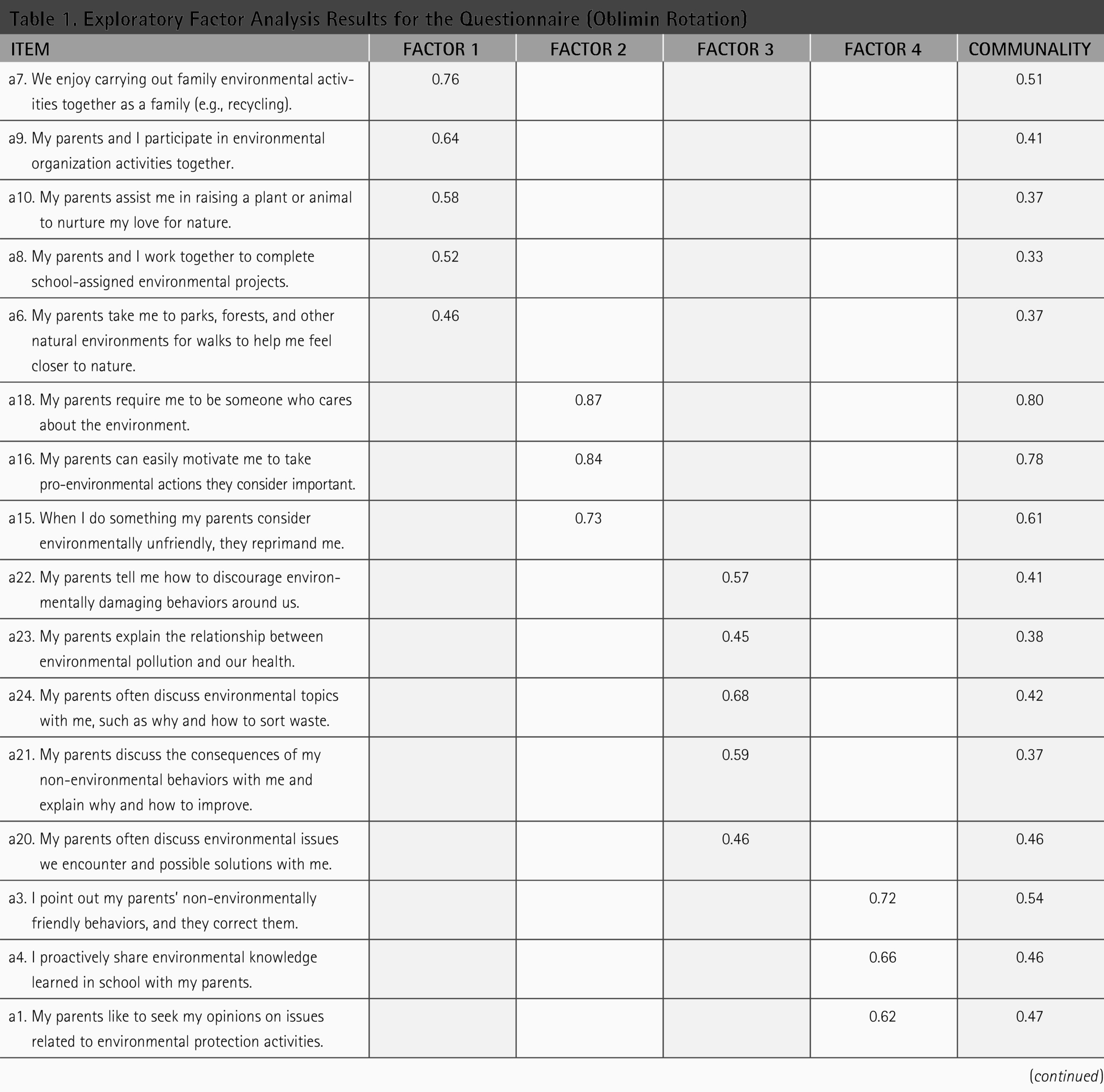
Prior to conducting the EFA, the suitability of the data was assessed. The Kaiser–Meyer–Olkin (KMO) measure was 0.94, and Bartlett’s test of sphericity was significant (χ2 = 3294.15, p < 0.001), indicating the data were appropriate for EFA. The principal axis factoring with oblimin rotation method was employed. The initial analysis yielded five factors with eigenvalues >1, which collectively accounted for 42.49% of the total variance. Items were removed based on the following criteria: (1) items with communalities <0.30; (2) items with factor loadings <0.40; and (3) items exhibiting cross-loadings on multiple factors (a > 0.40), and factor analysis is repeated until every item corresponds to a dimension with a unique loading greater than 0.40 (Wu, 2010). After several iterations, nine items (2, 11, 12, 13, 14, 17, 19, 25, and 26) were deleted, with only 17 items retained. An EFA was subsequently performed on the remaining 17 items. The results confirmed the data’s continued suitability for factor analysis (KMO = 0.918, Bartlett’s χ2 = 2148.274, p < 0.001). The factor loadings after rotation and the communalities for each item are presented in Table 1. Four factors were extracted, explaining 46.34% of the total variance. The factors were named as follows:
Exploratory Factor Analysis Results for the Questionnaire (Oblimin Rotation)
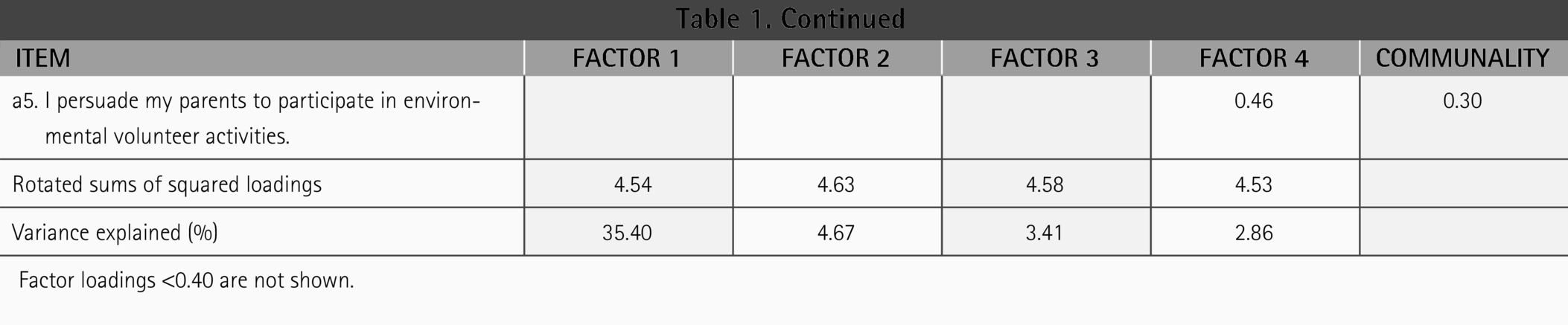
Factor loadings <0.40 are not shown.
The first factor, tentatively named as participatory interaction, consists of five items (a6, a7, a8, a9, and a10). This factor captures an interactive form in which parents and children jointly participate in various pro-environmental activities and enhance parent
The second factor, consisting of three items (a15, a16, and a18), is named behavioral demand interaction. It reflects a dynamic in which parents impose normative requirements on children’s specific behaviors, accompanied by communication and mild behavioral correction, and distinguished from harsh control or punitive discipline without any communication. Although this dimension originates from the “control” domain in socialization theory (Katz-Gerro et al., 2020), its actual manifestation aligns more closely with a combination of high responsiveness (through dialogue) and moderate demandingness (setting behavioral standards). For example, when a child engages in unfriendly environmental behavior, parents may criticize the child. This approach does not rely solely on authority or punishment but rather conveys behavioral expectations and emphasizes norms through immediate interaction.
The third factor includes four items (a1, a3, a4, and a5) and is tentatively termed reverse interaction. It signifies interactions initiated by the child, where the child acts as the primary initiator on environmental topics, where children transmit environmental knowledge to parents, put forward environmental protection suggestions, or point out parents’ nonenvironmental behaviors. It reflects the reverse socialization between parents and children, such as implementing a child’s idea for waste sorting at home.
The fourth factor contains five items (a20, a21, a22, a23, and a24) and is named guided interaction. It pertains to daily-life interactions in which parents educate and communicate with their children on environmental-related topics. In this dynamic, parents act as knowledgeable socialization agents—serving as teachers or coaches—who explain environmental knowledge and analyze environmental problems to children and transmit environmental protection concepts through communication and education, which is positive environmental socialization guidance from parents to children, such as the importance of conserving water or the correct method for sorting recyclables.
Confirmatory Factor Analysis
CFA on Sample 2 confirmed the four-factor structure. Model fit indices were good: χ2/df < 5; Comparative Fit Index (CFI) = 0.97, Goodness-of-Fit Index (GFI) = 0.93, Incremental Fit Index (IFI) = 0.97, Tucker-Lewis Index (TLI) = 0.96, Normed Fit Index (NFI) = 0.94 (all exceeding the recommended threshold of 0.90); Root Mean Square Error of Approximation (RMSEA) = 0.06, which is below the benchmark of 0.08. These results indicate a good model fit, supporting the satisfactory structural validity of the questionnaire. The path coefficient diagram is shown in Figure 1.
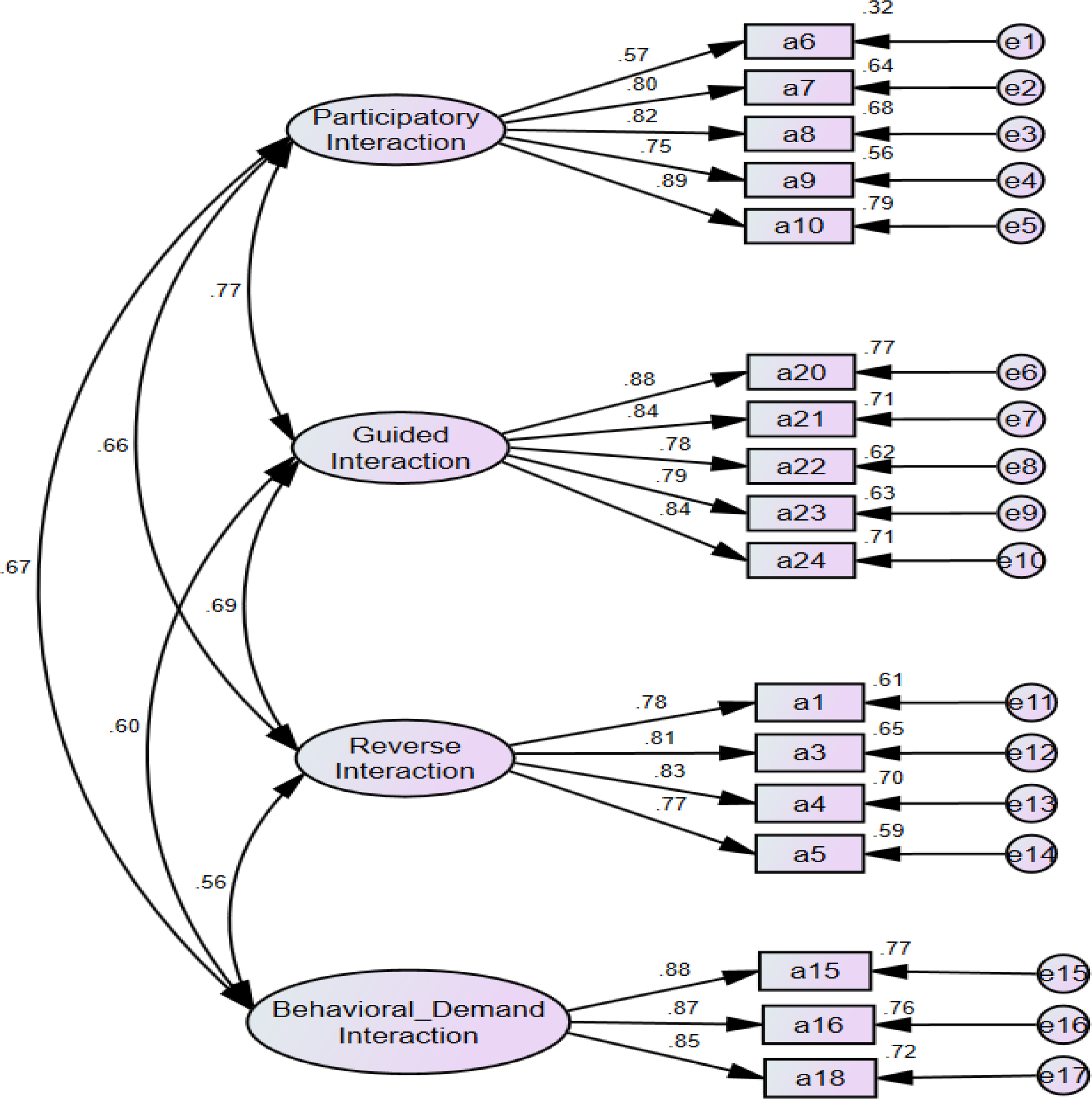
CFA of the Pro-Environmental Parent
Reliability Analysis
Internal consistency was assessed for the PEPCI Questionnaire. All dimensions of the scale showed high reliability, with Cronbach’s α coefficients exceeding 0.80, participatory interaction (0.87), guided interaction (0.92), reverse interaction (0.88), and behavioral demand interaction (0.89). The overall scale exhibited excellent reliability (α = 0.94), supporting the instrument’s consistency and measurement stability. Additionally, the test–retest reliability of the questionnaire was examined. A correlation analysis was conducted on the mean scores of 84 elementary school students from a primary school in Yunnan Province between the two administrations of the test. The test–retest reliability coefficient was 0.72, indicating high consistency and good stability of the questionnaire over time.
Criterion-related Validity Assessment
The Intergenerational Pro-Environmental Behavior Interaction Scale developed by Wu (2019) was adopted as the criterion measure to examine the criterion-related validity of the PEPCI Questionnaire. Correlation analysis revealed that the PEPCI Questionnaire was significantly correlated with the Intergenerational Pro-Environmental Behavior Interaction Scale (r = 0.89, p < 0.001).
Discussion
Study 1 aimed to develop a PEPCI Questionnaire. It began with an open-ended survey administered to fourth to sixth graders to explore the manifestations of such interactions. Based on the findings, an initial questionnaire was constructed. The process resulted in a final 17-item questionnaire encompassing four distinct dimensions: reverse interaction, guided interaction, participatory interaction, and behavioral demand interaction.
Numerous studies have demonstrated the intergenerational transmission of pro-environmental attitudes and behaviors from parents to children (Ando et al., 2015; Collado, Staats, & Sancho, 2019; Collado & Evans, 2019). Some studies have also identified reverse intergenerational transmission of pro-environmental attitudes and behaviors (Singh et al., 2020; Zukauskiene et al., 2021). Within the family system, parent
Study 2
This study employed a questionnaire survey to explore the relationships among PEPCI, perceived parental action, nature connectedness, and children’s PEB. Participants were selected from fourth to sixth graders across two elementary schools in Yunnan and Gansu Province, China. The target sample size was determined a priori using G*Power 3.1. For a multiple regression analysis with up to eight predictors (including mediators and covariates) to detect a small-to-medium effect size (f2 = 0.05) with 95% power at α = 0.05, a minimum of 160 participants was required. To ensure sufficient power for more complex mediation analysis, a total of approximately 1150 questionnaires were distributed. Participants were typically developing fourth to sixth graders with no diagnosed cognitive or behavioral disorders, and only complete responses with parental consent were included. After removing those with missing data or patterned responses, 1086 valid participants (Mage = 11.34, SDage = 0.87; 50.46% girls) were obtained. The participants in Study 2 were from different schools and provinces than those in Study 1.
Measures
The self-compiled PEPCI Questionnaire
This 17-item scale was rated on a 5-point Likert scale (1 = Never to 5 = Always), and higher scores indicate a higher level of PEPCI. The scale comprises four dimensions, with representative items for each dimension as follows: participatory interaction (e.g., My parents take me to parks, forests, and other natural environments for walks to help me feel closer to nature), reverse interaction (e.g., I proactively share environmental knowledge learned in school with my parents), guided interaction (e.g., My parents explain the relationship between environmental pollution and our health), and behavioral demand interaction (e.g., My parents require me to be someone who cares about the environment). In Study 2, the overall Cronbach’s α was 0.87, with the coefficients for each dimension being 0.62 for participatory interaction, 0.67 for reverse interaction, 0.52 for guided interaction, and 0.67 for behavioral demand interaction.
Perceived Parental Action
The scale was developed by Grønhøj and Thøgersen (2017). It includes six items within a single dimension. The items are rated on a 5-point scale ranging from 1 (Never) to 5 (Always). Higher scores reflect a stronger perception of parents’ PEB. The overall reliability of the participants’ responses was α = 0.72.
Nature Connectedness Scale
The scale developed by Mayer and Frantz (2004) was used. Its reliability and validity have been confirmed in Chinese populations (W. J., 2013). The 14-item measure employs a 5-point Likert scale (1 = Strongly disagree to 5 = Strongly agree). Higher scores indicate a stronger nature connectedness. In this study, Cronbach’s α was 0.75.
Pro-environmental Behavior
The scale was originally developed by Kaiser and Wilson (2004). Jia and Yu (2021) adapted it into Chinese samples. The original 23-item questionnaire uses a 5-point Likert scale (1 = Never to 5 = Always). Two items—“In summer, I keep the air conditioner on all the time at home to avoid sweating” and “In winter, I keep the heating on all the time so I don’t have to wear a thick sweater”—were deleted due to limited applicability to the study population. Thus, 21 items were retained. Higher scores indicate a greater tendency toward PEB. The internal consistency coefficient in this study was 0.84.
Procedure and statistical methods
Following the acquisition of informed consent from the school and parents, the survey was administered. Participation was voluntary, contingent upon participants’ understanding of the study guidelines. The classroom teachers, who were briefed by the research team, proctored the in-class questionnaire session, which took approximately 10–15 min to complete. Data were processed and analyzed using Excel 2003, SPSS 20.0, and PROCESS 3.4.
Results
As shown in Table 2, significant positive correlations were found among PEPCI, perceived parental action, nature connectedness, and PEB (p < 0.001).
Descriptive Statistics and Correlations Among Key Variables (N = 1086)
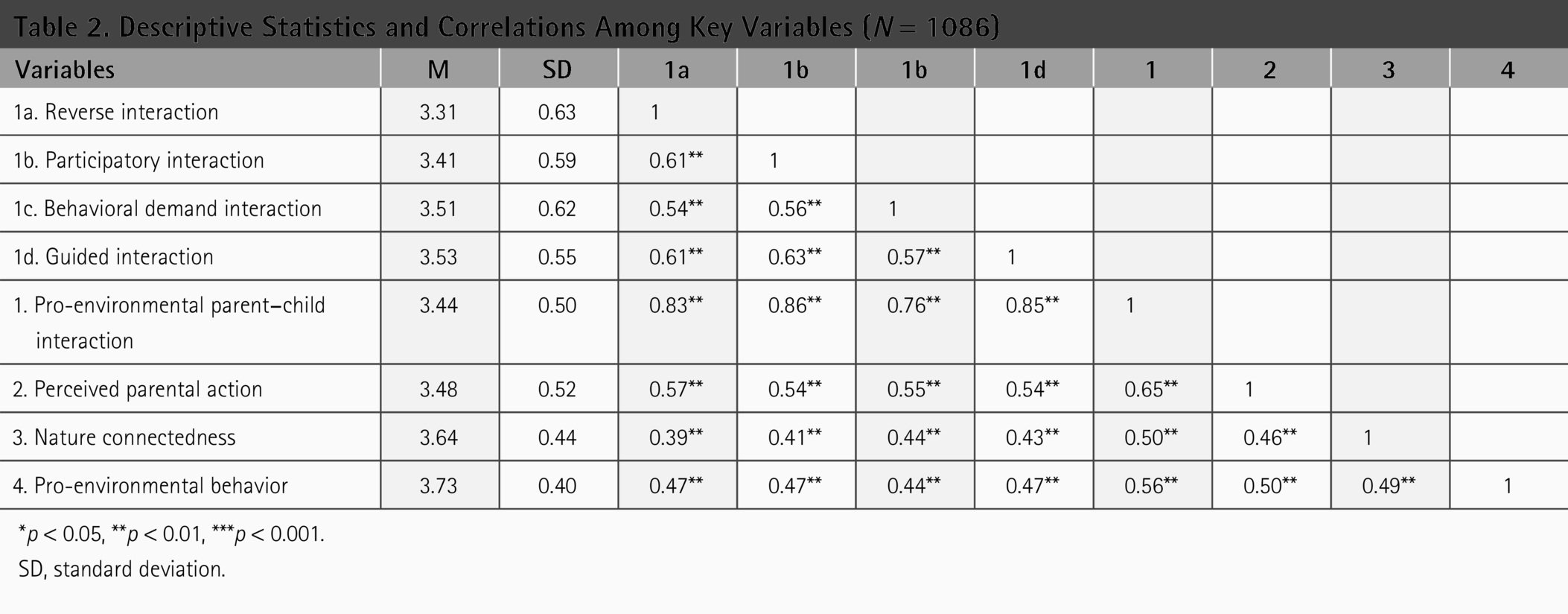
*p < 0.05, **p < 0.01, ***p < 0.001.
SD, standard deviation.
The results of the regression analysis indicated that, after controlling for variables such as parental education level and parental occupation, PEPCI had a significant positive relationship on PEB (β = 0.23, p < 0.001). This result supports Hypothesis 1 (H1), confirming that PEPCI positively predicts children’s PEB. Furthermore, all four dimensions of PEPCI demonstrated significant positive predictive effects on PEB (guided interaction: β = 0.18, p < 0.001; reverse interaction: β = 0.17, p < 0.001; participatory interaction: β = 0.17, p < 0.001; behavioral demand interaction: β = 0.15, p < 0.001). Collectively, these four dimensions accounted for 31% of the variance in PEB.
The current study used Model 6 of the PROCESS macro for SPSS with 5000 bootstrap samples (Hayes, 2017) to examine the mediation model predicting children’s PEB. Table 3 presents the direct and indirect effects. The overall regression equation was significant, R2 = 0.40, F(9, 1076) = 78.55, p < 0.001. Specifically, the results revealed that perceived parental action significantly mediated the relationship between PEPCI and PEB (β = 0.08, standard error [SE] = 0.01, 95% confidence interval [CI]: [0.05, 0.10]). nature connectedness also served as a significant mediator (β = 0.06, SE = 0.01, 95% CI: [0.04, 0.09]). Hypotheses 2, 3, 4, and 5 were all supported. Furthermore, there was a significant serial mediation effect through perceived parental action followed by nature connectedness (β = 0.03, SE = 0.01, 95% CI: [0.02, 0.04]). Hypothesis 6 (H6) was also supported. We tested a path model (shown in Fig. 2) in which PEPCI predicted children’s PEB, mediated sequentially by perceived parental action and nature connectedness.
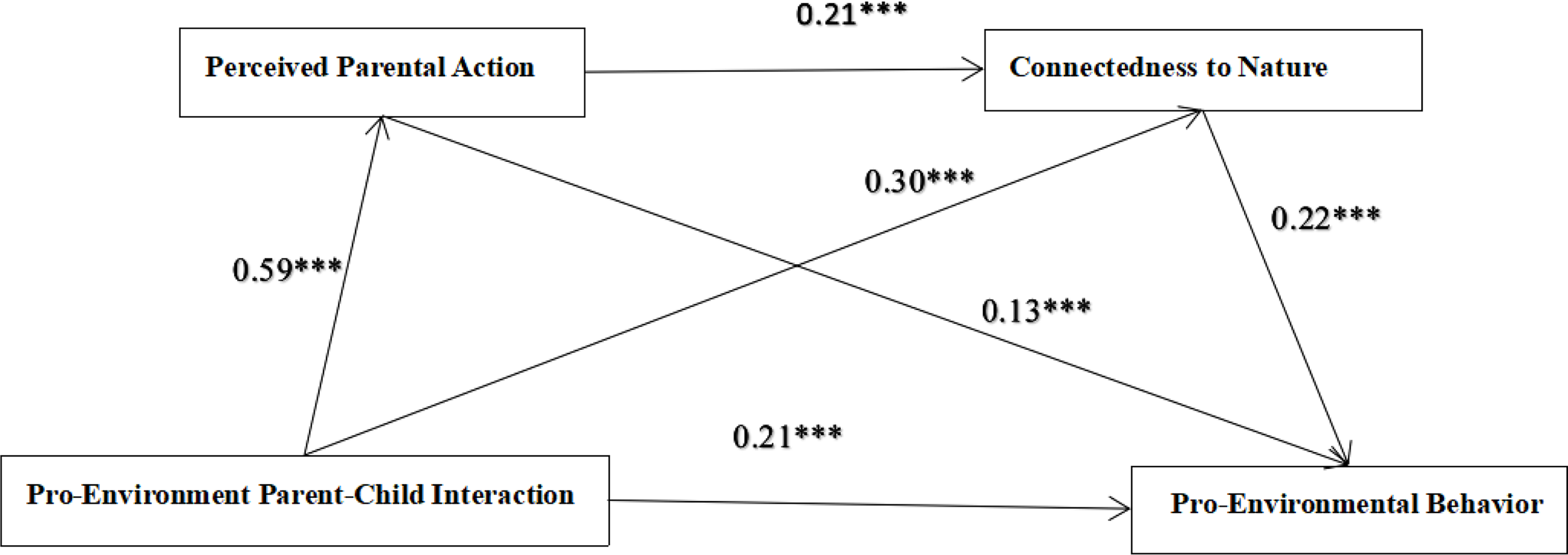
Mediation Model of the Perception of Parental Action and nature connectedness.
Bootstrap Analysis for Testing the Mediation Effect
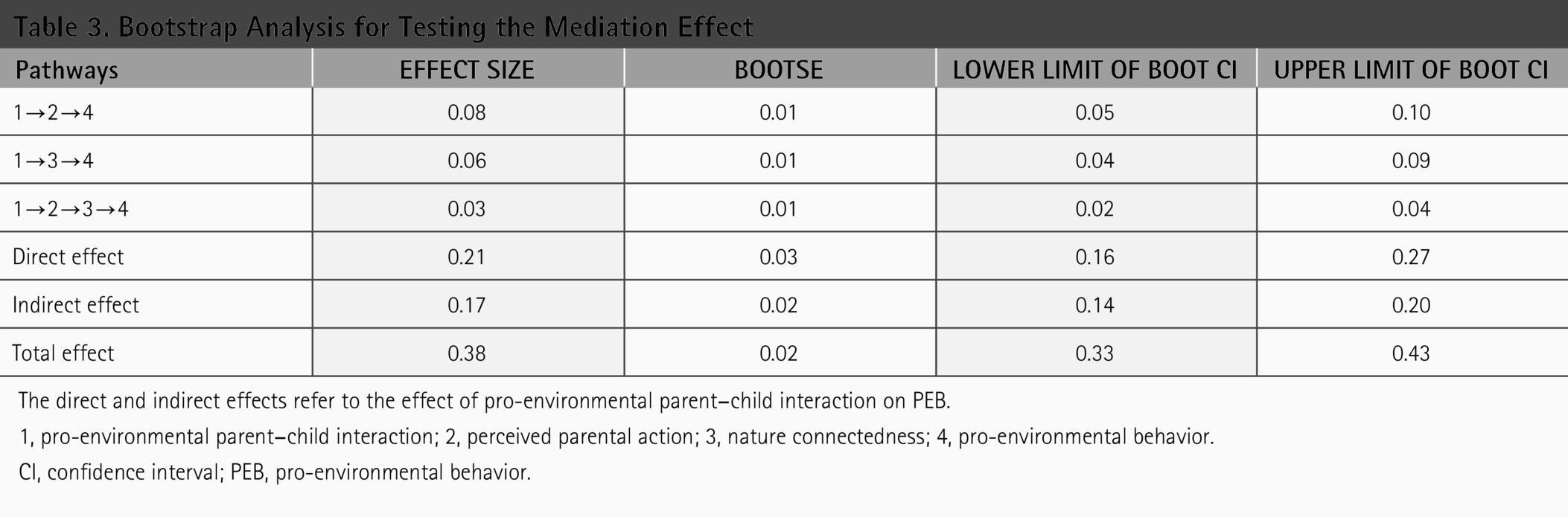
The direct and indirect effects refer to the effect of pro-environmental parent
1, pro-environmental parent
CI, confidence interval; PEB, pro-environmental behavior.
Discussion
The results of Study 2 indicated that PEPCI significantly and directly predicted children’s perception of parental action, nature connectedness, and PEB.
Specifically, more frequent PEPCIs were associated with higher levels of perceived parental action, which in turn enhanced children’s nature connectedness and ultimately promoted their PEB. Typically, parents serve as the most significant reference group and facilitators of socialization within the family environment, exerting a profound effect on children’s cognition and behaviors (Gong et al., 2022).
General Discussion
The family serves as a crucial context for early childhood socialization, and parent
More positive PEPCI is associated with higher levels of individual PEB. Katz-Gerro et al. (2020) conducted a cross-cultural study examining the relationship between socialization domains and PEB among participants from Israel, South Korea, and the United States. Their results indicated that only the domains of group participation and reciprocity significantly enhanced children’s PEB, with the most pronounced effects observed among South Korean participants. In contrast, the present research found that participatory interaction, guided interaction, reverse interaction, and behavioral demand interaction all positively promoted individuals’ PEB. Several factors may explain these divergent findings. First, although the theoretical foundation of the four dimensions of PEPCI in this study draws from the environmental socialization domains proposed by Katz-Gerro et al. (2020), the two questionnaires differ in structure and content. The questionnaire developed in this study was constructed in accordance with standard scale development procedures, demonstrates good reliability and validity, and is specifically tailored to assess PEPCI among Chinese elementary school students. Second, cultural differences likely play a significant role (Milfont & Schultz, 2016). In the current sample, guided interaction received the highest scores and also showed the highest regression coefficient in predicting PEB. This suggests that current PEPCIs in the studied context tend to emphasize verbal instruction—that is, parents are more likely to “preach” than to “practice” together with their children. Previous studies have confirmed that merely discussing environmental topics with children can influence their environmental values and behaviors (Grønhøj & Thøgersen, 2017; Meeusen, 2014). However, empirical evidence also suggests that participatory interaction more effectively promotes children’s PEB (Jia & Yu, 2021; Katz-Gerro et al., 2020). Although traditional Chinese cultural values emphasize that “actions speak louder than words,” actual practices appear to prioritize verbal guidance. Therefore, it is encouraged that parents not only impart environmental knowledge but also actively engage with their children in PEBs.
Reverse socialization was initially proposed in the context of family consumption, referring to “the process by which children may influence their parents’ consumption-related knowledge, skills, and attitudes” (Gentina & Singh, 2015). Findings regarding reverse socialization in the environmental domain have been inconsistent. Some studies suggest that adolescents can influence their parents’ PEB and environmental knowledge (Damerell et al., 2013; Maddox et al., 2011), while others indicate that although adolescents participate in family discussions about environmental consumption, their involvement does not necessarily lead to changes in household behavior (Grønhøj, 2006). The inconsistent results may be attributed to different underlying mechanisms. Adolescents’ environmental concern can effectively promote household PEB through parents’ perception of their knowledge and the use of two-way communication strategies (Singh et al., 2020). Consistent with the perspective of Singh et al. (2020), children can serve as positive role models for pro-environmental practices within the family. While previous studies have primarily focused on children’s effects on parental behavior, the present research focused specifically on the impact of reverse interaction on environmental topics on children’s own PEB. When children initiate discussions about environmental issues with their parents, they may not only influence their parents’ behaviors but also deepen their own understanding of environmental issues, enhance their connection to nature, and encourage the adoption of more PEB.
In addition, behavioral demand interaction by parents also contributes positively to children’s PEB. Requiring children to behave in environmentally friendly ways or rewarding their pro-environmental actions can directly promote such behaviors. This result aligns with domain-specific socialization theory (Grusec & Davidov, 2010) and reflects the value of normative guidance in Chinese family environmental education. Unlike rigid punitive control, this interaction combines high responsiveness (through dialogue) and moderate demandingness (setting behavioral standards; Martin-Blesa et al., 2024). Ling and Chen (2023) found that Chinese parents can exert either informational or normative influence to promote their children’s PEB. Consistent with Matthies et al. (2012), appropriate normative requirements—rooted in Chinese cultural values of parental authority balanced with emotional connection—effectively foster children’s PEB without triggering resistance. In alignment with Matthies et al. (2012), our research confirms that parents play a critical role as normative agents in shaping children’s PEBs. However, while Matthies et al. focused primarily on unidirectional parental influence (e.g., sanctions and descriptive norms) among younger children (aged 8–10), our research expands this perspective by incorporating bidirectional and multidimensional interactions—including participatory and reverse interactions—that reflect a more dynamic family system.
In summary, PEPCI facilitates the development of children’s PEB. In daily practice, parents use all four forms of interaction—participatory, guided, reverse, and controlling—although this study did not determine which form is most effective. Future research should further examine the relative impact of these interaction types.
PEPCI not only directly promotes children’s PEB but also indirectly affects it through the mediating effects of perceived parental action and nature connectedness. Frequent PEPCIs in daily life enhance children’s perceived parental action, which is particularly evident in participatory interactions, where joint engagement in environmental activities or the completion of PEBs within the family allows children to observe and experience their parents’ actions directly (Jia et al., 2022). Consequently, a stronger perceived parental action is associated with a greater tendency for adolescents to adopt PEB (Grønhøj & Thøgersen, 2012; Jia et al., 2022). Wallis and Klöckner (2020) also confirmed that adolescents who more clearly perceive their parents’ energy-saving behaviors are more willing to conserve energy in their own daily lives. Parents’ pro-environmental actions serve a role-modeling function (Matthies et al., 2012).
Furthermore, parents or guardians play a critical role in shaping children’s level of nature connectedness (Barrable & Booth, 2020; Passmore et al., 2021). Parents who show greater concern about environmental issues (Soga et al., 2016) or possess richer environmental knowledge and experience (Truong, Nakabayashi, & Hosaka, 2022) tend to interact more frequently with their children on environmental topics. Such parents often engage their children in discussions about environmental issues, encourage an appreciation for the natural environment, and are more inclined to involve them in outdoor activities and nature-based play.
Nature connectedness is a well-established predictor of children’s PEB (Barrera-Hernández et al., 2020; Liefländer et al., 2013; Mackay & Schmitt, 2019; Mayer & Frantz, 2004). Compared with environmental knowledge alone, a child’s emotional connection to nature is a stronger predictor of PEB, accounting for over 60% of the variance in such behaviors (Otto & Pensini, 2017). However, increasing urbanization has contributed to a growing incidence of nature-deficit disorder among children (Wang, Geng, & Rodríguez-Casallas, 2023). Therefore, it is essential to enhance children’s nature connectedness through diverse forms of PEPCI, thereby fostering the development of PEBs.
According to the SOR theory (Mehrabian & Russell, 1974), external stimuli trigger an individual’s internal psychological state, which in turn leads to behavioral change. In the context of PEPCI, repeated exposure to informational and emotional stimuli—such as discussions about ecological issues or shared reflections on human–nature relationships—can evoke empathy toward nature, stimulate critical thinking regarding environmental conditions, and foster a sense of responsibility for environmental protection. This internal shift motivates the adoption of PEBs.
These findings suggest that lower levels of PEPCI may correspond to reduced children’s PEB. Interventions aimed at enhancing both the frequency and quality of such interactions can strengthen children’s perception of parental action and their nature connectedness, thereby indirectly promoting PEB.
Limitations
Research has indicated that mothers and fathers may differ both in the frequency and topics of their interactions with children (Menashe & Atzaba-Poria, 2016; Rhoades et al., 2011). Future studies could therefore distinguish between maternal and paternal pro-environmental interaction patterns. Second, the present research focused exclusively on the children’s perspective. However, parent
Authors’ Contributions
H.S.: Conceptualization, methodology, formal analysis, writing—original draft, writing—review and editing, and English language editing. K.Y.: Conceptualization, methodology, formal analysis, writing—review and editing, and supervision. H.L.: Supervision and English language editing. J.D.: Data collection.
Footnotes
Author Disclosure Statement
The authors declared no potential conflicts of interest with respect to the research, authorship, and/or publication of this article.
Funding Information
This research did not receive any specific grant from funding agencies in the public, commercial, or not-for-profit sectors.