



Abstract
Background
Dupilumab was first approved by the United States Food and Drug Administration in 2017 for atopic dermatitis and has since been approved for many other indications. The use of dupilumab has grown, but industry payments to physicians have yet to be explored.
Objective
The study objective is to characterize the change in payments by pharmaceutical companies to physicians for dupilumab-related promotional activities.
Methods
Data from 2017 to 2023 was extracted from the Open Payments website and filtered to determine the number of dupilumab-related payments to physicians, the amounts of these payments, the number of unique physicians that were paid, and the amount of money going towards different payment purposes.
Results
In 2017, pharmaceutical companies paid a total of $6.1 million to allergists/immunologists, dermatologists, gastroenterologists, otolaryngologists, and pulmonologists for dupilumab-related activities. This amount grew to a total of $22.6 million in 2023. These specialties all experienced an increase in the number of unique physicians paid; the number of allergists/immunologists paid increased by 1.8-fold, dermatologists by 1.4-fold, gastroenterologists by 640-fold, otolaryngologists by 95-fold, and pulmonologists by 118-fold. Across all five specialties, pharmaceutical companies paid the most money for the purpose of non-consulting, non-continuing education speaker fees.
Conclusion
From 2017 to 2023, pharmaceutical companies have paid increasing numbers of payments to increasing numbers of unique allergists/immunologists, dermatologists, gastroenterologists, otolaryngologists, and pulmonologists for dupilumab-related promotional events.
Keywords
Introduction
Dupilumab is a monoclonal antibody that targets the interleukin-4 (IL-4) receptor alpha subunit to suppress IL-4 signaling. 1 It was developed by Regeneron Pharmaceuticals and received United States Food and Drug Administration approval in 2017 for treatment of mild-to-moderate atopic dermatitis. Since then, dupilumab has been approved for additional conditions, including asthma (2018), chronic rhinosinusitis with nasal polyposis (2019), eosinophilic esophagitis (2022), and prurigo nodularis (2022). 2 Regeneron Pharmaceuticals, in partnership with Sanofi, is continuing to research further indications for the use of dupilumab. 2 The number of providers prescribing dupilumab has also increased in recent years 3 and as a result, from 2017 to 2023, dupilumab revenue increased from $256 million to $11.6 billion. 4
Previous studies have shown associations between industry-funded meal payments to physicians and increased number of dupilumab prescriptions.5,6 Given this, it is important for providers to be cognizant of the magnitude of industry payments and the potential influence on prescribing patterns. As of 2010, the Sunshine Act mandates reporting of all payments between industry and physicians for greater transparency of these relationships 7 and this data is made publicly available on the Open Payments website, managed by the United States Centers for Medicare and Medicaid Services. 8 In this study we aimed to characterize the trends and types of dupilumab-related payments to providers across five different relevant specialties: allergy/immunology, dermatology, gastroenterology, otolaryngology, and pulmonology.
Methods
Data from the Open Payments website is separated into ownership payments, research payments, and general payments. 8 General payment data that involved dupilumab from 2017 to 2023 was extracted, which includes payments for honoraria, grants, travel and lodging, food and beverage, education, consulting, and non-consulting non-continuing education speaker fees. Preliminary searches showed that payments related to dupilumab were listed as ‘Dupixent’ or ‘Dupixent Dupilumab Injections’ in the database. The Dataset Explorer tool on the Open Payments website was used to filter for all payments containing the words ‘Dupixent’ or ‘Dupilumab.’ Payments that involved multiple products (ie, dupilumab and other products) were removed from further consideration. For all payment amounts, the Consumer Price Index from the Bureau of Labor Statistics 9 was used to adjust for inflation, with results reported by the value of the United States dollar in 2023.
The pulled data was filtered for payments made to providers of the following relevant specialties: allergy/immunology, dermatology, gastroenterology, otolaryngology, and pulmonology. Since the payments data may list varying specialties for the same provider based on company data entry discrepancies, the following methodology was used to determine provider specialty: (1) the ‘covered recipient profile primary specialty’ in Open Payments was used as the provider's designation if available; (2) if not available, the specialty entered at data entry was used if all data entries pulled for a provider fell under the same specialty; (3) for the few providers where discrepancies still existed, the most common specialty they were associated with was used. After filtering by specialty, the following payment variables were further analyzed: year, amount, recipient identification number, and purpose (listed on Open Payments as ‘nature of payment or transfer of value’).
Microsoft Excel was used to calculate the total dollars and number of payments made to the selected specialties each year. SPSS was used to analyze the spread of data and identify outlier payment amounts which are defined in this study as being above the 90th percentile. Given the publicly available nature of the data, this study was deemed exempt from institutional review board approval.
Results
The annual number of non-research, non-investment related payments to physicians practicing in the five specialties of interest followed an upward trend from 2017 to 2023, except for the year 2020 (Figure 1). The total dollars paid to physicians in each specialty followed a similar trend. From 2017 to 2021, the specialty that received the most dollars paid each year was dermatology, followed by allergy/immunology, pulmonology, otolaryngology, and gastroenterology in that order. In 2022, the total dollars paid to gastroenterology surpassed that of total dollars paid to otolaryngology and in 2023, gastroenterology surpassed both pulmonology and otolaryngology.

Total amount of dupilumab-related payments by year and specialty.
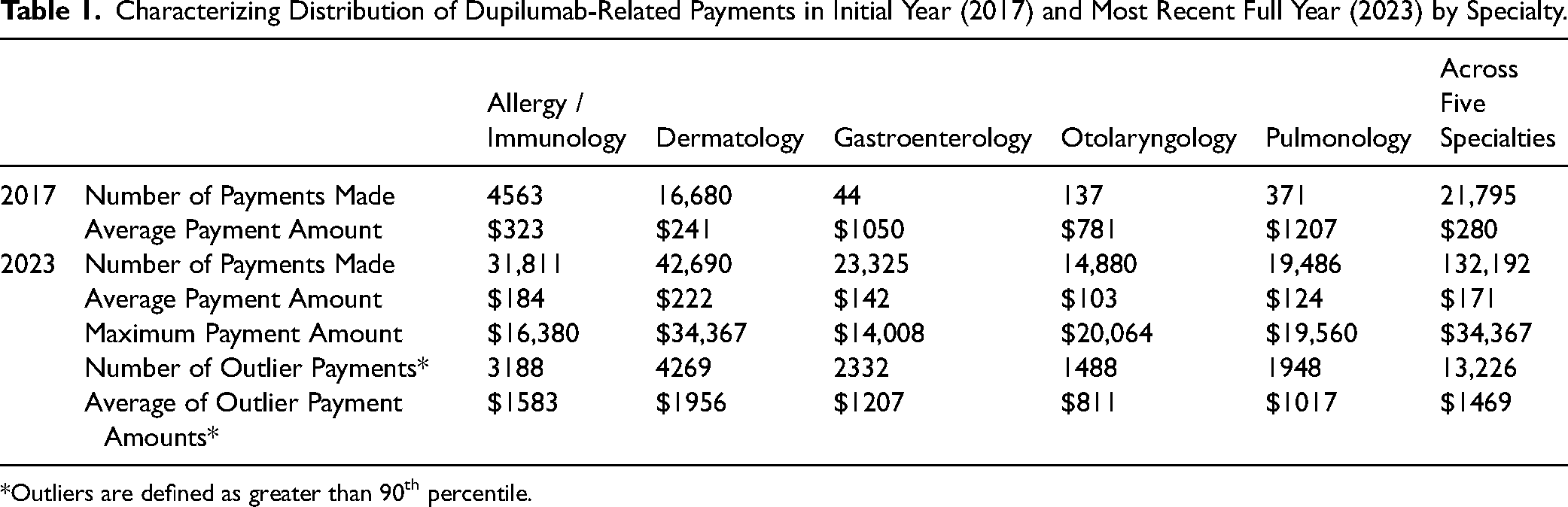
In 2017, pharmaceutical companies made a total of 21,795 payments to physicians in the five specialties of interest for dupilumab-related activities which increased to 132,192 payments in 2023 (Table 1). In 2017, a total of $6.1 million was paid to physicians across the five specialties which increased to a total of $22.6 million in 2023 (Table 2). From 2017 to 2023, pharmaceutical companies paid a total of $96.2 million to doctors across the five specialties (Table 2).
Characterizing Distribution of Dupilumab-Related Payments in Initial Year (2017) and Most Recent Full Year (2023) by Specialty.
*Outliers are defined as greater than 90th percentile.
Characterizing Dupilumab-Related Payments Across Specialties by Total Dollars Paid, Number of Payments Made, and Number of Unique Individuals Paid from 2017 to 2023.
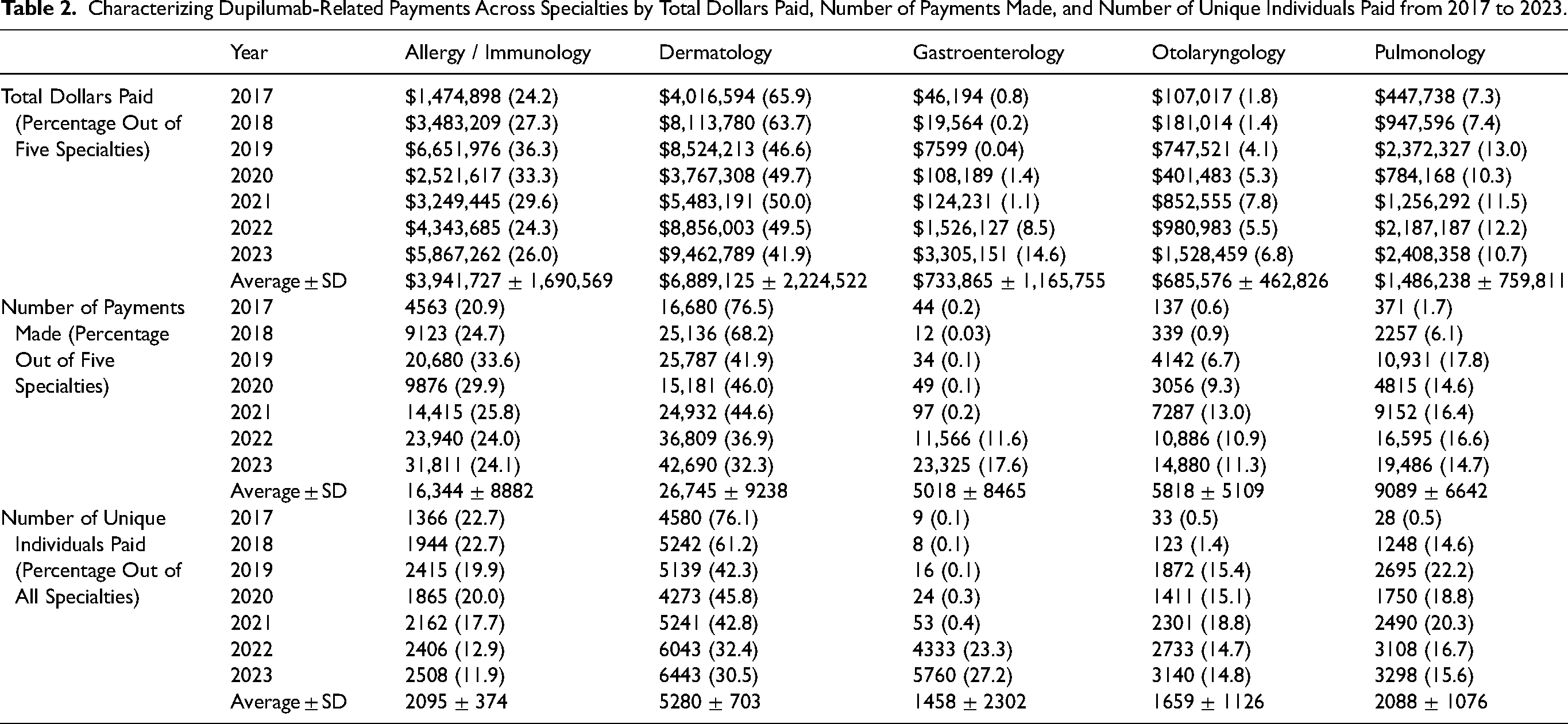
While the average payment transaction amount decreased from $280 in 2017 to $171 in 2023 (Table 1), the number of payment transactions made to physicians, as well as the number of unique physicians who received payments, increased during this time frame (Table 2). These overarching trends stayed consistent when each specialty was analyzed individually. The number of allergists/immunologists that were paid for dupilumab-related activities increased almost 1.8-fold during this period while dermatologists increased about 1.4-fold. The number of unique gastroenterologists, otolaryngologists, and pulmonologists paid increased by 640-fold, 95-fold, and 118-fold, respectively. In 2023, the top 10% of single payment amounts to allergists/immunologists ranged from $135 to $16,380, for dermatologists $129 to $34,367, for gastroenterologists $103 to $14,008, for otolaryngologists $85 to $20,064, and pulmonologists $91 to $19,560.
For all five specialties, non-consulting, non-continuing education speaker fees made up the largest category of spending (Figure 2). For allergy/immunology, dermatology, and pulmonology, the second largest category of spending was on consulting fees. For gastroenterology and otolaryngology, the second largest category of spending was on food and beverage. Pharmaceutical companies paid all five specialties the least amount of money for education purposes. Allergy/immunology was the only specialty of the five that received grant money.
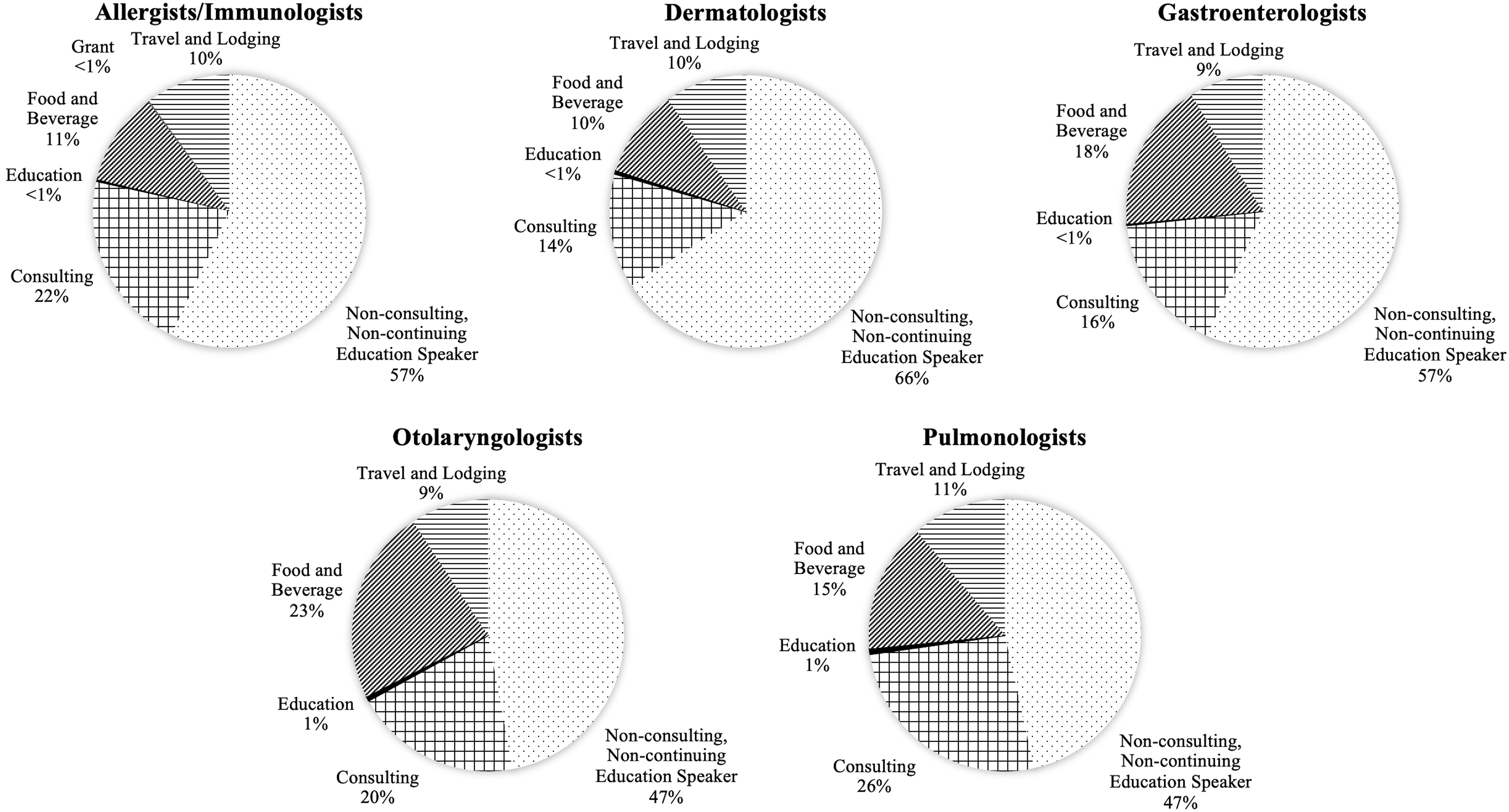
Proportion of total dollars paid from 2017 to 2023 for dupilumab-related payments to five specialties by payment purpose.
The five specialties of interest accounted for 91.2% of the total dollar amounts paid and 90.8% of the total number of payments related to dupilumab, supporting the premise that the specialties included for analysis are the most pertinent to examining payments related to the drug.
Discussion
As both the indications for, and general awareness of, dupilumab and other biologics have grown, promotional payments to physicians that treat these indications have also increased. From 2017 to 2023, pharmaceutical companies have increasingly paid more total dollars and completed more transactions with a greater number of unique allergists/immunologists, dermatologists, gastroenterologists, otolaryngologists, and pulmonologists. The increase in number of unique individuals paid can likely be partially attributed to pharmaceutical companies hosting more promotional events and dinners where providers can sign up and receive a payment, regardless of actual attendance.
In 2017, pharmaceutical companies paid dermatologists the greatest number of payments, likely due to dupilumab first being approved for atopic dermatitis. This mirrors data from a prior study showing that dermatologists comprise the largest specialty in terms of prescribers of dupilumab. 10 While dermatologists still hold the greatest proportion of payments in 2023 and will likely continue to do so due to the prevalence of eczema compared to other approved indications, companies are distributing increasing numbers of payments to gastroenterologists, otolaryngologists, and pulmonologists. This is consistent with the expansion of dupilumab's indications to include eosinophilic esophagitis, chronic rhinosinusitis, and asthma. The approval of dupilumab for eosinophilic esophagitis correlates with the increase in total dollars paid to gastroenterologists from 2021 to 2023. As the indications for dupilumab continue to expand, further changes in payment trends may follow. While these payments nominally go towards increased awareness and education for physicians, which will benefit more patients, it is important to recognize the possible effects pharmaceutical companies have on physician prescribing patterns. 11
Limitations of this study include the use of a large database with data that are self-reported by pharmaceutical companies. This subjects the data to reporting bias and potential inaccuracies despite the reporting mandate. Further, since this is an observational study, the results presented are based on association, and no causation can be asserted. Finally, the database is updated biannually, so the data in this study only reflects what was in the database at the time of collection. This issue is mitigated in part by reporting time requirements, and the results presented would be expected to change minimally if redone at a later date with updated data.
Conclusion
From 2017 to 2023, a total of $96.2 million were paid to allergists/immunologists, dermatologists, gastroenterologists, otolaryngologists, and pulmonologists for dupilumab-related activities with total dollars paid, number of payments made, and number of unique individuals paid increasing each year. As the indications for dupilumab continue to grow, it is crucial for physicians to be aware of the magnitude of industry payments and the potential effects on physician prescription patterns and their recommendations to patients.
Footnotes
Acknowledgments
Not applicable
Consent to Participate
Not applicable
Consent for Publication
Not applicable
Data Availability

Declaration of Conflicting Interests
The authors declared no potential conflicts of interest with respect to the research, authorship, and/or publication of this article.
Funding
The authors received no financial support for the research, authorship, and/or publication of this article.
Ethical Considerations
This study was deemed exempt from institutional review board approval due to the data being publicly accessible.