



Abstract
This article explores the breadth of the futures studies field by creating a dialogue with some prominent approaches to climate change. The first half of the article takes an evolutionary perspective on the development of the futures studies field. I show how developments in the field parallel the broader epistemological shift from the centrality of positivism to a plurality of postpositivist approaches particularly in the social sciences. Second, I explore the current scientific research on climate change including issues related to mitigation, adaptation, and coevolution. Finally, I apply my futures typology that includes five paradigmatic approaches to undertake a dialogue between futures studies and climate change.
Keywords
Introduction
Throughout the last half-century, a large number of futures scholars have produced significant bodies of work. 1 In spite of this substantial body of work, misconceptions about the futures studies field are common in academic, professional, and policy circles, and even more so in the popular media. Misconceptions range from the belief that futures studies is primarily about “prediction” and “forecasting” to the idea that futures studies can be nothing more than “ungrounded speculation,” because the future is inherently unknowable. Although some who call themselves futurists may rely almost solely on so-called predictive methods and populists may engage in ill-considered speculative fantasy, this is far from the whole picture. Between these extremes, we find the serious academic field of futures studies, proponents of which recognize that there is a huge amount at stake in learning how to approach futures concepts and methods to create more equitable, durable, and thus desirable futures. Although the acceleration of change has prompted an increasing use of the term “future” in academic and policy discourses, the vast body of material produced by futures researchers has been largely ignored in academia and misrepresented by the media. As a consequence, futures and foresight literature has not had the visibility or appreciation that it deserves.
What is generally unknown about futures studies is that in addition to empirical trend analysis, technological forecasting, scenario planning, and the increasingly popular trendspotting, there are several lesser-known approaches to futures understanding, research, and cocreation. This article explores the breadth of the futures studies field by creating a dialogue with some prominent approaches to climate change.
With respect to climate change, I acknowledge that the notion of anthropogenic climate change is not universally agreed and that although the science is clear the politics is not. I recognize that even those who agree with it do not universally see it as a negative issue. Some with an entrepreneurial spirit may see climate change as providing opportunities: for example, to settle on the poles, or even mine them; to extend agriculture into previously barren regions; and to live in closer relationship with the sea or in floating cities. Notwithstanding these examples of “climate optimism,” I wish to be transparent about my own bias at the outset. In this article, I take the critical view that the planetary climate is changing in ways that increase risk for large swathes of the global population and that this is potentially irreversible. I accept the science that argues this change is anthropogenic, that is, caused by our industrialized human lifestyle over the last century. I am deeply concerned that the kind of changes that appear likely will have potentially devastating effects on global human society in the foreseeable future in terms of melting polar glaciers, leading to rising sea levels, in turn leading to flooding of Pacific islands and inundation of low-lying countries and a large number of large coastal megacities, driving mass migration on a scale not seen for ten thousand years. My motivation for this article is to draw wider attention to how futures studies perspectives may assist in broadening the climate dialogue and the methods used to mitigate, prepare, and coadapt.
Understanding Futures Studies: A Broadening of Approaches
Futures studies is a transdisciplinary, transnational, and multisectorial field that includes thousands of academics and practitioners, many of whom operate globally. There are many possible ways to frame the recent history of futures studies. My approach is to trace the evolution of futures studies, as it parallels the epistemological development across the wider academic domain.
In the 1960s, when futures studies was emerging as an academic field, major changes were taking place in the way that scientific research per se was conceived and practiced. There were disruptive developments in thinking and knowledge systems that could be seen to mark a paradigm shift from industrial worldviews associated with positivism, modernism, specialization, and formal reasoning, to postindustrial worldviews associated with postpositivism, postmodernism, integration, and postformal reasoning. These developments are referred to elsewhere as “megatrends of the mind” 2 and “global mindset change” within the context of the evolution of consciousness. 3
Epistemological pluralism was introduced at the paradigmatic level last century through the emergence of the historical philosophy of science championed by Thomas Kuhn and Paul Feyerabend. This marked the shift from positivism/empiricism as the only way of knowing leading to the emergence of “postpositivism,” which seeded a plethora of research methodologies arguably better suited to social science research than the reductionist forms of empiricism.
During the 1970s, German philosopher Jürgen Habermas was a pioneer in highlighting the significance of postpositivist methods. He introduced the three notions of technical interests (through positivist methods for obtaining instrumental knowledge), practical interests (through interpretive/hermeneutic methods for obtaining practical knowledge), and emancipatory interests (through critical methods for obtaining emancipatory knowledge). 4
In the 1980s, Norwegian peace researcher and early president of the World Futures Studies Federation (WFSF) Johan Galtung and others involved in the futures studies field began to apply these pluralistic, postpositivist perspectives to perceptions of the future. 5 Galtung was one of the earliest futurists to write about different kinds of futures. I have expanded on his original terms as follows:
Probable future—relates to trend extrapolation, so-called prediction, and often bringing up fears, despair, and pessimism among young people;
Possible futures—relates to imagination, interpretation, and utopian and dystopian images—science fiction is a good stimulus;
Preferred futures—relates to and includes normative values so that critique of the status quo is often inherent in this perspective.
Building on Galtung’s work, Swedish futurist, Ake Bjerstedt identified a fourth orientation or goal in preparing for the future, which he called “prospective” futures capacity relating to “preparedness to act.” 6
Prospective futures—relating to readiness to act, in spite of feared images of the “probable” future and building on the original French prospective. 7
In the late 1990s, my master’s research on youth futures drew together the influential critical philosophical work of Habermas and the futures work of Galtung, Bjerstedt, and Inayatullah to develop a four-level futures typology making the following links:
Probable future with positivist/empirical
Possible futures with constructivist/interpretive
Preferred futures with critical/normative
Prospective futures with empowerment/participatory 8
In subsequent years, I built on this typology, integrating the approaches of Eleonora Masini, Wendell Bell, and Richard Slaughter. The typology below builds on earlier typologies—most of which propose three or four different futures paradigms. 9 Several other futures researchers have developed ways to describe the different futures approaches and how they have emerged, but it is beyond the scope of this article to explore them all. 10 In 2004, I proposed a five-paradigm futures studies typology, 11 which I have continued to refine. My current model begins with a single bifurcation between positivist and postpositivist, with the postpositivist approaches diverging into a plurality of well-known and oft-cited futures approaches 12 (see Figure 1).

Paradigmatic bifurcation of futures studies approaches. 13
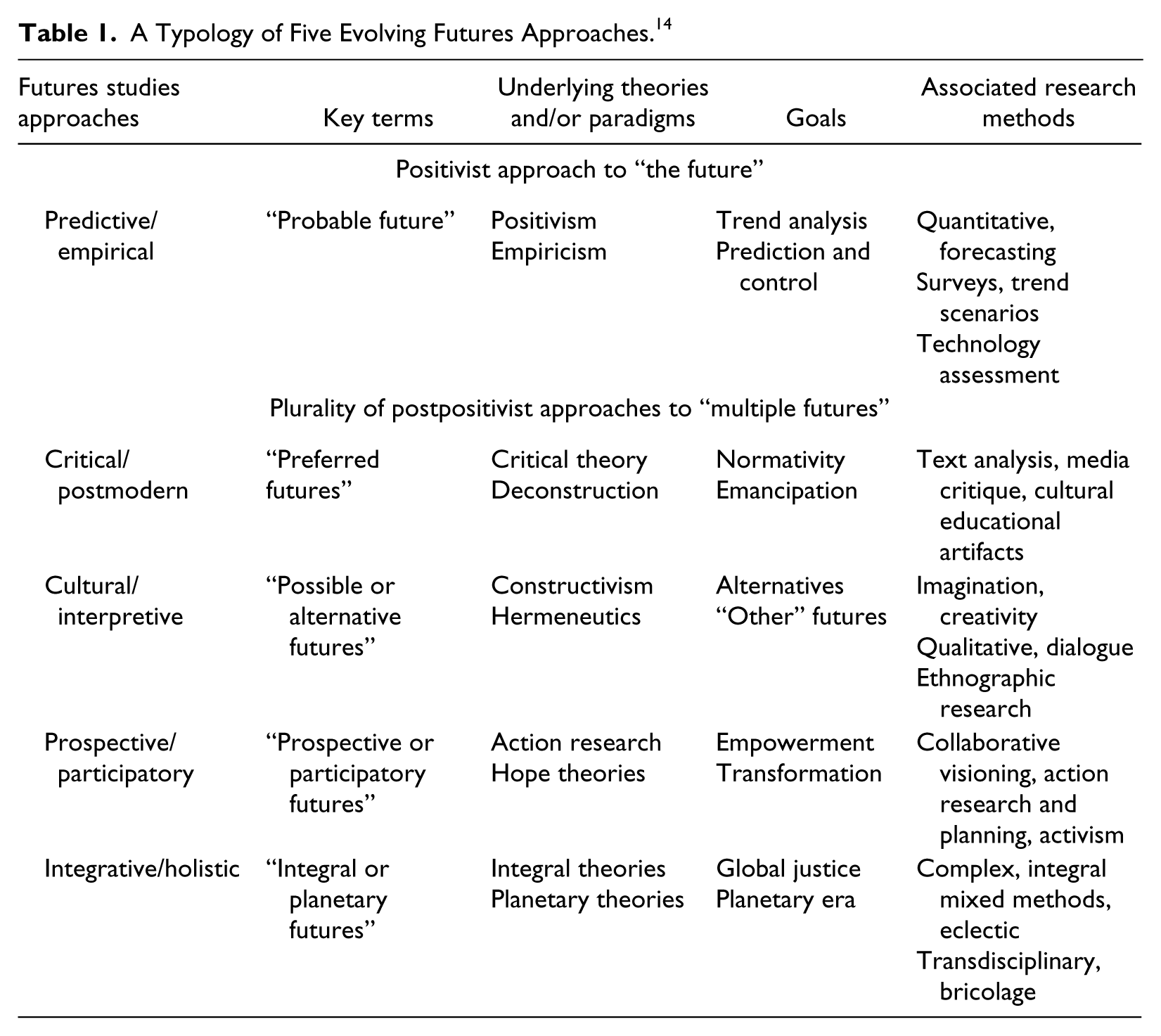
These approaches are not mutually exclusive, nor are they a definitive statement about all possible futures paradigms. They are all suitable pathways to futures research depending on the context. Nor should this conceptualization imply a linear developmental model. Each approach represents different epistemological underpinnings, which parallel similar developments in other fields (see Table 1). As indicated below, each of these approaches has strengths and limitations as does the futures studies field as a whole.
A Typology of Five Evolving Futures Approaches. 14
Positivist Approaches to “the Future”
Positivism is a theory of knowledge following or building on the work of the Vienna Circle of the 1920s and 1930s associated with such people as Moritz Schlick, Rudolf Carnap and Otto Neurath . . . It prominently features the work of Karl R. Popper, perhaps its most central figure in recent decades, despite his denials that he was a positivist. [Its central feature being] . . . the belief that science involves the idea of the unity of science, that there is, underlying the various scientific disciplines, basically one science about one real world.
15
The predictive-empirical tradition originated in the United States. It arose initially from U.S. Defense Intelligence but was supported as a methodology with broader purposes by the formation of the World Future Society in the late 1960s. This research refers to a one and only future that empirical trends suggest and is often referred to as the (singular) “probable future.” This approach still dominates the literature base and, particularly, the popular media view of futures studies. One of the strengths of this approach is its perceived objectivity and values neutrality. Its weaknesses may include narrowness in focus and lack of contextual awareness. It also implies that trends are inevitable and this can be disempowering if the trends are negative. The predictive-empirical approach to forecasting was developed by men such as Herman Kahn, Ted Gordon, and other U.S. researchers from Rand Corporation and Institute for the Future.
Postpositivist Approaches to “Multiple Futures”
By the end of the 1960s, many writers on epistemology were saying that positivism was no longer a plausible theory of knowledge . . . Postpositivists believe that science does not constitute a unity. They disagree that less profound sciences can be reduced to more profound ones, that for example, sociology is reducible to psychology, psychology to biology, biology to chemistry, and chemistry to physics. Rather, science is viewed as being composed of many different “knowledges” each relative to a particular topic and community of scientists.
16
The critiques of positivism and empiricism came from scientists and social scientists, such as Thomas Kuhn, the critical theorists of the Frankfurt School, and Jürgen Habermas, to name a few. In the above quote, Wendell Bell expands on his claim that perhaps the most central postpositivist feature is knowledge pluralism. In the following brief notes, I explore the impact of this knowledge pluralism on the evolution of approaches within futures studies.
The critical-postmodern tradition originating primarily in Europe, grew out of a critical social theory tradition and became part of the movement of the 1960s to rebuild Europe in the aftermath of the Second World War. Critical futurists sought to balance what was sometimes perceived as the overly empiricist approach of many futurists in the United States. This led to the foundation of Mankind 2000 in the late 1960s, which resulted, among other initiatives, in the founding of the WFSF in the early 1970s. This approach is normative and is often referred to in the plural as “preferred futures.” A strength of this approach is that it makes explicit the—often tacit—contextual and values dimensions and thus leads to a questioning of “business as usual.” A weakness is its perceived subjectivity, which can sometimes lead to excessive relativism. The work of many founders and former presidents of the WFSF reflects the critical theory approach to futures studies, for example, Bertrand de Jouvenel, Johan Galtung, Eleonora Masini, Richard Slaughter, and Jim Dator.
The cultural-interpretive tradition arose in large measure from the work of those futures researchers who sought to include non-Western cultures and to invoke a deeper consideration of civilizational futures. This approach opens up the possibilities of alternative, particularly non-Western, 17 feminist, 18 and youth futures 19 and is a crucial part of the dimension that may be referred to as “possible, or alternative, futures.” Strengths of this approach include its creativity and engagement with multiple perspectives. A weakness is that proposed alternatives may lack feasibility or be overpowered by the dominant empiricist approach. Some of the key people who developed and who work from the cultural-interpretive approach are Sohail Inayatullah, Eleonora Masini, Ashis Nandy, and Ziauddin Sardar, among others.
The prospective-participatory approach seeks to facilitate empowerment and transformation through engagement and participation. It was initially developed by Austrian, French, and, later, Swedish and Australian futurists. 20 This could be referred to as “prospective” or “participatory futures,” depending on context. The most obvious strength of this approach is that it engages participants in action research projects, empowering them to question and act on alternatives to “business as usual.” A weakness is that if it does not also take account of relevant empirical research, it may lack legitimacy in positivist scientific circles. Some of the key futures researchers to use this empowering and participatory approach, initially by way of workshops, were Elise Boulding and Robert Jungk. Others include Gaston Berger, Ake Bjerstedt, Jennifer Gidley, Frank Hutchison, and Jose Ramos.
The integrative-holistic approach is potentially the broadest and deepest approach to futures as it can integrate multiple aspects. 21 Because it is grounded in complex, integrative, and transversal epistemologies, it maximizes potential for facilitating normative “planetary futures.” Its strength is its breadth of scope, which may enable the integration of different methods in different contexts. 22 However, too much breadth may also be perceived as a weakness reflecting lack of depth. There is also an ideological trap, which can lead to contested claims about integrality of approaches. Some of the key people who developed and work from the integral approach are Richard Slaughter, Joseph Voros, and Jennifer Gidley. But there were forerunners who took an integrative approach, such as John and Magda McHale.
Understanding Climate Change: Mitigation, Adaptation, Coevolution
Human influence on the climate system is clear, and recent anthropogenic emissions of green-house gases are the highest in history. Recent climate changes have had widespread impacts on human and natural systems . . . Warming of the climate system is unequivocal, and since the 1950s, many of the observed changes are unprecedented over decades to millennia. The atmosphere and ocean have warmed, the amounts of snow and ice have diminished, and sea level has risen.
23
It is now widely accepted among scientific and other research circles that the complex issue of anthropogenic climate change endangers our entire civilizational futures as it tracks a path to radical, rapid, and potentially irreversible changes in the global ecosystem in the relatively near-term future—within a century. The most recent Intergovernmental Panel on Climate Change (IPCC)
24
Fifth Assessment Report (2014) quoted above is far less equivocal than any previous reports to date. Professor Spencer Weart, director of the Center for History of Physics at the American Institute of Physics, points to the moment in recent history when the world’s scientists got the first inkling of the possibility of what he terms “rapid [or abrupt] climate change.”
25
Weart states, How abrupt was the discovery of abrupt climate change? Many climate experts would put their finger on one moment: the day they read the 1993 report of the analysis of Greenland ice cores. Before that, almost nobody confidently believed that the climate could change massively within a decade or two; after the report, almost nobody felt sure that it could not.
26
It is worth noting that even prior to the release of this crucial report, there was already sufficient concern around the planet that at the Earth Summit in Rio in 1992, the United Nations Framework Convention on Climate Change (UNFCCC)
27
was agreed on and signed. In this agreement, it was formally acknowledged by thirty-six signatory countries that anthropogenic climate change was already well underway. In an extract from the agreement, it was stated, The Parties to [the UNFCCC] Convention, acknowledging that change in the Earth’s climate and its adverse effects are a common concern of humankind, concerned that human activities have been substantially increasing the atmospheric concentrations of greenhouse gases, that these increases enhance the natural greenhouse effect, and that this will result on average in an additional warming of the Earth’s surface and atmosphere and may adversely affect natural ecosystems and humankind . . . have agreed that . . . “Climate change” means a change of climate which is attributed directly or indirectly to human activity that alters the composition of the global atmosphere and which is in addition to natural climate variability observed over comparable time periods (emphasis added).
In his opening speech at the international meeting of the UNFCCC held in Poznow, Poland 28 in December 2008, IPCC Chair, Rajendra K. Pachauri, deplored the lack of adequate attention and action that has occurred despite the 1992 agreement, noting that greenhouse gas (GHG) emissions have increased by a startling 70 percent between 1970 and 2004. Referring to the Fourth Assessment Report of the IPCC, 29 he drew attention to the extreme seriousness of the current situation, highlighting several serious global impacts that would be likely to result from continued inaction. Perhaps some of the more significant are the following:
The number of people living in severely stressed river basins would go up from 1.4 to 1.6 billion in 1995 to 4.3 to 6.9 billion in 2050.
Roughly, 20–30 percent of species assessed are likely to be at increasingly high risk of extinction as global mean temperatures exceed 2°–3° above preindustrial levels. We are getting close to that range.
Abrupt and irreversible changes are possible, such as collapse of the Greenland or West Antarctic ice sheets, which can lead to sea level rise of several meters. For Greenland, the temperature threshold for breakdown is estimated to be about 1.1°C –3.8°C above today’s global average temperature. Again, we are close to that range too.
By 2020, significant loss of biodiversity is projected to occur in some ecologically rich sites including the Great Barrier Reef in Australia. 30
The situation is not improving as shown in the recently released United Nations Global Assessment Report on Disaster Risk Reduction (2015), that is reported as stating that floods, storms, and other extreme weather events have killed 606,000 people since 1995, “with an additional 4.1 billion people injured, left homeless or in need of emergency assistance.” Similarly, the head of the UN World Meteorological Organization (WMO), Michel Jarraud, claimed that “We are moving into uncharted territory at a frightening speed,” when commenting on the WMO’s annual report 31 findings that “Earth-warming greenhouse gases in the atmosphere . . . carbon dioxide (CO2), methane and nitrous oxide once again broke records last year [2014].”
However, as many of us know, in spite of the weight of scientific evidence, the politics of climate change is not so clear. There are some in political and business circles, not the least in the United States and Australia, who deny that climate change is happening and many more who accept the climate is changing but believe it is part of the natural cycle as climate has always been changing. In the domain of big oil and coal, there are even more complex issues in train. The recent publication of an email from oil giant Exxon Mobil’s in-house climate expert, Lenny Bernstein, revealed that Exxon both knew about climate change and yet continued to fund “climate change deniers” for more than thirty years. It has also come to light that even pressure from the original founders of Exxon, the Rockefeller family, a decade ago, failed to influence Exxon to reform its practices.
ExxonMobil, the world’s biggest oil company, knew as early as 1981 of climate change—seven years before it became a public issue, according to a newly discovered email from one of the firm’s own scientists. Despite this the firm spent millions over the next 27 years to promote climate denial.
32
Mitigation and Adaptation
Adaptation and mitigation are complementary strategies for reducing and managing the risks of climate change. Substantial emissions reductions over the next few decades can reduce climate risks in the 21st century and beyond, increase prospects for effective adaptation, reduce the costs and challenges of mitigation in the longer term and contribute to climate-resilient pathways for sustainable development.
33
There are two main strands of work being undertaken in the broad area of climate futures: climate mitigation, which is largely a global issue, and climate adaptation, which is largely a local issue. According to the IPCC, both mitigation and adaptation are necessary to avert worsening global catastrophes. We will briefly summarize some key components of mitigation, but of more interest to my research is coevolutionary community adaptation through social learning, which in turn does enable some small-scale, bottom-up mitigation.
There are multiple mitigation pathways that are likely to limit warming to below 2°C relative to pre-industrial levels. These pathways would require substantial emissions reductions over the next few decades and near zero emissions of CO2 and other long-lived greenhouse gases by the end of the century. Implementing such reductions poses substantial technological, economic, social and institutional challenges, which increase with delays in additional mitigation and if key technologies are not available.
34
Climate change mitigation involves research, design, and implementation of strategies that will slow, and preferably reverse, the current unsustainable climate trends, particularly those associated with increased global warming—catalyzed by hyperindustrialization. The seriousness with which mitigation needs to be tackled on a global scale can be summed up in the following statement from IPCC 2014. “Without additional mitigation efforts beyond those in place today, and even with adaptation, warming by the end of the 21st century will lead to high to very high risk of severe, wide-spread and irreversible impacts globally (high confidence).” 35 It is generally recognized by climate change experts that the single most powerful strategy for mitigation is the global reduction of GHG emissions, which needs to be targeted across various sectors—such as energy, transport, building, industry, agriculture, forestry, and waste. Although much of the effort to reduce GHG emissions tends to focus on emissions from industry and households, a recent UN Human Development Report noted how changing land-use patterns in the developing world “drives carbon flows into the atmosphere.” The 2007–2008 UN Development Programme (UNDP) Report included a paper that focused on “tropical deforestation as a major source of rising carbon emissions and wider human development problems in the Brazilian Amazon—the largest area of tropical forests in the world.” 36
The 2007 IPCC Fourth Assessment Report has itemized numerous key sectorial mitigation technologies, policies and measures, constraints, and opportunities. 37 It also notes that the five “reasons for concern” have strengthened as they were identified in its previous Assessment Report, thus strengthening the need for mitigation—and adaptation—efforts to be stepped up. The five “reasons for concern” can be summarized as follows:
In contrast to mitigation, which must be tackled on a cooperative global scale, because of the global nature of anthropogenic climate change, adaptation relates more to the local effects of this global challenge. Feminist climate change activists Minu Hemmati and Ulrike Röhr highlight the importance of engaging women’s perspectives in the climate protection discourse, given the key role of women in many of the sectors affected by climate change: Adaptation, which must be context-specific and participatory, requires that all members of the affected communities be part of a climate change planning and governance process. If women are not fully involved in planning and decision-making . . . the quality of adaptive measures will be limited and successful implementation will be doubtful.
39
In relation to the importance of adaptation it is argued by the IPCC that Adaptation can reduce the risks of climate change impacts, but there are limits to its effectiveness, especially with greater magnitudes and rates of climate change. Taking a longer-term perspective, in the context of sustainable development, increases the likelihood that more immediate adaptation actions will also enhance future options and preparedness.
40
Even if the best possible scenarios for reduction and stabilization of GHGs, as recommended by the UNFCCC, were achieved, projected climate change events would still require significant adaptation. We can take renewed hope as a result of the multinational accord achieved at the Paris COP 21, December 2015. The main purpose of encouraging adaptive responses in those regions or communities, which are most likely to be affected by the projected climate changes, is to reduce their vulnerability to major unplanned distress. The kind of foresight and preparation that is valuable in these circumstances is referred to as “adaptive capacity [which] is intimately connected to social and economic development but is unevenly distributed across and within societies.” 41 Adaptive capacity is a complex and dynamic phenomenon, and although it is generally assisted by the strength of a society’s “productive base . . . capital assets” and so on, even societies with “high adaptive capacity remain vulnerable to climate change, variability and extremes.” 42 An interesting case in point is the indigenous tribe in Indonesia that escaped the major tsunami of 2006 because of its deeply intuitive understanding and reading of natural forces in contrast to the devastation that occurred in New Orleans in spite of the apparently superior adaptive capacity of the United States. Such extreme climate events have been increasing and are highly likely to continue to increase unless there is much more attention paid to both mitigation and adaptation, globally and locally.
From Passive Adaptation to Active Coevolution
As indicated by Ray Ison et al., 43 there are two possible interpretations that can be made from the etymology of the term “to adapt.” 44 These are “to fit” or to “make suitable.” The first interpretation, which is also the most commonly used one, is to see adaptation as a passive “fitting into” predetermined conditions. For example, if climate change projections suggest that “x” is highly likely to happen, then the communities affected by “x” will need to adapt or “fit into” this outcome. As Ison et al. suggest, this approach is deterministic, thus allowing for little human agency on the part of the community concerned. It is based on a formal, positivist scientific worldview, classical mechanistic metaphors, and simple linear causal relationships.
If the second interpretation of “to adapt” is taken, to “make suitable,” then a more active two-way interaction becomes possible. This allows for an alternative postformal, postpositivist scientific worldview to come into play. In the latter, arising from the new biological sciences of chaos and complexity, organic metaphors enable causation to be viewed as complex, nonlinear (including feedback loops), emergent and self-regulating. 45 An interesting metaphoric example has been used by the environmental scientists Kai Lee and Philip Shabecoff to express the shift from formal to postformal thinking: the shift from the compass to the gyroscope. 46 From the perspective of this postformal worldview, passive adaptation—or fitting into—is transformed to active coevolution—or cocreation. As Collins and Ison indicate in the editorial introduction to a special issue of the journal Environmental Policy and Governance (2009) on climate change, the notion of coevolution moves beyond the idea of a “separate environment” in favor of “processes of mutual interaction which in human social systems can be seen as processes of learning and development.” 47 In this approach, adaptive capacity becomes intimately linked to the concept of social learning. 48 This active cocreating adaptive capacity is aligned to concepts such as the “double-loop learning” of Chris Argyris and Donald Schön 49 and the “learning organizations” and “learning societies” of Peter Senge and Otto Scharmer. 50
Futures Studies and Climate Change: A Dialogue of Approaches
Given the potential urgency of coming to terms with climate crisis and its planetary significance, one might expect the academic discipline of futures studies to have something to contribute. In the light of the typology of futures approaches discussed above (see Table 1), it may be useful to consider which—if any—of these approaches are being utilized by climate change researchers investigating dimensions of climate futures. A scan of the literature followed by a request to members of the WFSF via their electronic discussion board supported my proposition that despite the pressing nature of the climate challenge, only a limited range of futures approaches are currently being utilized by climate researchers. Two of the most common futures studies methods that are being used in relation to climate change are trend analysis/modeling and “top-down” scenario mapping based on the trends/models projected. These methods are heavily weighted toward the empirical/predictive approach and to a lesser degree toward the critical approach. This suggests that although the futures studies field has developed and diversified its theories and methods considerably over the past four decades, and has developed a substantial knowledge base, 51 very little of this knowledge base has so far been taken up in the climate change discourse.
As limited direct knowledge transfer has occurred between futures and climate change approaches, I explore whether any parallels can be found between the above futures typology and current approaches to climate change. Such a dialogue provides conceptual bridges from which knowledge transfer could take place between those approaches that are ideologically aligned (see Table 2).
Futures and Climate Change: A Dialogue of Approaches.

Note. UNFCCC = UN Framework Convention on Climate Change.
Clearly, the predictive/empirical approach to climate change using trend analysis and modeling are aligned to the predictive/empirical approach to futures studies. Empirical data are usually the basis of the type of “top-down scenarios” that are often used to evoke change but which, in effect, may elicit little engagement or motivation from local communities. There may be some value in collaboration between climate scientists and empirically oriented futures researchers. Such collaboration would center within the notion of the “probable future,” as indicated by trend analysis and modeling. It implies passive adaptation.
The critical futures tradition questions the empiricist notion of “trend as destiny” and unpacks the narrowly constructed and singular “probable future,” opening up such questions as “whose future is being predicted?” “whose science is being used to measure the trends?” and “who decides what is preferred?” This normative approach to envisaging preferred futures appears to have its parallels in UN climate protection initiatives such as the UNFCCC agreement (1992), the Kyoto Protocol (1995), and the annual COPs, all of which provide means both for critiquing existing climate insensitive activities associated with hyperdevelopment and collaboratively designing targets for reduction of GHG emission to enable “preferred climate futures” for the global population.
If the climate change discourse took a lead from the cultural/interpretive futures tradition, it would go beyond a mere critique of the empiricist approach and question the very basis of the categories of knowledge on which the Western worldview rests. Such an approach would critique the Western development model at its heart in line with the postcolonial and postindustrial perspectives, arguing that the rampant hyperdevelopment catalyzed by neoliberal globalization is not the only way for all societies to “develop.” The cultural/interpretive futures literature could evoke alternative “possible climate futures” through questions such as “what might climate futures look like if more voices were heard from the ‘cultural Other’ such as indigenous elders, women, youth, future generations, or nonhuman sentient beings?” Although not yet common, a good example of climate protection aligned to “possible or alternative futures” is the Climate Alliance of European Cities with the Indigenous Rainforest Peoples 52 and the Australian Youth Climate Coalition. 53
The prospective/participatory futures approach in this typology involves both informed forward thinking and active participation/engagement to enable its empowering and transformative potential. Although climate change activism is clearly both participatory and action-oriented, it needs to be also well informed about the complexity of climate issues to claim wider legitimacy. An emergent climate change methodology, which is utilizing the prospective/participatory futures approach, involves community-based scenario building. 54 Such an approach could be more widely used in climate-vulnerable communities worldwide to increase the empowerment of threatened communities and to enable the kind of social learning that would assist with active coadaptation. It may even facilitate increased motivation toward those small household actions that could mitigate climate change if they reached a critical mass—enabling “participatory futures.”
What then might the integrative/holistic futures approach have to offer in the climate futures arena? Anthropogenic climate change is a planetary issue of metaproportions and metacomplexity. It will require global/planetary, national, regional, and local collaboration. It will also require holistic/integral/transversal epistemologies and strategies if we as a species are to turn around the current trends and also find creative ways to coadapt to what is inevitable. It appears that many nations continue to behave nationalistically—putting their concerns for their economic competitiveness ahead of their commitment to meeting the global targets recommended by the IPCC. In this light, increasing the visibility of the UNFCCC and environmentally oriented international nongovernmental organizations (NGOs) is vital if the health and well-being of the planet is to be valued, ahead of nationalistic interests. At this point in time, notions such as “integral futures” and “planetary futures” are not yet sufficiently embedded in either the futures field or the climate change field. However, the emergent integral futures approach clearly has something to offer to climate futures, particularly by integrating multiple approaches.
Concluding Reflections
Because of the complexity of global climate crisis, the available pertinent knowledge needs to be brought together to bring maximum weight to the challenges we face. The diversity of approaches that have emerged within the futures studies field over the last fifty years need to be better understood by climate researchers. Also futurists need to bring their knowledge base to bear on this intractable challenge. This article is an attempt to begin a dialogue in those directions. This article merely begins a conversation, and it is to be hoped that others will respond with more detailed engagement.
Footnotes
Acknowledgements
I want to acknowledge that some parts of this article were drawn from conceptual research undertaken and published in collaboration with Professor John Fien.55
Declaration of Conflicting Interests
The author(s) declared no potential conflicts of interest with respect to the research, authorship, and/or publication of this article.
Funding
The author(s) received no financial support for the research, authorship, and/or publication of this article.