




Abstract
The work of futurist Graham Molitor presents examples of previously used methodologies to identify disruption and cumulative patterns of change. He offers foresight professionals a time-tested model to develop long-range futures.
Renaissance Man
I met Graham Molitor in 2015 in an effort to understand the thinking of the man behind the methodologies. The meeting took place at his home in the befitting countryside setting of historic Pennsylvania, where blossoming begonias, winding country roads, historic churches, stone pathways, and remnants of America’s past could not help but remind me of the historical parallels between two great thinkers. Pennsylvania has boasted the likes of Benjamin Franklin who, like Molitor, was also an author, inventor, statesman, and considered one of the paramount futurists in his day. Graham Molitor’s methodologies and contributions to futures are profound and have made an indelible imprint on the field of futures, through his books, publications, and speeches.
Graham Molitor had a flourishing career as a futurist, lawyer, author, inventor, and advisor to presidents and policy makers, served on the Board and as General Counsel to the World Future Society, and as head of lobbying for Nabisco and General Mills. From this experience, he had a unique vantage point to think about social and technological change. The fast-paced world of consumer products, produced by the likes of General Mills, requires a steady hand on the pulse of consumers—particularly those who have yet to be born, according to Molitor. 1
Understanding Disruption
Molitor’s research provided him templates to structure his long-term thinking on patterns, change points, and disruption. Among Molitor’s major contributions to the field of Futures were (1) an approach to identify patterns of change, (2) development of a methodology for approaching distant futures, and (3) the elaboration of the “S-Curve.”
Identifying Patterns of Change
Molitor (2003a) identifies more than 100 patterns of change through his models, with some being subtler social patterns like marriage and divorce, and other appearing as tectonic shifts in economic or political power. Molitor’s (1999b) “soft” patterns hint at human behavior but are included to the extent that they pose patterns. Many of Molitor’s methodologies are compatible with Philip Kotler’s (1991) Macroenvironmental Model, where Kotler attempted to define the landscape of business operations. However, Molitor (2003a) goes further in developing timing and associated “take-off points.”
Charting policy changes for decision makers in government and the private sector often requires anticipation of the future and prospection regarding to the lives of future generations and even their aging patterns (Wagner et al. 1999). Molitor’s model of the External Environment (Figure 1) notes his creation of distinct categories for detecting patterns of change. The External Environment (Figure 1) model is one of many Molitor models for forecasting and detecting patterns that might be foretelling of leading indicators of change.
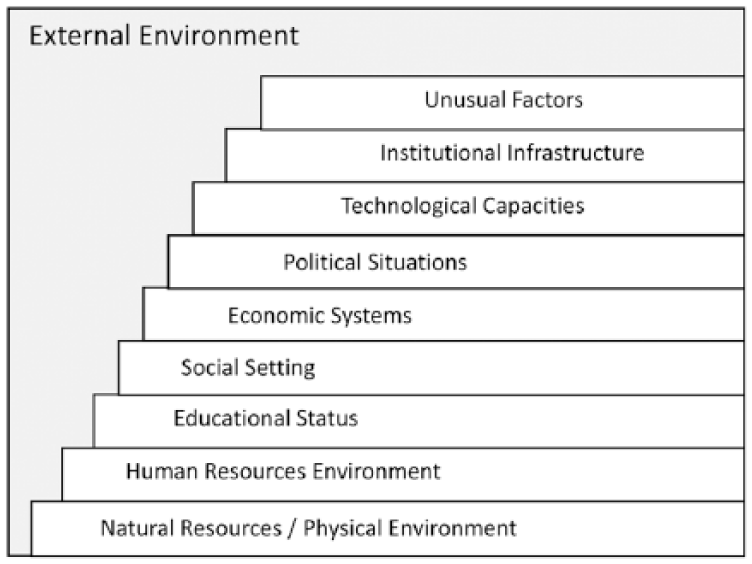
Molitor’s model of External Environment.
In Molitor’s model, “Nine Eras of Economic Sector Dominance” (Figure 2), he included (1) Industrial Age One (farming), (2) Industrial Age Two (textiles), (3) Services Age, (4) Information Age, (5) Leisure Age, (6) Life Sciences Age, (7) Mega Materials Age, (8) New Atomics Age, and (9) New Space Age, all of which correspond to eras of humanity’s technological progress from the years 1880 to 3000 (Molitor 1999a, 1999b, 2000a, 2000b, 2001, 2003a, 2003b).

Molitor’s “Nine Eras of Economic Sector Dominance” model.
Methodologies to Approach Distant Futures
In Molitor’s work on “The Next 1,000 Years,” he approaches the challenge through looking at “economic engines of growth” as defined through his “Nine Eras of Economic Sector Dominance.” He derived these patterns through transdisciplinary research across science, law, business, technology, economics, and a wide range of influencing events across subject matters. Inayatullah (2012) takes this further in his inquiry on how humanity will look in the year 3000, adding an additional dimension to how we anticipate the future.
The S-Curve: Disruption and Reorder
The S-Curve is useful in helping us understand that disruption and reorder are cyclical. Molitor created his methodology by categorizing events into discovery, lag time, and acceptance. He then used a time series of “take-off points” and influencing events. Molitor’s work has been successful in laying some foundational building blocks for studying the future. His methodologies delivered a step-by-step process for horizon scanning and categorization of the elements of change. Among his many credits remains the S-curve that proved his own hypothesis, after decades of research, that not only can patterns of change be detected but that they form similar patterns that resemble an S-curve. Molitor’s forecasting Model of Change that began with eleven steps and was expanded to twenty-two steps (forming an S-curve) involved (1) Framing, (2) Advancing, and (3) Resolving. The Molitor Model of Change offers a continued and viable methodology for flagging and following emerging issues. With perfect lawyerly precision, it sets up the scaffolding of a careful argument to take us into the future, whereby we are forced to either interact with that argument or bring our own. Molitor broke the process into stair steps that we could embrace, one at a time, to gain an understanding of social change by tracking emerging issue formulation to public policy.
Rittel and Webber (1973), in their work on improving planning, note that the challenges associated with providing a definition to a problem might be one of the most difficult of problems. As the original authors of the term “wicked problems,” Rittel and Webber write that wicked problems have both difficult definitions and difficult resolutions. Furthermore, these types of problems normally are deep seated in the policy and social systems arenas (where much of Molitor’s work resides). Molitor’s methodologies offer futurists and students of foresight a means to engage wicked problems through a cascading scale of categorization. Molitor’s identification of inflection points for change and addition of temporality to his model go a long way in attempting to harness wicked problems and tame them through corralling them into discrete models.
Much of Molitor’s work emanated from policy issues, which he became fascinated with as a young man, indulging himself in the books in his uncle’s library. His uncle’s library held a wide variety of legal and policy topics, given his uncle’s position as a state legislator. Molitor quickly came to understand that policy changes do not move quickly and often take five to ten years. He looked for engines of progress, turning points for social change, and placed a particular emphasis on technology infusion, as it is a key catalyst for reducing cost and creating disruption. Some of his work in weak signals began through the policy environment and through identifying long lead-time issues, such as inflection points in developing nations like social change and technology adoption (Molitor 2000b, 2003a, 2003b). Molitor was particularly fascinated by the sciences and their broadcasting of initial weak signals often a century prior to occurrence of dramatic change and mainstream technology adoption. He also felt it was important to portray issues visually. Molitor felt one of the greatest changes we would face in the future was developing better techniques to harness matter, including light and other energy forces (Molitor 1999a, 1999b, 2003a, 2003b).
Pictures Worth a Million Words
As an orator, Molitor certainly understood the value of words, but he also placed high value on finding the right image to convey an important concept. During my visit with Molitor in May 2015, he conveyed a deep concern for his work being passed down to future generations. He was also interested in the importance of future generations developing skill sets to recognize issues early on so that they could formulate solutions. Molitor hosted me on a guided tour of his albums containing hundreds of colorful charts, vivid slideshows, graphs, diagrams, and images from decades of presentations while he emphatically noted that pictures and graphics were essential to convey the essence of his points, particularly to policy makers.
Conclusion
Today, in the era of “Big Data,” Molitor’s methodologies retain structural validity to serve as a guide. Analysis of the underlying data, however, is likely to be subsumed by big data and artificial intelligence, as today’s researchers can develop bulk bodies of data and discern distinct patterns (Rhemann 2017). The questions are no longer just about the data, but how to organize it and draw the right conclusions. Molitor himself had noted, when asked about trends, that computers and artificial intelligence would one day replace the tedious effort of identifying change points and patterns, noting that when he began there were hundreds of trends which gave way to thousands. As we pass through eras of expanded knowledge constructed by endless mazes of digital data, we are no longer only vexed by gathering data but utilizing a framework that helps us ask the right questions. Graham Molitor has made a substantial and lifelong contribution, to how we might frame the approach and map that digital maze.
Footnotes
Declaration of Conflicting Interests
The author(s) declared no potential conflicts of interest with respect to the research, authorship, and/or publication of this article.
Funding
The author(s) received no financial support for the research, authorship, and/or publication of this article.