



Abstract
There is a rich academic literature about scenario planning expressing concerns with improving the effectiveness of scenario analysis as a process and with scenario methods being misused. Controlling for process execution and reacting to unforeseen events to avoid downside risks is the domain of operational control. Mechanisms for operational control are normally deployed ex ante, in-process, and ex post. A review of the scenario analysis literature from an operational control perspective leads to the conclusion that ex ante control mechanisms are extensively discussed. In-process control mechanisms are also discussed extensively but only by some authors. Ex post controls are almost never discussed. This suggests that when a scenario analysis goes wrong it cannot be reworked or recovered. This is a surprising implicit proposition and this article uses a case study approach to challenge this omission and to conclude that, like for many other business processes, rework and recovery of scenario analysis can be a legitimate and valuable activity.
Introduction
How can we make scenario analysis “better”? This is a central and persisting question in the scenario planning literature. No facilitator wants to hear participants state that a workshop was “a waste of time” or that corporate managers are not getting a full return for their investments in scenarios (Millet 2003). No manager wants the root cause of a failed strategic plan to be traced back to their prior vision of the future. No academic wants to be told that their application of scenario planning was a misuse of the method, a so-called “entertainment scenario” (Godet and Roubelat 1996), or that it was not rigorous enough (Godet 2000a).
Like any process, scenario planning may have negative consequences for its stakeholders. The occurrence of these negative consequences is an operational risk and it can be prevented by measures that form the body of operational control (Lewis 2003). In operations management, examples of operational risks abound and include a misfit between an organization and new processes (Hellstrom et al. 2010), task-technology misfit that leads to managers’ active circumvention of processes and systems (Bendoly and Cotteleer 2008), and outright failures in capacity planning, process design, supply chain design, and new product development (Lewis 2003).
Scenario planning is a rather broad terminology, which can be confusing in terms of scope, especially when considering its relationship with strategic planning (Godet 2000b). In this article, we adopt the definition proposed by Wright et al. (2013, 641, emphasis added) and focus on scenario analysis, the “process of application of selected scenario methods by individuals and organizations.”
In the following section, we adopt a process view to explore what the scenario planning literature tells us about the operational control of scenario analysis. Operational control can take place at three different stages of a process: ex ante, in-process, and ex post (Lewis 2003). Ex ante controls refer to preventive managerial actions implemented before a process is executed. In-process control means a real-time managerial reaction to a problem occurring as the process is being executed. Ex post operational controls are normally associated with terms such as recovery, crisis management, and disaster recovery (Lewis 2003). In a scenario analysis context, this means talking about scenario rework, scenario recovery, or scenario postproduction. The aim of this article is to question why so little is written about scenario recovery, whether it is legitimate to perform one, and whether or not it is a valuable activity.
Literature Review
Process Specification
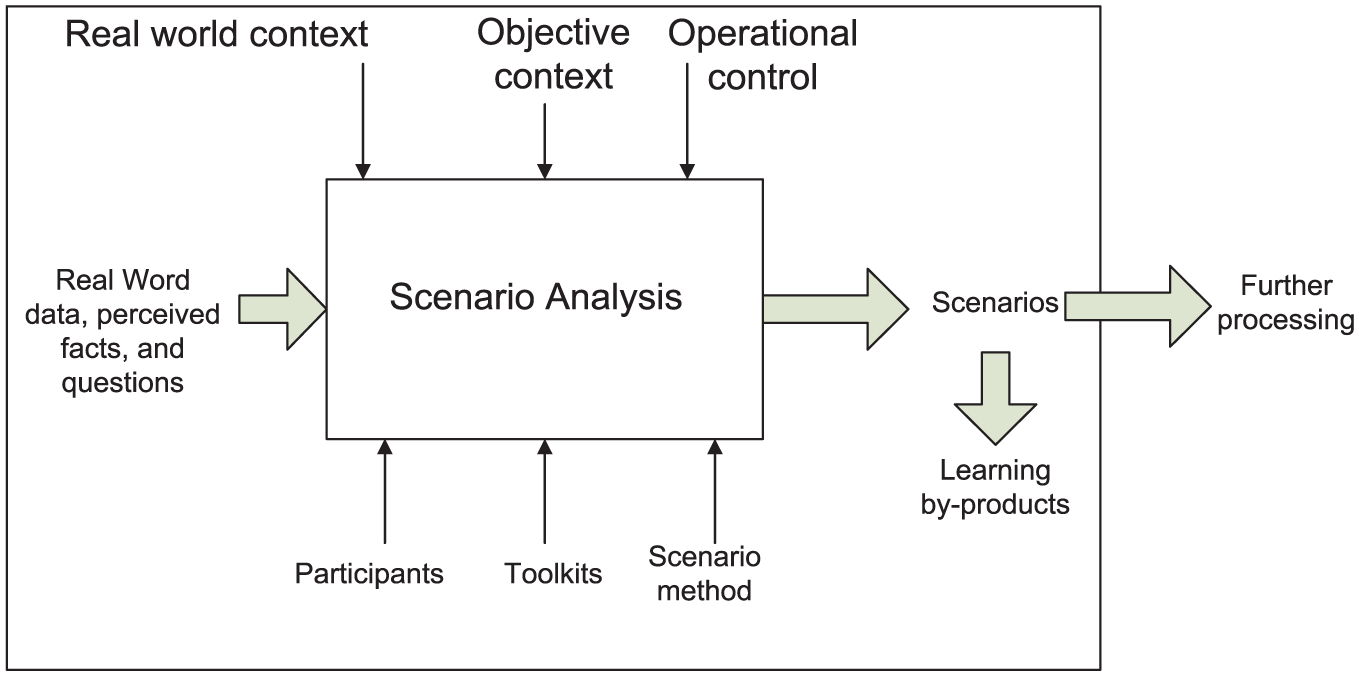
Figure 1 shows a high-level process model of scenario analysis based on the IDEF0 modeling approach (Kappes 1997). It may appear odd to use a formal process modeling technique to describe what is often called the “art of scenario planning” (Godet 2000b; van der Heijden 2005). Practicing an art is not antonymous to method though, as a scenario analysis that does not follow a “structured, multi-stage scenario approach [. . . is not . . .] devoid of form” (Cairns et al. 2016, 97). In this article, IDEF0 is used specifically to avoid an overly detailed and instrumental specification of scenario analysis by only focusing on process form, that is, higher levels of method specification. Figure 1 is an A0 context diagram in IDEF0 terminology.
Scenario analysis as a transformation process (A0 level).
In Figure 1, scenario analysis is conceptualized as a transformation process using factual inputs and questions about the future to produce one or multiple scenarios. As an output, scenarios are best described as intermediate products, that is, they are rarely an end in themselves. Instead, scenarios become the input of another process, for example, strategic planning, and organizations undertaking scenario analysis may also be interested in learning by-products of the process.
The execution of the process depends on the use of resources (shown at the bottom of Figure 1). The use of these resources is regimented by controls and constraints (shown at the top of Figure 1).
The resources used by the process are as follows:
The participants: as the essence of scenario analysis is to be a collective (Godet 2000a), team-based (Wright and Cairns 2011), and social process (Ramirez and Wilkinson 2016).
The scenario method: there are many articles and texts presenting and comparing different methods (e.g., Bishop et al. 2007; Bradley et al. 2005; Ringland 1998). A (very) simplified account of these sources is to differentiate the “intuitive logics” method (Wright et al. 2013) which is based on the approach originally designed by Shell from “La prospective” (Godet 2000a), which combines intuitive steps with quantitative analysis.
The different toolkits that can be added to a method to improve the rigor of the process: extensive description of toolkits or the “augmented method” for the intuitive logics approach are provided by Postma and Liebl (2005), Cairns et al. (2010), and Wright et al. (2013), and for La Prospective by Godet and Roubelat (1996).
The constraints/controls of the process are as follows:
The real-world context is the extent to which the underlying problem is simple or complex. Complex contexts for scenario planning are described by Ramirez and Wilkinson (2016) with the TUNA (Turbulence, Uncertainty, Novelty, and Ambiguity). High level of complexity can also be described by Knight’s (1921) notion of deep uncertainty, that is, a decisional context where probabilities of future events are unknown, the uncertainty is uncontrollable, and predictions based on past data are unreliable.
Whereas the real-world context refers to exogenous context variables, the objective context refers to the endogenous objectives that exist for undertaking scenario analysis. The objective context includes not only the specification of the objectives of the scenario exercise but also their perceptions by the members of teams (e.g., challenging, controversial, threatening). Thorough reviews of the literature on the first aspect of the objective context can be found in Wright et al. (2013), who summarize different objectives as enhancing understanding, challenging conventional thinking, and improving decision making. Varum and Melo (2010) propose improvement of the learning process, improvement of the decision-making process, and identification of new issues and problems. Scenario objectives are specific to the team performing the analysis but there is no guarantee that there is a consensus. Ramirez and Wilkinson (2016, loc. 537) explain that the essence of the Oxford Scenario Planning Approach (OSPA) is to allow participants to reperceive their own and others’ self-interest and options in relation to the problem at hand.
Finally, operational control is composed of the rules and actions that scenario analysts use to monitor and manage the performance of the process. They are the focus of this article.
Scenario Analysis Operational Control
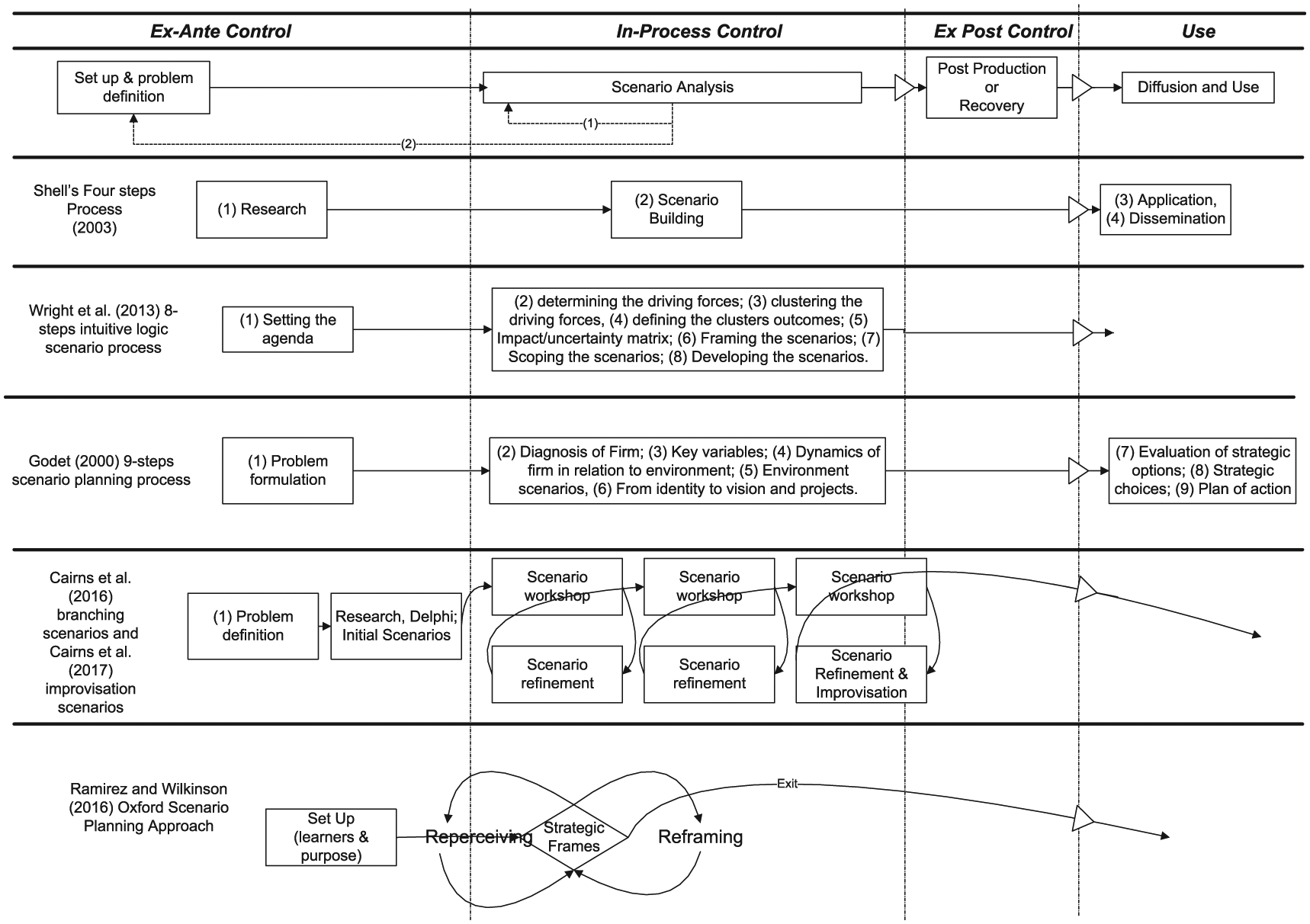
Figure 2 shows how different authors describe scenario analysis as a process by developing the IDEF0 process model shown in Figure 1 into a lower level process model. Again, it is important to stress that at that level (A1 in IDEF0 terminology) we are far from an actual specification of work. Instead, Figure 2 shows the “backbone” of the process or “form” of the process.
Models of scenario analysis.
The top two bands of Figure 2 show the phases where the different operational control mechanisms can be applied in relation to a generic process. For example, asking participants to read documents before a scenario workshop is a form of ex ante control. Not being satisfied with the scenarios and revisiting the definition of the scenario variables (as shown in loop 1 in Figure 2) is an example of in-process control. Changing the entire set-up of a scenario analysis if one is not satisfied with the results (as shown in loop 2 in Figure 2) is yet another example of in-process control.
The next bands display scenario analysis process models proposed by the “classic” schools of intuitive logic and La Prospective, respectively, from Royal Dutch Shell (2013), Wright et al. (2013), and Godet (2000b). More detailed lower level models of between four to thirteen steps can be found in Ramirez and Wilkinson’s (2016) review.
The next band proposes a summary model of the branching scenario method (Cairns et al. 2017) and of the scenario improvisation method (Cairns et al. 2016). Their distinguishing feature is that instead of suggesting that the scenario analysis is a stepwise process (as implied, for example, by Wright et al. 2003), the branching method and the improvisation method are more akin to an evolutionary spiral where scenarios are refined through several generations.
Finally, the lower band in Figure 2 represents the OSPA of Ramirez and Wilkinson (2016). It extends the discrete iterations proposed in the upper band into a continuous cycle of iterations with participants until an exit point, the “aha moment,” is reached.
If one puts aside small disparities in labeling and scope, Figure 2 reveals that there is a consensual view around three key phases: set-up and preliminary research, scenario analysis, and use/application. None of the scenario analysis process descriptions include an ex post stage, an observation which reinforces the topicality of the research question about the legitimacy and value of scenario recovery.
Going forward, it is important to differentiate the concepts of scenario rework, postproduction, and recovery from in-process controls. Ex post does not mean redoing or editing a scenario analysis as part of a workshop. Such actions would be in-process controls as they are an integral part of the scenario work as initially defined. Recovery implies some sort of work flow discontinuity, that is, a discrete stage gate shown through triangle filters in Figure 2. When work progresses past one of these stage gates, there is no going back, that is, it is not possible to loop back (e.g., loops 1 and 2 in the top band in Figure 2) nor it is possible to perform another scenario iteration. The discontinuity can be “soft” such as, for example, handing over a scenario analysis to an external party for small fixes or finishing touches. This could be called postproduction and compared with movie postproduction, where filming again is not possible. It could also be more serious, such as recovering from the impact of serious conflict between the participants or the realization that something was done carelessly or performed erroneously. The latter could be compared with a product recall in manufacturing.
This irreversible stage gate threatens the democratic principle often used in scenario analysis, as it implies a discontinuity in terms of participants. This goes against the “internal expertise” approach (Wright and Cairns 2011), which consists of a clear separation of the roles of internal experts (the clients and related stakeholders) and the facilitator. The role of the facilitator is restricted to supporting the application of the scenario method and excludes taking a position. Wright and Cairns (2011) further explain that they consider the scenario process a democratic one, that is, it is important that all participants express their view and engage to the same degree with the process so that dominating individuals cannot shape the scenarios. Advocating that a different set of participants, or a limited set of participants, or the facilitator alone can fix ex post a scenario analysis is clearly controversial from this perspective! However, more recent versions of the intuitive logics method including the same authors, such as the branching scenarios (Cairns et al. 2017) and improvisation method (Cairns et al. 2016), allow for participant discontinuities.
To better understand why scenario recovery is never explicitly discussed, the following sections review what the literature says about controlling the execution of a scenario analysis.
Ex ante controls
A striking feature of the scenario planning literature is its predilection for ex ante operational control, and especially method selection. This type of contribution can be summarized as providing three different types of preventive control mechanisms:
Promote adherence to a stepwise structured process model, as discussed previously.
Stress the importance of preparatory steps. This includes the communication and acceptance of guiding principles and ground rules, the preparation of reading material, and the use of a scenario process workbook allowing individuals to follow how the exercise is progressing (Wright and Cairns 2011). More generally these contributions are about proposing frameworks for engaging with the client from the outset of the project by considering factors such as organizational culture, state of mind, and fear of engaging (Burt and van der Heijden 2003) or about measuring the client’s organizational receptiveness (Wright and Cairns 2011).
Provide guidelines for selecting the right participants. For example, Franco et al. (2013) propose that only individuals with cognitive styles that are compatible with the planned scenarios activities should be invited. Hodgkinson and Healey (2008) recommend selecting participants with greater intrapersonal functional diversity and without divergent task-related background characteristics.
This strong focus on ex ante controls is conceptually rooted in quality assurance theory, that is, a successful scenario analysis is the result of a well-planned and well-designed process. In other words, it is better to spend time designing the right process than to spend time troubleshooting a poorly designed process. If ex ante controls work that well, in the same way that a six-sigma factory produces only good quality parts with a high level of confidence, there would indeed never be a need for recovery work, or for that matter, in-process controls. All that one needs to do is to follow the process.
However, the literature shows that scenario analysis is not that type of process. Some authors can be ambivalent regarding whether or not following the process is sufficient. Consider, for example, Wright and Cairns (2011, 24) when they state that “whilst the process is one of innovative and creative thinking we prescribe a very structured approach set out in clear stages.” However, they later add that “the structure should be seen as providing guidelines rather than being prescriptive, so it can be flexibly adapted to suit specific needs” (Wright and Cairns 2011, 24). Although apparently paradoxical, these statements are simply saying that at a high level there is a structured process, but that there is a need to adapt lower level processes to the circumstances of individual scenario exercises. Importantly, seeking to be structured yet flexible is an admission that ex ante controls by themselves are not enough to control the execution of the process.
In-process controls
The claim to be a structured yet flexible process is important from an operational control perspective. It is indeed only through a flexible process design that a scenario planner will be able to adapt to circumstances, that is, to exert in-process controls. Van der Heijden’s (2005) description of an iterative approach is one where flexibility to adjust is built into the process from the start. It is only after a prototype scenario formulation that a step of system analysis is performed. Flexible adjustments are also recommended in the branching scenario approach (Cairns et al. 2017) and by the OSPA with its flexible but structured learning-oriented approach (Ramirez and Wilkinson 2016). The OSPA goes even further by flexibly adjusting the method of intervention. Their default intuitive logics approach can be adjusted to become a deductive, inductive, abductive, normative, incremental, alternative futures, critical scenarios, or perspective-based method.
In-process controls are not only about cycles of iterations though and also include facilitation practices. There are few practical examples of these in-process operational controls in the literature. Anecdotal evidence of reacting to participants’ perception of complexity can be found in some reflective accounts of scenario planning (e.g., Godet 2000a; Moyer 1996a). In most cases, authors just state that adaptation is required to deal with issues, for example, low organizational receptiveness (Wright and Cairns 2011) but no specifics are provided in terms of actions to be taken. In other cases, specific guidelines are provided, as by Hodgkinson and Healey (2008), who formulate a number of propositions for effective facilitation. For example, they propose that emphasizing the shared fate of the scenario team will reduce intergroup bias and facilitate scenario construction in the case of a scenario team representing different areas of knowledge. Another example is provided by Franco et al. (2013) when they explore what to do if ex ante controls are not performed. If it is not possible to do a cognitive profiling of participants ex ante, they suggest in-process recommendation when issues emerge. For example, a group of participants with significant differences in cognitive styles could experience disruptive interpersonal conflicts. To address these conflicts, Franco et al. recommend emphasizing the shared fate of participants.
Ex post operational controls
Writing about ex post operational control would mean writing about an unsuccessful scenario intervention and explaining how it was recovered. There are only a few papers that discuss scenario failures (Bowman et al. 2013; Hodgkinson and Wright 2002; O’Keefe and Wright 2010). The research focus of these papers is a systematic analysis of the process steps to identify the root causes of failures. The first two papers report strategic inertia from top management teams as diagnosed through Janis and Mann’s (1979, 746) conflict decision theory while the latter conclude that “the difference between successful and unsuccessful scenario planning interventions may lie in between good and bad storytelling processes and their influence on political behavior.” This raises the following question: are strategic inertia and poor storytelling processes problems that cannot be recovered? It seems indeed odd that scenario analysis is described as a process that either succeeds or irrevocably fails and that research papers focusing on scenario failure never consider the possibility of recovery, or at least, should this be the position of their authors, that they never acknowledge the impossibility of recovery.
Framing Scenario Success and Failure
Framework
It is not the contention of this article to argue that ex post recovery work should systematically be done. As discussed previously there is a discrete point, a discontinuity, that triggers the recourse to recovery. Although there could be many root causes to this discontinuity, the trigger point will always be some sort of admission of failure.
Processes are “successful” if they achieve the objectives that they were designed for. For example, in a manufacturing context, this would be a simple expression of a target output (e.g., 100 units per hour) and quality (e.g., no more than 0.1% defective parts). As stated earlier on, all scenario researchers stress that the objective context of scenario analysis is much more complex and that both the reasons for undertaking a scenario analysis and the benefits to be expected from it are broad and varied. This complexity creates an ambiguity regarding the very definition of scenario success and this article argues that one’s position toward the relevance and value of operational control for scenario planners is directly linked to one’s definition of scenario success.
The scenario success ambiguity is similar to Grum and Hesse’s (1983) famous statement: “It’s the process not the product (most of the time).” Grum and Hesse (1983, 89) argue that the process of problem formulation, analysis, and implementation may have more far-reaching effects than the specific solution or product for the particular case. Management science has been valued for the final number or answer rather than for its true strength, a method of gaining insight and understanding of the whole situation.
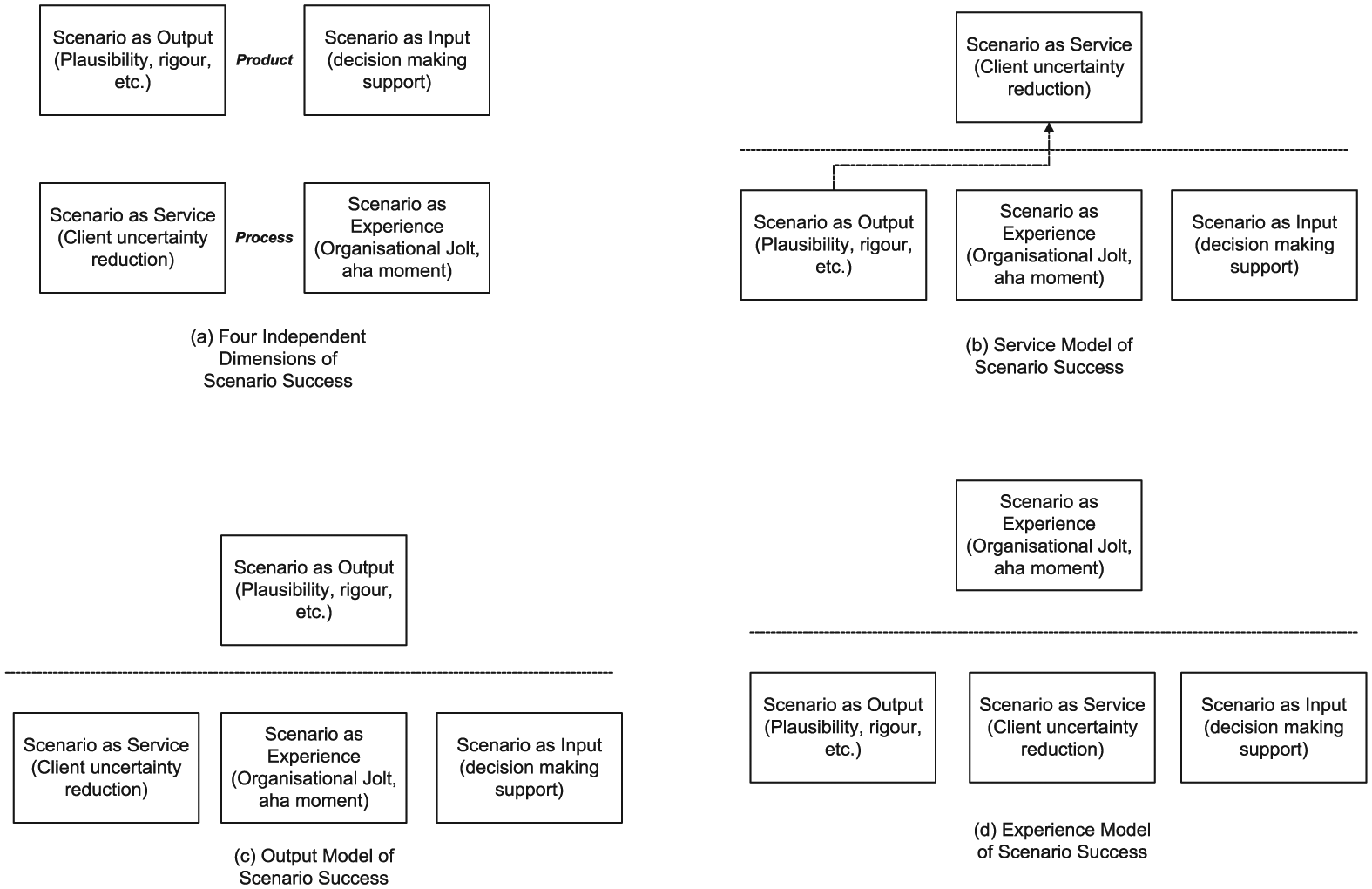
Figure 3 applies this product/process distinction and proposes four different ways of describing scenario success based on the earlier review of the literature. A scenario analysis can be defined to be successful against one or several of the following criteria:
Scenario as Output: Its products (the scenarios) are “accurate” or “right.” The notions typically associated with this success criterion are rigor (Godet 2000a) and plausibility (Ramirez and Selin 2014; Selin and Pereira 2013; Wiek et al. 2013).
Scenario as Input: Its products (the scenarios) will make a constructive and useful contribution to a further process of decision making.
Scenario as Service: The process of the scenario analysis is useful to the client and addresses preagreed contractual objectives.
Scenario as Experience: Participants will experience an enlightening moment as part of the scenario analysis, that is, they will collectively go through a genuine experience. This is a common theoretical portrayal of scenario analysis as an event unfolding on a time-sensitive social fabric (i.e., a form of collective learning which is both instant and team-based) and as fundamentally experiential. This experience is described as an “organisational jolt” (O’Keefe and Wright 2010; Wright and Cairns 2011), the ability to reframe and reperceive leading to an “aha” moment (Ramirez and Wilkinson 2016), or as appropriation (the collective mobilization translating anticipation efforts into action, Godet 2000a), or the meaning-making feature of storytelling (Bowman et al. 2013).
Possible mental models of scenario success.
Figure 3 also shows that a further challenge of labeling a scenario analysis as successful is that different individuals may form different mental models of the relationships between the success criteria listed above. As scenario analyses are social encounters, one could also argue that, as control theory in psychology suggests, a participant may prefer to adopt a mental model of success that is aligned with their perceived control, that is, their perceived ability to achieve the outcome (Mullins et al. 2015).
Figure 3a proposes that the four dimensions are independent: there are neither causal chains nor any hierarchical relationships between them. Figure 3b, 3c, and 3d posit the existence of hierarchical relationships. For example, Figure 3b is based on the view that satisfying the client is a superordinate success criterion that controls the other three subordinate criteria. This is the viewpoint adopted by Hodgkinson and Wright (2002, 950): “the underlying ethos of process consultation is to vest ownership of the entire process . . . with the client, as opposed to the ‘expert’ consultant.” The hierarchical structure of this model means that lack of plausibility, for example, would not be a cause for concern if the client estimates that the process was successful, that is, their objectives were attained. A slightly different definition of success is shown within Figure 3b by adding the arrow linking output to service. This variation of the definition would mean that satisfying the client is still the superordinate criterion but that it is believed that this can only be done by performing well on the scenario output criterion in the first place (yet the trade-off remains, that is, the client defines the boundaries of plausibility).
When performance criteria in Figure 3 are set in a hierarchical structure and when perceived causal links are added, this creates scenario success “scorecards.”
Figure 3 does not list all possible imaginable models and scorecards of scenario success as many hierarchical and causal assumptions are possible. The key point to note at this stage is that two individuals using different mental models of scenario success will never agree on definitions of success and failure. This means that when one individual calls for recovery, another will argue that the scenario analysis was successful, whereas another one will consider it an irrevocable failure (e.g., because their perception of the root cause of failure is beyond their control).
Illustration of Framework
To illustrate the framework shown in Figure 3, consider the fictitious example of a firm hiring a facilitator to perform a scenario analysis at a point in time when it faces considerable strategic uncertainty. The intervention will involve ten participants, five senior managers with considerable experience and tenure in the firm, and five less experienced junior managers. As the intervention unfolds, two coalitions form, respectively, composed of senior and junior managers. The senior managers’ selection of driving forces is based on a “business as usual” vision. The resulting futures that are considered are only nuanced versions of ongoing business. The junior managers’ selection of driving forces is based on less experiential and more cognitive searches of possibilities and results in a set of scenarios where radical industry change is possible. As workshops take place, it becomes clear that both coalitions have vested interested in their preferred visions of the future in terms of job relevance and opportunities for advancement. The senior managers systematically dismiss the views of the junior managers as alarmist and implausible scenarios which are irreconcilable with their extensive experience of the industry. The facilitator witnesses an increasing entrenchment of each coalitions in their positions. Despite being very skilled and aware of many approaches used to address such occurrences, the facilitator realizes that the coalitions were preexisting, and that the scenario workshop has become a powerful catalyst for airing out a dormant organizational conflict. As the workshop atmosphere gradually deteriorates, all five senior managers withdraw themselves from the process, invoking the time pressures involved with their roles as the reason for not being able to continue the exercise. The facilitator continues and completes the exercise with the five junior managers.
When considering this example in relation to Figure 3, the question is whether or not the intervention should be labeled as a failure and why? If success is defined in relation to the product, a scenario analysis has been completed and a set of scenarios will be available in a report or corporate presentation. The junior managers are likely to call the exercise a success (as they view the scenarios as plausible) whereas the senior managers will call it a failure.
Switching to the process side, the interpretation of success/failure is equally difficult. If the service model of service success is used (Figure 3b), one position is to argue that uncertainty has not been reduced for the client, and thus that the scenario analysis was a failure. The junior managers could however argue that uncertainty was reduced for them as they now share a collective understanding of possible futures. In the scenario as experience model (Figure 3d), the fact that the intervention resulted in open conflict is the opposite of the sought-after “aha moment,” suggesting a failure. The junior managers could counterargue that the scenario workshop provided them with such an experimental moment, and that it is the intensity of this experience that gave them the confidence to stand up to senior managers and address what had been an ongoing organizational issue. This example shows that labeling a scenario analysis as successful is not a straightforward binary classification (i.e., success/failure) and is instead a very idiosyncratic judgment.
Case Study
Conditions of Analysis
The initial impetus for this article was the author’s experience with a scenario analysis intervention which was problematic. Through a number of ex post actions, the author feels that the situation was recovered and eventually produced a successful scenario analysis. The process used did not comply with best practices, and instead the case study described in the next section is best described as an amateur attempt.
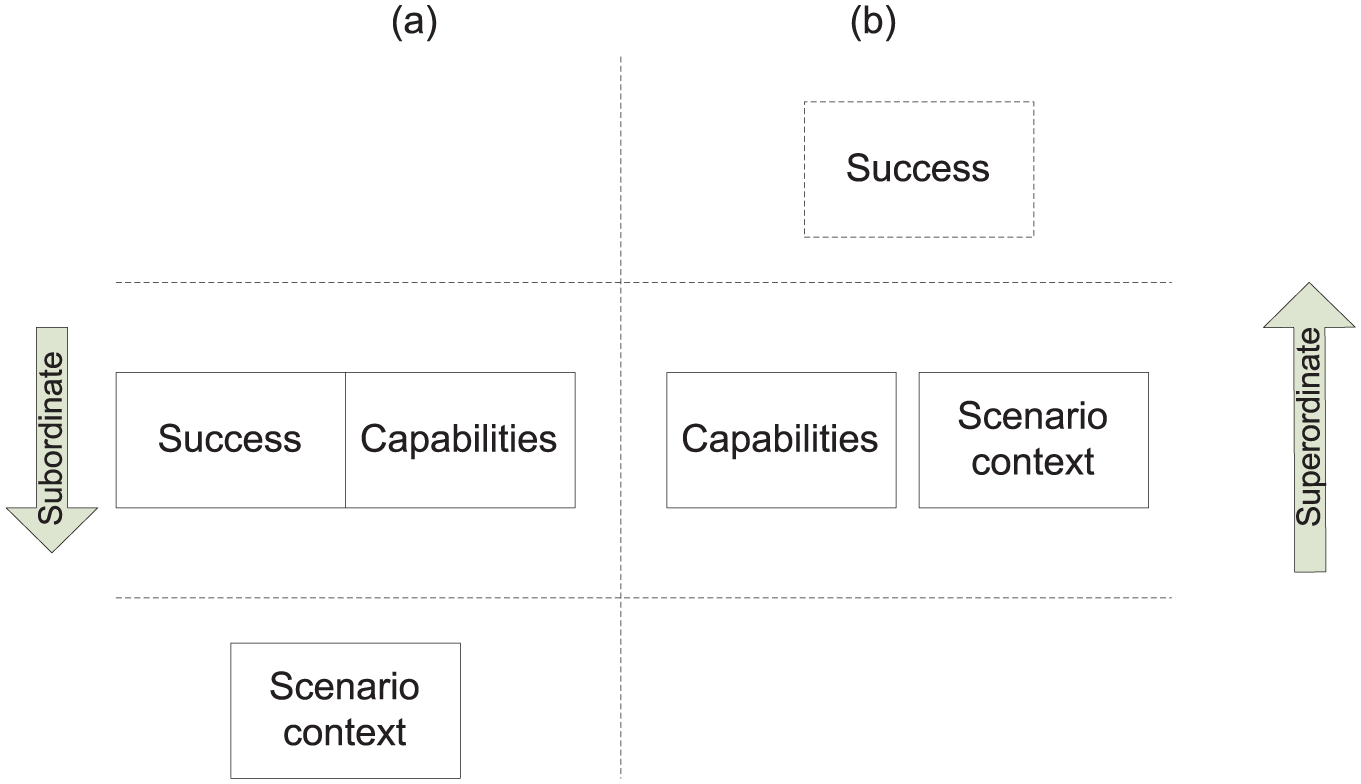
This means that one possible interpretation of this case study is that it was lack of knowledge and skills that resulted in weak ex ante controls, that is, a poorly designed intervention, and that any ex post work undertaken to recover issues could have easily been avoided. It is important to define the boundaries of this interpretation in logical terms as it could be used to argue that ex post controls are never required. This idea is depicted in Figure 4a, where the capabilities of facilitators are superordinate to context. This means that through ex ante and in-process actions, the facilitators can never fail and can thereby guarantee success. Success and capabilities end up merging as concepts, that is, skilled facilitators always run successful interventions and successful interventions are always run by skilled facilitators. Thus, if a scenario analysis fails, it can only be explained by the facilitators lacking skills, and analyzing failure becomes a catch-22 or logical double bind (Bateson 1972).
Hierarchical model of the relationship between context, capabilities, and success.
An example of such a double bind can be found in the scenario analysis literature. Hodgkinson and Wright (2002) published a case study of a failed scenario analysis that they facilitated. They conclude that the root cause of the failure was the strategic inertia of top management. This interpretation was challenged by Whittington (2006) who reinterpreted the case study and proposed that failure was caused by the lesser ability of the facilitators to influence participants when compared with that of the CEO. This viewpoint was then rebuked by Hodgkinson and Wright (2006) who argue that they were perfectly competent. In the world of Figure 4a, unless a statement about possessing/lacking skills is agreed to, failure becomes inexplicable.
The resolution of a double bind is possible through the realization that it stems from different levels of abstraction (Bateson 1972) as shown in Figure 4b. It proposes that the model in Figure 4a is untenable and that the hierarchical relationship between success and capabilities should be reconsidered. In Figure 4b, failure can happen even if facilitators are skilled. This is because success is a superordinate construct explained by two independent constructs, capabilities and scenario context. Either or both lack of skills and adverse circumstances can cause failure. The rest of this section should be read from the perspective shown in Figure 4b, which means that whether failure was avoidable or not does not matter. The question is, once it is experienced, can it be recovered?
The next section shows that the scenario analysis work described was a case in which capabilities were limited and the context far from ideal. Therefore, it should be read as a case study of bricolage (e.g., Ciborra 1994; Razgallah et al. 2017) used for the sole purpose of exploring the feasibility and value of scenario recovery.
The Channel-MOR (Marine Offshore Renewable) Project
Channel-MOR was a collaborative cross-border project funded by INTERREG Channel IVc, a European program financed by the European Regional Development Fund to encourage interregional collaboration across the Channel. The part of the project that the author led had the objective of providing strategic recommendations to regions in the coastal Channel area to facilitate and promote the uptake of offshore renewable energy opportunities by local businesses. One of the contractual deliverables was to produce a scenario analysis of accessing renewable energy technology supply chains. The project team was large and based on a “pyramid scheme” as illustrated in Figure 5. All participants and their organizations, including the lead team, were residents in the Channel region.
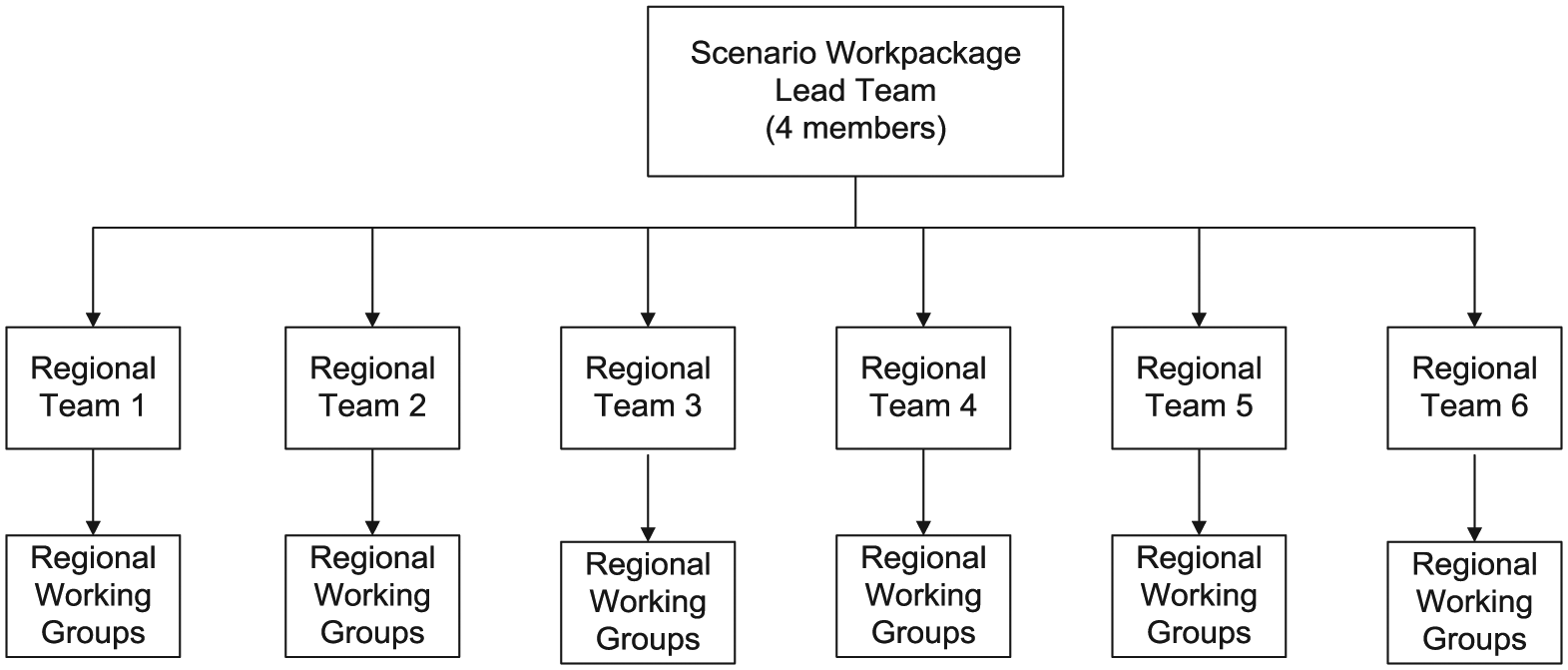
Channel-MOR project team composition.
The coordination of the work done in this case study is best described as being similar to a Delphi approach: each regional team was asked to produce independently a scenario analysis for their regions. The lead team has no visibility of the participants invited to perform regional scenario analysis in the regional working groups. The regional working groups performed their analysis in a variety of ways: some were based on workshops involving small (six) and large (up to twenty-five) groups, some used an e-mail-based Delphi process, some used scenario analyses performed by well-known consulting firms, and finally others reused past scenario analyses.
The scenario analysis was the last part of a project designed to last twelve months. Scenario work started halfway through a six-month extension to the delayed project. The regional teams were out of contracted hours or reaching them by the time the scenario analysis had to be performed. The conditions under which the scenario analysis was performed in the Channel-MOR project were similar to those described by Cairns et al.’s (2017) North West Tasmania case study in terms of the number of participants, limited time availability, and policy level engagement. However, the project was designed in such a way that the multiple in-process scenario iterations described by Cairns et al. (2017; cf. Figure 2) were not possible.
In the initial scenario meeting with all partners, the lead team offered to go through a structured process or to use a laissez faire approach, where each region could perform the analysis as it saw fit. All regions opted for the latter, and in practical terms, it resulted in each region adopting shortcuts to the process of performing the scenario analyses, transforming what should have been an intense collective introspection of the future into a rushed business.
These regional scenarios were then shared by e-mail before being presented in a final workshop involving external participants. The plan was that the workshop would be the crux of the process and that it would be there that unique scenario insights for the overall region would be discovered. The contractual design of the final scenario workshop was such that very little strategic conversation could take place. The presence of many external participants made the atmosphere quite formal and one where strategic debate and discovery could not take place.
Given the project organization and control processes adopted in Channel-MOR, the author was individually accountable for the quality of the final report for that work package. It was after the final workshop that the author felt that the scenario analysis part of the project was failing. Thus, the final workshop was the discrete event that triggered the process of recovery. Neither the author nor the rest of the lead team had been involved with the original set-up of the project. They were given a project brief specifying a set of scenarios as a deliverable and stating that the scenarios should be used for a large-scale workshop targeting external stakeholders. For this reason, it is important to note that it is unlikely that the sponsor (INTERREG) and that other members of the projects (both in the lead team and the regional teams) would have considered the scenario work as a failure. From their perspective, the workshop took place as per the agreed plan and attracted the contractually requisite number of participants. Thus, the perception of failure is better described as a scholarly concern than as a contractual issue.
After a critical review of all regional scenarios, the author summarized failure in a report with the following three issues:
Idealization of renewable energy: there was a problem of idealization of the potential and of the future of offshore renewable energy. Idealization is the process of overvaluing and augmenting a value or idea to the extent that it cannot possibly be challenged (Brown and Starkey 2000). This is not a desirable feature in a scenario analysis as it is likely to create “collective illusion” (Godet 2000a) or unconditional adherence to an idea (Wright and Cairns 2011). In many scenarios presented at the final workshop, uncertainty was muffled and many scenarios were descriptions of ideal states while others were expositions of promising strategic options that were not explicitly situated in different versions of the future. Most scenarios showed a strong desire to affiliate themselves with official directives. Very few of the participants were willing to challenge the official story and, in one case, a French region refused to produce a scenario as it argued that its mandate did not allow it to publish prospective material that could be seen to challenge national directives. Instead, the regional representative presented the strengths of his region and their official plan.
Coupled growth hypothesis: regional policy makers were often under the impression that significant economic spillovers will take place if they host a renewable energy facility, such as a commercial wind farm, on their shores. This means that they perceived the key driving force as the number and size of facilities that will be built in the future. All scenarios from regions new to the sector were grafted onto existing scenarios of infrastructure development. All scenarios from regions with established commercial wind farms did not consider planned constructions to be a key driving force and instead considered global sector growth, offshore experience, and the growth of nonpower generation opportunities (e.g., storage) as driving forces. In other words, they decoupled infrastructure projects from local economic growth opportunities.
Local scenarios for global concerns: the regional scenarios showed geographical diversity in that they focused on driving forces pertinent to their shores. For example, Western regions were very concerned about the ability to develop reliable floating wind turbine technology. Other regions had other concerns and each scenario inscribed itself only peripherally onto global scenarios about the future of the sector. In other words, regional scenarios were based on truncated external environment analysis.
Although this critical discussion was improvised by the author, positive feedback was received and revealed that the rest of the team was receptive to the idea of “taking time” to remedy the situation rather than being “taken by the time” (Ciborra 2004) by submitting the scenarios without rework. The partners’ contributions to the recovery process were minimal and consisted of reading communications and occasionally posting feedback. Although none were deeply involved with the recovery process, none opposed the idea that the author would individually improve this part of the project as a hedged form of care and concern (Ciborra 2006) for the final quality of the report. Table 1 summarizes the diagnostic of failure on the basis of Figure 3’s framework.
Rationales for Triggering a Scenario Recovery.

The subsequent ex post work was performed by the author and led to a reframing of the problem and a perception of the future summarized by the scenario grid shown in Figure 6. It was included in tabular form in the final draft of the project report and circulated to all partners for feedback prior to publication.
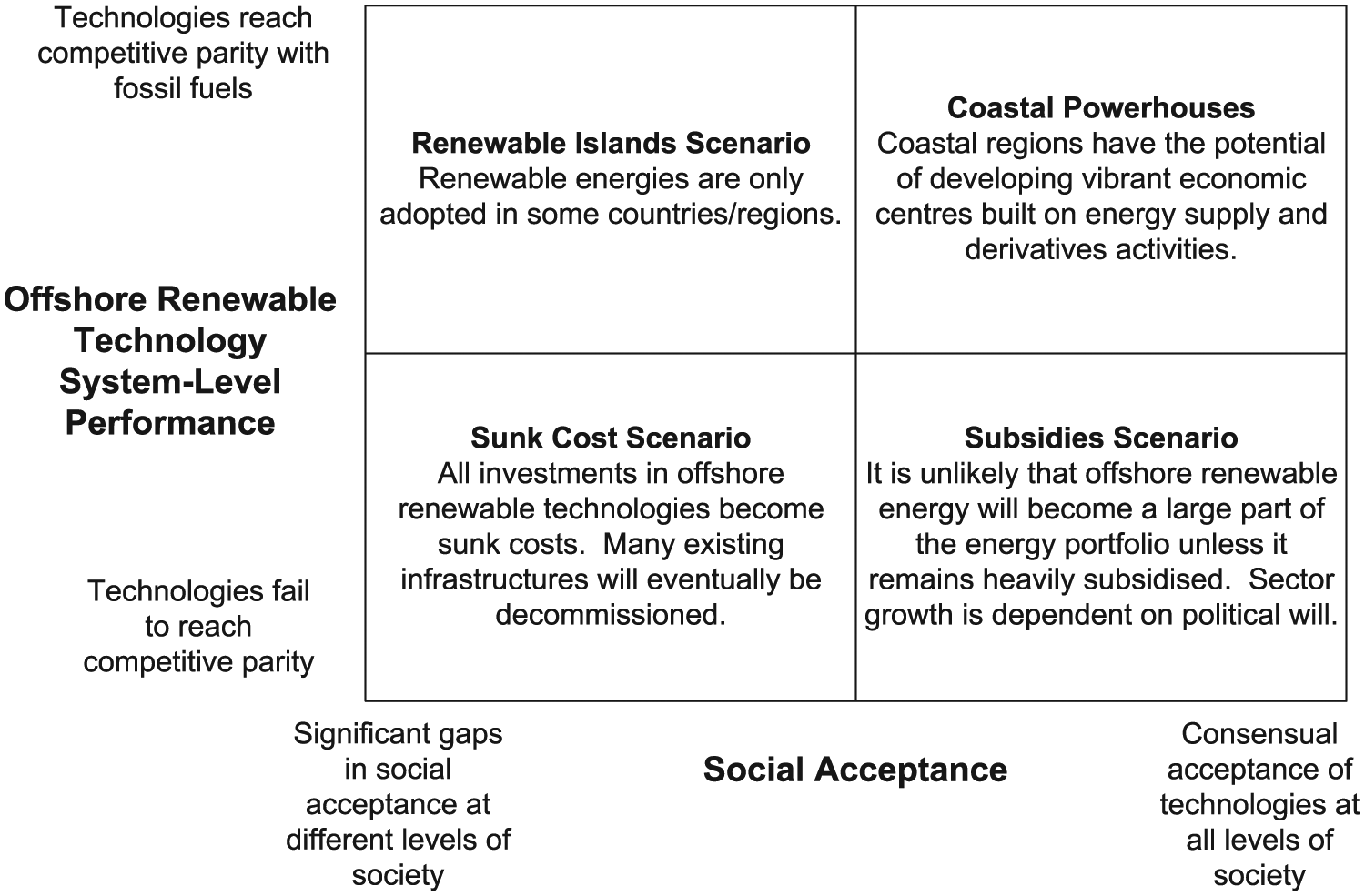
Ex post scenario analysis.
The vertical axis in Figure 6 is about the ability of offshore renewable energy sources to reach competitive parity with traditional energy sources in the energy systems of the future. It is important to stress that this variable is not the generating cost of the technology as used by manufacturers and developers and which is often commonly discussed in the energy literature (e.g., Crown Estate 2012). It is the ability of the generation technology (e.g., offshore wind) coupled with associated technologies (such as dynamic grids, storage, and demand-side management solutions) to be competitive in terms of final user cost when compared with the cost of the much more basic energy systems of today, and this, for high level of penetration of renewable energy sources in national energy mixes. The horizontal variable in Figure 6 is about social acceptance. This includes, but is not restricted to, the traditional issue of local acceptance which, for example, led to the cancellation of the Navitus Bay wind farm project in Dorset. It more generally refers to the degree to which renewable energy is accepted and valued as an energy source at all levels of society. Consider, for example, the rejection of the Cardiff bay tidal lagoon which was accepted and enthusiastically welcomed at a local regional level but opposed at central government level. The fact that renewable energy policies are political subjects creates social fragmentation increasing the salience of this variable.
Figure 6 was developed after using a technology innovation system (TIS) perspective (Bergek et al. 2008) to address the issue of coupling infrastructure development with local industry growth. This idea to decouple these two growth dimensions was initially received with resistance by the project team (an appropriation conflict). On both sides of the Channel, there are very strong government and industry campaigns that insist on linking these two aspects of renewable energy growth, mostly as a trade-off to overcome social acceptance. The TIS approach was used to explain why the coupling of technologies historically existed in first mover regions and no longer applies.
Three (the islands, subsidies, and sunk cost scenarios) out of the four plausible stories in Figure 6 are bleak visions of the future. They are visions of limited growth potential and of a permanent struggle for the sector to establish itself and to develop a robust commercial presence. A key reframing of the entire scenario exercise took place when the team realized that seven out of the eight original scenarios presented in the final workshop were built with an implicit vision of the future based of some versions of these scenarios. It is this very fact that created idealization. Throughout the project, the Channel-MOR team had been faced with interested yet mistrusting external stakeholders, unconvinced by the worthiness of investing today to develop a presence in this industry. Against this risk-averse push back from external stakeholders, it was easier to deliver an idealized message aligned with what the team was commissioned to do, that is, to change perception toward the sector and encourage investment.
Instead of facing the challenge of uncertainty of the future of the sector head-on, it was easier to complete the scenario exercise by finding a “pleasing” but unrealistic compromise between policy makers and business stakeholders. Quite ironically, by refusing to accept the downside potential of the future of the sector explicitly, that is, the possibility of the islands, sunk cost, and subsidies scenarios, the entire team implicitly rejected the possibility of the upside potential and exponential sector growth suggested by the coastal powerhouse scenario. This is even more ironic when considering the fact that these scenarios are frequently used in the energy sector. For example, the coastal powerhouse scenario is inspired by the “Nagashima Shelf” scenario presented in a video at the 2014 All Energy Conference (Sandberg 2014), where experts argued that coastal economies would in the future not only be net energy producers but would displace inland industrial districts.
Another way to explain this ironical outcome is that if Figure 6 were designed as a set of frames (Ramirez and Wilkinson 2014), that is, based on two continuous scales, seven out of the eight scenarios would be positioned around the center point in a collective subconscious attempt to reconcile the positive project mandate with the risk-averse reality of external stakeholders’ perceptions. However, the scales of Figure 6 are discrete and the center point has no practical meaning.
Table 2 explains how each of the issues identified after the final scenario workshop were recovered through ex post work.
Value of Scenario Recovery Process.

Note. TIS = technology innovation system; MOR = Marine Offshore Renewable.
Conclusion
It is tempting to develop a process model of scenario analysis inspired from quality assurance theory. From this perspective, all that matters is to deploy extremely careful ex ante design, preparation, and research steps. If the subsequent workshops are delivered by a skilled facilitator able to deploy effective in-process controls, the scenario analysis will always be a success. Such a story is credible when talking about designing a drilling machine working with a precision capability of ±0.05 mm. How convincing is it when transposed to a group-based set of workshops encouraging intuition?
This article follows the OSPA’s premise that scenario analysis, as a service designed to facilitate strategic learning by participants, does not happen that easily and will require multiple revisions and iterations. This article further extends this viewpoint and argues that, for many possible reasons, scenario facilitators will sometimes reach a discrete point in the process when they realize that the process has failed in some ways. This discrete point could be described as an “Oh No!” moment and the stark opposite of the “Aha!” moment. At this point, it is both legitimate and valuable to initiate a scenario recovery process to rescue the intervention. The article further proposes that scenario failure or success is a highly idiosyncratic judgment because of the multiple reasons that can be used for undertaking a scenario analysis.
Some will argue that recovery is not a legitimate activity as it is only trying to overcome poor planning and/or poor skills. However, this article takes the position that such a viewpoint is illogical (a double bind ever preventing the demonstration of the legitimacy of recovery) and that the reason why a scenario process has failed is irrelevant to the legitimacy of the recovery process. Why a process has failed is only relevant for the analysis of process efficiency and more generally, process elegance. This position aligns itself with the strategic valuation of bricolage of Ciborra (2004) that encourages unskilled learning, the acceptance of failure as a pathway to learning, and the rejection of the decoupling of the design and use stages.
The Channel-MOR case study is used to illustrate how a recovery process was valuable as it led to a more careful set of recommendations and triggered ex post a further cycle of reframing and reperceiving. As this article is based on a single case study, it is impossible to generalize its conclusion beyond the proposition that activities such as scenario postproduction, rework, and recovery are legitimate and valuable activities that should be researched further.
Footnotes
Declaration of Conflicting Interests
The author(s) declared no potential conflicts of interest with respect to the research, authorship, and/or publication of this article.
Funding
The author(s) disclosed receipt of the following financial support for the research, authorship, and/or publication of this article: The research presented in this paper was made possible through the financial support provided by INTERREG IVa for the Channel-MOR project.
