




Abstract
There are currently a number of preconceived ideas about the university and its possible fates within our socially latent future. Some of these assumptions can restrict our capacity to imagine much of the actual potential scenarios at present. Following the Integral Futures perspective, here we stress the relevance of its interior cultural development as a key factor when thinking about the futures of and for the university. Instead of defining specific foresight strategies, however, this paper suggests how some current university extension activities can facilitate a productive cultural basis to enhance their forethought capabilities. It specifically addresses the potential of cultivating Communities of Practice (CoPs), through which institutions are able to connect with wide-ranging cultural domains, from both the inner and outer worlds, and making organizational culture more prone to unbiased imagination. Such features are illustrated with recent action-research conducted at the University of the Basque Country, which will finally provide some guidance on how to seed future-oriented cultures in corresponding universities.
Will there still be a place reserved for the university in the future? Efforts to resolve this issue continue mounting in both academia and society alike (Conway 2019). Several authors see a number of universities under the thumb of cognitive capitalism, wherein knowledge has mutated into a commodity (Boutang 2011). As a result, the value of the university itself has since become a subject of contention. Now, the future of these institutions is seen as dependent upon their ability to contort—to fit—into an increasingly hostile environment. Reliance on the university’s longevity hitherto is no longer a sufficient safeguard for its perpetuation. Indeed, factors including globalization, multiculturalism, digitalization, and the politicization of the university, collectively reveal the need for future-oriented thinking (Munck and McConnell 2009; Slaughter 2012). Particularly so regarding the projected societal and developmental functions of the university.
According to current academic discourse, contemporary societies would be inconceivable in the absence of a university. This, however, is hardly helpful to those already aware of their real possible fates (Miller 2018). Regarding the future of these institutions, the only certainty universities can rely on, paradoxically, is their uncertainty. This prompted Nowotny et al. (2001) to argue in their influential book that “universities may be unable to react rapidly and creatively to future demands if they are constrained within either a historically determined or bureaucratically imposed division of institutional labor” (p. 255). Thus, should the lifespan of universities extend farther into the future, their continued existence hinges on the capacity to incorporate this desired future into the present. This wide-ranging task is being pursued within strategic foresight (Conway 2016; Miller 2018).
Piirainen et al. (2016) have shown how “Innovation System Foresight” can significantly contribute to the “third mission” of some neoliberal universities. Ultimately, the basis of their thesis is the promotion of active dialogue between universities, industries, and societies. This paper is similar but with an inversion. From the perspective of a public university, our primary objective is to examine how certain cultural activities—via “university extension”—can act as viable complements and alternatives to strategic foresight while contemplating the future. In line with the paradigm of “Integral Futures” (Slaughter 2004), rather than focusing on features relegated to the external realm—that is, technologies or infrastructures—our vision is instead directed toward the so-called “social interiors.” This includes beliefs, values, ideologies, worldviews, languages, customs, along with other indefinite aspects both individual and collective. While beliefs, values, and biases concerning the future of the university can diminish its members’ awareness of other potential prospects (Conway 2019), here we encourage the cultivation of Communities of Practice (CoPs) (Lave and Wenger 1991), a concept that emerged also in futures literature (Fuller and Warren 2006). These groups function as a mechanism for fostering reflexive, imaginative, and critical abilities, which in turn facilitates the questioning of feasible futures of and for the university. Moreover, it augments the organization’s awareness to understand and intervene in its environment. As it shall be subsequently shown, CoPs inspire culturally rich and open source experiences. Meaning, they operate in contrast to foresight-dependent models wherein reflections, principles, concepts, and frameworks are often “top-down” (Conway 2016; Voros 2003).
This paper is composed of four main sections. First, we identify the cultural mission as the backdrop for envisaging and prototyping university futures. This is presented in opposition to the other two missions—education and research—wherein strategic foresight has thus far served as the usual frame of reference. The so-called “third mission,” however, transcends what is traditionally known as “university extension.” By embracing a crucial role in the evolution of higher education—interior cultural development—it will later occupy one of the four quadrants outlined in Integral Futures. In the second section, cultural development is presented as an essential element in shaping open and adaptable organizations, because it enables them to handle long-term changes and hindrances. Similarly, the spread and integration of diverse cultural ingredients is a sure-fire formula for devising creative, critical, and future-oriented spaces within universities aware of their social milieu. Both aspects can be cultivated by seeding CoPs, so the penultimate part is dedicated to elaborating and highlighting methods through which they may work toward imagining futures of and for the university. The final section—based on recent research conducted at the University of the Basque Country (Casado da Rocha 2019)—concludes with a set of pragmatic guidelines for making these communities thrive in the context of university extension.
The Cultural Mission of Universities
During the 1930s, the Spanish philosopher Ortega y Gasset (1946) designed a program to reform modern universities in Spain. Since there were several—occasionally overlapping—university missions occurring at any given moment, he subsumed them under a program of “general culture.” With neither national borders, nor temporal restraints, general culture is meant to complement any national system of higher education. At the heart of his “Mission of the University,” Ortega followed two threads of inquiry. First, what knowledge should all students learn? Second, what are the functions of the university within modern democracy? From his familiarity with various university systems throughout Europe, he identified four core duties of these institutions. These include: training professionals; the support of academic research; societal guidance; as well as the endowment of well-educated individuals with a mind prepared to form critical interpretations of the world. The latter two tasks typically convene under the umbrella of the third mission, thereby differing from the former two, which instead involve education and research.
According to Ortega y Gasset (1946), each university needs to be prepared to generate its own new “uses.” This, however, demands more than simply imitating the examples of “exemplary nations,” for nothing exempts a culture from resolving its destiny in a self-contained sense. Indeed, Ortega claims that the value of an institution resides in the ability to forge and pursue its own independent future. Otherwise, universities would surrender their own authenticity, no longer capable “to create their own convictions.” To achieve this, he firmly advocated for cultural issues via active involvement into concerns both past and present, such as justice, the prerequisites of a good society, electing who should govern, or the responsibilities of citizens.
A century later, globalization, multiculturalism, the internet, and the politicization of academia, are among some of the main developments of this time-frame (Munck and McConnell 2009). In the meantime, a number of disparate universities have arisen (Perkmann et al. 2013), resulting in the emergence of new third missions (Laredo 2007). In this context, we agree with Slaughter (2012) concerning the current picture of many universities (p. 123): “As the world trembles on the edge of chaos, most universities remain caught up in business-as-usual thinking, their priorities very much bound up with inward looking purposes and goals such as funding, standards, and position in the international pecking order. Paradoxically, many have within them some of the most talented and capable people in the world, many of whom work at the leading edge of research and innovation in a vast number of fields. Universities need to be taking the lead in gearing up for the transitions ahead. They need to take up their potentially catalytic role in creating and sustaining social foresight.”
At this juncture, and rooted in action-research conducted at the University of the Basque Country, we believe that the cultural function of these kinds of public universities remains largely unexplored. In fact, there is much to be gained through devising and implementing formerly unrealized scenarios. The study carried out by Piirainen et al. (2016), highlights the prospective value of foresight for the third mission of universities more closely linked to innovation and the industrial fabric. Our focus is turned, by contrast, toward the significance of cultural status within public universities, being so in line with Ortega’s sway in the country. Thus, the eventual goal is enhancing institutional capabilities to think about the future, which is a primary stage in strategic foresight (Farhi 2002).
Conway (2019) outlined four distinct views concerning the university’s current prognosis. Although the conventional understanding of these institutions remains safeguarded within some, two further concepts have since emerged from the outside. Namely, the managerial idea established by the state, and the reframed idea of alternative university models beyond the scope of contemporary neo-liberal academia. There is also another attitude toward the university: the dismissive idea, a direct reproach against the protracted legitimacy of universities. To Conway (2019), these disparate perceptions all entail a degree of restricted thought, thereby inhibiting their capacity to contemplate existent possibilities. She thus endorses a holistic stance, one based on “the power of the integrated ideas, articulated, and made visible” (p. 2). By uncovering the underlying premises informing those perspectives, their validity, and pertinence are then subject to dispute, as well as being consciously tested. One can then test whether or not they help ascertain emerging futures. How is this to be brought to fruition, though?
An Integral Approach
To reinforce the aptitude of universities in recreating themselves vis-à-vis preconceived worldview scenarios, strategic foresight brings to the fore useful resources in the research and educational realms (Miller 2018). From the perspective of public universities, we think culture can play a vital role. This is illustrated through our invoking of the “Integral Futures” paradigm (Slaughter 2004), as it affords a wide-ranging picture of the manifold subsurface drivers of human development.
The framework of Integral Futures is a useful tool for speculating about the future fates of universities. Nevertheless, the goal here is not to demand its application. Rather, our efforts are dedicated to highlighting the prominent role of the cultural dimension, which is made of complex evolutionary dynamics within the systems, contexts, and interactions of higher education. To quote Slaughter, the integral technique entails “the specific ways that stakeholders construct meaning and significance; culturally derived perspectives, rules, and systems of meaning; the social infrastructure, including people’s concrete skills, behaviors, and actions; and, finally, the nature and dynamics of the relevant societal structures and systems” (2004, 165).
The integrated approach thus accounts for some pertinent details in human performance often overlooked in several instances. These are commonly classified under four separate quadrants:
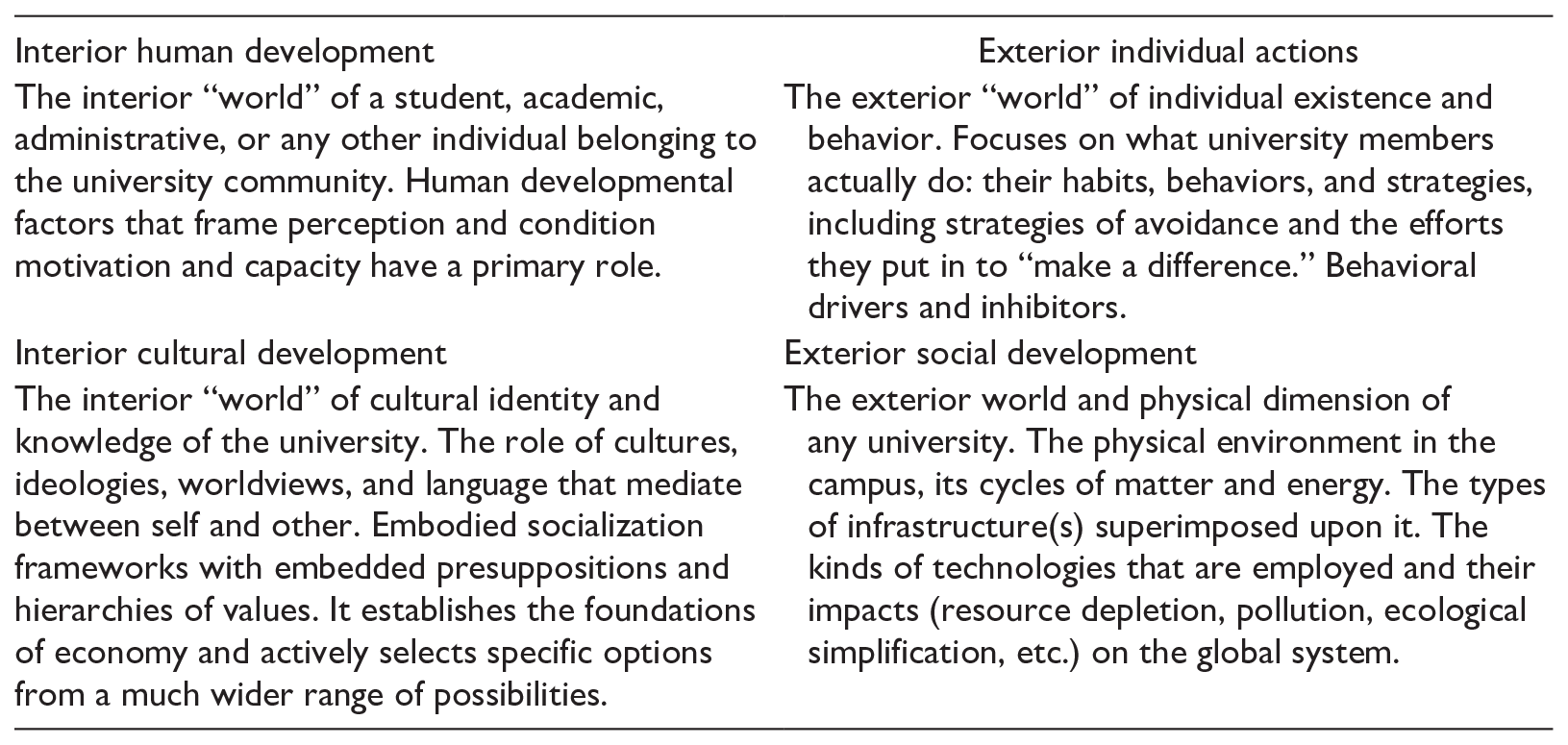
The four divisions above are closely interdependent; always interacting with one another. Each of these blocks represents a separate set of driving factors, influencing the development of the individual and collective, including of course the university. An in-depth look through these four “windows of reality” in envisioning the future of a given university would be optimal, but our investigation is restricted to the lower left quadrant—concerning the cultural identity of the university. Such a simple analytical distinction from the adjacent quarters provides license to explore paths where CoPs can stimulate the imagination and materialization of future-oriented cultures. Here, our gaze will turn toward two interrelated but distinguishable categories: organizational cultures and cultural domains.
Making Open and Flexible Organizations
In the first instance, we understand “organizational cultures” as the sum of experiences, habits, customs, beliefs, and values of university communities. As a result, the effect these factors have on the ability of its members to collectively think about—and anticipate—the future is particularly important.
Universities with well-functioning—that is, integrated, flexible, and open—organizational cultures have proven better equipped to handle fluctuating societal trends. In accordance with Sporn (1996), a robust culture affords a heightened level of consistency in the objectives and values of its members (pp. 44–48). Moreover, a hierarchical disposition allows for the effective enforcement of created strategies. Conversely, “weak cultures” are typified by the existence of “silos” (Scharmer 2016), a combination of poor, nonexistent, or mutually contradictory relationships among certain subcultures, for example between separate faculties or departments. The ability to develop a unified strategy, and then pursue its rapid implementation, depends on the quality of sub-cultural relations within a university. As a result, dynamic cultures could at first serve as a stepping stone, supporting, and sustaining successful strategic decisions—including those based on foresight (Conway 2016).
In the business realm, Wiener et al. (2018) sought to determine whether certain aspects of corporate culture intensify or impede open foresight. Their research reveals how corporate foresight simultaneously impacts the influence of internal pre-established patterns, along with the manner in which is restricted to pre-existing mindsets. They thus maintain that cultures linked through both external sources and collaborative efforts can cultivate an environment conducive to “innovative thinking.” In addition, it prevents the pitfalls of vulnerability and the limitations of preexisting thought patterns. Tyssen et al. (2012) write also in favor of innovation-friendly cultures in which high-level managerial and foresight partners respect exterior sources of knowledge. They further stress the widespread use of generated knowledge as “soft factors,” which are responsible for elevating the level of successful strategic foresight projects. But more research is needed when measuring the cultural bearing on foresight.
Nonetheless, academically-speaking, many cultures are currently struggling under the strain of their collective erosion, being subject to precarious working conditions and substandard circumstances—the result of a world governed by an accelerated cognitive capitalism, wherein no one truly knows for whom they work (Boutang 2011). The disparity between university subcultures—that is, academics versus administrators—is a critical impairment. Ultimately, they are plagued by inefficiency in dealing with the uncertainties and intricacies of their environment (Conway 2012). Considered together, these elements influence the likelihood of competently realizing a foresight strategy, for the result ultimately relies on cultural patterns and characteristics. As we shall soon see, communities of practice provide a decentralized cohesive space, which might unite individuals from different subcultures or collectives around a common intention. It might also connect people to external organizations in order to jointly conceive futures.
Fostering and Integrating Diverse Cultural Domains
In line with the CoPs approach, with “cultural domain” we are referring to new ideas, meanings, cosmovisions, philosophies, emotions, customs, traditions, languages, stories, knowledge, and so particular issues of common interest (Lave and Wenger 1991). All of these cultural nuances steadily flow within and without the campus, in a process that might be regarded as being “self-cultivated with others.” In this respect, the enrichment of different—and manifold—cultural domains cannot be exploited as an instrument of entertainment or financial gain; nor should it be regarded as a secular placeholder for religion. Rather, university culture is made up from multiple elements from the sciences and the arts, as a source for the collective self-construction of various narratives. Repeated perceptions gradually forge discourses, and similar discursive processes in progress shape the identity of the university; its self-understanding as an agent of transformation; as well as its resilience in the face of crises which threaten to undermine their role in society. Accordingly, cultural domains should not be taken as static entities. As a form of interior cultural development, we conceive them as a procedure of knowledge-acquisition, with adaptation and transition embodied within a range of organizational incarnations.
Promoting an array of distinct domains behaves as a vehicle for the universities to fathom the diverse world enveloping them. Their reaction to the uncertain nature of their future, albeit indirectly, is of paramount importance. These domains are, in essence, stories—not necessarily stemming from literature, but from the marriage of the arts and sciences. Accounts imparting their wisdom speak of the future’s condition as a consequence of decisions made in the present. They have a hand in cultivating a sense of curiosity, along with the ability to unify scattered threads of knowledge, thereby placing them in contact with each other. However, this assumption can no longer be sustained in a world governed by a cognitive capitalism, where knowledge is victim to the neo-liberal ethos of privatization, profiteering, and globalization. The result is that both humanistic and scientific cultures are both being undermined (Boutang 2011). Directing support toward these domains stretches beyond preservation alone or to a bare-bones program where the best possible outcome is limited to mending its injuries, or to provide “palliative care” for the humanities (Garcés 2017). Envisioning the future of the university focusing solely on internal knowledge sources is a needless limitation, for it can obstruct the circulation of novel insights, while also constricting the ease of its acclimation process. This reveals why it is advisable to facilitate the diversification of culture(s), going beyond the mission that was usually given to university extension. In this regard, communities of practice represent spaces of resistance and reformation. They function as informational filters; determining the shared selfhood and reciprocity in tandem with agents outside academia. Communities of this sort might be oriented toward the objective of an “alliance of knowledge” (Ibid.) addressing issues through practice, as we shall see next.
Communities of Practice and How They Can Be Used to Develop Interior Culture
Since it was introduced by Lave and Wenger (1991), the concept of “Communities of Practice,” understood as a type of informal learning organization, has been extensively used in the education and business sectors, although relatively less in cultural management (Hadley 2011). In general, CoPs are groups of people who care about the same real-life problems or hot topics, and who on that basis interact regularly to learn together and from each other (Wenger et al. 2002). Following Pyrko et al. (2017) and in accordance with our approach to interior cultural development, we see CoPs—and the knowledge they afford—more as a process rather than an entity that can be simply “set up” in a given environment.
A systematic review of the literature about CoPs in the health and business sector (Li et al. 2009) highlights several key features of existing CoP groups: their members interact with each other; collaborate to share and create knowledge; and foster the development of a shared identity among them. The emphasis on interaction between agents in formal and informal settings, and on the personal character of the identities and knowledge that emerge from it, suggests that the CoPs might be useful to cultivate university future-oriented cultures, both concerning its organization and its cultural domains aspects.
In this CoP-friendly way of thinking, the processes involved in imagining and developing future scenarios are not something to be done, neither from a top-down approach nor a bottom-up one, but rather implicitly by interaction between university agents with different interests and perspectives. In such a paradigm, the task of imagining university futures would be a process embedded in each participant’s context, and often it would be experimented as something enacted from cultural experiences in a surprising and unpredictable way. The future of the university might well emerge from the experience of an anomaly in campus, something outside “business as usual” or that seems senseless in relation to some aspect of the external reality in which the university is embedded. In this approach, described by Abma et al. (2010), the process would be conducted by surprise and in action (p. 244): “Learning is not just a matter of textbook and frontal learning (reading journals, following courses, etc.). Practitioners start to learn when confronted with anomalies in their practice, when their routines and habitual ways of thinking are challenged. They learn through reflection in and on action. Learning in and from practice is integrated in action and not just cognitive but, first of all, experiential and context-bound. It is learning while doing.”
Like we stated earlier, these anomalies would coalesce into a “domain.” Typical examples would be theater, reading groups and writing workshops, sports, music. . . all of them present in most of the inner campus cultures. Moreover, fostering informal learning by means of CoPs not only becomes a way of developing inner culture in those domains, but also of experimenting with social innovation and personal transformation—which on their behalf affects other quadrants within the Integral Futures paradigm. Interior culture evolution is naturally a form of outreach, a sort of “knowledge transfer” from the university toward the rest of society, including the industry and economy at large (Piirainen et al. 2016). It is also a tool for the university’s self understanding by means of “collective sensing organs that allow the system to see itself” (Scharmer 2017, 398), thus fostering its identity and inner cohesion. Future-oriented CoPs, as part of a stronger and more integrated interior culture, might then help the institution to design more effective strategies, anticipating, and adapting to long-term changes (Sporn 1996).
For that to happen, CoPs cannot simply be “created” from the top-down, but they can be sustained, and there is ample literature identifying and describing the factors that make them thrive or collapse. Those factors should be considered when deciding how campus life is to be organized, both in time—academic calendar, opening, and closing times, etc.—and space—architecture and accessibility. Time tables, campus facilities and services should make it easy to meet with colleagues and, more generally, “groups of people who share a concern, a set of problems, or a passion about a topic, and who deepen their knowledge and expertise in this area by interacting on an ongoing basis” (Wenger et al. 2002, 9).
As Ortega y Gasset said, all universities should aspire to direct their own destiny through shaping convictions unique to their institution. But in our experience, the elusive quality we call “leadership” cannot be designed by a university manager, at least not in the traditional sense of specifying a structure or process and then implementing it. No two universities are the same, nor are their sociocultural environments. Although campus vitality is not a product of chance; it emerges partially from the past and partially from the future scenario that is emerging. The collective intention of solving common problems and moving together toward a desirable future is a key factor. “Desirability” is indeed one of the principles making CoPs work: “Many natural communities never grow beyond a network of friends because they fail to attract enough participants. Many intentional communities fall apart soon after their initial launch because they don’t have enough energy to sustain themselves. Communities, unlike teams and other structures, need to invite the interaction that makes them alive” (Wenger et al. 2002, 50).
CoPs can thus be useful to stimulate the suitable ingredients in imagining futures of and for universities, but to do so, they have to stay alive. For CoPs to be as lively as possible, Wenger et al. (2002) provide a list of those principles, in the hope that making them explicit allows decision-makers to be more flexible and open-minded (pp. 51–63):
Design for evolution.
Open a dialogue between inside and outside perspectives.
Invite different levels of participation.
Develop both public and private community spaces.
Focus on value (to the university, to the centers on which community members serve, and to the members themselves).
Combine familiarity and excitement.
Create a rhythm for the community.
Blind spots, unconscious biases, and old ideas are indeed a problem, but they can be alleviated by following these principles when imagining university futures. In this sense, dialogue, peripheral participation of university members who operate in the margins of the system, and balanced power relations are key features allowing the players to challenge their own ideas. These are some features of CoPs that are helpful and compatible with other approaches, such as the Futures Literacy Laboratories (Miller 2018). For instance, Drimie et al. (2018) show the potential in setting up similar non-hierarchical transformation spaces, in which key players have the opportunity to share perceptions and thoughts without fear of prejudice or retaliation. In a nutshell, CoPs are spaces where stakeholders can come together and “freely think without the weight of a disciplinary history or institutional commitments to a given approach that may constrain dialogue, co-create, and prepare innovative ideas and interventions” (Pereira et al. 2015, 6035).
Case in Point: Suggestions When Cultivating Campus-Based Communities of Practice
The University of the Basque Country (UPV/EHU) is a public university comprising approximately 50,000 people on three campuses. In one of them, located in Gipuzkoa—a Spanish region next to France—an action-research project was launched in 2017 to study the cultural role of universities. The ongoing four-year project intends to understand and transform campus cultures by practical immersion in its processes, aiming to identify and sustain emerging dynamics in accordance with basic “Theory U” principles (Scharmer 2017, 54). Milestones included a World Café organized in 2018, a summer course and a collective book (Casado da Rocha and Arkaute 2019). The following is a summary of some preliminary conclusions—partially published in (Casado da Rocha 2019; Casado da Rocha and Uria Iriarte 2019)—including how the COVID19 pandemic has impacted on the project.
Making Time
Participants in the action-research often complained that campus life is demanding and “atomized” so that there is hardly any time to engage in activities other than study/teaching or research. Students have the feeling that there is no “free time” for them to spend on campus, and tend to go back home as soon as lectures are over. Academics and staff are stressed by the daily demands of a competitive and sometimes precarious job. That is the reason why it is especially important to save the date once in a while to meet with colleagues and friends who share similar interests.
Cultural events in universities often have a celebratory character, serving as milestones in the academic calendar and helping to emphasize the features of the academic ethos that are considered relevant to our daily lives and to society as a whole. After some trial-and-error, a shared governance model is being implemented, in which the culture program is jointly decided and funded by several CoPs in collaboration with the campus authority.
Opening Spaces for Creativity and Change
Another problem identified in the course of the action-research was related to the university extension courses, another fixture of academic culture all over Europe. Because of the inertia generated by administrative dynamics, in which things tend to be repeated if they are successful enough, those courses tended to attract the same group of students and teachers, year after year. The situation was not in line with a spirit of radical experimentation and openness to new ideas, so after consultation with experts and stakeholders, two criteria were agreed upon in 2019: (1) no teacher will be in charge of a given course for more than two consecutive years, thus maximizing the variety of topics and approaches covered by university extension; (2) all courses will include a practical dimension in which the group produces some form of creative output that could be shared with the campus community and beyond.
Granting Autonomy to Culture Makers
Another insight provided by the action-research is that cultural events cannot be organized from a top-down approach. One of the reasons why is that there is not a university culture, but many coexisting in the same campus. At the end of the day, culture is made by those who live it, and all university managers can and should encourage and facilitate that. Identifying and sustaining CoPs is a step toward that direction, but we are not talking about something new at all. The traditional model of student societies is still in good shape; for example, Oxford University has more than 150 officially recognized societies listed in its Register of Student Clubs.
Letting Go and Acting Fast
In one of the first studies about CoPs, Brown and Duguid (1991) described their approach as highly situated and improvisational (p. 47). CoPs respond to whatever the situation itself throws at them with something similar to Levi-Strauss’s concept of bricolage: the ability to make do with whatever is at hand. CoPs help “to build, ad hoc, and collaboratively, robust models that do justice to particular difficulties in which they find themselves.”
In an unexpected turn of events, the 2020 coronavirus crisis has tested every university’s “ability to make do” and transform its teaching, research, and outreach activities during the crisis. This unprecedented global disruption has had an enormous impact on the third mission, and in the case at hand it forced letting go of unquestioned dogmas, such as that university culture is always to be experienced in live, face-to-face events. After six hectic weeks, at the Gipuzkoa campus the cultural program has had to cancel all its live music and theater program, but CoPs have managed to move to the online world, some of them—for instance, the poetry community—with more energy than ever. University cultures are transitioning toward a hybrid model, combining online and offline activities.
Conclusions
Considering the profound transformations the university has recently experienced, we have proposed to reconsider its interior cultural evolution by paying attention to the shape-giving practices employed in rendering its restoration and foresight capacity. The “window of reality” is intertwined with the three quadrants which—in turn—form an integrated perspective on human development (Slaughter 2004). We have likewise submitted that the most substantial point about culture is its process of self-cultivation with others. Naturally, the same applies to the culture in higher education, particularly so in the organizational sense and the plurality of cultural domains handled on and off campus.
In what manner can cultural development support the future demands of foresight? We have presented here some cultural drivers, all of which might facilitate effective far-sighted strategic intervention. On the one hand, active interaction through multiple cultural domains is instrumental in nourishing the self-comprehension level of the university community within its particular sociocultural context. Doing so would help a more flexible and capable institution when facing future hardships. On the other hand, organizational cultures are of equal import when dealing with biases in imaginative capabilities. In these situations, strong cultures stimulate both cooperation and constructive criticism—the latter of which is essential for all academic personnel, as well as the external stakeholders. For this reason, organizational aspects and the variety of cultural domains are both relevant and intimately wedded. Together, they could achieve the status of a future-oriented cultural radar evolving beyond university walls.
A central point of our argument lies in how CoPs provide a beneficial setting for addressing such an open cultural approach. To do so, the on-campus cultural atmosphere needs to be compelling. Attendance to a given cultural event should be considered a satisfying action in itself—because it is intrinsically rewarding, formative, or transformative. Accordingly, we think the social responsibility of the university cannot be limited to programming cultural events. It cannot be organized in a “top-down” fashion. Instead, priority should be afforded to the interaction of its constituent parts both on and off campus. How the university manages to integrate with the rest of society is crucial to its own identity and compatibility. To this end, the process can be aided through allocating attention and resources to the promotion and outreach of CoPs. Three years of action-research conducted at the University of the Basque Country’s campus in Gipuzkoa has allowed us to identify some successful practices of this sort. These are: (i) make out time to celebrate university cultures; (ii) find spaces for creativity and change; (iii) grant autonomy to the cultural agents already present on campus; and (iv) maintain a prejudice-free attitude in order to tackle whatever unforeseen crises and disruptions may arise (e.g., COVID-19).
The conclusion to draw from the provided points is: in order to avoid biases and the prevalence of preconceived notions while imagining prospective university futures, the solution should not be sought only in the realms of teaching or research. Strategic foresight is a vertical literacy, which should permeate all aspects of university life. That includes the cultural dimension of the university in which students, academic, and administrative staff should not fail to experience the ultimate aims of the institution. Collective initiatives—involving the academic community at large, as well as external stakeholders—provide the requisite cultural background for universities to flourish: not for imagining its future alone, but as a means to shape together in practice the desired university in the present.
Footnotes
Acknowledgements
The authors acknowledge support from the Ethics in Communities of Practice Research Team (ETICOP) at the University of the Basque Country. Antonio Casado da Rocha acknowledges support from the Ethics in Communities of Practice Research Team (ETICOP) at the University of the Basque Country.
Author’s Note
José Luis Granados Mateo is also affiliated with Faculty of Social and Human Sciences, University of Deusto, Bilbao, Spain.
Declaration of Conflicting Interests
The author(s) declared no potential conflicts of interest with respect to the research, authorship, and/or publication of this article.
Funding
The author(s) received no financial support for the research, authorship, and/or publication of this article.
