



Abstract
Futures studies and foresight are new disciplines for Central Asia. Their methodology is making the first steps in the region. The present paper tests how narrative foresight can be applied in the field of religious education reform. For Kazakhstan, Islamic education has become a critical aspect of socio-cultural life. Its present situation requires radical changes, and the seven core questions of narrative foresight methodology help to research the vital dimensions of the problem in the quest for a solution. Going through the history of the issue, the forecast for current trends, identifying critical assumptions, and building alternative futures helps to arrive at the preferred future for Islamic education in Kazakhstan. With a new vision, some practical steps come forward that can guide to that new reality embodied in a new metaphor.
Introduction: Narrative Foresight in Religious Context
It is a paradoxical situation: the field that is mostly connected with the future by its inherent nature resists futures studies application most furiously. Try to ask any believer whether a Jew, Christian, or Muslim—who is one not by birth but by a conscious choice—about their attitude to the future or whether they want to learn about building alternative futures for their lives. You will probably get a reaction that varies from considering you a lunatic to pronouncing you a heretic committing blasphemy. Based on my personal experience, it will happen in almost 96% cases because, for most people, the future belongs to God alone. He is the One “declaring the end from the beginning and from ancient times things not yet done” (Isaiah 46:10, ESV, The BibleGateway 2001) and “He (alone) knows the Unseen, nor does He make anyone acquainted with His Mysteries” (Al-Jinn 72:26, The Qur’an 2010, Yusuf Ali). Any attempt to deal with the future or futures in particular means assuming God’s role.
However, there is a small group of believers—here comes the other four percent—who see a different pattern in their Holy Scriptures. The metanarrative that frames Abrahamic religions (Judaism, Christianity, and Islam) often encloses those categories in which futurists can easily distinguish backcasting components. These pieces are integrated into the descriptions of the New Jerusalem, the Heavenly Kingdom, or the Hereafter inviting going back from the future to the present day and identify rules and actions that believers have to take to reach the destination.
Moreover, the style that the Holy Scriptures employ presenting their content to readers and listeners—this category has been the original target group from the first verse of the Old Testaments up to the last ayah of the Qur’an—goes very well with the narrative foresight essence (Milojevic and Inayatullah 2015). To name a few parallels between the Holy Books and narrative foresight: (1) Both come mostly in stories: Scriptural stories include narratives of different caliber—from individuals (Noah, Maryam, David) and cities (Tire, Nineveh, Macca, Jerusalem) to tribes (the Ammonites, the Arabs, people of Hud, or “the chosen people”) to humanity in general (the history of creation or salvation) and the whole universe; narrative foresight concentrates on the stories of individuals, organizations, states, and civilizations. (2) Both extrapolates worldviews that underlie them: for the Scriptural narratives, this is primarily the Semitic worldview of people who led a nomadic life and encountered nature much more often and closer than we do now; narrative foresight deals with the worldview of modern people often “spoiled” with Hi-Tech, AI, and the rate-race lifestyle.
Both insist on linking stories to strategies: the Torah/Bible/Qur’an emphasize that if one claims to belong to the God’s chosen/followers of Christ Jesus/submitted ones (muslimūn), it is a must to follow the Law of Moses/the Ten Commandments/the Beatitudes/the Sunnah or all these together, thus creating your particular self, a new worldview. Nobody can do it for you, and your head knowledge is not enough for success because “faith by itself, if it does not have works, is dead” (James 2:17, The BibleGateway 2001, cf. Qur’an 49:15); narrative foresight focuses on including particular people and organizations with their stories built upon specific worldview striving to integrate disowned or ignored selves. (3) Both—if properly applied—lead to transformational changes on the deepest level: the Holy Scriptures via their Devine nature and the heard message work out on turning believers into a new creation (sanctification) performing the soul purification (tazkiyah al-nafs); narrative foresight via Causal Layered Analysis methodology deconstruct the worldview, uncovering subjective, individual, and cultural components and creating transformations there. (4) Furthermore, of course, both are never-ending stories but of different scope and scale: the metanarrative of the Holy Books continue living through human history in every new person that contact them, challenging personal assumptions, detrimental habits, and revealing eternal alternatives; for narrative foresight, the development of creativity and imagination multiplies possible, probable and preferable perspectives when “each new future needs to be deconstructed and reconstructed” (Milojevic and Inayatullah 2015, 161).
Therefore, we can conclude that using narrative foresight methodology is appropriate for considering a religious issue and constructing futures models. The global practice confirms this applicability, for example, suggesting incorporation of regional religious values into organizational foresight management (Ketola 2006), contributing to the assessment of moral values (Bell 2004), exploring various types of future relationships between science and religion (Bainbridge 2004), or the emergence of new alternative religions (Lohnson 2004) including more environmental-friendly (Taylor 2004).
However, for Kazakhstan, futures studies and foresight (further referred to as the futures) are entirely new and have no research history relayed to religion or religious studies. The present paper aims to bridge this knowledge gap and demonstrate the discipline’s applicability and affordability to the Kazakhstani religious context. The first step will take us to the field of Islamic education, and the next section will explain the choice.
Opting for Islamic Education
Religion can provide a long list of different topics where the futures can serve as a driver for critical improvements. Among the themes can be values transformation, state-religion relations, culture-religion intermingling, interreligious dialogue, new religious movements, and many others. Nonetheless, the choice of Islamic education has several reasons. Firstly, the educational component comprises all mentioned above topics that are interlace nicely in it. Secondly, a spiritual component is at the core of the contemporary discussion on educational issues worldwide (Wright 2000; Egorychev 2014; Mott-Thornton 2018).
However, the third reason is the most important. The socio-cultural paradigm of Kazakh people who comprise 68% of the country population (Kazakhstan Demographics Profile 2019) is currently going through the process of resurging traditional values, among which Islam has taken a predominant place for the last few decades. What is more important, the religious component plays a significant role for the youth, the future generation. According to the results of the sociological survey conducted by the Friedrich Ebert Foundation Central Asia (Youth in Central Asia. Kazakhstan 2016, 114), most young people associate themselves with Islam as their traditional faith [Table 1]:
What is Your Religion?

Therefore, Islamic education can be a significant factor in forming the identity of this future generation and their life strategy. What image of Islam will form their spirituality? What narrative about it will they consider valid and legitimate? Will Islamic factor have more constructive or destructive nature in their lives? Answers to these and many other questions of the kind depend on the future(s) of Islamic education the present paper will research and build.
Methodology
The construction of alternative futures works better in a group when many heads make great work bringing different ideas and knowledge together, blending and sifting them, discussing and arguing, and forming collective visions. From a practical perspective, workshops could have been the best option for building futures of Islamic education in Kazakhstan. However, such an opportunity is yet to come due to the discipline novelty and potential stakeholders’ cautious attitude. Therefore, the present research uses some traditional methods. Among them (1) Analysis of results from the surveys conducted under the research project Models of Islamic Education in a Postsecular Society: Eurasian and European Trends at the Institute of Philosophy, Political Science, and Religious Studies of the Ministry of Education and Science of the Republic of Kazakhstan. The representative sample included 114 students majoring in Islamic Studies at Al-Farabi Kazakh National University and Nur-Mubarak Egyptian University of Islamic Culture as well as madrasah students, plus 50 experts (Models of Islamic Education 2017); (2) interviews the author conducted with the first rector and the current one of Nur-Mubarak University in Almaty, and the director of the Institute on Combating Religious Extremism at Nur-Mubarak University (Author 2019a; 2019b; 2019c); (3) results of the survey the author conducted among students of Introductory Islamic Courses at the Central Mosque in Almaty (Kazakhstan). It covered 42 participants of Russian-speaking groups that made 81% of total attendance in this category. Among them, representatives of the Kazakh ethnic group comprised 71.4% (Author 2019d).
The narrative foresight methodology framework that focuses on questioning the current future and leads to new transformative narratives unites all these materials. The process includes the following foundational question (Milojevic and Inayatullah 2015, 158): 1. What is the history of the issue? 2. What is your forecast if current trends continue? 3. What are the critical assumptions you used in your forecasts? 4. What are some alternative futures based on different assumptions? 5. What is your preferred future? 6. Which strategies can be used in order to realize your preferred future? 7. What is a new narrative or metaphor for your preferred future?
These questions launch the process of more profound reflection on the past and present unleashing imagination to build futures alternatives. What follows in the paper presents answers to the specified questions to challenge the current status quo of Islamic education in Kazakhstan and come up with its new narrative.
History of the Problem
The first question requires a longer answer laying the foundation for further procedures. We will take a hundred-plus years journey back in the history of Islamic education in Kazakhstan that will lead us to the present.
Legitimization of Islam in the Republic during the time of independence raised some urgent issues in religious education. Firstly, during the Soviet era, the system of religious education that existed before was almost destroyed (Derbissali 2011, 179). That led to the second problem, namely, the absence of the developed institution of the ‘ulamāʾ or religious scholars. Traditional education of this group did not include graduating from a university (Berkey 1992, 44-92). Students instead sought to join a renowned teacher (ustāz), and upon completion of their studies, that ustāz approved them. The teacher’s individual discretion was the only body to give a student permission to teach and issue legal opinions (fatāwā). This practice has vanished in Kazakhstan, thus raising the third challenge for the independent republic. The lack of qualified Muslim clergy to nurture believers, edify them, and answer questions that naturally immerge during a spiritual quest was obvious.
So, what is the current situation with Islamic religious education in Kazakhstan? The description will imply a few quantitative elements, such as the number of mosques, imams, and specialized educational institutions, and some qualitative factors such as particularities of religious education, perception of Islam in the society, and the state policy on religion in general and Islam, in particular.
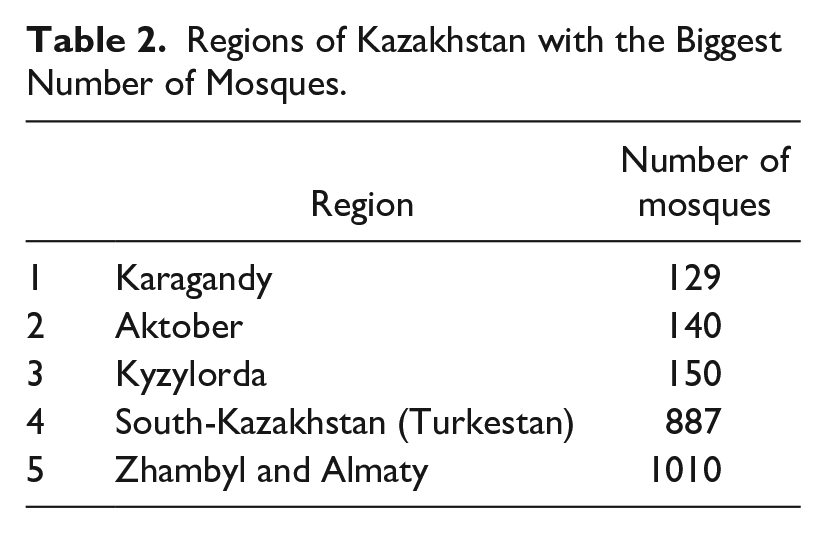
The quantitative parameters seem to be the most natural qualifier to identify a positive trend in the development of Islamic practices and education. Independent Kazakhstan inherited almost a destroyed structure of Islamic education from the Soviet past. Researchers mention that in 1961, Kazakhstan had only twenty-five registered mosques, and none of the twenty-five imams had tertiary Islamic qualifications (Olcott 2009, 304–305). However, by the end of the 20th century, the number of officially registered mosques was more than one thousand, and extra four thousand operated without proper registration due to the almost unhindered religious freedom (Olcott 2009, 304–305). After 13 October 2011, the downward shift happened when President Nazarbayev signed the new legislation on registration requirements for religious organizations. As a result, “one-third of the country’s religious organizations” failed to go through the procedure (One-Third of Kazakh Religious Groups 2012). The number of Islamic organizations and mosques dropped from 2811 in 2011 to 2229 in 2012 (Religious Conversions 2017, 154). If they were to continue their operation, mosques had to go under the jurisdiction of the Spiritual Administration of Muslims of Kazakhstan (SAMK), a semi-independent and heavily state-controlled body. Therefore, the recent data provides the following official figures: the SAMK has 2629 mosques and 4119 imams registered (Muzykina 2019a). The regions with the most significant number of mosques and imams are in Kazakhstan’s central and southern parts [Table 2] (Official Site of the Spiritual Administration of Muslims of Kazakhstan 2019):
Regions of Kazakhstan with the Biggest Number of Mosques.
Where do imams receive formal education that makes them eligible for serving? Currently, Kazakhstan has a three-level structure of local Islamic institutions that focuses on nurturing Islamic clergy and prospective scholars. The first level includes madrasahs, a traditional form of education in the Muslim world since the 9th-10th centuries. In Kazakhstan, this form was re-launched in 2009 when the first Abu Hanifa Madrasah was opened after almost a hundred years of void in this realm (Derbissali 2011, 194–195). Nowadays, there are nine educational organizations of this kind, mostly concentrating in the country’s southern regions. They are officially registered with the Ministry of Education of the Republic of Kazakhstan, have the operation licenses, and their curriculum recently became compliant with the general state requirements to such institutions (Religion Becomes a Required and Positive Factor 2016). It means that 60% of courses should be Islamic religious and theological disciplines, and 40% have to go for general education subjects. Madrasahs’ graduates receive a state diploma in Islamic Studies.
The second level includes the Republican Islamic Institute for Imams Advance Training in Almaty provides. Again, the institution’s official registration with the Ministry of Justice of the Republic of Kazakhstan took place on 10 April 2002. As mentioned, Absattar Derbissali, an ex-chief mufti of SAMK in 2000–13, the main objective of founding this institution was the so-called “recertification” of acting imams “because the level of proficiency was shallow” (Muzykina 2019c). Local and foreign professors from Turkey and Egypt lecture in Kazakh and Arabica variety of fundamental Islamic theology courses as well as Kazakh Language and History of Kazakhstan (Derbissali 2011, 192). More than 1200 imams graduated from the Institute with state-recognized certificates (shahadah) within 13 years (Muzykina 2019c). As for the period from 2013 till 2019, when the educational program was critically reassessed to ensure the continuing professional education, 1340 more imams went through the training program (Muzykina 2019b).
The successful graduates of the first two Islamic institutions mentioned above get a right to enter Nur-Mubarak Egyptian Islamic Culture University, the first and only one university of a kind in Kazakhstan. The University started its operation on 1 September 2001, and serves as an example of a bilateral project launched and supported by Kazakhstani and Egyptian governments. The Board of Trustees that includes representatives from both countries, supervises its activities (Derbissali 2011, 186). The main objective is to prepare specialists in Islamic Studies, train imam-khatyb, and enhance the general level of Islamic theology in Kazakhstan. Also, up to the year 2019, after passing the required exams, from 25 to 30 students were going on exchange to Al-Azhar University, the Sunni Islam most prestigious university and the primary knowledge center (now this number is considerably limited by the SAMK and students are almost not able to go on exchange).
After 2011, following the Republic of Kazakhstan’s educational standard, students of Nur-Mubarak University started to study general subjects, and new departments launched their work. Nowadays, there are four departments, such as Islamic Studies, Religious Studies, Arabic and Foreign Languages, and Humanities. Students can receive a multilevel education that includes Bachelor, Master, and Ph.D. degrees under the supervision of thirteen Egyptian professors from such universities as Al-Azhar, Cairo University, Alexandria University, and Ain-Shams teaching permanently at Nur-Mubarak. No other Islamic institution in the whole of Central Asia can boast of such a trait at all (Author 2019a).
However, the sociological surveys conducted under the research project Models of Islamic Education in Postsecular Society: Eurasian and European Trends (2016, 346–358) demonstrate that reform is highly demanded in the field of Islamic religious education. Firstly, 76% of the experts acknowledged the need for changes, arguing that the faculty teaching Islamic courses has a low professional level and needs to comply with the world practices taking into account the Kazakhstani context. The latter means the affirmation of Hanafi Madhhab and its role in the Kazakh cultural tradition. This aspiration is a result of intensive promotion of the “Hanafi Project” (Karimov 2018, 300–312) to safeguard Hanafi orthodoxy in Kazakhstan and secure the country from the intervention of “radical forces.” The propaganda started in the early 2000s reflecting a reductionist plan of shrinking Islam to a nationalistic element of a secular doctrine when practicing believers face growing ostracism in society.
The most alarming trend that marks the need for reform is the answers to the question, “Do you plan to teach at Islamic religious institutions or serve as an imam/ustaz (religious teacher) in a mosque?” [Table 3] (Models of Islamic Education 2017, 348–349):
Do You Plan to Teach at Islamic Religious Institutions or Serve as an Imam/ustaz in a Mosque?

The results indicate that, firstly, the status of a teacher/lecturer at a religious institution is more attractive than the status of an Islamic clergy for contemporary students. Secondly, the modern youth of Kazakhstan do not associate imams with research and scientific activities. They limit them to ritualistic duties, daily mosque routines, and inadequate salary. Any theological quest for balancing spiritual and material lives the youth mostly take away from the picture of a modern imam in Kazakhstan. That is why among more than 4000 acting Muslim ministers only 545 (13%) had higher education in 2016 (Religion Becomes a Required and Positive Factor 2016). That is why it is no surprise that Kazakhstani secular authorities and ordinary people express concern about the educational and intellectual level of imams in mosques around Kazakhstan (Bondal 2017). The SAMK itself understands the situation and strives to make a difference taking some steps (Religion Becomes a Required and Positive Factor 2016): 1. Development of “The Concept for the Development of Religious (Spiritual) Education of the Spiritual Administration of Muslims of Kazakhstan till 2020” adopted on 24 November 2015. The main objective is to form a unified Islamic educational system that should meet the spiritual needs of society and every citizen, creating a unique model of multi-format teaching of religious courses. 2. Launching an initiative “500 Enlightened Imams of Contemporary Time.” It focuses on comprehensive development and improvement of imams knowledge. The objective is that in the future, 500 imams of large mosques on regional, city, and district levels have diplomas both in religious and secular fields of study. This initiative aims to prepare imams for work with different groups of people. 3. Supporting the work of the Republican Islamic Institute for Imams Advance Training in Almaty, some regional madrasahs (e.g., in Pavlodar, Taraz, Shymkent, Saryagash, Aktober) organize short-term intensive training courses for imams who come there from all around Kazakhstan. Nur-Mubarak University also took an active part in advance training of imams and organized a summer school on its campus for more than 2000 imams in summer 2019 (Author 2019b).
However, ambivalence marks the current situation. On the one hand, Kazakhstan has built its Islamic educational system from scratch after the Soviet regime almost destroyed it. Three levels of Islamic education function in the republic nowadays, focusing on preparing a new Islamic clergy generation. Before the COVID-19, the enrollment was growing, keeping the gender balance among the students. The number of mosques in Kazakhstan was increasing together with the number of imams who served there.
On the other hand, the state was the main initiator of any national Islamic education changes. The Ministry of Religious and Civil Society Affairs, a unique governmental body, created in September 2016—in June 2018 it was renamed into the Ministry of Information and Public Development with the Religious Affairs Committee in its structure—has closely watched all religious activities and educational programs. Constitutionally, Kazakhstan is a secular state, and with religion separated in theory, the leading educational standards for Islamic education are the state ones. Any particular standards of Islamic theological education do not exist in the country. Moreover, only graduates with a state diploma from a state-accredited institution can get a job within the SAMK system that is entirely accountable to the state.
Though state oppression that was typical for the Soviet atheistic era has gone, it becomes more and more evident that a new tunnel thinking is taking ground in the form of the “Hanafi Project.” It stands as an antithesis to classical Islamic, Hanafi madhhab, and signifies “a hybrid ideology of a secular type built on an agglomerate of the state national policies, local ethnic traditions, and certain elements of the classical Islamic Hanafi School disguised as the only historically predetermined local authentic form of the Sunni Islam” (Karimov 2018, 301). It is a clear indicator of the state intention to control its citizens’ spiritual sphere for the sake of combating religious extremism and safeguarding the lives of the people. However, the internet, modern technologies, and globalization make people so tightly connected, and new ideas travel so rapidly from one corner of the world to another that stopping or controlling them is impossible. The control strategy should give place to balanced critical education.
The Current Stage and Assumptions
Therefore, from the perspective of narrative foresight, the metaphor that can describe the current situation with Islamic education in Kazakhstan can sound this way: In 2020, Islamic education in Kazakhstan looks like a prisoner bound hand and foot, forced to follow his taskmaster. He is poorly fed, has no perspective for freedom, and is frequently turned into a scapegoat whenever needed to switch public attention from economic or political downfalls and collapse.
Following up, if the trends described above continue, then by 2041, most of the imams in Kazakhstan can receive only local training, and we can assume the following: 1. The quality of that education will be quite low; 2. The curriculum will be narrowly focused that can lead to worldview dogmatization; 3. Restrictive measures and close control of religious educational institutions will grow; 4. A desire to go abroad and get an education there, for example, in Turkey or Egypt will increase among potential students; 5. As a reaction, the so-called “foreign” Islam will gain the ground in Kazakhstan, thus provoking counteractions from the government.
Nevertheless, it is not the end of our future journey. Taking it, let us remember what Maree Conway says, “There is no such thing as THE future. We always have multiple possible futures available to us in the present” (Conway 2016). Let us think about some alternative perspectives and understand what alternative scenarios Islamic education can have.
Looking at Alternatives: Utterly Positive, Negative, and In-Between
For building futures hypothesis, we will use the so-called “2 × 2 Matrix” method that is widely used for scenario planning. Its history goes back to the 1970s when Pierre Wack developed it for Royal Dutch Shell, and Peter Schwartz further systematized in his famous book on foresight “Art of the Long View” (1996).
The method uses a matrix with two dimensions of polarized uncertainty, where four cells represent four combinations of those uncertainties developed into alternative futures. We will choose (a) technology with its implementation, and (b) government with its control power. Extremes of the chart will include:
(a) A – Low Technology Environment
A + Advanced Technology Environment
(b) B – Strong Governmental Control (Authoritarian)
B + Participatory Governance (Democratic)
If we put together the initial characteristics of the chosen uncertainties, then the terms for scenarios will look like this (Figure 1).

The Matrix Scenarios.
Applying these sketches to the religious education context, we can briefly present the following alternatives.
Big Brother’s Care for Islamic Education (Upper Left Side)
All spheres of social life are under the strict control of corresponding governmental structures that use self-taught AI officials. All educational programs are gone online and stored on the Single National Server supervised by the Ministry of Digital Education and Security. Students at religious institutions and any other have to download unique apps for their studies that local programmers developed under the supervision of the Committee of National Security (KNB). All materials used for Islamic courses go through pre-approving and scanning for any discrepancy to the official version of “traditional Islam,” the brand that has been dominant for decades. Android tutors teach this type of Islam being preprogrammed for all subjects included in the official curriculum. Of course, with such “professors,” cheating is impossible, but close attention to power structures thrive. The installed apps give security services access to mobile gadgets of Islamic Studies students, tracking their daily activity and sites they visit (though free access to the internet is blocked in the country). There are channels that the Ministry of Digital Education and Security provides for online abroad studies, but a few young people apply for those options because there is nothing new or different to expect. Even the language improvement opportunity is no longer attractive because online programs provide quite high competence in Arabic, Turkish, Farcy, and Urdu. However, Muslim ummah’s unity in thought is surprisingly high, and no one deviates in common doctrines and traditional beliefs.
Back to Cramming (Lower Left Side)
Due to Islamic educational institutions’ low technical support, their curriculum is shifting more to the Middle Ages traditional system of text memorization. The courses are limited to those with enough printed or internet open-access materials. A lecturer is a key person in this educational process, and their improvement should come first from an institutional Board of Directors or an organization whose activity the security structure monitors very closely. Professional qualities might not be a decisive factor in hiring; loyalty to the ruling regime is paramount. Islamic educational institutions are state-sponsored, and the funds become the main instrument to enforce the policy that benefits the power holders. No new knowledge-generating process is possible in such circumstances for research capacities are limited due to inadequate supply of original materials, limited access to internet resources, and absolute absence of academic mobility for both the faculty and students. To receive state permission for going to a research trip abroad is almost next to impossible for authorities are afraid of losing control over their subjects there. As a result, local imams’ reputation gradually degrades among Muslims because the clergy often cannot answer believers’ urgent questions due to limited knowledge.
Striving for a Knowledge Hijrah (Low Right Corner)
The governmental authorities understand that the country’s digitalization level, in general, does not comply with world standards and modern requirements. Through a series of consultations with representatives of different social groups, the government prioritized the development of the educational sector. Islamic institutions received particular attention, for they have to prepare a new generation of Muslim ministers who can inspire believers to new living standards. Among them high morality, diligence in doing daily duties, critical thinking, striving for society’s well-being and every person in it, peaceful coexistence of all people, and many other virtues that Islamic tradition has been keeping for centuries. A special governmental decree designated national grants for technically gifted Muslim youth who are developing different apps and software to improve the Islamic educational system. New courses and new resources become widely available for future imams who get ready to lead their communities out of a dark period of popular beliefs and superstitions mixed with some Islamic ideas to a new era of Islam in Kazakhstan.
Digitalizing Eternal ‘Ilm (Upper Right Corner)
Islamic religious education has gone through a period of radical transformations. The religion-state cooperation and mutual support replaced original dependency on and patronymic attitude of the state. Now the institutions are independent entities that enjoy using all the latest technological advancements that help Muslim students keep up with their secular peers and even exceed them. Young Muslims establish virtual associations to exchange ideas, develop innovations, and fresh interpretations of Islamic heritage. Unique apps that integrate Big Data and AI with centuries-long wisdom of Islamic “ilm help them to find up-to-date Sharia” compliant solutions to emerging issues.
The education process has become more student-oriented and includes close cooperation with the faculty. Both sides make an active input to improving the curriculum, AI tutors, virtual libraries, international contacts, spiritual retreat summer camps, and other extra-curricular things. The human faculty include research-oriented professionals that develop a local version of Islam, integrating various useful ideas from around the Muslim world and different madhhabs. They are honored participants of all significant virtual international conferences and actively contribute to many internet portals, from Al-Jazeera to Digital Islam Today. Thus, the Kazakhstani Islamic Studies program and institutions have turned to be highly competitive and attractive for young people all around the world.
Envisioning the Preferred and Moving There
Now, we have reached a crossroad with several options, and like an ancient knight-vityaz in Russian fairytales have to choose what route to take. In other words, we need to answer the question, “What future will be preferable?” Norman Henchey, a Canadian futurist, defines the preferable future as what we want to have happened (Henchey 1978). It does not yet exist and requires a clear vision that moves reality beyond the present toward the best possible. The preferred future liberates and empowers because it encourages people to say, “This is the future that we appreciate and that we want to create.” This kind of future should release energy and creativity, helping to construct Islamic education, so we want it to happen rather than what we think is likely to come.
Of course, the fourth scenario described above is the closest idealistic perspective. It is not exhaustive and very sketchy. To make it speak to people’s hearts, we can summarize it as a vision statement that will help move forward. Regarding the time-period for it, we will take twenty years from now because, on the one hand, implementing changes and bringing innovations within this period looks realistic. On the other hand, education is a field where shifts do not occur overnight and sometimes require a few generations to go through them.
Therefore, the preferred future for Islamic education in Kazakhstan is this:
By 2041, Islamic education in Kazakhstan becomes a beacon of religious education in the Muslim world due to its critically innovative approach and radical reform in the education system. Graduates of this system are firmly rooted in the classical Islamic heritage yet actively contribute to the development of the contemporary Muslim thought that reflects the needs of a rapidly changing world, providing believers with a stronghold in times of turbulent uncertainties. A modern imam is a polymath that widely uses technology to fulfill God’s will.
This future might look preposterous considering the issue background, but as Alfred North Whitehead said, “almost all new ideas have a certain aspect of foolishness when they are first produced” (Bell 2004, 78). That is why futures studies is to challenge what many well-intended people believe to be impossible to happen.
For someone, it might sound like a fiction introduction. However, specific steps can take place today to make the preferable future real using it and paving the path to it. Of course, the list of potential steps is not exhaustive, but include the paramount points: – Kazakhstan establishes a genuine state-religion separation secured through the legislation and the Constitution, thus promoting the execution of authentic religious liberty; – The Ministry of Education and the Ministry of Justice of the Republic of Kazakhstan collaborate on developing new requirements for religious educational institutions registration, thus ensuring their variety—from state-sponsored to private and independent; – The curriculum of Islamic educational institutions includes futures literacy and futures studies that empower the youth to get ready for changes, generate them, and use the future to innovate the present; – The SAMK system is reconsidered and changed; imams obtain a renewed status in the society that focuses on their personal, spiritual, professional, and civic traits and rights, not only duties.
At the same time, it is essential to remember some risks that can occur along the journey. The current global situation with COVID-19 and the political life in Kazakhstan comprises both risks and enormous opportunities for the improvement of Islamic education in the country.
COVID-19 accelerated the immersion of humanity into virtual reality. A quite sudden and ubiquitous lockdown urged educational organizations to go online massively—no exclusion to none. It turned down to become a powerful stimulus for Islamic educational institutions to reconsider their relationships with modern technologies. It is no more a matter of “take it or leave it” but a must for both students and professors to adjust to this new reality. Moreover, here they can be either reacting or proacting, depending on previously adopted competences. That is why futures thinking oriented education plays a critical role. It increases participants’ change agency, the transdisciplinary character of the system, helps adopt long-term thinking, generates concern for others, and openness to alternatives (Chen and Hsu 2020).
The political situation in Kazakhstan can also play a risk-opportunity role. Kasym-Zhomart Tokaev, a new president, has all chances to bring positive changes restructuring all social life spheres, including education. However, under the pressure of the COVID-19 and more than plausible economic crises, religion and religious education will be the least issue Tokaev cares, thus continuing his predecessor’s policy described previously.
However, if things work right, a new metaphor for Islamic education can sound very inspiring:
By 2041, Islamic education in Kazakhstan is like Ibn Battuta, the Space-Traveler that merges the best of the heritage and the most innovative of the present to create an unthinkable future.
Conclusions
Summing up, futures studies can turn into an essential tool in choosing the way the reform of Islamic religious education in Kazakhstan may go, thus bringing crucial changes to the spiritual life of the whole country in the long run. Through narrative foresight, the process can become more personalized and internalized, bring new perspectives and metaphors that will ensure the success of the endeavor. The very nature of narrative foresight can awake the creative component that Islamic educational organizations in the republic and the Muslim world, in general, should promote in knowledge acquisition and production. In the present paper, the foresight methodology helped us understand how this may go into alternative futures. Focusing on the preferable future, we identified some critical steps that await their realization today as well as risks and opportunities that come along.
However, remembering that there are many futures, it is necessary to acknowledge that the one that will unfold depends on many factors, including human intervention. Whether people involved in the process are positive or negative about the opening possibilities, whether they feel themselves agents or doomed victims of the risks they face, all these shapes the narrative we compile. Sometimes, it is essential to stop and think, “What is my story?” because the internal narrative transformation is intimately linked to challenging underlying assumptions and bringing changes in the world around.
Footnotes
Declaration of Conflicting Interests
The author(s) declared no potential conflicts of interest with respect to the research, authorship, and/or publication of this article.
Funding
The author(s) received no financial support for the research, authorship, and/or publication of this article.
