




Abstract
This article introduces the Work/Technology 2050 study of the global Millennium Project and its main results. The article highlights how (invited) experts from different countries see the development of work and technology until 2050 and how they assess the three featured scenarios based on these views. In terms of technology, the study focused on the potential effects of artificial intelligence, while the role of basic income was given special consideration in the development prospects of work. In connection with the scenarios, the study produced hundreds of proposals for action under five different themes. Besides presenting and evaluating these scenarios and proposals for action, the Finnish authors of the article provide their own reflections and some critical remarks.
Keywords
Are the Large-Scale Impacts of Artificial Intelligence on Employment Just Hype?
The international community of futurists woke up to the opportunities and threats of artificial intelligence (AI) in early 2015, the topic shared by influencers such as Stephen Hawking (2017), Elon Musk (Holley 2018), Bill Joy (2000), and Bill Gates (Christian 2019). Admittedly, the transhumanists in the community of futurists had long spoken of AI as a key determinant of the future. Transhumanism as an intellectual movement advocates enhancement of the human condition by technologies. Thus, already in 2004, the Finnish Society for Futures Studies organized a transhumanism event in connection to its summer seminar (Heljakka and Mikkola 2004). There, Finnish transhumanists declared that, by 2050 at the latest, AI would integrate new technologies into a “singularity” (Heljakka 2005). Singularity refers to a hypothetical point in time at which technological growth becomes uncontrollable and irreversible, resulting in unforeseeable changes to human civilization. Upon encountering this singularity, the world would radically change, the transhumanists claimed. At the international level, Ray Kurzweil (2005) in particular, a founding member of the Singularity University in California, has written about the singularity of technology.
The recent developments in AI have been controversial: on one hand major breakthroughs are foreseeable, and on the other hand they have not yet been delivered. For example, IBM Watson, which laid the groundwork for AI with its Jeopardy victory, has made much slower progress in its main application area, healthcare, than what IBM estimated in 2015. Watson can provide fairly good symptomatic treatment recommendations, but not very much better than the average doctor. Sometimes it also suggests outright strange treatment recommendations. For these reasons, and because of doctors’ and other healthcare professionals’ general suspicions, the use of Watson has so far been quite limited in Europe and the US. In Asia, however, it has already begun to be applied more widely in healthcare planning (Strickland 2019).
The Global Millennium Project and Its Work/Technology 2050 Scenario Study
Since 2015, researchers in the global Millennium network have been systematically reflecting on the future impacts of AI on work. Launched in 1996, the Millennium Project 1 is the most geographically comprehensive community of futurists. Its network of national core groups, or nodes, now exists in 65 countries, and in some countries, such as the United States, there are several nodes. Today, the Millennium Project features a total of 70 nodes. This background of the virtual “global brain” is worth bearing in mind when reading the results of the Millennium Project studies.
In June 2021, at the International Conference of the Finland Futures Research Centre, the Helsinki Node organized a Special Millennium Forum on Sources and Risks of Digital Transformation, where Jerome Glenn gave a keynote on the topic “The Transition from Artificial Narrow Intelligence (ANI) to Artificial General Intelligence (AGI) Will Change Learning and Education.” Glenn (2021) emphasized that “if we don’t get the initial conditions ‘right’, for Artificial General Intelligence, then Artificial Super Intelligence (ASI) could evolve quickly beyond our understanding.” Artificial narrow intelligence is often better and faster than humans in, for example, driving trucks, playing games, and medical diagnostics. Artificial general intelligence is hypothetical ability of an intelligent agent to understand or learn any intellectual task that a human being can. Artificial super intelligence sets its own goals independent of human awareness and understanding (Glenn 2021). Distinguishing these three different levels of AI is relevant for discussing the results of the study.
The main form of work in the Millennium Network has been Delphi studies (so-called real-time Delphi or RTD studies) based on anonymous estimates and aspects, as well as seminars and other related events. The nodes of the Millennium Project have both participated themselves as well as looked for national experts and future decision-makers for the Delphi studies and the national events that support them. The Millennium Project combines the study of possible futures with the promotion of good practices. The results of its work are presented in the more or less annually published State of the Future reports (Glenn 2017) and in the Global Futures Intelligence System database. This multicultural and interdisciplinary node dynamics is especially suited for the Delphi approach because the participants can see real-time interaction from all respondents.
Launched in 2015, the Work/Technology 2050 study is the largest in the history of the Millennium Network thus far, both in terms of duration, the number of participants, and geographical coverage. Its final report was published in 2019 (Glenn 2019). The study proceeded in the following methodological stages as described in detail in the report cited above: 1. Evidence for the scenario construction was sought for via a literature review to find what questions were not asked or poorly addressed as input to an international RTD survey 2. The RTD process was executed with more than 450 people from 50 countries. Out of the nine RTD studies, four were conducted for building the scenarios and five for identifying actions. 3. Scenario drafts focusing on the future of work were then drawn as desktop research, to be evaluated and commented on by more than 450 individuals. 4. The updated scenarios provided material for futures workshops in 19 countries, organized by the MP node representatives. The participants elaborated appropriate measures for the scenarios.
2
5. Out of the more than 250 proposals for action, 93 were selected in the study for evaluation and divided into the following five policy areas: government and governance; business and labor; science and technology; education and learning; and culture, arts, and media. Separate RTD panels were established to assess the likelihood and effectiveness of each measure in these sectors. 6. The results were analyzed and synthesized as desktop research, published in separate reports, submitted to the relevant administrations in 50 countries, and integrated into a draft final report, then finalized by the MP project team (Glenn 2019).
Three Scenarios of the Future Work and Technology 2050
In this section, we will shortly summarize the three Work/Technology 2050 scenarios, and make some interpretations and critical comments. Those interested in the full scenarios are encouraged to see the report in its entirety (Glenn 2019). 3
Scenario 1. It’s Complicated—A Mixed Bag
“A business-as-usual trend projection of the increasing acceleration of change with both intelligence and stupidity characterizing decision-making. Irregular adoption of advanced technology; high unemployment where governments did not create long-range strategies, and mixed success of the use of universal basic income. Giant corporations’ powers have often grown beyond government control in this government-corporate, virtual 3-D, multipolar world of 2050.” (Glenn 2019)
This first scenario can be interpreted as a kind of extension of the current patterns of behavior, for which futures researchers use the name “business as usual” (BAU). It implies some regulation of the development, but this regulation is globally inconsistent and insufficient when addressing global issues. Universal basic income (UBI) is introduced somewhat inconsistently in the scenario, although a reference is made, for example, to the basic income experiment carried out by Finland, with the statement that some countries are already actively developing it.
The financing of the UBI is indicated to be derived from carbon taxes as well as from taxes on robots, AI, and financial transactions. Although carbon taxes are repeatedly mentioned as a source of funding for UBI in this study, climate change is not highlighted in the futures narratives of this scenario, nor in other Work/Technology 2050 scenarios. In Scenario 1, climate change is only seen as proceeding. The meager treatment of climate change can be considered a weakness of the scenarios, given the recent truly worrying estimates by the International Climate Panel (IPCC 2021).
In Scenario 1, the progress in the development of AI, and in particular the deployment of its applications, is slow in relation to the technical potential, especially in some sections of the world. This has given the world time to prepare for applications of AI, not only through UBI solutions, but also by seeking solutions in which AI, instead of employee replacement, supports the employees in a variety of roles. However, by the 2050s, AGI, similar to human intelligence, is expected to be widely used, with the exception of some countries that are still lagging behind. The technical potential is realized in particular in transportation and healthcare: cars are running autonomously without drivers, and the elderly generally have robots that personally assist them.
Although not mentioned in the report, the narrative of Scenario 1 fits with the development that ethical problems and fears will lead to the banning of many applications of AI in the EU. The reasons used in the scenario story are similar to those that motivated the EU’s restrictive rules on the use of human genetic information and those that banned the genetic engineering of plants. The legal grounds for banning several applications of AI can be found, in particular, from the already accepted EU General Data Protection Regulation (GDPR). The EU could ban the use of personal data if there is the slightest indication that the data could be misused (see, e.g., Minkkinen, Aufferman, and Heinonen 2017). We claim that a general ban on facial recognition would prevent the development of personal digital twins that learn together with a person through their sense of sight (see, e.g., Kaivo-oja et al. 2020), and the EU would lose many of the very promising future possibilities of photonics (cf. Purmonen and Saarinen 2018).
According to this scenario, the power of large companies like Google, Amazon, and Apple will remain at least at the current level. By the 2050s, out of the world’s six billion workers, two billion are said to be in permanent paid employment, two billion will be self-employed entrepreneurs, and one billion will be self-employed outside the job market. Furthermore, one billion will be unemployed or otherwise looking for work. More and more jobs, especially in large companies will be carried out on platforms, using self-employed entrepreneurs who will not have personal contact with their employers.
The current cautionary example of the free trade of simple work in the global marketplace is Amazon Mechanical Turk, where, according to (Wikipedia 2021), the hourly wage for short-term jobs averages less than $2. It remains understandable that wages remain at this level, given that they are in competition with, for example, Nigerian or Indian income levels, especially as AGI starts to replace not just simple jobs but also more advanced ones.
However, Scenario 1 assumes that the global well-being will increase by around 3% per year as measured by the “State of the World” index. This index has replaced GDP as an indicator of global progress in the State of the Future reports of the Millennium Project. Such an increase is believed to be possible through investment in education/skills, better regulation, and the gradual launch of UBI. Yet, the development varies greatly, with large regional and demographic differences.
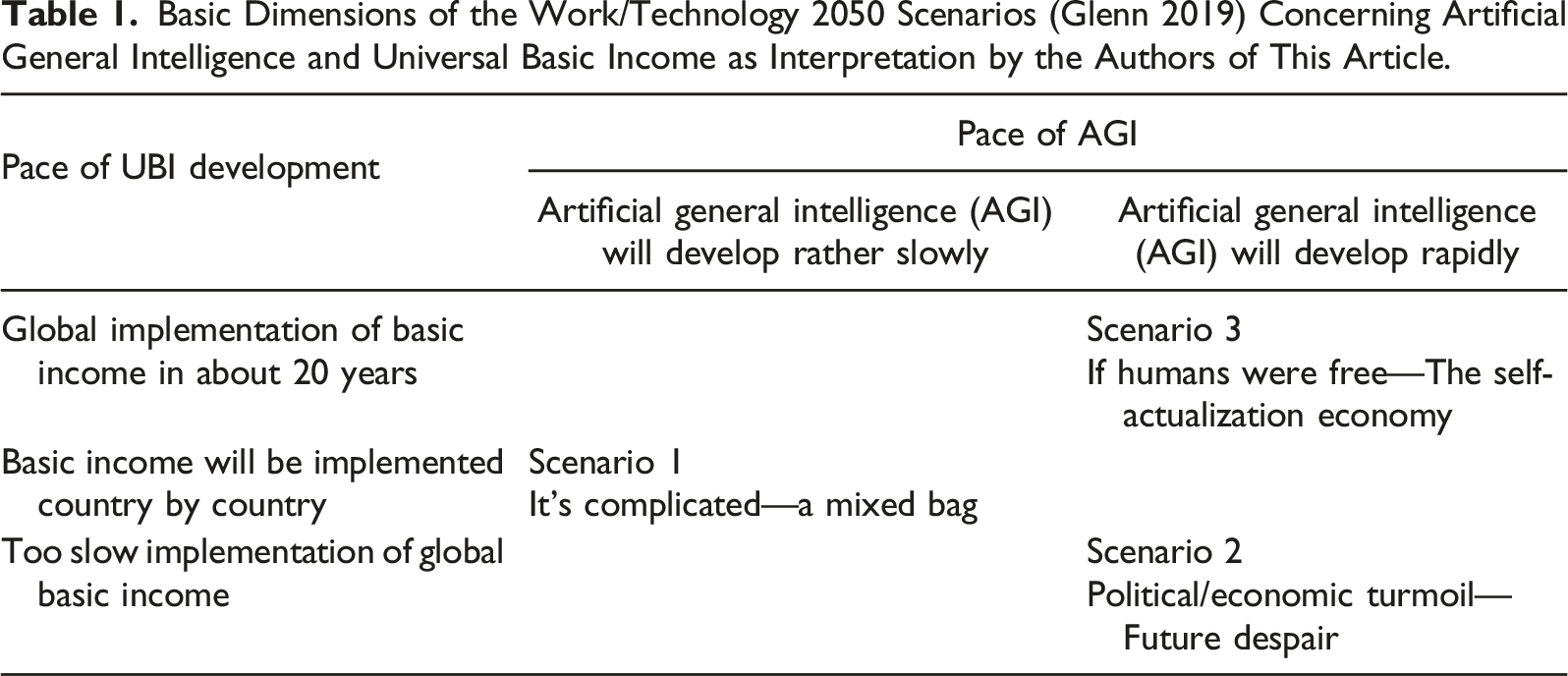
Basic Dimensions of the Work/Technology 2050 Scenarios (Glenn 2019) Concerning Artificial General Intelligence and Universal Basic Income as Interpretation by the Authors of This Article.
Scenario 2. Political/Economic Turmoil—Future Despair
“Governments did not anticipate the impacts of artificial intelligence and had no strategies in place as unemployment exploded in the 2030s, leaving the world of 2050 in political turmoil. Social polarization and political gridlock in many forms have grown. Global order has deteriorated into a combination of nation-states, mega-corporations, local militias, terrorism, and organized crime.” (Glenn 2019)
In Scenario 2, both companies and governments act in the short-term and in their own interest. Behind this is a low appreciation for fact-based information and little interest in long-term foresight. An important reason for such attitudes is consumption of the fake news and trivial social media on which people spend a lot of time. Due to a social mood of general superficiality, there is little awareness of the technological development and its social impacts. The technical change that replaces human work or radically cheapens it is also considered a development that cannot or should not be affected. The selfish choices of leaders are often justified by the international competitiveness of companies, which is considered crucial for national success, on the premise of rewarding short-term profits and immediate political favors.
This short-termism will accentuate when the social impacts of human-work–replacing technology are not taken into account. According to the scenario, out of the six billion workers only one billion will be employed and one billion will be self-employed in the official economy. Another four billion will either be working in the subsistence economy or unemployed or jobseekers, seizing all opportunities from which they can derive some income, including criminal activity.
These developments are characterized by more and more powerless states that will try to save on public spending as well as to lower the tax burden of firms because of the international corporate tax competition. The states are not able to cope with social unrest and are losing power to city governments and large corporations. This will lead to cuts in education spending, which in the long-term will increase unemployment due to skill shortages. For cost reasons, the states in this scenario generally end up not being able to afford to introduce universal basic income, even at a low level.
In Scenario 2, the worst and most lasting consequence of the mentioned short-term and selfish policies is crime and terrorism, which are difficult to eradicate. The scenario broadly describes the different forms of criminal activity that become more common when, in the absence of a basic income, there are no decent opportunities for a livelihood.
Another typical reaction to unemployment in Scenario 2, especially in developing countries, is the return to a low-income informal subsistence economy. Such a development would appear to be particularly likely in Africa with its rapid population growth, although climate change would make it more difficult. 4 However, in Scenario 2, for those aspiring to migrate from Africa to Europe, the borders will remain strictly closed, with the possible exception of the well-educated.
Scenario 3. If Humans Were Free—The Self-Actualization Economy
“Governments did anticipate the impacts of artificial general intelligence, conducted extensive research on how to phase in universal basic income systems, and promoted self-employment. Artists, media moguls, and entertainers helped to foster cultural change from an employment culture to a self-actualization economy.” (Glenn 2019)
In Scenario 3, humankind will understand that it is necessary to separate the basic livelihood of human beings from work income with decisive measures. In the scenario, the important first steps in this direction are experiments where citizens are given a basic income without employment promoting efforts or an incentive to study or be active in social activities. The experiments already made in Brazil, Finland, Switzerland, the Basque Country in Spain, India, Kenya, Liberia, Namibia, and Uganda are mentioned as early encouraging experiments (Glenn 2019). 5
We refer to a report (Kela 2020) stating that experiments have shown that guaranteed basic income encourages citizens to seek income more actively from work, which in turn improves health and education levels and reduces crime. The already mentioned other basic reason is that the disconnection of livelihoods and work is becoming more important if we want to avoid a serious global crisis when AGI becomes more widespread. According to this scenario, the perception of this connection will become prevalent, at the latest by the 2030s, because of the unemployment caused by AI.
This scenario explains how UBI will be implemented globally and how it will create the conditions for a society based on mutual trust and self-fulfillment. The scenario also provides a percentage calculation of how this globally implemented basic income will be financed: by closing tax havens (20%) and by setting a value-added tax (12%), a wealth tax on new technologies (11%), a robot tax (11%), an international remittance tax (the so-called Tobin tax) (9%), and a minimum level of corporate tax in the world (9%), as well as from profits collected from state-owned companies (7%). In view of the rapidly increasing concern about climate change, it is surprising that the taxation of coal and other greenhouse gas emissions is told to contribute only 11%. The increasingly stringent requirements for combatting the emissions would yield more revenue from this taxation category.
Artificial general intelligence, which serves many functions, will replace various forms of narrow artificial intelligence (ANI). In the scenario, AGI assists, for example, in organizing training/learning processes, waste management, flood prevention, and by enabling automated traffic.
In Scenario 3, with universal basic income, it is possible to decrease and in the long run perhaps even get rid of income inequality. All of humankind will be able to enjoy well-being–improving AI in a controlled way as well as the transition from human-level intelligence to AGI to smarter super intelligence (ASI). The scenario portrays the whole concept of status and inequality as thus changed owing to the basic income guarantee.
The scenario narrative includes the following techno-vision up to 2050, where AI integrates with other technologies: “Millions of robotic devices are flying in the air, travelling the seas and driving on the roads, day and night, under the control of an artificial intelligence system… People had been worried about job losses, but now they welcome the freedom it allows.”
The fight against climate change is also said to have been tackled when the importance of economic growth was questioned, China and the US reached an agreement on combating climate change, and effective technological solutions were put in place.
Further Discussion on the Three Scenarios
In this section, we further discuss the scenarios. One key theme of the Work/Tech 2050 scenarios is how the world might proceed from the current ANI to the more human-like AGI and ASI. The scenarios comprehensively examine the impact of all technologies on the future of work. However, the main guiding principle for the scenarios developed by the Millennium Network and the recommendations for action derived from them has been to identify measures that enable humanity to accept AGI, which can cope with a wide range of tasks. Moreover, the measures sought should be such that they also prepare for the possibility of an ASI that will exceed our human capabilities.
According to the final report of the study (Glenn 2019), most research on the relationship between AI and human labor looks at the impacts of narrow artificial intelligence and robots on work. They do not consider the mutually reinforcing effects of multi-tasking AI, quantum computing, synthetic biology, nanotechnology, and other so-called Next Technologies (NT). 6 The report assumes that the year 2050 is appropriate for the evaluation of artificial intelligence and all the technologies that enable it, as well as the technology that it enables. This is because it will probably take only 30 years before the interactions between technologies will begin to take full effect.
A critical moment for the future of work, and for the future of humanity in general, comes when AGI, which can cope independently with a wide range of tasks, matures into the dominant form of AI technology. The development of AGI can be linked in particular to the ability of AI, on the one hand, to act independently and flexibly in a wide range of situations and, on the other hand, to think and communicate in a human or human-like conceptual language. The future importance of linguistic and especially spoken communication is indicated by the rapid success of Apple’s Siri, Amazon’s Alexa, and Google Assistant.
All three scenarios assume that by the 2050s, at the latest, there will be a shift in AI applications from ANI to AGI. Another guiding idea is that nations should not isolate themselves as practitioners of AI. This claim is made in the study in order to benefit from global co-creation of AI, instead of ending up in splintered niches. The progress of the world at different paces in meeting the challenges of AI leads to various risks such as the lack of international agreements on uses of AI or insufficient exchange of research on AI. Imbalances may also arise in the form of uncontrolled migration—due to a lost potential of AI to anticipate pressures for migration or manage migrants integration to the receiving society. The risk of uncontrolled migration is also exacerbated by the expected acceleration of climate change. It follows from these guiding principles of the scenarios that one model of action rises above the others in the scenario stories since it plays a highlighted role in each of the scenarios: a globally realized, universal basic income (UBI).
Basic income was also one of the themes of the last U.S. presidential election, with Andrew Yang, a Democratic Party presidential candidate, highlighting a universal basic income of direct cash relief for all Americans in dire situation as a key election theme. Another candidate, Senator Elizabeth Warren, also expressed herself to be sympathetic to it. In 2021, when Yang was running for Mayor of New York, his key promise was “the largest basic income program in history” (Yang 2021).
However, in our opinion, the basic income in the Work/Technology 2050 scenarios should not be interpreted as resembling only the UBI as direct cash relief proposed by Yang or the one tested in Finland during the 2015–2019 election period. It is essential that a person be provided with a basic support that is independent of their income in the open labor market. With this UBI, they are at least partly free from the global demand and supply of labor in their choices. The experiment in Finland showed small employment benefits, but better economic security and well-being (Kela 2020).
The basic structures of the three scenario stories (Glenn 2019) are characterized in Table 1, which crystallizes our interpretation of the two key themes overrunning all three scenarios in different manifestations. Table 1 shows the three scenarios as placed into the matrix according to how the development of multi-purpose AI has progressed and how universal/global basic income (UBI) has been adopted.
What do the Panelists of the Work/Technology 2050 Study Consider to Be the Most Effective Ways of Action?
In the last phase of the Work/Technology 2050 study, the focus was on considering operating models and concrete measures. These proposals were formulated in workshops organized by the National Nodes of the Millennium Project in 20 countries. The result was a total of around 250 proposals for action, generated co-creatively by the workshop attendants, out of which 93 were selected for evaluation by the international panels. Each workshop was formulated to have five discussion groups. The submissions were grouped accordingly into proposals for (1) governments and governance; (2) business and labor; (3) science and technology; (4) education and learning; and (5) culture, arts, and media.
For the authors of this paper, it was inspiring to notice Finland’s strong visibility in both scenarios and proposals for measures. Finland was highlighted as a kind of a model for the rest of the world, especially in three respects: (1) its excellent education system (based on regular success in the Pisa survey); (2) its futures-oriented administration, for example, the Parliamentary Committee for the Future; and (3) the basic income experiment described earlier.
Regarding the above-mentioned five thematic groups by content analysis, five Delphi panels evaluated 93 proposals for measures based on their efficiency and feasibility, also producing more than 100 follow-up proposals. The panels were organized and managed by the project core team. In the following review of the quantitative results, we will focus only on efficiency. No set criteria for efficiency were given other than respondents’ own evaluation. The measures were not mutually exclusive; their interaction could be a topic for further studies. The different scales used have been calibrated to the format 1–10. 7 We present only the operating models, evaluated based on the averages of the responses. The final report of the study documents in more detail the panelists’ justifications for their assessments.
Based on the assessment averages, the measures for education and learning were evaluated as the most effective. The top six in this thematic area were as follows: First came “Increase focus on developing creativity, critical thinking, human relations, philosophy, entrepreneurship (individual and teams), art, self-employment, social harmony, ethics, and values, to know thyself to build and lead a meaningful working life with self-assessment of progress on one’s own goals and objectives (as Finland is implementing)” (average in effectiveness 8.4). The second most effective measure was “Include futures as we include history in the curriculum. Teach alternative visions of the future, foresight, and the ability to assess potential futures” (av. 8.0). Third came “Make Tele-education free everywhere; ubiquitous, life-long learning systems” (av. 7.8). Fourth, “Shift education/learning systems more toward mastering skills than mastering a profession” (av. 7.8). And the fifth arose “In parallel to STEM (and or STEAM - science, technology, engineering, arts, and mathematics) create a hybrid system of self-paced inquiry-based learning for self-actualization; retrain teachers as coaches using new AI tools with students” (av. 7.6). It was considered to be just as effective as number six, “Train guidance counselors to be more future-oriented in schools.”
The average of the estimates in the next six places was the same, 7.4, rounding off. Three of them were related to education and learning, while two others were related to those, too, but placed under the themes of Science and Technology, and Culture and Media. These measures, which were found to be equally effective, were: “The government, employers across all industry sectors, and the labor unions should cooperate in creating adequate models of lifelong learning” (Education), “Promote ‘communities of practice’ that continually seek improvement of learning systems” (Education), “Continually update the way we teach and how we learn from on-going new insights in neuroscience” (Education), “Repurpose libraries, old post offices, movie theaters, national parks, museums as well as ‘maker spaces’ as ‘creative placemaking’, hubs for integrating the arts and community building—a nexus for creative contribution, life-long learning, cultural exchange, and Next Tech/digital connection places.” (Culture and media), “Directors of national science labs and other leaders in the S&T community should devote more effort to making current science and future technology understandable to general public” (Science and Technology), and “Create national policies and standards for the Internet of Things (IoT) that stresses future cyber security systems” (Science and Technology).
In the “Government and Governance” policy area, the study identified the following as the two most effective measures: "Establish a national independent technology forecasting and assessment agency to inform about future technology and their impacts" (av. 7.1) and “The government, employers, and the labor unions should cooperate to create lifelong learning models including forecasts of future skills requirements” (av. 7.1).
Under the theme “Business and labor actions,” the following two were identified as the most effective actions: “Develop ways for companies and employees to create ethical, aesthetic, and social value alongside economic and material value” (av. 7.2.) and “Establish Labor/Business/Government Next Technologies, Future job skills, retraining Databases" (av. 7.0).
Actions Appropriate for Different Work/Technology 2050 Scenarios
Although the Delphi panelists were mainly futures researchers representing broad and open-minded thinking since they are expected to probe the “vast panorama of the span of possible futures” (Slaughter 1999), using the average of their evaluations is not a very good way to evaluate future-effective operating models. Averages are problematic, especially if the perceptions of the desired future differ among the futurists or the actions that a panelist considers suitable differ depending on the discussed scenario. So, in addition to the averages, it makes sense to focus also on the distributions of opinions and on how the different action proposals fit the different Work/Technology 2050 scenarios.
As stated above, two developments are particularly relevant to the Work/Technology 2050 scenarios: the maturation speed of AGI and the introduction of UBI. The third crucial trend, which has received rather little attention in the scenarios, is climate change. 8 Related to these three trends, the continued rapid population growth in Africa, the Middle East, and Central Asia has also, in our view, could have been dwelled upon to a higher degree in the scenarios, since high population growth requires swift solutions in these three areas.
On average, the basic income pilots did not receive top-level efficiency ratings from the panelists. We assume that the most market-minded panelists probably preferred, for example, decentralized banking and finance to basic income. For example, in their written comments on the proposal “Produce alternative cash flow projections for universal basic income to see if/when it is financially sustainable,” some panelists stated that basic income will be necessary to reduce economic inequality as AGI develops. Others mentioned the difficulties or raised ideological reservations concerning UBI. However, there was a broad consensus that different basic income experiments are needed to find the best model, and that international coordination only makes sense after the experiments. According to one of the comments, the EU could be the first coordinator of these experiments.
Further comments received in the study were diversified on this topic. One panelist considered that basic income experiments—where Finland was repeatedly mentioned as the example—taking place in the next 10 years will make it possible to move to working forms of basic income over the next two decades. Another panelist warned against ideologizing basic income. A third, on the contrary, stated that if we just try (it), we will find that basic income does not work in the current socio-economic system. According to a fourth panelist, there is widespread skepticism about the basic income trials in South America. A fifth, again, warned that basic income should not be allowed to provide an incentive to have more children, leading to an increase in the birth rate.
The measures to prepare for human-level AI received, on average, higher efficiency ratings than those related to basic income. An observation worth noting is that there were only a few panelists who believed that AGI will not be in common use in 2050.
Compared to the active global discussion on climate before the COVID-19 crisis, the presence of the issue of climate change in the Work/Technology 2050 report is limited. Climate change is scantily addressed, not only in the scenarios but also in the proposed measures assessed and suggested by the Delphi panelists. The first and third scenarios remark that the fight against climate change will create new jobs, and only the optimistic, third scenario states that the US–China agreement will lead to progress in the climate change issue. However, the scenarios contain various examples of environmentally beneficial solutions such as saltwater AI/robotic agriculture farms.
There was only one concrete action in the actions proposed, which refers to slowing down climate change: a carbon tax as part of the financing of UBI. The tax was mentioned as part of the above-mentioned action proposals promoting basic income.
Among the further action proposals suggested by the panelists, few action proposals focused on climate change. One proposal, however, was radical and specific: that the funding of UBI should be based primarily on the taxes from unsustainable energy production. This is clearly different from the calculation presented in the third scenario, where the carbon tax accounts for only 11% of the total funding of universal basic income.
Conclusions for Finland and the EU
This concluding section takes the stand of Finland and the EU upon which the results of the Future of Work/Technology 2050 study can be reflected, as an example for how global foresight can be concretized at a national and regional level. The Work/Technology 2050 study is particularly interesting because of its participants, who represent a variety of many different cultural backgrounds (see Glenn 2019). Some of them, as experts, are directly involved in preparing the future policies of their countries. In this way, we claim that the project also attracts an evaluation of the Finnish futures policy in relation to the perceptions prevailing in other parts of the world. In many comments, Finland was named as one of the pioneers of sustainable development in the world. It was cited as an example, especially based on its education system, future-oriented administration (especially the Parliamentary Committee for the Future), and its basic income experiment.
We might further ask: Could Finland become a global role model in the struggle against climate change, as well? Thus, some comments could be fed back to the study such as this emphasis on climate change. Compared to the deep concern about climate change that dominated the debate before the COVID-19 crisis, the Work/Technology 2050 study could have emphasized this theme more. Acting as a role model for climate change is an obvious opportunity for Finland, both as part of the EU, which has taken a leading role in combating climate change, and especially as a developer of new sustainable technology and related skills. So, the issue of climate change, work, and skills could be closer tied together in further Millennium project studies. The global community must act, but national and regional efforts may lead as pioneers (Heinonen and Karjalainen 2019).The EU goal of the Twin Transition to Green and Digital (EC 2021) would also imply combining efforts to holistically tackle both climate change and digitalization. This requires careful attention to AI developments, probing its promises and pitfalls.
Among the action proposals evaluated by the panelists of the study, those focused on education received the highest average scores. With a further reference to Finland, in the long run, it is by no means certain that Finland can keep its position as a role model in the field of education. In our opinion, for long-term success, the Finnish education system should integrate three key areas of competence: foresight, climate change, and AI. Foresight expertise includes long-term reviews, systems thinking, a silo-breaking holistic perspective, thinking out of the box, identifying discontinuities, and influencing the promotion of desired trends. Climate change expertise includes studying the phenomenon of climate change, what its effects are, what it means in terms of other global and societal change, how to combat it, and how to adapt to it. The same goes for AI: profound analyses should be made concerning its three types (ANI, AGI, and ASI), anticipating its implications widely, and discussing its role vis-à-vis humans and all living beings. Both climate change and the uncontrolled development of AI are already included in the academic debates on existential risks (Moynihan 2020).
The development of AI is now the key area of technological development, on which also other technological advances will depend. Besides continuous monitoring of the technical development of AI, it is highly important to understand its impacts on other technologies and on social and economic developments, as well. In addition to affecting the future of work, AI also raises various kinds of other ethical problems and risks discussed in the Work/Technology 2050 study. An interesting stance is given by Farrow (2021) who suggests exploring the potential of AI also by asking workshop participants to develop “user stories” of what they “did not want” AI to do (as an attempt to identify end-users’ requirements). A key issue seems to be the role of AI as a co-worker or co-learner beside human beings, instead of as a technology that will replace human beings in various activities. A rather realistic utopia is having AI as a trustful personal assistant or personal digital twin that follows high ethical and social standards. The AI should function like the social conscience of a person, still leaving the final choices to that person. This kind of personal assistant seems to be highly important in the time of AGI or even ASI, promoting both the well-being of single human beings as well as the handling of global challenges. 9
We find that the EU should seriously consider the policy implications that the anticipated proceeding from ANI to AGI before 2050 will require. According to our view, Europe should not react to the proceeding of AGI with strict restrictions, like it reacted to genetic engineering and plant gene technology, in particular. Especially the GDPR is now a tempting basis for stringent restrictions. Unless strict restrictions are avoided, we perceive EU to have a good chance to become the forerunner of the responsible introduction of AGI. Various functions of AI were discussed in the MP study. Within Europe, the development of trustful and socially responsible personal assistants or avatars is a promising target. At the global level, we see a promising perspective emerging from the MP study inputs: Europe could be one of the pioneers of UBI. Because of the already developed social security systems in the EU countries, UBI is not, however, as important there as it is in countries with poor or non-existing social security systems. We consider that Europe should take an active stance, especially to the step-by-step development of UBI in Africa. This could happen in synergy with the promotion of democracy, education, and equality.
The futures of work/technology 2050 study highlighted that “technological capacities improve faster that people think, but their application takes longer than seems reasonable” (Glenn 2019). Accordingly, we need a bridge from foresight to action. Both at the European and the global level, the question of pioneering and futures resilience becomes crucial. If a nation or society wants to grab the opportunities offered by new technologies and become a frontrunner, for example, as regards ANI developing toward AGI, it should happen proactively, through technology foresight combined with technology assessment. Restrictions are needed if and when the trajectories of the technological development indicate negative implications of introducing new technologies. However, the positive and negative impacts must be anticipated and addressed in advance in co-creative futures processes, such as scenarios and Delphi studies. The Work/Technology 2050 study has already revealed both possibilities and threats. Such futures probing work should now be continued and widened, especially by tapping into the various manifestations of ANI evolving into AGI. Climate change, the aging of the population and the growing population in developing countries, means for subsistence, and the search for a meaningful life are global challenges where the progress of AI could be harnessed for concrete solutions—with a futures vigilance to avoid unwanted impacts. In a new research project by the Academy of Finland called RESCUE (Real Estate and Sustainable Crisis Management in Urban Environments), 10 the development of AI is proposed to be utilized for anticipating, identifying, and analyzing possible crises and their impacts on sustainable land use and urban space. Thus, new policies and recommendations will be sought in order to develop futures resilience for cities and for people living and acting in them, while preserving the natural environment and combatting climate change. The complex nature and urgency of studying and exploring AI, and the transition of its stages into more developed ones, is now acknowledged. AI now poses a grand challenge, as climate change has been doing for decades. As a token of evidence, on 15th September 2021, UNESCO (2021) established Globalpolicy.ai, which serves as a portal to the global artificial intelligence observatory. The portal was developed by UNESCO in co-operation with seven major international organizations working on different aspects of AI. In a similar vein, the Millennium Project, The World Futures Studies Federation, and the Association of Professional Futurists had already earlier suggested the establishment of a UN Office on Strategic Threats to the United Nations. Indeed, global co-operation and governance is needed, on the one hand, to combat climate change and, on the other hand, to address the multifaceted evolution of AI. Both are critical challenges as such, not to mention combined, for the future of humanity.
Footnotes
Acknowledgments
We are grateful to our Millennium Project colleagues, especially Jerome C. Glenn, for conversations concerning AI. We also wish to thank Hazel Salminen, secretary-general of the Finnish Society for Futures Studies and a project researcher at the RESCUE project for her editorial help in finalizing the paper.
Declaration of Conflicting Interests
The author(s) declared no potential conflicts of interest with respect to the research, authorship, and/or publication of this article.
Funding
The author(s) disclosed receipt of the following financial support for the research, authorship, and/or publication of this article: This article was finalized within the research project RESCUE, which benefited from the support by the Academy of Finland [Grant Number 340185].
