



Abstract
The domestication of plants and animals differs from symbiotic relationships, in its literal redesign of one lifeform by another in form and behavior. The shaping of lifeforms with the domestication of both animals and plants from canines to corn via selective breeding, hybridization and now genetic engineering confirms how evolution is governed more by culture and less nature. The focus here is on the theme of human aesthetic biases in which we are fully involved as witnessed in our developing numerous breeds for our ends ranging from food to flowers. The patenting of life forms, genetic mapping and gene splicing have only accelerated what was already a process of artificial selection practiced for millennia. The piece concludes with discussion on the biases that have implications for life on this planet from our meddling with myriad species everywhere. Our preferences for the warm and furry over the cold and slimy is addressed suggesting that futurists should take the lead along with environmental scientists and bioethicists in critically assessing these biases in the context of the enormous complexity which comprises the web of life.
Keywords
And God said, “Let us make man in our image, after our likeness; and let them have dominion over the fish of the sea and over the fowl of the air, and over the cattle, and over all the earth, and over every creeping thing that creepeth upon the earth.” Genesis 1:26 KJV I don’t paint nature. I am nature. Jackson Pollock
Our relationship with living things as its master is rationalized as divinely ordained, while Pollock’s quote reflects usurping the role of creator at its most primal level; the level of emergence from chaos. Chaos is the void from which the gods emerged with Pollock’s splatters like that of a primal bubbling geothermal mud pot or lava erupting from volcanic depths. “Let there be light” is the first shock experienced by a fetus emerging from the womb from which we all issued, and after compelled to take up the task of ordering the world. Thus, our manipulation of nature to suit our preferences is itself natural. Only recently has it come to dawn upon us that this undeniable dominion includes a lagging recognition of our responsibilities in that role. This piece reviews a human bias towards those parts of nature that are aesthetically pleasing and its implications in determining where our control of evolution has and may continue to lead as our dominion deepens. It refrains from reviewing our biases towards functionality in food, forensics and pharmaceuticals; something that also has a determinative impact on the direction of life beyond ourselves.
Artificial Selection
Natural vs. Artificial Selection (From majordifferences.com).

Note that artificial selection spans both the plant and animal worlds. We humans have been domesticating both, and even now to the level of ambiguous levels of microbes and viruses . . . and including ourselves which is, at heart, what civilization is.
It is likely that the earliest form of artificial selection started with the gathering of the good tasting, nutritious, and pleasing berries, fruits, fungi, leaves, roots, seaweeds and seeds encountered by Neolithic hunter-gatherers during their treks. They were probably gathered by women following herd migrations, practicing informal forms of cultivation, particularly of faster maturing plants grown over the course of seasonal settlement. There was also likely a practice of seed scattering over the lands that roving bands would later return to over seasonal cycles to then be harvested. Darwin referred to these practices as, “unconscious selection”. In fact, plant-animal mutualism in which seeds are scattered by animals is millions of years old and a natural survival strategy evident in the evolution of nutrient rich flowers in the form of nectar and pollen (plant sperm), and in the sweet pulpy covers of fruit that attract animals allowing for the scattering of the seeds often eliminated in the dung. (Barlow 2008).
Transgenic Selection: The Rise of GMOs
Transgenic organisms are any lifeform whose genome has been altered by the introduction of one or more foreign DNA sequences from another species by artificial means. This has long been practiced in medical research mostly on mice, to model diseases and develop new treatments. We have now given our vegetables, fruits and flowers colors and sizes they never had in their natural states thanks to the introduction of such genetic modifications. We have long done so to increase yields of virtually every commercially farmed plant, rendering many key varieties drought and disease resistant, and better equipped for long-distance transport and storage. Now it is being done to make them aesthetically pleasing. Such refinements have had the unintended effect of exacerbating food waste, now estimated to be about twenty percent of all foods offered for consumption, in many cases because the foods don’t look good. Even apples and potatoes have been endowed with a transgenic modification to suppress discoloring bruises even though such marks have no effect on quality beyond looks.
This centuries long cross breeding of plants would be supercharged with the advent of genetic science and the ability to extract and endow food and other crops with traits from completely different species. This new science would be known as genomics which deals with the interactions between genes and their expression of an organism’s traits. As these interactions were identified it would open the door to transferring these traits into other organisms as with such novel creations as fluorescent tobacco plants (See Figure 1 below). On a less spectacular, but much more impactful level, it would lead to formulating various kinds of genetically modified organisms (GMOs) (Qaim 2020). Such modifications have resulted in an ambivalent public reaction to GMOs in the food chain, often tagged with the derogatory term “Frankenfood” (Bittman 2015). Tobacco plant engineered to fluoresce.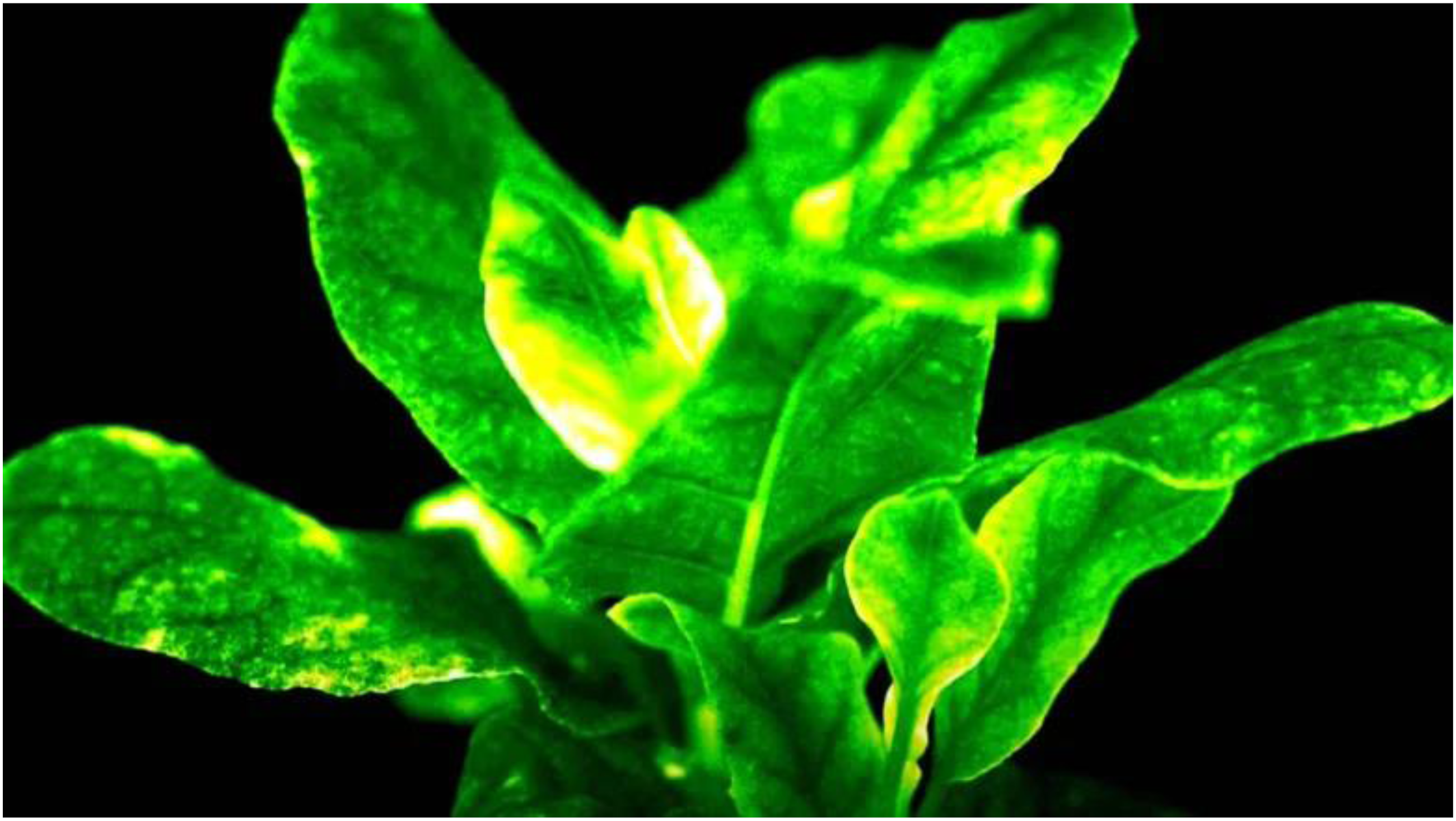
Fish: Florescent and Invented
“GloFish” are patented transgenic creatures sold in pet stores, artificially endowed with florescence. Being deemed neither food or medicine, they are not overseen by the Food and Drug Administration (FDA) that otherwise would regulate their use. They were developed specifically for aesthetic purposes, and are widely available in pet stores including major pet chains in the United States. One can buy danios, tetras, barbs, and even sharks with this added florescent trait (Figure 2). “Glo fish” transgenic models. Image is from: https://investor.spectrumbrands.com/news-releases/news-release-details/glofishr-brand-spectrum-brands-pet-llc-expands-fluorescent-fish/
The now ubiquitous goldfish were originally artificially selected by Chinese breeders who parlayed an orange and yellow variant on otherwise silvery scales into the brilliant varieties we have now. Breeding would eventually lead to fantastical varieties such as the fantail, veiltail, butterfly tail, lionhead, goosehead, golden helmet, golden saddle, bubble eye, telescope eye, and seven stars to name but a few. (Anthes 2013). The Koi, likewise would take what was essentially a common carp, and transform it into its own living work of art.
Plant Domestication: Flowers
Flowers are distinct from that of food plants in that their manipulation is almost entirely for aesthetic purposes and not for survival. Flowering plants are by far the most diverse and dominant vegetative life forms with at least 300,000 known species worldwide. Flowers are sex organs that mostly depend on insects, and other animals like bats, and now humans to fertilize them (interspecies sex turns out to be common in the plant world). Humans have intervened to become significant pollinators of those plants that carry pleasing traits. It is done by the longstanding practice of hybridization where certain traits are systematically cross-bred to enhance specific characteristics over each generation. Botanical science can trace many of its advances from the hybridization of flowers as much as from animals to conform with human purposes and tastes such as in form, strength and color. Flower cultivation, while mostly for aesthetic purposes, is also done for food as with banana flowers, consumed in the Philippines, petals used as salad garnishes. There are also common vegetables that are flowers like cauliflower and broccoli (Newman and Kirker 2016). Flowers proliferated with human migration introducing them eventually worldwide and becoming universal cultural icons with nations often associated with specific species such as the American Beauty rose, French Iris, Dutch tulip and Japanese chrysanthemum and cherry blossom. The centuries-long cultivation of flowers spills over to ornamental trees as well where apple, cherry, dogwood, pear, and plum trees are often planted in private and public spaces for the beauty of their blossoms.
Unconscious Selection: The Case of the Pine Trees of Northeastern Asia
Unconscious selection, in this instance turns natural selection on its head. In East Asia it manifested in the shape of its native trees. These pine ancestors’ trunks were naturally straight, but over many millennia, the prime specimens were harvested for building material leaving the functionally useless bent trees left to reproduce with that crooked trunk trait. In a sense, being twisted and bent was a key to survival. To be clear this trait is also associated with wind deformation where many trees and shrubs bend away from strong sustained winds that occur in various mountain and plains regions where such winds are common, but the process described here is not due to wind deformation, but from unconscious artificial selection. During the Japanese occupation of Korea from 1910 through World War II there was a wholesale denuding of its forests primarily for Japanese domestic use. Impoverished Koreans would also cut trees for firewood creating further deforestation. This would lead to a large-scale reforestation effort after the Korean conflict with straight-trunked pine trees, mostly from the United States, introduced to the country after the Korean truce again changing the landscape that it formerly didn’t exist. The effects of such long-term artificial selection, and the response by the trees with the twisted trunk trait, shows up in the classical Asian ink paintings as shown in Figure 3 below. Japanese ink painting in a classical style illustrating twisted trees.
Unconscious Selection 2: The War Between the Grasses and the Trees
Northeast Asia’s landscape is not the only one greatly altered by our species. Ever since becoming a cultivating people, ever greater swaths of lands have been cleared of trees to be made hospitable for grasses. The metaphor of “war” between the grasses and the trees can be invoked with humans becoming an unwitting ally of the grasses in the ongoing clearing of land for cereal farming and pasturelands all over the world (Williams 2003). Over now several generations the opening of forestlands, especially in the tropics, has profoundly transformed ecosystems in these regions as the human appetite for everything from beef to bananas continues to rise (Weis 2007). Subsistence farming of small plots in almost every region of the world has given way to massive plantations often covering thousands of hectors, as seen in Egyptian olive groves, Sudanese cotton fields and Ukrainian wheat and sunflowers.
This author has personally witnessed profound landscape changes on the “Big Island” of Hawai’i that once had vast sugar plantation lands that have disappeared to be replaced by extensive eucalyptus stands grown to be chipped and used as fuel. Figure 4 below shows a dramatic division between native ohia forests and pasturelands on the slopes of Mauna Loa. Landscape in Hawaii altered by pasturelands carved from native ohia forests.
We often idealize the aesthetics of pastoral rural landscapes, but modern farming and ranching practices are actually among the most unnatural things we do to land (Figure 5). Farmland in Indiana follows Jefferson's 1785 Land Ordinance grid. Aerial photo sourced from Wikipedia
The Proliferation of Aesthetic Foods
Many are familiar with the common orange carrot that many thought was developed in the Netherlands (true) by an ardent Dutch nationalist (untrue) (Denker 2015). It was certainly hybridized from original yellow and red varieties which were also smaller in size. Regardless of its debunked origin story, the orange carrot, with its high carotin content, sweet taste (carrots and their parsnip forebearers were originally bitter) and pleasing color that it brings to food dishes both cooked and raw. It is probably the first case of an intentionally modified aesthetic food though there are more ancient varieties that have come into recent fashion as with blue corn (Spence 2021). Many plants benefit from being pleasing to the palates of animals in general and humans in particular. It provides perpetuation for the plants by offering pulp as a food in exchange for seed spreading (Quintero et al. 2023). In this sense, mutualism is nothing at all new, and human manipulation of plants for both palatability and looks seems a logical next step. It is essentially what has been done with cats, dogs and rabbits bred for cuteness; chickens, sheep, goats, turkeys and cattle for meat; timber planted for construction, sap, fruit and fuel; and flowers cultivated for scent and beauty. It is confirmation that domestication is led by culture and increasingly also by market forces.
These variants are heavily promoted by developers of proprietary foods such as Well-Pict, Driscoll’s and Oneonta Starr in the United States that provide significant new varieties specifically to appeal to consumers’ tastes. These improvements also go to winnowing out of components with adverse effects such as with allergens. The prospect of boutique diets will almost certainly move beyond those with sensitivities to gluten, peanuts and soy. Figure 6 below illustrates the now common strains of novel, vegetable and berries available in supermarkets which are not necessarily more functional in terms of nutrition than they are aesthetically pleasing and seen, rightly or wrongly, as better tasting. Examples of boutique salad vegetables now commonly found in supermarkets.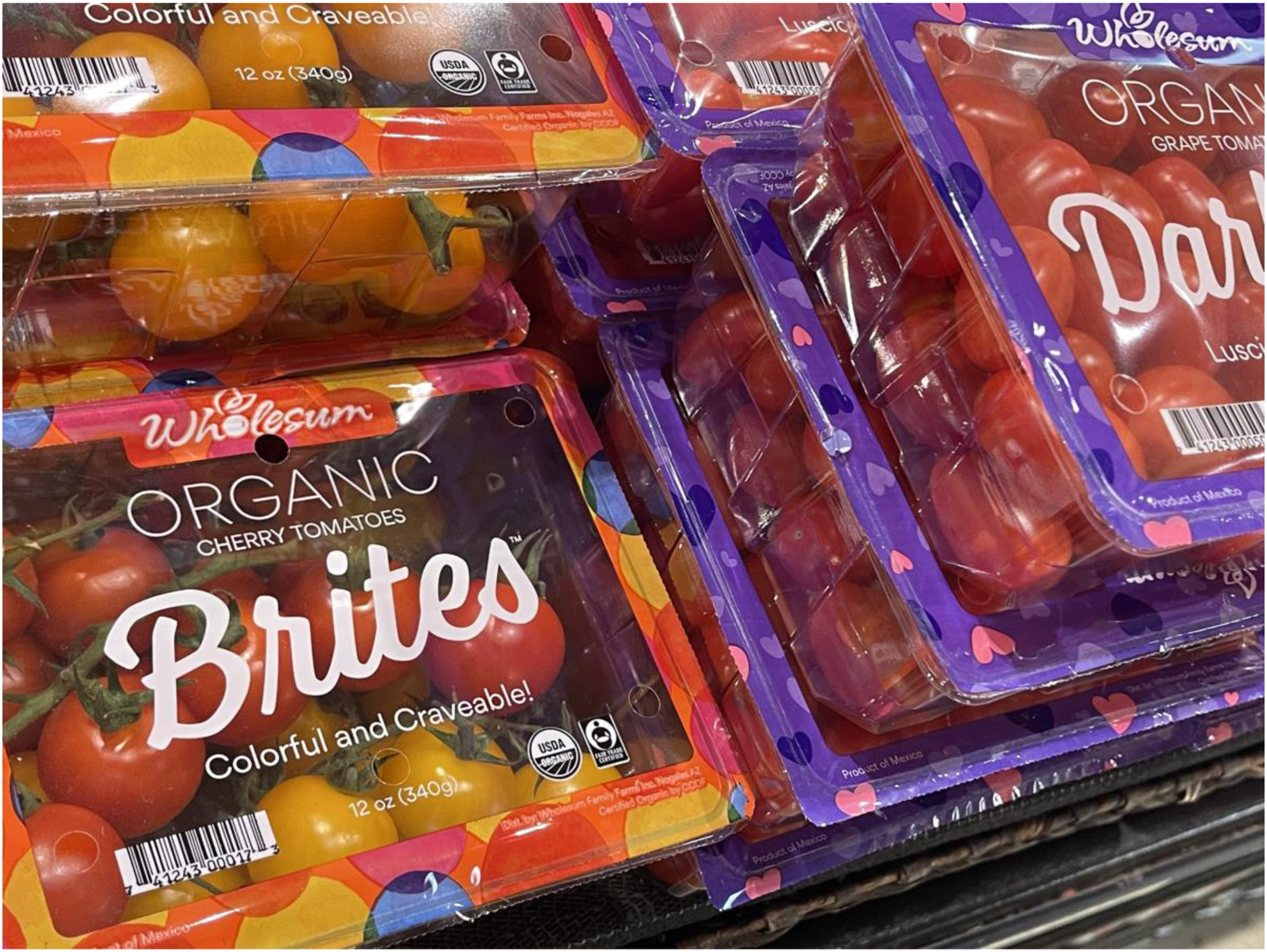
Most of us are eating transgenic foods such as potatoes, summer squash, apples, papayas, and pink pineapples without knowing that they are the products of transgenic manipulation. The United States Department of Agriculture maintains a list of bioengineered foods. Those with specific aesthetic traits include apples, pink flesh pineapples, and various varieties of summer squash. While the majority of large-scale GMO foods are designed for disease and pesticide resistance, how they look in a market and on a plate is a growing niche (Mathur et al.2017) (Figure 7). Dog and wolf (photo by tim flach/stone getty images) (Francis, 2015).
Dogs: The Most Domesticated of Animals
The explosion of various dog breeds provides ample evidence of our powers to alter animals, both physically and in behavior. Their alliance with humans has been forged over millennia with their core behavioral traits of subservience to hierarchical pecking orders going back to their wolf ancestries. This inborn tendency of canines to bow to power transferred from their species to our own is a unique quality to domesticated animals generally, but especially seen with dogs. This trait was intensified with cross breeding and the immersion of many breeds into completely human environments. Over a thousand dog varieties have been created and counting, almost all specifically designed to be household pets with their size and aggressiveness largely diminished; their barks worse than their bites). This shaping of physical and behavioral traits to suit tastes has yielded over one thousand distinct breeds broadly classified as working dogs such as hounds, huskies, retrievers, and shepherds; or “toy” lap dogs like poodles, terriers and chihuahuas, as well as other highly specialized breeds of all sorts. Some are seen as monstrosities like pugs with snouts so shortened as to make them prone to breathing problems. Other weaknesses like hip dysplasia in German Shepherds and other large dogs a chronic issue for those breeds. The chronic health issues of purebred animals are amply demonstrated in canines, that most manipulated of animals. The fact that such disparate dogs as Silky Terriers and Great Danes are the same species capable of interbreeding and producing viable offspring is strong evidence of how far that manipulation has gone. As pointed out by Francis (2015), one interesting trait of domesticated canines is that the ears get floppy, snouts shortened and coloration changing specifically with white fur otherwise unnatural in the non-Arctic and seasonal Alpine wild. Note in Figure 8 below, how many dog breeds are white or mostly white in color. Pure breed dogs recognized by the American Kennel Club.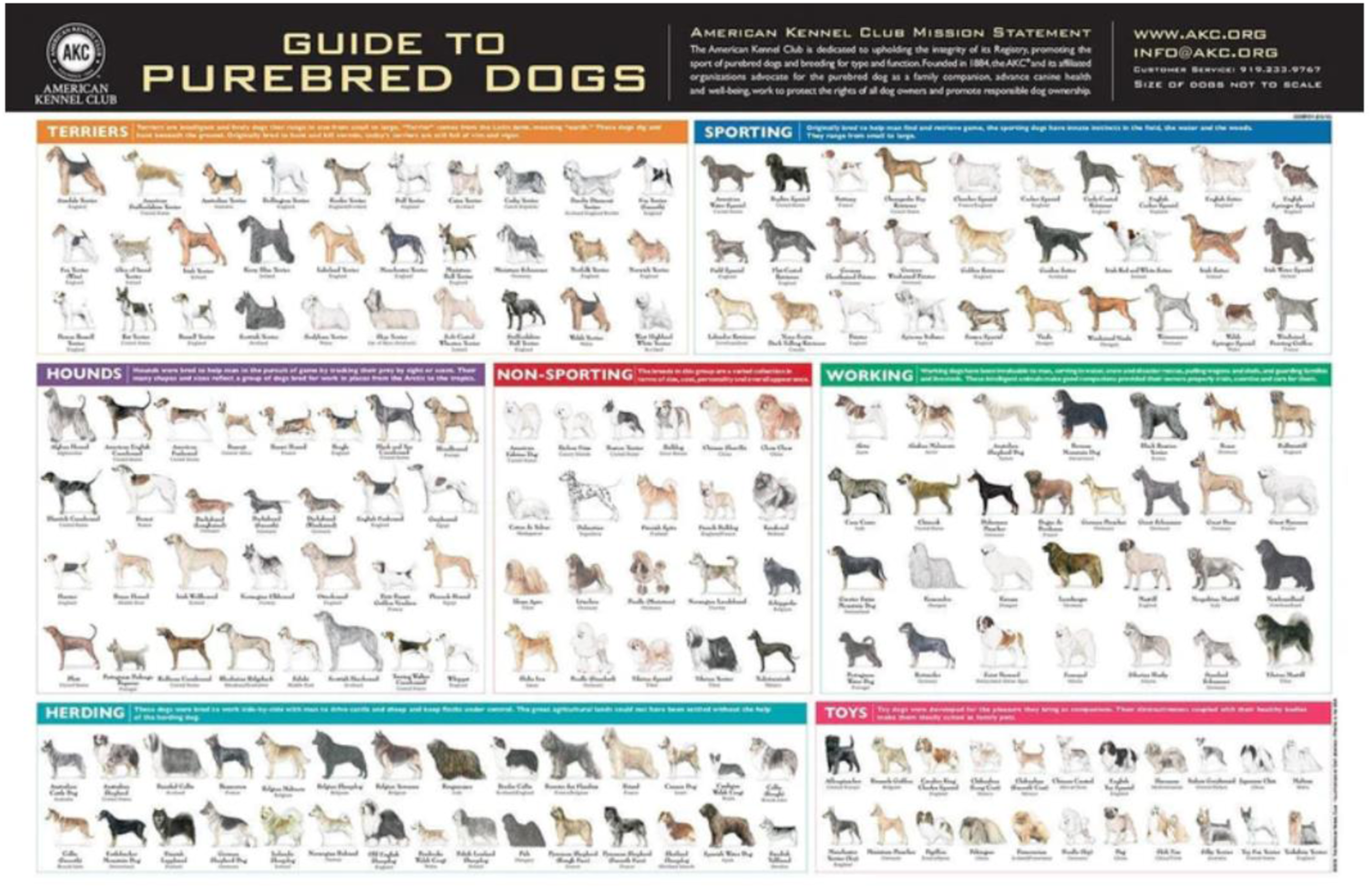
Effects of Domestication
Human manipulation lifeforms have been ongoing for many millennia. The historical record shows the massive effects coming from picking and choosing preferred species for grooming to taste and incorporation into the ever-expanding artificial landscape. An obvious effect of artificial selection is the crowding out and/or outright annihilation of neglected and those species deemed hostile to our interests. For the most part, active eradication, is now out of style, save for microbial and viral pathogens, and particularly virulent invasive species, after the numerous elimination and animals as with the dodo and passenger pigeons, standard cases in the litany of cautionary tales. Still the collective congratulating narrative of “rescue from the brink of extinction” applied to high profile animals from Pandas to California condors is problematic in the face of undeniable mass extinction not only ongoing, but accelerating over this generation.
Human bias towards the warm and furry over the cold and slimy is the most apparent mark of human choice over which lifeforms are worth saving. Concern for collapsing fish stocks, is focused on their critical role as a human and animal food source more than sympathy for their survival as life forms. The critical role in the web of life, both aquatic and terrestrial is inexorably linked to the oxygen producing capacity of the world’s oceans. That fish and other aquatic life viability is tied to microscopic life has largely escaped public recognition by all but marine biologists specialized in that line of research. Slimy life offends our aesthetics, and we strive mightily to get rid of it when it appears in our pools and ponds, or in our gardens as slugs and snails. Some unpalatable toxic slimes are produced by animals as a defense as with frogs and other amphibians. Its primal association with food spoilage and sickness is also of no help at all in making its case to exist. This includes religious proscriptions often framed around not consuming things that eat dead things (shellfish, mushrooms, pigs, etc.). Yet in terms of comprehensive planetary health, the microbial constituents of slimy life such as algae may be more consequential to perpetuating life on earth as a whole than nearly any other lifeform. That noted, there is the irony of industrial cultivation and ranching, with its heavy reliance on fertilizers and livestock manure from rangelands, often create massive algae blooms that take up free oxygen in waters receiving the runoff that can suffocate aquatic life. Even the relatively pristine ocean waters of Hawai’i, have had episodes of pollution due to fertilizer runoff and even certain forms of sunscreen from coastal golf courses causing some fish to become too toxic to consume. The state, along with the Virgin Islands and Palau, along with the local government in Key West, Florida, has moved to ban the sunscreens with the offending ingredients from their store shelves (Miller et al.2021).
Summary
Domestication to suit human tastes, is a continuously accelerating and ever more evolution-altering process. It has and is increasingly shaped by market preferences that include fad and fashion with occasional consumer hits like multi-colored tomatoes, bell peppers and cultured berries and some misses as with Japanese creating square watermelons. These ephemeral shifts in taste include pets with any number of novel breeds of dogs and cats, bunnies and birds coming and going much like automobile production models. Then there are more substantial alterations as with golden rice which has genetically added vitamin A, alleviating a serious deficiency among people is South and Southeast Asia (Dubock 2019). It certainly helped its case to be called “golden”.
This acceleration of domesticated plants and animals is coupled with the troubling fate of species left behind. Milkweed, as the name implies, was an abundant plant that often sprouted on the margins of cornfields. The rise of the Roundup, “miracle” weed control product would devastate the milkweed, that would, in turn remove the key food source for the monarch butterfly, that they depended upon over their annual continent-spanning migrations from Northern Canada to Southern Mexico. It is the beauty of the Monarch butterfly that might be what saves it from extinction with many people, aware of the threat, mobilized to plant milkweed in pollinator gardens (Preston et al.2021). If it weren’t for their good looks, there might not have been any mobilization to remediate. And it is here that we have a rather consequential blind spot in that we are culturally disposed to save Pandas and far less interested in saving plankton revealing aesthetic and human-scale biases.
In this sense we are doing to plants much as we have done with animals in bending their behaviors and forms to suit our tastes like done with Japanese bonsai trees. Decades ago, this author recalls a column in the English Language edition of the Korea Times written by an American Buddhist nun residing in that country in which she made a compelling case that the Japanese did not really love nature. She cited, for instance, how their fashioning miniature bonsai trees was an act of torture perpetrated on the tree to bind it and bend it to their version of nature. In essence bonsai trees are cultural aesthetic to design highly stylized trees that can literally be contained in the artificial environment, (Roy 2021). Having subsequently lived in Japan this author observed the contradictions of the Japanese imagined love of nature while simultaneously eschewing wilderness. It was very difficult take a panoramic photo that would not have a power line or building in it. The ubiquitous idyllic scenes depicted in Japanese photography are almost always cropped or taken as closeups. Ikebana, (Japanese flower arranging) only amplifies this contradiction in its cutting and shaping a largely prescribed floral architecture that don’t exist naturally. Then there are the shaved and stylized wooden structures that were Japanese traditional architecture from palaces to temples (Young and Young 2019). These buildings almost never had any bark on them and the wood was often varnished for both preservation and aesthetic purposes. In this sense the Japanese, most of whom live in places with specific nature references like “Fukuoka” (happy hill) or “Chiba” (thousand leaves), while also carrying family names like “Yamaguchi” (mouth of mountain), or “Tanaka” (Middle Field) the connection to the natural world is more often than not imagined and literally in name only with daily practices, like everywhere else, immersed in the artificial. The reader might look around where they are now. See how linear the interiors are and how non-linear, say that tree is just outside the window.
This is not to single out the Japanese, but the cultural narrative of Japan as a nation of nature lovers, that rises to the level of brand, should be up for critical review. The fact is that manipulating, sanitizing and segregating the tamed from the untamed is nearly universal. After all, besides being red in tooth and claw, nature tends to be quite filthy. The pilgrim settlers came to the New World thinking it as being unblemished by the corruption of Europe. These largely middle-class urban dwellers were rudely confronted by the harsh realities of being in the midst of untamed wilderness that would kill about a quarter of their number the first year, and another quarter the second. It is a pattern repeated by religious cult communities historically where attempts at establishing communes almost always fail, with lack of proper sanitation a root cause.
Colonizers were hardly alone in using the epithet “dirty” to describe those deemed to be uncivilized. Even now, there is a visceral reaction to encounters with chaotic homeless camps, shanty towns and slums. There are reasons to associate certain groups with dirt to justify despising them. Of course, sanitation is good, and filth is bad in terms of our collective health and well-being, but cleanliness in the full scheme of nature is problematic as our own immunological systems can weaken in sterility to the point of catastrophe as had happened with the indigenous peoples of the Western Hemisphere. They were almost wiped out when exposed to small pox and other diseases that was visited upon them by Old World settlers who had developed some resistance to these diseases originally transmitted from herd animals that did not exist in the New World.
That nature is almost entirely curvy, asymmetrical and fractal in form seems to offend our fetish for linearity, symmetry and shiny cleanliness that is the feature of artificial environments almost everywhere. If there is one mission humanity has in relation to the universe it is to boldly go forth and straighten it out. Linearity and symmetry are the literal marks of our now near total dominion over the earth. This is among the many biases that mark humans, forced upon the world in nearly all artificial environments. The manicured gardens and straight furrowed farmlands are preferred subjects in visual art. Nothing is less photogenic than a permaculture garden or thicket. This bias towards the smooth and symmetrical over the squiggly and fractal, and the warm and furry over the cold and slimy is problematic in a world where artificial selection is market-driven.
In our quest for dominion over the earth, there must be a wholistic consciousness and appreciation for the web of life beyond human scale. We can indulge in bright shiny tasty and nutritious foods; and cute pets that wouldn’t stand a chance of survival on their own. We can enjoy the sights of pastoral lands, with rows of crops, orchards, vineyards and livestock placidly grazing, but should also be aware of what has been removed in the process. We might not like the chaos of wilderness and the stresses is brings to us, so used to artificial worlds, but we ignore the costs of our biotech innovations to the biosphere at our peril. Nature is closer to a Jackson Pollock painting than any Japanese bonsai or flower arrangement. We would be wise to acknowledge this moving forward.
David Attenborough may have phrased the issue best: “The fact is that no species has ever had such wholesale control over everything on earth, living or dead, as we now have. That lays upon us, whether we like it or not, a”n awesome responsibility in our hands now lies not only our own future, but that of all other living creatures with whom we share the earth.”
There is all manner of remediation under way to help the environment. This includes the reintroduction of species rendered extinct in some habitats. Some even advocate resurrecting some species rendered completely extinct with genetic seeding into existing biosimilar species. It is speculative just how this “Jurassic Park” might go. No doubt it will be popular types from Dodos, to Mammoths, that will be fostered. The more here-and-now solution includes rewilding. The rewilding movement, as laudable as it is, is unlikely to go all the way. We are too domesticated as a species to do so.
To conclude, our aesthetic sense applied to biotech in general and genetic modification should not be seen as a vice. Rather we should simply be aware of where it might take us. When asked how the enlightened differ from the less so, Thich Nhat Hahn was said to have responded that they wake up in the morning, get dressed, eat, work, rest eat some more and sleep. When then asked how that is any different from what the unenlightened so, he said, that the enlightened know what they are doing. May this piece might take us to such awareness.
Footnotes
Declaration of Conflicting Interests
The author(s) declared no potential conflicts of interest with respect to the research, authorship, and/or publication of this article.
Funding
The author(s) received no financial support for the research, authorship, and/or publication of this article.
