



Abstract
Global measures and restrictions implemented to control the COVID-19 pandemic had a significant impact and created challenges in regular business, commerce, and scientific activities, including biobank operations. The challenges were exacerbated by a dependence on imported supplies and reagents from countries such as the United States, China, and within Europe, as well as restrictions on exporting biological samples. The pandemic has highlighted the pressing need for regional autonomy in biobanking activities. This article aims to enhance the capacity of biobanks to respond effectively to future crises. Recognizing the importance of adaptability and resilience, our study highlights the specific strategies employed by a large biobank in Costa Rica to ensure the continuity of operations during unprecedented times. During the COVID-19 pandemic, biobanking operations encountered a number of critical challenges, which led to the identification, implementation, and integration of targeted mitigation strategies into our contingency framework. Five challenges were identified and subsequently addressed: disruptions and shortfalls in the supply of essential material, continuity of daily biobank operations, storage capacity constraints coupled with export limitations, difficulties associated with consent procedures, and complications surrounding personnel testing. These lessons underscore the critical importance of contingency planning, digitization of biobanking workflows, and increased regional collaboration to strengthen the autonomy and resilience of biobanks in the face of future crises.
Introduction
The coronavirus disease 2019 (COVID-19) pandemic disrupted global health systems, research, and biobanking activities, posing unprecedented logistical and operational challenges. 1 Biobanks faced additional difficulties due to their reliance on imported reagents, strict export restrictions, and limited scalability in infrastructure for large-scale biobanking activities.
Mobility restriction measures, such as lockdowns, quarantines, vehicle circulation limits, and curfews, significantly impacted employment and workforce structure worldwide, especially in sectors requiring physical presence, causing an unprecedented economic downturn across multiple industries. 2 In addition, export restrictions on certain goods and raw materials worsened global supply chain disruptions. 3 These pandemic mitigations led to challenges in regular business operations, commerce, and science, including biobanking (accurate sample quality assurance, traceability, staff security, and financial investment). 4 In Costa Rica, a country with a population of 5.1 million, the first confirmed case of COVID-19 was reported on March 6, 2020. Since then, official records indicate 1.24 million confirmed cases and approximately 9,500 associated fatalities. 5 However, by the end of 2022, it is estimated that the majority of the population had been infected. 6
The Costa Rican government implemented a series of population-wide measures that encompassed school closures, cessation of customs operations, establishment of workplace guidelines, implementation of remote work within government institutions, and reduction of mobility. 7 These measures had a significant impact at the beginning of the pandemic, but their effect on case reduction declined by May 2021. 8 In contrast, the use of masks, adherence to sanitary guidelines, and vaccination were the key strategies for pandemic control in Costa Rica.
The Costa Rican Agency for Biomedical Research (ACIB-FUNIN) is the only biomedical research biobank in the country, certified according to the ISO 9001:2015 standard. The sole mission of this biobank is to promote biomedical research based in Costa Rica that contributes to the well-being of people worldwide by improving overall health. Initially established in 2001 as a disease-oriented biorepository, 9 it has evolved into a multi-project biobank with a central facility (main campus) housing ultra-low temperature storage (up to 800,000 vials), cryogenic temperature storage (up to 200,000 vials), specimen processing laboratories, and a genomics laboratory. It also includes a branch for specimen processing and temporary storage. During the pandemic, the biobank team consisted of 13 technicians and five professionals.10,11
Prior to the pandemic, the biobank supported a series of research studies conducted by ACIB-FUNIN in collaboration with the U.S. National Cancer Institute (NCI), including the ESCUDDO study, which recruited 20,330 adolescents and collected blood, urine, and self-collected cervical samples. 12 Simultaneously, due to a requirement of a sponsor at that time, efforts were made to improve biobank operations through ISO 9001 certification, implementation of a next-generation sequencing laboratory, and development of high-density storage systems. During the pandemic, follow-up of ESCUDDO continued, alongside the initiation of the VALIDO (178 participants) and RESPIRA (3,860 participants) studies, which expanded sample processing to include saliva (with and without preservatives) and nasopharyngeal swabs (NPS).13,14 Following the pandemic, ACIB-FUNIN and NCI launched the PRISMA 15 study, which recruited 5,000 young adult women, while follow-up visits for ESCUDDO and RESPIRA continued.
This article outlines the obstacles encountered by the ACIB-FUNIN biobank during the COVID-19 pandemic, as well as the strategy employed to mitigate these challenges, thereby formulating guidance applicable to other biobanks to de-escalate future crisis scenarios.
Challenges, Solutions, and Lessons Learned During the COVID-19 Pandemic
The pandemic highlighted the critical need for comprehensive contingency plans and risk assessments within biobanks, requiring continuous review, enhancement, and regular updates and assessments in alignment with the country’s evolving situation to ensure the continuity of essential activities and mitigate potential operational impacts.
After several years of voluntarily implementing best practices in biobanking, ACIB-FUNIN biobank initiated the ISO 9001:2015 certification process in early 2019, achieving certification in 2020. This milestone was crucial in strengthening our capacity to respond to the challenges posed by the pandemic. The discovery of potential issues and barriers was fundamental in the improvement of the biobank’s preparedness to handle future emergencies. In response to these challenges, a guide with detailed emergency plans has also been developed to minimize any risks that may arise in the future. A series of strategies and insights gained are subsequently detailed below.
Disruptions and shortfalls in essential material supply chains
Disruptions and shortfalls in essential material supply chains were one of the main obstacles encountered, which had substantial financial and operational repercussions on the biobank and jeopardized its overall sustainability. Although this issue has been widely reported in several publications,16–19 it is important to highlight the additional challenges faced by research in Latin America, where the cost of equipment, supplies, and reagents is often disproportionately higher than in developed countries. This was due to multiple factors, such as tariffs on imported goods, elevated shipping and logistics costs, limited availability of local supply, low procurement volumes, and fluctuations in currency exchange rates.
The situation worsened during the pandemic due to the significant increase in costs associated with importing critical supplies by intermediary entities representing commercial firms and the customs bureaucracy. Beyond cost, scarcity became another major issue, which was driven by four primary factors: (1) protectionist measures imposed by supply-producing countries, limiting availability; (2) an urgent shift in priorities, with health care needs taking precedence over health research; (3) widespread disruptions across the supply chain, from manufacturing to transportation; and (4) limited availability of raw materials. 20
A major consequence of this situation was the possibility of temporary interruption of follow-up specimen collection for several studies, which was particularly critical for research where follow-up was essential to meet the study objectives and ensure data integrity. To address the risks raised, it was important to differentiate between locally distributed supplies and those that necessitated international procurement and subsequent importation by the biobank (Fig. 1). In both scenarios, the first strategy was to source supplies from multiple vendors to secure better procurement during times of shortage.17,18
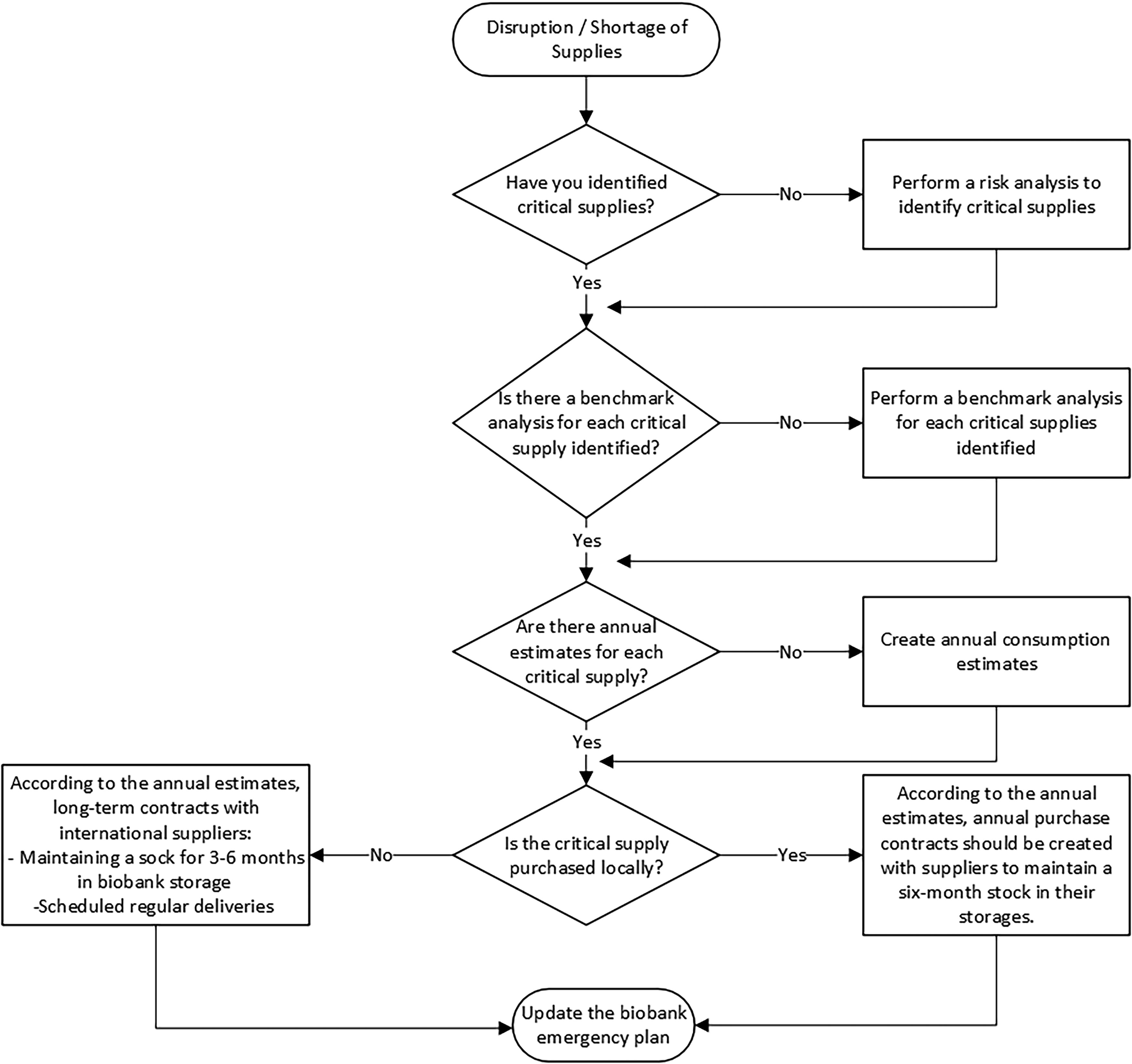
Algorithm applied to determine risk mitigation for disruption/shortage of critical supplies.
However, this strategy was not always a viable solution, as suppliers themselves faced sourcing and distribution challenges. Even when placing large orders, distribution constraints resulted in shipments arriving in small batches rather than in full, leading to increased and unpredictable transportation costs with each delivery. As demand surged, manufacturers had to prioritize high-demand models, discontinuing certain specialized versions and reducing the range of available options for biobanks.
For supplies that ceased production during the pandemic or became exceedingly limited due to the prioritization of high-demand models used for COVID-19 diagnostics (e.g., 1250 µL filtered pipette tips, swabs, vials), a comparative product analysis was conducted to identify alternative market options with equivalent characteristics to the original supplies, thus mitigating the introduction of pre-analytical variables that could potentially influence ongoing studies. During this benchmarking process, supplies were evaluated based on the similarity of their storage conditions, cap/seal design, barcode compatibility, and processing characteristics compared with the original items. Additional factors, such as pricing and compliance with storage protocols, were also considered to ensure an objective justification for their selection (Supplementary Table S1).
Once restrictions or shortages were eased, a plan was implemented to ensure adequate inventory in preparation for potential future crises. For locally purchased supplies, agreements were established with suppliers to maintain a six-month stock to meet our requirements, incorporated under an annual purchase contract. For internationally sourced supplies, contracts were established with vendors/suppliers for the required annual supply with regular deliveries, in addition to maintaining sufficient inventory for 3–6 months in our storage facilities, depending on storage capacity, expiration dates, and import or delivery times by vendors/suppliers. While these measures may have a financial impact on a biobank, long-term contracts have the potential to secure more favorable discounts or lock prices over the year. To effectively implement such contracts, it is essential to maintain annual projections of current projects to ensure that the necessary inventory levels are adequately secured.
Daily biobank operational continuity
During the COVID-19 pandemic, biobanks faced significant operational challenges that threatened their continuity. Lockdown measures and social distancing led to the suspension or reduction of routine biological sample collection, while operations were moved to merely maintenance mode. 16
Furthermore, consistent with reports from other biobanks,16–18 staff expressed concerns and uncertainties regarding the processing and storage of patient samples with active COVID-19 derived from the RESPIRA 13 and VALIDO 14 studies. Their main concerns included the increased risk of aerosol exposure during specimen handling, the potential for cross-contamination, and the spread of infection among staff. The introduction of a new layer of protective equipment to be worn in addition to the regularly used protective wear posed another challenge of having to adapt to new safety protocols.
To process samples from COVID-19 studies (saliva, NPS, and blood), the laboratories at both sites (main campus and branch) were modified to create an isolated biosafety level three (BSL-3) area, and personnel were trained to operate in these containment areas. Staff assigned to this task were rotated weekly (one per site), and their work hours were separated from those of other biobank staff to reduce the risk of potential transmission. During the lockdown periods, we were granted special government permission to travel to the biobank facilities in case of an emergency. In addition, weekly COVID-19 testing was implemented for all staff as a preventive measure.
Moreover, guidelines issued by the Costa Rican government during this period, 7 significantly affected the biobank’s daily activities of collection, processing, and management of biological samples. To comply with these requirements, the workforce was reduced to 50% during each shift, a mandatory two-meter distance between personnel had to be maintained, and government-imposed restrictions, including lockdowns and curfews, further limited the working hours of night shift staff.
The most critical period occurred in early March 2020, during the government-imposed lockdown 7 that required a complete shutdown of biobank and ACIB-FUNIN operations for several days, giving us a period for evaluation and planning. As part of our biobank automation plan and earlier risk analysis assessment, a previously installed IoT (Internet of Things) temperature monitoring system allowed us to remotely monitor our freezers’ temperature. This system provided real-time data transmission to cloud-based platforms and sent automated alerts when the temperature deviated from set thresholds.
These operational obstacles and heightened safety concerns underscored the need for proactive planning and technological solutions to ensure the continuity of biobank operations during the pandemic. Before the first case of COVID-19 was reported in Costa Rica, a meeting was held with all biobank staff to review our contingency plan in the event of a lockdown.
We conducted a thorough review of our biobank’s responsibility matrices to ensure a clear understanding and alignment of staff competencies and responsibilities to meet government-imposed requirements. This proactive review not only clarified roles but also reinforced the biobank’s resilience by enabling swift adjustments to operations during emergencies. The review resulted in the establishment of at least two backup staff for each biobank role and a comprehensive strategy for redistributing biobank activities to ensure continued operation (Fig. 2).

Algorithm applied to determine risk mitigation for pausing or scaling down the biobank’s daily operations.
Fortunately, no additional staff training was required, as a continuous training program had already been implemented based on a prior risk assessment. This program included staff rotation to ensure effective backups and familiarity with assigned tasks, while staggered shifts were implemented to ensure operations with the minimum necessary personnel. 7
Storage capacity constraints and export limitations
As a result of the limited travel capacity (as evidenced by an approximate 92% reduction in international flights between April and May 2020), 21 as well as the new regulatory frameworks established by various governments for the importation of biological samples, the biobanks encountered serious limitations in the export of samples during the pandemic. In addition, restrictions imposed by numerous airlines on the handling of human biological samples, the onset of COVID-19-related studies, and the inability to promptly acquire ultra-low temperature freezers (ULTFs) due to the high demand for COVID-19 vaccine storage created significant challenges in biobank storage capacity.
The ACIB-FUNIN biobank operated under a long-term storage (permanent storage) framework for the agency’s research projects and studies, and a mid-term storage (months to years storage) framework for international collaborative initiatives, for which we had a strict schedule for sample shipments. According to international biobanking guidelines, a contingency plan must be in place to ensure proper conditions and temperature stability in case of unexpected events that could disrupt the designated storage parameters. 22 Therefore, we reserved a backup storage space with a capacity equivalent to our largest storage unit (threshold 70% of the total ULTF capacity), maintained at the appropriate temperature to ensure availability in case of an emergency.
Upon reaching this 70% threshold in the first five months of the pandemic (July 2020), the second phase of our contingency plan was activated (the first phase was the acquisition of additional ULTFs). This phase included qualification and quality control testing of two unused liquid nitrogen-freezers. Upon successful completion of the tests, these freezers were designated as emergency storage in the event of ULTF failure, and continuous temperature monitoring was implemented to detect any potential issues before or during the storage of biological samples.
This measure allowed us to temporarily reduce pressure on our storage capabilities; however, due to export restrictions and continued sample collection from follow-up visits in ongoing studies, our overall storage demand continued to rise (Fig. 3). Our sample exports were made in batches of 24,000 1 mL vials or 9,000 5 mL vials using vapor-phase liquid nitrogen freezers (MVE 1536 Dry Shipper 23 ), allowing for an export every 22–30 days. Despite the commissioning of the newly acquired ULTFs, persistent export delays and the launch of new studies (RESPIRA and VALIDO) caused storage capacity to reach a critical level of 90% by December 2021. This placed considerable pressure on institutional/collaborative researchers and significantly increased the risk of sample loss in the event of freezer failure.

Monthly biological sample storage (%) and mitigation measure.
Upon reaching this critical 90% capacity, alternative methods of sample shipment had to be implemented. We decided to prioritize the export of samples stored in 5 mL vials on dry ice, as they require significantly more space in the freezers. This strategy was discussed with the principal investigators of the respective studies to obtain their approval for shipping samples on dry ice. Weekly shipments consisting of 2,400 5 mL vials per batch were conducted, plus shipments in vapor-phase liquid nitrogen freezers for the 1 mL vials, which allowed us to reduce the storage occupancy levels and return to our 70% threshold by April 2022.
To ensure the safety and integrity of the samples, we followed international recommendations for the validation and verification of shipping conditions. 22 The criteria for selecting a company to handle the shipment of 5 mL vials on dry ice included considerations such as the price per unit, the ability to complete the shipment within a maximum timeframe of 48 hours from dispatch to receipt, the availability of direct flight options or, in the case of a layover, the presence of company personnel at the airport, availability of dry ice refills, availability of temperature data logger, and ongoing communication regarding the status of the shipment. Prior to the first shipment of real samples, we conducted two test shipments to evaluate the courier’s performance and compliance with international guidelines.
Due to the many challenges faced during the pandemic, we developed an algorithm to optimize storage management and strategic decision-making (Fig. 4). This innovative tool allows biobanks to proactively assess their storage capacity, predict future space needs, and rationalize resource allocation, helping to anticipate potential storage capacity shortages or inefficiencies. In addition, it enables the implementation of strategies to mitigate the risk of inadequate storage of biological samples, promoting the operational efficiency of the biobank and contributing to the long-term sustainability of its operations by adapting to changing needs and challenges.
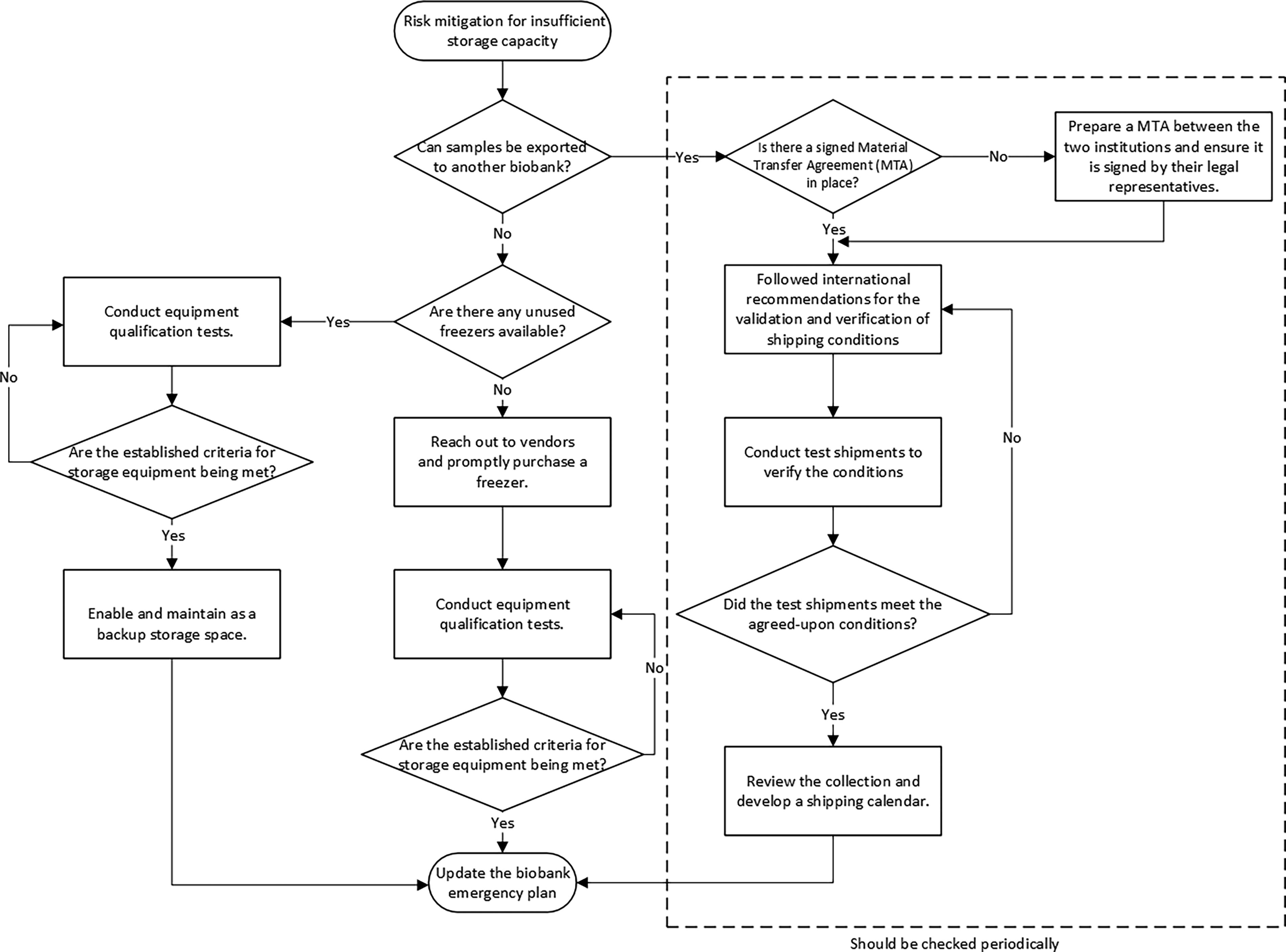
Algorithm applied to determine risk mitigation for insufficient storage capacity.
Difficulties associated with informed consent procedures
Informed consent is the ethical cornerstone of biomedical research. Obtaining informed consent for biobanking research related to COVID-19 presented several logistical challenges, the most significant being the potential risk of virus transmission to staff during the consent process or sample collection. 24
One of the major difficulties in the informed consent process was the inability to obtain informed consent by the usual methods, which necessitated changes in the consent procedures for patients diagnosed with COVID-19. 25 In our case, the main challenge was the enrollment of participants admitted to specialized hospital units due to restrictions imposed by health care institutions on the introduction and subsequent retrieval of printed forms for storage in our archives.
Therefore, we explored the feasibility of implementing electronic informed consent. After discussions with the Institutional Review Boards (IRB), permission was granted to use digital signatures on electronic devices only for hospitalized patients enrolled in the RESPIRA 13 and SECR-01 26 studies, in accordance with national regulations.
The implementation of electronic consent in Costa Rica was a fundamental step toward fully digitized workflows. However, the requirement for an impartial witness’s signature remains a complicated factor. While the implementation of online self-consent has been considered in other contexts, it was not currently feasible in Costa Rica. The online self-consent is obtained electronically through a digital interface where participants are presented with a comprehensive informed consent form. After reviewing the information, individuals shall indicate their voluntary agreement to participate, typically by selecting a checkbox or clicking a consent button.
According to Costa Rica’s Biomedical Research Law and related regulations,27,28 an individual’s participation in research requires explicit, written, and signed consent or a fingerprint on all pages of the informed consent form, along with the signature of an impartial witness on the last page, making online self-consent incompatible with the current regulatory framework. The introduction of an electronic informed consent form and online self-consent offers great advantages over traditional processes. As mentioned by Robins et al. 2020, online self-consent has demonstrated greater efficiency and higher participant recruitment rates, thanks to its ease of use and the possibility to be sent via email for participant registration.29,30
Complications surrounding personnel testing
Diagnostic or laboratory reagents used to detect COVID-19 were affected by export restrictions imposed primarily by the United States and other producing countries in the Latin America and Caribbean regions. 31
One of the primary concerns of the ACIB-FUNIN biobank was the health and safety of personnel. Staff were engaged in the collection, processing, and preservation of samples collected from active COVID-19 patients, including saliva samples and NPS, resulting in a high likelihood of infection due to the associated increased risk of exposure to the virus.
Initially, weekly nasopharyngeal swab tests were performed on all staff involved in sample collection and processing. However, after the first few months, the staff reported discomfort associated with the procedure. Moreover, this collection method presented challenges such as swab shortages and the potential for viral transmission to the personnel administering the test. 32 Consequently, less invasive alternatives such as the collection of raw saliva samples were introduced, and a novel COVID-19 detection method was adapted and subsequently validated within our facility following ISO 17025 guidelines.33–35 This approach was implemented to support regular staff testing while maintaining sensitivity and specificity comparable to the gold standard.
Hurdles related to personnel testing led our biobank to develop and validate a new procedure utilizing raw saliva samples for COVID-19 detection, highlighting the need for biobanks to play a broader role in supporting public health and developing new analyses. The algorithm developed (Fig. 5) showed that when equipped with the necessary infrastructure or partnerships, biobanks can contribute not only to the storage and management of samples but also to the design and implementation of efficient testing protocols, ultimately supporting public health efforts and ensuring the safety of workers during health crises.

Algorithm used to determine new analysis.
Conclusions
The COVID-19 pandemic underscored the importance of emergency preparedness within the public health sector, forcing biobanks to adapt swiftly by identifying potential risks and mitigating their impact through effective contingency planning. Maintaining an updated and comprehensive quality management system is essential to mitigate risks and ensure operational continuity during a pandemic. Our experience, particularly as we navigated the final stages of obtaining ISO 9001:2015 certification, reinforced the critical role of structured quality management, along with close collaboration, rigorous monitoring, and clear communication with investigators, clinicians, and research teams.
The ACIB-FUNIN biobank not only survived the pandemic but also adapted and evolved, actively supporting the implementation of critical projects such as RESPIRA and VALIDO, while ensuring the continuity of follow-up visits for ongoing studies. During these challenges, we achieved ISO certification and expanded our service offerings, including new sample processing workflows, integration of BSL-3 laboratory areas, and development of diagnostic testing. Thus, demonstrating that our 20 years of experience, commitment to innovation, continuous evolution, and dedication to quality helped us overcome the crisis and strengthen our role in biomedical research.
The challenges faced by our biobank during the pandemic reflect the experiences of numerous biobanks globally, so the algorithms developed to compare, evaluate, and implement emergency management strategies, along with advanced planning and risk awareness, are intended to help potential users prepare for, mitigate, and manage crises. Ultimately, safeguarding resources and supporting the biobank’s fundamental role in preserving and providing high-quality biological samples for research and diagnostic purposes.
This framework provides a valuable model for addressing unforeseen challenges in biobanking and emphasizes the need for repositories to establish and maintain robust emergency plans that can be rapidly deployed during crises. By prioritizing proactive measures and fostering a culture of preparedness, the continuous adaptation and review of biobank contingency plans, designed to address both predictable environmental factors and unforeseen emergencies, has become essential to enhancing operational resilience, safeguarding research integrity, and strengthening the biobank’s role in advancing public health initiatives.
Authors’ Contributions
M.Z.: Conceptualization (lead), methodology (equal), investigation (equal), writing—original draft (lead), and visualization (lead). D.M.: Methodology (equal), writing—original draft (supporting), and writing—review and editing (equal). B.C.: Investigation (equal) and writing—review and editing (equal). V.L.: Investigation (equal) and writing—review and editing (equal). A.A.: Investigation (equal) and writing—review and editing (equal). A.C.: Investigation (equal) and writing—review and editing (equal). D.U.-A.: Investigation (equal) and writing—review and editing (equal). K.S.: Conceptualization (supporting) and writing—review and editing (equal). C.P.: Writing—review and editing (equal). R.H.: Writing—review and editing (equal). D.M.: Conceptualization (supporting) and writing—review and editing (equal).
Footnotes
Acknowledgments
The authors acknowledge the enormous effort and dedication of the ACIB-FUNIN, as well as the participants and collaborators involved in the RESPIRA and VALIDO studies. The authors extend their deepest gratitude to the ACIB-FUNIN biobank, whose resilience and unwavering commitment were fundamental in maintaining operations and ensuring the continuity of critical research activities during the COVID-19 pandemic. Their ability to adapt and overcome unprecedented challenges exemplifies the crucial role of biobanks in times of crisis. The authors are also grateful to the NCI for their trust and guidance, especially during this challenging period. Finally, the authors sincerely thank Nazelee Dagliyan for her careful language editing, which significantly improved the clarity and quality of the article.
Author Disclosure Statement
No competing financial interests exist.
Funding Information
No funding information is to be reported.
Supplemental Material
References
Supplementary Material
Please find the following supplemental material available below.
For Open Access articles published under a Creative Commons License, all supplemental material carries the same license as the article it is associated with.
For non-Open Access articles published, all supplemental material carries a non-exclusive license, and permission requests for re-use of supplemental material or any part of supplemental material shall be sent directly to the copyright owner as specified in the copyright notice associated with the article.
