




Abstract

Introduction
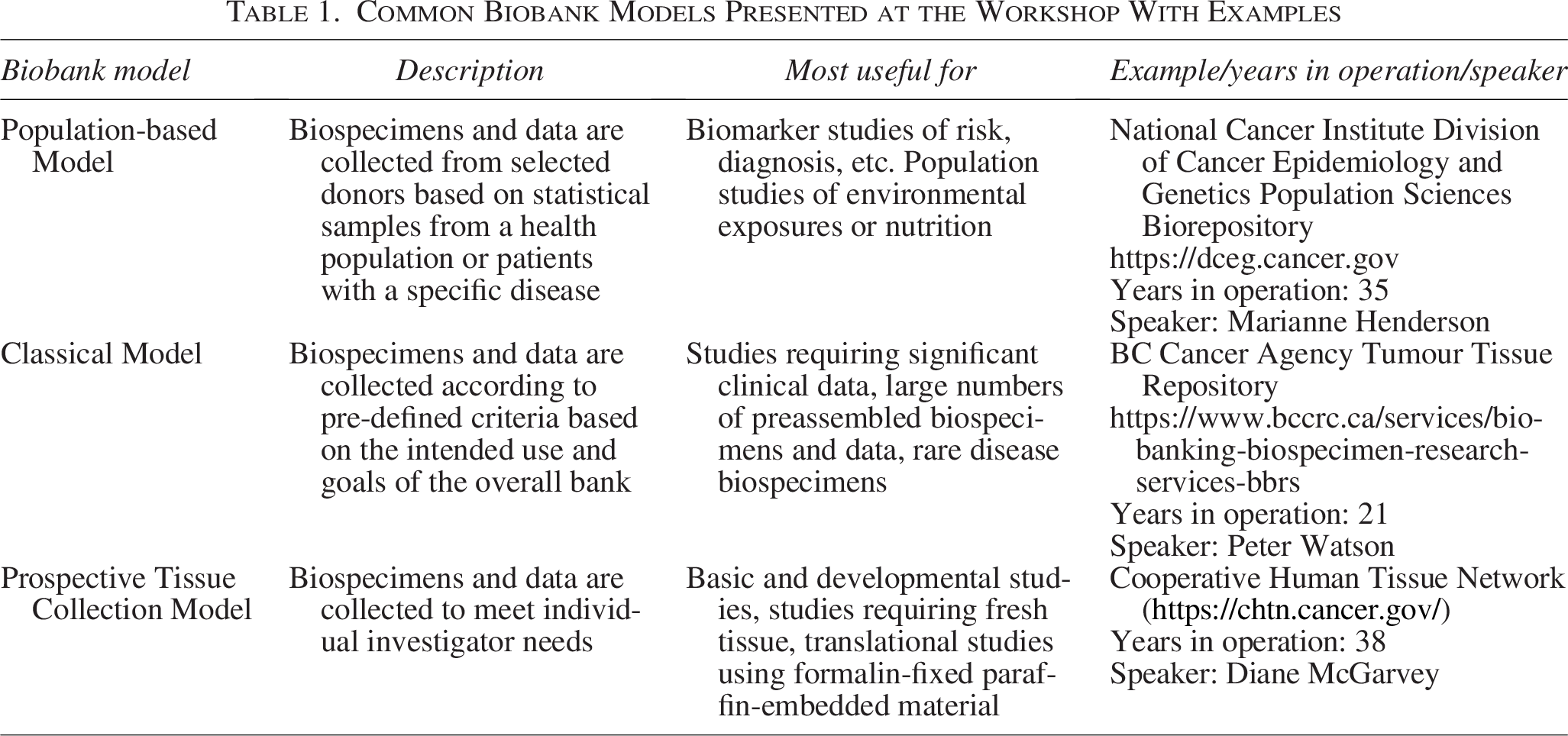
Future-proofing a biobank, or ensuring that a biobank continues to meet an identified scientific need(s), is essential for ensuring long-term sustainability of a biobank. This broad topic was the focus of a recent educational workshop held at the Annual Meeting of the International Society for Biological and Environmental Repositories (ISBER), in Montreal, CA, on May 16th, 2025. 1 As described herein, initial presentations to stimulate the subsequent discussion focused on providing an overview of the concept of future-proofing, followed by perspectives on the considerations that have been most relevant for three well-established biobanks representing population, classical, and prospective procurement biobank models (see Table 1).
Common Biobank Models Presented at the Workshop With Examples
Future-Proofing Actions
Biobanks that have a longer-term focus follow a distinct lifecycle (see Fig. 1). A biobank is often created with a general research need in mind that justifies an initial investment. The biobank then transitions through establishment and growth phases to reach maturity. At this point, it holds the highest value for the general research need identified at the outset. However, science is dynamic and constantly evolving in terms of direction and technological advancements, and there are changing needs for types and formats of biospecimens. Therefore, while the biobank may maintain scientific value for a period, in a plateau phase, its value will usually slowly decline as research turns to new platforms or resources to meet the needs. However, with foresight, the organizational components of the biobank (i.e., its expertise, equipment, and operational capabilities) can be redirected to recreate value if it transforms its focus to meet evolving needs.

The lifecycle of a biobank as a research platform. The schematic illustrates the evolution of a biobank over time and with respect to scientific relevance. The multiple phases begin with the startup and proceed to the point where the biobank either declines or transforms itself into a new platform to maintain relevance.
At different phases of the biobank lifecycle there are different design and operational considerations for scientific future proofing. In the initial phase, these include identifying the specific scientific needs, assessing the demand for specific biospecimens and services, weighing the availability of alternative or competing resources, appraising the regulatory environment and any in-scope constraints, selecting the best operational model along with a participant enrollment scheme, and implementing the most appropriate informed consent(s). In oligo-user environments, 2 this initial phase may also determine what collections may be conducted on behalf of research stakeholders and services required to support their studies. In the later phases, future-proofing actions include ongoing assessment of the science and demand, solicitation of feedback from stakeholders, and regular review and adjustment of the operations to ensure optimal collections that are fit for research purpose(s). Additional components of future-proofing relate to new cycles and updates to marketing, judgements on when to start/stop specific collections, and importantly decisions and adjustments to the size, scope, and value of the inventory. All of these components require feedback from the biobank’s stakeholder community to support its decisions and sustainability.
The overall approach to future proofing outlined above needs to be modified, depending upon the biobanking model(s) used by the biobank. Several common models of biobanks have been discussed in the literature 3 and were discussed at the workshop as summarized in Table 1.
Population-based biobanks support large-scale, long-term research by collecting and storing diverse biological biospecimens for cohort, case-control, family, and clinical studies. These biobanks are costly and require ongoing institutional backing. To ensure their continued relevance and quality, they should undergo systematic reviews assessing biospecimen types, storage methods, data integration, regulatory compliance, and future research needs. Periodic scientific evaluations help identify highly valuable collections for broader use, guide marketing, and inform decisions to transfer or cull less useful biospecimens. Balancing inventory between legacy and new collections is essential, taking into account the rarity of biospecimens, evolving scientific priorities, and emerging technologies that can enable new discoveries. This strategic approach maximizes the biobank’s scientific impact and sustainability.
Classic-model biobanks aim to support research by compiling and maintaining an inventory of preserved (largely frozen) biospecimens and data over time. Custom cohorts can then be selected and provided to researchers as requested. Importantly, an inherent aspect of enabling selection is that part of the inventory is not utilized. To maintain relevance and quality, classic biobanks need to focus on the same elements and issues as described for population model biobanks. But because there is a growing oversupply and relative decline in demand for stored frozen biospecimens, 4 it is important for new classic model biobanks to define the target for their inventory. 5 After the inventory target is reached, and especially before it achieves maximum value (often determined by maturation of associated participant outcomes data), the biobank must promote and redirect its expertise to undertake collections and/or provide other biobanking services such as consenting or storage for other research studies to sustain itself. This in turn means that the biobank must cull lower-value components of the inventory to enable the biobank to effectively provide these services.
Prospective procurement-based models aim to support research that needs procurement of new biospecimens on demand. A high utilization rate is therefore a primary focus and inherent to the model. This requires agile operations and decision-making to efficiently adapt processes and to quickly respond to emerging trends in research demand. Therefore, future-proofing involves regular process audits, applying continuous process improvement strategies, and gathering feedback from our investigator stakeholders to guide efficient and transformative changes. While the focus of this biobank model is not to amass a large inventory, by the nature of the operations, some samples are collected and retained in excess of active sample requests. For example, when opportunities arise, rare and difficult-to-acquire specimens, as well as frequently requested samples, are procured in anticipation of future requests. Therefore, changes to ongoing operations can negatively affect any transient inventory associated with the model. To preserve the viability and usefulness of existing inventory, all changes must be implemented carefully, ensuring that both samples and the associated data are accurately transitioned to the current applicable terminology across all variables.
The topic of culling was shared by all the model presentations and dominated the discussion that followed. It was highlighted that the ISBER community has recently published three independent efforts to provide frameworks or tools to support the biobank sector’s need to determine the value of collections and support culling decisions.6–8
Workshop Participant Characteristics
The workshop saw strong global attendance, with 89 participants and 76 actively engaging in the question and answer sessions. The surveys associated with these sessions revealed that the biobanks with which the participants were associated reflected all of the three operational models that were discussed and varied in maturity, with nearly half in early growth and others in plateau or transition phases. Most of these biobanks regularly seek stakeholder (donor, user, organization, and funder) feedback, but only 14% have an active scientific review and culling plan; 47% lack a plan entirely, and 28% are developing one. The practice of disposal of poor-quality samples is predominantly ad hoc or absent (84%). However, 74% of biobanks represented by the attendees reported suboptimal utilization rates.
Conclusion
In conclusion, the discussions at this workshop emphasized the need for legacy and self-assessment planning, periodic review processes, and balancing the fear of lost opportunities with the necessity for high-quality, reproducible research. Participants agreed that regular assessments are critical to maintaining valuable collections. The importance of regular assessments of value and culling of low-value collections within inventories was highlighted as an increasingly important component of future-proofing and sustainability for all biobank models.
Footnotes
Acknowledgments
The authors would like to acknowledge the participants of the workshop.
Author Disclosure Statement
No competing financial interests exist.
Funding Information
M.K.H. salary is provided by the National Cancer Institute, NIH intramural program.
Authors’ Contribution
Conceptualization: M.J.B., M.K.H., D.M.G., and P.H.W. Data curation: M.K.H. Writing—original draft: P.H.W. Writing—review and editing: M.J.B., M.K.H., and D.M.G.