




Abstract
Background:
To systematically evaluate the long-term stability of cryopreserved RNA, we extended RNA quality monitoring in our renal biobank from 7 to 11 years for samples stored in PAXgene® Blood RNA tubes at −80°C.
Materials and Methods:
We assessed the suitability of archived PAXgene® RNA tubes for RNA sequencing by performing quality control on 217 chronic kidney disease samples, stratified by storage duration 7 (n = 62), 9 (n = 98), and 11 (n = 57) years. RNA was extracted from 2.5 mL whole blood using the PAXgene® Blood RNA Kit, with quality assessed based on concentration (Qubit™ Fluorometer, yield), purity (NanoDrop™ 2000 spectrophotometer, A260/A280 and A260/230 ratios), and integrity (Agilent 2100 Bioanalyzer, RNA integrity number, RIN). Sequencing eligibility required ≥500 ng total RNA and RIN ≥6.0.
Results:
Median RNA yields were comparable across storage durations (7-year 7.00 µg, 9-year: 7.11 µg, and 11-year: 6.79 µg, p = 0.870). The median A260/280 ratios were 2.03 (7-year), 2.08 (9-year), and 2.07 (11-year) (p < 0.001, all ≥1.8), while median A260/230 ratios were 1.72, 1.77, and 1.87, respectively (p = 0.550). RNA integrity, as measured by RIN, showed median values of 8.90 (7-year), 9.00 (9-year), and 8.80 (11-year). While no significant differences were observed between the 7- and 9-year (p = 0.537) or 7- and 11-year groups (p = 0.052), the 9-year group had slightly higher RIN values than the 11-year group (p < 0.05). Sequencing suitability remained consistently high (7-year: 97%, 9-year: 98%, and 11-year: 98%, p = 0.750), with 98% (212/217) of samples meeting the standards. Even under stricter RIN thresholds, pass rates remained robust (RIN ≥ 7.0: 94%, RIN ≥ 8.0: 88%).
Conclusion:
PAXgene® Blood RNA tubes stored at −80°C for up to 11 years provide high-quality RNA suitable for total RNA sequencing.
Background
Whole blood samples serve as indispensable resources in contemporary biomedical research, particularly in biomarker discovery, immunological investigations, and therapeutic development. In the realm of molecular biology and high-throughput transcriptomic analyses—encompassing techniques such as polymerase chain reaction (PCR), quantitative real-time PCR (qRT-PCR), and next-generation RNA sequencing—RNA integrity and quality emerge as fundamental determinants of experimental reliability and data reproducibility. 1 The preanalytical phase presents substantial challenges, as improper sample handling may induce both RNA degradation and alterations in gene expression profiles. 2 Consequently, ensuring RNA stability throughout the entire workflow—from initial sample collection to long-term biobanking—represents a critical consideration for research. 3
The PAXgene® Blood RNA tube (PreAnalytiX, Qiagen, Germany) has emerged as a widely adopted solution for whole blood RNA preservation in research applications. 4 Our renal biobank implemented this system in 2011 based on its demonstrated superiority in maintaining RNA integrity under various storage conditions. 5 These specialized collection tubes incorporate a proprietary lytic/stabilizing formulation that achieves dual objectives: immediate cellular lysis coupled with comprehensive RNA stabilization. 6 Following this rapid stabilization process, samples can be securely archived at ultralow temperatures (−80°C) for extended durations without compromising their suitability for downstream molecular analyses. 4
An expanding body of validation studies has substantiated the exceptional long-term preservation capabilities of the PAXgene® system. Controlled investigations have confirmed stable gene expression profiles in samples maintained at −20°C for periods exceeding 12 months. 7 Most remarkably, a longitudinal cohort study examining samples preserved for 130 months reported no statistically significant degradation in RNA quality metrics over this extended duration. 8 Manufacturer specifications, supported by studies involving healthy donors (4.8–11.0 × 10⁶ WBC/mL), indicate that PAXgene® Blood RNA tubes can effectively preserve samples for up to 11 years at either −20°C or −70°C without compromising qRT-PCR performance. 9 Our biobank’s internal quality control data align with these observations, with preliminary assessments confirming successful extraction of high-quality RNA from PAXgene® RNA tubes cryopreserved at −80°C for 7 years. 5
To systematically evaluate the system’s extended preservation capacity, this study undertakes a comprehensive assessment of RNA suitability extracted from PAXgene® tubes after 11 years of cryopreservation, with particular emphasis on its applicability to the advanced total RNA sequencing techniques. The outcomes will provide critical evidence regarding the long-term viability of biobanked samples and their continued utility in genomic research.
Materials and Methods
Patients and PAXgene® tube samples
Fasting whole blood samples were collected from patients with clinically diagnosed chronic kidney disease using PAXgene® Blood RNA tubes. Each tube contained 2.5 mL of whole blood mixed with 6.9 mL of proprietary RNA stabilization solution to ensure immediate nucleic acid preservation. 10 All PAXgene® tubes were stored at −80°C for long-term storage until RNA extraction.
For this study, we analyzed a total of 217 PAXgene® tube samples stratified by storage duration: 7-year group (n = 62), 9-year group (n = 98), and 11-year group (n = 57). All samples were obtained from the Renal Biobank of the National Clinical Research Center for Kidney Diseases.
RNA extraction
Before processing, frozen PAXgene® samples underwent a standardized thawing protocol: samples were maintained at room temperature (22 ± 2°C) for 2 hours with gentle inversion to ensure homogeneous mixing and to monitor potential clots. The total volume of each PAXgene® tube sample (consisting of 2.5 mL whole blood mixed with 6.9 mL RNA stabilization solution) was subjected to RNA extraction. Following complete thawing, both the lysed blood solution and any observable clots were processed for RNA extraction. 11
Total RNA was isolated using the PAXgene® Blood RNA Kit (#762174; Qiagen) with the manual extraction method following the manufacturer’s protocol, including an on-column DNase I treatment step to eliminate genomic DNA contamination. 12 During the extraction process, we optimized key steps to improve efficiency. Following centrifugation of PAXgene® tube samples, the pellet was resuspended in RNase-free water. Notably, the remaining small debris in the supernatant after mixing was intentionally retained for subsequent experimental procedures. Special attention was given to complete lysate transfer—visual inspection was mandatory to ensure thorough migration of the lysate to the spin column. During DNase treatment, the incubation mixture was carefully applied directly onto the membrane, taking care to prevent any contact with the inner wall of the centrifugal column or the O-ring. After adding ethanol-containing buffer BR4 to the PAXgene® RNA spin column and completing centrifugation, we implemented an extended 2-minute lid-opening step before transferring the spin column to a fresh 2 mL collection tube to facilitate proper ethanol evaporation. The purified RNA was eluted in 70 µL of RNase-free elution buffer and immediately placed on ice for quality analyses.
RNA quality assessment
RNA quantification and purity assessment were performed using complementary analytical platforms. RNA concentration was determined by Qubit™ 4.0 Fluorometer (Thermo Fisher Scientific). 13 Sequencing requires a total RNA of ≥500 ng. Purity analysis was conducted using the NanoDrop™ 2000 spectrophotometer (Thermo Fisher Scientific), 14 with acceptable purity defined as A260/A280 ratios of 1.8–2.2.15,16
RNA integrity was rigorously evaluated using an Agilent 2100 BioAnalyzer (Agilent Technologies), which calculates the RNA integrity number (RIN) on a 1–10 scale, where 10 represents completely intact RNA and 1 indicates fully degraded samples. 17 Based on previous research, RIN values ≥7.0 were considered optimal for high-throughput downstream applications. 18 For this total RNA sequencing study, the minimum integrity requirement set by the sequencing company was RIN ≥6.0.
Ethics statement
This study was conducted in strict accordance with international ethical guidelines. The research protocol was reviewed and approved by the Institutional Review Board of Jinling Hospital (Approval No. 2017NZKY-013-13). Written informed consent was obtained from all participating individuals, and all patient data were anonymized prior to analysis.
Data sharing statement
All data generated during this study, including sample characteristics, preservation protocols, and analytical results, are presented in the article, tables, and figures.
Statistical analysis
All statistical analyses were performed using IBM SPSS Statistics version 22.0 (IBM Corp.) with statistical significance set at p < 0.05. Continuous variables were tested for normality using Shapiro–Wilk test. Given the nonparametric distribution of most quality metrics, between-group comparisons (7- vs. 9- vs. 11-year groups) were conducted using Kruskal–Wallis test with post hoc Mann–Whitney U tests. Categorical variables were analyzed using Pearson’s chi-square test. The correlation between storage duration and clot formation rate was evaluated using Pearson’s correlation coefficient, following confirmation of normal data distribution.
Results
RNA yield and quality remained stable across long-term storage durations. Median RNA yields from whole blood samples stored for 7, 9, and 11 years were 7.00 µg (IQR 4.48–9.24), 7.11 µg (IQR 4.88–9.96), and 6.79 µg (IQR 4.97–9.07), respectively, with no significant differences observed (p = 0.870, Fig. 1A). Quality assessment revealed good RNA purity, with median A260/280 ratios of 2.03 (IQR 2.01–2.06), 2.08 (IQR 2.06–2.10), and 2.07 (IQR 2.03–2.09) for the respective storage periods (Fig. 1B). Although statistically significant differences were detected in A260/280 ratios (p < 0.001), all values exceeded the quality threshold of ≥1.8. Furthermore, median A260/230 ratios were 1.72 (IQR 1.25–1.99), 1.77 (IQR 1.54–1.99), and 1.87 (IQR 1.48–1.95), with no significant differences among groups (p = 0.550, Fig. 1C).
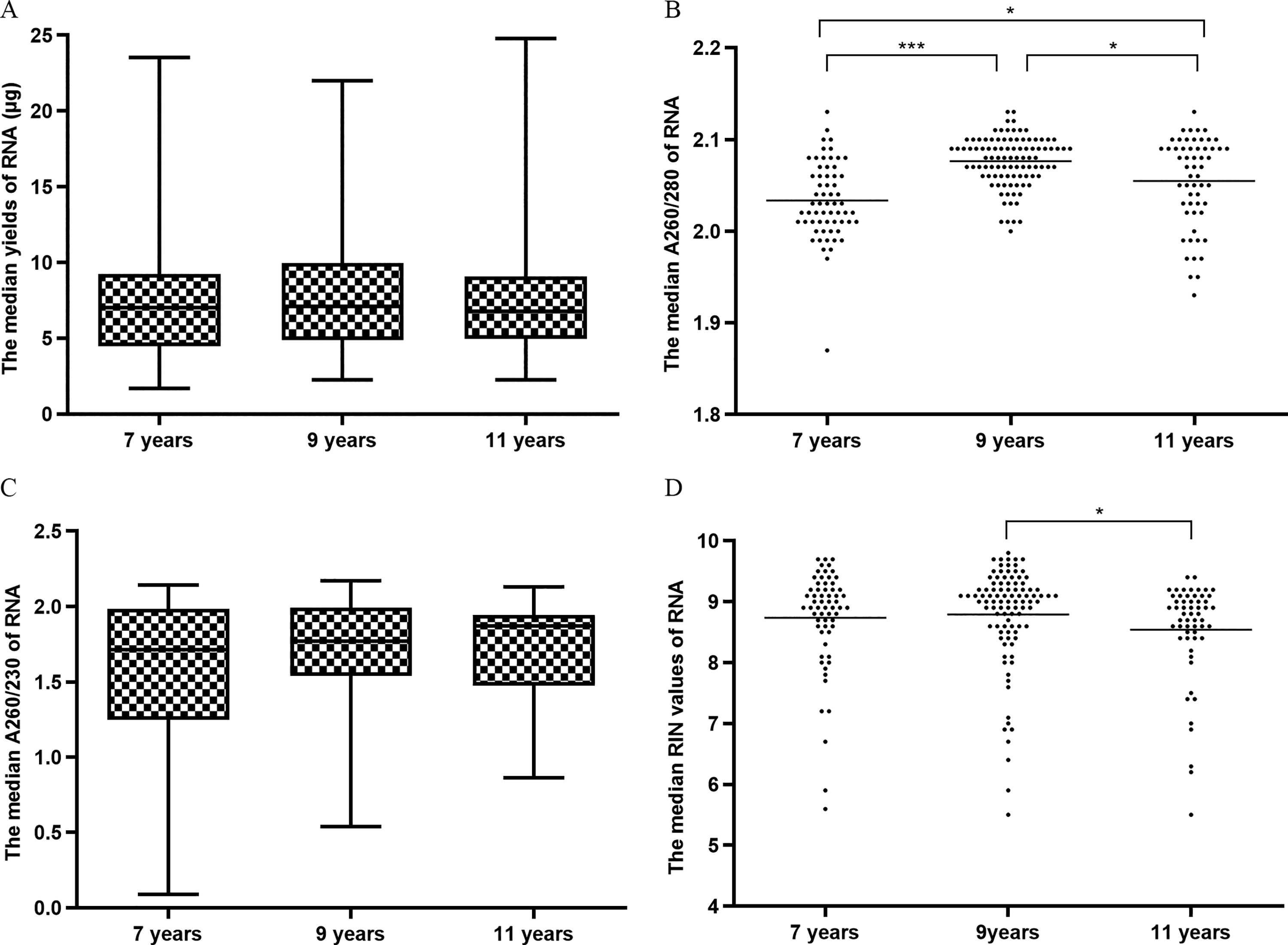
Quality control of the RNA extracted from the three storage periods.
RNA integrity was expressed using RIN values, with median RIN values of 8.90 (IQR 8.58–9.23), 9.00 (IQR 8.60–9.30), and 8.80 (IQR 8.40–9.10) for 7, 9, and 11 years of storage, respectively (Fig. 1D). While no significant differences were found between 7-year vs. 9-year (p = 0.537) or 7-year vs. 11-year storage periods (p = 0.052), the 9-year group showed marginally higher RIN values compared with the 11-year group (p < 0.05). The RNA integrity analysis revealed consistent quality control pass rates across samples preserved for 7, 9, and 11 years when using different RIN thresholds. At the RIN ≥6.0 cutoff, the pass rates were 97%, 98%, and 98%, respectively, with no statistically significant differences observed (p = 0.750). Similarly, when applying more stringent quality thresholds, the pass rates remained stable: 95%, 94%, and 93% for RIN ≥7.0 (p = 0.676), and 87%, 89%, and 86% for RIN ≥8.0 (p = 0.822) (Table 1).
The Qualified Proportion of RIN Values Under Different Standards
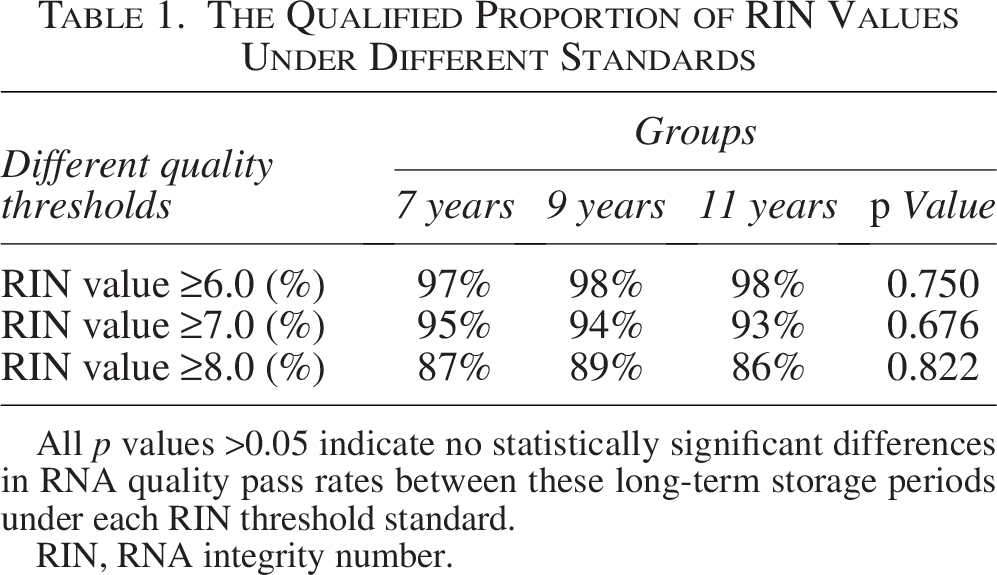
All p values >0.05 indicate no statistically significant differences in RNA quality pass rates between these long-term storage periods under each RIN threshold standard.
RIN, RNA integrity number.
Among the 217 collected samples, 5 (2.3%) were excluded from downstream analysis due to insufficient RNA integrity (RIN < 6.0). The excluded samples exhibited an average RIN of 5.7, with a mean RNA yield of 11.87 µg. Additionally, their absorbance ratios were 2.06 (A260/280) and 1.86 (A260/230). Notably, the storage duration of these excluded samples varied: two had been preserved for 7 years, two for 9 years, and one for 11 years. After quality filtering, a total of 212 samples met the stringent criteria for RNA sequencing, resulting in a qualification rate of 98%.
To evaluate the clot formation trends, we analyzed 517 PAXgene® RNA tube samples from our longitudinal quality control of biobank (1 month to 11 years storage), 5 including the 217 primary samples. We systematically evaluated the blood clot conditions in thawed PAXgene® RNA tubes during the RNA extraction process. All collected samples were examined postcollection, with no blood clots observed. Following the thawing of 517 quality control samples preserved for durations ranging from 1 month to 11 years (132 months), clots were observed in 48 samples (9% of the total tubes, Table 2). The incidence of clot formation showed an increasing trend with prolonged storage time, reaching its highest levels at 84 months (14%) and 108 months (16%). Comparative analysis revealed no statistically significant difference in median yields between the clot group (5.15 µg; IQR: 2.61–6.63) and nonclot group (5.29 µg; IQR: 3.49–8.09) (p = 0.083, Fig. 2A). However, RIN values differed significantly between groups, with the nonclot group demonstrating superior RNA integrity (median RIN = 8.6; IQR: 8.0–9.1) compared with the clot group (median RIN = 6.9; IQR: 5.9–8.0) (p < 0.001, Fig. 2B). In addition, statistical analysis revealed a significant positive correlation between storage time and blood clot formation rates (r = 0.795, p < 0.05; Fig. 3).
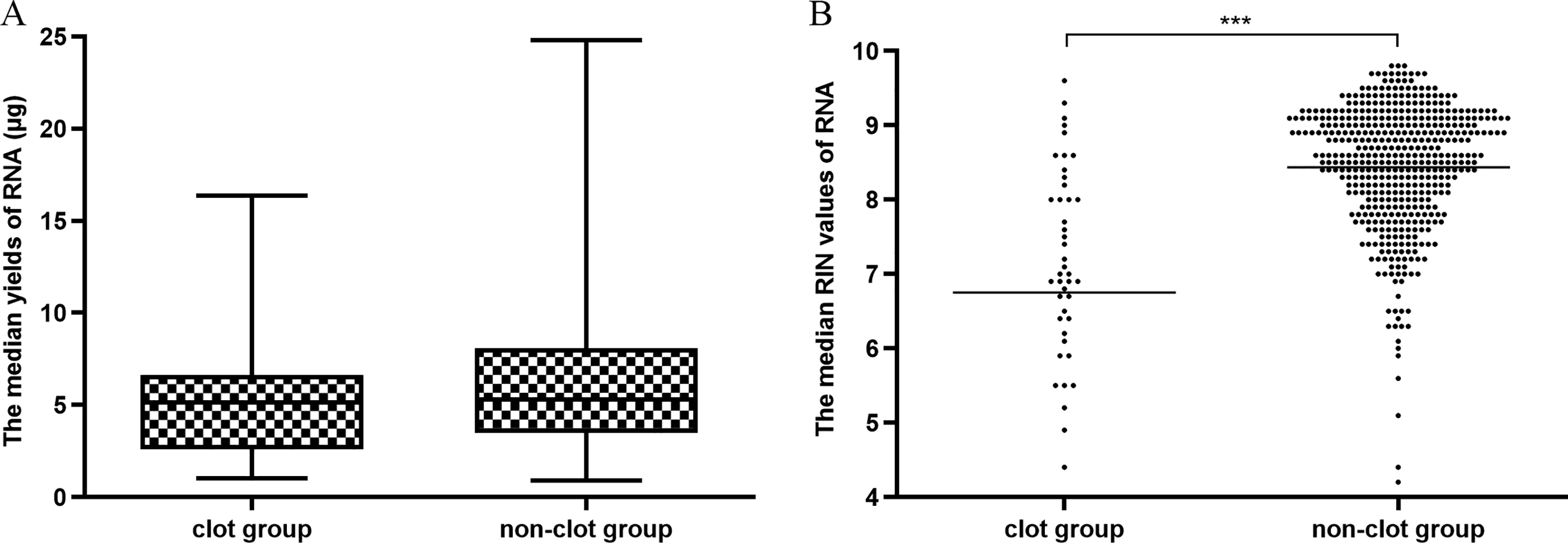
Comparison of RNA yields
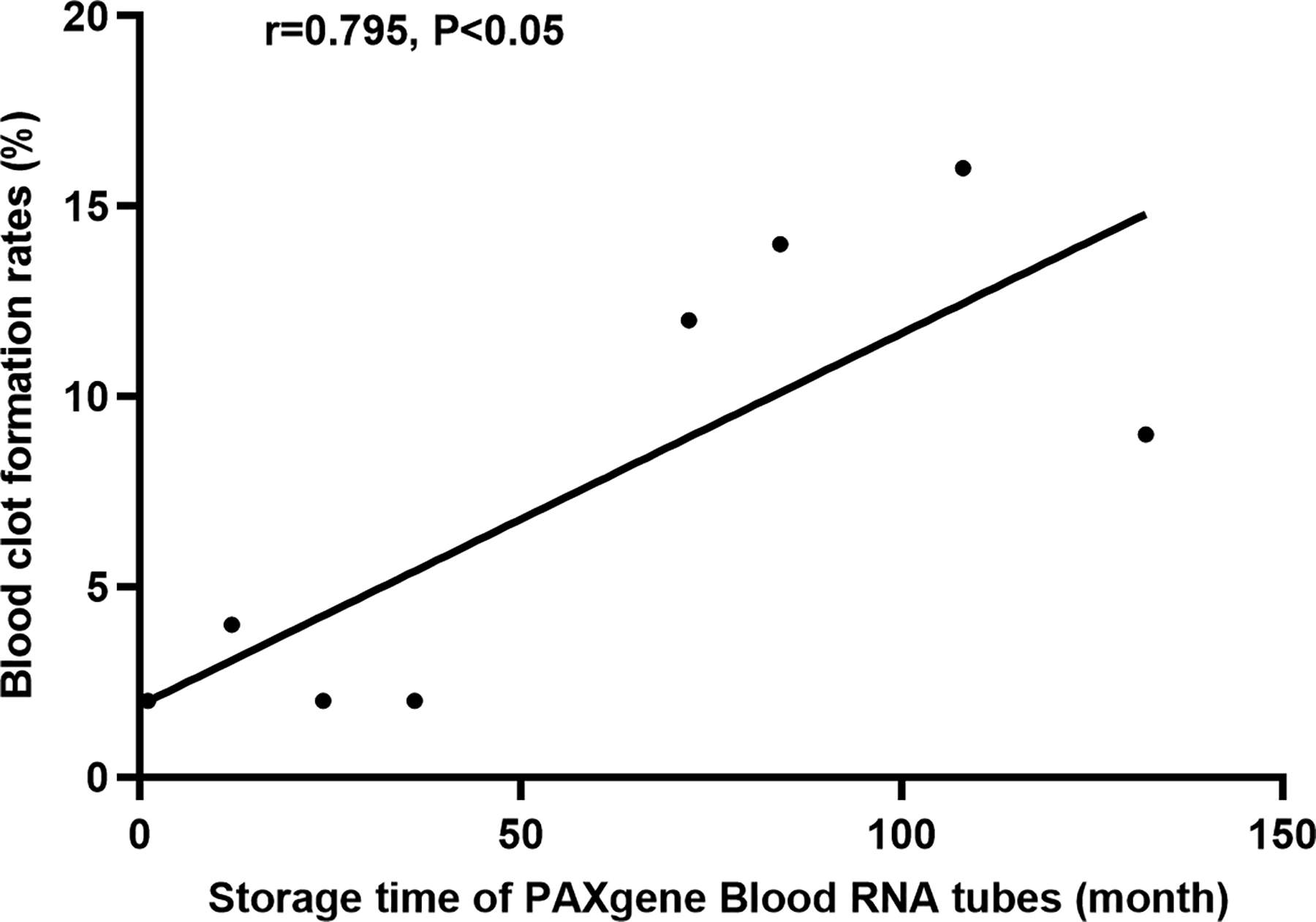
The correlation between storage time and blood clot formation rates. There was a significant positive correlation between storage time and blood clot formation rates (r = 0.795, *p < 0.05).
The Incidence of Blood Clot Formation Across Different Storage Periods
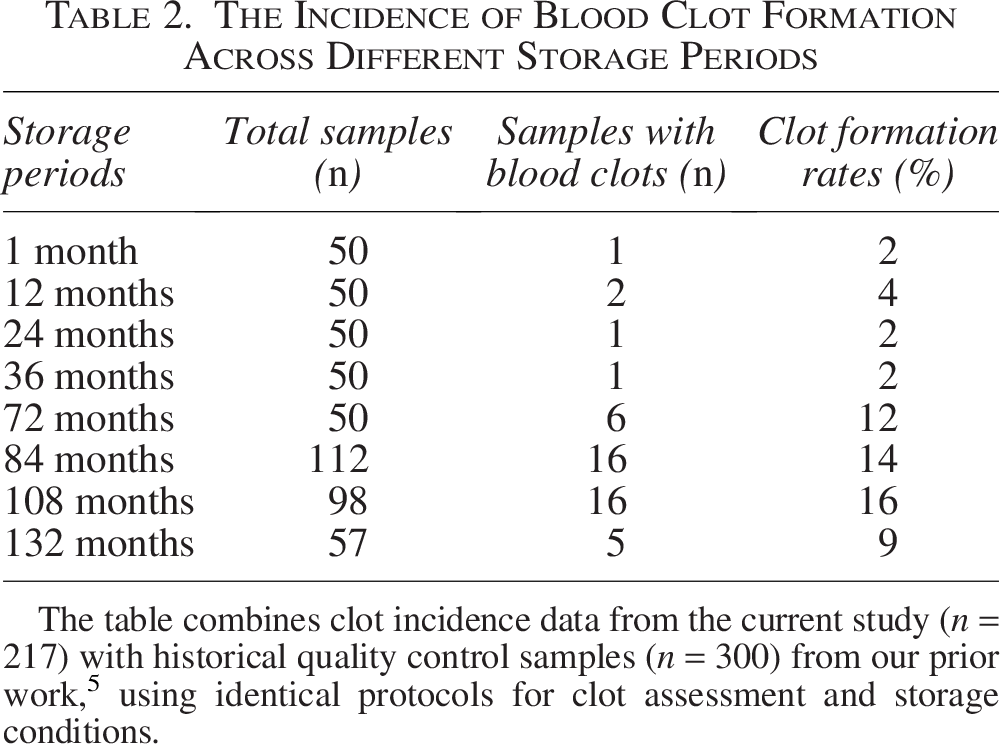
The table combines clot incidence data from the current study (n = 217) with historical quality control samples (n = 300) from our prior work, 5 using identical protocols for clot assessment and storage conditions.
Despite this observed increase in clot formation over time, our results demonstrate that PAXgene® blood RNA tubes effectively preserve RNA quality and integrity even after prolonged storage at −80°C for up to 11 years.
Discussion
Our previous findings demonstrated robust RNA stability in PAXgene® tubes stored for up to 7 years, 5 and the formation of blood clots in PAXgene® tubes will reduce the integrity of extracted RNA. 11 Expanding upon these results, we now present a comprehensive total RNA sequencing analysis of 217 PAXgene® tube samples stored for 7, 9, and 11 years at −80°C, further elucidating the long-term preservation capabilities of the PAXgene® system.
Among the 217 samples analyzed, 212 (98%) met the predefined total RNA sequencing quality criteria. When applying more stringent RIN thresholds (≥7.0 or ≥8.0), the pass rates remained high at 94% and 88%, respectively. Notably, qualification rates were consistently excellent across all storage durations: 97% at 7 years, 98% at 9 years, and 98% at 11 years. The median RNA yield was 7.00 µg (IQR 4.90–9.45), reflecting satisfactory extraction efficiency. Furthermore, the RNA exhibited high purity, with median A260/280 and A260/230 ratios of 2.07 (IQR 2.03–2.09) and 1.79 (IQR 1.50–1.98), respectively. RNA integrity was also well preserved, as evidenced by a median RIN of 8.90 (IQR 8.50–9.20). Collectively, these findings confirm that RNA extracted from the PAXgene® RNA tubes maintains high yield, purity, and integrity, even after prolonged storage.
Among our longitudinal quality control of 517 PAXgene® RNA tube samples, clots were observed in 48 (9%). Comparative analysis revealed no yield difference between clot/nonclot groups (5.15 vs. 5.29 µg, p = 0.083), but significantly lower RIN in clots (6.9 vs. 8.6, p < 0.001). Longitudinal clot monitoring (Table 2) revealed that storage beyond 6 years significantly increased clot incidence (12–16%), paralleling our observation of RIN decline in clot-affected samples. 11 While our study demonstrates a significant positive correlation between storage time and clot formation in PAXgene® tubes, several limitations should be considered. First, this analysis did not adjust for potential confounding factors including: (1) interindividual variations in hematocrit or platelet counts, (2) differences in blood collection techniques across sampling timepoints, (3) use of anticoagulant medications by donors, or (4) minor variations in prestorage handling intervals. These unmeasured variables could theoretically influence both clot propensity and RNA integrity. Future prospective studies should incorporate detailed donor hematological profiles and standardized documentation of preanalytical variables to enable multivariate adjustment. Nevertheless, the strong magnitude of correlation (r = 0.795) suggested that prolonged storage duration represents an independent risk factor for clot formation in stabilized blood samples.
Additionally, RNA extracted from 7-year-stored tubes in this study exhibited substantially higher yields compared with historical samples (median yield: 7.00 µg vs. 3.21 µg, p < 0.001). Similarly, the median RIN of current 7-year samples (8.9) exceeded the median RIN (7.9) of prior 7-year samples (p < 0.001). 5 However, these differences may be attributed to variations in the collected samples, instrumentation, and extraction protocols. While both studies employed the same commercial kits, this time our adoption of a manual extraction method—with optimized processing steps and operational flexibility (as detailed in the Materials and Methods section)—may have contributed to the enhanced RNA quality observed here.
Our findings align with prior studies supporting the stability of RNA in PAXgene® tubes. For instance, Wylezinski et al. reported stable long noncoding RNA expression profiles in whole blood stored at −80°C for up to 1 year, 19 while Seelenfreund et al. demonstrated that microRNA (miRNA) can be recovered and quantified from human blood samples stored for up to 3 years under similar conditions. 20 Another study further confirmed miRNA stability in hematopoietic samples stored in PAXgene® tubes for up to 5 years. 21 According to manufacturer specifications, PAXgene® RNA tubes are validated for stable preservation at −20°C or −70°C for up to 11 years without compromising qRT-PCR performance, though the claim was based on studies involving healthy donors with normal white blood cell counts (4.8–11.0 × 10⁶ WBC/mL). 9
In our ongoing study, our study focused on whole blood samples from patients with kidney disease, demonstrating that PAXgene® RNA tubes stored at −80°C for over 7 years—and up to 11 years—remain suitable for total RNA sequencing. These results provide clinically relevant reference data, reinforcing the utility of PAXgene® systems for long-term biobanking in research.
Authors’ Contributions
C.Z. designed the study and reviewed the article. R.T. performed the experiments, analyzed the data, and wrote the article. J.L. modified the article and made the figures. X.W., L.Z., R.Y., and P.Z. were responsible for resources. All authors have read and agreed to the final version of the article.
Footnotes
Acknowledgments
The authors would like to thank the patients for their contributions to this study. All patient samples were obtained from the Renal Biobank of the National Clinical Research Center for Kidney Diseases.
Author Disclosure Statement
All authors declare no conflicts of interest.
Funding Information
This study was supported by the Natural Science Foundation of Jiangsu Province (BK20221552).