




Abstract
Introduction:
Sperm cryopreservation is a vital tool for long-term preservation of genetic material, enabling the maintenance and transfer of genetic traits through assisted reproductive technologies.
Objectives:
This study aimed to assess the effects of incorporating Lactobacillus plantarum secretions (LS) into the cryopreservation protocol of goat semen.
Materials and Methods:
LS was added to semen extenders at concentrations of 20, 40, 60, 80, and 100 µL/mL. The control group received no additive. After freezing and thawing, various sperm quality parameters were evaluated.
Results:
The LS20 group showed significantly higher (p <0.05) total sperm motility compared with LS100, LS80, and the control. Progressive motility and straight-line velocity (VSL) were also improved in LS20 relative to LS100, though not significantly different from the control. LS20 demonstrated significantly higher amplitude of lateral head displacement (ALH) than the control, LS60, LS80, and LS100. LS40 also outperformed LS60–LS100 in ALH. Sperm viability was significantly increased in LS20 and LS40 compared with the control, LS80, and LS100. The sperm chromatin dispersion assay revealed significantly greater halo-to-core ratios in LS20 and LS40. Additionally, malondialdehyde levels, as a marker of oxidative stress, were markedly reduced in LS20 and LS40 compared with all other groups.
Conclusions:
Lower concentrations of LS, particularly 20 and 40 µL/mL, significantly improve sperm motility, viability, chromatin integrity, and oxidative status after thawing. These findings support the potential application of LS as an effective additive to enhance goat semen cryopreservation outcomes.
Introduction
Sperm cryopreservation is a widely employed method for long-term preservation of genetic material, enabling the transmission of genetic traits to subsequent generations via assisted reproductive technologies such as artificial insemination. 1 However, the cryopreservation process induces oxidative stress, causing significant biochemical and functional damage to sperm cells. 2
Mammalian sperm are particularly vulnerable to cryoinjury due to the high concentration of polyunsaturated fatty acids in their plasma membranes, which predispose them to lipid peroxidation. 3 During the freezing and thawing process, reactive oxygen species (ROS), natural byproducts of cellular metabolism, are generated. 4 The major ROS identified in mammalian sperm include hydrogen peroxide (H2O2), superoxide anion (O2−), hydroxyl radical (OH·), and hypochlorite radical (OCl−). 5 These highly reactive species interact with vital biomacromolecules such as proteins, lipids, and DNA, leading to detrimental effects. 6
Excessive ROS levels compromise membrane integrity, impair cellular functions, reduce motility, and ultimately trigger apoptosis in sperm cells. 7 Although seminal plasma contains a natural antioxidant defense system comprising glutathione (GSH), GSH peroxidase (GSH-Px), catalase, and superoxide dismutase (SOD), this system is often insufficient to counteract ROS during cryopreservation.8,9
The limited antioxidant capacity is primarily due to significant cytoplasmic loss occurring during spermiogenesis, resulting in reduced endogenous antioxidants within spermatozoa. 10
Within the sperm microenvironment, a delicate balance exists between ROS and antioxidant levels. 11 Disruption of this equilibrium, characterized by an excess of ROS relative to antioxidant capacity, leads to oxidative stress. 12 One effective approach to mitigate ROS-induced damage is supplementation of the cryopreservation medium with antioxidants, which has been shown to protect sperm function by minimizing oxidative stress. 13 Numerous studies have demonstrated that incorporating both natural and synthetic antioxidants into sperm extenders significantly reduces oxidative damage and enhances post-thaw sperm quality.1,2,11,14–17
Lactic acid bacteria (LAB) are ubiquitously distributed in nature.18,19 These microorganisms exhibit diverse biological properties that confer notable health benefits to humans and animals, primarily through potent antioxidant mechanisms. Recent studies have highlighted the antioxidant properties of LAB, which play a critical role in preventing diseases related to oxidative stress.20–22
Among LAB, Lactobacillus species encompass various strains, with Lactobacillus plantarum demonstrating particularly strong antioxidant capabilities. 23 These bacteria release extracellular metabolites with antioxidant potential during fermentation, including bioactive peptides and exopolysaccharides.22,24,25
Metabolic profiling of L. plantarum culture supernatant using gas chromatography–mass spectrometry (GC-MS) has identified several bioactive compounds, such as 2-ethyl-3,6-dimethylpyrazine, 2-butyl-3,5-dimethylpyrazine, p-tolyl methyl sulfone, among others. 26 Furthermore, the analysis of the extracellular metabolome of L. plantarum via GC-MS, liquid chromatography MS, and ultrahigh-performance LC revealed bioactive compounds including indoles, phenylpropanoids, fatty acids, amino acids, and B vitamins. 27 These secondary metabolites act as free radical scavengers, neutralizing 2,2-diphenyl-1-picrylhydrazyl (DPPH), superoxide, and hydroxyl radicals, while also conferring resistance to H2O2.18,28,29
Raad et al. 30 reported that the addition of L. plantarum secretions to human sperm cryopreservation media acted as a cryoprotectant, enhancing sperm motility and preserving DNA integrity compared with standard cryopreservation media. Similarly, Garrido-Fernández et al. 31 identified carotenoid secretion by L. plantarum via HPLC analysis, confirming its antioxidant properties. Moreover, Tian et al. 32 demonstrated that dietary supplementation with L. plantarum significantly increased serum testosterone levels, improved semen quality, and mitigated testicular damage in male mice exposed to diethylhexylphthalate.
While extensive research has explored the antioxidant properties of L. plantarum metabolites, limited studies have investigated their potential benefits in sperm cryopreservation. Given their promising antioxidant activity, incorporation of L. plantarum secretions (LS) into goat sperm cryopreservation extenders may confer protective effects on sperm quality during freezing and thawing. Therefore, this study aims to evaluate the protective effects of LS on goat semen during cryopreservation and thawing.
Materials and Methods
All experimental procedures were performed in accordance with international ethical guidelines and were approved by the Animal Care and Use Committee of the University of Kurdistan (Ethical Approval Code: IR.UOK.REC.1404.021).
Chemicals
All chemicals used in this experiment were purchased from Sigma-Aldrich (St. Louis, MO, USA) and Merck (Darmstadt, Germany).
Extraction of L. plantarum secretions
The L. plantarum strain ATCC 14917 was obtained from the Persian Type Culture Collection. Following reactivation according to the designated protocol, the bacteria were cultured in MRS broth (De Man, Rogosa, and Sharpe; Merck) under microaerophilic conditions at 35°C. Once the bacterial growth reached an optical density (OD600) of 0.5, the culture was centrifuged at 5000 rpm for 15 minutes. The supernatant was collected, and its pH was adjusted to 7.2. To ensure sterility, the solution was passed through a 0.22 µm membrane filter (Millipore, USA). The resulting sterile supernatant was used as a cryoprotective agent at various concentrations. 26
Analysis of extracted L. plantarum secretions
GC-MS analysis was conducted to identify the compounds present in the extracted secretions. 33
Animals, semen collection, and preparation
This study was conducted at the University of Kurdistan farm in Sanandaj. Semen samples were collected over a 10-week period, from early spring to late summer, from four mature Markhoz bucks (3–4 years old; weighing 60–70 kg), yielding a total of 40 samples (n = 40). The bucks were maintained under uniform feeding and housing conditions throughout the study. Semen collection was performed via electroejaculation. Samples from each buck were stored separately and transported to the laboratory within 10–15 minutes post-collection, kept at 37°C in a water bath. Prior to analysis, ejaculates were independently assessed for initial quality; only samples exhibiting motility rates above 75% and sperm concentrations exceeding 1 × 10⁹/mL were selected for cryopreservation. For each replicate (n = 8), semen samples were pooled to minimize individual variability and then prepared for further processing.
A Tris-based extender was used as the base medium, composed of 3.786 g Tris, 2.172 g citric acid, and 1 g fructose dissolved in 100-mL distilled water. This extender also contained 5% (v/v) glycerol and 5% (v/v) egg yolk. Osmolality was adjusted to 320 mOsm/kg, and pH was set to 7. 34
The experimental treatments included the base extender without additives (control) and the base extender supplemented with 20, 40, 60, 80, and 100 µL/mL of LS. Spermatozoa were diluted in these extenders to a final concentration of 240 × 106 spermatozoa/mL, with both the semen samples and the extender maintained at 37°C during the dilution process. The diluted samples were then loaded into 0.25-mL straws, sealed with polyvinyl chloride powder, and cooled at 5°C for 3 hours. Straws were frozen for 15 minutes over liquid nitrogen vapor at 4 cm above the liquid nitrogen surface (−120°C), followed by immersion in liquid nitrogen (−196°C) for storage. Finally, straws were stored in liquid nitrogen containers. For experimental analyses, frozen straws were thawed in a 37°C water bath for 30 seconds.
Sperm motion characteristics
Sperm motility analysis was performed using computer-assisted sperm analysis (IVOS version 12; Hamilton-Thorne Biosciences, MA, USA). 8 For this purpose, 5 µL of thawed sperm was placed on a prewarmed chamber slide (Leja 4, Leja Products, Luzernestraat B.V., Holland), and sperm motility characteristics were assessed in 10 fields of view, covering at least 300 spermatozoa, using a microscope at 10× magnification and a temperature of 37°C. The following parameters were recorded: motility (%), progressive motility (%), average path velocity (VAP, µm/s), straight-line velocity (VSL, µm/s), curvilinear velocity (VCL, µm/s), amplitude of lateral head displacement (ALH, µm), beat cross frequency (BCF, Hz), linearity (LIN; LIN% = VSL/VCL), and straightness (STR; STR% = VSL/VAP).
Sperm viability
Sperm viability was assessed using the eosin-nigrosin staining method. Briefly, 5 µL of diluted semen was mixed with 10 µL of eosin-nigrosin stain (prepared by dissolving 1.67 g eosin and 10 g nigrosin in 100 mL of distilled water) on a slide, smeared, and allowed to air-dry at room temperature. The stained slides were then examined under a light microscope (Nikon, Tokyo, Japan) at 40× magnification. Viable spermatozoa were identified as unstained cells and were counted accordingly. For evaluation, 20 fields were randomly selected, and 10 spermatozoa were examined in each field, after which the percentage of viable sperm was calculated. 34
Sperm membrane integrity
The hypo-osmotic swelling test was used to assess sperm membrane integrity. Briefly, 10 µL of thawed sperm was mixed with 100 µL of hypo-osmotic solution, which contained 9 g of fructose and 4.9 g of sodium citrate per liter of distilled water. The osmolarity of this solution was 100 mOsm/L. The mixture was incubated at 37°C for 60 minutes. Subsequently, a drop of the solution was placed on a slide and covered with a coverslip. Finally, 200 spermatozoa were evaluated following the method described by Revell and Mrode. 35
Sperm acrosomal integrity
A formalin-citrate solution (consisting of 96 mL of 2.9% sodium citrate solution and 4 mL of 37% formaldehyde) was used to assess morphological abnormalities in acrosomes. Sperm samples were mixed with the formalin-citrate solution at a ratio of 1:2 (50-μL sperm with 100-μL formalin-citrate solution), and a drop of the fixed sperm was placed on a slide, covered with a coverslip, and a drop of immersion oil was added on top, and the slide was examined under a light microscope (Nikon, Tokyo, Japan) at 100× magnification. A total of 200 spermatozoa were counted, and the percentage of normal acrosomes was calculated. 36
Estimation of lipid peroxidation
Malondialdehyde (MDA) levels, as an indicator of lipid peroxidation, were measured using the thiobarbituric acid (TBA) assay. Following thawing, semen samples were centrifuged at 1500× g for 5 minutes, and the supernatant was collected. Subsequently, 1 mL of the supernatant was mixed with 1 mL of Ethylenediaminetetraacetic acid (EDTA) solution (0.037 g EDTA in 10 mL of distilled water), 1 mL of Butylated Hydroxytoluene (BHT) solution (0.2 g BHT in 10 mL of ethanol), and 2 mL of Trichloroacetic acid (TCA) solution (3 g TCA in 30 mL of distilled water). The mixture was then centrifuged at 1200 rpm for 15 minutes. After that, 1 mL of the resulting supernatant was combined with 1 mL of TBA solution (0.134 g TBA in 20 mL of distilled water) and incubated in a water bath at 90°C for 20 minutes. The samples were subsequently cooled to room temperature, and absorbance was measured at 532 nm using a spectrophotometer. MDA concentrations were expressed in nmol/mL. 37
DNA integrity
DNA fragmentation was evaluated using the sperm chromatin dispersion (SCD) test, following the method described by Fernandez et al. 38 with minor modifications. This assay is based on the principle that spermatozoa with intact DNA form a characteristic halo of dispersed DNA loops, whereas spermatozoa with fragmented DNA do not produce such a halo. DNA integrity was determined by calculating the ratio of the halo area to the nuclear area (Fig. 1).
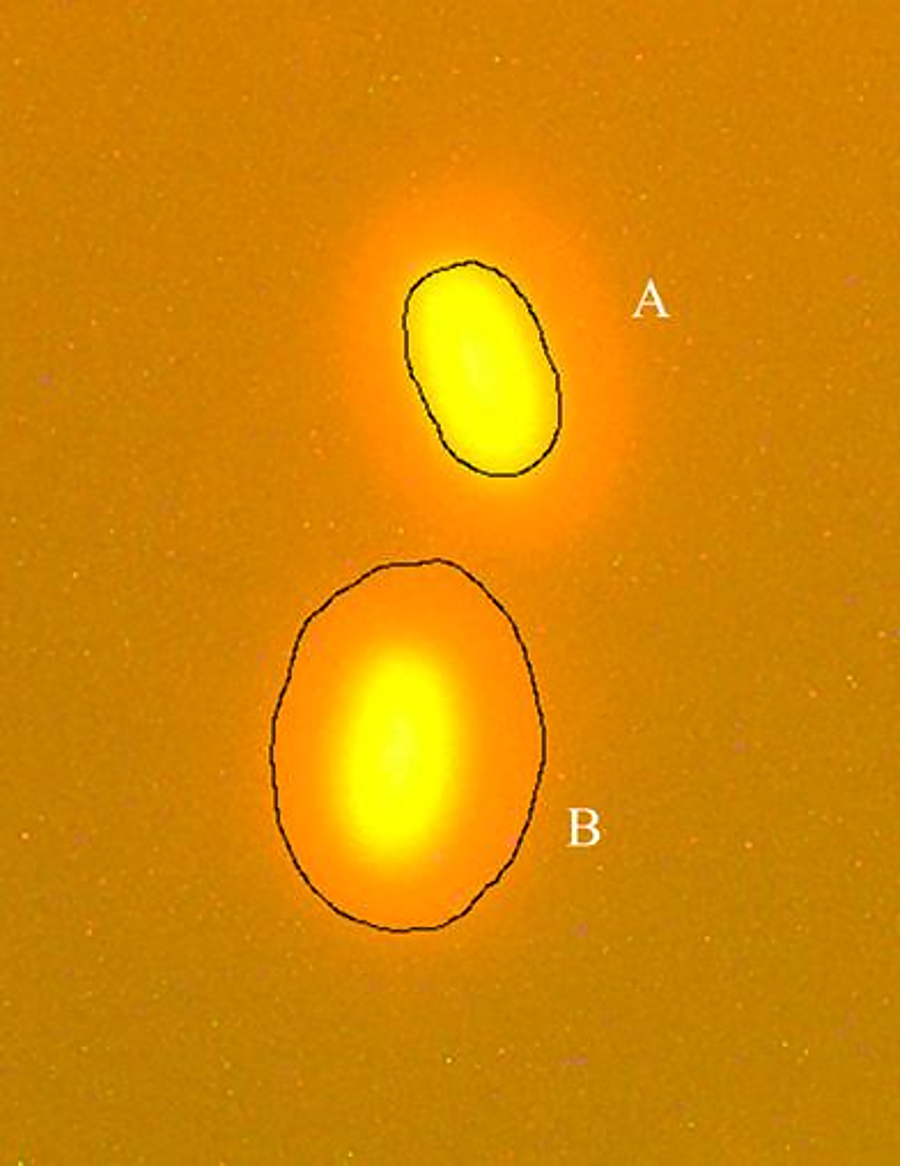
Fluorescence microscopy image of the sperm halo and core. The ethidium bromide (EtBr)-stained sperm nucleoid shows a central core
To perform the assay, 150 µL of 65% agarose was placed on a slide, covered with a coverslip, and kept at 4°C for 5 minutes to solidify. After solidification, the coverslip was gently removed. Then, 30 µL of thawed sperm sample was mixed with 70 µL of 0.7% low-melting point agarose, placed on the solidified agarose layer, covered with a coverslip, and allowed to dry at room temperature. The coverslip was then removed, and the slide was horizontally incubated for 7 minutes at 37°C in an acidic denaturation solution (0.08 N HCl) in the dark.
Following denaturation, the slide was incubated in a lysis solution (0.4 M Tris base, 0.8 M 1,4-Dithiothreitol (DTT), 1% SDS, 50 mM EDTA, and 2 M NaCl; pH 7.5) for 25 minutes. The slide was then rinsed with distilled water for 5 minutes and sequentially immersed in 70%, 90%, and 100% ethanol for 2 minutes each. After air-drying at room temperature, sperm nuclei were stained with ethidium bromide and examined under a fluorescence microscope.
Statistical analysis
Statistical analysis was performed using the General Linear Model procedure in SAS software (version 9.1; SAS Institute Inc., Cary, NC, USA, 2002), based on a completely randomized design. Orthogonal contrasts were applied to compare treatment means, and statistical significance was considered at p < 0.05. Results are expressed as mean ± standard error (SE).
Results
The identification of compounds in LS was conducted using GC-MS. Eleven components were identified in the secretions, with the compounds with the highest abundance being 2-methylbenzaldehyde and 4-methylbenzaldehyde (Table 1 and Fig. 2).

Gas chromatography–mass spectrometry (GC-MS) analysis of secretions produced by Lactobacillus plantarum (LS).
The Components of Lactobacillus plantarum Secretions Were Identified Using GC-MS Analysis

GC-MS, gas chromatography–mass spectrometry.
The data presented in Table 2 indicate that LS20 significantly increased total motility compared with LS100, LS80, and the control group (p < 0.05). Progressive motility in the LS20 group did not show a significant increase compared with the control but was significantly higher than in the LS100 group. Regarding the VSL parameter, the mean value in the LS20 group did not significantly differ from the control but was significantly higher than in the LS100 group. LS20 exhibited a significantly higher ALH compared with the control, LS60, LS80, and LS100. Additionally, LS40 demonstrated a significantly higher ALH than LS60, LS80, and LS100. No significant differences were observed among the experimental treatments for VAP, VCL, STR, LIN, and BCF parameters.
Effects of Different Concentrations of LS on the Evaluated Parameters of Post-Thawed Goat Spermatozoa (Mean ± SE)
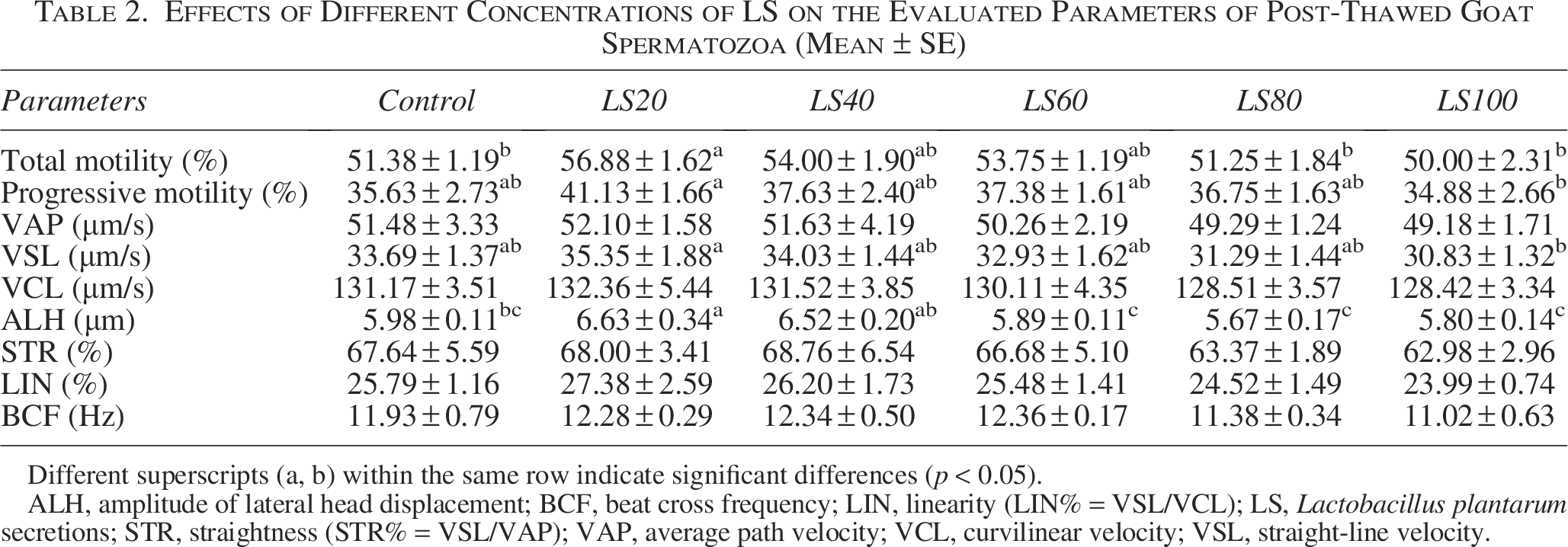
Different superscripts (a, b) within the same row indicate significant differences (p < 0.05).
ALH, amplitude of lateral head displacement; BCF, beat cross frequency; LIN, linearity (LIN% = VSL/VCL); LS, Lactobacillus plantarum secretions; STR, straightness (STR% = VSL/VAP); VAP, average path velocity; VCL, curvilinear velocity; VSL, straight-line velocity.
The results in Table 3 indicate a significant increase in viability in the LS20 and LS40 groups compared with the control, LS80, and LS100 groups. In the SCD parameter, the halo-to-nucleus area ratio was significantly higher in the LS20 and LS40 groups compared with the control, LS60, LS80, and LS100 groups (Table 3, Fig. 3). Additionally, as shown in Table 3, the MDA levels in the LS20 and LS40 groups were significantly lower than in the control, LS60, LS80, and LS100 groups.
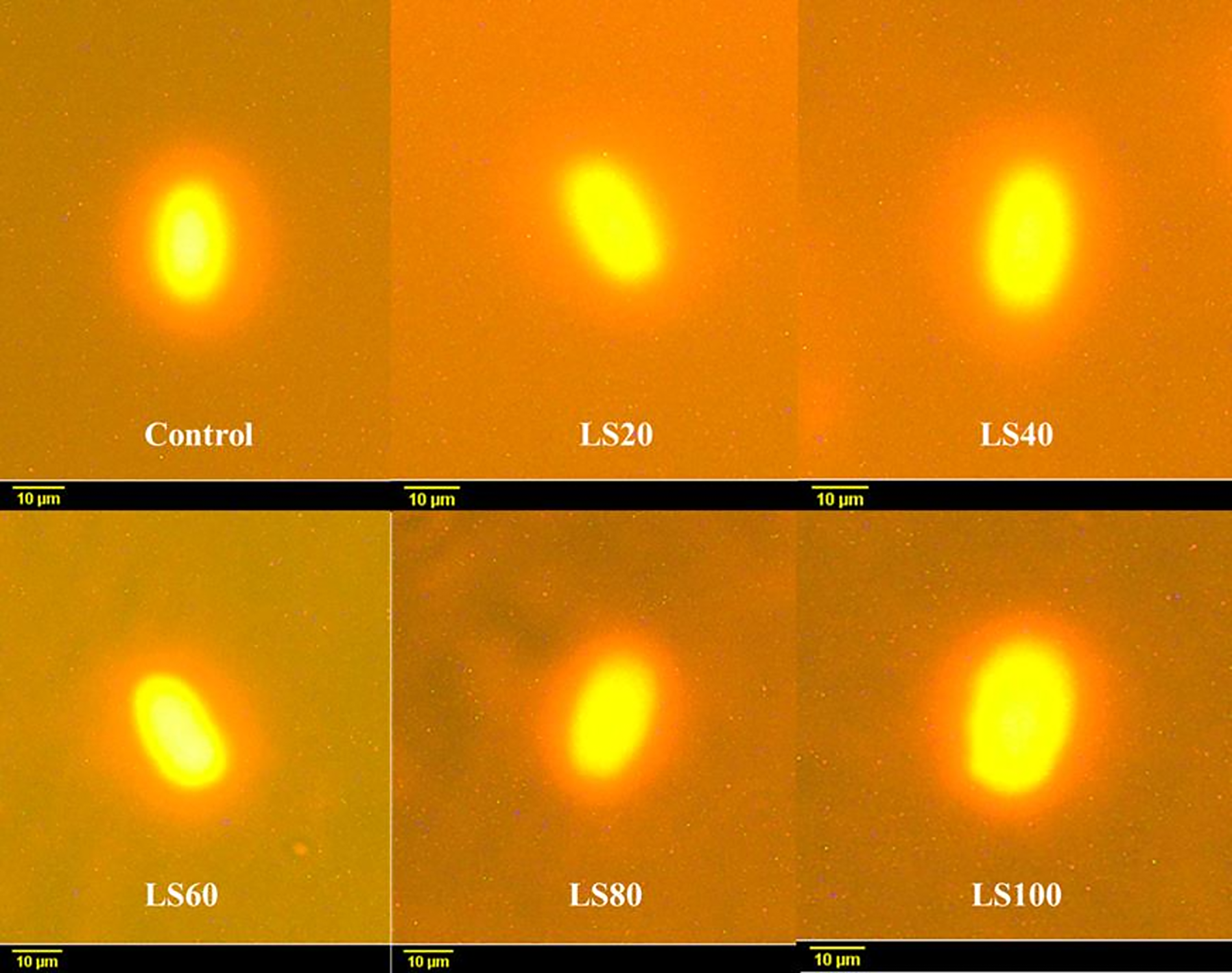
The effects of Lactobacillus plantarum secretions (LS) on DNA fragmentation levels in cryopreserved goat spermatozoa.
Effects of Different Concentrations of LS on the Evaluated Parameters of Post-Thawed Goat Spermatozoa (Mean ± SE)
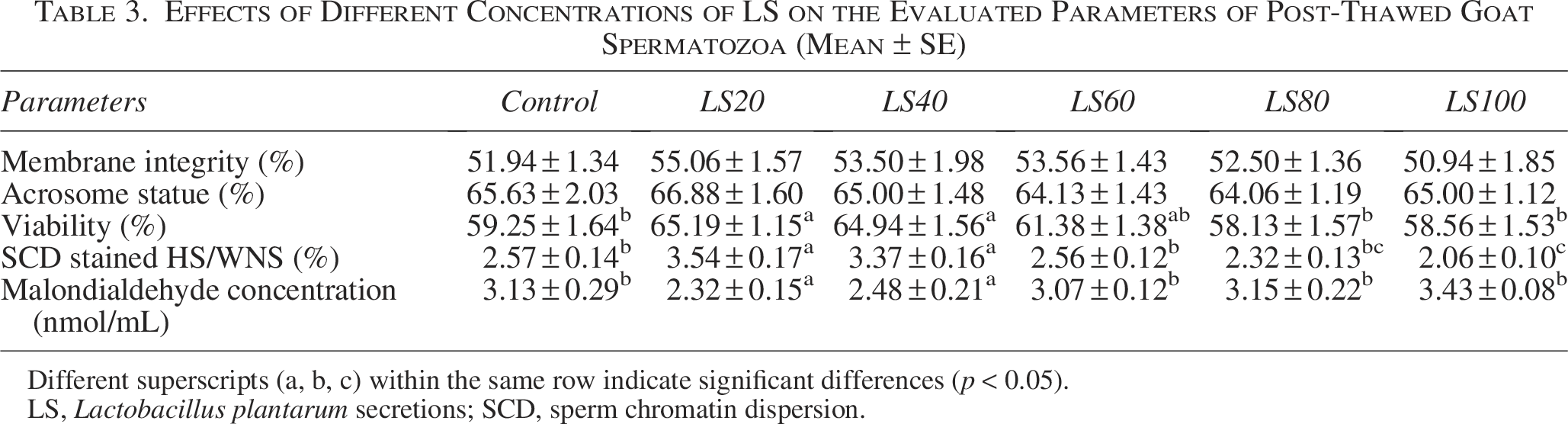
Different superscripts (a, b, c) within the same row indicate significant differences (p < 0.05).
LS, Lactobacillus plantarum secretions; SCD, sperm chromatin dispersion.
Discussion
In recent years, there has been growing interest in the discovery of new compounds with cryoprotective properties. Consequently, researchers in the field of biology have sought to identify biologically safe compounds with beneficial properties, including antioxidant effects. Among the compounds introduced, substances derived from probiotic bacteria have received particular attention due to their probiotic benefits.22,32 Accordingly, the present study aimed to investigate the protective effects of extracellular compounds from Lactobacillus plantarum on sperm cells during the freeze–thaw process. This objective was pursued using qualitative techniques on sperm cells.
As a first step, probiotic extracts were obtained using previously established methods,26,27 and their constituent compounds were analyzed and confirmed via GC-MS for quality assurance. The results indicated that 2-methylbenzaldehyde and 4-methylbenzaldehyde were the two main compounds in the extracellular extract of Lactobacillus plantarum. Given that this bacterium belongs to the probiotic group, the presence of these compounds was not unexpected. As reported by Kim et al., 27 LS primarily contains indoles, phenylpropanoids, and amino acids. Amino acids possess antioxidant properties that help reduce lipid peroxidation and protect cells against free radical–induced damage during cryopreservation.39,40 Amino acids in semen freezing extenders for ram,10,41 goat,42,43 and bull 44 have acted as effective additives and improved sperm quality parameters. Given the antioxidant and protective properties of these secreted components, the observed positive effects on sperm were anticipated. Moreover, we observed that several sperm quality parameters, including motility, viability, MDA concentration, and DNA integrity, significantly improved in the treatment groups compared with the control. For instance, sperm viability increased from 59% in the control group to 65% in the LS20 treatment group.
However, at higher concentrations, such as LS80 and LS100, the protective effect diminished, and negative effects emerged. This adverse effect at high doses could be attributed to osmotic imbalance, acidification of the medium by bacterial secretions, or excessive antioxidant levels because within the sperm microenvironment, a delicate balance exists between ROS and antioxidant levels, 11 and ROS are produced as essential by-products of cellular metabolism. 4 Consequently, LS20 was identified as the optimal dosage for all evaluated parameters. LS20 and LS40 treatments exhibited a significant reduction in MDA levels, which could contribute to sperm preservation under cryogenic conditions. ROS levels beyond physiological limits cause oxidative damage to various sperm components, including the cell membrane, under low-temperature conditions. Utilizing antioxidant compounds to counteract ROS-induced damage is a well-established protective strategy. Researchers have long been searching for such compounds. For example, Das and Goyal 45 and Barbonetti et al. 46 reported that probiotic-derived compounds have the potential to protect against oxidative damage caused by ROS, serving as antioxidants with protective effects on biological cells, including spermatozoa.
In the present study, the antioxidant effects of LS were evaluated by incorporating them into the cryopreservation extender for goat sperm under in vitro conditions. The results demonstrated that LS significantly enhanced the quality of goat sperm during the freezing process. Among the treatments, LS20 exhibited the most pronounced improvements in total motility and ALH compared with the other groups. Additionally, LS20 significantly increased progressive motility and VSL relative to LS100. However, no significant differences were observed among the treatments for VAP, VCL, STR, LIN, or BCF.
With respect to sperm viability, the LS20 and LS40 treatments significantly improved viability compared with the control, LS80, and LS100 groups. The beneficial effects of LS20 on motility and ALH, as well as the positive effects of LS20 and LS40 on sperm viability, were particularly notable. Similarly, Dim et al. 47 reported that oral administration of Lactobacillus to toms significantly improved semen quality, including total motility and the percentage of live sperm, compared with the control group. Furthermore, Raad et al. 30 reported that the addition of LS to human sperm freezing media acted as a cryoprotectant during the freeze–thaw process and resulted in improved sperm motility.
Lipid peroxidation disrupts the lipid matrix of sperm cell membranes, thereby reducing sperm motility and compromising membrane integrity. MDA is widely recognized as a biomarker of oxidative damage.
48
Our results showed that supplementing goat sperm cryopreservation media with LS20 and LS40 significantly decreased MDA levels compared with the control and other treatment groups. These findings are in line with those of Li et al.,
18
who reported that administration of Lactobacillus plantarum to aged mice under
The freeze–thaw process induces structural alterations in sperm chromatin. 50 Additionally, oxidative stress and the resulting free radicals can cause sperm DNA damage.51,52 Given the critical role of sperm DNA integrity in fertilization and embryo development, the SCD test was employed in the present study to evaluate the effect of the tested compound on sperm DNA quality. The results showed that incorporating LS20 and LS40 concentrations of LS into the sperm cryopreservation extender significantly reduced DNA fragmentation compared with the control and other treatment groups. These findings are in agreement with those of Raad et al., 30 who reported that a freezing medium supplemented with LS better preserved sperm DNA integrity compared with a medium lacking these secretions. The observed reductions in both DNA damage and MDA concentrations highlight the protective role of LS in minimizing genetic damage and preserving sperm membrane integrity during the freeze–thaw process.
The beneficial effects of LAB are mediated through various mechanisms. It is hypothesized that the positive impact of LS on sperm quality parameters during the freeze–thaw process observed in this study may be attributed to their free radical-scavenging capabilities. Several studies support this hypothesis. For instance, Kanno et al., 28 Das and Goyal, 45 Kuda et al., 53 and Lee et al. 54 have reported the in vitro free radical-scavenging capacity of lactobacilli, demonstrating activity against DPPH, superoxide anions, xanthine oxidase, hydroxyl radicals, and H2O2.
Furthermore, LS likely protects spermatozoa from cryodamage by mitigating oxidative stress and modulating antioxidant signaling pathways. Supporting this notion, Kobatake et al. 55 demonstrated that treatment of murine fibroblast cells with Lactobacillus gasseri under paraquat-induced oxidative stress enhanced cellular resistance to oxidative damage. Their findings revealed that L. gasseri activates a cellular defense pathway initiated by increased levels of the nuclear factor erythroid 22-related factor 2 (Nrf2). This activation facilitates the translocation of Nrf2 into the nucleus, where it triggers the expression of cytoprotective and antioxidant genes. The mechanism was found to be largely dependent on the JNK signaling pathway, which promotes Nrf2 upregulation and strengthens the cellular antioxidant defense system.
In a related study, Gao et al. 56 investigated the Nrf2-mediated antioxidant defense pathway in mice treated with Lactobacillus plantarum. Their results demonstrated that L. plantarum significantly enhances Nrf2 expression and its nuclear translocation, which in turn promotes the expression of key antioxidant enzymes such as SOD and GSH-Px. These enzymes play crucial roles in neutralizing ROS and preventing oxidative damage to cellular proteins, lipids, and DNA. Therefore, L. plantarum contributes to maintaining redox homeostasis and protecting cells from oxidative injury through activation of the Nrf2 pathway.
However, not all findings are consistent. Harding et al. 57 reported that probiotic supplementation in colitic piglets did not significantly affect protein synthesis, reduce oxidative stress, or enhance antioxidant capacity. Despite this, Tian et al. 32 found that administration of Lactobacillus plantarum in male mice improved testosterone levels and semen quality following testicular injury, effects comparable to the protective benefits of LS on goat sperm quality during cryopreservation. Similarly, Rahimiyan-Heravan et al. 58 demonstrated that L. plantarum improved sperm motility and viability in diabetic mice, paralleling the observed enhancements in frozen-thawed goat spermatozoa.
Additionally, Lactobacillus species have been reported to exhibit metal-binding properties. Halttunen et al. 59 demonstrated that Lactobacillus rhamnosus could bind and remove heavy metals such as cadmium and lead under in vitro conditions, suggesting a protective mechanism against toxic environmental agents. Mrvcic et al. 60 also showed that various Lactobacillus plantarum strains were capable of binding copper, which may contribute to their protective effects on sperm cells by mitigating damage induced by heavy metals or oxidative stress.
Moreover, Lactobacillus plantarum has been recognized for its antimicrobial properties. Arasu et al. 61 noted that this bacterium produces extracellular metabolites, including lactic acid and bacteriocins, which exhibit antimicrobial activity. These properties may provide an additional layer of protection for spermatozoa against microbial and environmental stressors.
Collectively, these findings suggest that LS, along with secretions from other Lactobacillus strains, can serve as natural protectants against oxidative and environmental stress, thereby enhancing sperm quality during processes such as cryopreservation. Overall, the results confirm the beneficial effects of Lactobacillus secretions in preserving sperm integrity and reducing oxidative damage during the freeze–thaw cycle.
Although the findings of this study provide valuable insights into the protective effects of Lactobacillus plantarum secretions (LS) on goat sperm during cryopreservation, certain limitations should be acknowledged. One major limitation was the inability to perform fertility tests (such as artificial insemination or in vitro fertilization) due to the lack of necessary laboratory facilities and equipment. While various sperm quality parameters—including motility, viability, membrane integrity, acrosome integrity, MDA concentration, and DNA integrity—were comprehensively evaluated, fertility testing of sperm treated with L. plantarum secretions was not feasible in this study. Therefore, it is recommended that future research incorporate fertility assessments to further validate the observed protective effects.
Conclusions
The results of this study demonstrated that the secretions of L. plantarum can serve as an effective protective agent during the freezing and thawing of goat sperm. The application of appropriate concentrations of these secretions, particularly LS20 and LS40, resulted in significant improvements in sperm quality parameters, including viability and motility. Furthermore, these secretions reduced lipid peroxidation and protected sperm DNA throughout the freezing–thawing process. These beneficial effects are likely attributed to the antioxidant properties of the bacterial secretions, which mitigate oxidative stress and neutralize free radicals. The findings align with previous studies and suggest that L. plantarum secretions may be utilized as a natural and safe additive to enhance sperm cryopreservation. Nonetheless, further research is necessary to elucidate the precise mechanisms underlying these effects and to evaluate their long-term impacts.
Authors’ Contributions
F.A., A.Farzinpour, and A.Farshad made substantial contributions to the conception and design; F.A. and A.S. were responsible for data acquisition; F.A., A.Farzinpour, A.Farshad, and A.S. performed analysis and interpretation of data; F.A. drafted the article; A.F. critically revised the article for important intellectual content. All the authors gave final approval of the article for publication.
Footnotes
Acknowledgment
The University of Kurdistan, which primarily emphasizes education and research, has provided full support for this study, as acknowledged by all authors involved.
Author Disclosure Statement
The authors declare that they have no conflicts of interest related to this work.
Funding Information
This research did not receive any specific grant from any funding agency in the public, commercial, or not-for-profit sector.
Confirmation Statement
The authors listed in this article confirm that the research was conducted and the article prepared as part of F.A.’s doctoral dissertation during his PhD studies.