




Abstract
The COVID-19 pandemic underscored the urgent need for strong biobanking infrastructures to facilitate rapid research and innovation in public health emergencies. The COVID-19 Québec Biobank (BQC19), launched in March 2020, serves as a pioneering initiative to address this demand, enabling the collection, storage, and sharing of biological samples and data to advance diagnostics, therapeutics, and epidemiological research. This article examines the development and operational framework of BQC19, highlighting five key themes central to its success. First, BQC19’s anticipatory governance model emphasizes adaptability, leveraging strategic foresight to maintain ethical and efficient operations during the pandemic. Second, the initiative’s harmonized yet flexible consent processes ensured participant autonomy and compliance with evolving clinical and public health contexts. Third, BQC19’s collaborative governance framework facilitated seamless interinstitutional cooperation, supported by standardized operating procedures and localized manuals of procedures. Fourth, streamlined data access mechanisms, managed by an independent data access committee, promoted ethical and equitable data sharing, balancing privacy considerations with research accessibility. Last, BQC19 demonstrates the transferability of its infrastructure to other health challenges, providing a scalable, ethical, and collaborative model for future public health crises. Through centralized data management, preestablished legal agreements, and tiered access protocols, BQC19 has significantly reduced response times and operational inefficiencies. Its achievements showcase the potential of biobanks in fostering global health collaboration, enabling rapid research mobilization, and addressing emerging health threats. BQC19’s legacy lies in its ability to integrate innovation, ethics, and collaboration into a sustainable framework for public health preparedness.
Keywords
Introduction
Biobanks play a pivotal role in pandemic response by serving as repositories for a diverse array of biological samples, including tissues, blood, and other bodily fluids, along with associated clinical and demographic data. These invaluable resources not only facilitate the development and validation of diagnostic tests but also contribute to the elucidation of the underlying mechanisms of disease transmission and progression. 1 Furthermore, they serve as essential repositories for the ongoing surveillance of viral evolution and the identification of emerging variants. 1 As the world grappled with the relentless spread of COVID-19, the establishment of robust biobanks emerged as a critical linchpin in the global response to the pandemic. Despite the limited array of models to draw from 2 and the difficulty of interinstitutional sharing practices that have often overshadowed scientific interactions, 2 various sites across Canada still pressed ahead and established local, provincial, and national biobanks specifically for COVID-19 research, with support from both provincial and federal funding. 2
One such biobank was the COVID-19 Québec Biobank (BQC19) program, launched in March 2020 by Fonds de recherche du Québec—Santé (FRQS; Quebec Research Fund–—Health) and Génome Québec with additional funding from the Public Health Agency of Canada (PHAC). Its goal was to establish a province-wide biobank in Quebec to collect, store, and share bio samples and data related to COVID-19. 3 It collaborates with Quebec’s health institutions and academic partners to oversee the collection and management of biological material and data, emphasizing the sharing of research findings following open-science principles. BQC19 seeks to understand the pathophysiology of COVID-19; discover new biomarkers, therapies, and vaccines; as well as advance research in prevention, treatment, epidemiology, and population management related to the pandemic. 3
BQC19 stands out as one of Canada’s pioneering biobanks dedicated to COVID-19 research. Its uniqueness lies in its collaborative structure involving 11 hospitals and 5 partnering academic institutions, which united under an interinstitutional agreement to standardize participant recruitment, consent procedures, sample collection, multiomic analysis, and data sharing. 3 Notably, BQC-19 swiftly established its governance framework early in the pandemic to expedite recruitment during the initial wave. 3 This framework underwent iterative improvements in response to evolving needs. By closely collaborating with Institutional Review Boards (IRBs) from participating hospitals, BQC19 ensured adaptability to scientific and ethical changes, facilitating rapid adjustments while fostering innovation and forward-thinking. 3 Subsequent initiatives like HostSeq 4 adopted a similarly collaborative and innovative governance model inspired by BQC19.
This perspective piece explores the development of the BQC19 governance framework and its adaptation to support the translation of research into practice through four main themes. It is informed by a descriptive qualitative analysis of governance documentation and operational practices associated with the BQC-19 developed between 2020 and 2024. The materials examined include internal governance instruments (such as the management framework, standard operating procedures (SOPs), consent templates, and data and material access agreements), operational guidance documents, and publicly available project documentation. The analysis also draws on the authors’ (J.B., M.D., S.R., M.H.Z.) direct involvement in the design, implementation, and oversight of BQC19 within the Quebec public research and health governance context. An iterative and reflexive analytical approach was used to examine how governance structures evolved over time in response to changing scientific, ethical, legal, and public health conditions. Rather than offering a comprehensive empirical evaluation, the analysis identifies key governance features, trade-offs, challenges, and adaptations relevant to pandemic biobanking and data sharing, with the aim of extracting analytically grounded and transferable lessons for future public health emergencies. First, it discusses the significance of evolving, expedient, and anticipatory governance in shaping COVID-19-related policies. Second, it outlines the procedures for participant recruitment and consent for the database. Third, it examines the challenges and opportunities encountered in creating the BQC19 governance. Fourth, it details the data access mechanisms established to promote transparent and efficient data sharing. Last, this article concludes with considerations for future pandemic policy development.
Theme I: From Crisis to Collaboration: The Evolution of BQC19’s Governance Framework
Infectious disease outbreaks, though unpredictable, occur regularly. Databases serve as vital resources for scientific and medical communities, assisting in developing prevention and treatment strategies.5,6 During the pandemic, access to clinical data from COVID-19 patients was particularly crucial for understanding their presentations, medical histories, and genetic factors influencing the virus’s impact on the host’s system. 3 The lack of preparedness and delays in responding to the COVID-19 pandemic highlighted the importance of proactive measures, including establishing BQC19, to provide Quebec with a provincial infrastructure for banking samples and data to assist scientific and medical communities in understanding, combating, and mitigating the impact of COVID-19.
This expeditious and proactive response to the pandemic was not in line with the typical linear process of both policymaking and policy development. The unprecedented circumstances of the pandemic have hindered the development of evidence-based policies due to time constraints and the rapid progression of the situation. A dynamic approach was therefore chosen for the development of the critical data governance policy, namely the management framework for the BQC19. 3
In the context of data repositories for research purposes, the governance framework (or management framework) outlines the essential structural and procedural components governing data management. 3 This framework encompasses all stages of the database’s life cycle, from participant recruitment and data collection to researcher access. Effective governance is crucial for sustaining large-scale databases, protecting participants’ rights, and upholding public trust in scientific endeavors. 7 Leveraging the existing framework from the biobanque du réseau en santé respiratoire du Québec (Biobank of the Quebec Respiratory Health Network), the development occurred in multiple phases to address the urgent need for operational efficiency while upholding ethical values and transparency. 8 Beginning with recruitment, successive stages addressed governance and access, enabling the BQC19 to adjust to changing scientific and ethical conditions while staying innovative and future-oriented. 3 This iterative and dynamic method was supported by strong collaboration with IRBs from the hospitals involved, but especially from the multicentric IRB system, which allowed the BQC19 to get approvals from one board. 3 As the pandemic situation evolved, so did the management framework, making it increasingly flexible and responsive to emerging challenges.
The development of BQC19’s management framework also prominently demonstrates anticipatory governance, as defined by the Organization for Economic Cooperation and Development (OECD). Anticipatory governance involves the systematic integration of strategic foresight across all aspects of governance, including policy analysis, engagement, and decision-making. In essence, it entails actively preparing for potential future scenarios to inform present actions. Moreover, BQC19’s approach highlights the institutionalization of strategic foresight within the framework of anticipatory governance. BQC19’s utilization of anticipatory governance is evident in several key aspects:
Establishment of dedicated foresight mechanisms
BQC19 implemented dedicated committees, such as the Steering Committee and the Access Committee, specifically tasked with overseeing governance and decision-making processes. These committees serve as platforms for continuous assessment of emerging trends and facilitate proactive decision-making based on foresight analysis.
Integration of foresight culture
BQC19 fosters a culture of foresight within its governance structure by actively involving leaders from participating institutions and experts in legal matters and patient-partner relationships. This integration ensures that strategic foresight principles are deeply embedded throughout the organization, influencing policy analysis, stakeholder engagement, and decision-making processes at every level.
Theme II: Navigating Consent Challenges: The Harmonized and Adaptive Approach of BQC19 During the Pandemic
International entities like the OECD and World Health Organization emphasized cooperation and data exchange, especially during the COVID-19 crisis. Before the pandemic, documents such as the OECD’s Recommendation on Health Data Governance stressed this need. 5 Declarations, like Wellcome’s, supported by institutions such as the Fonds de recherche du Québec and the National Institutes of Health, urged open and swift sharing of COVID-19 research and data. Standardized data collection criteria are advocated for by international bodies to ensure smooth collaboration across borders during the pandemic. 9 At the same time, proper informed consent is crucial to respect patient autonomy. As individuals are encouraged to support global initiatives like biobanks during the pandemic, it is essential to document their consent accurately. A balanced approach that respects patient autonomy while enabling effective data sharing is vital in responding to the pandemic.
During the pandemic, obtaining consent from COVID-19 patients presented significant obstacles due to the intricate balance required between managing clinical care and collecting and handling samples. 9 Conventional consent practices seemed unsuitable for public health research needs, and the practicalities of clinical settings had to be acknowledged during recruitment. With the highly contagious nature of the virus, limited contact with patients meant that research personnel could not directly administer their consent. 9 The feasibility of obtaining written consent was compromised, especially for severely ill patients, highlighting the necessity for alternative consent strategies, including involvement of legal representatives or next of kin. Additionally, protocols for obtaining consent post-discharge and addressing situations where patients lose capacity or pass away needed to be established. 9 The consent process also required the inclusion of transparent explanations of privacy protections, data usage, and participation in biobanks.
The recruitment and consent process outlined by the management framework of BQC19 effectively tackled the aforementioned challenges. Given BQC19’s collaborative multicentric framework, a harmonized approach was implemented to record participant consent across multiple participating institutions. Additionally, in response to the uncertainties of the pandemic’s early stages and in alignment with the evolving BQC19 management framework, the recruitment and consent process demonstrated adaptability to the dynamics of patient care and participants’ capacity fluctuations.
Harmonized
Recruitment from participating institutions.
Participants are sourced from institutions collaborating within the Biobank. The standardized initial inclusion criteria encompass various categories, including individuals tested for COVID-19, capable adults, temporarily incapacitated adults due to COVID-19, those unable to consent due to other conditions (represented by a legal guardian), specific criteria for children, and a targeted percentage of negative COVID-19 cases.
Identification of potential participants.
Lead researchers at the institutions oversee the identification of potential participants, ensuring compliance with both the management framework and institutional regulations. Attending physicians may also assist in identifying suitable candidates for recruitment.
Consistency in consent processes.
Each participating institution tailors its consent process to align with BQC19 SOPs, ensuring that essential elements are incorporated into the informed consent form (ICF) and verbal consent script. The consent procedure includes procedures for approaching patients, handling positive/negative COVID-19 cases, sampling protocols, and recruitment timelines, which are in line with BQC19’s internal procedures. Despite the multicentric structure, BQC19 ensures consistency and alignment across all participating institutions. Established consent procedures must uphold two key principles: respecting participant autonomy while considering their health status and ensuring safe recruitment practices for all involved parties.
Adaptable
Modification of inclusion criteria.
In response to the changing pandemic situation and vaccination progress, the inclusion criteria for participant recruitment were modified and approved by the Steering Committee. This ensured alignment with the current context and optimized recruitment efforts.
Flexible consent procedures.
Acknowledging the high infection risk and unique clinical contexts, the consent process was adjusted from traditional face-to-face meetings and written forms. Instead, adaptable methods were employed, such as verbal consent over the phone or other electronic tools, ensuring compliance with safety measures while respecting participant autonomy. Verbal consent was utilized innovatively within the BQC19 to enhance flexibility and adaptability in the consent process. Innovative use of verbal consent involved:
Involvement of legal representatives.
Procedures were established to obtain consent from participants who were incapable due to illness, involving contact with legal representatives. Verbal consent was recorded and documented electronically, with clear communication channels established to ensure legal representatives’ involvement.
Management of reinfected participants.
Special provisions were made for participants experiencing reinfection with COVID-19, ensuring that informed consent was obtained at each rehospitalization. The process allowed for flexibility in decision-making regarding the contribution of additional samples, without necessitating re-consent for follow-up visits.
Overall, the BQC19’s consent and recruitment process demonstrated adaptability by implementing flexible procedures that could be tailored to the dynamic nature of the pandemic and individual participant circumstances.
Theme III: Navigating the Complexities of Collaborative Governance: Lessons from BQC19
Governance, defined as the collective rules for decision-making in a system with diverse players and organizations, cannot be fully grasped through formal laws or constitutions. 10 Instead, it operates as a complex network of organizations collaborating on various activities, requiring negotiation rather than mere enforcement of rules. 10 In the context of biobanking, such collaborative governance is essential for managing the complexities of multisite data collection and processing. BQC19 adopted this model to coordinate 11 hospitals and multiple academic partners within a shared operational and ethical framework. 10
Collaborative biobank governance faces persistent challenges, including privacy and data protection obligations, interoperability across data systems, and balancing institutional variation with the need for standardization. 11 Data access and sharing require nuanced considerations, as they range from restricted sharing to open access depending on sensitivity. Standardization plays a central role in enabling harmonized data sharing and effective genomic analysis.11,12 Institutionalizing procedural arrangements, such as formalizing roles and responsibilities and developing guidelines, rules, and procedures, is essential for the smooth functioning of collaborative networks like BQC19. 12 These arrangements clarify roles, facilitate communication, and ensure effective coordination among network members, ultimately contributing to the success of collaborative initiatives in genomics and biobanking.
Standardization
BQC19 implemented centralized SOPs to ensure consistency across all sites, while allowing participating institutions to develop local manuals of procedures (MOPs) to accommodate contextual realities. This approach balanced harmonization with institutional flexibility, ensuring alignment on core ethical and operational requirements while allowing local adaptation, particularly in consent processes and clinical workflows. 11
Each institution’s MOP covers specific aspects such as when and where patients are approached, the protocol for handling positive or negative COVID-19 test results, the timing and nature of sample collection based on the patient’s COVID-19 status and hospitalization status, and the duration of the recruitment period. The SOPs developed for BQC19 offer detailed guidance on these aspects, which can be tailored to each facility. For consistency, consent processes at BQC19 sites must uphold two key principles: respecting participants’ autonomy as per legal and research ethics standards and ensuring the safety of all stakeholders involved.
Sample collection and data processing were similarly standardized through centralized SOPs, with local MOPs aligning collection, storage, tracking, and data linkage practices to institutional realities while maintaining interoperability across the network.
Collection process.
Biological materials are collected by clinical staff or designated individuals following institutional guidelines. This collection is integrated into the participant’s standard care.
Processing at participating institutions.
All collected biological material is processed at one of the participating institutions, adhering to the SOPs. These procedures ensure optimal storage and linkage of clinical data to samples using the RedCAP data management application. The management and inventory are updated in the BTRSR electronic database, specifically designed for the Biobank of the Respiratory Health Network of the FRQS.
Local standardization.
Each participating institution develops its own MOPs to ensure that the collection process and tracking of biological material align with local realities. A common core document is provided to promote cohesion within BQC19. These MOPs are appended to the management framework and shared with other member institutions, facilitating consistency across the collaboration.
Institutionalizing procedural arrangements
Effective collaboration within health care systems relies on the leadership of internal governing bodies, which develop, implement, and assess new health care strategies. 12 These bodies establish agreements and alliances to tackle challenges. The two internal governing bodies of BQC19 are the Governing Committee and the Steering Committee. The Governing Committee of BQC19 plays a crucial role in overseeing the access to data and biological material, approving expertise profiles for the Access Committee members, and ensuring compliance with rules and procedures set by the Québec COVID-Pandemic Network and the BQC19 Steering Committee. Additionally, it promptly approves access requests and makes final decisions in case of disputes. By having senior leadership members from each participating and funding institution involved, the governing body also provides legitimacy to BQC19’s mission.
Adaptive systemic leadership, blending formal centralized authorities with distributed frontline leadership, is essential for nurturing an environment that prioritizes patient-centered care, facilitates resource sharing, and ensures fair distribution of power. 12 Each participating institution typically has a representative on the BQC19 Steering Committee, with new institutions appointing representatives upon joining following equity, diversity, and inclusion principles for appointment. The Steering Committee evaluates the project’s progress, scientific decisions, timeline, and finances. It also has the authority to modify the project if needed and find solutions to potential issues. The Steering Committee maintains the inventory of biological material and data, handles communications related to BQC19, and tracks research data returned to ensure compliance with FAIR principles (Findable, Accessible, Interoperable, Reusable).
BQC19 has expanded its team with key roles like manager, data and sample coordinator, ethics coordinator, and access officer, hired between 2020 and 2021. Additional staff were hired in 2022, including a database specialist and a data visualization tool developer. Future plans involve adding collaborating research professional and an ethics and interinstitutional contracts coordinator. The manager, the Coordinators and the Access Officer of the BQC19 are also ex officio nonvoting members of the Steering Committee. Worldwide, biobanks operate alongside advisory committees, which offer valuable insights and guidance across technical, scientific, ethical, and organizational aspects. These committees comprise experts and professionals from both national and international spheres. 13 To improve decision-making within BQC19, new working groups comprising experts in various fields were established, covering areas like ethics/governance, translational research, data management, access to data and samples, basic analysis, scientific development, and collaborations.
Collaborative leadership encourages the exchange of resources and information, shapes power dynamics, and cultivates a collaborative culture. Formalizing collaboration ensures clarity regarding roles and organizational structure, often achieved through strategic steering committees and governing boards. 12 In the context of BQC19, formalization of collaboration occurred through the Interinstitutional Agreement, signed by all participating institutions. This agreement aimed to establish a Quebec biobank to address the challenges posed by the COVID-19 pandemic. It outlined various conditions to govern collaboration among institutions, ensuring a unified approach toward achieving common objectives, greatly facilitating the distribution of data and biological material to end users.
Theme IV: Streamlining Data Access Mechanisms—Navigating Ethical Challenges for Efficient Global Health Research
Sharing research data lies at the heart of BQC19’s mission. Facilitating easier access through the development of streamlined data access mechanisms stands as a crucial objective. 14 Data sharing is pivotal for transformative global health research and is increasingly acknowledged as a cornerstone of collaborative efforts to address health crises. Epidemics and pandemics underscore the vital role of rapid data sharing and biobanking in advancing knowledge on diseases, enabling more efficient and effective responses. 15 However, ethical challenges continue to rise, including safeguarding patient privacy when sharing data with third-party researchers and ensuring equitable data distribution. Ethical imperatives dictate widespread data sharing within the scientific community, particularly for data collected and processed through public funding. Establishing comprehensive and streamlined data access procedures is therefore crucial for advancing ethical research utilizing genomic data. 16
To strike a balance between protecting the privacy rights of participants and improving access to data for sharing of benefits smoothly, the data access at BQC19 is divided into two categories: open access and controlled access. Open access covers data with minimal risk of reidentification or vulnerability, such as metadata and aggregated patient cohorts. Data that does not present significant concerns for the rights and interests of participants can be shared openly without obstacles or procedural requirements. Controlled access pertains to biological material and data with a higher risk of reidentification or vulnerability, which will be strictly controlled within the network side of the data management application. BQC19 offers access to its biological material and data for research projects meeting scientific and ethical standards, subject to approval by the relevant REB.
To oversee access requests for controlled access data, an independent data access committee (DAC) was established. Indeed, DACs play a vital role in executing procedures aligned with the fundamental principles of genomic data sharing. 16 Having them independent from the project ensures impartiality and provides better resources to manage conflicts of interest.
To effectively function, a DAC should comprise a suitable number of members, each possessing expertise in various relevant areas. 17 BQC19’s Access Committee consists of experts in various fields including immunology, virology, pharmacology, statistics, epidemiology, ethics, and biobanking. Additionally, it includes a member who can assess risks of participant reidentification. Depending on project needs, external experts may be brought in, especially for pediatric-related projects. Although it is crucial for the DAC to be independent from sponsors and institutions, it does not mean that they should not include members of the study or database. Thus, the access officer (responsible for administrating access requests) and a representative from the BQC19 Steering Committee serve as nonvoting members on the committee. This ensures that the unique features of the database are considered by the DAC. Regional representation is essential regardless of the institution’s contribution size, and so representative outside Quebec can also be included in the Committee.
Ensuring fairness, transparency, and objectivity is crucial in the data access and review process for responsible data sharing. Reviews need to be tailored to the unique aspects of genomic data research, which have different risks compared with physical risks in clinical trials. One-size-fits-all access reviews contradict the idea of proportionality. So, it is important to establish clear criteria for risks in genomic research. Tailoring the review process depends on data sensitivity and privacy protection mechanisms. 16
BQC19’s data access mechanism echoes its commitment to fairness, transparency, and equality, ensuring equitable opportunities for researchers across diverse backgrounds. This includes academics from both within and outside Canada, as well as those in the private sector. Access to BQC19’s data adheres to transparent rules and priorities, publicly available to maintain integrity. Researchers must adhere to access procedures, rules, and criteria set by the BQC19 Steering Committee and relevant authorities. While data accessibility is open to all, it is subject to authorizations, legal frameworks, regulations, and data sensitivity.
Depending on the nature of the request, the project undergoes either an expedited evaluation process (if it pertains only to data) or a regular evaluation process (if it involves biological samples or requires recontacting participants). For an access request to be considered, the research project must meet several conditions. First, it must align with the objectives of the BQC19 and the scope of participants’ consent. Second, it must demonstrate scientific value and soundness. Third, the research must be proposed and conducted by qualified researchers. Additionally, approval from the REB is required. For both the expedited process and regular evaluation, this approval must be obtained at the latest following the Access Committee’s approval and before signing the Biological Material and Data Transfer Agreements. The project’s ethics review can be undertaken by either the REB competent to review the researcher’s studies, BQC19’S REB (CHUM), if the competent REB is not available and also if the researcher comes from a jurisdiction where non-identifiable research data and biological material are exempt from ethics review. This comprehensive process ensures that access to BQC19 resources is granted responsibly and ethically, with due consideration given to the research’s alignment with BQC19 objectives, scientific rigor, and ethical standards.
For the controlled access process, special attention is given to preventing reidentification risks. Applicants are obligated to adhere to strict guidelines and instructions regarding data safety and confidentiality. This includes signing confidentiality agreements, using data only for approved projects, refraining from reidentification attempts, and restricting data access to authorized team members. Failure to comply with these obligations may result in termination of access privileges. BQC19 has established core analyses for a large subset of bio samples to maximize accessibility to analytical data. These analyses include whole genome sequencing, genome-wide association studies, transcriptomics, proteomics, metabolomics, circulating inflammatory marker profiling, and serology for SARS-CoV-2 antibodies. These standardized analyses are integrated into the BQC19 database and are accessible to authorized researchers.
Another crucial aspect for enabling quick and effective data sharing is the signing of a Biological Material and Data Access Agreement. This process has been further streamlined as the participating institutions, acting as custodians of the Material and Data, agree to centrally manage the transfer agreements. The institution selected for this purpose will be responsible for setting up and signing all Material and/or Data transfer agreements regarding BQC19, regardless of the physical location where the Material and Data are stored. In BQC19’s case, a host institution (McGill University) was chosen to sign on behalf of all the institutions involved in the data and sample collection.
As was the case for the management frameworks, the access procedures underwent several rounds of optimization to respect the principles outlined above, while optimizing the time to transfer, an important metric during a pandemic. This included simplifying signature procedures and implementing an electronic ticketing system to speedup follow ups of unanswered queries. New improvements to access procedures include the upcoming development of a trusted research environment provided by BQC19, whereby data do not physically move from the servers where it is hosted, but users are granted access to a local virtual machine providing means to perform analysis on site, increasing data security and eliminating procedures associated with physical data transfer.
Since the inception of BQC19, we have reviewed and finalized 40 applications. Among these, 30 were requests for data only, while 10 involved both data and material. Of the 40 applications, 28 originated from Quebec, 8 from other provinces in Canada, and 4 from international institutions. The time required to process applications and finalize the Material Transfer Agreement (MTA) has significantly improved, decreasing from over 8 months in 2020 to approximately 2.5 months in 2023–2024. The primary bottleneck remains the governing law clause in the MTA, which requires the application of Quebec law. For institutions outside Quebec, this clause often triggers extended legal review and negotiation, particularly for transfers of biological material, thereby prolonging agreement finalization. However, delays can arise if institutions face challenges in approving and processing the access fees. To streamline management, payment of access fees is now a mandatory step before data or samples can be accessed.
Conclusion and Points to Consider: Navigating the Post-COVID Landscape: Lessons and Key Considerations from BQC19
As we transition into a post-COVID era, the pandemic has imparted important lessons regarding collaborative biobank initiatives, data governance under emergency conditions, and the persistent tension between safeguarding participant privacy and enabling broad data access. While BQC19 demonstrates the value of adaptability, central coordination, and anticipatory governance in a public health crisis, its experience also reveals the trade-offs and structural constraints that accompany rapid, large-scale mobilization of research infrastructures. Through the implementation of adaptive consent processes and the establishment of centralized data storage and access mechanisms, BQC19 has significantly streamlined data accessibility for researchers. At the same time, these efficiencies relied on heightened centralization and public-law constraints that limited flexibility in cross-jurisdictional collaborations. Strategic partnerships with initiatives such as HostSeq illustrate the benefits of alignment and scale, while also highlighting the institutional and legal coordination required to sustain such collaborations beyond emergency conditions.
In April 2023, BQC19 unveiled a significant data release tailored for COVID-19 researchers, showcasing a diverse array of data types spanning clinical, phenotypic, transcriptomic, proteomic, immuno-serological, metabolomic, and enriched genomic data. This wealth of information originates from willing participants across Quebec who have generously contributed their data and blood samples to advance our understanding and combat of COVID-19. At the time of the announcement, the initiative boasted 6272 participants who had donated blood samples at nine clinical sites spread across four regions of Quebec, amounting to a staggering collection of over 53,129 biological samples. 18 However, the scale and richness of the dataset also underscore ongoing challenges related to long-term sustainability, governance workload, and equitable access for researchers operating in resource-constrained or legally distinct environments.
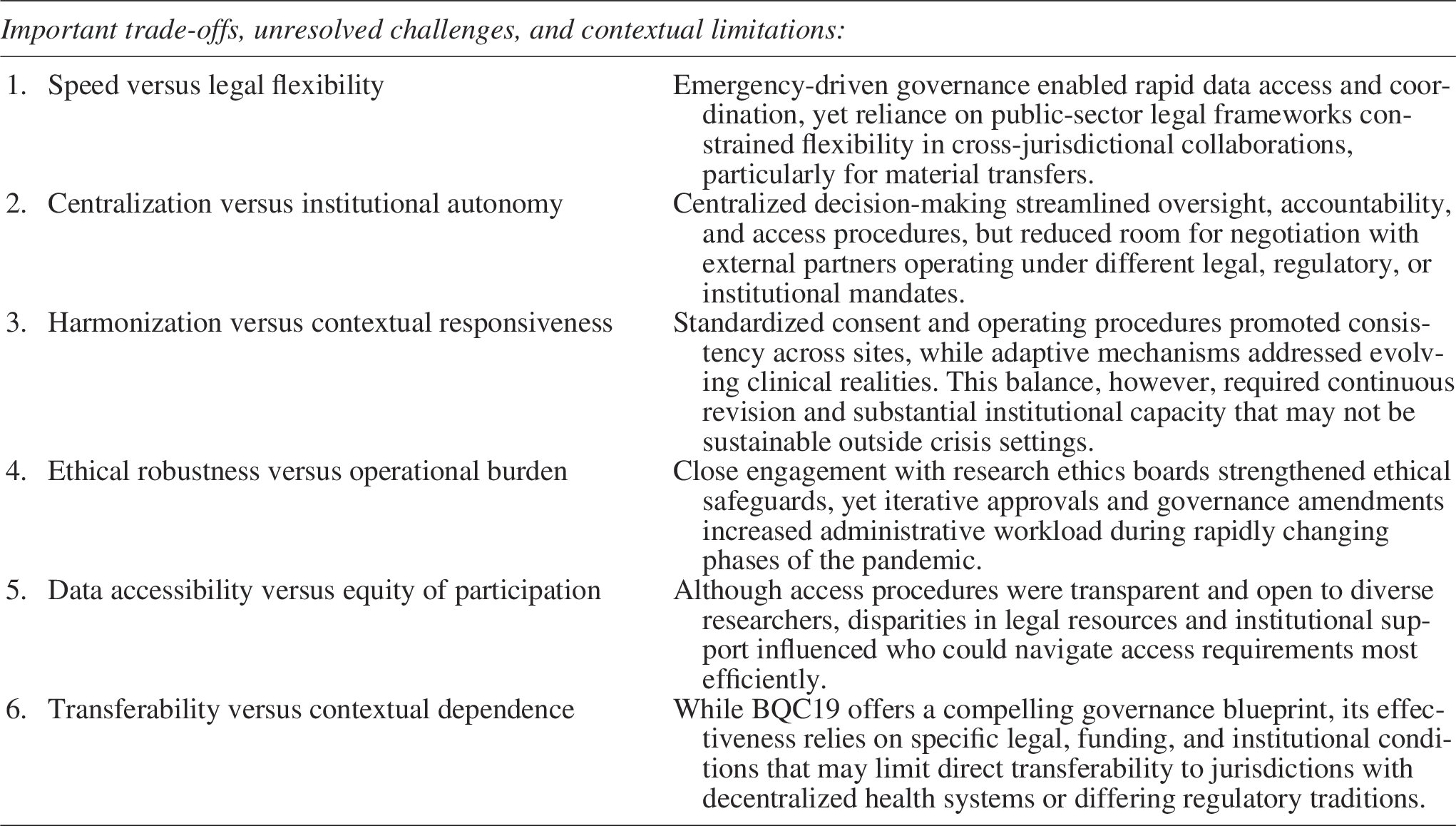
While the impact of the COVID-19 pandemic cannot be reversed, the lessons learned through BQC19’s operations can be swiftly leveraged in situations where time is of the essence and urgent action is imperative. Though preventing future pandemics entirely may be challenging, we can respond more effectively by employing the tools and strategies honed through BQC19, ensuring a faster and more efficient response. These insights, distilled into key considerations, stand ready for reference within the BQC19 initiative or any comparable efforts should the need arise.
Key considerations
Transferability of Core Infrastructures to Other Threats to Health
BQC19’s governance and infrastructure were intentionally designed for adaptability, aligning with other large-scale COVID-19 biobanking initiatives in high-income settings, such as HostSeq in Canada and comparable national or consortium-based efforts in Europe and the United States. Like these initiatives, BQC19 benefited from pre-existing public funding structures, centralized health systems, and robust legal and regulatory capacity, which enabled rapid implementation of centralized data management, standardized operating procedures, tiered access models, and pre-negotiated legal agreements for data and material sharing. At the same time, these features reflect a high-income country governance context that may not translate seamlessly to low- and middle-income settings or jurisdictions with more fragmented health systems, limited legal infrastructure, or different data sovereignty priorities. While BQC19 offers valuable tools for preparedness—such as anticipatory governance, centralized oversight, and committee-based access review—its transferability depends on local institutional capacity, funding stability, and regulatory alignment. As such, BQC19 should be understood not as a universally replicable model but as a situated governance blueprint whose core principles may require adaptation to support equitable and context-sensitive responses to future health emergencies.
Footnotes

Authors’ Contributions
M.B.: Conceptualization, methodology, formal analysis, investigation, data curation, writing–—original draft, writing–—review and editing, visualization, and project administration. J.B., M.D., and S.R.: Resources, investigation, data curation, and writing–—review and editing. M.H.Z.: Conceptualization, methodology, supervision, resources, writing–—review and editing, validation, project administration, and funding acquisition.
Author Disclosure Statement
M.B. and M.H.Z. have no conflicts to disclose. J.B. is the coordinator of the BQC19. M.D. and S.R. are the lead researchers of the BQC19.
Funding Information
This work was made possible through the open sharing of data and samples from the Biobanque québécoise de la COVID-19, funded by the FRQS, Génome Québec, the PHAC, and, as of March 2022, the Ministère de la Santé et des Services sociaux du Québec (Quebec Ministry of Health and Social Services). M.H.Z. would also like to acknowledge the J2 Research Career Award of FRQS.