




Abstract

The Essentials of Biobanking (EOB) education course (https://www.isber.org/page/EssentialsBiobanking) was created by the Canadian Tissue Repository Network 1 and is offered in partnership with the International Society of Environmental and Biological Repositories (ISBER) through ISBER’s website. The course is online and self-paced and uses the ISBER Best Practices (BP) as the foundation for the curriculum. The last update to the course was in 2018.
At the end of 2023, ISBER updated their BP to version 5. This update involved significant restructuring with the incorporation of many new concepts. 2 We therefore initiated a project to review, update, and reorganize the EOB course in order to keep it aligned with the ISBER BP.
The EOB course is made up of nine modules. The first is an overview of biobanking, and the remaining eight modules provide more in-depth details on all aspects of biobanking (see Table 1). The ISBER BP are divided into 12 chapters A–L.
Essentials of Biobanking Module Titles and Their Corresponding International Society of Environmental and Biological Repositories Section Titles
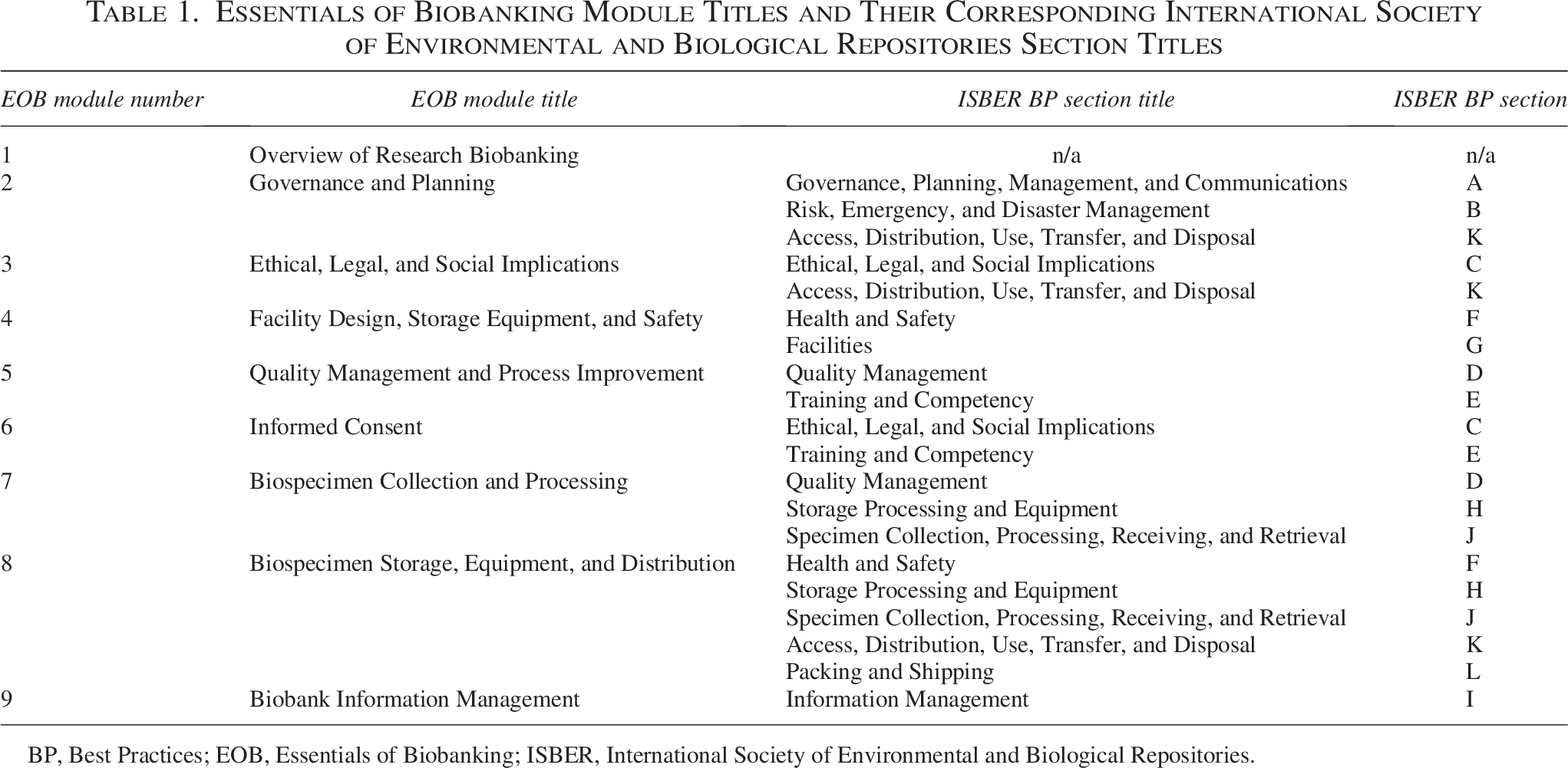
BP, Best Practices; EOB, Essentials of Biobanking; ISBER, International Society of Environmental and Biological Repositories.
The project began with review of the content of the EOB course modules and the ISBER BP chapters to determine the high-level relationship between the course and BP (Table 1). Five team members were then assigned ISBER BP sections as relevant to their biobanking expertise and asked to review the changes in the ISBER BP and to recommend the changes required to update the EOB. BP changes were categorized as critical, major, and minor, and a time estimate to update the EOB was also determined. All “critical” and “major” category changes and new text sections required in the EOB were discussed and refined through whole team review.
We found that no critical changes were required, and on average, 8 major changes and 11 minor changes were required per module. In addition to these text changes, graphics were updated. We also recruited experts from Australia, Germany, and the United States to review and update optional sections dedicated to country-specific content that are provided in some parts of the course to accommodate regional variations.
Our team has also done work on incorporating equity, diversity, and inclusion (EDI) principles into Canadian Biobank practices. 3 We used this experience to ensure that the EOB course reflected these EDI values. Finally, all links and references as well as the glossary and abbreviations were updated. Once all updates were completed, the new content was uploaded and verified on the server before live publication.
Completion of this project involved significant work and personnel time (a total of 2352 hours). This does not include additional time involved in translating and updating a French version of the EOB that is accessible in Canada, which is a bilingual country.
The course continues to be extensively accessed by biobankers through ISBER and is part of the recommended reading material for the ISBER Qualification in Biorepository Science course. It is therefore important to keep the course up to date. Since its inception in 2015, more than 750 individuals have completed the EOB course through ISBER’s website, with an average of 69 individuals per year (standard deviation [SD] = 19). An optional post-course survey focuses mostly on the user experience with the delivery format. Of 135 respondents, 88% indicated that it is better than or equivalent to any other online course they have taken, and 81% found that the quizzes and activities enhanced their learning. General comments about the course content are all positive.