



Abstract
The rise in demand for string teachers is a sign of support for string programs across the United States. Despite an increase in string teacher positions, there is growing concern regarding the lack of qualified string music education graduates to fill the vacancies, sometimes leading administrators to close programs. This study investigated the status of string teacher education programs in the United States. Participants for this study were degree-granting institutions (N = 636) accredited by the National Association of Schools of Music (NASM). The NASM directory listings and institution websites were examined to determine what type of degrees were offered, and presence of a full-time string music education faculty member. Results indicated that while most NASM-accredited institutions offer some type of undergraduate degree in music education, very few institutions (16%) were shown to have a full-time string music education specialist. Results also indicated a significant relationship between the size of school and likelihood of having a full-time string music education specialist, χ2 (7, N = 526) = 80.03, p < .001.
The status of string education in the United States has been well documented by music education researchers and provides important insights into demographic shifts, program presence, and estimated demand for future string educators (Gillespie, 2010; Gillespie & Hamann, 1997; Hamann, 2002; C. M. Smith, 1997; B. Smith et al., 2018). Research generally suggests that school string program enrollment, on a national level, has been increasing over the past 20 years (National String Project Consortium [NSPC], 2009; B. Smith et al., 2018). Many rightly interpret this upward trajectory as a positive indicator for the future stability of string music programs—clearly, there is a demand for string music programs in schools. Continued growth will be limited unless the demand for additional string programs is satisfied by a supply of additional string teachers to teach in new and growing programs. Consider, for example, that as existing string programs grow, some string teachers may find themselves transitioning from itinerant positions to working at a single school. For county school music coordinators and supervisors, this ultimately necessitates the hiring of additional string teachers to direct the programs that will no longer be served by the teacher who now finds themselves at a single school. Thus, demand for string music education must be correlated with demand for string music teachers, and there can be no growth without a supply of teachers to teach in new and growing programs (Hamann et al., 2002; B. Smith et al., 2018). In a White Paper released in 2009, the NSPC in conjunction with the American String Teachers’ Association (ASTA) estimated that by the year 2013, there would be a need for approximately 3,000 new string teachers in the United States. These concerns may lead to a vital question: Can the current professional pipeline supply the demand for new string teachers? The current body of research suggests not (Hamann et al., 2002; Kuehne & Harrison, 2016; Schimek, 2002).
Empirical evidence suggests that about 43% of posted string teacher positions went unfilled between 2000 and 2001 (Hamann et al., 2002). Faced with the pressure of programmatic demands coupled with a shortage of applicants with a strong string background, administrators may naturally consider alternative solutions (Hamann et al., 2002; NSPC, 2009; B. Smith et al., 2018). Alternatives include hiring nonstring player music teachers, collaborating with educator preparation programs to place string music education majors in the classroom with a qualified substitute teacher, or closing down the string program all together. Hamann et al. (2002) found that about 24% to 28% of the 57% of string positions that were filled between 2000 and 2001 were filled by nonstring primary specialists. Similarly, data collected by the NSPC (2009) suggests that about 50% of string job openings in the 2008 to 2009 school year were filled by teachers whose primary instrument was not a string instrument. Although music teachers who are not primarily string players can be effective in string classrooms, significant concerns for nonprimary string specialists include string performance techniques, confidence on the discipline, time to study the instrument family, and level-appropriate literature selection (Sckipp & Abeles, 2010).
An additional alternative for administrators struggling to fill a string position is to close the string program altogether (Schimek, 2002). The Oklahoma City Public School District serves as a valuable case study in this regard. The school system was intent on hiring string teachers, but when faced with a shortage of job candidates, the district began to consider closing the positions. Fortunately for the stakeholders, the district was able to partner with local universities to place advanced music education majors in the classroom with substitute teachers with the hope that the preservice teachers could be hired full-time upon graduation (Schimek, 2002). Of course, the reality is that many districts across the country lack the resources of the Oklahoma City Public Schools and continue to operate without an orchestra program (Ihas, 2019; Schmidt et al., 2006; Tast, 2014). Exacerbating the problem may be the lack of full-time, dedicated string music education faculty and subsequent lack of string-specific courses in music education curricula (Gillespie & Hamann, 1999; Lesniak, 2008).
Estimates suggest that about 757 string positions will be posted each year through 2020 (B. Smith et al., 2018). If recent history provides any indication of future hiring trends, then it seems likely that many of these positions will continue to be filled by educators whose primary instrument is outside of the string family, if they are filled at all. These trends and facts beg the following question: What factors are contributing to the shortage in qualified string music educators?
The need for qualified string music educators has led some researchers to examine recruiting trends targeting high school string players and current string music education majors. Lee and Swearingen (2003) found that of 84 string music education majors, 88.7% participated in school string programs. Multiple researchers have cited the encouragement from a music teacher to be influential in the decision-making process for the future music educator (Edgar, 2018; Lee & Swearingen, 2003; Madsen & Kelly, 2002). With limited string programs in schools, it is less likely that students will experience any encouragement to join the profession as a string music educator.
The music teacher shortage has been linked to a perceived lack of music teacher educators (Asmus, 2001; Teachout, 2004). It is no surprise that with fewer music teacher educators, there would also be recruiting and retention deficits in music education majors. Lee and Swearingen (2003) suggested that fewer than 30% of string music education majors were recruited by their university. Of those who were actively recruited, the primary contact from the university was the private instructor or the orchestra director, not a music education faculty member. Lee and Swearingen (2003) asked students to describe how different university faculty recruited them. Responses indicating encouragement from public school and private teachers appeared twice as often as responses indicating involvement with university faculty members.
In an effort to improve university recruiting practices within music education, Edgar (2018) explored perspectives of potential students, administrators, faculty members, and admission departments regarding recruiting processes. Findings from this study suggest that what works well is a custom-tailored recruitment process for each student, focused on the degree of choice and with an emphasis on interpersonal experiences on campus and with other music education majors and faculty members (Edgar, 2018). To create a personalized recruitment process for each student, the presence of a dedicated string music education faculty member would be valuable.
The role of an individual string faculty member is often split between multiple areas within a university (Lesniak, 2008). This split in duties may lead to scheduling limitations and challenges regarding recruiting and identity. There is some debate as to whether or not university string faculty members are aware of the string teacher shortage (Gillespie & Hamann, 1997; Lesniak, 2008). Greater awareness of the need for more string educators may improve recruiting practices, string education course offerings, and the hiring of experienced string music educators and faculty. Researchers agree that the lack of focus on string training found at the university level is reflected in the inability to fill string teaching positions in public schools (Gillespie & Hamann, 1999; Lesniak, 2008). Lesniak (2008) surveyed 94 university string professors and found that 60% of participants believed that music education programs are not taking enough action to remedy the string teacher shortage. Lesniak also found that 75% of participants were not satisfied with the quantity of string-specific courses available to students. It is possible that the limited availability of string-specific courses may be due in part to the limited supply of string music education faculty at universities. Lesniak (2008) expressed challenges with finding string music education/pedagogy faculty and noted that 80% of participants in the 2008 study were string performance professors as opposed to music education faculty.
The need to recruit more music educators has been an ongoing issue since the beginning of the new millennium. In the early 2000s, music education researchers expressed concern over an anticipated shortage of music teacher educators in the United States (Asmus, 2001; Teachout, 2004). Past MENC President: Willie L. Hill, Jr. (2003) also expressed concerns regarding the need to place music teachers “in every corner of our nation,” (p. 6). Hill (2003) goes so far as to call the teacher shortage a crisis that is “shortchanging our children” (p. 6). It is widely recognized that student decisions to major in music education are heavily influenced by school and private music teachers (Bergee & Demorest, 2003; Bright & Barry, 2005; Madsen & Kelly, 2002; McClellan, 2011; Rickels et al., 2010). Additional important factors regarding the decision to pursue music education as a career include talent for music, passion for teaching, and strong parental support (Bright, 2006; McClellan, 2011).
When potential “barrier factors” were examined, Teachout (2004) identified two potential factors as reasons qualified students chose to forgo pursuit of doctoral degree in music education. Those factors were “financial challenges” and “family/time considerations” (Teachout, 2004). Asmus (2001) described the potential music teacher educator shortage as the “single biggest threat to the health of music in our nation’s schools” (p. 4). When asked how to encourage future music educators, preservice music education majors suggested opportunities for teaching, a demonstration of job satisfaction, development of musical skills, and exposure to a variety of musical settings (Thornton & Bergee, 2008). McClellan (2014) found that enthusiasm about being a teacher, social identity as an educator, active involvement in teaching activities, and encouragement are primary factors of the self-concept in preservice music educators. Hill (2003) cited policy as the answer and reveals the implementation of various grants for professional development and teacher mentorship training programs (p. 6). Ammerman and Wuttke (2017) described the shortage of string-specific teachers as a cycle of attrition (p. 14). In this cycle, the lack of string teachers leads to unfilled string teaching positions, resulting in a decrease in string programs. The decrease in string programs naturally leads to fewer string players, which returns to the original issue of a lack of string teachers. A similar cycle can be applied to higher education, in which the scarcity of string teachers can be traced back to a paucity of string education graduates. Fewer string professors naturally lead to a deficit of string undergraduates and graduates, returning to a shortage of string programs (Chang, 2018; See Figure 1).
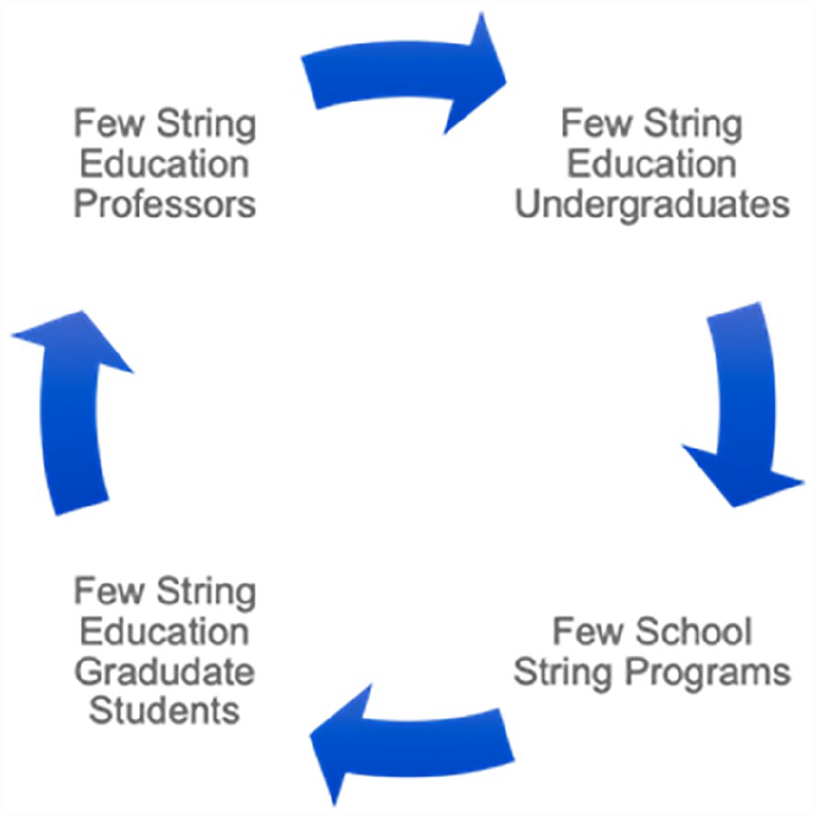
How the number of string teacher educators impacts the number of string teachers and school orchestra programs.
In 1969, Boney posed the question, “What are the colleges doing to educate string players so that they can teach?” (p. 63). The interactions between the university music faculty and potential students have a significant impact on the teacher identity of the preservice music teacher (Aróstegui & Louro, 2009; McClellan, 2014). However, examinations of string teacher education programs in the United States suggested uneven requirements in string teacher preparation programs, and that institutions in the North Central Division offered the greatest number of string education courses (C. M. Smith, 1995). McClellan (2014) found that music department culture, socialization, curriculum, and authentic teaching experiences contribute to music teacher identity. Zint (2002) found a significant relationship between self-efficacy, attitude, and subsequent behaviors. This would suggest that as a music education major’s self-efficacy improves and attitude becomes more favorable toward teaching strings, then so will their likelihood to follow through with the behavior of teaching strings as a career.
The purpose of this study was to investigate the status of string teacher education programs in the United States. Specifically, the aims of this study addressed the following questions: (a) How many institutions accredited by the National Association of Schools of Music (NASM) offer some type of undergraduate degree in music education? (b) How many of the aforementioned institutions have a full-time string music education specialist on their faculty? and (c) Is there a relationship between size of school and presence of a full-time string music education faculty member?
Method
Participants for this study were degree-granting institutions (N = 636) accredited by the NASM. For the purpose of this study, a “string music education specialist” was considered any full-time faculty member listed on the school website whose job title or biography referenced (a) string music education, (b) string music education and applied lessons, or (c) string music education and orchestra. To examine the presence of string education in higher education, the researchers first compiled a list of accredited institutions found in each state. Accredited nondegree-granting institutions (i.e., community music schools) were removed from the master list. The NASM directory listing of each institution was examined to determine whether the school offered some type of undergraduate music education degree. Following the examination of the NASM directory listings, the researchers then examined the website of each university to determine whether a designated full-time string music education professor was listed in their faculty directory. A professor was considered “full-time” if (a) the university directory noted full-time versus part-time/adjunct and (b) the professor was listed as lecturer, assistant professor, associate professor, or professor.
If the directory listings were ambiguous, the researchers read the biographies provided for each of the faculty members to determine whether string music education or K–12 school orchestra experience was included. If the website did not have any information listed, the researchers marked the school as an institution without a string music education faculty member. Institutions which placed advertisements for job vacancies for string music education positions on public forums such as ChronicleVitae or Higher Ed Jobs during the 2018 to 2019 academic school year were listed as having a designated string music education faculty member.
To establish reliability, an outside reviewer was used to check 174 schools. Each school was assigned an integer from 1 through 637. Random.org was then used to select which schools the reviewer would examine. Following the methodology used by the primary investigators, the outside reviewer first checked the NASM directory listing of each school to determine what type of degrees were offered. Second, the reviewer was asked to check the official website of each assigned school, to determine if there was a full-time string music education specialist on the faculty. Interjudge reliability was calculated by dividing the total number of agreements by the number of agreements plus disagreements and was found to be 94.9%, which was considered an acceptable percentage (Madsen & Madsen, 1998). Krippendorff’s alpha was calculated and found to be .78, indicating acceptable reviewer reliability.
Results
To address our first two research questions, results were calculated using sums and percentages. Approximately 84% (n = 533) of NASM-accredited schools examined (N = 636) offered an undergraduate degree in music education. Of the schools that offered degrees in music education (n = 533), approximately 16% (n = 87) of the schools were found to have a full-time string music education specialist on their faculty.
To address our third research question, the Carnegie Classification® (Carnegie Foundation for the Advancement of Teaching, 2011) of each institution was used to determine size of school (Table 1). A chi-square test of independence was used to determine whether there was a relationship between the size of institution and presence of a full-time string music education faculty member. Results showed the relationship between the variables was significant, χ2 (7, N = 526) = 80.03, p < .001. NASM schools classified as Mixed Baccalaureate/Associates (BA1, n = 2) were omitted because neither institution offered a degree in music education. NASM schools classified as Special Focus Four-Year: Arts, Music & Design Schools (SF47, n = 1), Special Focus Four-Year: Other Special Focus Institutions (SF49, n = 1), and Special Focus Four-Year: Faith-Related Institutions (SF41, n = 3) were omitted because of the small number of institutions in each category.
Carnegie Classification Key.

Discussion
Music education researchers have predicted that the number of school strings and orchestra programs in the United States will continue on an upward trajectory (B. Smith et al., 2018). However, researchers found that approximately half of the available public school string teacher positions in 2008 to 2009 were filled by teachers whose primary field was not strings (NSPC, 2009). Previous research attributes the music teacher shortage in the United States to a lack of music teacher educators (Asmus, 2001; Teachout, 2004). Therefore, the purpose of this study was to examine the status of string teacher education programs in the United States. We found that while most NASM-accredited institutions offer some type of undergraduate degree in music education, very few (approximately 16%) were found to have a full-time string education professor on the faculty. Larger universities were more likely to have a full-time string education faculty member when compared with smaller institutions (Figure 2). During the process of data collection for this study, we found several interesting trends among schools beyond the scope of this study that may warrant future investigation.

School size and presence of string music education specialists.
In searching websites for full-time string music education faculty members, we noticed some schools did not have a string education faculty member but did have a National String Project that was run by an applied strings faculty member. We also found that some schools did not have a string music education faculty member but did have a Suzuki pedagogy professor. Future studies are needed to examine how these programs and positions support the string music education majors at their respective universities. Do these programs and positions prepare the students in the same way a string music education specialist prepares students to teach in the schools? Do these programs and positions exist to provide additional teaching and pedagogy experience to the string music education majors to supplement the instruction of the string music education majors in lieu of having a full-time string music education specialist on the faculty?
Due to the large number of institutions offering degrees in music education, yet small number of universities with a full-time string music education faculty member, further research is also needed to determine what the string education curriculum looks like in each institution. At schools that do not have a string music education specialist on the full-time faculty, who teaches the string methods and string techniques courses? Does the person teaching string methods have K–12 heterogenous teaching experience? Further research could also explore what strategies are being implemented by string education faculty members to recruit string music education students.
There were several limitations to this study. The most significant limitation was that our data collection relied on the NASM directory and school websites. In some instances, university websites were outdated or had links that were inoperable. In addition, some university directories did not have faculty biographies or titles; therefore, their positions were unable to be determined. This study also did not examine schools that were not accredited by NASM. Future studies could expand upon the current list by including schools accredited by other agencies. Data collection for this study occurred during the 2018 to 2019 academic year; therefore, new positions added or eliminated for 2019 to 2020 were not accounted for in our totals.
Scholars have stressed the importance of string teacher education for the health and survival of school string and orchestra programs since the 1960s (Boney, 1969; Shepard, 1964). However, the overwhelming majority of NASM-accredited institutions that offer a music education degree do not have a full-time string education faculty member. This could be due to the number of positions in the department. Smaller schools have fewer faculty and, therefore, are less likely to have specialized positions. According to Pugh (1973), “No school that gives degrees to string majors should consider itself small enough to be exempt from the need for offering pedagogy courses” (p. 11).
Gillespie and Hamann (1999) suggested that string teachers should be “teaching role models” for their students to attract more people to string music education. Therefore, one item that should be examined in future research is the relationship between the presence of a full-time string music education specialist on the faculty and the number of string music education majors. How can smaller schools meet the needs of their string music education majors? As our colleagues in higher education retire or leave the profession, how can those of us in the field continue to advocate for the presence of string music education faculty at other universities?
Footnotes
Correction (September 2024):
Article updated to add reference details for Hamann 2002 and correct reference details for Hamann et al., 2002 in the reference section.
Declaration of Conflicting Interests
The author(s) declared no potential conflicts of interest with respect to the research, authorship, and/or publication of this article.
Funding
The author(s) received no financial support for the research, authorship, and/or publication of this article.
Authors’ Note
This manuscript has not been published previously in part or in whole and that it is not under consideration by any other source.
