




Abstract
Some individuals in long-term marriages report intensities of romantic love comparable to individuals newly in love. How common is this? Are correlates of long-term romantic love consistent with theoretical models of love? In a random sample of 274 U.S. married individuals, 40% of those married over 10 years reported being “Very intensely in love.” Importantly, correlates of long-term intense love, as predicted by theory, were thinking positively about the partner and thinking about the partner when apart, affectionate behaviors and sexual intercourse, shared novel and challenging activities, and general life happiness. Wanting to know where the partner is at all times correlated significantly with intense love for men but not women. For women, but not men, passion about nonrelationship factors significantly correlated with intense love. In a random New York (NY) sample of 322 individuals married over 10 years, 29% reported being very intensely in love and our predicted correlates cross validated.
It is commonly assumed that intense romantic love occurs in the early stages of a romantic relationship, but decreases drastically across time. Some theorists have proposed that romantic love is uncommon in marriage (e.g., Sternberg, 1986) or has little use after the child-rearing years (e.g., Buss, 1989). Others suggest that given the right circumstances it may evolve into companionate love—low in intensity and generally devoid of attraction and sexual desire (e.g., Berscheid & Hatfield, 1969). More recently, some theorists proposed adaptive reasons for romantic love to endure. For example, Buss (2006) proposed that love emerges in the context of long-term mating and functions to signal long-term commitment, ensuring individuals will stay with their partners. Fisher (2006) posited that romantic love generally fades over time, but that some couples manage to maintain it because it enhances physical and mental vitality and provides companionship and optimism for older individuals.
Despite arguments that intense love may exist in some long-term relationships, there are minimal data to address this issue. Cuber and Haroff (1965) interviewed a convenience sample of 500 Americans in marriages of 10 years or more, and they distinguished between “intrinsic” couples (20%) who continued to enjoy deep, intimate, and affectionate connections and “utilitarian” couples (80%) who maintained bonds for other reasons than to experience deep involvement with their spouse. Tennov (1979) reported descriptions of happy marriages among older couples who reported being in love and who talked about shared interests, leisure activities, ability to work together, pleasurable sexual experiences, and general contentment. However, they did not report continuous and unwanted intrusive thinking common among those experiencing infatuation. Acevedo and Aron (2009) found that in a New York (NY) convenience sample married an average of 8.39 years, 13% reported the highest ratings on nonobsessive type items on the Passionate Love Scale (PLS; Hatfield & Sprecher, 1986). Thus, based on prior research, we expected that at least 10–15% of long-term married individuals would report intense love.
Although research with convenience samples suggests romantic love can last in long-term relationships, it remains unknown if it is merely a rare phenomenon. As Hatfield, Pillemer, O’Brien, and Le (2008) noted, we know little about love and gender differences in love in long-term marriage. Thus, the present study assessed, for the first time, the prevalence and theoretically predicted correlates of intense love in two representative samples of long-term married individuals.
We predicted that some key variables would be linked with intense love, even controlling for general relationship satisfaction, based on (a) the conceptualization of intense romantic love involving intensity, physical desire, and engagement, but not involving obsession (Acevedo & Aron, 2009), (b) the self-expansion model which posits that love is enhanced by engaging in joint activities that are novel and challenging (Aron & Aron, 1986), and (c) findings from functional magnetic resonance imaging (fMRI) studies of romantic love, which have found significant reward system activations (Acevedo, Aron, Fisher, & Brown, 2011; Ortigue, Bianchi-Demicheli, Patel, Frum, & Lewis, 2010). The focal variables we examined were physical desire (sex and affection), engagement (thinking positively about and doing things with the partner), and obsession. We also examined general life happiness, which we expected to show a unique relation to love over and above relationship satisfaction, and general life passion, an exploratory variable.
Physical Desire
Survey studies provide some support for sex and intense love being significantly correlated in long-term relationships. In an online study, women reported “love” as among the top 3 of 13 reasons for engaging in sexual intercourse (Meston, Hamilton, & Harte, 2009). In a study of older Greek adults, “still being in-love with a partner” significantly correlated with sexual interest and behaviors (Papaharitou et al., 2008). However, these studies were not representative and they did not assess love directly.
Engagement
Positive cognitions
Individuals in new relationships develop idealized images of their partners, exaggerating their strengths and downplaying their flaws (Murray, Holmes, & Griffin, 1996). In nonrepresentative samples, positive illusions were associated with love and relationship satisfaction in new marriages and dating couples (Miller, Caughlin, & Huston, 2003; Murray & Holmes, 1997). Weiss (1980) described a phenomenon called “sentiment override” to help explain why individuals in highly satisfactory relationships appear to recall more positive events than may have actually occurred. Indeed, in an experiment, individuals in dating relationships described as satisfying, compared to individuals in less satisfactory relationships, were more likely to recall positive descriptors of their partner they had seen presented (Jose, Rajaram, O’Leary, & Williams, 2010). Similarly, dissatisfied (vs. happily) married partners were more likely to recall negative words describing their partner (Whisman & Delinsky, 2002).
Shared activities
It has long been known that individuals who spend time together engaging in activities such as cooking, sports, and intellectual pursuits tend to report they are happy in their marriage. In fact, engaging in outside activities together and working together on a project are items on Spanier’s (1976) Dyadic Adjustment Scale. Further, the Marital Satisfaction Inventory (MSI; Snyder, 1997) contains a Time Together Scale. In a large community sample, this scale correlated .64 with MSI Global Satisfaction, and highly differentiated community couples from couples in therapy.
According to the self-expansion model, love is enhanced when couples engage in shared novel and challenging activities. Indeed, laboratory (Aron, Norman, Aron, McKenna, & Heyman, 2000) and field experiments (Reissman, Aron, & Bergen, 1993) with convenience samples show that engaging in such shared activities caused significant increases in both love and marital quality.
Obsession
Some studies with nonrepresentative samples suggest that one important distinction between early-stage and long-term romantic love is less obsession and anxiety in long-term love (Acevedo & Aron, 2009; Tennov, 1979). However, the level of obsession about a partner may be underestimated in long-term relationships because the measures used for it were developed for new relationships, and thus did not assess the kind of obsession that might exist in long-term relationships. Thus, we aimed to examine this issue in representative samples using measures appropriate for long-term marriages.
General Life Happiness and Passion
Several studies suggest that love is an important predictor of happiness, positive emotions, and life satisfaction (e.g., Diener & Lucas, 2000; Kim & Hatfield, 2004). For example, Aron and Henkemeyer (1995), using a convenience sample of long-term couples, found significant positive correlations of love with global happiness. However, because previous studies have used nonrepresentative samples, individuals experiencing low relationship satisfaction or low general happiness, but intense love, may have been underrepresented, and the pattern could be quite different in a representative sample.
We also examined for the first time in a representative sample the association of intense love [for spouse] with passion (getting “fired up”) for life matters (e.g., politics, career, sports, environment). The fMRI research examining both passion for a partner and general passion (e.g., for hobbies) suggests the two share some common reward circuitry (Ortigue, Bianchi-Demicheli, Hamilton, & Grafton, 2007)
Summary of Study Goals
In sum, the present research examined for the first time the prevalence and key theoretically relevant correlates of intense romantic love in representative samples of long-term married individuals. Study 1, a nationally representative U.S. sample, assessed the prevalence and key correlates of intense love. In addition, we conducted partial correlations to evaluate the extent to which key predictors of intense love remained significant after controlling for relationship happiness. Finally, we conducted two specific exploratory analyses of interest: (a) A moderation testing whether the association of intense love with physical affection and sexual intercourse would be stronger for couples with low levels of relationship satisfaction (because the physical aspect of the relationship would be especially salient) and (b) conditional probability analyses of the percentage of individuals reporting intense love but reporting no physical affection.
Study 2, with NY State residents, replicated and extended Study 1, employing the love and general relationship happiness items from Study 1, plus 3 items assessing physical desire, engagement, and obsession that were behavior-focused to minimize opportunities for memory distortions or other response biases and which had been used in previous love research. Study 2 also provided the opportunity to counterbalance the order of response options to the intense love item to assess whether answers were biased by positive response options appearing first in Study 1.
Study 1: Nationally Representative Sample
A random-digit dialing (RDD) survey was conducted (August 5, 2007 to September 9, 2007) to contact individuals 18 years and older, across the United States. Only married individuals are included in the analyses.
Method
Participants
Out of those with whom we spoke, approximately 40% agreed to participate. Of the 529 respondents who started the interview, 500 completed the survey. Of these, 274 (119 women) were married and completed the marriage section. Average length of completed surveys was 10 min. There were no monetary incentives for participation. Demographic factors were as follows: Women’s mean relationship length, 21.40 years (range 1–62); men, 20.23 (1–62); mean age: women = 46.06 years; range 20–84; men = 48.47, 22–93; modal family income: women = $35,000–59,999, range: <$20,000 to >$150,000; men = $80,000–99,999, range <$20,000 to >$150,000); education/highest grade obtained: women: modal: high school graduate; range ninth grade to master’s degree; men: modal: high school graduate; range fourth grade to master’s degree; ethnicity: women: White 90%, Black 3%, Hispanic 3%, Asian 4%, and Other 0%; Men’s respective origins: 73%, 9%, 3%, 9%, 4%, and 2%.
Procedure
Respondents were told “We are conducting a survey of Americans regarding their views on retirement issues and people’s relationships. To be sure we obtain an accurate cross section of local residents, we need to speak to the person in your household who is 18 years of age or older, and had the most recent birthday. Is that you?” Once selected, respondents were told that the survey was funded by the State University of New York at Stony Brook, that their telephone was dialed by a random process, and that all answers would be kept confidential.
The questions were read to the respondents and they were to answer each only after all options for that question were given, with most questions having several options. For example, the central question about intense love was as follows:
How in love are you with your partner? Very intensely in love Intensely in love Very in love In love Somewhat in love A little in love Not at all in love
We employed a global item for intense love for two reasons. First, and most important, existing widely used measures of romantic love (e.g., PLS, Love Attitudes Scale) are based on theoretical conceptualizations of newly in-love individuals. Second, it is specifically the subjective sense of being intensely in love that was our focus, not the prevalence or correlates of a set of hypothetically underlying variables that might or might not correspond to what people experience as intense love and might or might not overlap with other related constructs.
The sample was weighted to conform to the 2007 American Community Survey conducted by the U.S. Census Bureau. Following standard procedures, weighting was conducted by a raking procedure on the basis of gender, age, race, and education, and thus the weighted sample closely matches the demographics of the United States.
Results
Prevalence of very intense love
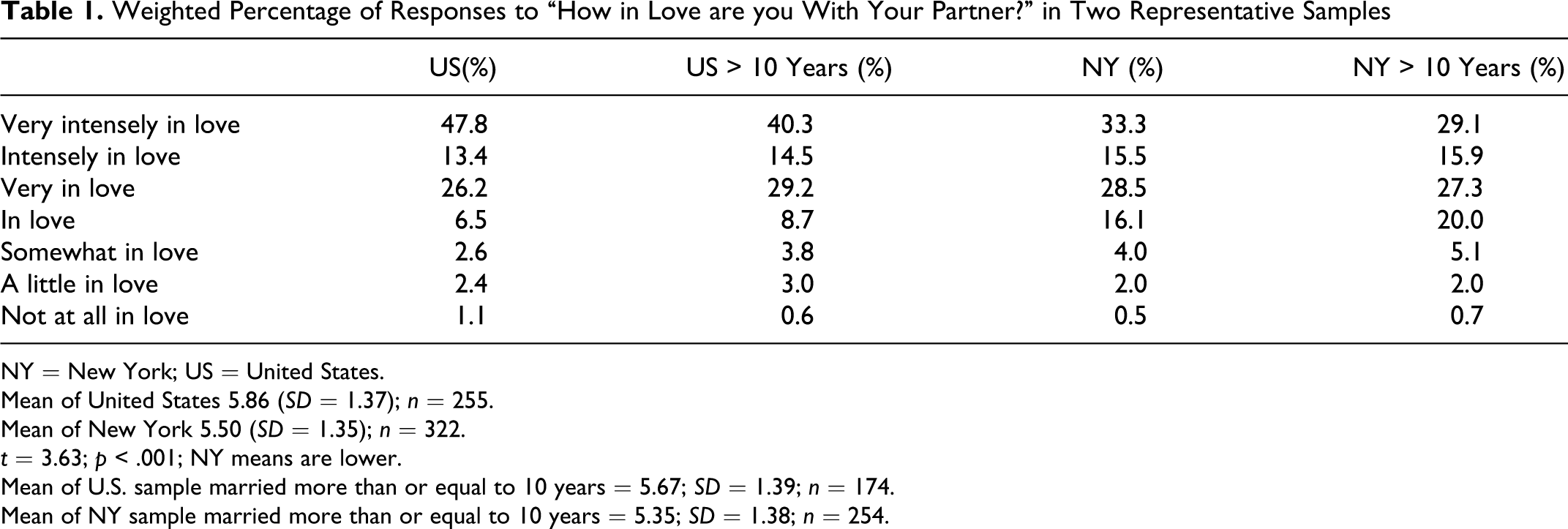
Unexpectedly, when asked how in love they are with their partner, the most frequent response was “Very Intensely in Love;” Women 46.3%; Men: 49.0%. Since the gender differences were not significant, percentages are combined in Table 1. Notably, even for the very longest marriages (≥ 30 years), 40% of women and 35% of men reported being very intensely in love. When relationship length was divided into four groups (<10 years, 10–19 years, 20–29 years, 30+ years), there were differences across the groups, F(3, 249) = 3.81, p = .011. Bonferroni comparisons showed that marriages <10 years had higher levels of love than marriages of 10–19 years (p = .015), but mean levels were not different across the other groups (see Figure 1).
Weighted Percentage of Responses to “How in Love are you With Your Partner?” in Two Representative Samples
NY = New York; US = United States.
Mean of United States 5.86 (SD = 1.37); n = 255.
Mean of New York 5.50 (SD = 1.35); n = 322.
t = 3.63; p < .001; NY means are lower.
Mean of U.S. sample married more than or equal to 10 years = 5.67; SD = 1.39; n = 174.
Mean of NY sample married more than or equal to 10 years = 5.35; SD = 1.38; n = 254.

Intensity of being in love on a scale of 1 (Not at all in love) to 7 (Very intensely in love) with one’s spouse by relationship length (Study 1, representative U.S. sample).
Zero-order general correlations
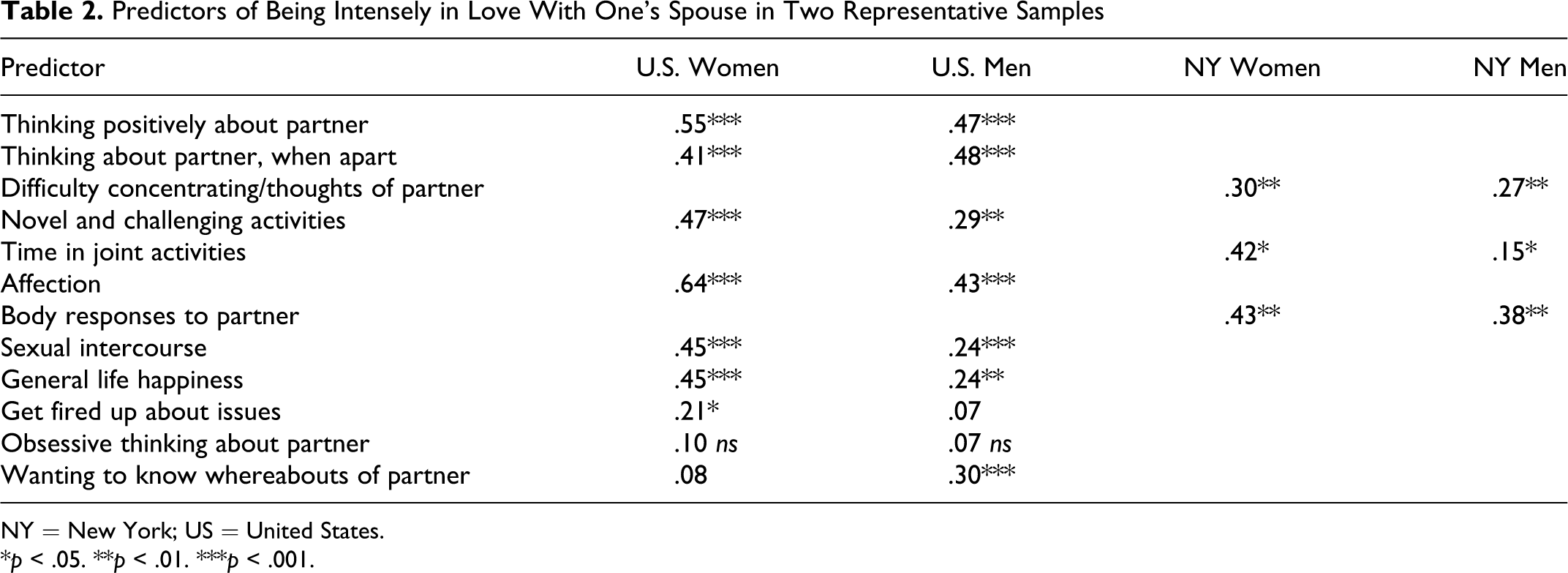
Thinking about the partner in positive ways and how often they thought about the partner when not together were two of the strongest predictors of intense love (See Table 2). Affection (hugging, kissing), frequency of intercourse, doing novel things together, and general life happiness were also significantly related to reports of intense love. Wanting to know whereabouts of the partner was significantly associated with intense love for men but not women; getting “fired up” about issues with intense love, for women but not men.
Predictors of Being Intensely in Love With One’s Spouse in Two Representative Samples
NY = New York; US = United States.
*p < .05.
**p < .01.
***p < .001.
Two demographic variables had small but significant associations with intense love, age (−0.19) and relationship length (−0.15). Education and income were not significantly correlated with intense love.
Love and general relationship happiness were very strongly, but far from perfectly correlated (r = .80 for women; r = .50 for men; difference: Z = 4.30, p < .001).
Partial correlations
Since relationship happiness had a stronger association with intense love for wives, correlations of intense love controlling for relationship happiness are presented separately for wives and husbands. As seen in Table 3, there were fewer significant associations for wives, not surprisingly given that relationship happiness and intense love had stronger associations for women. Two of the seven first-order significant correlations for men no longer remained significant controlling for relationship happiness—happiness with life in general and intercourse frequency. One nonsignificant correlation became negatively significant controlling for relationship happiness—getting fired up about issues. For women, three of the seven significant first-order correlations were not significant controlling for relationship happiness—doing novel things with partner, intercourse frequency, and getting fired up about issues.
Predictors of Being Intensely in Love With One’s Spouse in Two Representative Samples, Controlling for General Relationship Happiness

NY = New York.
*p < .05.
**p < .01.
***p <.001.
Interaction of association of intense love and physical desire by level of relationship satisfaction
Standard scores were obtained for a combined measure of affection and sexual intercourse which in turn were related to marital satisfaction. This measure of affection and intercourse (physical desire) was positively associated with intense love at both low and high levels of marital satisfaction but the association was strongest under condition of low satisfaction (interaction β = −234; p < .025). In short, physical desire and love are most clearly associated when marital satisfaction is low.
Conditional probability analyses
No intercourse but intense love? There were 25 individuals (9% of the total sample) who reported not having any intercourse in the past month. Of these 25, 6 (24%) reported being very intensely in love; these 6 ranged in age from 48 to 84 (Mean = 64.16).
No hugs, intense love?
Only 10 individuals (4% of the total sample) reported that there was no physical affection (hugging, kissing, holding hands). Of these 10, not a single individual reported being very intensely in love.
Study 2: NY State Sample
Method
To replicate and extend Study 1, we surveyed a sample of NY residents (October 14, 2009 to November 24, 2009) using a list-assisted RDD method, employing the selection procedures used in Study 1. A total of 807 interviews were conducted in the general population of NY. Of these, 396 were married and included in the analyses reported below. Results were weighted on gender, age, educational attainment, race, ethnicity, and living location in NY state.
To address the issue of question order, a random half of the married respondents were asked the question about intensity of love with the first option being “Very intensely in love,” and the last option, “Not at all in love”; the other random half had the first option “Not at all in love,” and the last option, “Very intensely in love.”
Results
There were no significant or near significant differences between mean ratings of intensity of love related to the question order.
Overall, 33.3% of respondents indicated that they were intensely in love. Means were lower in the NY sample (Mean = 5.50; SD = 1.37) than in the national sample (5.86; 1.35), t = 3.16; p < .001. Thus, using our national sample, we compared respondents from the Northeast with three other U.S. regions (South, Midwest, and West). As expected based on previous studies of general happiness ratings of NY and other Northeast states compared to other areas of the country (Oswald & Wu, 2010), in our data, ratings of intense love were lower in the Northeast than in the remaining regions, t(253) = 1.74, p = .04.
In our NY sample, as in Study 1, relationship length had a small negative correlation with love intensity (r = −.11; p = .034), but age was not significant (r = −.09). Replicating Study 1, in the NY sample, there was also a significant difference in love intensity when relationship length was divided into four decade groups, F(3, 317) = 5.08; p = .002. Bonferroni comparisons showed that individuals married <10 years had higher levels of love than those in the other three relationship groups (ps < .05), but mean levels of love were not different across the other groups. Also as was true for the U.S. sample, the marital happiness with love-intensity correlation was stronger for women (r = .77) than men (r = .48), Z = 4.35, p < .001.
To assess the extent to which engaging in three types of behavior measuring our three key theoretical variables were related to ratings of intensity of love, respondents were asked to indicate “how true each of the following statements is:” (using a 6-point Likert-type scale from Definitely true to Not at all true). I spend time almost every day with my partner in pleasant activities like cooking together, watching TV, or walking together. I sense my body responding when my partner touches me. I sometimes find it difficult to concentrate because thoughts of my partner occupy my mind.
As seen in Table 2, all three types of behavior significantly correlated with ratings of intensity of love both for women and men. As reflected in Table 3, when relationship happiness was controlled, the correlations dropped markedly for women, given the very strong correlation between relationship happiness and intense love. Only body responses remained significant for women whereas all three types of behavior remained significantly correlated for men.
Discussion
A substantially larger percentage of married individuals reported being intensely in love with their partners than predicted. In the national sample, even among those in marriages of 30 years or more, 40% of wives and 35% of husbands reported very intense love for their partner. In the NY sample married 30 years or more, 19% of wives and 29% of husbands reported being very intensely in love. The NY sample’s lower percentage is consistent with research on general happiness in the United States, showing that NY and Northeastern states disproportionately report the lowest happiness ratings (Oswald & Wu, 2010).
The higher than expected prevalence of intense love may have been due in part to a social desirability response set and a belief that one should be intensely in love with a partner. However, controlling for social desirability in reports of constructs like marital satisfaction is debatable, as has long been noted by Murstein and Beck (1972) who found that social desirability corrections did not influence the pattern of results they obtained regarding person perception and marital adjustment. Further, there are a number of studies showing that social desirability and marital satisfaction have small correlations as exemplified by Hansen (1981) who reported correlations of .24 for men and .22 for women. With correlations of that magnitude, statistical adjustments for social desirability will be minor. Indeed, Aron and Henkemeyer (1995) in a convenience sample of 100 married individuals found that the associations of passionate love with items like relationship excitement, kissing, shared activities remained significant after controlling for social desirability, and the changes in effect size were negligible. Finally, Study 2 showed that question order did not affect the ratings of intense love, suggesting that the high incidence was not due to a response bias due to which option was presented first.
The percentages of individuals who reported being intensely in love raise concerns that self-reported intense love is inflated because of the presence of an interviewer (Aquilino 1994; Currivan, Nyman, Turner, & Biener, 2004; Villarroel et al., 2006). While there may be a modest increase in self-reported estimates of intense love due to having a phone interviewer, that possible increase seems far less of a problem than estimates regarding prevalence of intense love based on convenience samples. Further, our national sample had ratings of marital happiness that were similar but even lower than in another national sample. In a National Survey of Families and Households, Donnelly (1993) found that the mean 1–7 rating of marital satisfaction was 5.90 for women (SD = 1.35) and 5.95 for men (SD = 1.31). The mean 7-point rating of marital happiness in our national study was 5.68 for women and 5.73 for men.
There was a stronger association for women than men of marital happiness intensity of love in both the national and the NY sample, and the absolute magnitude of the associations was almost identical across the two samples. This greater association for women may be due to women’s well demonstrated typically greater life centrality of relationships. Such differential associations provide some rationale for the greater reductions in the association of intense love and other variables for women. Nonetheless, even for women, intense love reflects more than overall happiness in a relationship. The ratings of intense love had valid and predicted associations with reports of thoughts and behaviors in two randomly recruited samples. Further, the patterns across the two samples showed consistency in that affection in the form of hugs (national sample) and physical responding (NY sample) had moderate to strong correlations with intense love; range 0.43–0.63). In addition, the cognitive variables regarding thoughts about the partner also were significantly associated with intense love in both the national and NY sample range 0.28–0.55. Finally, engaging in novel and challenging activities together (national sample) or joint activities (NY sample) was more strongly associated with being intensely in love for women than men in both samples. More specifically, the correlation of intense love with engaging in joint activities in the NY sample for women was .42 and for men it was .15, Z = 2.63, p < .01. The correlation of intense love and engaging in novel activities in the national sample was .47 for women and .29 for men, Z = 1.64, p = .05.
As shown above, the use of a single Likert-type scale in-love item with seven options read to the respondents in phone surveys showed consistent patterns across two samples. Further, we assessed the extent to which an almost identical single-item in-love measure [“On a scale from 0 (not at all) to 10 (extremely), how in love are you with your partner?] related to the 15-item short form of Hatfield and Sprecher’s (1986) PLS, the most widely used measure of romantic love, in a sample of undergraduates from one of our labs of whom 63 were in committed relationships of 12 months or longer. A little less than half (45%) gave a rating of 10. Five PLS items had correlations with the single in-love item of .60 or greater (all p < .0001): “I will love <> forever” (r = .85); “<> can make me feel effervescent and bubbly” (.77);” I possess a powerful attraction for <>” (.64); “I have an endless appetite for affection from <>” (.62); and “An existence without <> would be dark and dismal” (.60). Further, the 1-item Likert-type scale in-love assessment had an overall correlation with the 15-item PLS of .75, p < .000001.
A major strength of the present research is the random sampling of U.S. and NY respondents, including individuals with a wide range of family incomes, educational backgrounds, and ethnicities. The national sample herein included married individuals from ages 20 to 93, and we were able to examine for the first time whether intense love was reported in individuals who do not report any intercourse in the past year. That was the case for 24% of that group, and, as expected, the average age of those individuals was over 60 years. Of the individuals who reported no physical affection, not a single individual reported being intensely in love. Thus, some individuals, especially older individuals can feel intensely in love without intercourse in the past month, but a sine qua non for intense love to exist appears to be frequent affection.
Outside the marital relationship, general life happiness was predictive of reports of being intensely in love for both women and men in the national sample. This is consistent with research showing strong links between marital quality and well-being (e.g., Coan, Schaefer, & Davidson, 2006; Kiecolt-Glaser et al., 2005). Similarly, low-quality marital bonds are associated with depression (Beach & O’Leary, 1993), poor health outcomes (Kiecolt-Glaser & Newton, 2001), and marital dissolution (e.g., Huston, Niehuis, & Smith, 2001).
Physical desire/affection interacted with level of marital satisfaction in that there was a stronger association of physical desire/affection and reports of intense love for individuals with lower levels of marital satisfaction. In our experience, couples with marital problems sometimes report excellent sexual interactions and strong feelings of love but at the same time they may have very significant problems in other areas of their marriage (differences over child discipline, money, and how they each spend individual time). Thus, their overall level of marital satisfaction would not be particularly high. However, the physical desire/affection can be a key factor on which they can focus and have strong positive feelings.
The generalizability of the present findings beyond the United States would seem to be a clearly important direction for future research. Studies of convenience samples in diverse cultures have found differences in the relation of love with other variables (e.g., Kim & Hatfield, 2004), so that it is possible that the incidence and correlates of long-term intense love when studied with representative samples may well differ in important ways across cultures.
Nevertheless, the present study is the first research endeavor to formally and randomly sample individuals in any cultural context to assess the prevalence and correlates of intense love. Further, at least in the U.S. context, this knowledge may be helpful to practitioners in guiding them to set expectations about the possibility of intense love in long-term marriages. However, as has been shown by Huston (2009) in a longitudinal study of marriage across the first 14 years, couples can have long-lasting marriages without being deeply in love. The data herein also show that about half the couples married more than 10 years or more do not rate themselves as being “very intensely in love” or “intensely in love.” Nonetheless, our findings provide a scientific basis for the development of a conceptualization of long-term intense love by showing factors associated with love, such as thinking about one’s partner in positive ways, engaging in novel and challenging activities together, and engaging in affectionate behaviors and sexual intercourse.
Footnotes
The author(s) declared no potential conflicts of interest with respect to the research, authorship, and/or publication of this article.
The author(s) disclosed receipt of the following financial support for the research, authorship, and/or publication of this article: This research was supported in part by a Provost’s Research Award at Stony Brook University.