



Abstract
Does the extent to which people are smiling in their Facebook photos predict future life satisfaction? In two longitudinal studies, the authors showed that smile intensity coded from a single Facebook profile photograph from male and female participants’ first semester at college was a robust predictor of self-reported life satisfaction 3.5 years later—as they were about to graduate from college. Controlling for first-semester life satisfaction, the authors also determined that smile intensity was a unique predictor of changes in life satisfaction over time. In addition, the authors demonstrated that the results were not due to extraversion or to sex differences in smile intensity. Finally, the authors showed that participants who exhibited a more intense smile in their Facebook photo had better social relationships during their first semester at college and that the association between smile intensity and life satisfaction 3.5 years later was partially mediated by first-semester social relationships satisfaction.
The expression of positive affect captured in a photograph can convey surprisingly rich information about people’s long-term well-being. Harker and Keltner (2001) garnered much attention, for example, by showing that the intensity with which female students were smiling in their college graduation yearbook photos (in 1958 and 1960) was correlated with self-reported life satisfaction up to 30 years later. More recently, Hertenstein, Hansel, Butts, and Hile (2009) found that intensity of smiling in photos taken before the age of 22 was negatively correlated with likelihood of divorce later in life. Abel and Kruger (2010) also coded smile intensity in archival photographs of early career professional baseball players; those who displayed an intense smile in their photos lived an average of 7 years longer than players who displayed minimal smiling.
Although such findings are highly intriguing, at this point, it is still unclear why smile intensity in photographs predicts future well-being. Further, in the decade that has passed since their novel findings were published, Harker and Keltner’s (2001) work predicting future self-reported life satisfaction from smile intensity in (formal) photographs has yet to be replicated or extended—even in shorter duration studies. In fact, the only published attempt (Freese, Meland, & Irwin, 2007) failed to replicate the findings using high school graduation yearbook photos. Given that Harker and Keltner’s participants were female, questions also remain as to whether their findings would be likely to replicate with male participants. Past research has shown, for example, that women tend to smile more intensely than men (e.g., LaFrance, Hecht, & Paluck, 2003).
We conducted the present research with two main goals in mind. First, we aimed to examine whether the intensity of smiling in men and women’s Facebook profile photos (which are typically informal in pose) would predict future subjective well-being—just as formal photos did in the previous research. Second, and more importantly, we sought to take steps toward clarifying why intensity of smiling in a photo at one point in time might predict later subjective well-being. One possibility is that smile intensity predicts life satisfaction because it reflects the relatively stable personality trait of extraversion, which is associated with both life satisfaction (Diener, Oishi, & Lucas, 2003) and smiling (Naumann, Vazire, Rentfrow, & Gosling, 2009). That is, extraversion might be the third variable responsible for the association between smile intensity and long-term life satisfaction. A second possibility is that people who smile more intensely in their “public” photos (e.g., on Facebook) may have more satisfying social relationships. Past research has shown, for example, that smiling in a photo signals interpersonal warmth, friendliness, and other desirable attributes (Back et al., 2010; Naumann et al., 2009; Vazire & Gosling, 2004). People who display more positive affect may therefore have an easier time of forming and maintaining satisfying social relationships. Because positive relationships are also associated with life satisfaction (Diener & Seligman, 2002), intensity of smiling in publicly shared photographs might lead to higher levels of life satisfaction via positive social relationships.
To our knowledge, the current research is the first to test these possible mechanisms (i.e., personality and social relationships) linking smile intensity at one point in time with future self-reported life satisfaction. In order to do this, we conducted two longitudinal studies in which we tracked female and male students beginning in their first semester of college until their final semester—just before graduation. We coded the intensity with which participants were smiling in their first-semester Facebook profile photos and used this variable to predict self-reported life satisfaction in the final semester at college 3.5 years later.
Study 1 Method
Participants
Participants were required to be first-year students (in fall 2005) in the participant pool at University of Virginia and to have at least one Facebook profile photograph that could be retrieved and coded for smile intensity. A total of 92 participants (35 male) met these criteria and were invited to complete the follow-up measures given 3.5 years later (in their last semester at college). The final sample consisted of 48 participants (20 male). We compared those who completed the follow-up study with those who dropped out after Time 2; we found no differences in life satisfaction, extraversion, or social relationships satisfaction, |t|s < .77, ps > .44. 1
Materials
Time 1 (beginning of first semester at college). Participants completed an assessment of extraversion (Brody & Ehrlinchman, 1997) as part of the departmental pretesting session.
Time 2 (end of first semester). Participants completed the Satisfaction with Life Scale (SWLS; Diener, Emmons, Larsen, & Griffin, 1985). They also rated social relationships satisfaction in the following domains: friendships, family relationships, and social relationships in general (1 = extremely dissatisfied to 7 = extremely satisfied).
Time 3 (end of final semester; Spring 2009). Participants again completed the SWLS.
Procedure for coding the expression of positive affect in photographs
After participants completed the Time 2 measures, we retrieved and saved their most recent Facebook profile photo—which is the largest and most “public” photo displayed on the site. In the majority of cases, participants’ photos had been made public on Facebook prior to completion of the Time 2 self-report measures. Only photos containing a clear (and “non-jokey”) shot of the participants’ face were deemed suitable for coding. 2 In the small number of cases in which the current profile photo could not be coded, we used the next (most recent) codable profile photo (which are archived by Facebook in order of upload date).
Because we wished to replicate and extend their past findings, we adopted the coding procedure used by Harker and Keltner (2001). This involves coding the intensity of action in the two muscle action units (AUs) associated with smiling. The first, AU6 (orbicularis oculi), elicits raised cheeks and squinting. The second, AU12 (zygomatic major), causes smiling via raising the corners of the mouth. Each AU was coded using an intensity scale that ranged from 1 (minimal) to 5 (maximum). The two scores were added together in order to create a continuous score for smile intensity (which could range from 2 to 10). Photos were coded by the first author and two other trained research assistants (α = .88). We calculated the final smile intensity score by taking the mean of the three coders’ ratings.
Results and Discussion
In line with past research on sex differences in smiling, women (M = 8.41, SD = 1.28) did smile more intensely than men (M = 7.04, SD = 2.27), t(46) = 2.68, p = .01, d = .74. However, sex did not moderate any of the analyses reported here. All results are thus reported using the full coed sample.
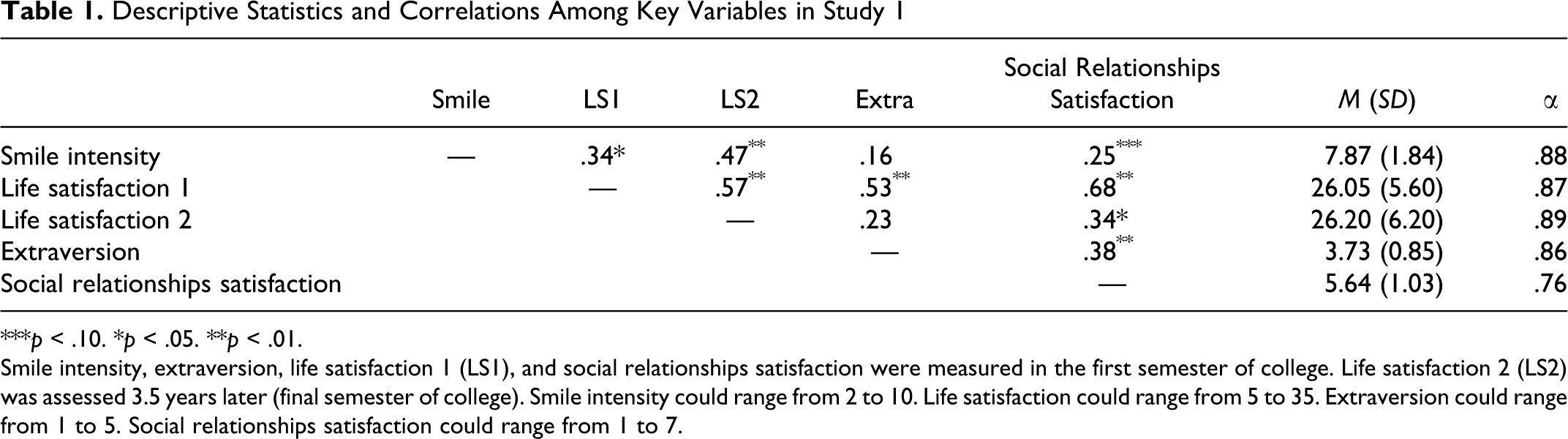
Table 1 shows the descriptive statistics and the correlations among the key variables. As seen in Table 1, participants who displayed a more intense smile in their first-semester Facebook profile photo were also more satisfied with their lives during that semester than those who displayed a less intense smile. More importantly, smile intensity predicted self-reported life satisfaction at the end of college—3.5 years later, r(46) = .47, p < .01. We were, in other words, able to replicate the basic predictive relationship reported by Harker and Keltner (2001) in their all-female samples.
Descriptive Statistics and Correlations Among Key Variables in Study 1
**p < .10.
*p < .05.
**p < .01.
Smile intensity, extraversion, life satisfaction 1 (LS1), and social relationships satisfaction were measured in the first semester of college. Life satisfaction 2 (LS2) was assessed 3.5 years later (final semester of college). Smile intensity could range from 2 to 10. Life satisfaction could range from 5 to 35. Extraversion could range from 1 to 5. Social relationships satisfaction could range from 1 to 7.
We also examined whether changes in self-reported life satisfaction from the first year to the fourth year would be predicted by smile intensity. This was important to assess in part because the past research reported only simple correlations between smile intensity and self-reported life satisfaction at each future time point. Controlling for first-semester life satisfaction, smile intensity in the Facebook profile photos still predicted life satisfaction measured 3.5 years later, β = .32, t(45) = 2.60, p < .05, ΔR2 = .089, f 2 = .098. Thus, we were able to extend the past research in a second novel way by determining that intensity of smiling in the first-semester profile photo was also a unique predictor of changes in self-reported life satisfaction over time.
Next, we tested whether the longitudinal association between smile intensity and life satisfaction would be due to the third variable of extraversion. As seen in Table 1, smile intensity in the profile photos was not significantly correlated with self-reported extraversion. If the longitudinal association between first-semester smile intensity and final-semester life satisfaction was due to extraversion, then inclusion of extraversion in the regression model should reduce the association to zero. However, smile intensity in the Facebook profile photos remained a significant predictor of life satisfaction at the end of college, controlling for extraversion, β = .40, t(40) = 2.81, p < .01, ΔR 2 = .156, f 2 = .185. In short, we found no evidence for the extraversion-as-third-variable account of the longitudinal association between smile intensity and later life satisfaction.
Finally, we examined a second possible mechanism, namely, whether smile intensity in the Facebook profile photos would predict the quality of participants’ end-of-first-semester social relationships satisfaction, which in turn would predict life satisfaction 3.5 years later. As seen in Table 1, smile intensity did predict satisfaction with social relationships. In addition, satisfaction with social relationships was positively associated with final-semester life satisfaction. We next tested whether satisfaction with social relationships would mediate the longitudinal link between first-semester smile intensity and life satisfaction at the end of college. To do this, we used Mplus 4.21’s (Muthén & Muthén, 2007) bias-corrected bootstrap method (number of bootstrap set to 5,000, as recommended by Preacher & Hayes, 2008). The model indicated the presence of partial mediation, indirect effect = .10 (95% confidence interval [CI] = [.02, .42]), z = 1.66, p = .10. Thus, first-semester social relationships satisfaction did appear to be an important link between smile intensity and future self-reported life satisfaction.
In sum, our longitudinal study using the Facebook profile photos of college students replicated—for the first time and with contemporary male and female participants—Harker and Keltner’s (2001) earlier findings which used the formal graduation yearbook photos of female college students (class of 1958 and 1960) to predict future self-reported life satisfaction. One issue not addressed in the past research was that the longitudinal association between smile intensity at one point and life satisfaction at a later time might be explained by the possibility that both variables are indicators of a general latent factor of well-being. In order to eliminate this general well-being account, we felt that it was critical to determine whether the longitudinal association would exist even when life satisfaction at the first assessment is statistically controlled. In the current research, we demonstrated for the first time that smile intensity in the public photo did indeed predict future life satisfaction even after controlling for life satisfaction reported in the first semester at college. In other words, first-semester smile intensity predicted not only the level of life satisfaction 3.5 years later but also the change in participants’ life satisfaction from the first to the final semester at college.
In addition, we found no evidence that extraversion (which is typically correlated with well-being) was responsible for the longitudinal association between smile intensity in the photos and future life satisfaction. Finally, we found preliminary support for the idea that participants who exhibited a more intense smile in their Facebook profile photo had better social relationships during their first semester at college, and that the association between smile intensity and life satisfaction 3.5 years later was partially mediated by first-semester social relationships satisfaction.
When interpreting the present findings, however, it is important to acknowledge several limitations. First, although the participants in our study appeared to be rather typical of their university cohort, the size of our final sample was modest. Second, our participants had the distinction of being a somewhat unique group—they were members of the very first cohort of college freshmen (in fall 2005) to make use of Facebook when it became available at most U.S. colleges. Why might that matter? By the following calendar year, the number of Facebook users more than doubled (from 5.5 million to in excess of 12 million); during that time, the site also became available to non-academic users, and many new features intended to increase ease of content sharing were added (Facebook.com, 2010). Thus, because the participants in Study 1 were early adopters of Facebook, it is plausible that they could be quite different from subsequent Facebook users in terms of display norms in their profile photos or other measured or unmeasured variables. Combined with the fact that this study was (to our knowledge) the first to successfully replicate and expand upon Harker and Keltner’s (2001) groundbreaking work, we felt that it was important to replicate these findings in another sample. Additionally, the lack of correlation between smile intensity and extraversion seemed a bit surprising, given the documented positive relationship between smiling and perceived extraversion in past research (Naumann et al., 2009). 3 Thus, this matter also appeared to warrant further investigation. To address each of these concerns, we conducted a second longitudinal study with a cohort of male and female university students who began in fall 2006, when Facebook enrollment and usage had greatly increased.
Study 2 Method
Participants
Participants were required to be first-year students in the participant pool at University of Virginia (in Fall 2006) and to have at least one Facebook profile photograph that could be retrieved and coded for smile intensity. A total of 49 participants (17 male) met these criteria and were invited to complete the follow-up measures given 3.5 years later (when they were in their last semester at college). 4 The final sample consisted of 36 participants (13 male). As with Study 1, no differences were found for life satisfaction, extraversion, or social relationships satisfaction between those who completed all three phases of the study and those who dropped out after Time 2, |t|s < .701, ps > .489. 5
Procedure and Materials
The procedure and materials were largely identical to those used for Study 1. However, participants in Study 2 completed a different measure of extraversion (Gosling, Rentfrow, & Swann, 2003; possible range of 1–6) at Time 1 (the department-wide pretest). The procedures used for coding the photographs were identical to those used in Study 1. Once again, interrater reliability was high (α = .96).
Results and Discussion
As in Study 1, women (M = 7.86, SD = 2.13) smiled more intensely than men (M = 6.10, SD = 2.80), t(34) = 2.12, p = .042, d = .71. For a second time, however, sex did not moderate any of our analyses. All results are therefore reported using the full coed sample.
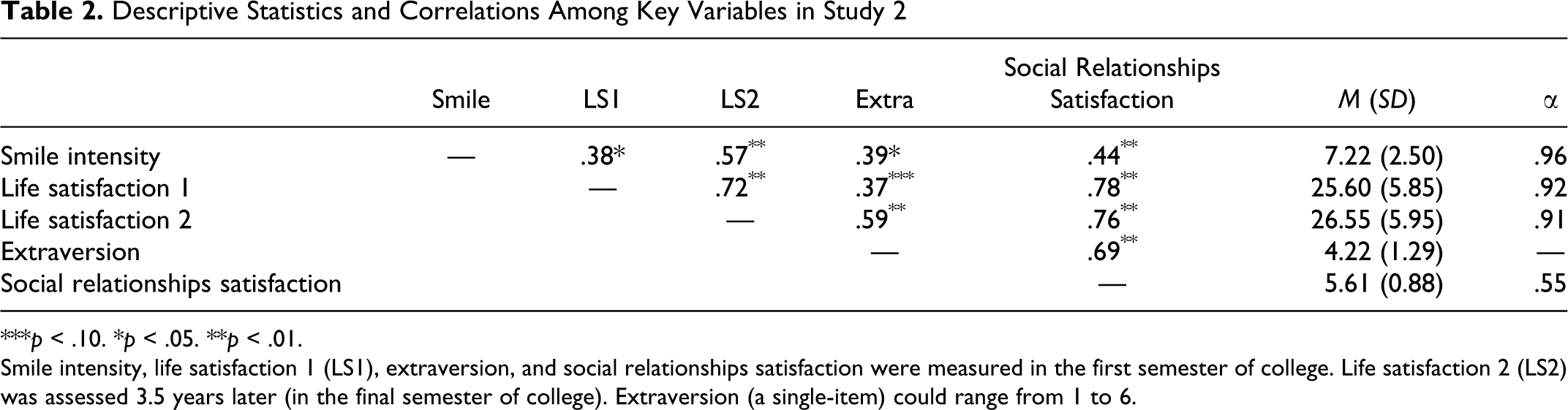
Table 2 shows the descriptive statistics and the correlations among the key variables. Replicating Study 1, participants who displayed a more intense smile in their first-semester Facebook profile photo were more satisfied with their lives during that first semester. More importantly, they were also more satisfied with their lives in their final semester at college, r(34) = .57, p < .01. Thus, we again replicated the basic Harker and Keltner effect. In addition, smile intensity predicted self-reported life satisfaction 3.5 years later even when controlling for first-semester life satisfaction, β = .35, t(33) = 3.02, p < .01, ΔR 2 = .104, f 2 = .116. For a second time, then, we were able to show that smile intensity was also a unique predictor of changes in self-reported life satisfaction over time.
Descriptive Statistics and Correlations Among Key Variables in Study 2
***p < .10.
*p < .05.
**p < .01.
Smile intensity, life satisfaction 1 (LS1), extraversion, and social relationships satisfaction were measured in the first semester of college. Life satisfaction 2 (LS2) was assessed 3.5 years later (in the final semester of college). Extraversion (a single-item) could range from 1 to 6.
In contrast with the results of Study 1, smile intensity was significantly correlated with extraversion (see Table 2). However, first-semester smile intensity still predicted life satisfaction in the final semester of college controlling for extraversion, β = .44, t(23) = 2.83, p < .01, ΔR 2 = .167, f 2 = .200. Thus, we were again able to conclude—and with greater confidence given the use of a different measure of extraversion—that the longitudinal association between smile intensity and life satisfaction 3.5 years later was not due to the third variable of extraversion.
Next, we tested whether participants who displayed a more intense smile in their Facebook photo were also more satisfied with their first-semester social relationships. As in Study 1, this was indeed the case (see Table 2). Additionally, first-semester satisfaction with social relationships predicted life satisfaction in the final semester of college. Both smile intensity and social relationships satisfaction, then, were unique predictors of future well-being. We conducted a mediation analysis, again using Mplus 4.21’s (Muthén & Muthén, 2007) bias corrected bootstrap method. In a more decisive showing than the results of Study 1, satisfaction with social relationships mediated the longitudinal association between smile intensity and life satisfaction, indirect effect = .13 (95% CI = [.03, .28]), z = 2.51, p < .05.
In sum, we were able to replicate each of the main findings from Study 1 in our second cohort of male and female students—who entered college a year later (in fall 2006) when Facebook usage had more than doubled. In addition, we addressed the lack of (expected) correlation between extraversion and smile intensity in the first study using a different measure of extraversion. Although extraversion scores were correlated with smile intensity in the current study, smile intensity again remained a unique predictor of future life satisfaction controlling for extraversion. Building on the results of Study 1, in this cohort we also found that first-semester satisfaction with social relationships mediated the longitudinal association between smile intensity and life satisfaction.
Combined Mediation Analysis
Because the sample size in our two studies was relatively small for mediation analysis, it could have produced a biased estimate (Fritz & MacKinnon, 2007). Therefore, we repeated the mediation analysis, this time with the combined data from Studies 1 and 2 (n = 84). As seen in Figure 1 , smile intensity in the first-semester Facebook profile photo predicted the quality of social relationships, which in turn predicted life satisfaction at the end of college, indirect effect = .08 (95% CI = [.02, .16]), z = 2.32, p < .05. Thus, we can conclude with greater certainty that the longitudinal association between smile intensity and life satisfaction was partially mediated by the quality of participants’ first-semester social relationships.

The direct longitudinal association between smile intensity in the first-semester Facebook profile photo and life satisfaction at the end of college, and the mediation analysis of the combined Studies 1 and 2 data. Note. Numbers indicate standardized regression coefficients.
General Discussion
We began by testing the possibility that the intensity with which college students were smiling in their first-semester Facebook profile photos would predict future self-reported life satisfaction—just as formal photos did in past research. In two longitudinal studies (the first of which consisted of early adopters of Facebook), we found that female and male participants who displayed a more intense smile in their first-semester profile photo were indeed more satisfied with their lives during that first semester at college—and, more importantly, 3.5 years later as they were about to graduate from college. In addition, the latter finding held even when we controlled for first-semester life satisfaction. Thus, we were able to replicate (for the first time) the work of Harker and Keltner (2001) in two coed samples, and extend it in another key way by showing that smile intensity also predicted changes in self-reported well-being over time.
We next set out to take steps toward clarifying why smile intensity might predict future self-reported well-being. First, we examined the possibility that the longitudinal association between smile intensity and life satisfaction would be explained by extraversion. This seemed plausible in that extraversion is typically correlated with well-being. Using two different measures of extraversion, however, we found no evidence for this third variable account.
Because relationships are positively associated with long-term well-being, we also sought to determine whether the link between smile intensity and future life satisfaction might be explained by the quality of participants’ social relationships. In our two studies, participants who displayed a more intense smile in their first-semester Facebook profile photos were indeed more satisfied with their social relationships during that time period. Defying simple explanation, however, smile intensity and social relationships satisfaction were both shown to be unique predictors of life satisfaction at the end of college. By using the combined data from our two studies in order to maximize statistical power, we found that the link between smile intensity and future life satisfaction was partially mediated by first-semester social relationships satisfaction. This provides us with the first-ever evidence of a complex causal link between these variables. Because the mediation was partial and our design was limited, however, we are left with far more questions than answers about the meaning of these particular results. Future research is thus required in order to determine the specific social/relationship processes at play. But which processes seem most worthy of consideration?
First, it is plausible that an intense smile displayed in a Facebook profile photo (especially in a college context) indicates that people will be likely to act similarly in “real life.” If so, those who tend to display more positive affect may seem more friendship-worthy and approachable. This type of “smile-as-approach-signal” strategy could prove to be especially beneficial when people are new to a social environment (e.g., in the first semester of college). Some past research has shown, for example, that smiling individuals are perceived by strangers to be more extraverted, agreeable, conscientious, open, and emotionally stable (Naumann et al., 2009; Table 3).
Second, those who display more positive affect during interactions may be likely to elicit similar responses in others. To the extent that people value those who give them reason to smile, individuals who tend to smile intensely may be more sought-after as interaction partners. Just as positive emotions build good relationships (Waugh & Fredrickson, 2006), then, a more intense display of positive affect in the context of social interactions may play an active role in helping to solidify people’s relationships over time and give rise to higher levels of life satisfaction.
Before drawing any conclusions, however, it is important to recognize several limitations of the current research. First, as noted, our design prevented us from being able to identify why relationship quality partially mediated the link between smile intensity and later life satisfaction. The two processes detailed above need to be tested in the future. Second, a robust relationship between people’s affective displays in photographs and their real-world display behaviors has been predicted (e.g., Keltner, 2004) but has yet to be proven. More research is thus needed on this important (and likely complex) variable. Third, although we found no evidence for the extraversion-as-third-variable account, we did so via use of two brief measures of extraversion. Use of extended self-report measures will be beneficial in future research, as a specific facet of extraversion could prove to be a key third variable underlying the association between smile intensity and future life satisfaction. Fourth, because of the temporal sequence of our measurement (i.e., photos were posted to Facebook before the Time 2 self-report measures were completed), we did not test the reverse mediation model (social relationships → smile intensity → future life satisfaction). Conceptually speaking, however, it is possible that having good social relationships gives people more reason to smile intensely—on Facebook and in real life—which in turn gives rise to higher levels of life satisfaction over time. Clearly, it is important to test various alternative models of smile intensity and well-being in the future.
Taken as a whole, the current research represents a sizable (and long overdue) step forward in the quest to understand whether and why affective displays in publicly shared photographs can predict future well-being. Because this program of research is still relatively “young,” numerous other important questions seem warranted. Will our findings extend to other college students in the United States? More importantly, will they extend to older (or younger) Americans—and to cultural contexts in which a smile is not always prized (e.g., China)? Might different types of smiles (Niedenthal, Merillod, Maringer, & Hess, 2010) and variability in smile intensity across different contexts (e.g., informal vs. formal photos and solo vs. social photos) relate to well-being differently?
Additionally, some recent research has shown that observers can, with surprising accuracy, judge the extent to which people are extraverted or agreeable (Vazire & Gosling, 2004) or narcissistic (Buffardi & Campbell, 2008) just by viewing the content of their online profiles (e.g., on Facebook). Do such findings suggest that untrained observers might also be able to infer people’s (current or future) well-being or social relationships satisfaction just by looking at the extent to which they are smiling in a photo (or photos)? Given that many people consult social networking websites in order to “screen” (for worse or for better) prospective friends, dates, and colleagues, the latter question is certainly worthy of investigation.
In times prior to the advent of the Internet in the late 1990s, most college students had at least one thing in common with the women in Harker and Keltner’s (2001) study: A single, formal graduation yearbook photo was likely to be the only public photographic record of their time in college. The participants in our two studies, however, were members of the first two national cohorts of college students who were able and willing to document the entirety of their college years (and beyond) via photos and other content posted to the social networking website Facebook. Hundreds of millions of people around the world (of all ages) are now following that lead in their own lives. In combination with the promising results of our two studies, the latter development suggests that there has never been a better time than the present for researchers to learn what subtle affective displays—such as the intensity with which people are smiling in photos posted to Facebook—might reveal about longitudinal well-being in different populations and cultures.
Footnotes
Acknowledgments
The authors would like to thank Jonathan Haidt, James E. Burroughs, Gerald Clore, and Amori Yee Mikami for their invaluable comments on earlier versions of our article.
The author(s) declared no potential conflicts of interest with respect to the research, authorship, and/or publication of this article.
The author(s) received no financial support for the research, authorship, and/or publication of this article.