



Abstract
Research has shown that self-affirmation often leads to more adaptive responses to messages that focus on behavior-specific, individual threats. However, little is known about the effects of self-affirmation in the context of an ongoing collective threat, such as climate change. In the study reported here (N = 90), the authors examined whether self-affirmation might polarize orientations toward environment-related actions when people rely on their established beliefs about climate change. The authors found that self-affirmation led to more constructive pro-environmental motives among participants with positive ecological worldviews but led to less constructive pro-environmental motives among participants with negative ecological worldviews. These findings suggest that in the absence of a persuasive threatening message, self-affirmation might serve to validate a person’s initial worldviews about environmental issues.
Research has repeatedly shown that people strive to maintain a positive image of the self, and are motivated to protect this image whenever it is threatened (e.g., Sherman & Cohen, 2006). In daily life it is impossible to avoid encounters with self-threats, which can include information that challenges cherished beliefs, scientific results pointing out health risks, performance evaluations, personality feedback, and so on. People often respond defensively by avoiding, dismissing, or denying a threat in order to maintain a sense of self-worth, thereby depriving themselves of the opportunity to learn from potentially useful information (Kunda, 1987; Lord, Ross, & Lepper, 1979). According to self-affirmation theory, this defensiveness can be reduced through affirming a valued aspect of the self (Steele, 1988). It suggests that reflecting on important personal values affirms a sense of self-integrity, which in turn provides a buffer to self-threats and enables individuals to respond to self-threats in a more open and adaptive manner.
As a result of the focus of self-affirmation theory on the responses to information that threatens self-integrity, the majority of research tends to examine self-affirmation effects using a threatening persuasive message. Self-affirmation has been shown to produce a range of beneficial effects in these persuasive contexts, such as less defensive processing of threatening messages (Harris & Napper, 2005; Sherman, Nelson, & Steele, 2000), stronger intentions to adapt behavior (Harris & Napper, 2005; Sherman et al., 2000), and more openness to self-improvement (Crocker, Niiya, & Mischkowski, 2008). In comparison, little is known about the effects of self-affirmation when people are not presented with explicit threatening information; that is, in situations where people need to rely on their existing cognitions about the topic at hand. In the present study, we aimed to extend self-affirmation research by investigating whether self-affirmation in the absence of a threatening persuasive message can lead to a validation of a person’s initial worldviews.
According to the self-validation hypothesis (Petty & Briñol, 2008; Petty, Briñol, & Tormala, 2002), one determinant of the extent of persuasion effects is the level of confidence that people have in their own thoughts, which in turn can increase both reliance on these thoughts to underpin opinions and beliefs in the validity of these judgments. Briñol, Petty, Gallardo, and DeMarree (2007) have shown that self-affirmation can enhance people’s self-confidence in their thoughts in a nonthreatening persuasive context: When people were affirmed after reading a persuasive message about a new consumer product, self-affirmation increased self-confidence in the validity of thoughts regarding the message. However, it has not been examined how affirming self-worth may influence responses to familiar threats in a nonpersuasive context. The present study will address this issue by focusing on the effects of self-affirmation on established beliefs about an ongoing environmental threat.
Surprisingly, research has only recently started to focus on the potential effectiveness of self-affirmation as an intervention device to influence pro-environmental motivation (Sparks, Jessop, Chapman, & Holmes, 2010). Despite scientific evidence about the human contribution to climate change and the catastrophic consequences humans are likely to face (Parry, Canziani, Palutikof, Van Der Linden, & Hanson, 2007), people often tend to deny or downplay climate change and respond defensively to information on this topic (Dickinson, 2009). Due to the urgency of these environmental problems, we believe that the application of self-affirmation theory to the psychology of climate change threats merits further research.
The persuasive messages that are presented in self-affirmation research often contain relatively new information about a behavior-specific, individual threat in order to test how self-affirmation may affect responses to these threats (for reviews, see Harris & Epton, 2010; Sherman & Cohen, 2006). However, these threats appear to be quite different from climate change, which can be considered to be a collective and pervasive threat that presents an intangible risk for most individuals. Most people in the western world possess a certain amount of background information about climate change and have heard about the dangers that climate change can bring (Reser & Swim, 2011). People are confronted with the severity of climate change and its consequences on a regular basis through the media, and have formed opinions about environmental problems that have become incorporated into their belief systems. Due to the established beliefs that people have about climate change and due to the nature of the threat that climate change poses, it is important to examine the effects of self-affirmation under conditions in which no explicit information is presented and where people have to access their prior beliefs about, and attitudes toward, environmental threats. In the present study, we examined whether existing ecological worldviews (in a nonpersuasive context) might moderate self-affirmation effects on people’s moral judgments of pro-environmental behavior, their perceptions of the effort required to reduce one’s carbon footprint, their self-efficacy with regard to pro-environmental behavior, and their intentions to carry out pro-environmental actions.
We propose that self-affirmation may polarize orientations toward environment-related actions. When people hold previously formed opinions on an issue and these opinions are not subjected to a persuasive message, self-affirmation might potentially serve to encourage people to trust their initial position; that is, to affirm their current worldviews. Thus, we hypothesized that self-affirmation can accentuate previously held ecological worldviews. This would produce more constructive pro-environmental responses among people with positive ecological worldviews, who are concerned about the environment and who believe that the natural environment is highly susceptible to human interference (Dunlap, Van Liere, Mertig, & Jones, 2000). In contrast, we expected that self-affirmation would lead to less constructive environmental responses among people who are less concerned about the environment and who are skeptical, for example, about the role of human intervention in climate change processes (i.e., among people with negative ecological worldviews).
Method
Participants
Ninety (76 female and 14 male) nonpsychology students at a U.K. university participated in this study. Their ages ranged from 18 to 48 years (M age = 22.32, SD = 5.81). Participants who completed the study were automatically included in a prize draw in which they had a chance of winning £100 (about $160).
Design and Procedure
Participants were invited by e-mail to participate in an online study that consisted of two questionnaires. The e-mail message included the link to the first questionnaire, which directed participants to a short pretest. In this pretest, ecological worldviews were assessed with the revised New Ecological Paradigm scale (Dunlap et al., 2000), which consisted of 15 items (e.g., Humans are severely abusing the environment, 1 = strongly disagree, 7 = strongly agree), α = .75.
To reduce possible effects of ecological worldview salience, a link to the second questionnaire of the study was sent to the participants 1 week after completion of the pretest. Participants were sequentially assigned to the affirmation or to the control condition.
Self-affirmation manipulation
A list containing nine values (e.g., honesty, kindness, loyalty) was presented to the participants in the affirmation condition (n = 43), which was adapted from Sherman, Nelson, and Steele (2000, study 2). Participants were asked to select the value that was most important to them, to write a short statement about why it was important to them and how they used the selected value in their everyday life. Participants in the control condition (n = 47) completed a task similar to that used by Cohen, Aronson, and Steele (2000, study 1), in which participants were asked to list everything that they had eaten or drunk in the previous 48 hours.
After the self-affirmation manipulation, participants completed the dependent measures. All responses were provided on Likert-type scales ranging from 1 (strongly disagree) to 7 (strongly agree); measures were constructed from the means of the constitutive items.
Moral judgment
Moral judgment about pro-environmental behavior was measured with 2 items: “It seems ethical to me to adjust one’s lifestyle in order to protect the earth” and “Trying to reduce your carbon footprint is the right thing to do,” r(88) = .73, p < .001.
Perceived effort to reduce carbon footprint
Five items were used to assess the perceived effort it would require to reduce one’s own carbon footprint (e.g., It would take much effort to reduce my carbon footprint), α = .88.
Self-efficacy
Five items (adapted from Van Zomeren, Spears, & Leach, 2010) assessed self-efficacy with regard to pro-environmental behavior (e.g., There are simple things I can do that contribute to preventing the negative consequences of climate change), α = .90.
Pro-environmental intentions
Six items were used to measure intentions to increase pro-environmental behavior (e.g., I intend to reduce my carbon footprint from now on), α = .98.
Results
Two-step hierarchical regression analyses were performed to examine the effects of self-affirmation (1 = affirmation vs. 0 = control), ecological worldviews (as a mean-centered continuous variable), and the two-way interaction on each outcome measure. The moderating effects of ecological worldviews were probed further by conducting separate regression analyses for the affirmation and the control conditions, and by comparing the effects of self-affirmation separately for positive ecological worldview participants and negative ecological worldview participants (assessed at 1 SD above and below the mean, as recommended by Aiken & West, 1991).
Moral Judgment
The analysis of moral judgment yielded a significant interaction between self-affirmation and ecological worldviews, β = .32, t = 2.65, p = .01 (see Figure 1). Ecological worldviews were a significant predictor of moral judgment in the affirmation condition, β = .55, t = 4.21, p < .001. There was no significant effect of ecological worldviews in the control condition, β = .18, t = 1.20, p = .24. As predicted, negative ecological worldview participants reported less pro-environmental moral judgments about lifestyle change in the affirmation condition than in the control condition, β = –.31, t = –2.22, p = .03. The effect of self-affirmation on moral judgments for positive ecological worldview participants did not reach statistical significance, β = .23, t = 1.61, p = .11; however, participants with very positive ecological worldviews (1.5 SD above the mean) reported significantly more pro-environmental moral judgments in the affirmation condition than in the control condition, β = .36, t = 1.99, p = .05.
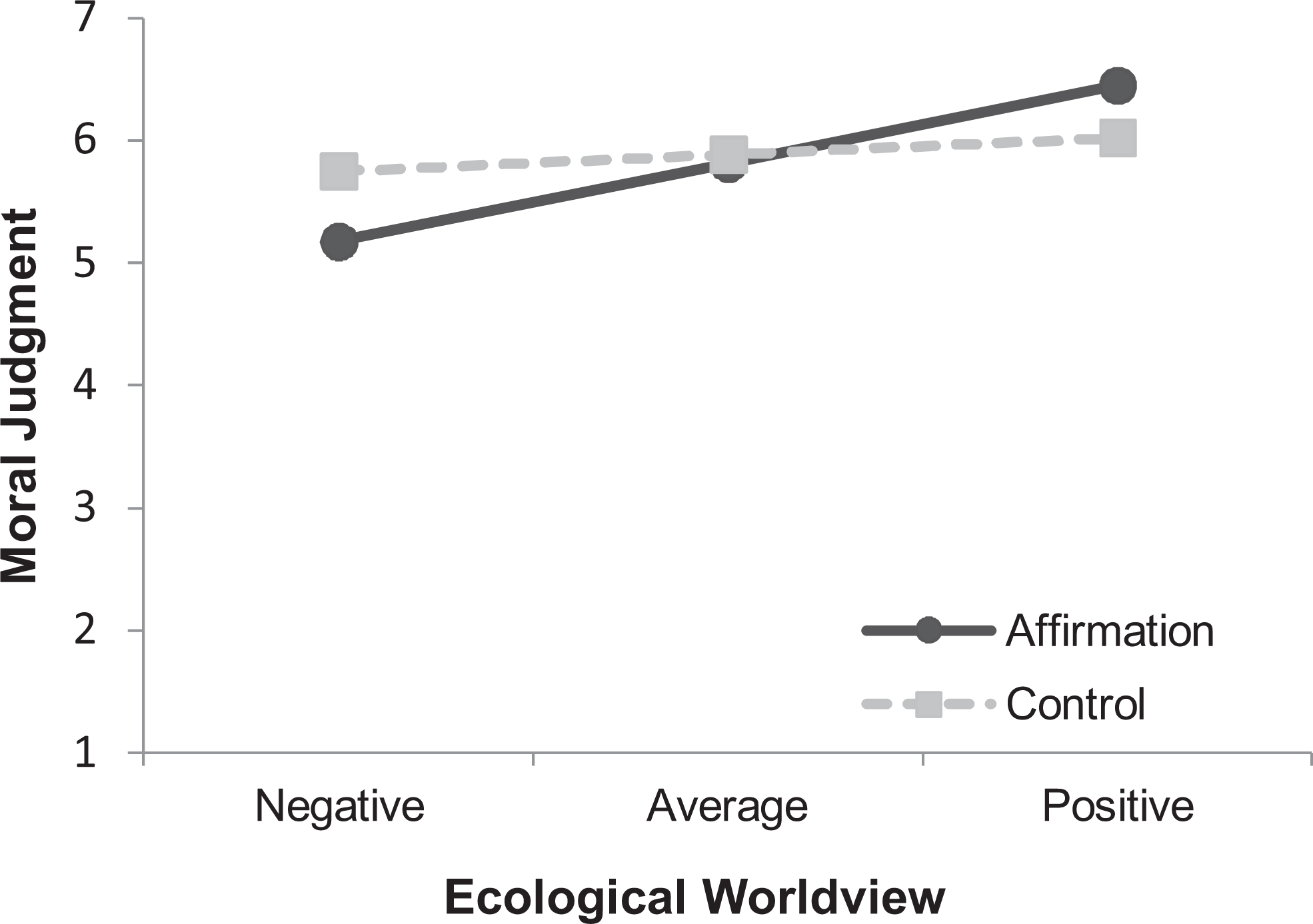
Moral judgment regressed onto ecological worldview by self-affirmation.
Perceived Effort to Reduce Carbon Footprint
There was a main effect of ecological worldviews on perceived effort to reduce carbon footprint, β = .25, t = 1.99, p = .05, which was qualified by an interaction with self-affirmation, β = –.49, t = –3.90, p < .001 (see Figure 2). Ecological worldviews were a stronger predictor of perceived effort to reduce carbon footprint in the affirmation condition, β = –.42, t = –2.99, p = .005, than in the control condition, β = .33, t = 2.32, p = .03. As predicted, negative ecological worldview participants reported more perceived effort in the affirmation condition than in the control condition, β = .37, t = 2.57, p = .01. By contrast, positive ecological worldview participants reported less perceived effort in the affirmation condition than in the control condition, β = –.44, t = –3.07, p = .003.

Perceived effort to reduce carbon footprint regressed onto ecological worldview by self-affirmation.
Self-Efficacy
The analysis of self-efficacy yielded a marginally significant interaction between self-affirmation and ecological worldviews, β = .23, t = 1.87, p = .07 (see Figure 3). Ecological worldviews were a significant predictor of self-efficacy in the affirmation condition, β = .47, t = 3.45, p = .001. There was no significant effect of ecological worldviews in the control condition, β = .22, t = 1.50, p = .14. As predicted, negative ecological worldview participants reported lower levels of self-efficacy regarding pro-environmental behavior in the affirmation condition than in the control condition, β = –.28, t = –1.99, p = .05. There was no effect of self-affirmation on self-efficacy for positive ecological worldview participants, β = .10, t = .72, p = .47.

Self-efficacy regressed onto ecological worldview by self-affirmation.
Pro-environmental Intentions
There was a main effect of self-affirmation on proenvironmental intentions, β = .24, t = 2.35, p = .02: Participants in the affirmation condition reported greater intentions to reduce their carbon footprint (M = 5.09, SD = 1.06) than did their counterparts in the control condition (M = 4.55, SD = 1.17). There was no significant interaction between self-affirmation and ecological worldviews, β = .15, t = 1.15, p = .25. It is noteworthy, however, that the planned contrasts revealed that positive ecological worldview participants reported stronger pro-environmental intentions in the affirmation condition than in the control condition, β = .37, t = 2.46, p = .02, whereas negative ecological worldview participants did not, β = .12, t = .81, p = .42 (see Figure 4).

Pro-environmental intentions regressed onto ecological worldview by self-affirmation.
Discussion
Previous research has shown that self-affirmation can reduce defensive responses to messages that focus on individual threats. However, little is known about the effects of self-affirmation in a nonpersuasive context on existing cognitions about a familiar collective threat that is largely beyond an individual’s control, such as climate change. In this research, we proposed that self-affirmation can bolster orientations toward environment-related actions when people only have recourse to their existing beliefs. Whereas self-affirmation manipulations that include a persuasive threatening message have been shown to promote more openness to threats to the self (e.g., Sherman & Cohen, 2006), our results are compatible with the suggestion that self-affirmation without such a message can promote a validation of previously held beliefs toward potentially threatening issues. More specifically, our findings showed that ecological worldview effects were accentuated through self-affirmation in the absence of a threatening persuasive message. Self-affirmation led to more constructive pro-environmental responses to climate change among participants with positive ecological worldviews and to less constructive pro-environmental responses to climate change among participants with negative ecological worldviews.
We found that self-affirmation resulted in more constructive pro-environmental responses only among those participants who are likely to be amenable to the idea of adapting one’s environment-related behavior. Individuals with (very) positive ecological worldviews reported more pro-environmental moral judgments, less perceived effort involved in reducing their carbon footprint, and more positive pro-environmental intentions in the self-affirmation condition compared to the control condition. It should be noted that self-affirmation did not increase self-efficacy with regard to pro-environmental behavior for positive ecological worldview participants. This could potentially be due to ceiling effects, as participants with positive ecological worldviews reported high levels of self-efficacy in the control condition. By contrast, self-affirmation resulted in less constructive pro-environmental responses among participants who might be expected to be more resistant to adapting their environment-related behaviors. Thus, self-affirmed participants with negative ecological worldviews reported less pro-environmental moral judgments, more perceived effort involved in reducing their carbon footprint, and marginally lower levels of self-efficacy regarding the performance of pro-environmental behaviors compared to their counterparts in the control condition. Interestingly, self-affirmation did not appear to influence the pro-environmental intentions of negative ecological worldview participants. Further research is required to explore more fully the boundary conditions of self-affirmation manipulation effects on intentions and other pro-environmental responses.
In previous research, self-affirmation has been shown to increase self-confidence in the validity of one’s own thoughts regarding a nonthreatening persuasive message (Briñol, et al., 2007). The current study extends this finding by showing that the effects of self-affirmation are not limited to a validation of cognitive responses to nonthreatening messages, but it can also lead to a polarization of environmental orientations in a nonpersuasive context. Although we did not explore the underlying processes that accompany these validations of ecological worldviews, we suspect that self-affirmation may enhance self-confidence in established beliefs about a familiar topic when no persuasive message is presented. In the absence of a threatening persuasive message, self-affirmation may induce a greater reliance on prior knowledge and opinions. An alternative explanation for the polarization of established beliefs about environmental threats through self-affirmation is that by writing about personally important values, the self-concept tends to become clearer and more coherent (Wakslak & Trope, 2009), which may in turn result in stronger beliefs. These two explanations are clearly not mutually exclusive and subsequent studies might usefully explore the potentially differential pathways through which self-affirmation can validate personal convictions.
Previous self-affirmation research has indicated that people tend to be more defensive about beliefs that are important to their self-concept. Self-affirmation manipulations have consequently been shown to be most effective in individuals for whom a threat is of high perceived personal relevance (Correll, Spencer, & Zanna, 2004; Reed & Aspinwall, 1998). However, the role of the perceived personal relevance or importance of climate change issues in self-affirmation effects is likely to be more complex, since climate change can be construed as a global threat that is potentially relevant to everyone. Whereas it is relatively commonplace to categorize people in terms of the personal relevance of behavior-specific individual threats, we suggest that the perceived importance of reducing carbon footprints to mitigate climate change effects might be approached as a continuum on which more polarized views reflect greater personal issue involvement and possibly involve stronger potential personal threat. For instance, people with positive ecological worldviews may feel threatened because of environmental change per se, while people with negative ecological worldviews may feel threatened due to the discrepancy between the scientific consensus on climate change information and the anti-zeitgeist views that they might personally hold.1 Our findings are consistent with this suggestion in that self-affirmation primarily influenced people with more polarized environmental orientations.
In conclusion, our results showed that self-affirmation can accentuate previously held environmental orientations when no information is introduced to challenge those beliefs. These issues clearly need to be explored in more detail. However, we feel that this study provides an important initial step in our understanding of the contextual and personal conditions under which self-affirmation may motivate people to tread more carefully with their own carbon footprints.
Footnotes
Acknowledgments
The authors would like to thank an anonymous reviewer for this suggestion.
Declaration of Conflicting Interests
The author(s) declared no potential conflicts of interest with respect to the research, authorship, and/or publication of this article.
Funding
The author(s) disclosed receipt of the following financial support for the research, authorship, and/or publication of this article: This research was financially supported by a University of Sussex doctoral training award to the first author.