




Abstract
Moral foundations theory contends that people’s morality goes beyond concerns about justice and welfare, and asserts that humans have five innate foundations of morality: harm and fairness (individualizing foundations) and in-group loyalty, deference to authority, and purity (binding foundations). The current research investigates whether people’s moral judgments are consistently informed by these five values, or whether individualizing and binding foundations might be differentially endorsed depending on individuals’ mind-sets. Results from our study demonstrated that when participants were experimentally manipulated to think abstractly (vs. concretely), which presumably makes their higher level core values salient, they increased in their valuations of the individualizing foundations and decreased in their valuations of the binding foundations. This effect was not moderated by political ideology. Implications and areas for future directions are discussed.
Researchers have recently argued that psychologists’ definition of morality—which highlights the roles of justice and welfare (Kohlberg, 1969; Rawls, 1971; Turiel, 1983)—has been too narrow. Proponents of the “moral foundations theory” (Haidt & Graham, 2007) propose that in addition to violations that infringe on the rights of others or that otherwise cause harm, individuals make moral judgments based on other concerns, including loyalty to the in-group, deference to authority, and purity. The question of whether moral judgments are consistently informed by these five values, or whether some moral values are more central than others, remains an open one. In this research, we examine the hypothesis that when people are in an abstract (vs. concrete) mind-set, in which their most core and consistently adhered values are presumably most salient (Eyal & Liberman, 2012), concerns about fairness and harm will be enhanced, whereas other moral concerns will be devalued.
Moral foundations theory posits that morality goes beyond concerns solely centered on the individual, and extends to protecting the welfare of the community as well. The first two foundations, harm and fairness, are primarily concerned with protecting the rights and freedoms of individual people, and are referred to as the individualizing foundations. In-group loyalty, authority, and purity are focused on preserving the group as a whole (Haidt & Graham, 2007). According to the theory, humans have evolved these binding foundations as a way to preserve social institutions by promoting and celebrating those who support and sacrifice for the group (in-group loyalty), respect and obey traditions (authority), and rise above their base urges and exercise self-control (purity).
Empirically, support for moral foundations theory has almost exclusively focused on ideological differences in the endorsement of these five values. When making moral judgments, both liberals and conservatives consider individualizing foundations; conservatives seem to take into account individualizing and binding foundations equally, whereas liberals tend to prioritize the individualizing values over the binding ones (Graham, Haidt, & Nosek, 2009; Graham et al., 2011; Haidt & Graham, 2007). The theory proposes that all five foundations make up the “‘first draft’ of the moral mind” (Graham et al., 2009, p. 1031) and ideological differences emerge because of environmental factors, such as culture, parenting, or education, that encourage the suppression of these innate binding intuitions (Haidt & Graham, 2007; Joseph, Graham, & Haidt, 2009; Haidt & Graham, 2009).
Recent experimental work, however, has not supported the idea that liberals are suppressing, or cognitively overriding, their intuitions in the binding domains. Rather, evidence suggests that the ideological difference in the endorsement of binding values is explained by conservatives enhancing them. Specifically, Wright and Baril (2011) replicated the previous moral foundations pattern in a control condition: conservatives relied equally on all five foundations, whereas liberals were more likely to endorse the individualizing foundations than the binding foundations. Under cognitive load (when people presumably do not have the cognitive resources to override or enhance justifications for their moral judgments), however, the morality of conservatives shifted to resemble that of liberals—with higher endorsement of the individualizing foundations over the binding foundations.
This work is consistent with the conjecture that harm and fairness may be more “core” values—moral sentiments that are consistently applicable across time, place, and contexts—whereas binding moral judgments might be “second-order,” peripheral values, perhaps especially likely to be elicited only in certain situations or mind-sets. Here, we examine this hypothesis by leveraging methods from construal level theory. We propose that individuals in an abstract (vs. concrete) mind-set—who presumably are focusing on their core (or higher level) values—will prioritize individualizing foundations and devalue the binding ones in their moral judgments.
This prediction is inspired by research on construal level theory, which has illustrated that mind-sets can influence individuals’ judgments and evaluations (see Trope & Liberman, 2010). Specifically, when people are in an abstract mind-set, they tend to focus on core features that are consistent across situations; when in a concrete mind-set, by contrast, people are less likely to make a distinction between core and secondary factors. For instance, Trope and Liberman (2000) found that construal affected how people evaluated objects, such as a radio. When thinking abstractly, people focused mostly on the core features of a radio (e.g., the quality); when in a concrete mind-set, people placed equal weight on peripheral (e.g., the clock on the radio) and core features.
Research has directly examined the impact of construal level on morality, offering converging evidence that moral values are more salient and more important in informing behavior when individuals are thinking abstractly as opposed to concretely (Eyal & Liberman, 2012; Eyal, Liberman, & Trope, 2008; Ledgerwood, Trope, & Chaiken, 2010; Luguri, Napier, & Dovidio, 2012; Torelli & Kaikati, 2009). Eyal, Liberman, and Trope (2008) showed that when thinking abstractly (vs. concretely), participants judged negative acts to be more morally wrong, and positive acts to be more morally virtuous, suggesting that moral concerns are more important and influential when thinking abstractly. Similarly, Torelli and Kaikati (2009) found that an abstract mind-set, as compared to a concrete mind-set, promoted judgments and behaviors that were more in line with individuals’ moral values.
It seems that abstract processing of moral issues makes individuals’ judgments less vulnerable to other (nonmoral) influences. For instance, a series of studies by Ledgerwood, Trope, and Chaiken (2010) demonstrated that when thinking concretely, people were more likely to align their views on sociopolitical issues with the views of an ostensible interaction partner. When people were thinking abstractly, however, they showed less susceptibility to the influence of others and instead held onto their (previously reported) core beliefs. Thus, abstract thinking and psychological distance allow individuals “to be able to efficiently abstract across the particularities of any one experience to extract evaluation-relevant information that is stable across time, contexts, and relationships” (Ledgerwood & Trope, 2010, p. 1).
In the current research, we examine how construal level impacts the five moral foundations. If all five foundations represent core moral domains for both liberals and conservatives, abstract (vs. concrete) thinking should increase people’s adherence to all five foundations of morality regardless of their political orientation. A second possibility is that, if the binding foundations are central to, and consistently relevant in, conservatives’ (but not liberals’) moral judgments, an abstract (vs. concrete) mind-set should increase endorsement of the binding foundations among conservatives, thus increasing moral polarization. Our prediction, however, is based on the proposition that moral principles regarding fairness and harm are values that are more broadly accepted across myriad situations, contexts, and time, as compared to concerns about in-group loyalty, authority, and purity. Thus, we predict that an abstract (vs. concrete) mind-set will lead people to increasingly favor their individualizing values over their (presumably more peripheral) binding values.
Method
Participants
Our sample for this study came from registered users of an online subject pool, managed by Yale University, in which people can participate in short studies in exchange for a chance to win a gift certificate. Of the 224 people we recruited, 13 did not fill out the construal manipulation (described below) and an additional 11 did not respond to the questions; these individuals were omitted from analyses. This yielded a final sample of 200 participants, the majority of whom were female (62%) and White (73.9%); the mean age was 35.52 years (standard deviation [SD] = 13.42).
Procedure
Participants were randomly assigned to complete an abstract or concrete construal priming manipulation developed by Fujita, Trope, Liberman, and Levin-Sagi (2006). Participants assigned to the abstract condition were given a list of 20 common objects and asked to generate superordinate categories by asking them “_____ is an example of what?” As an example, when presented with the word dog, participants could answer “pet.” Participants in the concrete condition were instead asked “An example of ____ is what?” causing them to give subordinate exemplars to these words, such as “poodle” or “Benji.”
Following the manipulation, participants filled out a short version of the Moral Foundations Questionnaire, which is designed to asses the five moral foundations: harm, fairness, in-group loyalty, authority, and purity (Graham et al., 2011). 1 Following previous researchers (Van Leeuwen & Park, 2009; Wright & Baril, 2011), we combined the four harm and four fairness questions into a single variable representing “individualizing values” and the questions pertaining to purity (4 items), in-group loyalty (3 items), and authority (3 items) into a composite measure of “binding values.” Consistent with findings from previous research, the combined individualizing values measure showed higher reliability (α = .86) than its subcomponents of just the harm questions (α = .72) or just the fairness questions (α = .76). Similarly, the reliability of the combined binding values measure (α = .85) was superior to any of its three subcomponents, including in-group loyalty (α = .58), authority (α = .56), or purity (α = .80).
Finally, participants filled out a variety of demographic questions, including 1 item that assessed their political orientation on social issues on a scale from 1 (very liberal) to 6 (very conservative; M = 2.81, SD = 1.49). 2
Results
We conducted a fixed effects multilevel regression model with a random intercept, predicting value endorsement with foundation type (individualizing = −1; binding = 1), construal condition (concrete = −1; abstract = 1), and political orientation (mean centered), as well as all two- and three-way interactions between these variables. Results from this model revealed a significant main effect of foundation type, b = −.45, standard error (SE) = .03, p < .001: people were more likely to endorse the individualizing foundations, M = 4.59, SD = .75, than the binding foundations, M = 3.72, SD = .88. This effect of foundation type was qualified by a significant two-way interaction with political orientation, b = .19, SE = .02, p = .001. Consistent with previous work, comparisons of the simple slopes (Aiken & West, 1991) revealed a slight negative relationship between political orientation and individualizing foundation endorsement, b = −.07, SE = .04, p = .065, such that more conservative (vs. liberal) participants were less likely to endorse these foundations; the reverse was true for the binding foundations, b = .31, SE = .04, p < .001, which were more likely to be endorsed among more conservative participants as compared to liberal ones.
Results also revealed the predicted significant interaction between foundation type and construal condition, b = −.10, SE = .03, p = .001. As shown in Figure 1, the endorsement of individualizing values was higher in the abstract condition (M = 4.71, SD = .71) than in the concrete condition (M = 4.50, SD = .77), b = .21, SE = .11, p = .051, whereas the endorsement of the binding values was lower among individuals who were put in an abstract mind-set (M = 3.59, SD = .88) as compared to those in a concrete mind-set (M = 3.81, SD = .87), b = −.20, SE = .11, p = .066. Putting it another way, people endorsed the individualizing values significantly more than the binding ones when they were thinking abstractly, b = 1.10, SE = .09, p < .001, as compared to concretely, b = .70, SE = .08, p < .001.
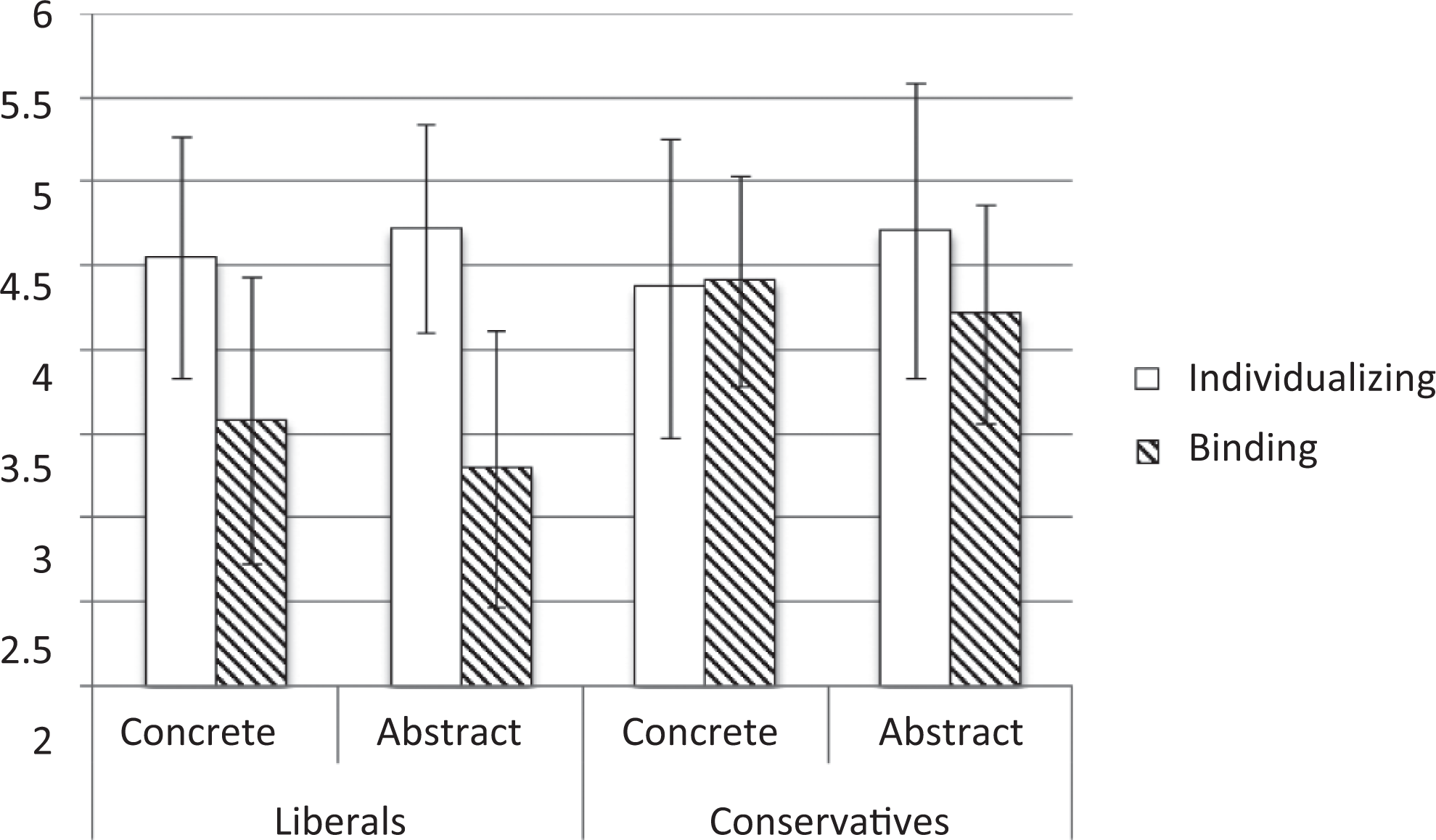
Mean endorsement of individualizing and binding moral foundations as a function of construal condition (abstract vs. concrete) for liberals (i.e., those who chose 1, 2, or 3 on a 6-point political orientation measure) and conservatives (4, 5, or 6 on the political orientation measure). Error bars represent standard deviations.
The interaction between construal and political orientation was not reliably different from 0, b = .03, SE = .03, p = .273, suggesting that liberals and conservatives were not differentially affected by the construal manipulation. In addition, no three-way interaction between foundation type, construal condition, and political orientation emerged, b = .00, SE = .02, p = .950. Thus, both liberals and conservatives significantly increased on individualizing concerns about harm and fairness and decreased on binding concerns when thinking abstractly as compared to concretely, and to the same extent.
One noteworthy consequence is that, although conservatives (+1 SD) did not differentiate between individualizing and binding values in the concrete condition, b = .13, SE = .11, p = .239, they significantly favored the individualizing values over the binding ones in the abstract condition, b = .54, SE = .12, p < .001. Liberals (−1 SD) were more likely to prioritize individualizing values over other values in both conditions, but this differentiation was enhanced when they were thinking abstractly, b = 1.67, SE = .12, p < .001, as compared to concretely, b = 1.27, SE = .11, p < .001.
Discussion
We examined endorsement of “individualizing” and “binding” moral foundations through the lens of construal level theory. Results from our study demonstrated that when individuals were thinking abstractly, and thus more likely to make judgments based on their core values that are reliably applicable across time and contexts (Eyal & Liberman, 2012; Ledgerwood & Trope, 2010), both liberals and conservatives increased their valuations of individualizing foundations, and decreased their valuations of the binding foundations, as compared to when they were thinking concretely. In the concrete condition, our findings mirrored the pattern that emerged in past research: liberals valued the individualizing foundations more than the binding foundations, whereas conservatives valued the individualizing and binding foundations equally. When people were manipulated to think abstractly, however, conservatives looked more like liberals, valuing the individualizing foundations significantly more than the binding foundations.
One potential limitation of our study is that we did not include a control condition in which neither a concrete or abstract mind-set was primed. We omitted such a condition because it would be difficult to interpret and to compare to the concrete and abstract conditions—presumably, all people have to be thinking one way or the other, so a condition that does not manipulate mind-set seems likely to be “noisy.” Previous research that has included a control condition suggest that people might generally default to concrete-level processing in the absence of a construal manipulation (Khan, Zhu, & Karla, 2011). This possibility is in line with our findings—the pattern that emerged in our concrete condition replicates the relationship between moral foundations endorsement and political ideology that has emerged in prior work (Graham et al., 2009; Wright & Baril, 2011).
This study adds to a body of evidence suggesting that there are important differences between the individualizing moral values of harm and fairness and the binding values. Prior work has shown that the endorsement of the binding (but not the individualizing) foundations is lower when people’s cognitive resources are limited (Wright & Baril, 2011) and higher among individuals who tend to perceive danger (van Leeuwen & Park, 2009). Our study highlights mind-set (or construal level) as another factor that can influence the criterion people use to make moral judgments. In our prior work (Luguri et al., 2012, Study 3), we found that abstract thinking increased people’s concerns about fairness. This current research expands on this by demonstrating that an abstract (vs. concrete) mind-set increases individualizing values more generally, as well as decreases concerns about binding values.
Taken together, the results from our study are in line with the notion that concerns about justice and welfare make up the “gist” of moral values (e.g., Kohlberg, 1969; Rawls, 1971; Turiel, 1983), at least when people are taking a “big picture” perspective. This is not to assert that values regarding in-group loyalty, authority, or purity are not moral concerns, at least some of the time. Instead, our study pushes toward a new understanding of when people’s judgments will (or will not) be influenced by their individualizing or binding values. Harm and fairness concerns may be more enduring components of people’s morality, whereas concerns regarding in-group loyalty, deference to authority, and purity may or may not play a role in moral judgments depending on situational or contextual factors. For instance, Republicans might value deference to authority more when thinking about a Republican president than when thinking about a Democratic president.
In that vein, this work opens up interesting new avenues for future research aiming to understand how people arrive at moral judgments. Although it is beyond the scope of this study, one possibility for future researchers to explore is the notion that “binding” values might reflect, not moral foundations, but rather moral boundaries. Although people realize violations of individual welfare and justice are immoral, their level of endorsement of “binding” concerns might represent their willingness to accept acts of harm and injustice directed toward certain individuals or groups—namely, those that somehow threaten their notions of authority, in-group loyalty, or purity. In other words, people who value these socially binding principles might exclude those who violate these principles from their moral radius (see Wright & Baril, 2011, and Baril & Wright, 2012, for a similar discussion that highlights the role of threat).
If this speculation is correct, research in this area could offer a theoretical perspective to explain findings from research on support for public policies. For instance, conservative opposition to the welfare system, which was initially conceived of as a program to aid widows and their children, emerged as economic and legislative factors allowed more Black Americans to also receive aid (Gilens, 1999; Neubeck & Cazenave, 2001). Indeed, despite the fact that most Americans acknowledge that society is morally obligated to provide for the basic needs of the poor (Gilens, 1999), studies have demonstrated that support for welfare programs are markedly decreased when they are perceived to aid out-group members, especially among political conservatives (Bobo, 1988; Bobo & Kluegel, 1993; Iyengar, 1990; Peffley, Hurwitz, & Sniderman, 1997; Terkildsen, 1993; Wilson, 1987).
The findings from these welfare studies are at least consistent with the supposition that binding values, such as heightened concerns for the in-group, might represent limits to people’s moral radius such that concerns about harm (or justice) are tempered (or even eliminated) for some individuals or groups. It is also possible, however, that these studies are illustrating a “moral conflict,” at least insofar as people associate helping an out-group with hurting the in-group. Both of these possibilities are intriguing endeavors for morality researchers. For instance, do people lower their standards for harm and fairness for not only out-group members, but also for people who violate concerns about purity (e.g., the homeless) or authority (e.g., feminist women)?
The findings from the current work demonstrate that concerns about individualizing and binding values are influenced by people’s mind-set. It suggests, for example, that binding values have more of an impact on moral judgments when individuals are envisioning concrete scenarios (e.g., two men kissing) and less so when people are considering big picture implications (e.g., changing the constitution). Thus, to the extent that abstract thinking brings the values of fairness and individual welfare to the forefront, a focus on construal (or framing) could be an important and useful tool for reducing ideological discord on policy issues.
Footnotes
Declaration of Conflicting Interests
The author(s) declared no potential conflicts of interest with respect to the research, authorship, and/or publication of this article.
Funding
The author(s) received no financial support for the research, authorship, and/or publication of this article.