



Abstract
The importance of hope has long been asserted in the field of conflict resolution. However, little is actually known about either how to induce hope or what effects hope has on conciliatory attitudes. In the current research, we tested whether (1) hope is based upon beliefs regarding conflict malleability and (2) hope predicts support for concessions for peace. Study 1, a correlational study conducted among Israeli Jews, revealed that malleability beliefs regarding conflicts in general are associated with hope regarding the Israeli–Palestinian conflict as well as with support for concessions. In Study 2, we established causality using an experimental manipulation of beliefs regarding conflicts being malleable (vs. fixed). Findings have both theoretical and practical implications regarding inducing hope in intractable conflicts, thus promoting the attitudes so critical for peacemaking.
Several decades of research make it clear that emotions influence conflict resolution in interpersonal conflict and negotiation (for a review see Van Kleef, De Dreu, & Manstead, 2010). This includes the effects of both emotional experiences (e.g., Baron, Fortin, Frei, Hauver & Shack, 1990; Carnevale & Isen, 1986) and the other party’s emotional expressions (Sinaceur & Tiedens, 2006; Van Kleef, De Dreu & Manstead, 2004) on concession making and conflict management strategies.
Recently, researchers have begun to examine the role of emotions in the context of intractable conflicts (e.g., Halperin, Crisp, Husnu, Dweck, & Gross, 2012; Reifen-Tagar, Halperin, & Frederico, 2011). Intractable conflicts, such as those in the Middle East, Kashmir, and Cyprus, share a number of characteristics that distinguish them from other conflicts. They are protracted, extensive (including all societal life domains), and violent confrontations that demand investment from those involved. They are widely perceived as existential and zero sum in nature (Bar-Tal, 2001; 2007; Kriesberg, 1993; 2007) and generate considerable negative intergroup emotions.
In such contexts, intergroup emotions such as anger and hatred have been found to influence attitudes and behavioral tendencies related to resolving the conflicts; transforming these emotions can potentially increase willingness to resolve the conflict. In the present studies, we extend this work by considering the emotion of hope within the context of intractable intergroup conflict resolution.
The Role of Hope in Intractable Conflict
We define hope as an emotion, which, like other emotions, involves an appraisal of a meaningful event that leads to emotional goals and action tendencies (Frijda, 1986). This perspective accords well with Lazarus (1999) who defined hope as a positive emotion that arises from “a strong desire to be in a different situation than at present” (p. 663). According to Lazarus, hope is activated when one visualizes a meaningful goal of which there is intermediate probability of achievement, followed by a positive change in mental state (Lazarus, 1999). The associated action tendency is planning paths to achieving this goal (Snyder, 1994; 2000; Staats & Stassen, 1985; Stotland, 1969), and hope has been found to lead to cognitive flexibility, creativity, and risk taking (Breznitz, 1986; Chang, 1998; Clore, Schwarz, & Conway, 1994; Isen, 1990).
Given this definition of hope, it is not surprising that an ongoing highly negative situation (such as an intractable conflict) might induce despair rather than hope (Sallfors, Fasth, & Hallberg, 2002; Stotland, 1969), which, when translated into behavior, can become apathy, indifference, and unwillingness to create change (Jarymowicz & Bar-Tal, 2006). Coleman, Vallacher, Nowak, and Bui-Wrzosinska (2007) discuss the paradoxical cycle of hope in intractable conflicts, in which, though the situation is ever changing in its volatility, its very essence is seemingly constant. Subsequently, those involved in conflict adopt this perception of the conflict as stable and unchanging, further feeding into its hopelessness.
Research on interpersonal conflict resolution has demonstrated that positive effect can reduce hostility and increase creative problem solving in negotiation contexts (Baron et al., 1990; Carnevale & Isen, 1986). Bar-Tal (2001) discusses the importance of hope within intractable conflict resolution, since it involves conceiving of new paths and behaviors toward the positively viewed goal of conflict resolution, motivating people to support peace. In Northern Ireland, hope was found to be positively associated with lower desire to retaliate and a higher inclination to forgive the outgroup (Moeschberger, Dixon, Niens, & Cairns, 2005). Halperin and Gross (2011) conducted a nationwide survey among Jewish Israelis and found that hope was positively associated with willingness to provide humanitarian aid to Palestinians during the 2008 war in Gaza. Based on our definition of hope, and the reported previous findings, we believe that imagining a better future and experiencing hope should increase support for the steps necessary to achieve the desired goal, thus increasing support for concessions.
However, within the context of violent, prolonged conflicts a sense of futility arises, and the attempt to transform despair into hope constitutes a huge challenge (Coleman et al., 2007). Hopes have been raised and shattered repeatedly throughout the years, and mere reference to the end of conflict, even in a positive context, can lead to negative and inverse reactions, ruining the ability of those who wish to promote peace from doing so in a direct manner. Thus, a growing need has been identified for a method of indirectly changing the key appraisals (Halperin, in press) involved in the emotion of hope. Specifically, the belief that a different, better future of the conflict is impossible, since conflicts are fixed, must be transformed to a belief in peace as a future possibility, since conflict situations are malleable and ever changing.
Conflict Malleability Beliefs and Hope
One starting point is research on implicit theories (e.g., Chiu, Dweck, Tong, & Fu, 1997; Dweck, Chiu, & Hong, 1995). Implicit theories are beliefs that individuals hold—often outside of awareness—regarding whether a particular construct is either malleable (an incremental belief) or fixed and unchanging (an entity belief). For example, the effects of lay beliefs about the malleability of people or groups have been investigated in the field of person perception. Those holding a malleable (incremental) belief about persons or groups have been found to be less prone to make stereotypic judgments (Levy, Stroessner, & Dweck, 1998; Plaks, Stroessner, Dweck, & Sherman, 2001; Rydell, Hugenberg, Ray, & Mackie, 2007). They are also less likely than those with a fixed (entity) belief to attribute perceived wrongdoings to a fixed nature (Chiu, Hong, & Dweck, 1997; Levy & Dweck, 1998), less prone to recommend punishment and retaliation for wrongdoing, and more likely to recommend negotiation and education (Chiu, Dweck et al., 1997).
Although much attention has been given to malleability beliefs regarding individuals and groups, less attention has been paid to people’s beliefs regarding the malleability of situations and the effect these beliefs have on different emotions in conflict resolution. We were interested in whether there exists a concept based on implicit theories that refers to people’s malleability beliefs regarding highly negative situations, namely prolonged conflicts. We refer to this concept as implicit theories about conflicts. Since hope is an emotion focused upon future positive change in circumstances, as opposed to change in the behavior of a specific entity, we propose that it is a belief about the circumstances, and explicitly conflict situations, which is the driving force of hope in such settings.
The connection between implicit theories about conflicts and hope is that within the context of an ongoing, intractable conflict, experiencing hope incorporates envisioning the end of the specific conflict and subsequently includes the belief that the particular conflict's nature can be changed for the better. Therefore, for people to believe that it is possible for the specific conflict to be resolved, they must first believe that violent, prolonged conflicts can change in general. We therefore hypothesized that a hopeful perception of a better future regarding the end of conflict is driven by a perception of conflicts in general as able to change. We further hypothesized that hope would mediate the effect of incremental beliefs about conflicts on support for concessions toward peace.
The Present Research
To test these hypotheses, we conducted two studies in the context of the conflict between Israeli Jews and Palestinians in the Middle East. The Israeli–Palestinian conflict is a violent conflict that has been ongoing for over five decades. Major attempts have been made to resolve the conflict, ending with dismay, disappointment, and at times (like the Oslo Accords ending with a Palestinian uprising) escalation of violence on both sides, further perpetuating despair and fear and preventing hope from arising once again (Bar-Tal, 2001).
Study 1 was a correlational study in which we measured people’s implicit beliefs about conflicts, their levels of hope regarding the end of conflict, and their support of major concessions toward peace. In Study 2, we experimentally manipulated beliefs about the malleability of conflicts (based on Halperin, Russell, Trzesniewski, Gross, & Dweck, 2011) and measured their causal effects on the experience of hope regarding the conflict and support for concessions. Across studies, we predicted that believing conflicts can change over time would be associated with higher levels of hope, which in turn would predict support of major concessions in conflict.
Study 1
Conflict Malleability Beliefs, Hope, and Conciliatory Attitudes
The goal of the first study was to examine the relationship between implicit theories about intractable conflicts in general, levels of hope, and support for concessions toward peace. For this purpose, we conducted a correlational study in which we measured the extent to which participants believe that violent and prolonged conflicts in general are malleable, levels of hope experienced with relation to the Israeli–Palestinian conflict in particular, and their support for concessions on concrete and core issues of the conflict.
Method
Participants and Procedures
Two hundred and three Jewish Israelis (37% male, 63% female, mean age 33.8, standard deviation [SD] = 15.3) were approached and recruited to fill in an online questionnaire. The sample was made up of a combination of general population (123 recruited using an online survey website and 9 using snowballing techniques) and a student population (n = 71, recruited in return for course credit points), since we wanted to mirror the sociopolitical characteristics of the general society.
Results were not influenced by the kind of sample; hence, we collapsed across them for all analyses. In terms of political orientation, 34% indicated their political orientation as rightist/hawkish, 48% stated they were centrists, and 18% indicated they were leftist/dovish.
Measures
Independent Variable
In order to assess incremental beliefs about conflicts, we used a 3-item scale, adapted from past scales (Halperin et al., 2011; Rydell et al., 2007), assessing beliefs about group malleability. Instructions asked participants to indicate to what extent they agreed with the three statements regarding “extremely violent conflicts (like the conflicts in Northern Ireland and Rwanda).” In the present case, the items tapped the participants’ general beliefs about the malleability of conflicts of a prolonged and violent nature, with no mention of the Israeli–Palestinian conflict (“Under certain circumstances and if all core issues are addressed, the nature of conflicts can be changed,” “The inherent characteristics of conflicts cannot be changed since their nature is fixed and unchanging” (R) and “Conflicts may seem at times like they are being resolved, but their true underlying nature will never change” (R); α = .67). Answers ranged from 1 (strongly agree) to 6 (strongly disagree), indicating the extent to which people believe that conflicts have fixed versus malleable natures. High scores indicate an incremental belief (conflicts’ nature is malleable), whereas an entity belief (conflicts cannot change) is indicated by a lower score on this scale.
Mediating Variable
In order to assess hope, we used a 3-item scale, adapted from the work of Beck, Weissman, Lester, and Trexler (1974), with the items appraising participants’ hopefulness as to the end of the Israeli–Palestinian conflict (“I am hopeful regarding the end of the Israeli-Palestinian conflict,” “I don't expect ever to achieve peace with the Palestinians” (R), and “There’s no use in really trying to end the conflict because it probably won’t happen,” (R); α = .77). Answers ranged from 1 (strongly disagree) to 6 (strongly agree) indicating to what extent people are hopeful regarding the possibility of ending the Israeli–Palestinian conflict.
Dependent Variable
To assess support for concessions, we used a 4-item scale based upon the work of Halperin et al. (2011) in which the items tapped participants’ support for concessions regarding the core issues of the conflict (“Withdrawing to the 1967 borders with various territorial exchanges,” “Various concessions regarding Jerusalem,”, “Monetary compensation for Palestinian refugees and recognition of their right to return to Israel but would not include actual right of return for refugees,” and “After a settlement is achieved, to what extent do you support establishing economic and social relations between Israel and the Palestinians?”; α = .77). Answers ranged from 1 (strongly oppose) to 6 (strongly support) indicating to what extent people support the various concessions to be made by Israel.
Control Variables
As control variables, we measured age, gender, and self-reported political orientation.
Results and Discussion
Means, SDs, and zero-order correlations among variables are presented in Table 1. Incremental beliefs about conflicts were positively associated with hope (r = .42, p < .001). In addition, a positive correlation was found between incremental beliefs about conflicts and support for concessions regarding the conflicts’ core issues (r = .37, p < .001). Thus, the more participants believed in the malleability of violent conflicts, the more they experienced hope regarding the Israeli–Palestinian conflict specifically, and the more they were willing to make major concessions. As expected, we also found a significant positive correlation between hope and support for concessions (r = .59, p < .001), indicating that the more hopeful participants felt regarding the possibility of ending the conflict, the more they were willing to make concessions in order to achieve this resolution.
Correlations Between Malleability Beliefs, Hope, and Concessions.
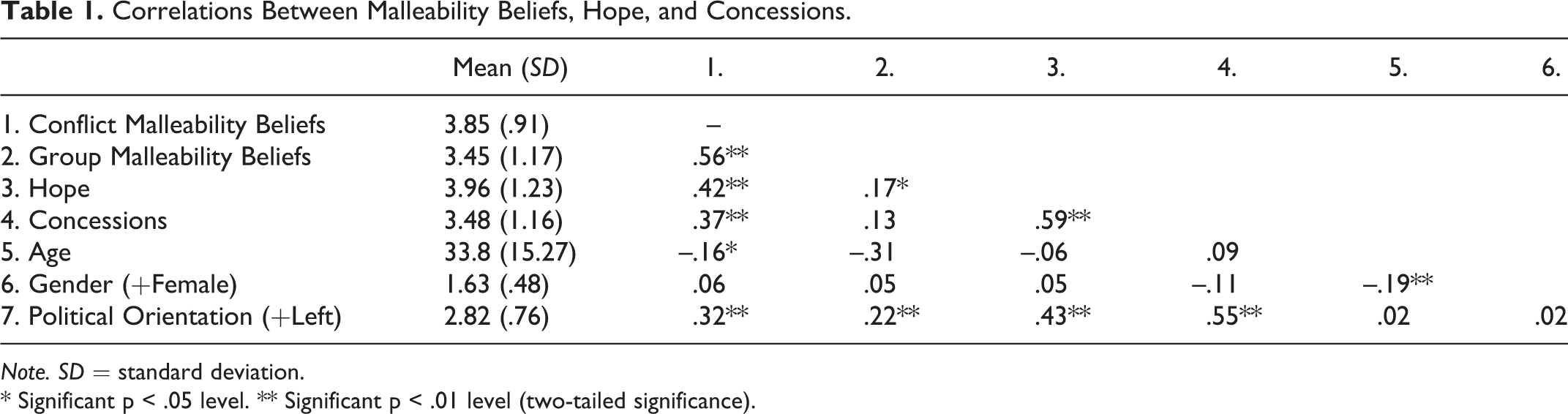
Note. SD = standard deviation.
* Significant p < .05 level. ** Significant p < .01 level (two-tailed significance).
No interaction effect of implicit theories about conflicts and either gender (β = .48, p = .21) or political orientation (β = −.19, p = .60) was found on concession making. Thus, implicit beliefs about conflicts are associated with support for concessions in the same way regardless of political stance or gender.
These results led us to examine a mediation model in which incremental beliefs regarding conflict malleability indirectly affect support for concessions through hope (Figure 1). To examine this, we used Preacher and Hayes’ (2008) bootstrapping macro, while controlling for participants’ political orientation, age, and gender. Results revealed that the direct effect of incremental beliefs about conflicts on support for concessions (b = .31, SE = .08, t = 3.95, p < .001) was reduced after hope was included in the model (b = .15, SE = .07, t = 1.98, p = .05) and that the indirect effect through hope was significant (point estimate: .16; 95% confidence interval: .084; .254).
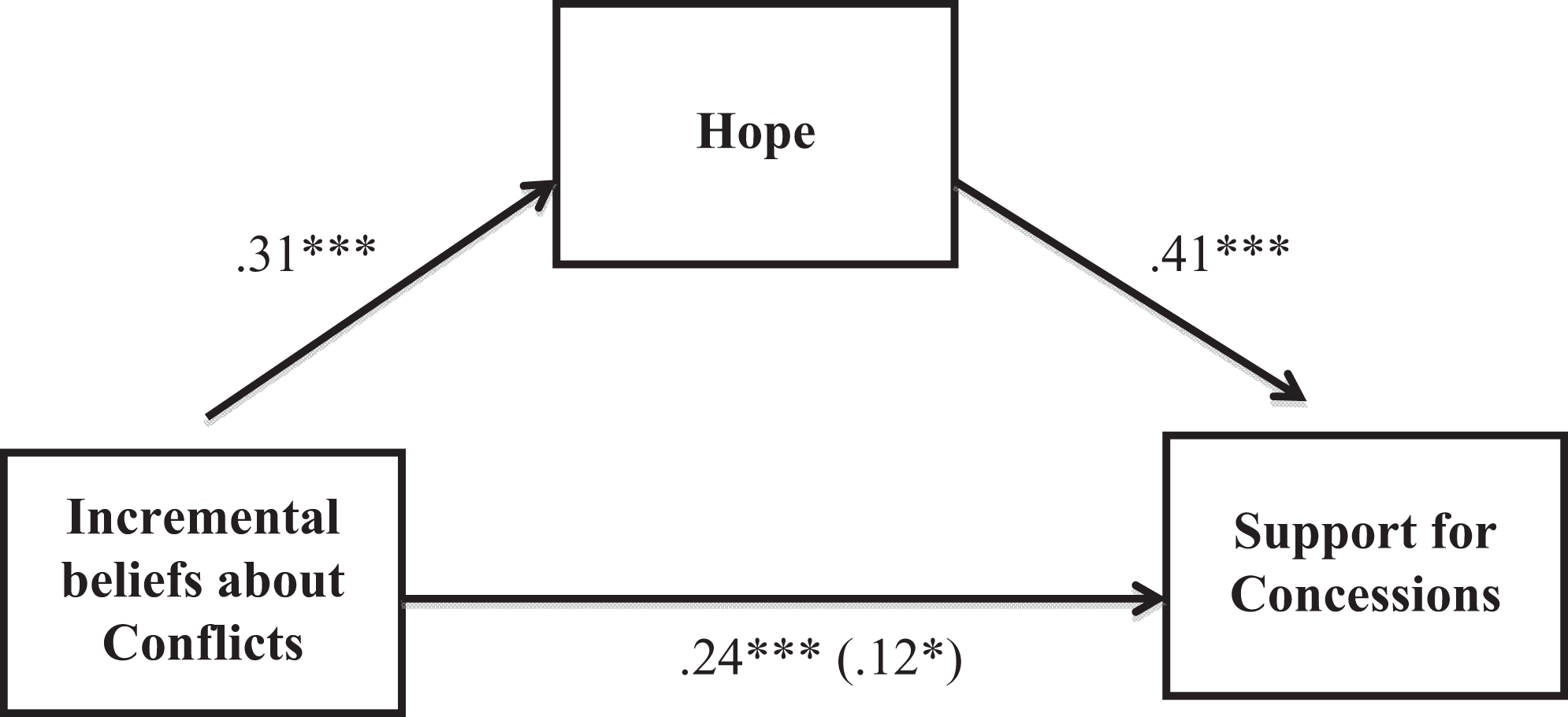
Hope mediates the link between incremental beliefs about conflicts and support for concessions.
We compared the aforementioned mediation model to two alternative models. In the first, hope led to increased incremental conflict beliefs, which in turn led to higher support for concessions. In the second, support for concessions mediated the effect of incremental beliefs about conflicts on hope. Given that the two alternative models were nonnested within the original model, we used two fit measures for the comparison–Akaike information criterion and expected cross-validation index, commonly used to compare nonnested models, which include the same set of variables (Kumar & Sharma, 1999). In both cases, AIC and EVCI were lower in the hypothesized model compared to both alternative models, indicating that this model fits the data better than the others.
These results lend support to our argument, according to which people who believe that conflicts in general can change tend to experience higher levels of hope regarding the specific conflict, which leads people to be more supportive of concessions crucial for peacemaking. Findings constitute an initial, though not a causal, indication of such a relationship. Nevertheless, we were further interested in whether implicit beliefs regarding conflicts can be manipulated.
Study 2
Enhancing Hope by Inducing a Malleability Belief About Conflicts
The goal of Study 2 was to test whether the relationships identified in Study 1 were causal. To address this goal, we employed an experimental design in which we manipulated incremental beliefs about conflicts, based on manipulations used in previous research, and in which participants are presented with information supporting the specific belief (Halperin et al., 2011; Rydell et al., 2007). We then examined the effect this had on participants’ level of hope and in turn, support for major concessions. Participants were randomly assigned to read an article that emphasized either the malleability of conflicts (incremental condition) or their fixed quality (entity condition). We expected to find a similar pattern to the one found in Study 1, such that participants in the incremental condition would be more willing to make concessions toward peace, relative to participants in the entity condition, and that this effect would be mediated by the experience of hope.
Method
Participants and Procedures
Eighty participants were recruited using an online survey website and completed an online questionnaire (54% male, 46% female, mean age 39.4, SD = 13.9). In terms of political orientation, 42% indicated their political orientation as rightist/hawkish, 43% stated they were centrists, and 15% indicated they were leftist/dovish.
Participants were randomly assigned to one of the two conditions; an incremental condition and an entity condition. All participants were presented with two seemingly separate studies. The first “study” was presented as a reading comprehension study and included an article apparently from Ynet.co.il, a leading online news source in Israel, through which incremental beliefs about groups were manipulated. After reading the article, participants answered a number of informative/factual questions regarding the article’s content in order to check that they had indeed read and understood the manipulation. Participants also indicated their opinions regarding the malleability of conflicts. Participants then proceeded to the next “study” presented as separate and seemingly unrelated to the manipulation they had just read. This part included the dependent variables of hope regarding the Israeli–Palestinian conflict and support for concessions toward peace as well as demographic information.
Implicit Beliefs Manipulation
The manipulation was adapted from Halperin et al. (2011) to apply to the conflict malleability domain. Participants in the incremental condition (n = 38) read about a breakthrough study allegedly revealing that conflicts can change and that the detrimental characteristics associated with conflicts should not be seen as a fixed state but explained by context and circumstance (“The article's findings show that the violence and hostility that accompanied most of the conflicts examined changed throughout the years … and are not a fixed characteristic of conflicts … In studies examining violent conflicts in history, we observed that they often change significantly, and that this change holds over time”). Those in the entity condition (n = 40) learned that conflicts cannot change, since their prolonged effects are enduring and unchangeable (“The article's findings show that the violence and hostility that accompanied most of the conflicts examined did not change throughout the years … and constitute a fixed characteristic of conflicts … In studies examining violent conflicts in history, we observed that they do not change significantly, and that even if a change occurs, this change does not hold over time”). Neither article referred directly to the Israeli–Palestinian conflict in any way.
Measures
Manipulation Check
In order to assess incremental beliefs about conflicts, we used a 4-item scale. To the original scale used in Study 1, we added an additional item (“Conflicts are sustained over many years, therefore they cannot be completely changed”); as anticipated, this improved the reliability of the scale (α = .84).
Mediating Variable
In order to assess hope, we used a 3-item scale similar to the measure used in Study 1. We removed the item that lowered the measure’s reliability in Study 1 and added an additional statement (“With regard to the Israeli Palestinians conflict, what has been will always be, and the conflict will stay this way forever”); as expected, this improved the scale’s reliability (α = .91).
Dependent Variable
In order to assess support for concessions, we used a three-item scale similar to the measure used in Study 1. In order for the concessions to be relevant to the conflict-related events and developments at the time of conducting the study, we replaced the last 2 items with the item “In return for a full peace agreement, to what extent would you support Israel conceding control of the Arab neighborhoods in Jerusalem”; α = .78).
Control Variables
As control variables, we measured age, gender, and self-reported political orientation.
Results and Discussion
Two participants had out-of-range values (over 2.4 SDs from the selected dependent variable’s mean). These were recoded as missing values. Means, standard deviations, and zero-order correlations among variables above and beyond the experimental conditions are presented in Table 2. To see whether our manipulation affected our measures, we first conducted a series of independent sample t tests, examining the mean differences between our two conditions. As expected, participants in the incremental condition expressed significantly higher malleability beliefs regarding conflicts (M = 3.98, SD = .95) than those in the entity condition (M = 3.26, SD = 1.16); t(76) =−2.95, p = .004, d = −.67. As hypothesized, the manipulation also had a significant effect on the participants’ experience of hope regarding the conflict; participants in the incremental condition reported higher levels of hope (M = 4.33, SD = 1.36) than those in the entity condition (M = 3.55, SD = 1.73); t(76) = −2.19, p = .03, d = .51. Finally, and most importantly, the manipulation also had a significant effect on support for concessions, t(76) = −2.16, p = .03, indicating that participants in the incremental condition were more willing to make concessions (M = 3.79, SD = 1.16) than those in the entity condition (M = 3.19, SD = 1.31, d = .48). No interaction effect of the manipulation and both gender (β = .13, p = .78) and political orientation (β = −.13, p = .75) on the support for concessions was found. This indicates that the manipulation influenced participants’ support for concessions in the same way, regardless of their gender and political stance.
Correlations between Malleability Beliefs, Hope, and Concessions.

Note. SD = standard deviation.
* Significant p < .05 level. ** Significant p<.01 level (two-tailed significance).
As in Study 1, we wanted to determine whether the effect of beliefs about conflicts as malleable on concessions was mediated by hope (Figure 2). We used Preacher and Hayes’ (2008) bootstrapping macro to determine whether the effect of the manipulation on support for concessions was indirectly affected by the experience of hope while controlling for participants’ political orientation, age, and gender. Results revealed that the direct effect of incremental beliefs about conflicts on support for concessions (b = .58, standard error [SE] = .21, t = 2.81, p = .006) was reduced after hope was included in the model (b = .26, SE = .18, t = 1.45, p =. 15) and that the indirect effect through hope was significant (point estimate: .316; 95% confidence interval: .096; .626).
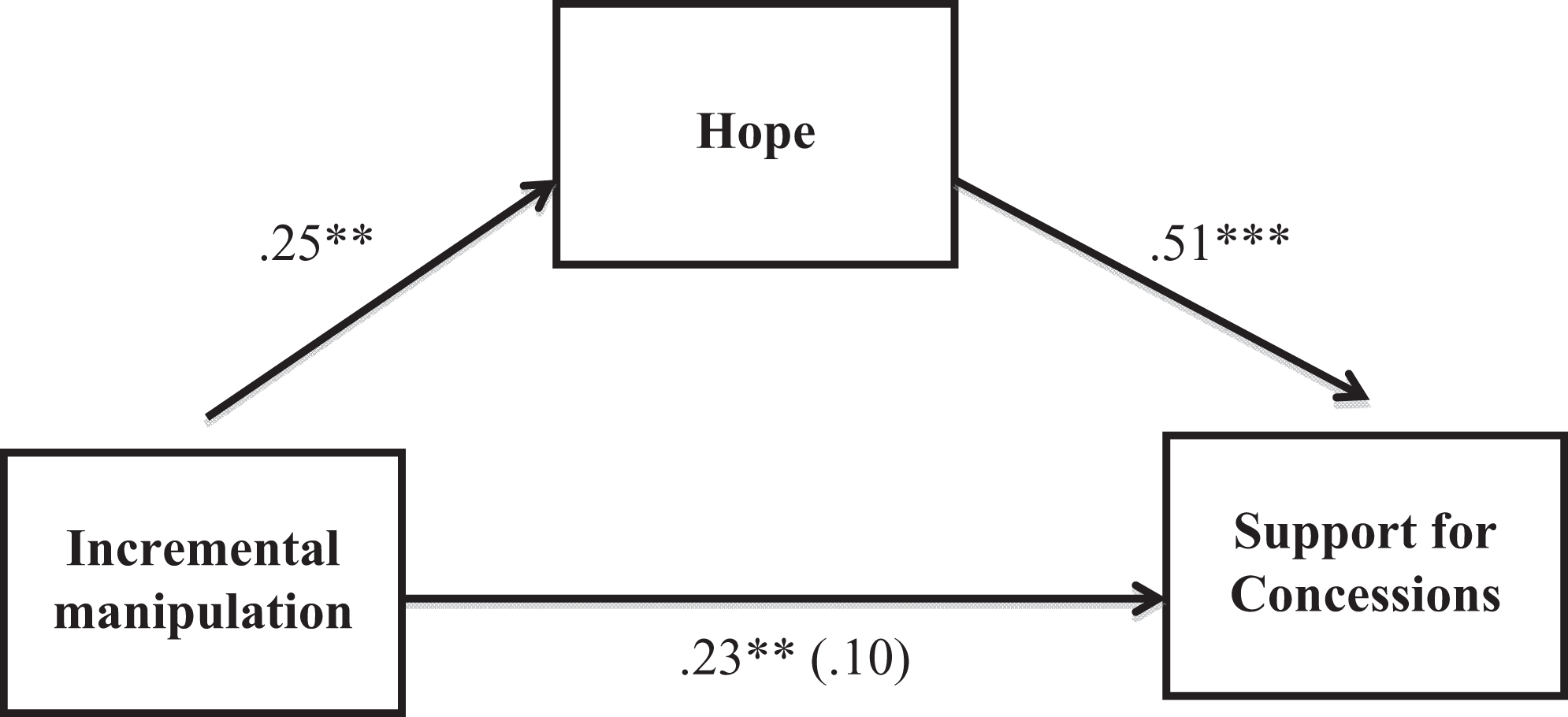
Hope mediates the effect of experimentally induced incremental beliefs about conflicts on support for concessions.
These findings suggest a causal role for malleability beliefs. Manipulating malleability beliefs led to increased hope as well as increased support for compromise. Mediational analyses indicated that changes in hope mediated the link between increased malleability beliefs and increased support for compromise.
General Discussion
One of the greatest barriers to resolving intractable conflicts is the perception that such conflicts are inherently unchangeable (Bar-Tal, 2007; Bar-Tal &Teichman, 2005; Kriesberg, 1993). This perception leads people to apathy and indifference, resulting in its perpetuation and continuation. To change this appraisal of the future as being stable and identical to the present, hope regarding the end of the conflict must be induced. Hope is associated with much-needed cognitive flexibility and has been associated with attitudes supportive of peacemaking within the context of conflict (Halperin & Gross, 2011; Moeschberger et al., 2005). However, two major questions remain: is it hope that causally drives this process, and how can hope be induced in the highly hopeless situation of intractable intergroup conflict?
Our two studies addressed these questions in the context of the Israeli–Palestinian conflict, a particularly prominent example of a protracted, ongoing conflict, in which the repeatedly erupting cycle of violence has led to the terrible cost of extensive destruction and widespread despair. Results from the first, correlational study indicated that participants who believe that conflict situations can change their nature in general were also more hopeful regarding the end of the Israeli–Palestinian conflict specifically, and this was in turn associated with higher support for concessions regarding the peace process. The second study established our proposed model’s causal direction: we successfully increased the participants’ levels of hope by influencing beliefs regarding the malleability of conflicts, and this led them to be significantly more supportive of concessions to peace. Taken together, these two studies point to a distinct mechanism in which an increased belief about the malleability of conflict situations induces higher levels of hope regarding the end of the Israeli–Palestinian conflict in the future, and this in turn increases support of major concessions needed in order to promote peace.
Theoretical and Applied Significance
Our findings hold theoretical implications both within the realm of emotions in intergroup conflict and the field of implicit theories. Many studies have established the significance of emotions in conflict (Bar-Tal, Halperin, & de-Rivera, 2007; Kelman, 1998; Petersen, 2002; Staub, 2005) and its resolution (Halperin et al., 2012; Reifen-Tagar et al., 2011). However, few have addressed the cardinal role of hope within this context, and the lion’s share of empirical evidence has been correlational. This research sheds new light on hope as a predictor of conciliatory action tendencies and attitudes within intractable conflicts. Additionally, these results uncover a new underlying mechanism, whereby hope regarding the end of a specific conflict can be induced relatively simply by inducing a malleability belief regarding conflicts in general.
This research also serves to expand the domain of implicit theories (Blackwell, Trzesniewski, & Dweck, 2007; Chiu, Dweck, et al.,1997; Halperin et al., 2011; Halperin et al., 2012; Heslin, Latham, & VandeWalle, 2005; Levy & Dweck, 1998; Plaks et al., 2001). Until now, researchers have focused on malleability beliefs concerned with specific and concrete entities such as individuals, groups, and institutions. However, since hope is an emotion focused upon a positive change in certain circumstances in the future (Lazarus, 1999; Snyder, 1994; 2000; Staats & Stassen, 1985; Stotland, 1969) and not a specific construct, it is a belief regarding conflict situations that is the driving force of hope, and this is the first time that beliefs regarding negative situations have been addressed. In addition to their theoretical implications, our findings have applied relevance. Successful use of a relatively simple manipulation of conflict malleability may serve as a basis for a large range of long-term educational programs to indirectly promote hope within conflict situations. Although we refer to hope as an intense, short-term emotion, short-term psychological interventions have been found to have long-term, recursive effects. It is not the intervention’s content alone, but the frequent application to various contexts, which creates the effect’s endurance over time (Yeager & Walton, 2011). Indirectly inducing hope may enable overcoming negative reactions to more direct approaches. The importance of hope within conflict resolution processes as well as the relatively simple and indirect message leading to its inducement is highly relevant to those who perceive peace as a worthy endeavor.
Limitations and Future Directions
By design, our studies focused on a particularly serious type of conflict, namely an intractable conflict. We found that in this context a malleability message had salutary effects. In other contexts, however, it is possible that a malleability message could backfire, leading to a perception of the conflict as changing for the worse. In the present studies, the situation was so negative that it is reasonable to conclude that the reference to malleability implied that the conflict situation could improve. In other conflict contexts, however, a malleability message might have a different meaning (e.g., that recent, hard-won gains might be lost over time), and this possibility should be addressed in future studies. In such studies, it would be interesting to examine the effectiveness of a message which (a) does not refer whatsoever to conflicts but to a more overarching conception of reality, and thus (b) overcomes the implied notion of improvement as opposed to malleability, positive or negative.
Future studies should also examine the effect that expressions of hope (rather than feelings of hope) toward the rival has on conflict resolution. Emotional experience and emotional expressions have been found to have opposite effects on outcomes for some emotions in interpersonal conflict resolution (Allred, Mallozzi, Matsui, & Raia, 1997; Ketelaar & Au, 2003; Sinaceur & Tiedens, 2006; Van Kleef, De Dreu, & Manstead, 2004; 2006). For example, positive affect is associated with creativity and integrative solutions in conflict resolution (Carnevale & Isen, 1986), but at the interpersonal level, expressions of happiness are associated with exploitation (Van Kleef et al., 2004). Therefore, it is conceivable that while experiencing hope may lead to concession making, expressions of hope from the outgroup may be perceived as weakness, decreasing support for concessions.
Finally, future research should examine this mechanism’s durability by studying whether the short-term manipulation would persist over time and outside the laboratory, in the face of ongoing “real-world” conflict-related events. It would also be prudent to investigate the presented effect’s source by adding a control group, representing the baseline regarding beliefs, emotions, and attitudes.
In summary, this research illuminates a new mechanism for promoting peace: increasing hope by inducing beliefs in the malleability of conflicts. In doing so, hope can lead to increased support for conciliatory attitudes within the context of intractable conflicts. The current theoretical integration demonstrates that beliefs about conflict malleability serve to increase the experience of hope, with major implications for the understanding of intergroup conflicts and their resolution. As such, this research contributes a novel dimension to the literatures on emotions in conflict and the field of malleability beliefs. On a more applied level, these and further studies could serve as a basis for interventions aimed at promoting peace in intergroup relations.
Footnotes
Acknowledgments
The authors would like to thank Professor Carol S. Dweck for her invaluable suggestions and feedback on earlier versions of this paper. The authors would also like to thank Tal Meidan-Lehman for her assistance in data collection for the current study.
Declaration of Conflicting Interests
The author(s) declared no potential conflicts of interest with respect to the research, authorship, and/or publication of this article.
Funding
The author(s) received no financial support for the research, authorship, and/or publication of this article.