



Abstract
We propose that dissent decisions involve a tension between shorter term group stability goals and longer term group change goals. Strongly identified members may be animated by either goal, and their behavior with respect to group norms is influenced by which is currently dominant. In two experiments, we manipulated construal level, a factor that affects goal selection, such that people are more likely to make decisions that further long-term goals at high (vs. low) construal level. As predicted, at high construal level, strong identifiers were more willing to dissent from group norms than weak identifiers; at low construal level, strong identifiers were equally or more conformist. These findings advance understanding of the motivational dynamics of dissent decisions and speak to the nature of depersonalization/self-categorization in groups. Identified members retained individual agency and exercised their own judgment regarding group norms, choosing to deviate when they perceived it to be in the group’s interest.
What happens to individual agency—the capacity to act on the basis of one’s own judgment—when people identify with groups? Social identity/self-categorization theorists posit a process of depersonalization, which involves “a shift towards the perception of the self as an interchangeable exemplar of some social category and away from perception of self as a unique person” (Turner, Hogg, Oakes, Reicher, & Wetherell, 1987, p. 50). Depersonalization research has often focused on changes in the self-concept and finds that when people identify with a salient social category, they perceive themselves as possessing more group normative characteristics and attitudes (e.g., Bennett & Sani, 2008; Onorato & Turner, 2004), which serve to guide behavior (e.g., Abrams, Wetherell, Cochrane, Hogg, & Turner, 1990; Terry & Hogg, 1996). On the basis of this assimilative process, one might infer an attenuation of individual agency, such that identified group members defer to group norms in decision making—they may rely on norms rather than personal judgment to define their goals and the appropriate means to achieve them.
However, an alternative perspective suggests that depersonalization may go deeper than this, and in a way that individual agency is retained. In this view, depersonalization involves not only changes to self-conception but a reconfiguration of the broader motivational system. When members identify with groups, they may shift from evaluating events and making decisions primarily in terms of personal level contingencies (individual gains/losses) to evaluating/making them primarily in terms of collective contingencies (group gains/losses; e.g., Brewer, 2008; Brewer & Kramer, 1986; De Cremer & van Dijk, 2002; De Cremer & van Vugt, 1999). From this perspective, individual agency can be retained—identified members make decisions and act on the basis of their own judgments about the interests of the group (see Reicher & Haslam, 2006; Reicher, Haslam, & Smith, 2012; Reicher, Spears, & Postmes, 1995).
It is difficult to tease these conceptions of depersonalization apart. Group norms are established, in large part, to foster cohesion, facilitate interaction, and project a positive group image (Campbell, 1990). Most of the time, therefore, conforming to existing norms is in the collective interest. 1 But, circumstances change, crises arise, competitors emerge, and patterns of behavior that served well in the past need to be changed. This makes dissent—challenges to extant norms—a particularly useful domain for differentiating between the two conceptions of depersonalization (Packer, 2008). If depersonalization simply reflects assimilation to a group prototype, then strongly identified group members should (in most instances; see McAuliffe, Jetten, Hornsey, & Hogg, 2003) be the least likely to deviate from group norms even when doing so would be in the group’s interest. However, if depersonalization involves a reconfiguration of the motivational system such that individuals make decisions on the basis of perceived collective contingencies, then strongly identified members might be the most likely to deviate from group norms if they are believed to be counter to the group’s interest. Consistent with this perspective, recent tests of the normative conflict model of dissent (Packer, 2008) have shown that identification with a group positively predicts dissent when members perceive group norms as collectively harmful or when collective (but not other types of) harms are salient (Crane & Platow, 2010; Packer, 2009; Packer & Chasteen, 2010; Tauber & Sassenberg, 2012).
Motivational Dynamics of Dissent Decisions
Here we take a closer look at the motivational dynamics of dissent decisions. If it is the case that depersonalization involves individual level agency, we expect to observe that intrapsychic factors that influence decision making when individuals make choices for themselves also influence decisions with regard to the collective interest. We advance a goal-conflict approach to dissent, which posits that dissent decisions confront identified group members with a conflict between competing goals and that these goals have an important temporal component. On one hand, these members possess present-oriented group stability goals: motives to promote a positive group image, foster cohesion, and maintain smooth interactions (e.g., Crocker & Luhtanen, 1990; Hogg, 2000; Tajfel & Turner, 1979). Conforming to extant norms maintains short-term stability, and avoids the sorts of immediate disruption associated with criticism and disagreement. On the other hand, strong identifiers may also hold future-oriented goals for group change: motives to become better, stronger, or more moral (see Ellemers, 1993; Johnson & Fujita, 2012; Reicher & Haslam, 2006; Tajfel & Turner, 1979). Dissenting from extant norms advances long-term change, but at the cost of present stability. Critically, both stability and change goals can be perceived to be in the collective interest. Whether identified members conform to or dissent from problematic group norms is likely to depend, therefore, on how they construe the collective interest—that is, on whether short-term stability or longer term change goals are dominant in a particular situation.
As a critical test of a goal-conflict approach to dissent, and of the more general hypothesis that strongly identified group members make decisions on the basis of their own judgments about group interests, we manipulated construal level, a psychological factor known to affect goal selection in other contexts (Freitas, Solovey, & Liberman, 2001; Fujita, Trope, Liberman, & Levin-Sagi, 2006). Construal level theory proposes that people represent events differently as a function of psychological distance (Liberman & Trope, 2008; Liberman, Trope, & Stephan, 2007). People engage in high-level construal of psychologically distant events (e.g., those in the far vs. near future), such that they are represented in terms of the global and abstract features that capture their essential meanings. As the specifics of events become more available with increasing proximity, people are able to engage in low-level construal—representing events in terms of the secondary and concrete details that make them unique. The influence of construal level on decision making can be profound (Liberman & Trope, 2008). Low-level construal promotes decisions that give greater weight to concrete and immediate considerations. In contrast, high-level construal causes people to make decisions that reflect broader and longer term concerns. Research in the domain of self-control, for example, demonstrates that high-level construal promotes a tendency to forgo smaller, immediate rewards in favor of larger, delayed rewards (e.g., Fujita et al., 2006; Fujita & Han, 2009; Malkoc, Zauberman, & Bettman, 2010).
Applying construal level to dissent decisions, we predicted that whereas low-level construal would enhance the more immediate goals of group stability, high-level construal would enhance long-term goals of group change. Two studies tested the hypothesis that construal level would moderate the relationship between collective identification and dissent from collectively problematic group norms, such that identification would predict greater dissent at a high but not a low level of construal. Study 2 tested the additional hypothesis that construal level should only affect behavior when group stability and group change goals conflict. That is, only when there are competing conceptions of the collective interest are factors that shift decisions toward longer term/broad (vs. immediate/narrow) concerns likely to influence behavior.
Study 1
In Study 1, we manipulated construal level as a function of temporal distance. We predicted that when strongly identified group members adopted a distant (vs. near) future perspective, they would be more motivated by group change than stability goals and thus more willing to dissent.
Method
Participants
Participants were 47 undergraduate psychology students at the University of Toronto. There were 21 males and 26 females, with a mean age of 20.00 years (SD = 5.06).
Procedure
Participants completed a scale assessing identification with the University of Toronto. Following Packer and Chasteen (2010), participants then received ostensible normative information regarding University of Toronto students’ attitudes toward plagiarism. They were informed that a majority of students at their university did not believe that plagiarism was a “big problem” and thought that first time offenses should be treated leniently. They were told that a recent poll had found that a majority of students at their university agreed with the statement that “although it should generally be avoided, plagiarism is not a serious offence.” After receiving the normative information, participants were randomly assigned to one of two conditions. In both cases, they were asked to spend a few minutes (self-timed) thinking about why plagiarism might be harmful to the university as a whole. However, in the low-level construal condition, they were asked to think about why plagiarism “may be harmful to the University of Toronto in the near future”; in contrast, participants in the high-level construal condition were asked to think about why plagiarism “may be harmful to the University of Toronto's long-term future.”
Following the manipulation, participants rated their willingness to express dissenting views regarding the plagiarism norm. The study concluded with a manipulation check and a full debriefing, which highlighted the university’s strict penalties for plagiarism.
Measures
Collective identification (α = .84) was measured with 6 items commonly used in the social identity literature (e.g., “I am proud to be a student at the University of Toronto,” “I have a strong sense of belonging to my university,” “Belonging to my university is an important part of my identity;” e.g., Packer & Chasteen, 2010). Participants responded from 1 (strongly disagree) to 6 (strongly agree).
Willingness to express dissenting opinions (α = .85) was measured with 7 items, which included “How willing would you be to write a letter to a student newspaper presenting arguments against plagiarism at the University of Toronto” and “How willing would you be to express negative opinions about plagiarism to other students in your classes.” Participants responded from 1 (not at all willing) to 6 (very willing).
In order to ensure that participants perceived the existence of a lax plagiarism norm, at the end of the study they completed a single item that asked them to estimate the percentage of students at the University of X who did not perceive plagiarism to be a serious offense. Estimates were made on an 11-point scale from 0% to 100%.
Results
Preliminary Analyses
The manipulation check indicated that most participants perceived the existence of a lax plagiarism norm. On average, participants estimated that 76.53% (SD = 18.56) of students did not believe that plagiarism was a serious offense, significantly more than a plurality, t(46) = 9.80, p < .001. Estimates of the norm did not vary as a function of construal level, identification or their interaction (ps > .40). Five participants estimated that 50% or less of the student body did not believe that plagiarism was a serious offense. It was important to test effects specifically among those people for whom opinion expression represented dissent (rather than conformity); as such, these participants were excluded from reported analyses.
Predicting Dissent
A hierarchical regression analysis predicting willingness to express dissent was conducted to test for the hypothesized interaction between construal level and collective identification. Condition was effects coded (−1 = short-term harm, +1 = long-term harm), and standardized identification scores were entered as a continuous predictor. Neither construal level nor identification exerted significant main effects on willingness to express dissent (ps > .20). Critically, however, there was a significant condition-by-identification interaction, β = .58, t(38) = 2.10, p < .05—see Figure 1. Under high-level construal, collective identification positively predicted willingness to express dissent, β = .41, t(20) = 2.07, p = .05. In contrast, under low-level construal, identification was unrelated to dissent, β = −.16, t(18) = −0.95, p > .30. Thus, consistent with the notion that a high level of construal tips the balance between group stability and group change goals in favor of the latter, the positive relationship we have previously observed between collective identification and dissent when group members attend to collective harm (Packer, 2009; Packer & Chasteen, 2010) was only evident among participants focused on longer (vs. shorter) term considerations.
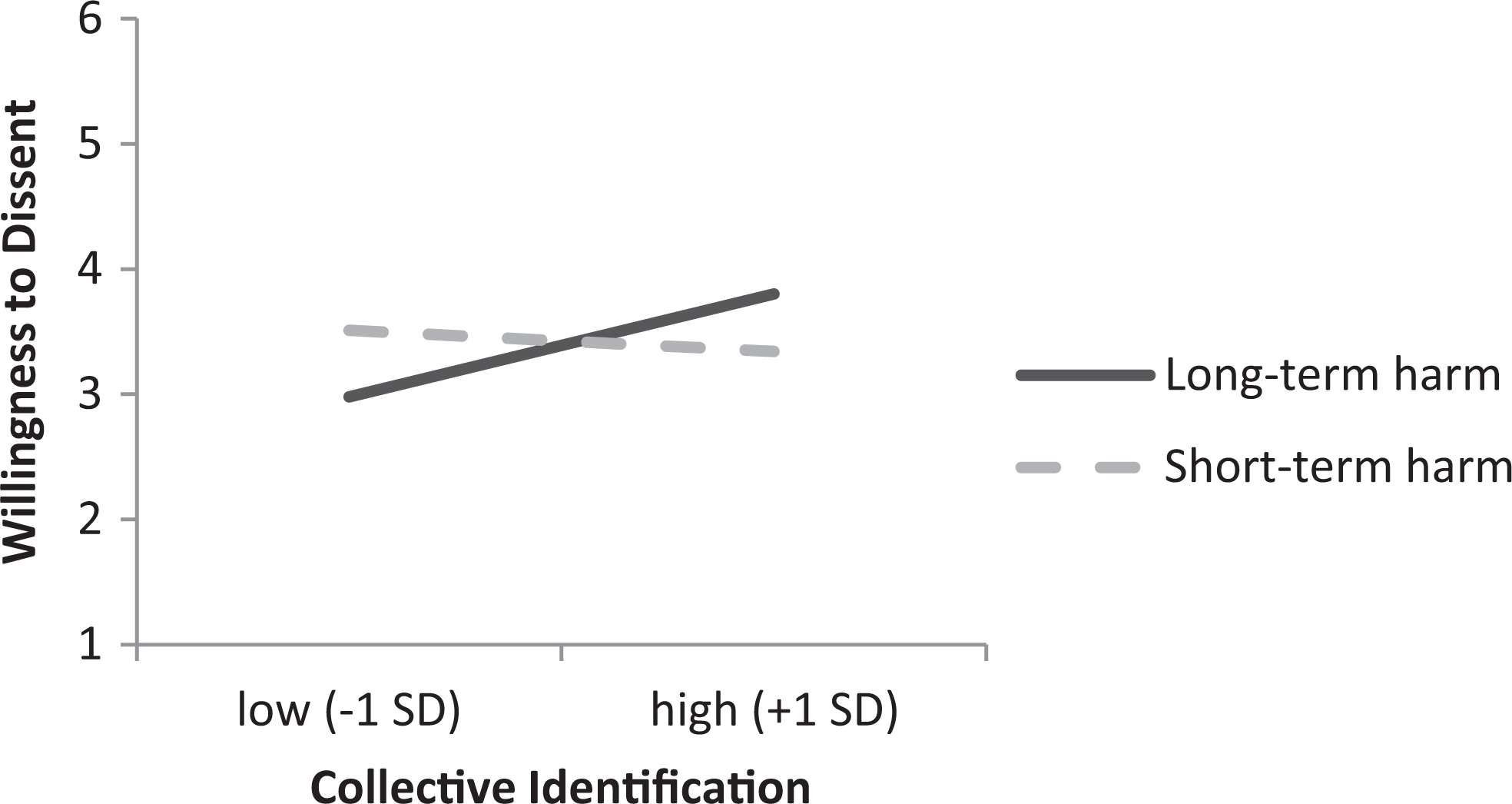
Construal Level × Collective Identification interaction predicting willingness to dissent.
Study 2
Strong conclusions from Study 1 are limited by a potential confound. We manipulated construal level by varying whether participants focused on long-term versus short-term harms caused by a group norm. It is possible that participants perceived long-term harms to be more serious than short-term harms and that the observed effects were driven by these differential perceptions of collective harm rather than differences in construal level per se. In order to provide a more direct and stringent test of our construal level predictions, in Study 2 we employed a manipulation unrelated to norms or opinion expression: In a separate task, we focused participants either on exemplars (specific, concrete information) or on categories (abstract, high-level information), a validated procedure that reliably primes construal-level mind-sets that then carry over to subsequent unrelated contexts (Fujita et al., 2006). We also manipulated a group norm. Rather than focusing on norms regarding specific attitudes or behaviors, we experimentally varied norms regarding the desirability of in-group criticism itself. In a 2 × 2 between-subjects design, participants identified a collective problem, were randomly assigned to a high- versus low-level construal condition, and then learned that fellow group members were likely to welcome versus spurn discussion of group problems. Further extending the previous study, participants then had the opportunity to give what they believed was an actual public expression of their opinion regarding the group problem they had identified in an online chat room. The dependent variable assessed the extent to which group members were willing to publicly assess the issue they had identified (privately) as problematic for the group (i.e., frame it as a serious problem), particularly when they knew that their interlocutors were opposed to in-group criticism.
The manipulation of group norms provides a critical test of the motivational dynamics proposed by the goal-conflict model. We propose that change and stability goals compete in dissent decisions for the highly identified, and that in such situations, high-level construal promotes change over stability. When the articulation of group problems is not normatively sanctioned, strongly identified group members do not face a goal-conflict: that other group members are unlikely to react negatively means that group stability goals (e.g., for cohesion, efficacy) are not at odds with group change goals. In these nonconflict situations, opinion expression is unlikely to be affected by construal level. Critically, however, when in-group criticism is normatively taboo, there is a clear goal-conflict between stability and change; as such, construal level was predicted to moderate the relationship between identification and opinion expression. As in Study 1, we expected that a positive relationship between identification and dissent (Packer & Chasteen, 2010) would only be evident among participants operating at a high level of construal.
Method
Participants
Participants were 185 undergraduate psychology students at Lehigh University who participated for extra course credit. There were 89 males and 95 females (one participant did not report demographic information), with a mean age of 18.60 years (SD = 1.08).
Procedure
Participants completed a measure of identification with Lehigh University embedded among other questionnaires. Following Packer, Fujita, and Herman (Under review), all participants were asked to identify an issue or problem they believed existed at their university. Instructions read: “In a couple of sentences, please describe a problem that you have noticed at Lehigh—a problem facing the university and its students. What is the problem, and what negative effects does it cause (or have the potential to cause)?” Participants were then randomly assigned to one of the two conditions that manipulated level of construal. They received a list of 30 nouns and were asked to generate either exemplars of each (low-level construal condition) or categories to which each belong (high-level construal condition).
Participants then entered an ostensible online chat room with five fellow students to “discuss issues relevant to the Lehigh community.” After logging in, participants were presented with two statements, one open to expressing criticism and one sanctioning criticism: In order to remain successful, groups should welcome the expression of critical opinions. Although it is sometimes difficult to hear, criticism of one’s own group is important when it comes to solving problems and remaining strong. In order to remain successful, groups should be careful about allowing the expression of critical opinions. Although it sometimes sounds good on the surface, talking about all the problems in a group can undermine and weaken it.
Participants were then asked to describe in a few words the issue facing Y (that they had identified earlier in the session) to the other members of the chat room (under the premise that they had randomly been selected to go first). Participants subsequently provided a public rating of their concern regarding the issue, which served as an index of the extent to which they were willing to publicly assess the issue as problematic for the group (i.e., frame it as a serious problem, consistent with or in violation of the manipulated norm). The study concluded with a manipulation check, a demographics questionnaire, and a full debriefing.
Measures
Identification (α = .92) was assessed with 10 items corresponding to the “self-investment” component of Leach et al. (2007) multidimensional measure of collective identification. On a scale from 1 (strongly disagree) to 6 (strongly agree), participants rated such statements as “I feel committed to Lehigh,” “I think that Lehigh University has a lot to be proud of,” and “Being a student at Lehigh is an important part of how I see myself.”
Participants provided an ostensibly public assessment of problem severity on a single item that read: “Please rate how concerned you are about this problem.” Responses ranged from 1 (I am not at all concerned that this is a problem) to 6 (I am highly concerned that this is a problem).
At the end of the study, participants were asked to indicate whether a majority of the members of their chat room were in favor of expressing or refraining from expression of opinions critical of the in-group.
Results
Preliminary Analyses
A large majority of participants (87%) selected the statement in favor of expressing in-group criticism as being most representative of their opinion. This rate did not vary as a function of construal level, χ2(1) = .09, p > .80. Analyses that included versus excluded participants who selected the other statement yielded the same pattern of results, and these participants were included in reported analyses. 2 The vast majority of participants (94.6%) also correctly answered the manipulation check question about the normative view regarding in-group criticism. Ten participants answered this question incorrectly and were excluded from reported analyses.
Predicting Expressions of Concern
A hierarchical regression analysis predicting public ratings of concern was conducted to test for predicted effects of construal level, the degree to which discussion of group problems was counternormative and collective identification. The condition variables were effects coded (construal level: −1 = low, +1 = high; norm: −1 = criticism acceptable, +1 = criticism taboo), and standardized identification was entered as a continuous predictor. There was a marginally significant main effect of construal level, β = .16, t(171) = 1.76, p = .08, such that participants in the high-level construal condition (M = 4.29, SD = 1.10) expressed greater concern regarding their identified group problem than participants in the low-level construal condition (M = 3.96, SD = 1.29). The only statistically significant effect was the hypothesized three-way interaction between construal level, group norm, and identification, β = .20, t(167) = 2.14, p < .05—see Figure 2. We decomposed the interaction by examining effects of construal level and identification separately within the criticism acceptable versus criticism taboo conditions. There were no significant effects among participants in the criticism acceptable condition; as such, public expressions of concern did not vary as a function of construal level, β = .16, t(88) = 1.34, p = .19, identification, β = −0.06, t(88) = −0.50, p > .60, or their interaction, β = −0.08, t(87) = −0.52, p >.50, when the group had indicated it was legitimate to raise collective problems.
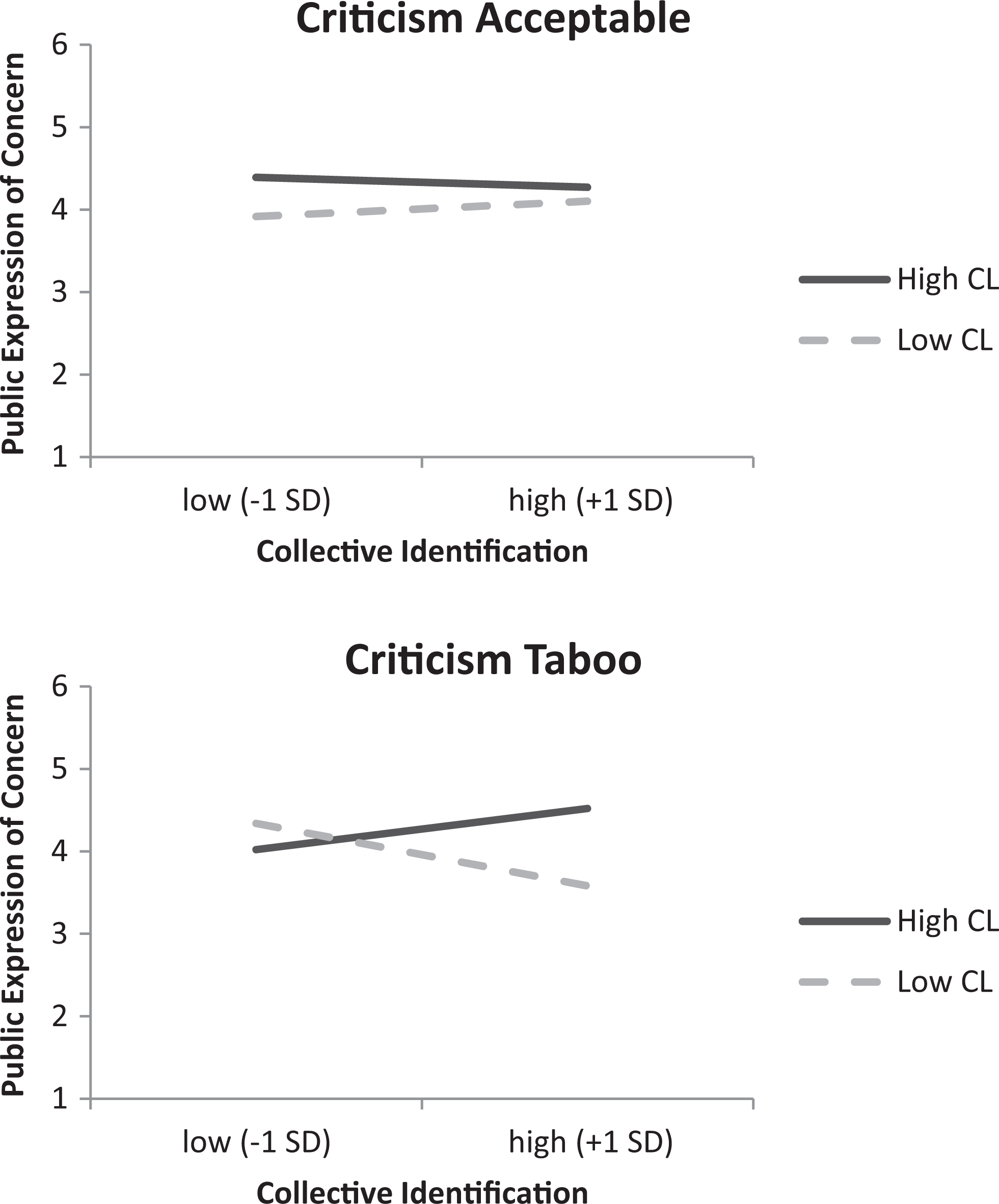
Construal Level × Norm × Collective Identification interaction predicting public expression of concern.
Critically, there was a significant Construal Level × Identification interaction among participants in the criticism taboo condition, β = .32, t(80) = 2.91, p < .01. Decomposition of this interaction revealed that when it was normative to avoid discussion of group problems, members in the low-level construal condition exhibited a negative relationship between identification and expressions of concern, β = −.38, t(44) = −2.12, p < .05. As such, identification was associated with conformity to the norm prohibiting in-group criticism when group members were at a low level of construal. In dramatic contrast, group members operating at a high level of construal faced with the same norm exhibited a positive relationship between collective identification and expressions of concern, β = .26, t(36) = 2.15, p < .05. Thus, when group members were at a high level of construal, identification predicted dissent; strongly identified members thinking abstractly were willing to publicly assess an issue as problematic for their group despite knowing that doing so was contrary to the norm among their interlocutors.
General Discussion
These two studies provide strong evidence for a goal-conflict approach to dissent. We propose that dissent decisions involve a tension between shorter term group stability goals and longer term group change goals. Strongly identified group members may be animated by either type of goal, and their behavior with respect to group norms in a particular situation is likely to be determined by which goal is currently dominant. We manipulated construal level, a factor known to affect goal selection, such that people are more likely to make decisions that further longer term and broader goals at a high construal level. Study 1 varied temporal focus and Study 2 employed a direct manipulation of construal level in which participants’ attention was focused on abstract versus concrete features. In both studies, a positive relationship between identification and dissent was only observed in the high construal level conditions.
Study 2 is particularly important. First, it suggests that the effect of temporal focus in Study 1 was indeed mediated by changes in construal level. Second, this study directly tested the motivational dynamics that the goal-conflict approach posits: Construal level only influenced decisions with respect to group norms when stability and change goals were in conflict. When articulation of group problems was normatively acceptable, group members’ willingness to express their opinion was unrelated to identification or construal level. In contrast, when criticism was taboo and striving for change was in tension with extant norms, construal level fundamentally altered the relationship between identification and responses to norms. At low low-level construal, strong identifiers conformed more to the norm (i.e., were less willing to express concern with a group problem) than weak identifiers. At high-level construal, however, strong identifiers dissented more from the norm than weak identifiers. This highly specific pattern of results demonstrates the motivational dynamic between conflicting stability and change goals, and how high-level construal tips the balance in favor of change when the two are in competition.
At broader level, these findings speak to the nature of depersonalization—what happens to individual agency when people identify with social groups. Consistent with other recent research (e.g., Packer, 2009; Packer & Chasteen, 2010; Reicher & Haslam, 2006), identified group members in our studies did not exhibit an attenuation in individual agency such that they blindly conformed to group norms. Rather, they exercised their own judgment with respect to the norms, choosing to deviate when they perceived dissent as being in the interest of the group. Importantly, the current studies go beyond previous research by demonstrating that intrapsychic factors that influence decision making when people make decisions for themselves also influence decisions with regard to the collective interest. This provides direct evidence that depersonalization involves more than simply changes to the working self-concept (e.g., self-stereotyping), but also involves a reconfiguration of the motivational system. Group-oriented decisions are affected by the same motivational dynamics as individually oriented decisions.
Future Directions
In future research, it will be important to consider the influence of other motivational factors. Previous findings suggest, for example, that regulatory focus is likely to be important, such that prevention (vs. promotion) focus has been observed to reduce openness to change (Liberman, Idson, Camacho, & Higgins, 1999). This may suggest to some that prevention foci should reduce willingness to dissent. We hypothesize, however, that dissent can be both promotion oriented (aimed at advancement and gain) and prevention oriented (aimed at averting losses and maintaining security; see also Liberman et al., 1999; Scholer, Stroessner, & Higgins, 2008; Scholer, Zou, Fujita, & Stroessner, 2010). Integrating construal level and regulatory focus, future research might test the hypothesis that whereas a high-level construal shifts group members’ goals from stability to change, regulatory focus affects which type of change goals (gain vs. loss focused) they are most motivated by.
Our conclusions are, of course, limited by our paradigms. The chat room paradigm, for example, did not measure dissent to the full group. Rather, participants expressed their opinion to a subset of members who had indicated that they disliked criticism of the full group. Participants may have believed that although the local norm was counter to criticism, there was norm in favor of criticism in the larger collective. Further research is required to investigate the interactive dynamics of subordinate versus superordinate group norms (Packer, 2008). That said, we observed analogous effects when participants were asked about their willingness to articulate criticism to a wider audience (Study 1), which bolsters our confidence in the generalizability of these effects.
We have suggested that construal level alters the relationship between collective identification and dissent because it shifts group members’ goals. It is additionally possible that construal level influences members’ identification with the group, given that categorization of the self at a collective (vs. individual) level may be more abstract. However, it is unlikely that shifts in levels of identification can fully explain the interactive effects we observed. If construal level were simply exerting an effect on identification, we would expect heightened dissent among weak identifiers in the high construal level conditions—strong identifiers already self-categorize at the collective level, so the effect of the manipulation should occur only (or have a greater effect) among those who typically do not. There was no evidence for such an effect. To further rule out changes in identification as an explanation for the current findings, we ran a third experiment in which 52 students at Lehigh University completed the category versus exemplar construal level manipulation from Study 2 before the same 10-item measure of collective identification. There was no significant difference between the conditions, t(50) = 1.58, p = .12, and the pattern of means was in the opposite direction, such that identification was slightly higher in the low construal (M = 4.46, SD = .85) than the high construal level (M = 4.03, SD = .98) condition.
Practical Implications
Our findings also have important applied implications. Effective long-term organizational and civic functioning is dependent on groups engaging in critical self-assessment and collective change. The current studies suggest that groups interested in fostering collectively oriented dissent should pay careful attention to the mind-sets in which their members operate. As we have seen, dissent is most likely among strong identifiers when they approach decisions abstractly and adopt a long-term perspective. However, it is worth considering just how often this occurs in contemporary decision-making contexts. Companies’ share prices are highly dependent on quarterly earnings (Bushee, 1998; Rappaport, 2005); industrial, environmental, and international crises involve heavy time pressure (Flin, Slaven, & Stewart, 1996); and political decisions are increasingly oriented toward the next election (Cook, 2002). In these circumstances, it is likely that decision makers often adopt a short-term focus. Rather than taking broad and long-term considerations into account, group members are likely to focus on immediate considerations, which in many normative climates is likely to lead to conformity and suppression of in-group criticism. Further research into these processes and, in particular, into mechanisms for encouraging divergent thought and dissent in pressurized decision-making environments is urgently needed.
Footnotes
Declaration of Conflicting Interests
The author(s) declared no potential conflicts of interest with respect to the research, authorship, and/or publication of this article.
Funding
The author(s) disclosed receipt of the following financial support for the research, authorship, and/or publication of this article: This research was supported, in part, by a post-doctoral fellowship from the Social Sciences and Humanities Research Council of Canada to DJP.