



Abstract
National data on romantic relationships reveal a prominent gap between members of devalued and dominant groups in the United States, with devalued group members experiencing less positive relationship outcomes. However, little research examines how social stigma affects relationship quality for members of devalued groups and moderating factors have generally not been explored in the literature. In the current studies, we experimentally examined the effects of social stigma on relationship quality among women (Study 1) and African Americans (Study 2) as well as whether these effects differed based upon relationship length (Studies 1 and 2). Results showed that individuals involved in shorter relationships reported lesser relationship quality after social stigma was made salient, while those involved in longer relationships reported somewhat greater relationship quality after social stigma was made salient. Implications for future research on social stigma and relationship quality as well as moderating factors are discussed.
Interpersonal bonds are a fundamental human need, irrespective of race, gender, or other social group memberships (Baumeister & Leary, 1995). While various types of close relationships can fulfill the need for interpersonal connection (e.g., friendships, filial relationships), romantic relationships are generally among the most consequential for adults (Hazan & Zeifman, 1994; Reis, Clark, & Holmes, 2004). Yet, statistics on the stability and quality of romantic relationships in the United States reveal a striking pattern: Across various social identities, members of devalued groups consistently experience impaired relationship outcomes compared to members of dominant groups. For example, there are stark gender and racial differences in statistics related to marriage and divorce. Women are more likely to initiate divorce compared to men (Kitson, 1992) and women are less likely to remarry once divorced (U.S. Census Bureau, 2011). Similarly, African Americans are less likely to be married compared to Whites and are also more likely to be divorced (U.S. Census Bureau, 2011). Moreover, for both women and African Americans who do marry, they tend to be less satisfied with their marriages relative to men (Kitson, 1992) and Whites (Bulanda & Brown, 2007), respectively.
Collectively, these data suggest that members of devalued groups in the United States experience higher levels of impairment in romantic relationship quality relative to members of dominant groups. Theorists have offered a number of different explanations for impaired relationship quality among members of devalued groups, including unequal distribution of household labor in many heterosexual marriages (Coltrane, 2000) and a shortage of marriageable men (partly due to incarceration) among African Americans (South & Lloyd, 1992). However, theories meant to explain impairments in romantic relationship quality generally do not focus on the direct effect of a critical variable in the lives of socially devalued group members—social stigma. Social stigma refers to the potential for an individual to be discredited due to possession of a devalued social identity (Crocker, Major, & Steele, 1998; Goffman, 1963). When the stigma attached to one’s social identity is made salient, such as through prejudice and discrimination, members of devalued groups tend to experience a sense of threat (Steele, Spencer, & Aronson, 2002). However, one does not necessarily have to encounter prejudice and discrimination to experience social identity threat. Past research has shown that reminders of one’s devalued position in society can engender threat and consequent stress responses in members of stigmatized groups (Major & O’Brien, 2005; McCoy & Major, 2003).
Relevant to the current work, stressors have been shown to be capable of contaminating romantic relationships (Karney & Bradbury, 1995; Randall & Bodenmann, 2009; Story & Bradbury, 2004). In the context of relationships, stressors can be both internal (e.g., a quarrel with one’s partner over what movie to watch) and external (e.g., having a bad day at work before returning home to one’s partner). One way in which external stressors may contaminate romantic relationships is through impaired relationship perceptions (Neff & Karney, 2004). Only recently have researchers begun to recognize that the chronic stress of social stigma may constitute a burden on the romantic relationships of members of devalued groups (e.g., Doyle & Molix, 2013; Murry, Brown, Brody, Cutrona, & Simons, 2001; Trail, Goff, Bradbury, & Karney, 2012), potentially contributing to the aforementioned disparities in relationship outcomes. Yet, none of this work has experimentally examined the effects of acute threats to social identity, or social stigma salience, on romantic relationships. Furthermore, factors that could potentially moderate these effects, such as relationship length, remain underexplored in the literature.
Despite sobering statistics on impaired relationship quality among members of devalued groups, not all romantic relationships of devalued group members inevitably fail; many do in fact thrive and succeed. If social stigma is stressful and taxes romantic relationships, how can this be? We propose that when faced with threats, some individuals pull away from their romantic relationships, while others are able to draw closer. Past research has shown that security and trust in one’s romantic partner are essential to successful relationship adaptation following acute threats (Murray, Holmes, & Collins, 2006; Simpson & Rholes, 2012). Specifically, the risk regulation model of dependence has revealed that those who are not secure in their romantic partners’ positive regard are more likely to distance themselves from their relationships following a variety of different types of acute threats (Murray, Bellavia, Rose, & Griffin, 2003; Murray et al., 2006; Murray, Holmes, MacDonald, & Ellsworth, 1998). In contrast, those who are secure in their partners’ positive regard are able to draw upon their relationships and their romantic partners as a source of affirmation following threat (Murray, Bellavia, Feeney, Holmes, & Rose, 2001; Murray et al., 1998). Importantly, in much of this work, individual differences such as self-esteem and attachment style are used to model perceived regard.
Generally, past studies have found that individuals involved in relationships marked by greater interdependence (Rusbult & Buunk, 1993) as well as greater stability (Simpson, 1987) may be more likely to persist in the face of threats. Since relationship length, like self-esteem and attachment style, is closely associated with interdependence and relationship stability (e.g., Arriaga, 2001; Fletcher, Fincham, Cramer, & Heron, 1987; Kirkpatrick & Davis, 1994; Le, Dove, Agnew, Korn, & Mutso, 2010; Simpson, 1987), we predicted that relationship length might moderate the effects of stigma-related stress on relationship quality. Research from an attachment theory perspective has shown that romantic partners take about 2 years on average to form mature and complete attachment bonds (Fraley & Davis, 1997; Fraley & Shaver, 2000; Hazan & Zeifman, 1994). Once romantic partners secure these bonds, they become more likely to trust in each other’s unconditional positive regard (Murray et al., 2006). Additionally, individuals involved in longer relationships may have greater coping resources to draw upon when faced with specific external stressors. For example, past experience with external stressors, including prejudice and discrimination, may inoculate romantic partners against deleterious effects of these same stressors on their relationships in the future (Neff & Broady, 2011). As relationships progress and external challenges are encountered along the way, romantic partners may become more practiced and adept at managing the impact of those stressors on their relationships.
Although external stressors can have deleterious effects on all relationships, past research has shown that individuals involved in shorter relationships are generally less resilient to the negative effects of acute stress on relationship functioning (Fraley & Shaver, 1998; Howe, Levy, & Caplan, 2004). For example, after job loss, relationship quality for those involved in shorter relationships is more negatively affected relative to those involved in longer relationships (Howe et al., 2004). Based upon such findings, we hypothesized that individuals involved in shorter relationships would be more vulnerable to the threat engendered by acute social stigma salience relative to those involved in longer relationships.
Despite the fact that researchers have not examined the acute effects of social stigma on romantic relationships, previous research suggests that chronic prejudice and discrimination, or self-reported experiences of discrimination in one’s daily life, may constitute a burden on the romantic relationships of members of devalued groups (e.g., Doyle & Molix, 2013; Murry et al., 2001; Trail et al., 2012). Although the stigma attached to female gender is in some ways qualitatively distinct from other stigmas in that women are valued for their reproductive capacity and thus hold a vital and protected position in society (Glick & Fiske, 1996), women continue to comprise a devalued social group in the United States. While much research on social stigma has focused on the social category of gender (e.g., Crocker, Voelkl, Testa, & Major, 1991; Schmitt, Branscombe, Kobrynowicz, & Owen, 2002), no research of which we are aware has directly examined whether women’s perceptions of sexism impact their romantic relationships.
Among racial minorities, including African Americans, a few studies of chronic perceived discrimination have found evidence for negative effects on romantic relationships (e.g., Doyle & Molix, 2013; Lincoln & Chae, 2010; Murry et al., 2001, 2008). Notably, a recent random sampling study focusing on Latino newlyweds living in low-income neighborhoods in Los Angeles found that chronic perceived discrimination was predictive of impaired marital quality, both self-reported and observer-rated (Trail et al., 2012). Germane to the current conceptualization of relationship length as a moderating factor, the authors suggested that their results may have differed had they included participants involved in longer relationships in addition to newlyweds: “Although studying first-married newlyweds helps control for cohort effects, the implications of discrimination … may vary in more established marriages” (p. 9). The authors further described how newlywed couples might be more vulnerable to the stress of prejudice and discrimination compared to those involved in more established marriages because of selection effects: Less stable relationships may break up earlier thus resulting in greater stability among those involved in longer relationships. This speculation is in line with the hypotheses of the current research.
Present Research
Taken together, there appears to be some initial evidence that social stigma acts as a stressor that depletes romantic relationship quality for members of devalued groups whose relationships are relatively vulnerable. However, all of the previously reviewed work conducted to date has been cross-sectional, which limits our understanding of the directionality of effects. Furthermore, factors that could moderate the effects of social stigma on relationship quality, such as relationship length, have not yet been examined. We conducted two studies in order to experimentally investigate the effects of acute social stigma salience and the moderating role of relationship length on romantic relationship quality among members of devalued groups in the lab. Across studies, we predicted that stigma salience would impair relationship quality for those involved in shorter relationships but not those involved in longer relationships. In addition, in order to highlight the importance of social stigma across different types of devalued groups, we investigated the effects of both sexism (Study 1) and racism (Study 2).
Study 1
The purpose of the first study was to test the effects of a manipulation of social stigma on self-reported romantic relationship quality, with the hypothesis that those in the stigma salience condition would evidence impaired romantic relationship quality relative to those in the control condition. Additionally, we investigated the moderating role of relationship length, predicting that women involved in shorter relationships would be more vulnerable to the stigma salience manipulation relative to women involved in longer relationships.
Method
Participants
Eighty-nine women currently involved in romantic relationships participated in exchange for partial fulfillment of course requirements, extra course credit, or $10 compensation. The mean age of participants was 21.15 (SD = 7.21) and the mean relationship length was 19.39 months (SD = 32.78). Participants were primarily White (76.4%), but included those who identified as African American (10.1%), Asian (7.9%), and Hispanic (3.4%). Because national data on marriage and divorce suggest a racial gap in relationship quality and the focus of Study 1 was on social stigma based exclusively upon the category of gender, race was controlled for in the following analyses (similarly, gender was controlled for in Study 2). 1
Materials and Procedure
Participants for Study 1 were recruited from a private university as well as the surrounding community. This quasi-experimental study employed a single-factor design with two levels (condition: control, stigma salience) and measurement of the proposed continuous moderator (relationship length: shorter, longer). 2 Specifically, women were asked to complete a series of demographic questions (including relationship length) and then shown one of the two articles ostensibly from a local newspaper (a manipulation adapted from prior work on social stigma; McCoy & Major, 2003). In the stigma salience condition, the article described the continued prevalence of discrimination based upon gender and its impact on women’s lives. In the control condition, the article described efforts to preserve a local park. Both articles were of similar length and included personal quotes as well as relevant statistics. As a manipulation check, after reading the article participants were asked to briefly summarize its content. Finally, participants completed a measure of relationship quality.
Relationship Quality
Relationship quality was assessed via the love subscale of the perceived relationship quality components inventory (Fletcher, Simpson, & Thomas, 2000). Participants responded to each question from this 3-item measure on a scale ranging from 1 (not at all) to 7 (extremely). A sample item from this measure is, How much do you cherish your partner? The internal consistency for this measure in the current study was α = .93, consistent with high reliabilities reported in past research (e.g., Fletcher et al., 2000).
Results and Discussion
One woman responded incorrectly to the manipulation check and therefore her data were excluded from the analyses. Next, data were screened for normality with relationship length evidencing significant positive skew. We transformed relationship length by calculating the square root of this variable prior to entering it into analyses. The transformed values are reported in all of the following analyses for Study 1 as well as Study 2; however, analyses with relationship length entered as an untransformed variable revealed an identical pattern of effects in both studies (and all simple slopes for the effects of condition on relationship quality were found to be significant at p < .05 in these analyses with relationship length untransformed).
In order to test the main hypotheses, we utilized hierarchical linear regression analyses, entering race (effects coded as −1 = White, 1 = non-White), condition (effects coded as −1 = control, 1 = stigma salience), and relationship length, which was mean-centered, on the first step. On the second step, we added the interaction between condition and relationship length. The criterion variable in these analyses was relationship quality.
As displayed in Table 1, there was a significant main effect of relationship length on relationship quality but no main effect of condition. However, as predicted, this main effect of relationship length was qualified by a significant interaction between condition and relationship length predicting relationship quality. In order to probe this interaction, we followed the recommendations of Aiken and West (1991) and computed simple slopes for the association between relationship length and relationship quality in both the control and the stigma salience conditions. These results are plotted in Figure 1. In the control condition, relationship length was not associated with relationship quality, b = .05, standard error (SE) = .07, β = .08, p = .54. However, in the stigma salience condition, relationship length was positively associated with relationship quality, b = .39, SE = .11, β = .69, p = .001.
Study 1: Hierarchical Linear Regression Analyses Predicting Relationship Quality From Condition, Relationship Length, and Their Interaction Among Women in Study 1.

Note. SE = standard error.
N = 88. R 2 = .14.
*p < .05.
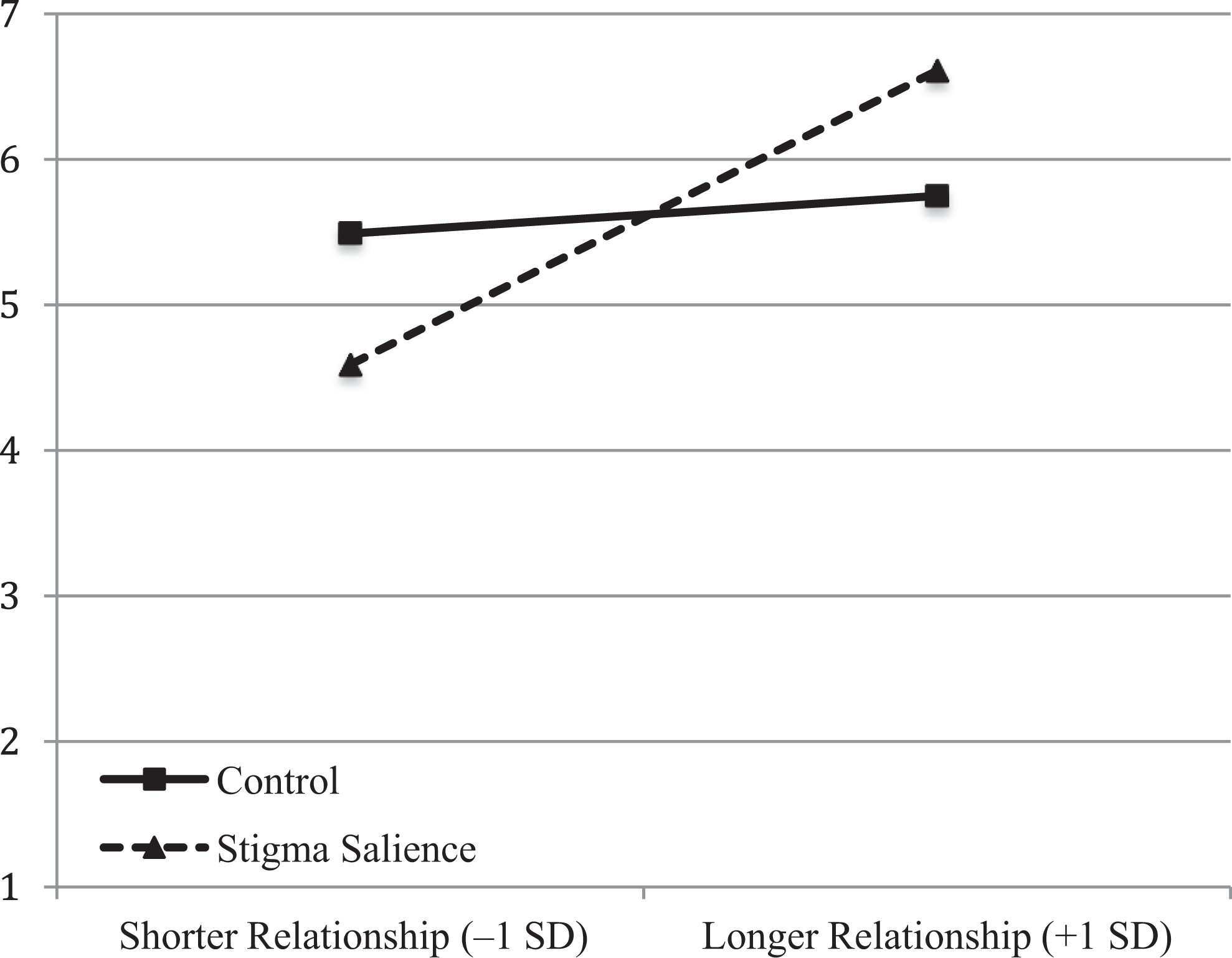
The association between relationship length and relationship quality moderated by condition among women in Study 1.
Having found that condition moderated the association between relationship length and relationship quality, we next examined our specific hypothesis of relationship length as a moderator of the effects of condition on relationship quality. We examined the effects of condition on relationship quality by calculating simple slopes for shorter relationships (−1 SD) and longer relationships (+1 SD) separately. We found that for those involved in shorter relationships, stigma salience significantly decreased relationship quality, b = −.46, SE = .23, β = −.31, p < .05. In contrast, for those involved in longer relationships, stigma salience marginally increased relationship quality, b = .43, SE = .23, β = .29, p = .06. Overall, the proposed model was found to be significant and accounted for approximately 14% of the variance in relationship quality, F(4, 83) = 3.22, p = .02, R 2 = .14.
In summary, in Study 1, we found that a manipulation of social stigma salience had divergent effects on women involved in shorter compared to longer relationships. Consistent with hypotheses, social stigma impaired relationship quality for those involved in shorter relationships. For those involved in longer relationships, however, social stigma actually appeared to increase self-reported relationship quality.
Study 2
The purpose of the second study was to replicate the effects observed in the previous study with a different devalued group: African Americans. In addition to replication, another reason for selecting African Americans as the target social group in Study 2 is that in Study 1, women’s romantic partners were predominantly members of dominant groups (i.e., White men). 3 Therefore, we wanted to provide evidence for these effects with participants who were primarily involved in romantic relationships with members of the same devalued group (i.e., African Americans). Another goal of Study 2 was to adjust the control condition in order to demonstrate that the previously observed effects were not due to the salience of stigma in general, but rather the salience of stigma associated with one’s own social group. This altered control condition was designed to provide a more rigorous examination of our hypotheses.
Method
Participants
One hundred African Americans (57 women) currently involved in romantic relationships participated in exchange for course credit or $10 compensation. The mean age of participants was 23.03 (SD = 7.29) and the mean relationship length was 25.32 months (SD = 52.18). Gender was controlled for in all analyses.
Materials and Procedure
Participants for Study 2 were recruited from two private universities (one of which was a historically Black university) as well as the surrounding community. Just as in Study 1, in Study 2, we employed a single-factor design with two levels (condition: control, stigma salience) and measurement of the proposed continuous moderator (relationship length: shorter, longer). All procedures for Study 2 were identical to those for Study 1, except that in the stigma salience condition participants read an article describing the prevalence and consequences of discrimination against African Americans in the United States (i.e., a relevant social group), while those in the control condition read an identical article describing the prevalence and consequences of discrimination against the Inuit in Canada (i.e., an irrelevant social group). This difference in social groups was meant to trigger social stigma only when the relevant group was discussed. As a manipulation check, after reading the article participants were asked to briefly summarize its content as well as select the social group to which the article referred (Asian Americans, African Americans, or the Inuit). Finally, participants completed the same measure of relationship quality utilized in the previous study, which again evidenced good internal consistency (α = .82).
Results and Discussion
One participant responded incorrectly to the manipulation check and thus was dropped from the analyses and a second participant was excluded because after identifying to the researcher as African American, the participant listed a race other than African American as primary identification in the demographic section. As in the previous study, we utilized hierarchical linear regression analyses, entering gender (effects coded as −1 = male, 1 = female), condition (effects coded as −1 = control, 1 = stigma salience), and relationship length, which was mean-centered, on the first step. On the second step, we added the interaction between condition and relationship length. Once again, the criterion variable in these analyses was relationship quality.
As shown in Table 2, there was a significant main effect of relationship length on relationship quality but no main effect of condition. However, this main effect of relationship length was qualified by a significant interaction between condition and relationship length, just as in Study 1. In order to probe this interaction, we once again computed simple slopes for the association between relationship length and relationship quality in both the control and the stigma salience conditions. These results are plotted in Figure 2. In the control condition, relationship length was marginally associated with relationship quality, b = .09, SE = .05, β = .21, p = .06, while in the stigma salience condition, relationship length was once again positively associated with relationship quality, b = .28, SE = .08, β = .69, p = .001.
Study 2: Hierarchical Linear Regression Analyses Predicting Relationship Quality From Condition, Relationship Length, and Their Interaction Among African Americans in Study 2.
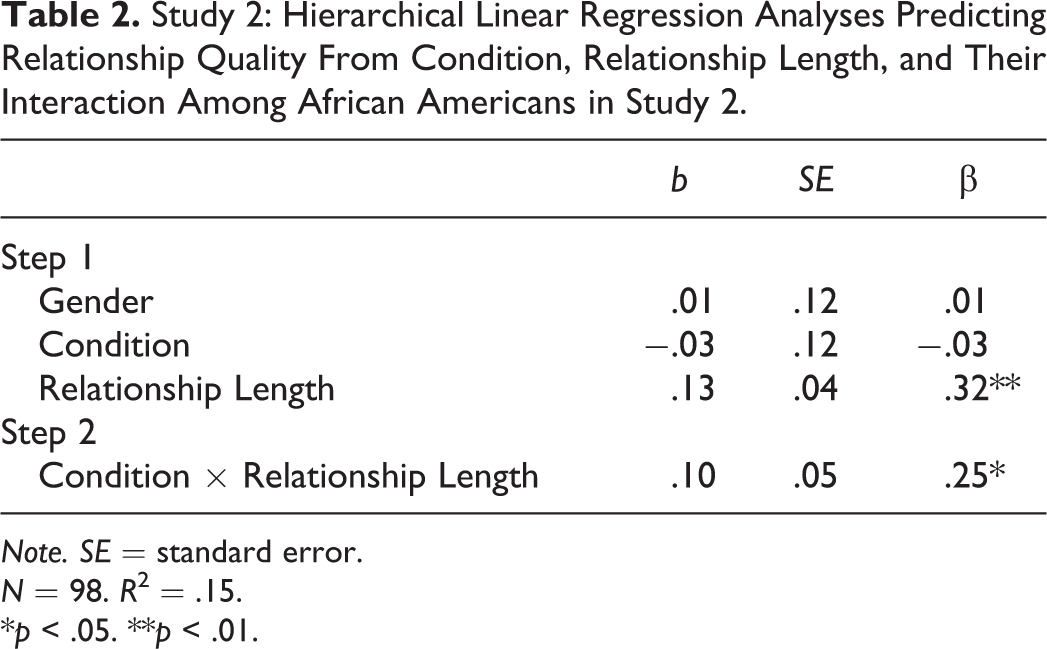
Note. SE = standard error.
N = 98. R 2 = .15.
*p < .05. **p < .01.
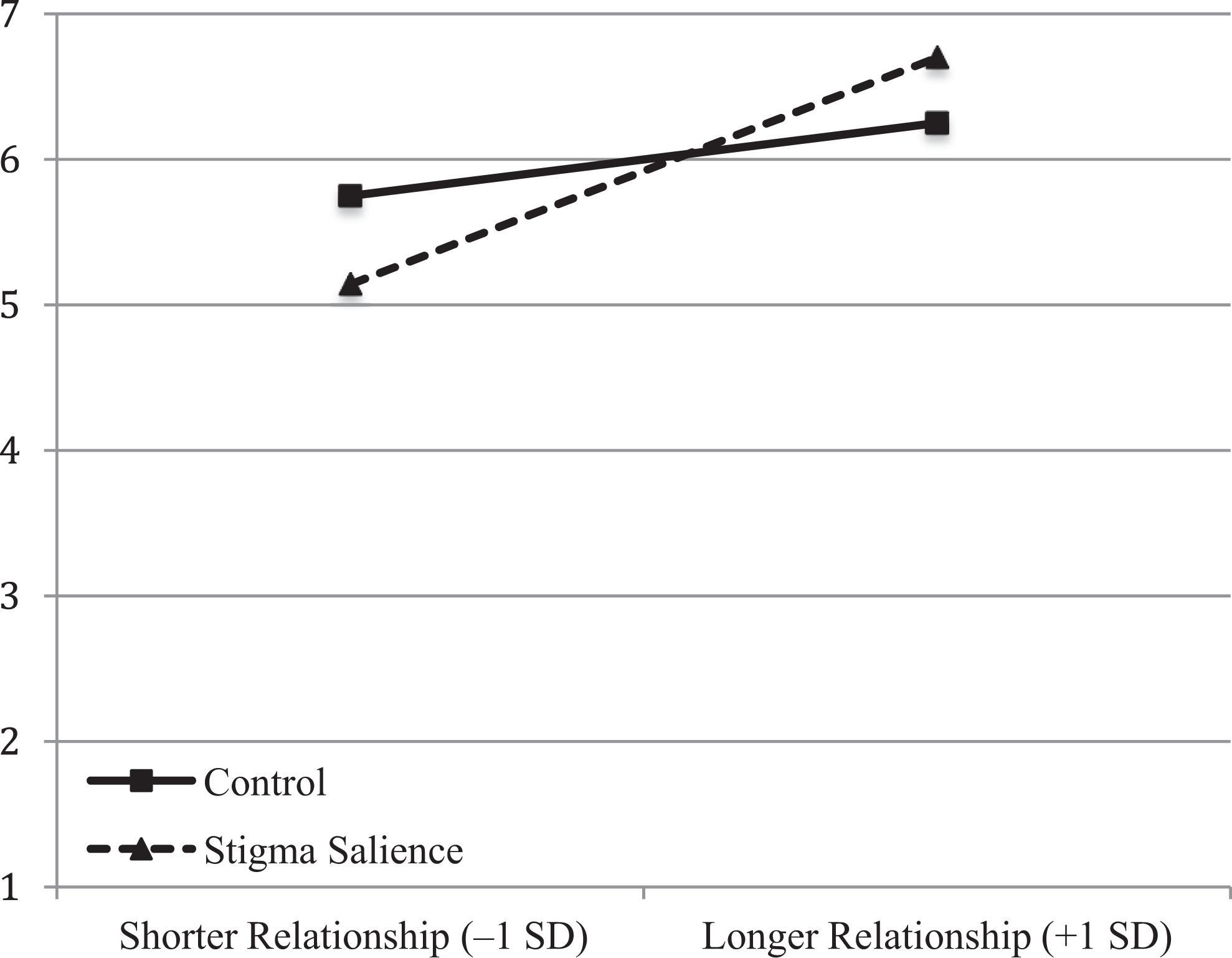
The association between relationship length and relationship quality moderated by condition among African Americans in Study 2.
As in Study 1, we tested our specific hypotheses regarding the effects of condition on relationship quality by calculating simple slopes for those involved in shorter relationships (−1 SD) and longer relationships (+1 SD) separately. In line with results from the previous study, for those involved in shorter relationships, stigma salience marginally decreased relationship quality, b = −.30, SE = .17, β = −.25, p = .09, while for those involved in longer relationships, stigma salience resulted in a trend toward increased relationship quality, b = .27, SE = .19, β = .23, p < .15. Overall, the proposed model was once again significant and accounted for approximately 15% of the variance in relationship quality, F(4, 93) = 3.98, p < .01, R 2 = .15.
Consistent with the findings from Study 1, we found that relationship length moderated the effects of social stigma on relationship quality among African Americans. Specifically, social stigma decreased relationship quality for African Americans involved in shorter relationships. For those involved in longer relationships, there was again some evidence for a positive effect of social stigma on relationship quality.
General Discussion
Despite the fact that researchers have examined many different outcomes of social stigma, the current work is among the first to explicitly test the hypothesis that stigma may have deleterious consequences for individuals’ romantic relationships as well as explore a dyadic-level moderator of these effects. In line with past research (e.g., Doyle & Molix, 2013; Murry et al., 2001; Trail et al., 2012), we found that social stigma salience consistently evidenced a negative effect on self-reported romantic relationship quality for individuals involved in shorter relationships. In other words, experiences with prejudice and discrimination, including acute experiences, can harm the romantic relationships of members of devalued groups. Presumably, experiencing stress due to social identity threats (in the form of prejudice and discrimination) spills over and contaminates perceptions of romantic relationship quality just as it contaminates psychological and physical health (Clark, Anderson, Clark, & Williams, 1999; Pascoe & Richman, 2009). Moreover, it is possible that the deleterious effects of social stigma on romantic relationships contribute to the aforementioned disparities in relationship and marital quality between dominant and devalued groups, although this contribution has often been overlooked in favor of more essentialist explanations for group differences.
However, as predicted, the effects of social stigma salience on relationship quality diverged for those involved in longer relationships. Specifically, results from the current studies revealed a trend toward increased relationship quality after social stigma salience for these individuals. We posit that the experience of threat engendered by social stigma results in different responses based upon the stage of one’s romantic relationship. Those who have been with their partners for relatively longer and have had more time to establish secure relationship bonds (Hazan & Zeifman, 1994) may be able to draw upon their relationships as a source of self-affirmation following threat (Sherman & Cohen, 2006; Steele, 1988). This finding is consistent with work on the risk regulation model that has shown similarly divergent effects of threat on romantic relationships based upon other individual difference variables (e.g., self-esteem and attachment style; Murray et al., 2006). In light of the consistent evidence for divergent effects of threat in the current studies, future research may focus on relationship length as a potential moderator of other forms of stress spillover in relationships. Indeed, our findings suggest that acute stigma salience may actually have beneficial effects for certain couples, echoing research on stressor appraisals and stress-related growth (Park, 1998). Of note, however, the positive effects of social stigma may apply only to acute stressors (such as our laboratory manipulation of stigma salience) and not more chronic burdens of prejudice and discrimination (Karney, Story, & Bradbury, 2005).
Limitations and Future Directions
Although the current studies provide evidence that relationship length moderates the effects of acute social stigma salience on romantic relationship quality, we did not examine a specific mechanism underlying the observed moderation. It may be, for example, that those involved in shorter relationships construe the salience of social stigma as an indicator of things to come and therefore focus on the obstacles and challenges they will need to surmount in their relationships, while those involved in longer relationships may recall all of the hardships and challenges they have already overcome in their relationships and see the future as all the brighter. This remains a question for future research, but it would be consistent with qualitative data suggesting that some individuals view the effects of social stigma on relationships as a generative experience (Frost, 2011). Research examining specific mechanisms underlying the effects observed in the current studies would be valuable.
Another way in which future research could build upon the current work is to examine responses to more naturalistic manipulations of social stigma. More natural forms of discrimination may be relatively subtle and ambiguous (Dovidio & Gaertner, 2000), meaning that individual differences responsible for shaping attributions could become even more important. However, the subtlety of naturally occurring stigmatization may also be moderated by social norms surrounding the expression of prejudice and discrimination against specific devalued groups. For example, modern forms of racism may tend to be more covert, while negative attitudes and behaviors directed toward heavyweight individuals may still be openly and freely expressed (Crandall, 1994). Furthermore, more severe instances of acute stigma, such as hate crimes, may have negative effects on romantic relationship quality irrespective of relationship length. Social stigma salience may also have different effects depending upon whether one’s devalued identity is concealable or not. In fact, recent work suggests that social identity salience may mediate the effects of anticipated stigma on psychological distress for those who possess a concealable identity (Quinn & Chaudoir, 2009). Therefore, the effects observed in the current study may be exaggerated among members of other devalued groups who possess a concealable identity, such as sexual minorities.
Finally, longitudinal research would provide valuable insights into the many ways in which social stigma may affect romantic relationships. While the current work reveals evidence based upon experimental manipulations of acute social stigma salience, prejudice and discrimination are chronic, daily stressors for members of most devalued groups. Daily diary studies with romantic dyads could help researchers begin to understand how perceptions of discrimination seep into romantic partners’ interactions with one another in the real world. Moreover, by following newly formed couples for extended periods, researchers could examine whether the effects of social stigma on relationships do indeed change as romantic relationships become more stable and secure over time.
Conclusion
While a growing number of resources are being devoted to research aimed at reducing social disparities in psychological and physical health, much less attention has been paid to social disparities in interpersonal relationships. Given that interpersonal relationships are an essential component of the human experience (Baumeister & Leary, 1995), remedying this gap in research should be a priority. Only by examining direct effects of social stigma as well as contextual factors that might moderate these effects (such as relationship length) can we begin to understand who may be most vulnerable and under what specific circumstances. Furthermore, research on the effects of social stigma on romantic relationships should encompass members of diverse devalued groups, including groups examined in the current work (i.e., women and racial minorities) as well as groups not examined in the current work. Romantic relationships are universal in that they cut across social groups, and the elimination of relationship disparities will require research inclusive of all marginalized populations.
Footnotes
Acknowledgment
The authors wish to thank Charles P. Nichols for his helpful comments on an earlier draft of this article.
Declaration of Conflicting Interests
The author(s) declared no conflicts of interest with respect to the research, authorship, and/or publication of this article.
Funding
The author(s) disclosed receipt of the following financial support for the research, authorship, and/or publication of this article: Louisiana Board of Regents Grant (RA-547265) awarded to Lisa Molix.