



Abstract
This study examined the extent to which dreams of close others would predict subsequent waking experiences with those partners, suggesting a process for the effects of dreams parallel to findings on “priming” as observed in other contexts. Participants in committed relationships completed measures of attachment and relationship health (interdependence), followed by a 2-week diary of dream reports and interactions with their partners. Multilevel modeling results indicated (among other effects) that certain types of content (e.g., infidelity) and emotions (e.g., jealousy) in participants’ dream reports were associated with less intimate feelings and more conflict with their partners on subsequent days. These associations were unidirectional and they remained significant while controlling for trait attachment styles, overall relationship heath, and the previous day’s activity, thus identifying for the first time a unique and important role for dreams in affecting relationship behaviors.
Social psychological science often addresses questions about behavior and emotion in close relationships, such as love, intimacy, and conflict. A seldom-studied facet of people’s lives that may explain important variability in relationship experiences is sleep mentation, commonly known as dreaming. Dreams contain interpersonal scenarios that mirror conscious behavioral experiences (Schredl & Hofmann, 2003); yet, no previous work has systematically examined the extent to which dreams may affect daily activity. In this article, we explored the idea that dreams with social content would predict subsequent relational behavior, much as other social stimuli often activate or prime relevant cognitions that predict subsequent experiences. Put another way, we predicted that the content of recalled dreams containing relationship partners would heighten relevant emotions and behaviors pertaining to the focal relationship on the following day.
There is not a universally accepted scientific definition for what dreams are (Pagel et al., 2001). However, dream content is predominantly social; humans frequently dream about familiar people and even more frequently about close others such as parents, friends, partners, and children (Domhoff, Meyer-Gomes, & Schredl, 2005; Schredl, 2001; Selterman, Apetroaia, & Waters, 2012).
In terms of where dreams originate, and what may explain variance in dream content, there are several plausible competing theories. One perspective suggests that current life concerns manifest in dreams (Cartwright, 1991). For example, among recently separated/divorced individuals, former spouses were prominently featured in dreams (Cartwright, Agargun, Kirkby, & Friedman, 2006). Another perspective suggests that dreams vary based on attachment security (Bowlby, 1969/1982). For example, insecure individuals are less comfortable seeking and effectively utilizing support from others when distressed in their dreams (Mikulincer, Shaver, Sapir-Lavid, & Avihou-Kanza, 2009; Selterman et al., 2012), which is similar to how these individuals behave in their relationships while awake. Dreams may serve in part to reinforce relational schemas associated with attachment functioning (McNamara, 1996). The “continuity hypothesis” (Schredl, 2002) specifies that dream content corresponds to past events, in part due to salience in the mind (e.g., dreaming about an event after experiencing it while awake). This theory has received some supporting evidence (Schredl & Hofmann, 2003); however, research on direct correspondence between daily events and following dreams has yielded mixed results (e.g., Fosse, Fosse, Hobson, & Stickgold, 2003; Nielsen, Alain, Kuiken, & Powell, 2003; Nielsen, Kuiken, Alain, Stenstrom, & Powell, 2004; Nielsen & Powell, 1992; Roussy et al., 2000).
Taken together, the perspectives outlined above offer some insight as to how and why people dream, though there is not a definitive theoretical or empirical consensus. However, what stands out is that nearly all of this work has examined dreams as a consequence of experiences. As far as we are aware, no previous research has explored the effects of dreams on subsequent social behavior on a daily level, which is the focus of the present research.
A likely process by which dreams may predict subsequent changes in behavior and activity while awake is “priming” (Bargh & Chartrand, 2000); that is, the process by which a stimulus triggers an internal cognitive reaction that produces some measurable downstream psychological response. Priming research has been abundant in social and personality psychology, and has been used to investigate a variety of processes including prejudice, aggression, person perception, attraction, and relationships (see Loersch & Payne, 2011 for a review). For example, an embodied experience of instability (primed by sitting on a wobbly chair) evokes desire for more “stable” (reliable, trustworthy) relationship partners (Kille, Forest, & Wood, 2013). Other research has shown associations between the direction in which partners move and relationship satisfaction, suggesting that synchronizing physical movements primes compatibility/similarity in goal states and values (Huang, Dong, Dai, & Wyer, 2012).
Although dreams often vary in their vividness and emotional intensity, and though people may ascribe varying interpretations to their dreams (Morewedge & Norton, 2009), dreams may prime people’s mental state when they wake, similarly to other behavioral or environmental cues. When recalling a dream after waking, the content and/or emotions are active in the mind, and once they are active, may influence subsequent behavior. For example, recalling an affectively negative dream after waking may prime people to think, feel, and behave in a more negative way. The current research permitted us to directly explore for the first time the idea that dreams effectively function as primes that predict fluctuations in subsequent relational behavior. We examined how dreams with social content evoked relevant associated behavioral responses (e.g., dreaming about a conflict with one’s relationship partner and then experiencing conflict with that partner post-dreaming). We expected that any effects of dreams would be independent of activity reported during the previous day; that is, dreams would have unique predictive power over and above more stable behavioral patterns.
The Current Study
In an effort to deepen our understanding of what contributes to behavior with relationship partners (e.g., intimacy, conflict), we examined the predictive role of relational dream content (e.g., infidelity, jealousy) on a night-to-day level. That is, our focal research question was about the extent to which specific dream content containing significant others would predict changes in relational activity (love/intimacy, conflict) on subsequent days. We investigated the unique role of dreams to predict behavior while controlling for any effects of the previous day’s activity.
In addition, we examined the potential moderating role of attachment styles and relationship health on any potential associations between dreams and subsequent behavior. Recent research has shown that attachment-related avoidance and anxiety (two relatively stable indicators of discomfort and insecurity with relationship partners) are associated with more negative emotions in dreams (Selterman & Drigotas, 2009), negative self-representations and greater desire for distance from others in dreams (Mikulincer, Shaver, & Avihou-Kanza, 2011), and themes of aggression and self-denigration (McNamara, Pace-Schott, Johnson, Harris, & Auerbach, 2011).
Previous research has also shown that current/proximal concerns, especially concerns about relationship partners, manifest in dreams (Cartwright 1991; Cartwright et al., 2006). This suggests that the extent to which people perceive the quality of their current relationships as satisfying or problematic not only influences dream content but may also influence how people react to dream content. Thus, independent of trait insecurities, we hypothesized that relationship health (as assessed by measures of interdependence) may be another potential moderating variable of importance in our investigation of dreams and subsequent relational activity.
Method
Participants
Sixty-one Stony Brook University undergraduates (47 women; M age = 20.84, range: 17–42 years) fully participated in the study (8 of the 69 originally recruited did not complete the diaries). The sample size was determined through a qualitative power analysis drawing on previous work examining very similar research questions, with nearly identical sample sizes (Mikulincer et al., 2009; 2011; N = 65 and N = 68, respectively). Participants were recruited through the psychology department (for extra credit or for a chance to win a $200 raffle). The one requirement for participation was that participants be in a dating relationship of at least 6 months duration (Mdn length = 15 months); most participants (47) were exclusively dating, with a few (6) casually dating, and the rest (8) cohabitating, engaged, or married.
Materials
We assessed attachment-related avoidance and anxiety using the 36-item Experiences in Close Relationships–Revised questionnaire (Fraley, Waller, & Brennan, 2000), which examines inclinations in relationships on two dimensions: anxiety (e.g., “I often worry that my partner doesn’t really love me”) and avoidance (“I am nervous when partners get too close to me”). Reliability for both dimensions was strong; αs = .94 for both dimensions.
We assessed interdependence using a modified 9-item version the Rusbult Investment Model scale (Rusbult, Martz, & Agnew, 1998). 1 Items include, “My relationship is close to ideal” (satisfaction), “I have put a great deal into our relationship that I would lose if the relationship were to end” (investments), “My alternatives are attractive to me (dating another, etc.)” (alternative quality). Reliability was adequate, α = .74. We computed interdependence as a composite variable based on the standardized Z-scores from satisfaction, quality of alternatives (reverse scored), and investments.
Procedure
The study took place over two visits approximately 2 weeks apart. At the initial phase, participants completed the measures described above. Participants were given a booklet containing blank pages for recording dreams in free-response format for 14 days, along with Likert-type scale items for 13 emotions experienced in each dream they reported. Dream emotion items were based on previous research (Merritt, Stickgold, Pace-Schott, Williams, & Hobson, 1994; Selterman & Drigotas, 2009).
For efficiency and to reduce the risk of Type 1 error, we computed composite dream emotion scores based on an exploratory factor analysis. The principal components analysis (with Oblimin rotation) for all dreams in the sample yielded four distinct emotion factors: (a) negative affect (anger, anxiety, stress, frustration, and sadness), (b) positive affect (joy, affection, eroticism, and calmness), (c) jealousy (jealousy and betrayal), and (d) guilt (guilt and embarrassment).
Participants also reported their daily activity, which included the following variables: (a) 3 items measuring love and intimacy (“How much love did you feel
Participants completed dream reports immediately upon waking and daily activity reports in the evening at the end of each day. Thus, a full day’s time separated participants’ dream reports and their daily activity reports. Participants were instructed to complete all sections of the booklet while alone, and to write down any and all dreams that they had, regardless of content or perceived meaning. Participants were told to include as much detail as possible for each dream: what happened, in what time frame, with whom, and so on including thoughts, emotions, and behaviors.
Dream Coding Strategies
Two coders (blind to other information about participants) independently coded all dream reports for relevant content involving the dreamer’s romantic partner: (a) presence of the partner in the dream, (b) arguments/conflict between them, (c) sexual behavior, (d) positive nonsexual interaction (e.g., dating), (e) presence of an extradyadic partner, (f) infidelity by the dreamer, and (g) infidelity by the dreamer’s partner. Appendix provides examples of coded dreams.
Operationally, dreams that contained the dreamer’s partner were coded as such, if, anywhere in the dream, this individual was present and identified either by name or label. “Dreamer infidelity” was operationalized as containing at least of the following: kissing, sensual touching, naked displays, sexual behavior, dates, or marriages between the dreamer and an extra-dyadic partner. Conversely, a dream containing explicit mention of the dreamer’s partner behaving unfaithfully was labeled “partner infidelity.” All positive nonsexual behavior between dreamer and partner was labeled “positive partner interaction.” We excluded sexual behavior from this category because people sometimes describe sexual behavior in dreams as not enjoyable (Selterman & Drigotas, 2009). All negative interaction between the dreamer and his or her partner, including arguments, disputes, or elicited negative emotion were labeled “conflict.”
Each dream received a 0 or 1 score on each of the content variables representing whether that content appeared in a given dream. Consistent with established procedures for dream content coding (see McNamara, McLaren, Kowalczyk, & Pace-Schott, 2007), each coder rated half the dreams in the sample (approximately 420 dreams each), and agreement between coders was assessed with an overlapping 20% of the entire dream sample. One hundred and twelve dreams were dually scored, with 90% agreement on the dream content variables combined. Disagreements were discussed, independently rescored, and resolved.
Results
Because data points were nested within participants, we used multilevel modeling (MLM; with SAS v. 9 for Windows PROC MIXED) for data analysis, permitting us to examine the unique effects of within-subject and between-subject variables, and cross-level interactions. Our analysis approach closely followed related research on attachment and dreams (Mikulincer et al., 2009, 2011). Each model contained Level-1 predictors (dream content), as well as Level-2 predictors (attachment, interdependence), to predict relational activity (daily love/intimacy, general interaction, and conflict) as Level-1 outcomes. To facilitate interpretation, all Level-2 variables were centered on the grand (sample) mean, while all nonbinary Level-1 variables were centered on the group (individual) mean.
In total, 842 dreams were collected for the entire sample (M = 13.82; SD = 4.16 per participant). Fifty-three participants (87%) reported at least one dream containing their significant other in the 14-day period. The total number of dreams correlated with the number of times that significant others appeared in dreams, r = .32, p = .01, indicating that the more frequently people reported dreaming, the more frequently they had dreams that contained their partners. 2 Given that the number of dreams reported was unequal across participants, a composite score representing the total number of reported dreams (per participant) was included as a control variable in all analyses, along with gender and relationship length.
Analyses for Dream Emotion
The focal research question concerned whether dream content would predict subsequent relational behavior. The criterion variables were love/intimacy, general interaction, and conflict following dreams that contained significant others. Level-1 predictors were the preceding night’s dream emotion (negative affect, positive affect, jealousy, and guilt). To control for stability across time, the previous day’s activity was also entered at Level-1. Level-2 predictors were attachment avoidance and anxiety, interdependence, and total dreams per person, with a random intercept. Finally, cross-level interactions between each of the Level-1 and Level-2 variables were included. 3 For these analyses, only data from participants who had one or more dreams containing their partners were included (final N = 53; 220 dreams).
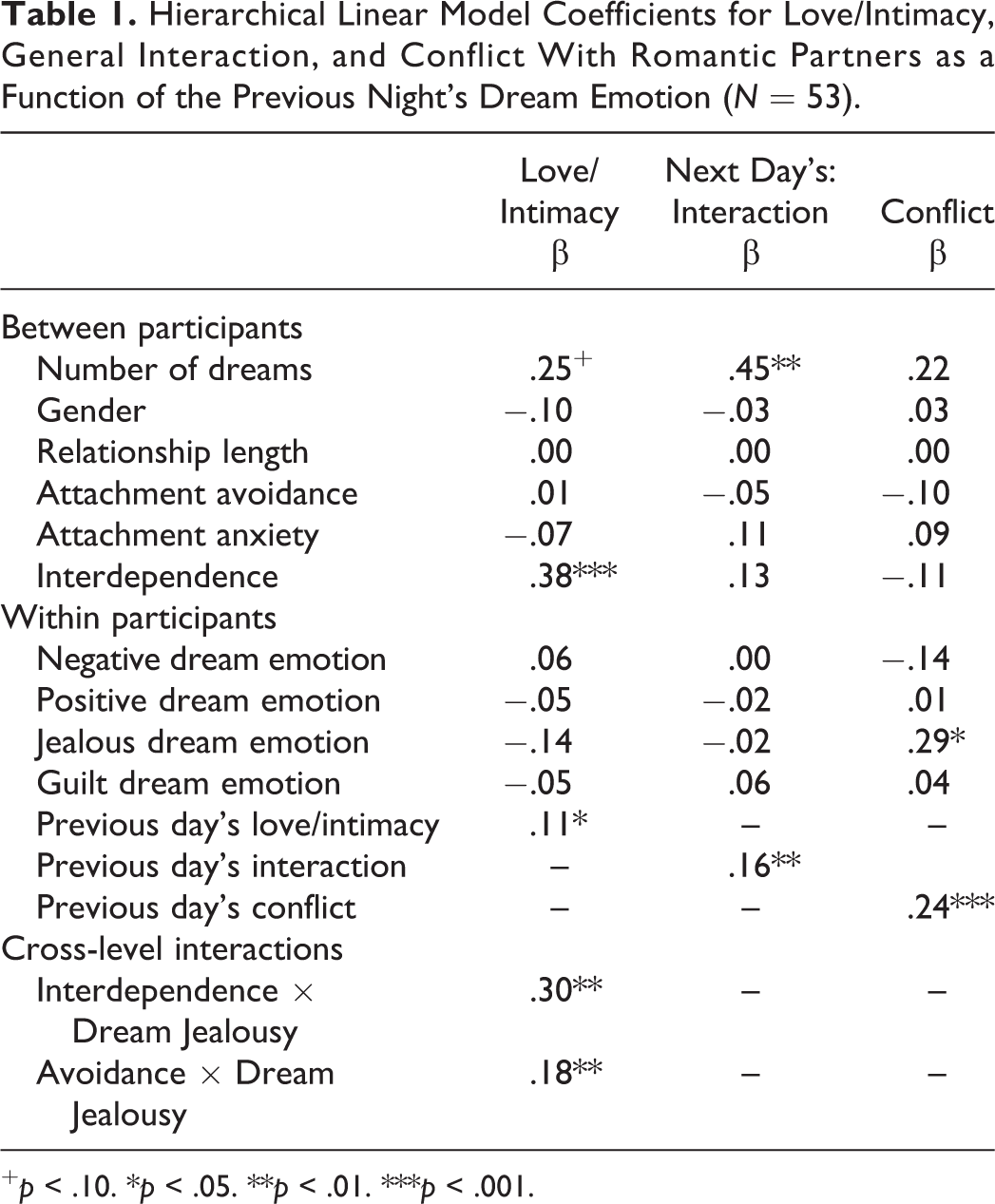
MLM coefficients are displayed in Table 1 (see Hox, 2010 for a formula to standardize MLM coefficients after centering). Unsurprisingly, interdependence was associated with greater daily love/intimacy (β = .38, p < .001). The total number of dreams that contained significant others was associated with more general interaction post-dreaming (β = .45, p < .01) and (marginally) with more post-dreaming love/intimacy (β = .25, p < .07), such that the more frequently participants dreamt of their partners, the more they reported interacting with them after dreaming and (marginally) more intimacy. Jealous dream emotion was associated with increased post-dreaming conflict (β = .29, p < .03), such that when people reported greater jealous emotion in dreams of their partners, they reported more conflict with their partners on the day after the dream.
Hierarchical Linear Model Coefficients for Love/Intimacy, General Interaction, and Conflict With Romantic Partners as a Function of the Previous Night’s Dream Emotion (N = 53).
+ p < .10. *p < .05. **p < .01. ***p < .001.
Two cross-level interactions emerged. Interdependence moderated the association between dream jealousy and subsequent love/intimacy. Simple slopes analyses revealed that for people with high interdependence (+1 SD) dream jealousy was not significantly associated with daily love/intimacy γ = .13, but people low in interdependence (−1 SD) showed a negative association between dream jealousy and love/intimacy on following days (γ = −.35, p < .01). Attachment avoidance also moderated the association between dream jealousy and love/intimacy. Simple slopes analyses revealed that for people with high avoidance (+1 SD) dream jealousy was not significantly associated with daily love/intimacy γ = .09, but people low in avoidance (−1 SD) showed a significant negative association between dream jealousy and love/intimacy on following days (γ = −.31, p = .03).
Analyses for Dream Content
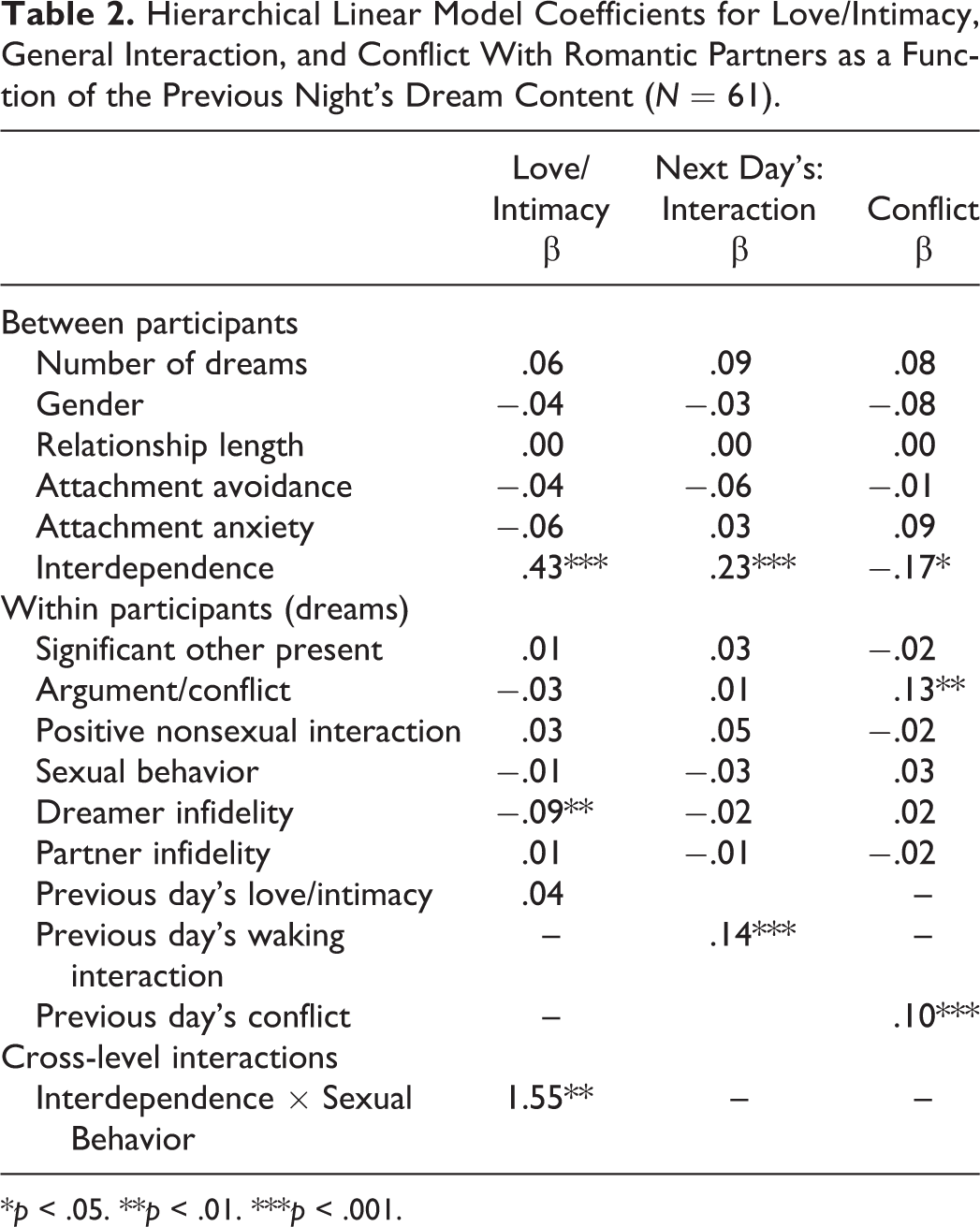
We conducted multilevel regressions using dream content to predict post-dreaming activity that were nearly identical to those for dream emotion. These analyses utilized the entire set of dreams reported in the sample. Dreams of extradyadic partners correlated highly with dreams of infidelity (r = .77, p < .001), so to reduce redundancy, we removed the variable representing extradyadic partners from these analyses. MLM coefficients are displayed in Table 2. Unsurprisingly, interdependence was associated with greater feelings of daily love/intimacy overall (β = .43, p < .001), more general interaction (β = .23, p < .001) and less conflict (β = −.17, p = .02). Dreamer infidelity predicted less love/intimacy on following days (β = −.09, p = .01), such that after dreaming about romantic involvement with an extradyadic partner, participants felt less love/intimacy toward their partner the next day. Similarly, dreams containing conflict predicted greater conflict on following days (β = .13, p < .01). No significant effects emerged for general interaction on following days.
Hierarchical Linear Model Coefficients for Love/Intimacy, General Interaction, and Conflict With Romantic Partners as a Function of the Previous Night’s Dream Content (N = 61).
*p < .05. **p < .01. ***p < .001.
A cross-level interaction emerged between interdependence and dreams with sexual behavior in predicting daily love/intimacy. As shown in Figure 1, simple slopes analyses revealed that when individuals high in interdependence (+1 SD) had dreams containing sexual behavior with their partner, they felt more love/intimacy on following days (γ = 1.11, p < .05). In contrast, when individuals low in interdependence (−1 SD) reported such dreams, they felt less love/intimacy on following days (γ = −1.40, p = .01).
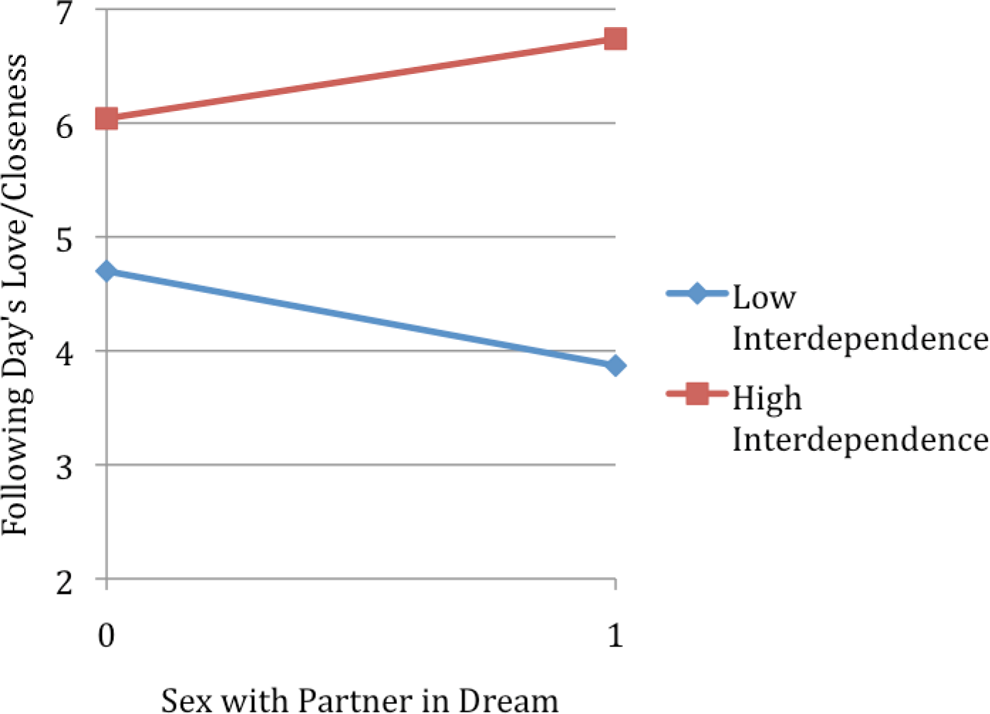
Love/intimacy with partners as a function of sexual behavior in dreams the preceding night (Level 1) and interdependence (Level 2). The figure displays an effect of increased love/intimacy following sex dreams for individuals high in interdependence, but an opposite effect for individuals low in interdependence.
Other Results
Although not central to the focal research question, we also examined associations in the reverse direction, that is, between daily activity and subsequent dream content. These findings may help interpret the aforementioned effects (see Discussion section). Daily love/intimacy was significantly associated with more positive affect and less negative affect in subsequent dreams containing partners (β = .27, p < .001 and β = −.17, p < .03, respectively). Daily activity variables were not associated with the other dream emotion or content variables. Importantly, none of the associations reported above between dream content and subsequent activity approached significance in the other direction; thus, the associations reported were unidirectional.
Attachment avoidance was significantly associated with greater dream jealousy and less positive affect in dreams containing partners (β = .24, p < .03 and β = −.25, p < .03, respectively). Multilevel logistic regression analyses revealed that avoidance was also associated with an increased likelihood of having dreams containing partner infidelity (b = .57, p < .05), and interdependence was associated with a decreased likelihood of having dreams containing extra-dyadic partners or dreamer infidelity (b = −.59, p < .03 and b = −.71, p < .01, respectively).
Discussion
In the current study, we found evidence that participants’ recalled dreams of their significant others were associated with subsequent relational activity, even after controlling for the previous day’s activity, trait attachment styles, and relationship quality. Further, there were not parallel findings in the opposite temporal direction (from behavior to subsequent dreams). These results provide evidence for the first time that specific dream content predicts subsequent behavior with relationship partners. These results deepen our understanding of dreams, as a previously unstudied factor that contributes to important relationship processes (particularly love/intimacy and conflict).
A parsimonious explanation for the current results, consistent with current social psychological theory and research, is that as participants recalled their dreams, the social content (thoughts, feelings, and images) was made salient in a manner similar to priming, and that predicted shifts in relational behavior. For example, as participants recalled dreams with higher amounts of jealousy, this evoked a behavioral response involving conflict with their relationship partners. Notably, this effect was independent from general negative affect in dreams (sadness, anger), which we controlled for statistically, suggesting the domain-specific emotion of jealousy in dreams elicits conflict in close relationships. Similarly, behavioral conflict (arguments) in dreams was also associated with increased reported conflict on following days. Finally, dreamer infidelity was also associated with decreased feelings of love/intimacy on subsequent days. These findings suggest the value of incorporating dream content variables in our understanding of how couples build intimacy and engage in conflict, as well as efforts to manage or mitigate relationship distress.
For those low in attachment avoidance, dream jealousy was associated with less love/intimacy, but for those high in avoidance, there was no significant association. This is likely due to the fact that avoidance was associated with higher levels of dream jealousy over the entire study period, which is consistent with prior research (Buunk, 1997; Sharpsteen & Kirkpatrick, 1997). Highly avoidant people may not have experienced as much fluctuation in these variables each day because they consistently felt greater jealousy in their dreams; whereas for those low in avoidance, an increase in jealousy from a given night’s dream would have more directional influence on the next day’s love/intimacy.
In contrast, those high in interdependence did not show the association between dream jealousy and daily love, whereas those low in interdependence did. This may be explained by the fact that having high relationship health buffers people against the negative effects of dream jealousy, such that they are able to maintain greater love/intimacy overall; whereas those with low relationship health showed more decreases in love/intimacy as a result of having jealous dreams on a given night.
For those with higher interdependence, sex dreams were associated with more love/intimacy on following days, but for those with lower interdependence, this type of dream predicted less love/intimacy. This interaction may be explained by the fact that sex with partners is not always enjoyable (Selterman & Drigotas, 2009), and there is a high degree of association between relationship satisfaction and sexual satisfaction (Sprecher & Cate, 2004). It is possible that the reason why participants with low interdependence reported less love/intimacy after sex dreams (compared to participants with high interdependence) is because the sexual experience in the dream was unsatisfying. Future research should explore this idea further.
The tendency to dream frequently about significant others was associated with more frequent dreaming overall, as well as increased interaction/intimacy with those partners on days subsequent to dreaming about them. This is consistent with theoretical perspectives and predictions about the social bonding functions of dreams (McNamara, 1996). Dreams may serve to facilitate or promote attachment bonding in close relationships.
Strengths, Limitations, and Caveats
The associations between recalled dreams and relational behavior remained significant while statistically controlling for the previous day’s activity, suggesting a unique role for dream content aside from more stable behavioral patterns. This is a strength of the design and one that allows us to conclude that recalled dreams are associated with fluctuation and change in relational behavior day to day. As discussed above, the process through which dreams predict changes in social behavior may be similar to priming, whereby the dream content triggers related socioemotional responses, which then affect interpersonal activity and relational behavior. Typically, researchers study priming effects within the confines of the laboratory, and such effects are observable only for short periods of time. In addition, primes typically come from the social and physical environment, as opposed to dreams, which are generated internally. Our study extended this framework by examining how naturally occurring primes (dreams) had effects extending throughout the following days, in the externally valid, real-world setting of everyday behavior.
We do not yet know the relative strength of dreams to predict subsequent activity compared to other variables (e.g., memories, embodied cues), and we do not yet know whether the influence of dreams is more implicit or conscious (or both equally). Nevertheless, the social effects of dreams can be potent regardless of whether they operate on a more implicit level (e.g., affect in a dream altering mood states upon waking without conscious reflection) or on a more deliberate level (e.g., explicitly considering the implications of a dream and intentionally changing behavior).
It should be noted that the results from the current study are not experimental, and do not conclusively indicate direction of causality. However, our analyses showed weak support for the biggest threats to causality (namely, reverse causality and common “third” variables). We found no evidence that daily activity predicted dreams in the same way that dreams predicted subsequent activity. These unidirectional associations make the possibility of reverse causality less likely, although still possible. We were also able to control for some of the most likely “third” variables (attachment style, gender, relationship length, and relationship health) in our analyses, thereby addressing some alternative causal explanations. Future research might attempt to experimentally test the effect of previous day’s activity on subsequent dreams; this approach is more difficult, but potentially possible (see Wegner, Wenzlaff, & Kozak, 2004).
To clarify, we are not claiming that daily behavior has no effect on dreams. To the contrary, we found that love/intimacy predicted general positive and negative affect in subsequent dreams, and attachment avoidance and interdependence predicted varying levels of dream jealousy and infidelity content in dreams. These findings (along with previous research) suggest that daily activity and personality variables do predict dream content, albeit in a fundamentally dissimilar way that dreams predict subsequent activity.
Concluding Thoughts
The present study provided evidence that affect and content of recalled dreams uniquely predict important relationship processes on following days. This study is the first to systematically identify such patterns of behavior. These findings also support the idea that dreams are an important component of human social life, the scientific examination of which may provide unique insight into close relationship processes.
Footnotes
Appendix
Acknowledgments
We would like to thank Shira Gabriel for her very helpful comments/feedback on earlier versions of this article. Other special thanks to Everett Waters, Joanne Davila, Judith Crowell, and the undergraduate research assistants who helped with various aspects of the project: Jamie McDonald, Marissa Gomez, Mike Subrize, Stephanie Nolasco, Brittany Anderson, Corey Herth, Stephanie Nandoo, Danielle Wischenka, Monica Margulis, Greg Vosits, Melissa Willner, Sal Silinonte, and Urmi Vaghela.
Declaration of Conflicting Interests
The author(s) declared no potential conflicts of interest with respect to the research, authorship, and/or publication of this article.
Funding
The author(s) received no financial support for the research, authorship, and/or publication of this article.