



Abstract
Although higher social class carries mental and physical health benefits, these advantages are less robust among members of racial and ethnic minority groups than among European Americans. We explore whether differential reactions to discrimination may be a factor in explaining why. Working-class and middle-class Latino American women engaged in an evaluative interaction with a European American woman who rejected them and held either prejudiced or unprejudiced attitudes. We examined how participants responded to this rejection by measuring neuroendocrine reactivity, executive functioning, and the affective content of their verbal responses during the interaction. Among middle-class Latinas, rejection from a prejudiced, compared to unprejudiced, out-group member was associated with less adaptive stress responses, greater cognitive depletion, and more feelings of uncertainty. In contrast, among working-class Latinas, neuroendocrine, cognitive, and affective responses were similar across the two sources of rejection. Results suggest that social class is an important moderator of responses to discrimination.
Higher social class provides several benefits, including better physical and mental health outcomes (i.e., the “SES gradient”; Adler et al., 1994; Kitagawa & Hauser, 1973). However, the socioeconomic status (SES) gradient is shallower among racial and ethnic minorities (e.g., Williams & Collins, 1995). For example, higher education is strongly associated with a decreased risk of coronary heart disease among European American men, but the association is much smaller among Latino American men (Ribisl, Winkleby, Fortmann, & Flora, 1998). These weaker relationships imply that higher socioeconomic status may not confer the same protective health benefits for racial and ethnic minorities that it does for European Americans. We suggest that one previously unexamined reason for this may be that experiences of prejudice and discrimination are incompatible with the agency-related beliefs and higher social status of middle-class minorities.
Middle-class individuals—those who have some college education—typically seek to influence their environments; in contrast, working-class individuals—those with a high school education or less—more typically adjust to their environments (e.g., Snibbe & Markus, 2005; Stephens, Hamedani, Markus, Bergsieker, & Eloul, 2011). When people are rejected because of their ethnic group membership, they are less able to influence or control this negative evaluation than when they are rejected because of their personal characteristics. Consequently, discrimination, compared to personal rejection, is likely to be less compatible with middle-class individuals’ agency-related beliefs. In contrast, the two experiences may be similarly compatible with working-class individuals’ agency-related beliefs. As a result, middle-class racial and ethnic minorities may cope poorly with the experience of discrimination, compared to personal rejection. However, working-class individuals may cope equally well with both experiences. To gain traction on this question, we examine working-class and middle-class Latino Americans’ physiological, affective, and cognitive responses to negative feedback from a prejudiced versus unprejudiced out-group member in a controlled laboratory environment.
Influencing Versus Adjusting
Social class shapes not only access to material and social resources (e.g., Kraus, Piff, Mendoza-Denton, Rheinschmidt, & Keltner, 2012; Stephens, Markus, & Fryberg, 2012) but also implicit assumptions about what constitutes normatively “good” action (i.e., models of agency; Markus & Kitayama, 2003; Stephens, Markus, & Townsend, 2007). Defined in a culturally neutral manner, “agency” is acting in the world (Markus & Kitayama, 2003). It does not necessarily involve influence or personal control and can instead involve adjusting the self. Higher social class contexts contain greater access to economic capital and greater opportunities for choice (Kohn, 1969), which promote a model of agency that emphasizes influencing one’s environment (Stephens, Fryberg, & Markus, 2011). In contrast, lower social class contexts contain less access to economic capital, more environmental constraints, and fewer opportunities for choice (Kraus, Piff, & Keltner, 2009). These experiences foster a model of agency that emphasizes adjusting to one’s environment (Stephens, Hamedani, et al., 2011).
Individuals' models of agency guide how they interpret and respond during social interactions, including how they cope with threatening or stressful situations. For example, during an evaluative interaction with an out-group member, middle-class individuals may cope by attempting to control the situation and influence the out-group member’s impression of them. In contrast, working-class individuals may cope by adjusting to the situation and enduring the other person’s impression (i.e., “shifting and persisting”; Chen & Miller, 2012).
Prejudice-Based Versus Personal Rejection
In addition to potential rejection based on their personal characteristics, members of lower status racial and ethnic groups, such as Latino Americans in the United States, also face the possibility of rejection based on their group membership (i.e., prejudice or discrimination), regardless of their social class backgrounds (Chávez, 2011; Pieterse & Carter, 2007). Although both types of experiences are likely to be stressful, preventing group-based rejection may be experienced as less under personal control than preventing individual-based rejection (e.g., Cook, Arrow, & Malle, 2011; Shorey, Cowan, & Sullivan, 2002; Verkuyten, 1998; but see Eccleston & Major, 2006). We argue that one largely unexamined factor shaping individuals’ responses to, and ability to adaptively cope with, these forms of rejection is the degree of compatibility between the type of rejection and the model of agency promoted in their social class context.
We propose that middle-class Latino Americans’ orientation toward influencing their environments may be relatively incompatible with experiences of discrimination, making those experiences less familiar and predictable compared to personal-level negative treatment. In contrast, we propose that working-class Latinos’ orientation toward adjusting to their environments may be reasonably compatible with both types of experiences. Working-class individuals may also be more likely than their middle-class counterparts to experience discrimination (e.g., Willis-Esqueda, Espinoza, & Culhane, 2008), further enhancing their ability to adjust. Consistent with this theorizing, self-reported racism-related stress is correlated with lower psychological well-being among middle-class African American men but is unassociated with psychological well-being among working-class African American men (Pieterse & Carter, 2007).
Adaptive Coping
Measuring responses to discrimination with explicit, self-report measures can be challenging (Major & O’Brien, 2005). Therefore, we used subtle or implicit measures to capture participants’ affective and cognitive responding. These measures included changes in participants’ catabolic and anabolic hormones (i.e. cortisol and dehydroepiandrosterone [DHEA(S)], respectively), while they engaged in an evaluative intergroup interaction. Both cortisol and DHEA(S) are end products of the hypothalamic–pituitary–adrenocortical (HPA) axis, one of the primary stress systems. However, some hormonal increases indicate maladaptive states, whereas others indicate benign or healthy reactions (Epel, McEwen, & Ickovics, 1998; McEwen, 1998). In particular, DHEA(S) may protect the body from catabolic aspects of the stress response by counterregulating catabolic hormones (Epel et al., 1998; Wolf et al., 1997), and low levels of DHEA(S) have been linked to affective vulnerability (Anikola & Mendes, 2008). Thus, in addition to cortisol, we measured the ratio of anabolic and catabolic hormones, that is, anabolic balance. Anabolic balance indicates the net anabolic versus catabolic effects of stress and may provide a more nuanced picture of adaptive versus maladaptive coping (Mendes, Gray, Mendoza-Denton, Major, & Epel, 2007; Wolkowitz, Epel, & Reus, 2001).
The Current Study
The present study tests the novel prediction that Latino Americans’ social class backgrounds moderate their responses during a stressful interaction with a European American. Taking the role of a job applicant, Latino American female participants were interviewed by a European American female confederate who they believed held prejudiced or nonprejudiced attitudes. Prior to the interview, the confederate gave the participant rejecting feedback. We created these conditions to model the experience of rejection due to factors under one’s personal control (i.e., rejection from an unprejudiced out-group member) versus factors beyond one’s personal control (i.e., rejection from a prejudiced out-group member). Participants provided saliva samples that were assayed for cortisol and DHEA(S). We also assessed participants’ affective responses during the interview, as revealed in the content of their verbal expressions, and their executive functioning following the interview using a Stroop task.
We theorized that middle-class Latinas’ relatively higher social class status and model of agency as influence would be less compatible with rejection by a prejudiced interviewer than by an unprejudiced interviewer, making the former situation more threatening. Therefore, we predicted that middle-class Latinas would evidence less adaptive stress responses (higher cortisol and lower anabolic balance), greater uncertainty, and greater cognitive depletion with a prejudiced interviewer than an unprejudiced interviewer. In contrast, we theorized that working-class Latinas’ relatively lower social class status and model of agency as adjustment would be compatible with both types of rejection. Thus, we predicted that working-class Latinas would show similar levels of neuroendocrine reactivity, uncertainty, and cognitive depletion regardless of the interviewer’s prejudice.
Method
Setting and Participants
The experiment was conducted in a social psychophysiology laboratory consisting of separate control and participant rooms. Latino American female undergraduates (N = 69) received course credit or a payment of US$25 for participating.
Confederates
We trained five European American female confederates to act neutrally. They were unaware of the participants’ prejudice condition and the study hypotheses and were randomly distributed across conditions.
Preliminary Measures
At least 2 weeks before the experiment, the participants completed an online questionnaire that included demographic questions and two measures of acculturation to mainstream American society. 1
Social Class Background
We used parental educational attainment to determine participants’ social class (e.g., Stephens et al., 2007, 2011). We chose educational attainment, because it can be considered the most fundamental indicator of social class, given it provides access to greater income and higher status occupations (Kraus & Stephens, 2012), and because it is closely associated with the agency-related psychological tendencies we theorize to be correlated with responses to personal and group-based rejection (Meyer, 1990; Snibbe & Markus, 2005).
Previous research, often with European American participants, has used attainment of a 4-year degree as the cutoff between middle-class and working-class (e.g., Stephens et al., 2007, 2011). Instead, we classified participants as “working class” if both of their parents had a high school diploma or less and as “middle class” if at least one parent had some college education. Although a 4-year degree confers unique advantages, every additional year of education beyond high school also carries benefits. Importantly, the high school diploma cutoff may be particularly relevant in our participant population (i.e., Latinos in California) who has lower average educational attainment than European Americans. Thus, for the parents of our Latina participants, having any education beyond high school likely conveys higher social class than held by the majority of their community. 2
Acculturation
Given that participants’ tasks were completed in English and that they interacted with a European American, we wanted to control for potential differences in English proficiency and acculturation that might affect participants’ comfort or ease in completing these tasks. We asked participants to report whether their first language was English and to complete a 10-item acculturation scale (i.e., the American version of the general ethnicity questionnaire; Tsai, Ying, & Lee, 2000). An example item is, “I was raised in a way that was American.” Participants reported how true each statement was of them on a scale of 1 (not at all true) to 5 (very much true), and their answers formed a reliable composite, α = .73 (mean [M] = 3.55, standard deviation [SD] = 0.52). We included participants’ acculturation scores and whether English was their first language as covariates in our analyses.
Procedure
We modeled our procedure on published studies examining dyadic interactions using the “work group paradigm” (e.g., Major et al., 2002) and followed standard procedures for collecting salivary hormones (Kirschbaum & Hellhammer, 1989). Participants were run between 2:00 p.m. and 7:00 p.m., which is when cortisol levels are at their waking nadir.
Arrival
Latinas arrived individually for a study on “interviewing.” Experimenters escorted the participant and confederate into separate rooms. Participants completed a hormone-screening form followed by a “workplace questionnaire” designed to bolster our cover story and serve as our manipulation. Participants indicated their agreement with 15 statements. Ten were neutral filler statements. The remaining five statements, labeled “diversity issues,” referred to intergroup attitudes (e.g., “Ethnic minorities often do not make as good employees as Whites because they are not as motivated to work hard as Whites” and “I would rather work for a boss who is a member of my own ethnic group than of a different ethnic group.”). After participants had been in the lab for 20 min, they provided a baseline saliva sample.
Role Assignments and Manipulation
Based on an ostensibly random drawing, the participant was assigned to the role of “job applicant.” She learned that, on the basis of a face-to-face interview, “the interviewer” (confederate) would decide whether to “hire” her for a desirable position and, if hired, she would have a chance to win US$50. Participants were then shown the workplace questionnaire ostensibly completed by the interviewer. This served as our prejudice manipulation. Participants saw that the interviewer had either strongly agreed with the “diversity issues” statements (described above), which indicated she held prejudiced attitudes, or strongly disagreed with them, which indicated she was unprejudiced.
Feedback
Participants were then asked to introduce themselves to the interviewer for 2 min via video. They were told that this was an important precursor to the interview and that they should use the introduction to describe what appears on their resumes (e.g., their educational and work background). Subsequently, participants received written feedback indicating that the interviewer’s “initial impression” of them was that they were only moderately intelligent, ambitious, and likeable. The interviewer also wrote “I wasn’t all that impressed with her.”
Interview
Subsequently, the interviewer was brought into the participant’s room. The interview consisted of a question-and-answer segment and a cognitive task. For the question-and-answer portion, the participant had 1 min to respond to each of five work-related questions read by the interviewer. The beginning questions were relatively innocuous (e.g., “Why do you think you should be hired for this position?”), but the final question focused on diversity (i.e., “How would you manage employees who were of a different cultural background than yours?”). The cognitive task was a 5-min backward digit span task. Participants listened to an adult female voice recite a list of 19 sets of four, five, or six 2-digit numbers and repeated the numbers in reverse order immediately following each set.
Postinterview
After the confederate left the room, the participants completed a Stroop task followed by the manipulation check. We collected saliva samples at three additional times, 20, 30, and 45 min after the participants read the negative feedback.
Measures
Hormone-Screening Questionnaire
Participants reported the time they woke that morning and the first day of their last menstruation.
Neuroendocrine Measures
We collected saliva samples by having participants expectorate 1 mL of saliva into IBL (Hamburg, Germany) SaliCap sampling devices. Salicaps were stored in a freezer at −20°C until shipped on dry ice to the California National Primate Research Center at the University of California, Davis. Salivary concentrations of cortisol and DHEA(S) were estimated in duplicate using commercial radioimmunoassay kits (Diagnostics Products Corporation, Los Angeles, CA). Intra- and interassay coefficients of variation were 3.23 and 3.09 for cortisol and 2.90 and 5.04 for DHEA(S), respectively.
Uncertainty: Linguistic Analysis
As a subtle affective measure, we examined the participants’ responses to the final interview question, which mentioned diversity and, therefore, made the interviewer’s prejudice salient. We focus on this question, because we theorized that the interviewer’s prejudice would be inconsistent with middle-class Latinas’ model of agency and, therefore, associated with greater uncertainty and hedging in their interview responses. We transcribed and analyzed these responses using the Linguistic Inquiry and Word Count program that has a series of preestablished categories and provides the percentage of words within each category out of the total words (Pennebaker, Booth, & Francis, 2007). We examined three categories, tentativeness (e.g., maybe, perhaps), exclusion, which also indicated the speaker was qualifying her statements (e.g., except, sometimes), and certainty (e.g., must, always). We created an uncertainty composite by adding the proportions of tentative and exclusive words and subtracting the proportion of certainty words.
Cognitive Depletion: Stroop Performance
We used a Stroop color-naming task to measure cognitive depletion. Words were presented on a computer screen in different colors (red, yellow, green, blue). Participants identified the color in which each word was printed by pressing a designated key on a keyboard. Participants first viewed a fixation cross for 1,000 ms and then a word appeared on the screen and remained until the participant selected the correct key. There were five words in each of three categories, anger related, anxiety related, and neutral. Each word appeared in each of the colors two times for a total of 120 stimuli. Although this task was originally designed as an emotion Stroop (response times should be slower to the extent that participants are experiencing a certain emotion), we found no difference in reaction times between the word categories. Thus, we interpret the task in its original intent—as a measure of cognitive depletion.
Manipulation Check
Participants reported how racist and prejudiced they thought the interviewer was on a 0 (not at all) to 6 (very much) scale. We averaged the 2 items to form a composite, r = .79 (M = 2.25, SD = 1.86).
Results
Participant Attrition
One participant withdrew from the study before receiving the prejudice manipulation. Eleven participants did not report their parents’ education levels. Our final data set included 58 participants (30 in the unprejudiced condition). In addition, due to equipment malfunction, we lost data from 2 participants for the linguistic analysis and 16 for the Stroop analysis.
Preliminary Analyses
A 2 (condition: prejudiced vs. unprejudiced) × 2 (social class: middle-class vs. working-class) univariate analysis of variance on the manipulation check revealed that our manipulation was successful. Specifically, there was a significant main effect of condition, F(1, 52) = 20.80, p < .001 (two participants did not complete the manipulation check). As expected, regardless of the social class, participants in the prejudiced condition perceived the interviewer to be more racist and prejudiced (M = 3.23, SD = 1.83) than those in the unprejudiced condition (M = 1.21, SD = 1.36). No other effects were significant, Fs <1.24, ps >.27.
Analytic Strategy
For all the analyses, we included participants’ acculturation scores and whether English was their first language (0 = no, 1 = yes) as covariates (see Table 1 for a summary). 3 For the neuroendocrine analyses, we also included baseline neuroendocrine levels, time since awakening, and menstrual phase (0 = follicular, 1 = luteal) as covariates. One participant did not report waking time, so we used the sample mean for this data point. Additionally, two participants did not report days since their last menstrual period, so we used a “1,” which was the modal phase. 4
Results of Repeated Measures ANCOVAs and Univariate ANCOVAs.
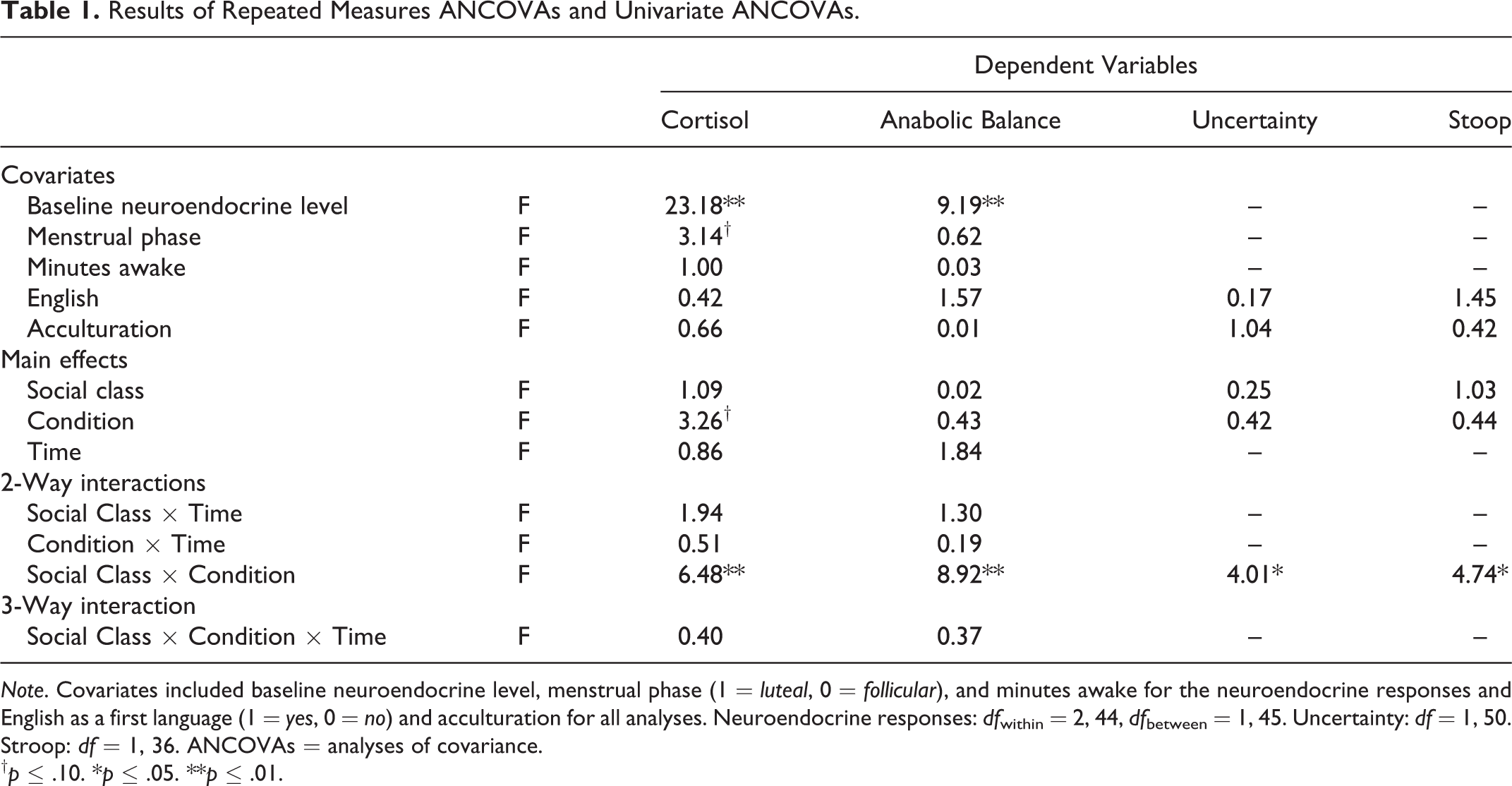
Note. Covariates included baseline neuroendocrine level, menstrual phase (1 = luteal, 0 = follicular), and minutes awake for the neuroendocrine responses and English as a first language (1 = yes, 0 = no) and acculturation for all analyses. Neuroendocrine responses: df within = 2, 44, df between = 1, 45. Uncertainty: df = 1, 50. Stroop: df = 1, 36. ANCOVAs = analyses of covariance.
† p ≤ .10. *p ≤ .05. **p ≤ .01.
Neuroendocrine Reactivity
We first calculated an index of anabolic balance by converting the measures of cortisol and DHEA(S) to a common unit (nmol/L) and then created a ratio score (DHEA(S)/cortisol). To examine the participants’ neuroendocrine changes, we created reactivity scores for both cortisol and anabolic balance (poststressor − baseline). Higher reactivity values indicate greater cortisol or anabolic balance. We then ran two 2 (condition: prejudiced vs. unprejudiced) × 2 (social class: middle-class vs. working-class) × 3 (time: 20, 30, and 45 min poststressor reactivity) mixed analyses of covariance (ANCOVAs), one with cortisol as the outcome and the other with anabolic balance.
Cortisol
The repeated measures ANCOVA with cortisol as the outcome revealed only a significant Condition × Social Class interaction, F(1, 45) = 6.48, p = .01, η p 2 = .13. Among middle-class Latinas, those rejected by a prejudiced confederate showed significantly higher cortisol (M = 1.75, standard error [SE] = .82) than those rejected by an unprejudiced confederate (M = −2.08, SE = .93), F(1, 45) = 9.03, p = .004, η p 2 = .17. However, among working-class Latinas, condition was unrelated to cortisol responses (prejudiced, M = −1.33, SE = .92; unprejudiced, M = −0.78, SE = .77), F(1, 45) = 0.20, p = .66, η p 2 = .004 (Figure 1A).
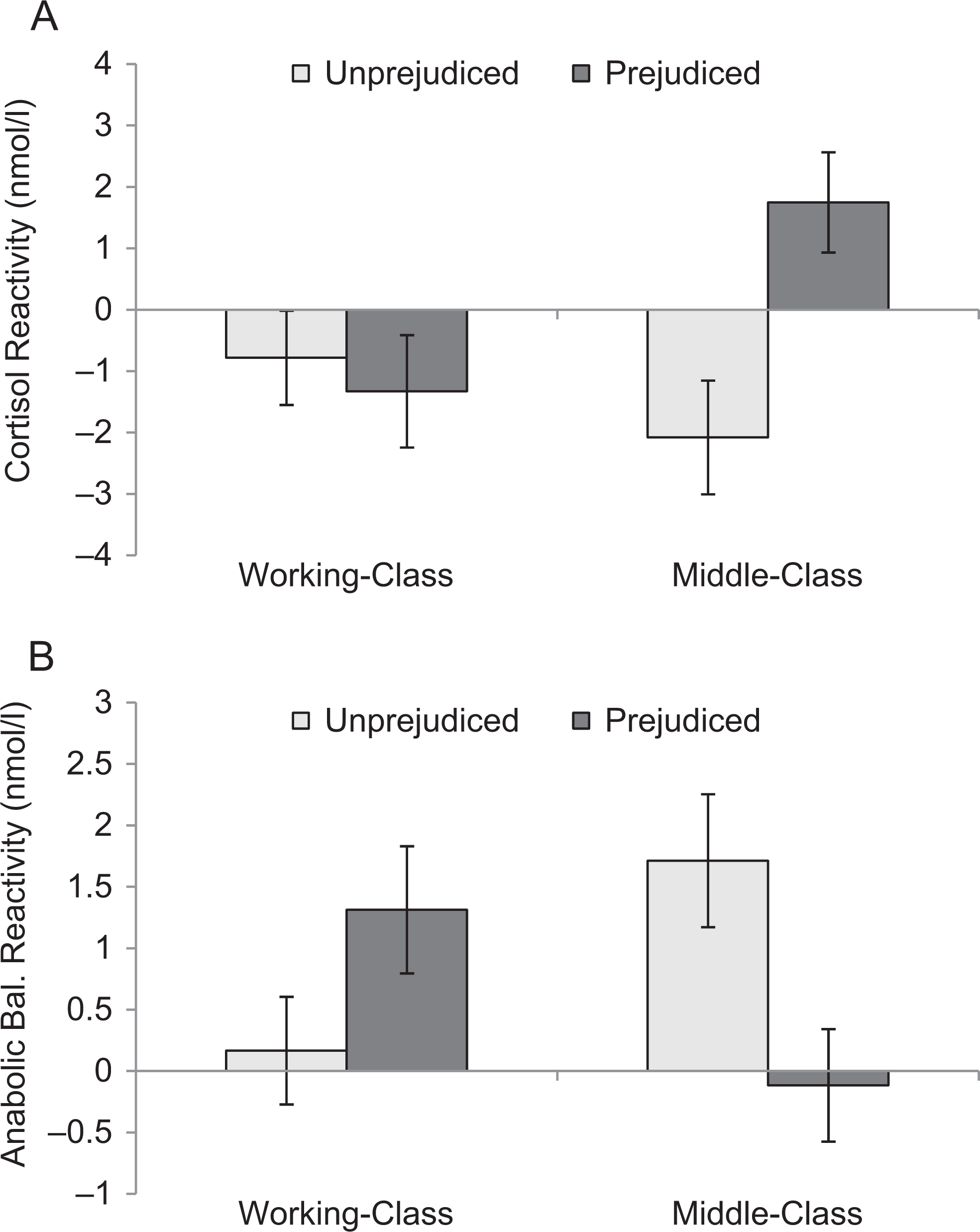
Cortisol and anabolic balance levels by social class and condition.
Anabolic Balance
The repeated measures ANCOVA with anabolic balance as the outcome also yielded only a significant Condition × Social Class interaction, F(1, 45) = 8.92, p = .005, η p 2 = .16. As predicted, among middle-class Latinas, those rejected by a prejudiced confederate showed significantly lower anabolic balance (M = −0.11, SE = .46) than those rejected by an unprejudiced confederate (M = 1.71, SE = .54), F(1, 45) = 6.14, p = .02, η p 2 = .12. However, among working-class Latinas, condition was not significantly related to anabolic balance changes (prejudiced, M = 1.31, SE = .52; unprejudiced, M = 0.17, SE = .44), F(1, 45) = 2.69, p = .11, η p 2 = .06 (Figure 1B).
Uncertainty—Linguistic Analysis
A 2 (condition) × 2 (social class) ANCOVA on participants’ expressions of uncertainty also yielded a significant interaction, F(1, 50) = 4.01, p = .05, η p 2 = .07. Consistent with the neuroendocrine data, middle-class Latinas who were rejected by a prejudiced confederate expressed marginally greater uncertainty (M = 10.87, SD = 6.14) than those rejected by an unprejudiced confederate (M = 7.17, SD = 4.16), F(1, 50) = 3.45, p = .07, η p 2 = .06. However, condition was unrelated to the uncertainty evident in working-class Latinas’ responses, F(1, 50) = 0.71, p = .40, η p 2 = .01 (prejudiced, M = 7.45, SD = 5.23; unprejudiced, M = 9.19, SD = 3.70; Figure 2).
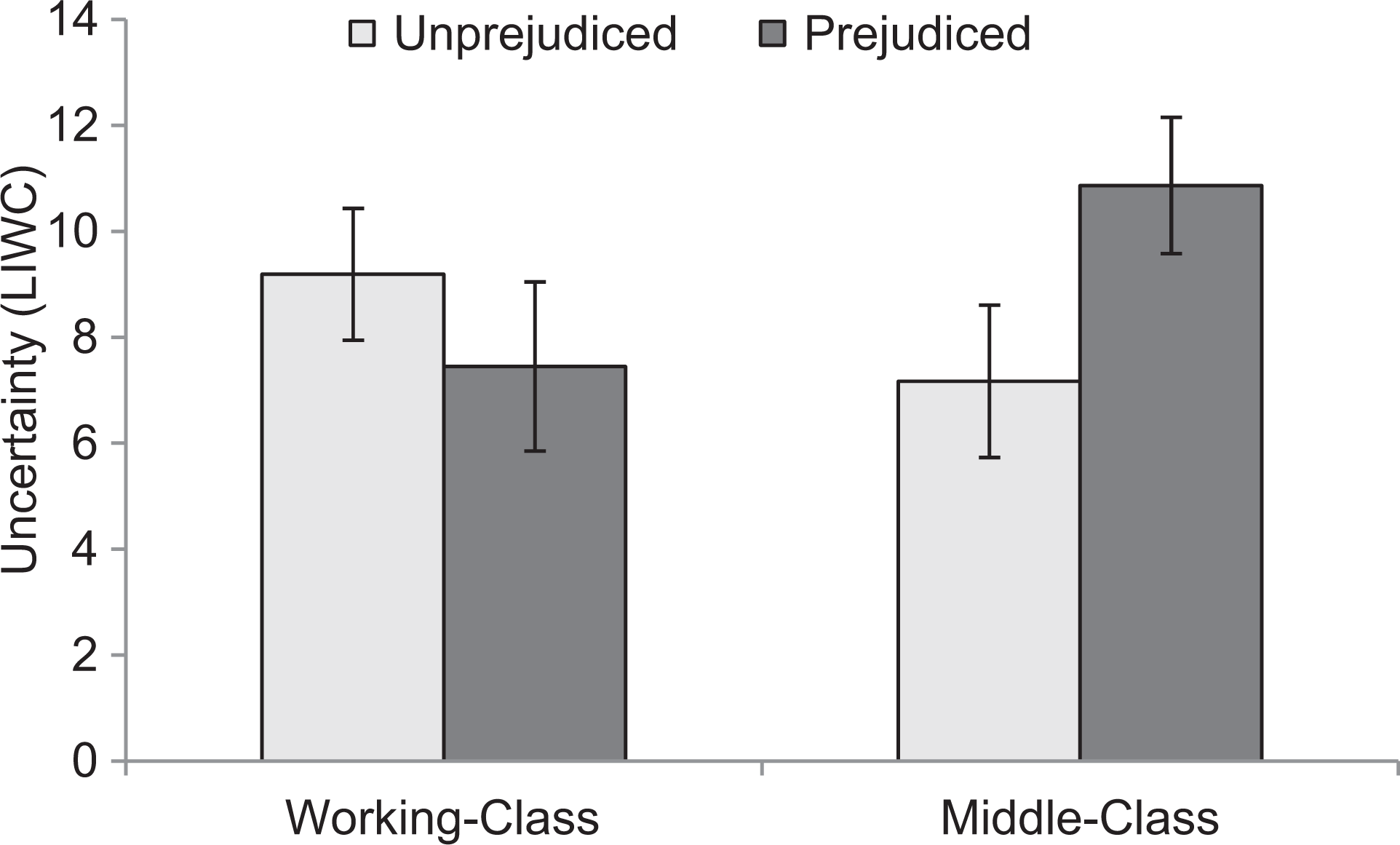
Uncertainty in interview response by social class and condition.
Cognitive Depletion—Stoop Performance
To examine cognitive depletion, we first winsorized Stroop reaction times if they exceeded |3| SD from the mean (i.e., >1,284.05 ms or <264.05 ms). We then averaged responses from all the 120 trials. A 2 (condition) × 2 (social class) ANCOVA on participants’ response times yielded a significant interaction, F(1, 36) = 4.74, p = .04, η p 2 = .12. Middle-class Latinas who were rejected by a prejudiced confederate showed greater cognitive depletion, as evidenced by longer reaction times (M = 749.16, SD = 87.62), relative to those rejected by an unprejudiced confederate (M = 666.55, SD = 84.54), F(1, 36) = 4.11, p = .05, η p 2 = .10. In contrast, condition was unassociated with cognitive depletion among working-class participants (prejudiced, M = 715.62, SD = 102.65; unprejudiced, M = 759.25, SD = 85.92), F(1, 36) = 1.10, p = .30, η p 2 = .03 (Figure 3).
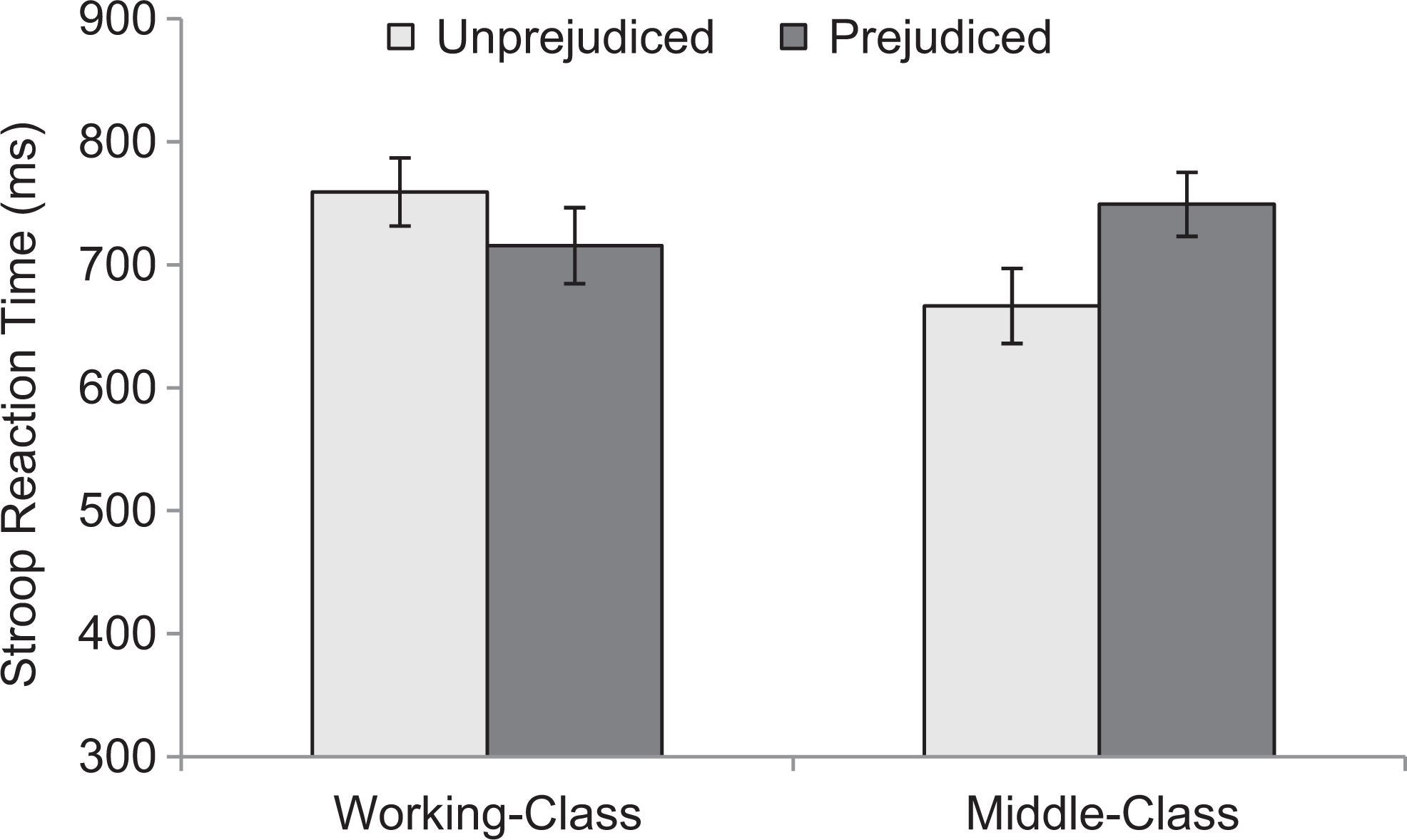
Stroop latencies by social class and condition.
Discussion
Is higher social class psychologically beneficial? Although the answer to this question is often “yes,” our results suggest that class may not always convey an advantage for targets of prejudice or discrimination. Among middle-class Latinas, interacting with a rejecting and prejudiced European American interviewer was associated with higher cortisol, lower anabolic balance, and greater uncertainty and cognitive depletion than interacting with a rejecting and unprejudiced interviewer. In contrast, whether the rejecting out-group interviewer was prejudiced or unprejudiced did not significantly affect the working-class Latinas’ responses.
We did not expect or find significant main effects of social class or prejudice condition on participants’ hormonal responses, uncertainty, or cognitive depletion. Given the emphasis on interdependence prevalent in working-class contexts (e.g., Stephens et al., 2007), one might predict working-class Latinas to be more sensitive to social rejection than middle-class Latinas. However, this interdependence emphasizes the relationships with close others, not all relationships. Therefore, we did not anticipate finding social class differences in sensitivity to rejection from the interviewer who was an out-group member and a stranger. We also did not expect a main effect of prejudice condition, given previous evidence that discrimination does not engender strong threat responses among all participants (i.e., HPA activation, vascular increases; Jamieson, Koslov, Nock, & Mendes, 2012; Mendes, Major, McCoy, & Blascovich, 2008). Our results are consistent with a body of work showing that responses to prejudice are often moderated by individual difference factors (Eliezer, Major, & Mendes, 2010; Townsend, Major, Sawyer, & Mendes, 2010).
Clear instances of discrimination can be externally attributed (e.g., Crocker & Major, 1989), which relieves targets of responsibility but also control (e.g., Cook et al., 2011; Shorey et al., 2002; Verkuyten, 1998). We argue here that middle-class Latinas’ model of agency as influence may have been less compatible with the prejudiced condition, where participants had less control over the interviewer’s final evaluation of them compared to the unprejudiced condition. Being in a situation that was mismatched with their model of agency may have interfered with their executive functioning, initiated more maladaptive stress responses, and engendered more uncertainty in their verbal fluency. In contrast, working-class Latinas’ model of agency as adjustment may have been equally effective for responding to rejection by a prejudiced and unprejudiced out-group member. Our theorizing is consistent with recent research demonstrating cultural differences in response to being the target of a positive stereotype (Siy & Cheyran, 2013). Like our middle-class participants, people with an independent self-construal responded more negatively when they were stereotyped and treated based on their social group membership than when they were treated based on their personal characteristics. In contrast, people with an interdependent self-construal responded similarly to both forms of treatment.
We do not have direct evidence, however, that differences in middle-class versus working-class models of agency account for our findings. We did not directly assess participants’ models of agency, which are multifaceted and largely implicit constructs that are difficult to measure (e.g., Kitayama, Park, Sevincer, Karasawa, & Uskul, 2009). Thus, it is possible that additional factors may work in tandem with our cultural mechanism. For one, experiences of discrimination may make Latinas’ lower race-based status salient. This low status is incompatible with middle-class Latinas’ relatively high class-based status but compatible with working-class Latinas’ class-based status. In addition, working-class individuals may experience more discrimination than their middle-class counterparts (e.g., Willis-Esqueda et al., 2008) and, as a result, they may possess more effective coping strategies.
Our findings are consistent with the research demonstrating that responses to being the target of discrimination are not monolithic, even within a given lower status group, but are often moderated by individual differences (Eliezer et al., 2010; Townsend et al., 2010). The current research adds to a growing but limited body of work exploring how the intersection of multiple social categories impacts responses to stigma and discrimination. It is the first to suggest that people’s psychological and physiological responses to encountering discrimination depend on their social class background.
Footnotes
Declaration of Conflict Interests
The author(s) declared no potential conflicts of interests with respect to the research, authorship, and/or publication of this article.
Funding
The author(s) disclosed receipt of the following financial support for the research, authorship, and/or publication of this article: The National Heart, Lung, and Blood Institute (grant number RO1 HL079383).