



Abstract
When we buy our daily cup of coffee, sometimes we engage in a social interaction with the barista, and sometimes we are in a rush. Every day we have opportunities to transform potentially impersonal, instrumental exchanges into genuine social interactions, and the happiness literature suggests that we may reap benefits by doing so; in other words, treating a service provider like we would an acquaintance (i.e., weak tie) might make us happier. In the current study, people who had a social interaction with a barista (i.e., smiled, made eye contact, and had a brief conversation) experienced more positive affect than people who were as efficient as possible. Further, we found initial evidence that these effects were mediated by feelings of belonging. These results suggest that, although people are often reluctant to have a genuine social interaction with a stranger, they are happier when they treat a stranger like a weak tie.
Sometimes we stagger blearily into a coffee shop in search of a pick-me-up, wanting only to get our coffee and go. Other times, we exchange a few words with the barista, enjoying a bit of social interaction as we get our coffee. Indeed, every day we encounter many situations like these, which allow us to transform an instrumental exchange into a genuine social interaction with a stranger, but often we choose to forego these opportunities. Might we be missing out on a hidden source of belonging and happiness? Would we be happier if we embraced opportunities to treat strangers as if they were, or might become, acquaintances?
Studies using a wide variety of methodological approaches, from experience sampling and daily diaries to the day reconstruction method, all converge on the same finding: people enjoy socializing (e.g., Berry & Hansen, 1996; Clark & Watson, 1988; Kahneman, Krueger, Schkade, Schwarz, & Stone, 2004; Krueger, Kahneman, Schkade, Schwarz, & Stone, 2009; Pavot, Diener, & Fujita, 1990; Reis, Sheldon, Gable, Roscoe, & Ryan, 2000; Vittengl & Holt, 1998; Watson, Clark, McIntyre, & Hamaker, 1992). However, due to the methods used, these studies have primarily focused on interactions with close friends and family, largely overlooking minimal interactions such as the one with the barista. For instance, many of these studies asked people to recall their interactions after hours had passed (e.g., Clark & Watson, 1988; Kahneman et al., 2004; Vittengl & Holt, 1998), and evidence suggests that after a delay, people are more likely to remember interactions with close others (Eagle, Pentland, & Lazer, 2009; Fu, 2005). In addition, a number of these studies targeted interactions of a substantial duration (e.g., Berry & Hansen, 1996; Reis et al., 2000; Watson et al., 1992), which are more likely to be interactions with close others. Yet, a typical day provides many opportunities for interactions with people outside our close social circle, including strangers as well as weak ties—relationships involving less frequent contact, low emotional intensity, and limited intimacy, such as the ones with acquaintances (Granovetter, 1973). It remains an empirical question whether these easily overlooked opportunities for social interaction can provide an untapped source of happiness in daily life.
Although past research has focused on interactions with close friends and family, there is growing evidence that even interactions with strangers can boost positive affect (PA). In one study, people were assigned to interact with either their own romantic partner or an opposite sex stranger. Surprisingly, although they expected to feel better after interacting with their romantic partner versus a stranger, people felt just as good after interacting with the stranger (Dunn, Biesanz, Human, & Finn, 2007). The present research examines a situation in which a conversation with a stranger is required—placing an order at Starbucks—and varies whether or not the interaction is treated as strictly instrumental (i.e., solely in service of filling one’s order) or treated as genuinely social, as if it were with a weak tie.
Minimal social interactions, in addition to providing a hidden source of enjoyment, might provide cues of belonging. Humans have a need to belong, and experience lower physical and emotional well-being when they struggle to fill this need (Baumeister & Leary, 1995). Even minimal cues signaling a lack of belonging have negative consequences. For example, not being thrown the ball in a game of Cyberball results in more negative feelings, mediated by a decrease in belonging (Williams, Cheung, & Choi, 2000). In other studies, being faced with someone’s averted gaze (Wirth, Sacco, Hugenberg, & Williams, 2010) or hearing an awkward pause in the flow of conversation (Koudenburg, Postmes, & Gordijn, 2011) leads to lower feelings of belonging and being forgotten by a research assistant lowers feelings of meaning in life (King & Geise, 2011).
In the same way that minimal cues can lead to people feeling excluded, it is possible that minimal cues can also lead people to feel a greater sense of belonging. Indeed, people who are visually acknowledged by a stranger experience greater feelings of social connectedness (Wesselmann, Cardoso, Slater, & Williams, 2012). We speculate that having a genuine social interaction with a stranger could also signal belonging. Further, given that people experience more PA on days when the need to belong is satisfied (i.e., on days when they feel related to others; Reis et al., 2000), this minimal cue of belonging should also carry implications for happiness.
In the current study, we investigated the effects of a customer initiating a conversation with a service provider. All customers buying a coffee at Starbucks must exchange information with the barista, but we instructed some of the participants to expand upon this minimal exchange and have a genuine social interaction, as they would with an acquaintance (i.e., weak tie). We hypothesized that customers who treated the service provider like a weak tie, rather than a stranger, would experience more PA, and be more satisfied with their overall experience. Further, we hypothesized that this social interaction would trigger feelings of belonging, which would mediate the effects of socializing on PA and satisfaction.
Method
Participants
We recruited 60 participants (29 male, 29 female, and 2 unreported) in person, from in front of a Starbucks in a busy, urban shopping district. 1 Participants spanned a wide range of ages: 22 were 25 years of age or younger, 13 were between 26 and 34 years of age, and 17 were 35 years of age or older (8 did not indicate their age).
Procedure
We approached people who were nearing Starbucks and asked whether they would be willing to participate in a study in exchange for a Cdn$5 Starbucks gift card. If they agreed to participate, they filled out a consent form. Participants were then randomly assigned to make their interaction with the barista either social or efficient. In both conditions, the instructions encouraged participants to see the barista as an individual and take their perspective—our intention was for participants to perceive both sets of instructions as respectful toward the barista.
In the “social” condition, participants were instructed to “have a genuine interaction with the cashier—smile, make eye contact to establish a connection, and have a brief conversation.” We asked them about their usual interaction style, and then asked them to either exaggerate their usual behavior, or change their behavior, in order to follow the instructions (see Figure S1 in the supplemental online materials). In contrast, participants in the “efficient” condition were instructed to “make your interaction with the cashier as efficient as possible—have your money ready, and avoid unnecessary conversation.” As in the social condition, we asked them about their usual interaction style, and then asked them to either exaggerate their usual behavior, or change it.
After receiving the instructions, participants in both conditions were provided with a gift card. They were asked to approach another research assistant, who was blind to their condition assignment, as they exited the store, in order to fill out a questionnaire.
Measures
After making their purchase, participants completed the Scale of Positive and Negative Emotions (Diener et al., 2010) as a measure of their current mood (PA: α = .87, NA: α = .84). This scale was developed to measure affect at the trait level, asking people to report the frequency of various feelings over the past 4 weeks. We adapted it to measure state-level affect, asking participants to “tell us how intensely you are experiencing each of the following feelings right now” (1 = very slightly or not at all to 5 = extremely). Participants also reported how satisfied they were with their Starbucks experience (1 = not very satisfied to 5 = very satisfied).
Next followed several questions that were designed to allow us to test whether belonging mediated the hypothesized effects of condition on happiness and satisfaction. First, participants answered the item from the Sense of Community scale (Davidson & Cotter, 1986) with the highest item-total correlation in a past study in our lab (“I feel like I belong here;” Sandstrom & Dunn, 2013). Further, they answered two face-valid questions from the Social Connectedness scale (Lee, Draper, & Lee, 2001), with high item-total correlations in the same past study in our lab (“I feel distant from people,” “I feel like an outsider,” both reverse scored). All three belonging questions were answered on a scale from 1 = strongly disagree to 6 = strongly agree.
Finally, as a manipulation check, participants rated the degree of their interaction with the barista (1 = interacted a lot less than usual to 5 = interacted a lot more than usual).
Results
Manipulation Check
An independent-samples t-test showed that people in the efficient condition (M = 2.58, SD = .96) interacted less than people in the social condition (M = 3.31, SD = .89), t(58) = 3.05, p = .003, thus confirming the efficacy of our manipulation. One-sample t-tests confirmed that people in the efficient condition interacted significantly less than usual (i.e., less than the midpoint on the scale), t(30) = −2.44, p = .02, and people in the social condition interacted marginally more than usual, t(28) = 1.88, p = .07.
Data Preparation
In order to assess the broader construct of belonging, we averaged the single item from the Sense of Community measure with the 2 items from the Social Connectedness measure, which were all measured on the same scale, to create a belonging composite (α = .63 2 ).
The Effect of Efficient Versus Social Interactions
We ran analyses of variance to predict outcomes from condition (social vs. efficient). Compared to those in the efficient condition, participants in the social condition reported significantly higher PA, F(1, 58) = 14.75, p < .001,
Condition Means and ANOVA Results.
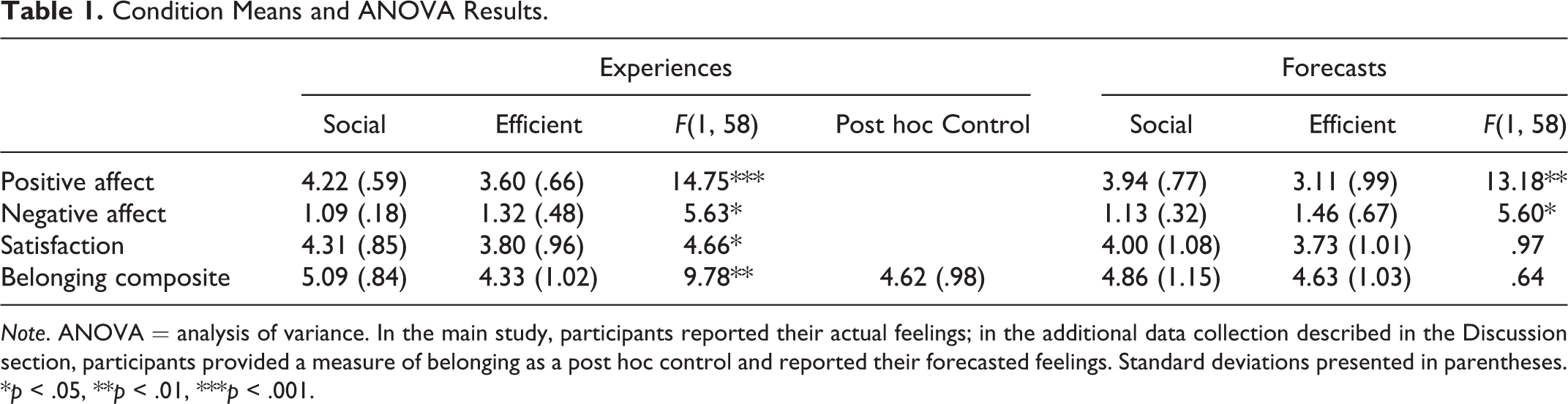
Note. ANOVA = analysis of variance. In the main study, participants reported their actual feelings; in the additional data collection described in the Discussion section, participants provided a measure of belonging as a post hoc control and reported their forecasted feelings. Standard deviations presented in parentheses.
*p < .05, **p < .01, ***p < .001.
Mediation
Next, we tested whether the effect of condition on the outcome variables was mediated by feelings of belonging. We did so by running a bias-corrected and accelerated bootstrap analysis using the INDIRECT macro developed by Preacher and Hayes (2008). Compared to those in the efficient condition, participants in the social condition reported a significantly greater sense of belonging, F(1, 58) = 9.78, p = .003,
Discussion
The present study demonstrates that simply taking the time to have a social interaction with a barista at Starbucks increases people’s sense of belonging. Transforming an instrumental exchange with a barista into a genuine social interaction also decreased NA, as well as increasing PA and satisfaction with the Starbucks experience, and we found some evidence that these effects were mediated by belonging. Importantly, these effects emerged at a busy, urban Starbucks location on a weekend afternoon, as people went about their daily lives. Thus, going beyond previous lab research, this field experiment documents how seemingly trivial social experiences can shape belonging and well-being in the real world.
Limitations and Alternative Explanations
Although we theorized that having a social interaction with the barista would increase belonging, it is also conceivable that our effects were driven by a decrease in belonging among those in the efficient condition, who may have felt uncomfortable with foregoing the usual social niceties. To examine this possibility, we returned to the same Starbucks location where we had conducted our study and collected additional data in the same season on the same days of the week at the same times of day. Sixty passersby (24 male and 35 female) 4 completed the same measure of belonging used in our study, providing a post hoc control group. Compared to this control group, participants in the social condition in the original study reported feeling significantly greater belonging, t(28) = 2.97, p = .01, whereas participants in the efficient condition reported feeling slightly—but not significantly—lower belonging, t(30) = −1.60, p = .12 (see Table 1 for means). Thus, although it is possible that the efficient condition had some detrimental effect on participants, these findings are more consistent with our hypothesis that minimal social interactions enhance belonging.
Another alternative explanation of our findings is that people could guess that we expected them to feel greater belonging after being instructed to connect with the barista, creating a demand characteristic. To explore this idea, following the additional data collection described above, we presented passersby with the instructions used in our study and asked them to imagine how they would feel after carrying out these instructions. Participants who were presented with the social condition instructions forecasted that they would feel more PA and less NA (ps < .03; see Table 1) than those who were presented with the instructions from the efficient condition. Importantly, however, participants did not foresee that having an interaction with the barista would influence their satisfaction with their Starbucks experience or contribute to feelings of belonging (ps > .30; see Table 1). Thus, although it is always difficult to rule out demand characteristics, it is unlikely that our main results were driven by participants’ expectations, given that people did not expect the social interaction with the barista to enhance belonging or satisfaction.
An additional limitation of the present study is that we measured our presumed mediator (belonging) concurrently with our dependent measures (affect and satisfaction), precluding any strong conclusions about the chain of causality. Indeed, the current results are also consistent with a reverse mediation account: PA, NA, and satisfaction with the Starbucks experience each significantly mediate the relationship between condition assignment and belonging. We believe this chain of causality to be less plausible; Baumeister and Leary (1995) argued that people cannot thrive when their need to belong is unmet, suggesting that belonging is a precursor of happiness. Further research in which the mediator is manipulated is necessary to establish the causal direction.
Implications
The present study is the first to highlight the benefits for happiness and belonging that result from turning everyday exchanges into social interactions. Our findings suggest that treating service providers like weak ties rather than strangers can provide a source of happiness that may often be overlooked in the drive for efficiency. Future work should continue to move beyond interactions with close friends and family, to further investigate the happiness potential of interactions with weak ties and strangers, and to compare the magnitude of the benefits of interactions with different partners. Although the greatest happiness benefits will undoubtedly stem from meaningful, positive interactions with close others, the current results suggest additional means of boosting happiness, through the hidden potential of transforming everyday interactions.
The current study has implications for the belonging literature as well as the happiness literature. In their model of belonging regulation, Gardner, Pickett, and Knowles (2005) suggested that when people are dissatisfied with their current state of belonging, a social monitoring system will search for opportunities for positive social interaction. Initiation of even a minimal, genuine social interaction with a stranger, like the barista at Starbucks, might be enough to temporarily satisfy the need to belong. Further, proactively engaging in these types of interactions could preemptively bolster feelings of belonging, thus avoiding the need for restorative measures. In other words, future work should test whether minimal social interactions with strangers can (a) restore a sense of belonging after a belonging threat occurs and (b) boost belonging before a belonging threat occurs, thus buffering against the negative consequences that result from the threat.
This study also moves beyond past research focusing on how the behavior of service providers impacts customers. When employees greet customers, make eye contact and smile (i.e., display PA), customers also display more PA (Pugh, 2001; Tsai & Huang, 2002), perceive the service quality to be higher (Pugh, 2001), and report more positive behavioral intentions (e.g., intentions to return to the store or recommend it to others; Tsai & Huang, 2002). Although the behavior of the barista is undoubtedly important, this study’s novel shift in focus finds that customers can shape their happiness through their own behavior. Of course, these happiness benefits would likely disappear if the customer was thwarted in their desire to make a connection with the barista. However, this is unlikely to happen at Starbucks; given that employees are trained to make a connection with customers through eye contact and open-ended questions (Moon & Quelch, 2006), Starbucks provides an ideal context to study this effect. In contrast, attempting to turn an efficient exchange into a social interaction might lead to unpleasantness in other contexts, such as a busy Department of Motor Vehicles office or airport security line. Thus, the emotional benefits observed in the present study may be limited to contexts in which service providers are willing and able to engage in friendly conversation.
If minimal interactions have positive benefits for happiness and belonging in many contexts, why do people often fail to seize such opportunities for social interaction? Our additional data, described above, suggests that people do recognize that a social interaction would boost their mood. We speculate that people do not notice these opportunities, however, due to other activated goals; people waiting in line for their coffee may be thinking of their daily to-do list, rather than thinking of making a connection. One of us recently attended a Canadian citizenship ceremony. After swearing in the new citizens, the judge took the time to ask them to shake hands and introduce themselves to each other. He urged the new citizens to continue to make these kinds of connections as they went about their daily lives, promising that it would be worthwhile. Perhaps with other forces in our daily lives pushing us to focus on our personal goals, we need reminders like these to look outward and seek connections with others.
As we go about our daily lives, we are surrounded by opportunities to talk to strangers. Although these interactions may be enjoyable, the prospect of initiating a conversation with a stranger is often daunting. The current results highlight the benefits of transforming instrumental conversations that we are already having—such as placing a coffee order—into more sociable encounters. The next time you need a little pick-me-up, you might consider interacting with the Starbucks barista as if they were a weak tie, instead of a stranger, thereby mining this readily available source of happiness.
Footnotes
Acknowledgment
The author(s) are grateful to the following people for assistance with data collection: Michelle Atkinson, Ryan Buell, Lysandra Chan, Mina Khan, Victoria Lau, Jaden Lu, Negah Mortazavi, Pegah Mortazavi, Sophia Ng, Vanya Saxena, Dhaarna Tangri, and Fontayne Wong.
Declaration of Conflicting Interests
The author(s) declared no potential conflicts of interest with respect to the research, authorship, and/or publication of this article.
Funding
The author(s) disclosed receipt of the following financial support for the research, authorship, and/or publication of this article: This work was supported by a Doctoral Fellowship from the Social Sciences and Humanities Research Council [grant number 752-2011-2192], awarded to the first author and a Standard Research Grant from the Social Sciences and Humanities Research Council [grant number 410-2011-0582] awarded to the second author.
