




Abstract
We conducted three studies to examine whether novel and interesting experiences can expand individuals’ self-concepts. In Studies 1 and 2, participants completed measures of experienced self-expansion and self-concept size. Results indicated that participants who had more novel and interesting experiences tended to have larger self-concepts. In Study 3, we employed an embodied cognition manipulation of self-expansion and again measured self-concept size. Results indicated that participants who pulled (vs. pointed to) objects labeled with novel and interesting (vs. nonnovel and uninteresting) activities toward themselves reported larger self-concepts. Additionally, those who pulled novel and interesting (vs. nonnovel and uninteresting) activities reported a larger self-concept. These studies provide the first empirical evidence that nonrelational novel and interesting experiences result in self-concept growth.
Individuals’ self-concepts—the collective set of beliefs individuals have about themselves—are capable of changing (Greenberg & Pyszczynski, 1985; Kernis & Johnson, 1990; Lewandowski, Aron, Bassis, & Kunak, 2006; Markus & Wurf, 1987). A reduction in the amount of self-concept content is associated with negative consequences, such as reduced self-concept clarity and greater emotional distress (Slotter, Gardner, & Finkel, 2010). There is a growing body of research showing that increases in an individual’s self-concept content (i.e., all of their self-beliefs) result in an array of positive outcomes. For example, individuals with larger self-concepts report greater self-efficacy for resolving problems (Aron, Paris, & Aron, 1995; Mattingly & Lewandowski, in press), exert greater cognitive and physical effort on difficult tasks (Mattingly & Lewandowski, 2013a; Xu, Floyd, Westmaas, & Aron, 2010), and have higher self-esteem (Aron et al., 1995). Taken together, this research demonstrates that an expanded or increased self-concept produces direct benefits for the individuals. Such benefits may then benefit the individual indirectly as well. For example, a person who is willing to exert more effort may realize more success in his or her career, while a person with greater self-efficacy may more easily rise to the challenges of the inevitable stressors life presents.
In fact, the self-expansion model posits that individuals are fundamentally motivated to expand their self-concept by acquiring new identities, cultivating new perspectives, enhancing capabilities, and obtaining new resources, and the model theorizes that having novel and interesting experiences produce self-expansion (Aron, Lewandowski, Mashek, & Aron, 2013; Mattingly & Lewandowski, 2013b). Self-expansion has traditionally been examined in the context of romantic relationships, in which romantic partners share perspectives, identities, and resources, as well as sharing novel experiences that are challenging and/or interesting (e.g., Aron & Aron, 1986; Aron, Norman, Aron, McKenna, & Heyman, 2000; Aron et al., 1995; Reissman, Aron, & Bergen, 1993). However, newer research has extended self-expansion to nonrelational contexts (Mattingly & Lewandowski, 2013a, 2013b, in press; Xu et al., 2010).
Novel and interesting experiences are theorized to increase the size of the self-concept largely because these experiences require individuals to adopt new perspectives, develop new skills, or utilize resources in order to navigate these situations (Aron & Aron, 1986; Aron et al., 2013; Mattingly & Lewandowski, 2013b). That is, if an experience is something a person has never done before and stimulating it will be notable enough to grow the self-concept. However, there is minimal evidence that novel and interesting experiences increase self-concept size. In fact, we are aware of only two studies that remotely address this prediction. In one study, individuals who fell in love wrote self-descriptions that indicated greater self-concept size and diversity (Aron et al., 1995). 1 This study is limited, however, because it is not experimental and focused on the specific relationship experience of falling in love. Certainly, falling in love is novel and interesting (i.e., has self-expanding elements; Aron et al., 2013), but it also includes a wide range of other experiences such as heightened physiological arousal (e.g., Aron, Dutton, Aron, & Iverson, 1989) and preoccupied thoughts about the romantic partner (e.g., Hatfield & Sprecher, 1986). Additionally, Aron, et al., (1995) did not account for various confounds, such as partner support, and only examined self-concept change in the context of a finite experience within romantic relationships.
To address some of the confounds associated with relational self-expansion, Mattingly and Lewandowski (2013a) conducted the first experimental studies of nonrelational self-expansion. In one study, they randomly assigned participants to carry various objects (e.g., table tennis balls, paper clips) in a novel and interesting way (i.e., using only a set of chopsticks) or in a nonnovel and uninteresting way (i.e., by hand). Participants who carried the objects in the novel and interesting way reported a greater sense of self-expansion than those who carried the objects by hand. In a follow-up study, participants were assigned to read a set of facts that were either novel and interesting (e.g., “Butterflies taste with their feet”) or nonnovel and uninteresting (e.g., “Butterflies begin life as a caterpillar”). As in the previous study, participants who read the set of novel and interesting facts reported a greater sense of self-expansion than those who read the nonnovel and uninteresting facts. However, in both of Mattingly and Lewandowski’s (2013a) studies, participants reported on their sense of self-expansion (e.g., “How much do you feel you have a larger perspective on things?”) rather than their actual self-concept size. Thus, it remains unclear whether novel and interesting experiences literally change the amount of content in individuals’ self-concepts.
In the current set of studies, we empirically examine whether novel and interesting experiences increase the size of the self-concept. In addition, the current studies test the most central—and virtually untested—prediction of the self-expansion model. That is, although research has established that self-expansion results in a variety of inter- and intrapersonal benefits, such as greater relationship quality (Aron et al., 2000), increased positive affect (Graham, 2008), and greater self-efficacy (Aron et al., 1995; Mattingly & Lewandowski, in press), no direct examination of self-expansion’s effect on the self-concept exists. Importantly, we examine this core component of the model in a nonrelational context that allows us to eliminate several potential confounds found in previous work (e.g., Aron et al., 1995). In doing so, we can explore whether self-expansion-induced self-concept change necessarily requires the presence of a romantic relationship. Based on the self-expansion model, we predicted that novel and interesting experiences would be associated with increased self-concept size.
Study 1
In Study 1, we conducted a correlational study to examine whether novel and interesting experiences in everyday life are associated with self-concept size. We used validated measures of novel and interesting experiences and self-concept size, and predicted that there would be a positive correlation between the two measures.
Method
Participants
We recruited 130 participants (48 women, 82 men; M age = 27.17) through Amazon’s Mechanical Turk (MTurk; Buhrmester, Kwang, & Gosling, 2011) and compensated them US$0.20 for participating. Though we did not collect data on ethnicity or location within the United States, MTurk samples tend to be more demographically diverse than university samples or traditional Internet samples (Buhrmester et al., 2011).
Materials
Novel and Interesting Experiences
Participants first completed Xu, et al.’s (2010) measure of experienced novel and interesting events. Using a set of 49 events, participants indicated which events they experienced in the previous 6 months (e.g., “gained major knowledge that was new and exciting”; “started new spiritual experience”; “learned a new skill”; “became interested in new ideas or ways of thinking”). Participants were also allowed to list any experienced event that was not on the list 2 ; thus, participants were able to select among 50 total events. Higher scores represent more novel and interesting experiences.
Self-Concept Size
Participants then completed Mattingly and Lewandowski’s (in press) measure of self-concept size. Specifically, using a checklist, participants indicated which of the 115 adjectives/traits described their self-concept (e.g., happy, independent, selfish, caring, anxious, smart). Higher scores represent larger self-concept size.
Results and Discussion
As predicted, the amount of novel and interesting experiences was positively correlated with self-concept size, r = .39, p < .001, indicating that individuals who had experienced more novel and interesting events over the previous 6 months also indicated larger self-concepts. A limitation of these results, however, is that the observed positive correlation may have been due to response sets, such that a positive correlation between novel and interesting experiences and self-concept size would emerge if participants responded with acquiescence or naysaying on both measures. To address this limitation in Study 2, we added and controlled for a third unrelated checklist, which would allow us to determine if the positive correlation between novel and interesting experiences and self-concept size was a statistical artifact due to response sets. Specifically, if participants respond with acquiescence, then they would be more likely to select more items on the unrelated checklist. If the correlation between novel and interesting experiences and self-concept size was an artifact due to response sets, controlling for scores on this unrelated measure would reduce the correlation between novel and interesting experiences and self-concept size to nonsignificance.
Study 2
Method
Participants
We recruited 151 participants (63 women, 82 men, 6 did not report gender; M age = 27.95) through Amazon’s MTurk and compensated them US$0.25 for participating.
Materials
Novel and Interesting Experiences
As in Study 1, participants completed Xu et al.’s (2010) measure of experienced novel and interesting events.
Self-Concept Size
As in Study 1, participants completed Mattingly and Lewandowski’s (in press) measure of self-concept size.
Kitchen Checklist
Participants also completed a third checklist requiring them to select items that they believed belonged in a well-stocked kitchen. The checklist consisted of 101 various kitchen items.
Results and Discussion
As predicted and replicating Study 1, the amount of novel and interesting experiences was positively correlated with self-concept size, r = .51, p < .001, indicating that individuals who had experienced more novel and interesting events over the previous 6 months also indicated larger self-concepts. Unexpectedly, the number of items selected on the kitchen checklist was significantly associated with the number of novel and interesting events (r = .19, p = .02) and self-concept size (r = .46, p < .001), indicating that participants may have been responding with an acquiescence response set to some degree. Importantly, however, the correlation between novel and interesting events and self-concept size remained after controlling for the number of items selected on the kitchen checklist, pr = .49, p < .001. Thus, the magnitude of the correlation between novel and interesting experiences and self-concept size decreased in magnitude by .02 after controlling for the number of items selected on the kitchen checklist. Per the recommendations of Olkin and Finn (1995), we calculated a 95% confidence interval (CI) for this decrease and found that the 95% CI was [−.01, .05]. Because zero falls within the CI, these results indicate that the drop of .02 was nonsignificant. This indicates that the association between novel and interesting experiences and self-concept size was not due to an acquiescence response set.
Although preliminary, Studies 1 and 2 provide the first empirical evidence that nonrelational novel and interesting experiences are associated with larger self-concept size. However, as with the Aron et al. (1995) study, because the study is correlational, we are unable to determine a causal direction and are unable to rule out plausible alternative mechanisms. Thus, in Study 3, we experimentally manipulated individuals’ novel and interesting experiences and subsequently measured their self-concept size.
Study 3
In Study 3, we employed an embodied cognition manipulation of novel and interesting experiences. The use of embodiment paradigms utilizes strong connections between individuals’ bodily states and experiences and their processing of social information (Landau, Meier, & Keefer, 2010; Niedenthal, Barsalou, Winkielman, Krauth-Gruber, & Ric, 2005). Because embodiment effects tend to be primarily unconscious (e.g., Niedenthal et al., 2005), embodiment paradigms provide a useful approach for examining cognitions and behaviors that are relatively free from demand characteristics and biases associated with self-report. Moreover, aspects of individuals’ self-concepts are malleable via embodied cognition manipulations (Landau et al., 2011), and embodied manipulations of self-expansion have successfully been used to support fundamental aspects of the self-expansion model (i.e., greater self-efficacy; Mattingly & Lewandowski, in press).
There are several different embodiment manipulations that could potentially relate to one’s self-concept. We elected to create a sense of self-concept growth along by having participants either pull objects toward themselves, or simply point to them. The act of pulling objects toward the self symbolically and metaphorically represents a sense of bringing new things toward the self and adding them into the self. This is consistent with other embodiment research which has used arm flexion as a form of embodied consumption (cf. Cacioppo, Priester, & Bernston, 1993). Embodiment research also shows that individuals perceive heavier objects as having greater importance (Jostmann, Lakens, & Schubert, 2009), so rather than have participants simply pull pieces of paper, we used bricks wrapped in paper. We labeled bricks with either novel and interesting activities that are theorized to lead to self-expansion (Aron et al., 2013) or nonnovel and uninteresting activities that are theorized to be non-expanding. Pulling (vs. pointing to) activities perceived to be important toward the self should subsequently lead to the incorporation of these experiences into the self-concept. Because self-expanding activities are novel (and, by definition, have not yet been experienced), the self-concept should therefore expand. On the other hand, because non-expanding activities are nonnovel, the self-concept should remain unchanged because the activities are redundant with the existing self-concept, regardless of whether individuals pull or point to the activities. Thus, we predicted an interaction between motion (pull vs. point) and activities (novel/interesting vs. nonnovel/uninteresting) on self-concept size, such that individuals who pulled novel and interesting activities toward themselves would subsequently report a larger self-concept than individuals who pointed to novel and interesting activities, those who pulled nonnovel and uninteresting activities, and those who pointed to nonnovel and uninteresting activities.
Method
Participants
One hundred twenty undergraduates (81 women, 39 men; M age =19.27) participated for partial fulfillment of course requirements.
Procedure
Embodiment and Activity Manipulations
We randomly assigned participants to one of four conditions in a 2 (Activity: novel/interesting, nonnovel/uninteresting) × 2 (Brick Motion: pull brick, point to brick) between-subjects design. In all conditions, we seated participants in front of an array of 20 bricks wrapped in brown paper. We labeled each brick with a variety of activities, partially derived from Reissman, Aron, and Bergen (1993), that participants may or may not have yet experienced (e.g., try Japanese food, fly in a helicopter, go bowling, learn how to juggle, play billiards/pool, read a popular/best-selling book). We instructed participants in the novel and interesting condition to “find three activities you have never done before but you think these activities would be interesting,” whereas we instructed participants in the nonnovel and uninteresting condition to “find three activities you have done before, but you think doing these activities would not be very interesting.” For participants in the pull brick condition, we instructed them to “reach out, grab the activity, and pull it towards yourself. Do not pick it up, just slide it toward yourself. Please pull each as close to yourself as you can.” For participants in the point to brick condition, we instructed them to “reach out and point to the activity. Do not move the activity, just point to it.”
Self-Concept Size and Accessibility
Participants then completed Mattingly and Lewandowski’s (in press) computerized measure of self-concept size. We presented the identical 115 traits used in Studies 1 and 2 individually at the center of the screen. We instructed participants to indicate whether or not the trait was characteristic of the self by pressing the “A” key for “yes” responses and the “L” key for “no” responses. The computer program also recorded response latencies for each trait, which allowed us to assess self-concept accessibility.
Approach Motivation
Participants also completed the 24-item Behavioral Inhibition System/Behavioral Activation System (BAS) scale (Carver & White, 1994). Participants rated all items on a 4-point scale (1 = very true for me, 4 = very false for me). Following previous procedures (Mattingly, McIntyre, & Lewandowski, 2012), we first recoded responses such that higher values indicated greater approach motivation, and then we computed an overall measure of approach motivation rather than the individual subscales of the BAS, α = .79.
Manipulation Check
For each of the three activities the participant chose in the brick activity, the experimenter asked participants to verbally report how new and interesting the activity would be using a 7-point scale (1 = not at all, 7 = very much). The manipulation check across the three activities displayed good reliability, α = .83, so we combined these ratings into a composite score.
Results and Discussion
Manipulation Check
We first examined whether the activities selected by participants in the novel and interesting condition were indeed more novel and interesting than those selected by participants in the nonnovel and uninteresting condition. As expected, there was a main effect of Activity, such that participants who chose novel and interesting activities rated the activities as significantly more novel and interesting (M = 5.71, SD = 0.94) than those who chose nonnovel and uninteresting activities (M = 2.89, SD = 1.15), F(1, 114) = 211.19, p < .001, d = 2.69. Both the main effect of Brick Motion, F(1, 114) = 0.33, p = .57, and the Activity × Brick Motion interaction, F(1, 114) = 1.52, p = .22, were nonsignificant.
Main Analyses
To determine whether self-concept size increased as a result of pulling novel and interesting activities toward the self, we conducted a 2 (Activity: novel/interesting, nonnovel/uninteresting) × 2 (Brick Motion: pull brick, point to brick) between-subjects analysis of variance. As predicted, there was a significant Activity × Brick Motion interaction, F(1, 116) = 7.29, p = .01 (Figure 1). Simple effects tests revealed that for participants who chose novel and interesting activities, those who pulled the brick toward themselves (M = 81.17, SD = 8.75) reported a larger self-concept than those who pointed to the bricks (M = 76.10, SD = 8.79), F(1, 116) = 5.89, p = .02, suggesting that bringing novel activities into the self results in increases in self-concept size. In contrast, for participants who chose nonnovel and uninteresting activities, there was no difference in self-concept size between those that pulled (M = 75.30, SD = 7.18) versus pointed to (M = 78.20, SD = 7.49) the bricks, F(1, 116) = 1.93, p = .17, suggesting that bringing nonnovel (and therefore redundant) activities into the self does not affect self-concept size. Furthermore, simple effects tests revealed that for participants who pulled the bricks toward themselves, those who selected novel and interesting activities reported a larger self-concept than those who selected nonnovel and uninteresting activities, F(1, 116) = 7.90, p = .01, suggesting that activities must necessarily be novel in order for individuals’ self-concepts to increase. In contrast, for participants who pointed to the bricks, there was no difference in self-concept size between those that selected novel and interesting versus nonnovel and uninteresting activities, F(1, 116) = 1.01, p = .32, suggesting that the act of bringing activities into the self is necessary for an increased self-concept.
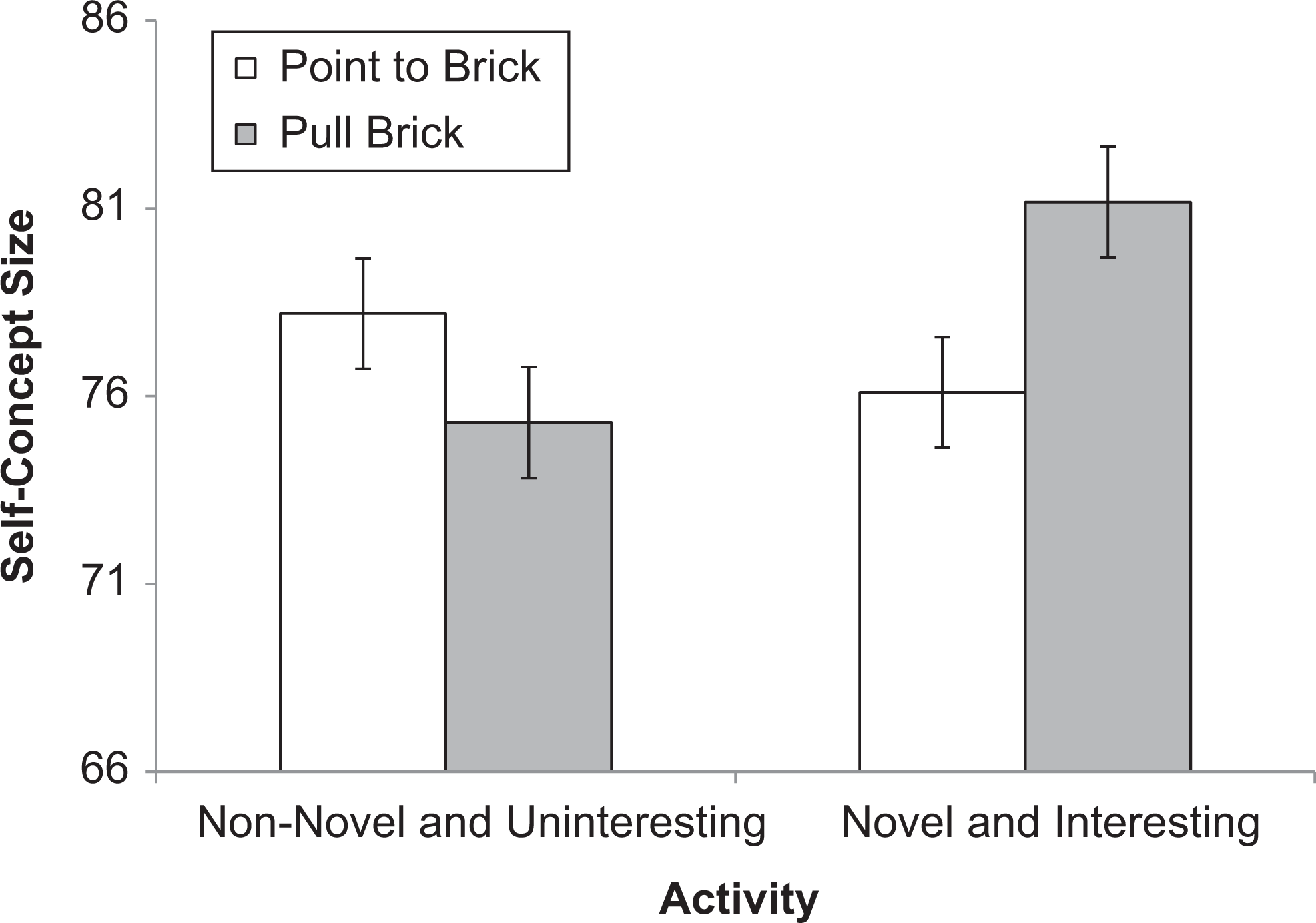
Means and standard errors for self-concept size measured as number of traits in Study 3. Vertical bars denote 1 SE. SE = standard error.
An alternative interpretation of these results is that individuals who pulled nonnovel and uninteresting (vs. novel and interesting) activities toward themselves actually harmed their self-concepts by incorporating the nonnovel and uninteresting content. However, participants who pulled nonnovel and interesting activities did not have significantly smaller self-concepts than those who pointed to novel and interesting activities (and who were unlikely to have harmed their self-concepts by identifying interesting activities), t(58) = 0.39, p = .70. Thus, our data indicate that the act of pulling novel and interesting activities toward the self increases self-concept size, rather than the alternate possibility that pulling nonnovel and uninteresting activities decreases self-concept size.
Because research indicates that approach motivation underlies self-expansion (Mattingly et al., 2012) and the motion of pulling may activate approach motivation (e.g., Cacioppo et al., 1993), it is possible that the larger self-concept size demonstrated by participants who pulled novel and interesting activities toward themselves is due to approach motivation becoming active. To test this alternative explanation, we first examined whether approach motivation differed between the experimental conditions. Contrary to this alternative explanation, the main effect of Activity, F(1, 116) = 0.01, p = .94, the main effect of Brick Motion, F(1, 116) = 1.37, p = .24, and the Activity × Brick Motion interaction, F(1, 116) = 1.73, p = .19, were all nonsignificant. Furthermore, when controlling for approach motivation, the Activity × Brick Motion interaction on self-concept size remained significant, F(1, 115) = 5.48, p = .02. Thus, approach motivation cannot explain the increase in self-concept size after embodied self-expansion.
We also explored whether pulling novel and interesting activities results in participants’ self-concepts being more accessible in general, therefore leading to more traits being selected as self-indicative. To test this alternative explanation, we examined participants’ response latencies on the self-concept task. Contrary to this alternative explanation, the main effect of Activity, F(1, 116) = 0.60, p = .44, the main effect of Brick Motion, F(1, 116) = 0.01, p = .92, and the Activity × Brick Motion interaction, F(1, 116) = 0.001, p = .98, were all nonsignificant. Furthermore, when controlling for response latencies, the Activity × Brick Motion interaction on self-concept size remained significant, F(1, 115) = 7.25, p = .01. Thus, increased self-concept accessibility cannot explain the increase in self-concept size after embodied self-expansion.
General Discussion
Across three studies (two correlational, one experimental), we found the first empirical evidence that nonrelational novel and interesting experiences increase the size of individuals’ self-concepts. In Studies 1 and 2, individuals who experienced more novel and interesting experiences over the previous 6 months tended to report larger self-concept sizes. In Study 3, we experimentally employed an embodied cognition paradigm and found that self-concept sizes were larger after participants metaphorically integrated novel and interesting (vs. nonnovel and uninteresting) experiences into the self. Consistent with other embodiment research (e.g., Niedenthal et al., 2005), pulling (vs. pointing to) novel and interesting activities toward the self activated a sense of possession that was sufficient for individuals to incorporate the novel experiences into the self-concept. These results are also consistent with embodiment research testing central predictions of the self-expansion model (Mattingly & Lewandowski, in press).
Importantly, Study 3 provides the first experimental test of the core aspect of the self-expansion model. Although Aron et al. (1995) showed that falling in love was associated with greater self-concept size, their data were nonexperimental, did not rule out alternate explanations, and did not provide definitive evidence of the causal direction of the theorized mechanism. Our Study 3 addresses these issues by demonstrating that the integration of novel experiences into the self literally increases individuals’ self-concept size and that the self-concept changes were not due to greater self-concept accessibility or activated approach motivation. The current studies also provide evidence that self-expansion need not require a romantic partner, and by extension self-expansion’s effects cannot entirely be explained by inclusion of other in the self, partner support, physiological arousal, or preoccupied thoughts of a romantic partner, all of which were potential confounds in the “falling in love” study (Aron et al., 1995). Rather, the present study establishes that novelty and interest are central to the self-expansion process.
Moreover, the present studies provide clear evidence that self-expansion can occur beyond a relational context and the processes associated with self-concept growth are broad and diverse. For example, experimental research demonstrates that following the experience of novel and interesting activities individuals report feeling more self-expansion (Aron et al., 2000; Mattingly & Lewandowski, 2013a, in press). In our Studies 1 and 2, we provided evidence that these novel and interesting experiences are associated with self-concept growth. Additionally, Slotter and Gardner (2009) have shown that mentally simulating (vs. actually experiencing) a romantic relationship is sufficient to lead individuals to integrate a partner’s traits into their own self-concept; and in our Study 3, we provide evidence that metaphorically including imagined nonrelational novel and interesting experiences into the self is sufficient to promote self-concept growth. In this way, the act of imagining engaging in novel and interesting activities may result in individuals taking new perspectives (e.g., “what would it be like if I had done this activity?”), which itself is indicative of self-expansion (Aron et al., 2013).
Finally, the current studies provide a combination of both internal and external validity. In Studies 1 and 2, we had noncollege samples report about their actual experiences, whereas in Study 3 we conducted a controlled experiment. The consistency of our results across these methodologically diverse studies with both university and Internet samples provide evidence of the robustness of the effect of novel and interesting experiences on self-concept size.
Conclusion
Individuals’ self-concepts are malleable (Markus & Wurf, 1987), and the degree to which self-concepts increase in size is associated with various positive outcomes (e.g., Mattingly & Lewandowski, 2013a, in press). Though novel and interesting experiences are theorized to increase the size of the self-concept, no empirical research had supported this prediction. We addressed this by providing both correlational and experimental evidence that novel and interesting experiences literally expand individuals’ self-concepts and that the act of mentally simulating the incorporation of such experiences is sufficient to alter the content of the self-concept. Ultimately, our studies demonstrate that self-growth can be achieved through novel and interesting experiences.
Footnotes
Acknowledgment
We would like to thank Rachel Carson, Samantha Diemer, Sarah Guarino, Kayla Hoover, Jessica Istanich, Amanda Mayes, Mary Moeller, Amanda Mosley, and Dylan Pelham for their assistance with data collection.
Declaration of Conflicting Interests
The author(s) declared no potential conflicts of interest with respect to the research, authorship, and/or publication of this article.
Funding
The author(s) received no financial support for the research, authorship, and/or publication of this article.