



Abstract
We hypothesize that two distinct facets of religiosity—orthodoxy (an emphasis on belief) and orthopraxy (an emphasis on behavior)—predict differential sensitivity to an actor’s intent when making moral judgments. Participants judged actors who performed misdeeds intentionally or unintentionally. In Study 1, high orthopraxy predicted harsher judgments of the unintentional actor, while high orthodoxy predicted more lenient judgments. In Study 2, we investigated a potential explanation for these effects, priming participants with either an “action focus” or a “thought focus.” Action-focused participants judged the unintentional actor more harshly than did thought-focused participants. In Study 3, participants from an orthopraxic tradition (Hinduism) judged the unintentional actor more harshly than did those from an orthodox tradition (Protestantism). These findings contribute to a growing literature on the multifaceted nature of religion. They also carry broader implications for understanding people’s responses to actions as a function of the actor’s mental state.
Keywords
Most judicial systems assume that crimes committed with “malice aforethought” and awareness of the act’s consequences deserve longer sentences than unintentional acts producing identical outcomes (Denno, 2003; Duff, 1990). Social psychological studies and public opinion surveys find that laypeople likewise tend to judge intentional crimes, committed with free choice, more harshly than unintentional crimes (Carlsmith, Darley, & Robinson, 2002; Carroll, Pekowitz, Lurigio, & Weaver, 1987; Cullen, Clark, Cullen, & Mathers, 1985; Darley & Pittman, 2003; Kleinke, Wallis, & Stalder, 1992; Plaks, McNichols, & Fortune, 2009; Sasson, 1995; Sims, 2003). Moreover, when making moral judgments, people immediately seek information about intentionality (Carlsmith, 2006), further suggesting that perceptions of intent feature prominently in punishment decisions and moral judgments.
At the same time, data suggest considerable variability in individuals’ sensitivity to intention information (Hermand, Mullet, Tomera, & Touzart, 2001; Killen, Lynn-Mulvey, Richardson, Jampol, & Woodward, 2011; Oswald, Orth, Aeberhard, & Schneider, 2005; Plaks et al., 2009; Young & Saxe, 2011). Although people generally judge less intentional acts more leniently, there are individuals for whom this is less true.
Here, we propose that variation in the role of intentionality in moral judgment can be partially explained by considering religious orthopraxy and religious orthodoxy. We suggest that religious orthopraxy, defined as an emphasis on rituals and observable behavior, is associated with placing little weight on an actor’s intentionality. In other words, we hypothesize that high orthopraxy leads to harsh judgments of unintentional actors. In contrast, we suggest that religious orthodoxy, defined as an emphasis on faith and the individual’s relationship with the supernatural, is associated with attributing great importance to intentionality. In other words, we hypothesize that high orthodoxy leads to lenient judgments of unintentional actors.
Orthopraxy and Orthodoxy
Virtually all religions contain both orthopraxic and orthodox elements. However, more orthopraxy-oriented traditions place greater emphasis on rituals and rules for conduct; more orthodoxy-oriented traditions place greater emphasis on beliefs, spirituality, and mental states (Cohen, Siegel, & Rozin, 2003). Orthopraxy and orthodoxy can differ between religions—for example, Protestantism is higher in orthodoxy and lower in orthopraxy than Hinduism and Judaism (Bowker, 1997; Cohen et al., 2003; Collins, 1999; Flood, 1996; Placher, 1988)—and between individuals within the same religion (see, e.g., Cohen et al., 2003). Moreover, orthopraxy and orthodoxy can vary independently; an individual (or a religion) may be high in one, both, or neither.
Orthopraxy, in emphasizing rules for behavior, implies that right and wrong is a question more of observable behavioral outcomes than of mental states. Intention is by definition a mental state. Thus, orthopraxy, with its focus on observable behavioral outcomes, may lead people to distinguish less between intentional and unintentional acts. At the same time, orthodoxy, with its focus on mental states, may increase the weight people place on the actor’s intentions, leading people to distinguish more between unintentional and intentional, acts.
Existing research on the relationship between religiosity and punitiveness, one form of moral judgment, yields contradictory results: Some studies suggest a positive relationship and others a negative relationship (e.g., Grasmick, Davenport, Chamlin, & Bursik, 1992; Greer, Berman, Varan, Bobrycki, & Watson, 2005; Mancini & Mears, 2010; Unnever, Bartkowski, & Cullen, 2010). Within the literature, however, no studies have distinguished between reactions to intentional versus unintentional acts. The present studies begin to address this gap, testing whether religious orthopraxy and religious orthodoxy influence the weight perceivers place on actors’ intentionality and, in turn, the harshness by which they judge unintentional (vs. intentional) actors. At the same time, these studies extend work on the orthodoxy/orthopraxy distinction and moral judgment. Whereas prior research has examined judgments of actors who harbor immoral thoughts but do not perform the corresponding action (e.g., Cohen & Rozin, 2001), the present studies examine judgments of actors who perform an immoral action in the absence of the corresponding intent.
Overview of the Studies
In all studies, participants read about an actor who committed an intentional or unintentional misdeed and then rendered moral judgments. In all three studies, we predicted that participants high in orthopraxy would show less sensitivity to the intentionality information than participants low in orthopraxy. At the same time, we predicted participants high in orthodoxy would show more sensitivity to the intentionality information than participants low in orthodoxy. In Study 1, we tested this prediction by measuring individual differences in religious orthopraxy and orthodoxy. In Study 2, we manipulated features of orthopraxy and orthodoxy (action focus vs. thought focus) that we hypothesized would cause divergent judgments of unintentional actors. In Study 3, we sampled participants from orthopraxic (Hindu) and orthodox (Protestant) religious traditions and predicted that differences between the two groups’ sensitivity to intentionality would be mediated by their adherents’ degree of orthopraxy/orthodoxy.
Study 1
Method
Participants
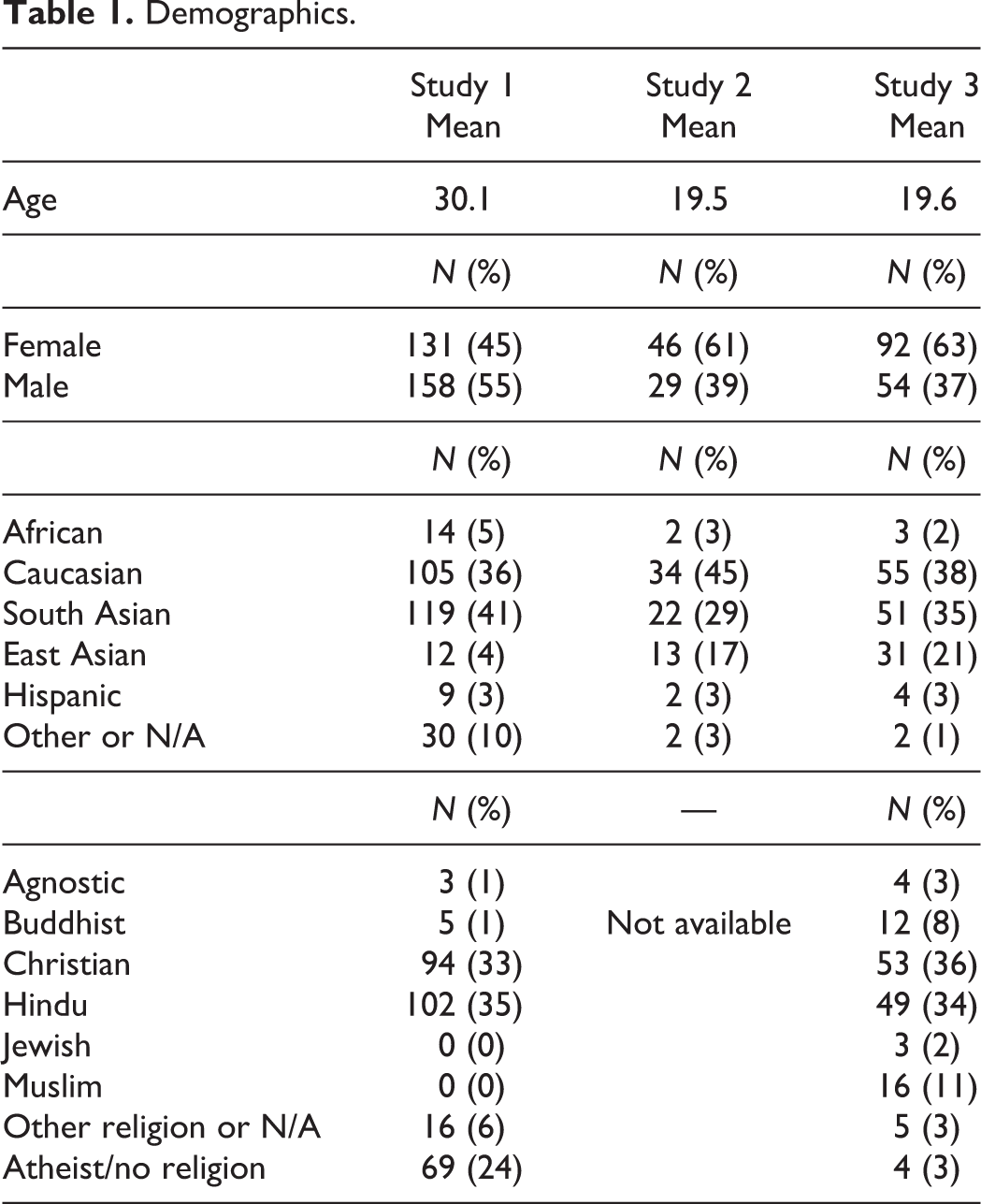
Adults (N = 289) participated online via Mechanical Turk for a small sum. See Table 1 for demographics for all samples.
Demographics.
Procedure
Participants read either the intentional or the unintentional version of a story in which the protagonist caused the death of his uncle. There are many ways to manipulate the degree of an actor’s intentionality, including manipulating the actor’s belief (e.g., Young, Cushman, Hauser, & Saxe, 2010), desire (Cushman, 2008), skill (e.g., Guglielmo & Malle, 2010), or conscious control over the act that produced the negative outcome (Malle & Knobe, 1997; Plaks et al., 2009). Here, we focused on the actor’s degree of conscious control, reasoning that it would be highly intuitive to participants as a marker of intentionality. In both versions of the story (modified from Chisholm, 1966), the actor desired a harmful outcome, believed he had the skill to accomplish it, and planned to accomplish it. What differed was whether or not the outcome occurred through a deliberate, controlled action.
Specifically, in both versions of the story, J.G. wanted to kill his uncle to gain an inheritance. He planned to hit his uncle with his car while his uncle was out for his morning walk. In the intentional version, J.G. carried out his plan perfectly, and his uncle died as the intended consequence of J.G.’s consciously performed action. In the unintentional version, J.G. was surprised when a pedestrian appeared in the roadway. In the confusion, he pressed the accelerator instead of the brake, hitting and killing the pedestrian, who turned out to be his uncle. In other words, the uncle died as a result of J.G.’s unintended action. See Supplementary Online Material for the text from the scenarios used in all studies.
Participants then used 7-point scales to rate the following 4 items (see Pizarro, Uhlmann, & Bloom, 2003; Plaks et al., 2009): “How severe a punishment should be given for this offense” (1 = not at all; 7 = extremely), “How much moral responsibility does J.G. deserve from the outcome of this scenario?” (1 = no responsibility; 7 = all the responsibility), “how much blame goes to J.G. for what happened?” (1 = no blame; 7 = all the blame), and “how negatively should J.G. be judged?” (1 = not at all; 7 = extremely). These items formed a scale of moral judgment (Cronbach’s α = .93). A final item, “how intentional was J.G.’s action?” (1 = not at all; 7 = extremely) served as a manipulation check.
Finally, participants completed a demographics form that included two questions about their religion, both rated on 7-point scales (1 = not at all; 7 = extremely). An orthopraxy question asked participants to indicate how important it was to them “to follow the rules, customs, and obligations of your religion;” an orthodoxy question asked them, “How important is it to you to embrace the beliefs put forth by your religion?” (See Supplementary Online Material for validation of these 1-item measures.)
Results and Discussion
Manipulation Check
Participants who read the intentional scenario rated J.G.’s action as significantly more intentional (M = 5.61, standard deviation [SD] = 1.77) than did participants who read the unintentional scenario (M = 2.83, SD = 2.02), t(287) = 12.46, p < .001.
Effects of Orthopraxy and Orthodoxy
We hypothesized that orthopraxy and orthodoxy would exert independent effects on participants’ moral judgments. Specifically, we predicted separate two-way interactions (Orthopraxy × Intentionality and Orthodoxy × Intentionality). We expected that those who reported higher orthopraxy would judge the unintentional actor more harshly than would participants who were lower in orthopraxy. We expected that participants who were higher in orthodoxy would judge the unintentional actor less harshly than would those who were lower in orthodoxy.
To test these predictions, we regressed participants’ moral judgments on orthopraxy (centered on 0), orthodoxy (centered on 0), intentionality (unintentional = −1, intentional = 1), and the Orthopraxy × Intentionality and Orthodoxy × Intentional interaction terms. Participants overall judged the intentional actor more harshly than the unintentional actor, β = .58, t(285) = 13.25, p < .001. Moreover, there was a significant main effect for orthodoxy, such that higher orthodoxy was associated with more lenient judgments, β = −.12, t(285) = −2.19, p = .023.
Consistent with our hypotheses, both the Orthopraxy × Intentionality interaction, β = −.32, t(285) = −5.83, p < .001, and the Orthodoxy × Intentionality interaction, β = .12, t(285) = 4.89, p < .001, achieved significance. We estimated simple slopes at scores of +1 and −1 SD from the means of the orthodoxy and orthopraxy distributions. As predicted, while all participants judged the intentional actor more harshly than the unintentional actor, this effect was greater among low orthopraxy participants, β = .82, t(285) = 12.56, p < .001, than among high orthopraxy participants, β = .37, t(285) = 5.62, p < .001. Also as predicted, the tendency to judge the intentional actor more harshly than the unintentional actor was greater among high orthodoxy participants, β = .71, t(285) = 10.74, p < .001, than among low orthodoxy participants, β = .61, t(285) = 8.69, p < .001. That is, high orthopraxy predicted a smaller distinction between intentional and unintentional acts, but high orthodoxy predicted a larger distinction (see Figure 1).
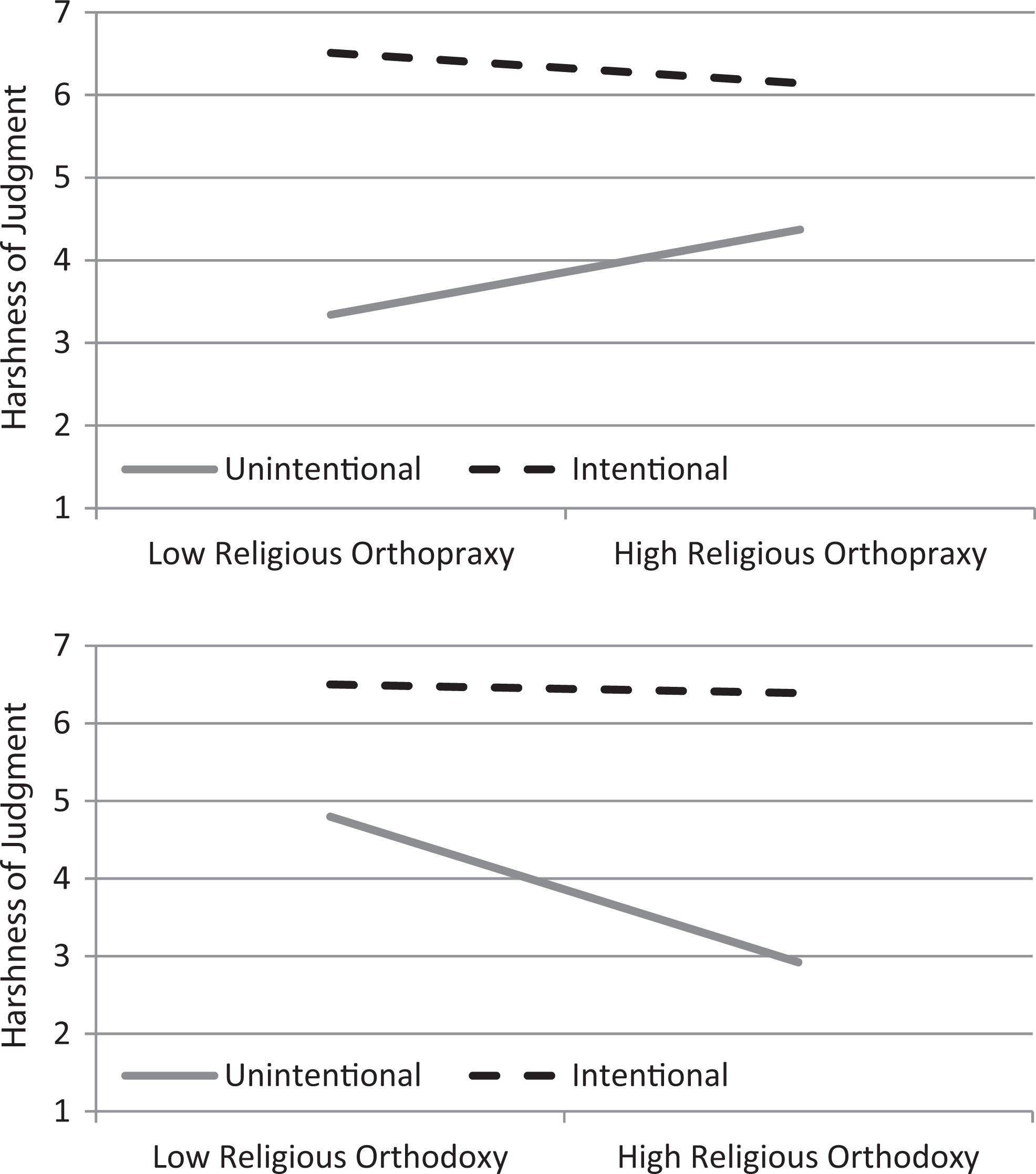
Moral judgments of intentional and unintentional actors, plotted by religious orthopraxy and orthodoxy (Study 1).
Seen differently, in the unintentional condition, high orthodoxy predicted less harsh judgments, β = −.33, t(285) = −4.60, p < .001, while high orthopraxy predicted more harsh judgments, β = .29, t(285) = 4.21, p < .001. In the intentional condition, orthodoxy no longer predicted punishment, β = −.06, t(285) = −0.998, p = .319; the effect of orthopraxy was reversed, β = −.17, t(285) = −2.71, p = .004.
In summary, individual differences in both orthopraxy (an emphasis on religious practice) and orthodoxy (an emphasis on religious faith) predicted the degree to which participants incorporated information about the actor’s degree of intent into their moral judgments. Those high in orthopraxy showed less sensitivity to intentionality, judging the accidental actor more harshly than did those low in orthopraxy. In contrast, those high in orthodoxy showed greater sensitivity; they judged the accidental actor less harshly than those low in orthodoxy.
Study 2
In Study 2, we sought more insight into the effects of orthodoxy and orthopraxy on moral judgment by manipulating participants’ focus on thought versus action. Our hypotheses rest on the assumptions that religious orthodoxy promotes an emphasis on mental states when it comes to moral judgment, whereas religious orthopraxy promotes an emphasis on observable behavior. Thus, focusing people on thoughts should mimic the effects of orthodoxy: a greater distinction between unintentional and intentional actors. In contrast, focusing people on behavior should mimic the effects of orthopraxy: less of a distinction between intentional and unintentional actors.
Method
Participants
Undergraduates (N = 71) at a large North American university participated for extra course credit.
Procedure
Participants entered the lab for what they believed would be two separate experiments. First, we randomly assigned participants to one of the two conditions. In the “action-focus” condition, participants imagined, regardless of whether they actually believed in God, that God is watching you. He is observing your movements and actions very carefully, as if He is watching your daily life on television. What kinds of things would God notice as He watches you go about your normal activities? What would He think of your behavior? Write a few paragraphs about what God would think of you if He were watching your actions in this way. that God is listening to you. He hears your thoughts and feelings as if He were listening to a radio broadcast. What kinds of things would God hear as He listens to your thoughts during your daily activities? What would He think of the contents of your mind? Write a few paragraphs about what God would think of you if He were listening to your thoughts in this way.
Second, participants read about an actor who had committed a misdeed either intentionally or unintentionally. For the sake of generalizability, we used a new pair of scenarios, involving “Barbara” (the actor) and “John” (the victim). In the intentional scenario, Barbara wanted John to die and successfully executed her plan to poison him with full conscious awareness of her action. In the unintentional scenario, the deathblow occurred outside of Barbara’s intentional control: Barbara poured poison into John’s food, but John subsequently changed his dish to something that, unbeknownst to all parties, contained a deadly allergen (see Pizarro et al., 2003). That is, although Barbara desired John’s death, his death was caused outside of her conscious control. Following the scenario, participants rated Barbara on the same moral judgment items used in Study 1.
Results and Discussion
Manipulation Checks
Two blind coders guessed each participant’s condition based on responses to the “imagination exercise.” These coders achieved 100% accuracy, suggesting participants complied with the instructions for condition. Participants who read the intentional scenario rated Barbara’s action as significantly more intentional (M = 4.74, SD = 0.62) than did participants who read the unintentional scenario (M = 2.41, SD = 1.26), t(69) = 9.77, p < .001.
Primary Analyses
We submitted participants’ scores on the moral judgment index to a 2 (focus manipulation: action focus vs. thought focus) × 2 (intentionality: intentional vs. unintentional) analysis of variance (ANOVA). This analysis revealed a significant main effect for intentionality, F(1, 67) = 45.18, p < .001, as well as the predicted two-way interaction, F(1, 67) = 5.77, p = .019.
Simple effects tests revealed that participants in the thought-focus and action-focus conditions judged the intentional actor equivalently (M thought focus = 4.52, SD thought focus = 0.42; M action focus = 4.34, SD action focus = 0.46), F(1, 67) = 0.61, p = .438. However, participants in the action-focus condition judged the unintentional actor more harshly (M = 3.64, SD = 0.56) than did participants in the thought-focus condition (M = 3.04, SD = 1.06), F(1, 67) = 7.06, p = .010, d = 0.74. Moreover, thought-focused participants made a larger distinction between intentional and unintentional acts, F(1, 67) = 14.57, p < .001, d = 2.02, than did action-focused participants, F(1, 67) = 9.41, p = .003, d = 1.39.
Additional Analyses
We also ran a third condition—a control condition—to examine the independent effects of our two experimental conditions. An additional 37 participants underwent only the second phase of the study, without any focus manipulation. When we included that condition in the analyses, the Condition × Intentionality Interaction remained marginally significant F(2, 102) = 2.64, p = .076, and the simple effects comparing the judgments of the unintentional actor made by thought-focused participants to those made by action-focused participants remained significant, F(1, 102) = 6.07, p = .003. The judgments of the unintentional actor made by participants in the control condition (M = 3.33, SD = 0.89) fell between, but did not differ significantly from, those in the other two conditions (Fs < 2.16, ps > .120).
In summary, as predicted, participants in the action-focus condition (God is watching) made ratings that resembled those of Study 1’s orthopraxic participants; participants in the thought-focus condition (God is listening) paralleled Study 1’s orthodox participants.
We referenced God in Study 2’s manipulation because we wished to activate the concept of a moral judge who could either observe participants’ behavior or listen to their thoughts. Future research may find that thinking in these ways about other entities connected to morality may activate similar processes. Moreover, future research may find that inducing a thought versus action focus in the abstract (in the absence of any moral judge) may produce similar effects. Nonetheless, the Study 2 data represent initial evidence for a pathway linking orthodoxy/orthopraxy and moral judgment.
Study 3
In Study 3, we tested our hypotheses using between-religion differences. In contrasting religious orthodoxy and orthopraxy, Cohen and Rozin (2001) distinguished at the group level between thought-focused versus action-focused religious traditions. According to these researchers, thought-focused traditions such as Protestantism place high importance on individuals’ relationship with God and therefore emphasize the individuals’ private thoughts. For example, Protestantism, more than other religions, views sinful thought as equivalent to sinful action, a perspective expressed in the Book of Matthew (5:27), “…I tell you that anyone who looks at a woman lustfully has already committed adultery with her in his heart.” By contrast, Rabbinic Judaism traditionally places greater emphasis on observable, ritual practices (Cohen et al., 2003). Other scholars have suggested that Hinduism is relatively heterodox with respect to articles of faith but places greater emphasis on “sanatana dharma” translated roughly as “everlasting appropriate way to live” (Bowker, 1997; Flood, 1996). Thus, Protestantism tends to instill more orthodoxy than orthopraxy, whereas Judaism and Hinduism likely do the reverse (see also Collins, 1999; Placher, 1988).
Our perspective, then, suggests that Protestants should be more lenient than Jews or Hindus toward an unintentional wrongdoer. Indeed, Cohen and Rozin (2001) found that while Protestants and Jews rated a person who intentionally committed an immoral act equally negatively, Protestants rated a person who had immoral thoughts (but did not act on them) more negatively than did Jews. In other words, Protestants placed greater importance on the actor’s mental state of sinful thought. Our final study examines the other side of that coin: Immoral action in the absence of a corresponding sinful thought (i.e., in the absence of intention). Whereas Cohen and Rozin (2001) found that Protestants made harsher judgments of a target who had sinful thoughts but did not perform the corresponding action, our hypotheses (and our results from Studies 1 and 2) lead to the prediction that Protestants would judge the target more leniently when she performed the action without the corresponding sinful thought. Given the demographic makeup of our sample, we compared the responses of Protestants, whose faith is relatively orthodox, to the responses of Hindus, whose faith is relatively orthopraxic.
Method
Participants
Undergraduates (N = 146) at a large North American university volunteered to participate during a lecture course. To ensure that our final sample reflected participants who had been effectively influenced by their stated religious tradition, we decided a priori to exclude participants who scored below the midpoint on the religiosity measure (but report the results including these participants in a Note following the main analyses). Within that subsample, we identified the largest orthopraxic and orthodox groups: Hindus (n = 40) and Protestants (n = 33).
Procedure
Participants first completed a demographics form, wherein they provided their religious identification (What is your primary religious identification?) and their overall religiosity (Overall, how religious would you consider yourself?). We used this information to identify, as described previously, subsets of participants influenced by a more orthodox (i.e., Protestant) or less orthodox (i.e., Hindu) religious tradition. We also assessed self-reported orthodoxy and orthopraxy using the items from Study 1.
Next, participants read a scenario about an actor who performed an intentional or unintentional misdeed (see Young & Saxe, 2008). All participants read that “Kate” is a waitress who adds sesame seeds to the dish of a customer who is deathly allergic to sesame seeds. In the unintentional condition, Kate was not aware of the customer’s allergy; in the intentional condition, she was. Participants then provided ratings on the same moral judgment items used in Studies 1 and 2.
Results and Discussion
Manipulation Check
Participants who read the intentional scenario rated Kate’s action as significantly more intentional (M = 3.84, SD = 0.72) than did participants who read the unintentional scenario (M = 2.66, SD = 1.09), t(71) = 5.51, p < .001.
Primary Analyses
We hypothesized that Hindus and Protestants would judge Kate equivalently in the intentional condition but that Hindus would judge her more harshly in the unintentional condition. To test this hypothesis, we conducted a 2 (religion: Hindu vs. Protestant) × 2 (intentionality: intentional vs. unintentional) between-subjects ANOVA. This analysis revealed a main effect for intentionality, F(1, 69) = 38.48, p < .001, a main effect for religion, F(1, 69) = 6.18, p = .015 (overall, Hindus judged the actor more harshly), and the predicted two-way interaction, F(1, 69) = 4.42, p = .039.
As predicted, simple effects tests revealed that although Hindus and Protestants rated the intentional actor equivalently (M Hindu = 3.88, SD Hindu = 0.69; M Protestant = 3.80, SD Protestant = 0.77), F(1, 69) = 0.08, p = .778, Hindus (M = 3.04, SD = 1.18) judged the unintentional actor more harshly than did Protestants (M = 2.09, SD = 0.62), F(1, 69) = 9.92, p = .002, d = 1.05. Examining the pattern in a different way, Protestants made a larger distinction between intentional and unintentional acts, F(1, 69) = 14.57, p < .001, d = 2.45, than did Hindus F(1, 69) = 9.41, p = .003, d = 0.90. 1
Mediational Analyses
Protestants and Hindus differ in a number of ways beyond the orthodoxy/orthopraxy distinction (e.g., specific doctrinal tenets, independent vs. interdependent cultures). We therefore wished to test whether degree of orthodoxy/orthopraxy per se mediated the effect of religion on judgment of unintentional actors. To do so, we conducted a bootstrapping mediation analysis (5,000 resamples) with religion as the predictor, moral judgment as the dependent variable, and orthopraxy as the mediator using participants in the unintentional condition only. All confidence intervals were bias corrected and accelerated. The confidence interval for the indirect effect, [−1.14, −0.04], did not include 0, indicating that the difference between Hindus and Protestants in orthopraxy contributed significantly to their difference in judgment.
An analogous analysis that substituted the orthodoxy item as the mediator did not yield any evidence for mediation. Specifically, the link between religious tradition (Hindu vs. Protestant) and orthodoxy was not significant, β = .11, p > .50, suggesting that Hindus and Protestants differ more in terms of their orthopraxy than their orthodoxy.
To summarize, participants from the more orthopraxic religious tradition (Hinduism) judged the unintentional actor more harshly than did participants from the less orthopraxic tradition (Protestantism). Moreover, of the numerous differences between Hindus and Protestants, their difference in orthopraxy appears to explain at least part of their difference in moral judgment.
Study 1 Revisited
The results from Study 3 raise two questions about Study 1. Given that our Study 1 sample was also comprised of two subgroups—primarily Protestant Americans and primarily Hindu Indians—can we replicate the between-group results there as well? And if so, does this between-group difference account for the individual differences in results we reported, or do the effects of orthopraxy and orthodoxy hold even keeping religious affiliation constant? Analyses described in the SOM confirm that the between-group results do replicate in the Study 1 sample. Moreover, within both the American (N = 154) and Indian (N = 130) subsamples, we replicate the Study 1 results involving individual differences in orthodoxy and orthopraxy. Taken together, Studies 1 and 3 provide evidence supporting our hypotheses at both the individual and group levels of analysis.
General Discussion
In three studies, religious orthopraxy and orthodoxy predicted the weight people place on the actor’s degree of intentionality when rendering moral judgments. Participants high in orthopraxy made harsher judgments of unintentional actors than did those low in orthopraxy, while participants low in orthodoxy made harsher judgments than did those high in orthodoxy (Study 1). Analyses considering group differences, rather than individual differences, replicated these effects (Studies 1 and 3). Moreover, participants induced to focus on actions made judgments similar to those of participants high in orthopraxy, whereas participants induced to focus on thoughts made judgments similar to those of participants high in orthodoxy (Study 2). These effects emerged consistently across distinct operationalizations of orthodoxy and orthopraxy and different sets of intentional–unintentional scenarios.
Religion: A Complex Construct
These data speak to the complexity of religion. Rather than viewing religions as monolithic entities, recent evidence invites a more nuanced approach that understands religions as sets of distinct, interacting elements (Ginges, Hansen, & Norenzayan, 2009; Kay, Gaucher, Napier, Callan, & Laurin, 2008; Laurin, Shariff, Henrich, & Kay, 2012; Malka & Soto, 2011; Shariff & Norenzayan, 2011). Here, we add to this literature, highlighting the importance of distinguishing between two of these elements—orthodoxy and orthopraxy. In particular, our findings complement and extend related work by Cohen and Rozin (2001) and Cohen et al. (2003)in a number of ways. First, rather than examine participants’ responses to thought in the absence of the corresponding action (Cohen & Rozin, 2001), we examine responses to action in the absence of the corresponding thought. Second, within the domain of thought, we distinguish between desires and intentions, following the work of many philosophers and a smaller number of psychologists (e.g., Brand, 1984; Duff, 1990; Knobe, 2003; Malle & Knobe, 1997). In our studies, the key difference between conditions was not whether the actor desired a morally bad outcome, but what the actor intended during the execution of action. Third, the experimental findings from Study 2 provide preliminary evidence regarding mechanism: Orthodoxy and orthopraxy may guide moral cognition by activating a focus on either thought or action.
Moreover, our findings may help reconcile a central conflict in the psychology of religion. Religiosity has been associated positively (e.g., Applegate, Cullen, Fisher, & Vander Ven, 2000; Grasmick & McGill, 1994; Greer et al., 2005), negatively (e.g., Greer et al., 2005; Unnever et al., 2010), or not at all (Cochran & Piquero, 2011) with punitiveness and moral judgment. The specific aspects of religiosity that predict harsher judgments include extrinsic religiosity and fundamentalist Protestantism (Grasmick et al., 1992; Grasmick & McGill, 1994; Grasmick, Morgan, & Kennedy, 1992; Greer et al., 2005; Mancini & Mears, 2010). Extrinsically religious individuals view religion as a means to an (often social) end (Allport & Ross, 1967; Donahue, 1985). As such, they may be more focused on observable elements of their religion such as attendance at services and rituals and adherence to behavioral rules. In other words, they may have strong orthopraxic religiosity. By contrast, specific elements of religiosity that predict more lenient judgments include intrinsic religiosity (Greer et al., 2005) and having a close relationship with God (Unnever et al., 2010). Both of these elements focus on private internal states, and thus may be linked to religious orthodoxy. From our perspective, then, studies may indicate a negative link between religion and moral judgment when researchers measure a more orthodox form of religiosity (which predicts greater sensitivity to the actor’s intent). On the other hand, studies may indicate a positive link between religion and moral judgment when researchers measure a more orthopraxic form of religiosity (which predicts lower sensitivity to the actor’s intent).
Intention, Moral Judgment, and Punishment
Most justice systems assume that intentionality matters when it comes to assigning punishments. A long line of research confirms that most people intuitively agree with this principle (e.g., Carlsmith et al., 2002; Darley & Pittman, 2003; Wooten, 2009). A smaller body of work suggests, however, that individual and cultural differences moderate this tendency (e.g., Hermand et al., 2001; Oswald et al., 2005; Plaks et al., 2009). This work identifies specific variables that moderate the subjective link between intention and blameworthiness.
Other individual difference variables likely play a similar role in moderating the weight moral judges place on an actor’s intent. For example, consider the autism spectrum. Studies have suggested that high-functioning people with autism are less sensitive to an actor’s mind, including aspects of intent (e.g., Moran et al., 2011; Young, Camprodon, Hauser, Pascual-Leone, & Saxe, 2010). The present findings, especially those from Study 2, suggest that any variable that highlights internal states might increase the weight placed on intention, while any variable that highlights observable behavior and outcomes might decrease this weight. Individuals toward higher up on the autism spectrum may make judgments similar to those made by individuals high in orthopraxy. Similarly, further research may discover that our effect generalizes to other mental states as well: For example, more orthodox individuals may be more likely than more orthopraxic individuals to show leniency toward actors who feel remorse or who claim they acted in the heat of the moment as a result of an intense emotional trigger.
Concluding Remarks
Until recently, the literature on moral judgment has devoted a comparatively small amount of attention to the role of perceptions of the actor’s intent (see Gray, Young, & Waytz, 2012). In addition, research on the relationship between religion and moral judgment has, until recently, tended to operationalize religiosity in relatively broad brushstrokes. The present data suggest that by (a) isolating specific elements of religiosity and (b) manipulating how intentionally the actor acted, researchers may account for more of the variability in moral judgment. Thus, such research contributes to a sharper view of both the psychology of religion and the psychology of moral judgment.
Footnotes
Declaration of Conflicting Interests
The author(s) declared no potential conflicts of interest with respect to the research, authorship, and/or publication of this article.
Funding
The author(s) received no financial support for the research, authorship, and/or publication of this article.
