




Abstract
The purpose of this study was to examine the potential universality of age differences in romantic attachment. Relatively few studies have investigated attachment processes beyond young adulthood and very little is known about age differences in romantic attachment orientations in geographic regions outside North America. We examined attachment anxiety and avoidance among 90,904 Internet respondents in 81 countries. Attachment anxiety was highest among younger adults and lowest in middle-aged and older adults. Attachment avoidance was lowest among younger adults and highest in middle age and older adults. Further, the patterns of age differences were universal across individualistic and collectivistic regions. Findings are discussed in the context of normative social roles and the universality of their influence on life span personality development.
Attachment theory was originally conceptualized as a framework for explaining close relationship dynamics across the entire life span (Bowlby, 1969/1982). However, most attachment research has focused on early childhood and young adulthood (Magai, 2008). This oversight is surprising in light of the many attachment-relevant experiences that take place after young adulthood (e.g., marriage, parenthood, and bereavement). To date, very little is known about how an individual’s romantic attachment orientation (i.e., approach toward close relationship) differs across the life span and in geographic regions outside North America. Our goal in this study is to examine the potential universality of age differences in romantic attachment orientation. By examining life span differences in romantic attachment in different cultures, we can test whether personality development follows a normative pattern around the world despite regional influences that might affect development.
Age-Related Differences in Romantic Attachment Orientations
An individual’s romantic attachment orientation is generally conceptualized as their position on two conceptually distinct dimensions: anxiety and avoidance (Fraley & Waller, 1998). Attachment-related anxiety reflects a preoccupation with the availability of close others (Mikulincer, Gillath, & Shaver, 2002). Individuals with higher anxiety scores exhibit excessive reassurance seeking and hypervigilance to signs of rejection and abandonment (Shaver, Schachner, & Mikulincer, 2005). Attachment-related avoidance is characterized by chronic attempts to inhibit attachment system activation in an effort to minimize expressions of distress (Edelstein & Shaver, 2004). Individuals with higher avoidance scores generally dislike intimacy and are less likely to provide emotional support to romantic partners (Brennan, Clark, & Shaver, 1998; Li & Chan, 2012). Individuals reporting low scores on both dimensions are generally considered secure. Individual differences in anxiety and avoidance are also hypothesized to have evolutionary underpinnings. Belsky, Steinberg, and Draper (1991) consider the attachment system to be an evolved mechanism to evaluate social conditions and choose a contextually effective sexual strategy at each developmental stage, making trade-offs to maximize one’s fitness. As such, an individual’s romantic attachment orientation is also hypothesized to guide sexual strategies across the human life span to maximize that individual’s reproductive potential (Del Giudice, 2009).
Theories of social investment suggest that commitment to social institutions (e.g., partnership and parenting) shapes personality development (Roberts, Wood, & Smith, 2005). Individuals generally invest in age-graded social roles (e.g., as a partner and parent) and are rewarded when they meet the expectations of a particular role.
These social roles require people to regulate their emotions and behave in a socially mature way, which may decrease the number and intensity of negative experiences, and in turn, attachment anxiety (Gross et al., 1997). Age differences in anxiety could therefore reflect changes in one’s personality to meet the challenges of a new role (Roberts et al., 2005). However, age differences in anxiety could also be the product of the security-enhancing effects of being in a relationship for an extended period of time (Davila, Karney, & Bradbury, 1999). Decreases in anxiety could also reflect changes in an individual’s reproductive strategy at a particular life stage. For example, hypervigilance toward the availability of one’s partner early in a relationship could reflect a strategy to ensure parental investment and increase paternal certainty (Kruger et al., 2013; Schachner & Shaver, 2002). After this developmental stage passes, an individual can shift his or her reproductive strategy in light of improvements in social support and the quality of romantic relationships and possibly report lower levels of anxiety (Chisholm, 1993, 1999). Thus, one might expect attachment anxiety to decrease across the adult life span, as lower levels of anxiety would aid in the transition to new roles, result from the adoption of these new roles, or reflect changes in reproductive strategies. In support of this hypothesis, in a large cross-sectional sample of over 80,000 largely North American participants, we recently found that attachment anxiety was highest in young adulthood and lower in middle and older adulthood (Chopik, Edelstein, & Fraley, 2013).
The direction and utility of age differences in avoidance are much less clear. Small increases in avoidance across the life span may reflect the culmination of the individuation process and increasing levels of independence throughout young adulthood (Arnett, 2000; Erikson, 1968; Stewart & Ostrove, 1998). Higher levels of avoidance could also mitigate some of the anxieties surrounding relationship formation and maintenance. Lower levels of avoidance among younger adults predict engagement in long-term committed relationships during this developmental period and reflect a strategy of cooperation in relationships that maximizes an individual’s long-term fitness (Del Giudice, 2009; Schindler, Fagundes, & Murdock, 2010). In our aforementioned study (Chopik et al., 2013), avoidance was higher in middle-aged adults compared to younger and older adults. However, it is unclear whether these age differences are present in regions outside North America. Further, large samples from multiple geographic regions are often needed to detect small differences and enable comparisons between regions. Thus, replicating the patterns of age differences in attachment from our previous work in a more geographically diverse sample would strengthen the claims that attachment differs by age and is driven by changes in social roles.
Age Differences in Romantic Attachment Orientations and Geographic Region
Do romantic attachment orientations differ by age in a similar way across geographic regions? Or are there region-specific characteristics that influence the development of individuals’ romantic attachment orientation? There is empirical support for both claims, and we review the evidence for each subsequently.
The age-graded nature of normative social roles (e.g., partnering and parenthood) and the expectations of increased social maturity with age are thought to be relatively universal across cultures (Roberts et al., 2005). According to this view, personality development should be similar across geographic regions, as development is tied to these relatively universal, age-graded roles. Past work has shown that age differences in personality traits (e.g., the Big Five) are relatively consistent across cultures (Bleidorn et al., 2013; McCrae, 2004; McCrae et al., 1999, 2000). However, many of the studies that have examined age differences in personality traits have been limited by small numbers of both participants and geographic regions (usually ∼five countries; McCrae et al., 2000). Age differences in romantic attachment might also be similar across geographic regions; however, no study to date has examined this hypothesis. Considering the culture-specific diversity in social norms and practices, large samples of both participants and geographic regions are needed to make definitive statements about the universality of personality development. In sum, the extent to which age differences in romantic attachment are universal across geographic regions remains an open question.
Extant research on cultural differences in mean levels of attachment anxiety and avoidance suggests that geographic region can have a considerable influence on an individual’s romantic attachment orientation. Geographic regions are an important unit of analysis because there is large regional variation in important psychological constructs, such as individualism/collectivism. For example, individuals from more collectivistic regions may report higher levels of anxiety because they tend to evaluate themselves with respect to the values of broader social structures (Markus & Kitayama, 1991). As a result, individuals in these regions gain self-acceptance by continually striving for the approval of their partners (You & Malley-Morrison, 2000). Similarly, anxiously attached individuals are preoccupied with the availability and responsiveness of their partners (Mikulincer et al., 2002). Indeed, Schmitt et al. (2004) assessed regional differences in romantic attachment and found that individuals from Asia and East Asia (more collectivistic regions) reported higher attachment anxiety compared to those in North America and Western Europe (more individualistic regions). Schmitt and colleagues found no relationship between individualism/collectivism and attachment avoidance, however. Yet, only 4 of the 62 cultural regions (6.5%) examined by Schmitt et al. had at least one sample of either men or women with a mean age over 30 (see Table 1; Schmitt et al., 2004). Considering how young the participants were, it is unclear whether their findings adequately capture the relative contributions of development and culture. In this study, we redress this gap by examining how romantic attachment differs by age in different geographic regions in a more developmentally diverse sample.
Regressions Predicting Attachment Dimensions from Age, Gender, and Region.
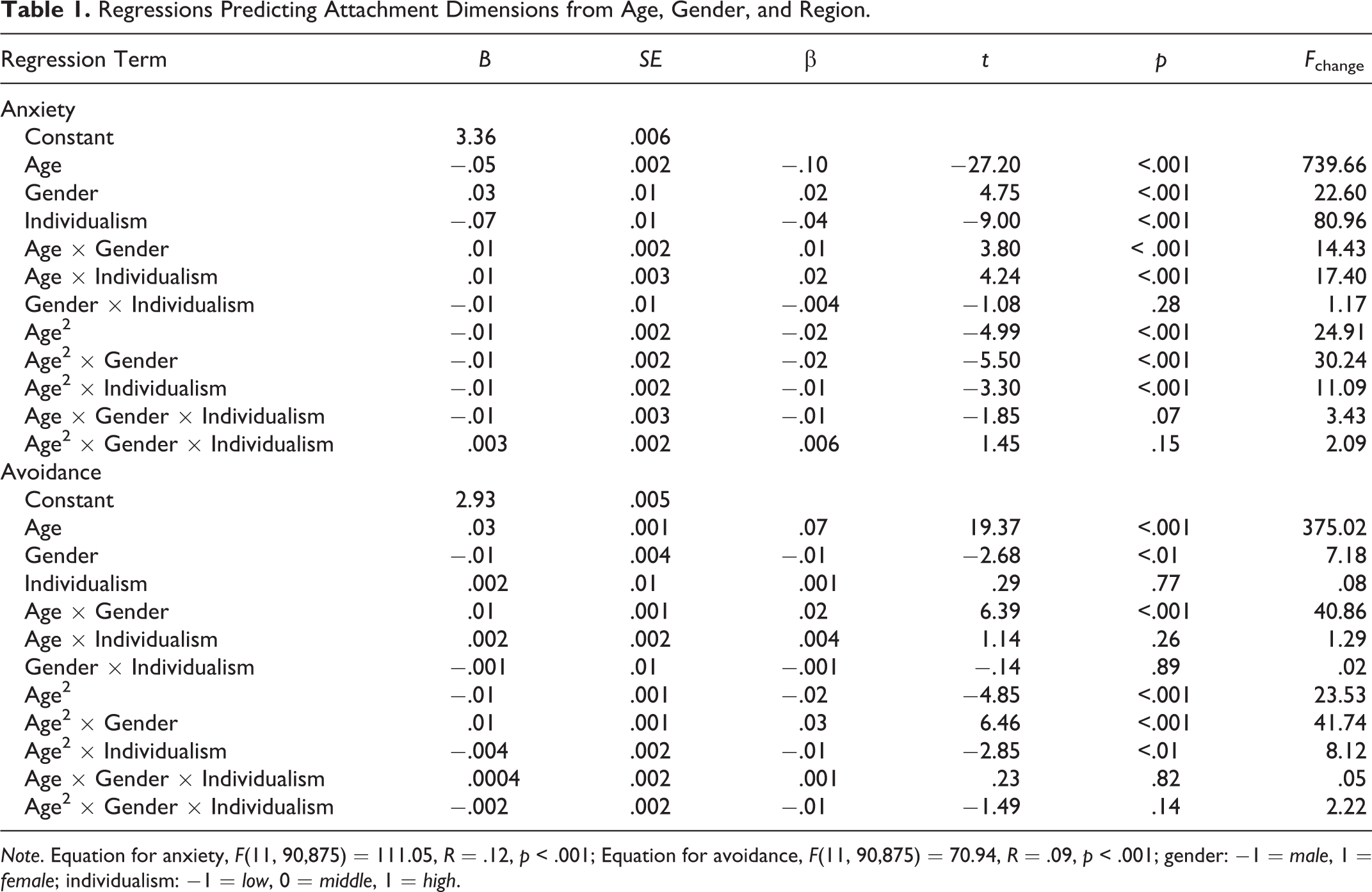
Note. Equation for anxiety, F(11, 90,875) = 111.05, R = .12, p < .001; Equation for avoidance, F(11, 90,875) = 70.94, R = .09, p < .001; gender: −1 = male, 1 = female; individualism: −1 = low, 0 = middle, 1 = high.
Do cultural differences in the expectations placed on people have implications for personality development (You & Malley-Morrison, 2000)? Much of an individual’s success in a social role (e.g., as a romantic partner) is tied to the degree to which he or she meets the expectations imposed by others in his or her social network, and these expectations may drive personality change (Caspi & Roberts, 1999; Roberts et al., 2005). If people in collectivistic regions are more attuned to or motivated by the demands and expectations of others (Schmitt et al., 2004), age differences in romantic attachment in these regions may be even more dramatic than age differences in individualistic regions (like North America). Age differences in romantic attachment could also differ based on the optimal reproductive strategy of a given ecological or geographic context (Del Giudice, 2009). However, the possibility that age differences in romantic attachment may differ by geographic region has not been examined. In this study, we compare age differences in romantic attachment between individualistic and collectivistic regions. We chose to compare individualistic and collectivistic regions because of the clear implications of individualism/collectivism for age differences in attachment and social role expectations and because of their relationship with attachment orientation found in previous research.
Method
Participants and Procedure
An initial pool of 194,955 adults, ranging in age from 18 to 64 (73.4% female) completed a survey online (at authentichappiness.com) between September 2002 and March 2012. The current sample is distinct from our previous cross-sectional study of age differences in romantic attachment (Chopik et al., 2013). Participants self-reported their age by selecting one of the seven discrete age groups (i.e., 18–20 years old, 21–24, 25–34, 35–44, 45–54, 55–64; Mdn age category = 25–34 years old). This initial pool includes participants from 219 countries and territories, with the majority (62.1%) residing within the United States (see Supplementary Table 1 for a breakdown by cultural region from the original participant pool). To make comparisons between regions more equitable, we randomly sampled 20% of U.S. participants (n = 24,123) and used these respondents in our regression analyses (see Bleidorn et al., 2013). An additional 4,449 individuals were excluded from the current analysis because they did not report their age (n = 150) or (due to relatively smaller sample sizes) were younger than 18 (n = 2,719) or older than 64 (n = 1,580). Additionally, participants from countries that were not included in Hofstede’s report on individualism/collectivism (n = 5,990) were excluded from the analyses reported below.
The exclusions and random sampling resulted in a final sample of 90,904 (72.9% female). Each age group was well represented (e.g., 18–20 years: 7,024; 21–24 years: 11,562; 25–34 years: 25,879; 35–44 years: 22,361; 45–54 years: 17,248; 55–64 years: 6,830). Participants came from several different geographic regions including North America (n = 36,985; 40.7% of the sample), South America (n = 1,442; 1.6%), West Europe (n = 21,642; 23.8%), East Europe (n = 996; 1.1%), South Europe (n = 2,351; 1.3%), Middle East (n = 753; .8%), Africa (n = 1,280; 1.4%), Oceania (n = 18,011; 19.8%), South/Southeast Asia (n = 2,143; 2.4%), East Asia (n = 5,101; 5.6%), Caribbean Islands (n = 66; .1%), and other miscellaneous regions (n = 134; .1%). A small number of participants did not report their gender (n = 17) and are therefore excluded from analyses involving gender. The majority of the sample (63.7%) had at least a bachelor’s degree. Participants were not asked about their ethnicity, nationality, or relationship status. All participants completed the survey in English (a limitation that we address in the Discussion).
Romantic Attachment
The Experiences in Close Relationships–Revised Inventory (ECR-R; Fraley, Waller, & Brennan, 2000) was used to assess attachment anxiety and avoidance. The 18-item avoidance subscale (α = .91) reflects an individual’s discomfort with closeness and intimacy. The 18-item anxiety subscale (α = .90) reflects an individual’s concern about abandonment. Sample items include “I don’t feel comfortable opening up to romantic partners” (avoidance), and “I often worry that my partner doesn’t really love me” (anxiety). Participants rated the extent to which they agreed with each statement, using a 7-point Likert-type scale, ranging from 1 (disagree strongly) to 7 (agree strongly). Items were averaged to create subscales for avoidance (M = 2.92, SD = 1.22) and anxiety (M = 3.39, SD = 1.41). The correlation between anxiety and avoidance was .47 (p < .001), which is similar to previous research using the ECR-R.
Individualism/Collectivism
Individualism/collectivism refers to the degree to which people prefer loosely knit social networks and uniqueness versus tightly knit social networks and interdependence with others. Scores on each of these dimensions were obtained from Hofstede’s latest reporting on cultural dimensions (Hofstede, Hofstede, & Minkov, 2010). Country-level scores on each of the dimensions were available for 81 countries in the current analyses. Each country was categorized into one of the three levels based on the distribution of the sample denoting scores low, medium, and high on individualism. Respondents were fairly evenly distributed by age across the low (18–20 years: 8.2%; 21–24 years: 16.5%; 25–34 years: 34.7%; 35–44 years: 22.9%; 45–54 years: 13.4%; 55–64 years: 4.4%), middle (18–20 years: 4.9%; 21–24 years: 9.3%; 25–34 years: 27.2%; 35–44 years: 27.9%; 45–54 years: 22.3%; 55–64 years: 8.3%), and high (18–20 years: 12.3%; 21–24 years: 15.0%; 25–34 years: 24.5%; 35–44 years: 20.5%; 45–54 years: 18.5%; 55–64 years: 9.2%) individualistic/collectivistic regions. This three-level variable was used in regression analyses to test whether individualism/collectivism moderated the effects of age on romantic attachment orientation.
Results
To model the associations between age and romantic attachment dimensions, we conducted hierarchical multiple regression analyses predicting avoidance and anxiety from the linear, quadratic, and cubic effects of age and their interactions with gender and individualism/collectivism. Gender (−1 = male, 1 = female) and individualism/collectivism (−1 = low, 0 = medium, 1 = high) were contrast coded prior to computing the interaction terms. The linear (age), quadratic (age2), and cubic (age3) effects of age were constructed using orthogonal, polynomial contrasts across the six age categories and these contrasts were entered into the regression analyses. Considering the large sample size, we followed the conservative approach recommended by Srivastava, John, Gosling, and Potter (2003) and retained models with higher order terms only if these terms improved the overall model fit at about F = 25. 1 The effects of linear, quadratic, and cubic effects of age were the same without including the moderating role of gender and individualism/collectivism.
Results from these analyses are presented in Table 1. We found that the quadratic effect of age was the best fit to the data for attachment anxiety. The linear term was also significant for anxiety, but the addition of the cubic term fell short of the criteria for overall fit, F change = 10.70. As shown in Figure 1, anxiety was highest among younger adults and lowest in middle-aged and older adults. The quadratic effect of age was also the best fit to the data for attachment avoidance; the linear was also significant for avoidance, but the addition of the cubic term fell short of the criteria for overall fit, F change = 12.77. As shown in Figure 1, avoidance showed fewer age differences overall compared to anxiety but was lowest among younger adults and highest in middle-aged and older adults.
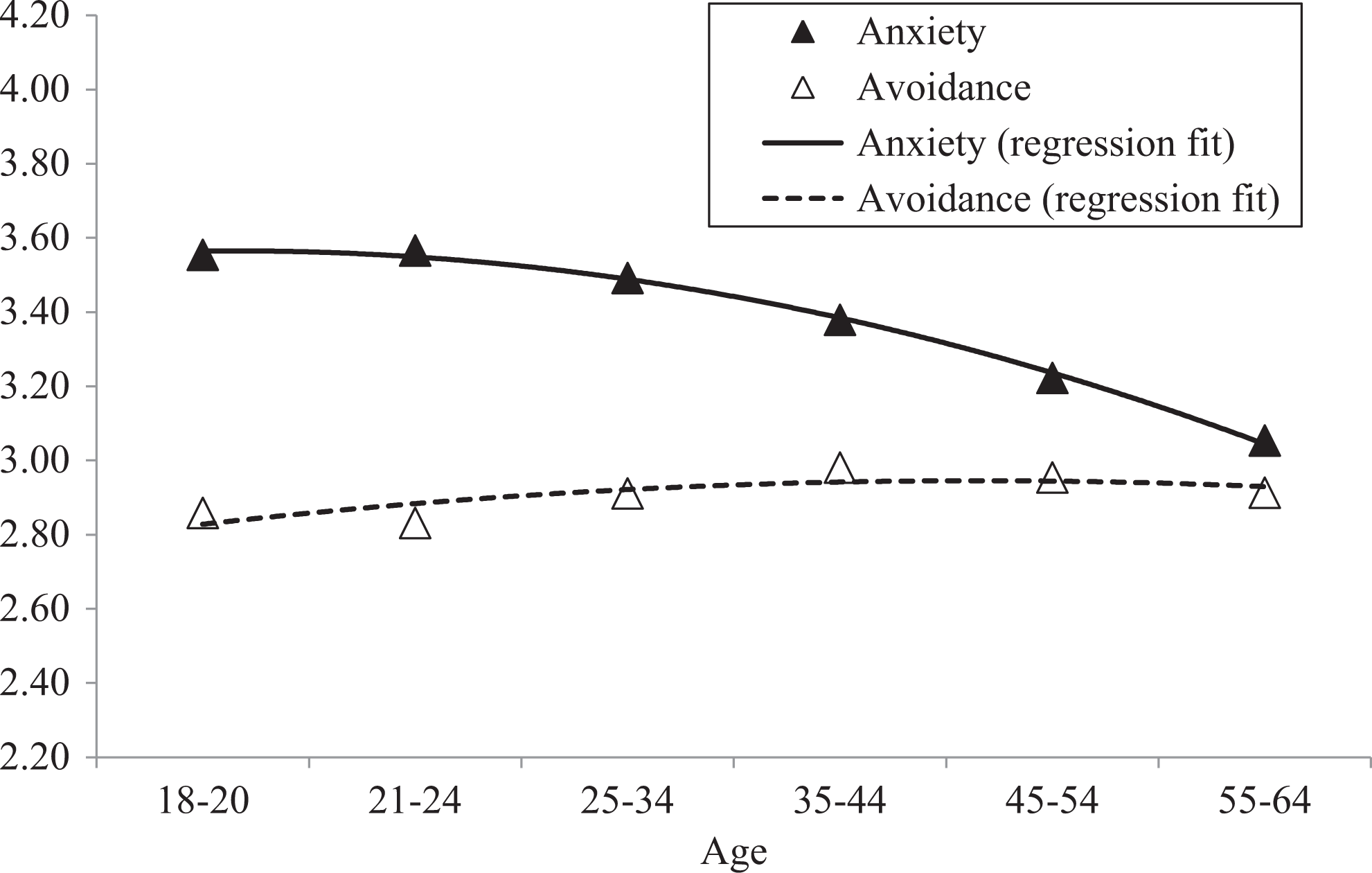
Age differences in attachment anxiety and avoidance in the overall sample.
For anxiety, the main effect of gender approached our cutoff criteria, such that women were higher in anxiety compared to men. These effects were qualified by a significant Age2 × Gender interaction. As shown in Figure 2A, anxiety was higher among women compared to men, particularly among middle-aged adults. Overall, gender differences in anxiety were relatively small in every age group (18–20 years: d = .01; 21–24 years: d = .02; 25–34 years: d = −.11; 35–44 years: d = −.09; 45–54 years: d = −.05; 55–64 years: d = −.06). These differences were generally smaller than the differences typically found by researchers but consistent with predictions made by evolutionary accounts of attachment (Del Giudice, 2009, 2011; Schmitt et al., 2003). For avoidance, the effects of age were qualified by significant Age × Gender and Age2 × Gender interactions. As shown in Figure 2B, avoidance was higher among younger men compared to younger women, consistent with Del Giudice’s meta-analysis on gender differences in romantic attachment. Among older adults, avoidance was higher among women compared to men, partially consistent with previous cross-sectional work (Chopik et al., 2013) and inconsistent with the aforementioned meta-analysis. As with anxiety, gender differences in avoidance were relatively small in every age-group (18–20 years: d = .02; 21–24 years: d = .10; 25–34 years: d = .08; 35–44 years: d = −.02; 45–54 years: d = −.07; 55–64 years: d = −.08) and were generally smaller than the differences typically found by other researchers (Del Giudice, 2011; Schmitt et al., 2003).
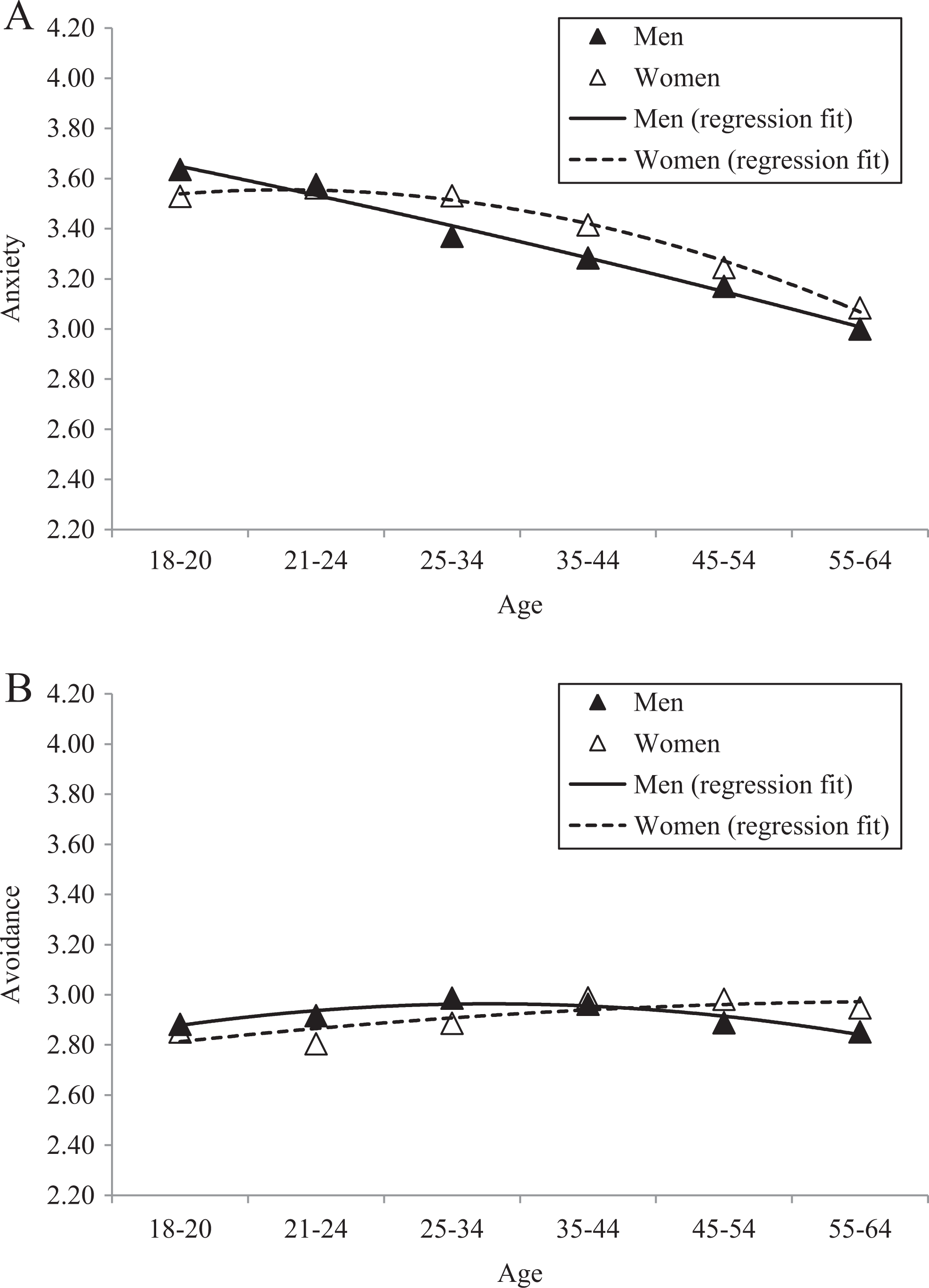
Age differences in (A) attachment anxiety and (B) avoidance for men versus women.
Perhaps one of the most notable observations is how similar men and women are to one another, particularly when examining the pattern of age differences within gender. It is worth noting that Del Giudice (2011) found the largest gender differences in community samples, whereas college-aged and Internet samples (such as our own) showed very small or even nonexistent differences. Del Giudice argues that these differences reflect limitations of online studies, such as self-selection based on gender-typed interests or variable male-to-female ratios. However, because Internet samples may be just as diverse as community samples and are especially likely to include both younger and older participants (Gosling, Vazire, Srivastava, & John, 2004), it is not yet clear whether gender differences in romantic attachment reflect differences in sample composition, survey format, or some combination of the two.
The effects of age, gender, and their interactions closely replicate our previous findings on age differences in attachment anxiety (Chopik et al., 2013). However, in our previous work, women were higher than men in avoidance at every age. The small differences in findings between these two large, cross-sectional samples may be attributable to the greater number of regions from which we drew our participants, as gender differences often vary across cultures (Schmitt et al., 2003).
Of interest to this study were the associations between age, individualism/collectivism, age and romantic attachment. For anxiety, the main effect of individualism/collectivism emerged as significant. Respondents from individualistic countries were lower in anxiety compared to participants from collectivistic countries, replicating the overall pattern found in previous cross-cultural research (Schmitt et al., 2004). Importantly, none of the interactions between age and individualism/collectivism surpassed our model cutoff, indicating that the associations between age and anxiety were largely consistent across cultures. For avoidance, the main effect of individualism/collectivism was not significant and, importantly, as with anxiety, individualism/collectivism did not moderate any of the associations between age and avoidance. Age differences in anxiety and avoidance in countries low, medium, and high in individualism/collectivism are presented in Figure 3A and B.
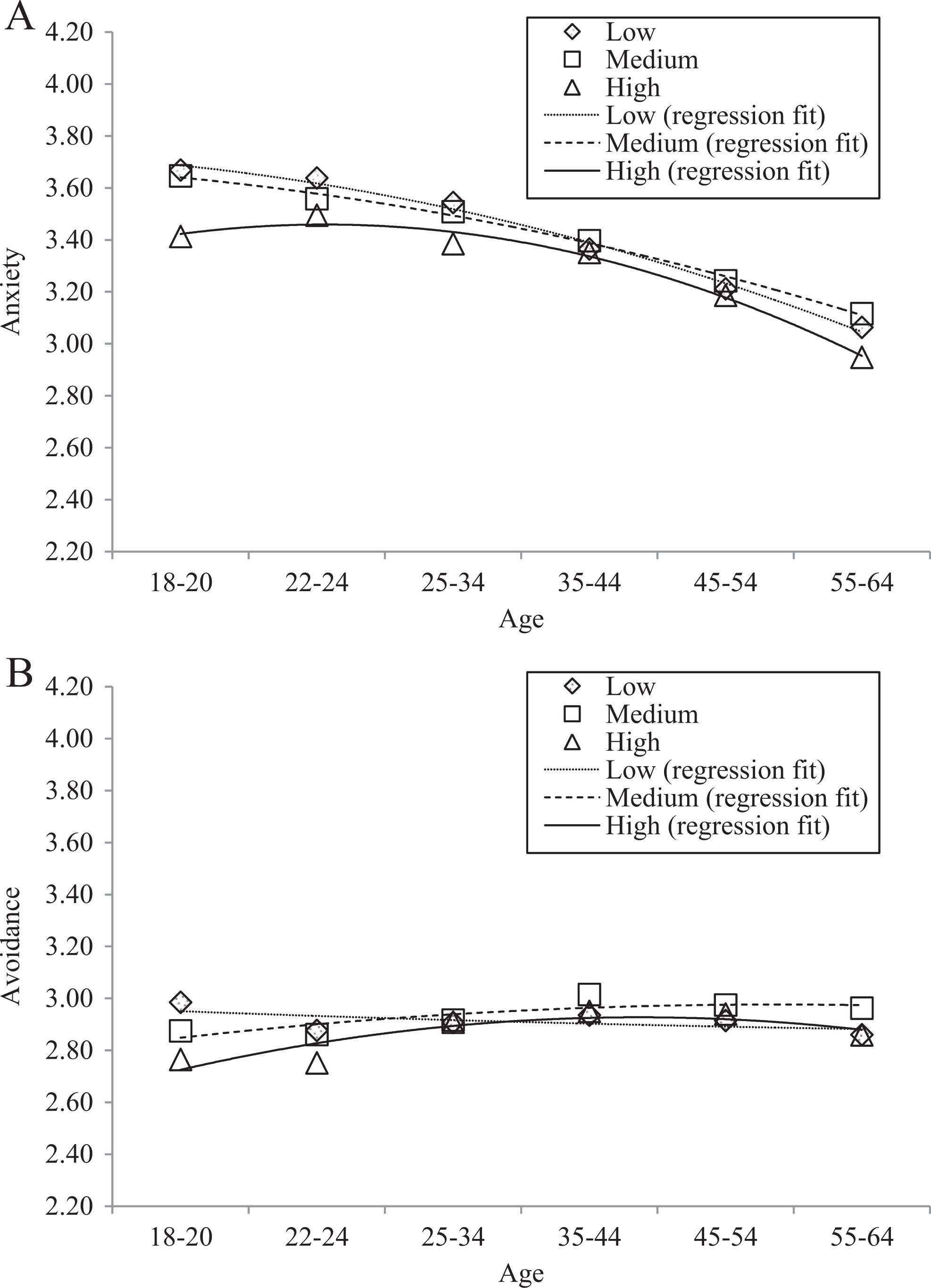
Age differences in (A) attachment anxiety and (B) avoidance for countries low, middle, and high in individualism.
Discussion
This study is the first to investigate the universality of age differences in romantic attachment. We examined associations among age, individualism/collectivism, and romantic attachment orientation in a sample of 90,904 participants ranging in age from 18 to 64. Attachment anxiety was highest among younger adults and lowest in middle-aged and older adults. Attachment avoidance was lowest among younger adults and highest in middle-aged and older adults. Participants from collectivistic countries reported higher levels of attachment anxiety than those from individualistic countries, but there was no such difference in avoidance. Further, individualism/collectivism did not moderate any of the associations between age and romantic attachment, providing strong evidence that age differences in attachment may be universal around the world.
Our large sample provided us with the statistical power to assess the moderating role of individualism/collectivism and to draw meaningful conclusions from null results. The universality of age differences in romantic attachment is consistent with other studies demonstrating the similarity of personality trait development in different countries (McCrae, 2004; McCrae et al., 1999, 2000). Because many of the social roles that drive personality development exist across cultures (e.g., partnership and parenting), it seems plausible that romantic attachment would develop similarly across cultural regions (Bleidorn et al., 2013; Roberts et al., 2005).
Age differences in romantic attachment may look very similar across cultures, despite different underlying mechanisms. In individualistic cultures, relationships might promote attachment security because partners serve specific functions (e.g., enhancing feelings of individuality or independence, confirming one’s self by appearing similar). In collectivistic cultures, security may be more closely tied to a type of “settling in” with a partner, which enhances feelings of familiarity—a concern shared by individuals whose evaluations of the self are closely tied to relationships (Markus & Kitayama, 1991). There is also evidence that attachment avoidance, which does not “fit” well with collectivistic cultures’ expectations of strong interdependence and closeness, is more strongly associated with relationship problems in collectivistic compared to individualistic cultures (Friedman et al., 2010).
Although our study is the first to document the universality of age differences in romantic attachment across cultures, it is not without limitations. One limitation to our findings is that a stringent interpretation of the social investment hypothesis would lead to a slightly different prediction than the one we examined. Although many social roles are age-graded and similar across cultures, there is considerable cross-cultural variability in the timing and onset of these roles. Individuals marry and/or have children earlier or later in different cultures, which would lead to the prediction that there should be at least some variability in age differences in attachment across regions. Indeed, in a recent study examining age differences in personality among nearly 900,000 individuals from 62 nations, Bleidorn and colleagues (2013) found that age differences in personality could be partially attributed to variation in the timing of marriage and childbirth in each nation. However, our sampling design may have limited our ability to find these cultural variations in age differences in romantic attachment. Our survey required that participants have access to a computer and speak English. Also, the majority of our sample had at least a bachelor’s degree and nearly everyone (89.6%) had at least some college education. As a result, our sample could reflect a highly educated, high socioeconomic status segment of the world population that actually shared commonalities in many demographic and family-timing variables, leading to similarities in age differences across cultures. Although we did find cultural differences in anxiety that at least temper this possibility, our highly educated sample may underestimate the moderating role of individualism/collectivism on the relationship between age and romantic attachment, creating a possible confound that limits the interpretability of our findings. The fact that the majority of our sample was from North America, female, and between the ages of 25 and 34 may have also influenced the results when we examined the moderating roles of gender and individualism/collectivism on age differences in romantic attachment. Future research can examine the relationships between these variables in more representative populations using a more equitable numbers of participants in each region (Henrich, Heine, & Norenzayan, 2010).
Despite these limitations in our sampling strategy, there are a few considerations that strengthen our confidence that participants were reliably sampled from their respective geographic regions. Worth noting is that Internet-based samples are often more diverse and representative than the convenience samples used in psychological research (Gosling et al., 2004). Moreover, results from psychological studies are often very similar when comparing Internet and non-Internet samples, particularly when examining age differences in personality (Srivastava et al., 2003). Research using large Internet samples to make cross-cultural comparisons reveals that, even when surveys are provided in English, the majority of Internet respondents match the ethnic composition of the area from which they are sampled (Brumbaugh & Wood, 2013). In their study examining the universality of age differences in mate preferences, Brumbaugh and Wood found that participant ethnicity generally matched the region from which they were sampled (e.g., 93% of participants from Asia indicated that they were Asian), despite the use of a convenience survey presented in English. Further, our research replicates (both directly and conceptually) previous research that utilizes rigorous translation procedures and community-based samples. For example, we found that participants from individualistic countries were generally lower in attachment anxiety than respondents from collectivistic cultures, consistent with findings from a large collaboration of researchers from all over the world (Schmitt et al., 2004). This suggests that, in our current sample, participants were reliably sampled from each region. If participants were so homogenous on psychological and demographic variables that comparisons were moot, cultural differences in attachment anxiety would likely not have emerged. The universality of age differences in romantic attachment also aligns conceptually with results from cross-cultural research on age differences in other personality traits in which questionnaires were translated into participants’ native language (McCrae et al., 1999, 2000). Other associations between romantic attachment and relationship-related outcomes are similar across individualistic and collectivistic regions, bolstering the hypothesis that there may be universal processes governing the progression of attachment-related dynamics (Frías, Shaver, & Díaz-Loving, 2014). Nevertheless, the representativeness of our sample could be improved, particularly in developing countries, in which citizens do not have easy access to the Internet. In order to increase confidence in the findings from this study, future research should recruit more representative and indigenous samples (Schachner, Scheib, Gillath, & Shaver, 2005).
In this study, the mean age differences that we observed were relatively small in magnitude. Although these differences are generally consistent with previous research on both romantic attachment (Chopik et al., 2013) and other personality traits (O’Brien, Konrath, Gruhn, & Hagen, 2013; Soto, John, Gosling, & Potter, 2010), the practical importance of a .15 difference on a 7-point scale for actual behavior in interpersonal settings is unclear. These small age differences in romantic attachment could reflect the strong stability of attachment in adulthood (Fraley, Vicary, Brumbaugh, & Roisman, 2011). Future research can quantify these effects by examining how they might be reflected downstream in interpersonal behavior. Further, we did not have access to a measure of relationship status or length, which limits our ability to test some of the predictions made from the social investment hypotheses. In our past cross-sectional work, individuals in relationships showed more dramatic age differences than single individuals (Chopik et al., 2013). This provides preliminary evidence of the security-enhancing effects of relationships; longitudinal studies also confirm that partnered individuals become more secure over time and that disruptions in relationship status can have large effects on attachment security (Davila et al., 1999; Kirkpatrick & Hazan, 1994). Thus, future research should include relationship status as a moderating variable in examining age differences in romantic attachment (Chopik et al., 2013).
Despite these limitations, this study redresses many important gaps in the study of life span attachment dynamics. We demonstrated that age differences in romantic attachment were consistent across individualistic and collectivistic cultures. These findings advance our knowledge of relationship processes by suggesting that shared social roles across different cultures drive personality development in a similar way.
Footnotes
Acknowledgment
We thank Christopher Peterson for providing us with the data for this study. We also thank Patricia Reuter-Lorenz, members of the University of Michigan LIFE program, and members of the Personality, Relationships, and Hormones Lab for comments on an earlier version of this article.
Declaration of Conflicting Interests
The author(s) declared no potential conflicts of interest with respect to the research, authorship, and/or publication of this article.
Funding
The author(s) disclosed receipt of the following financial support for the research, authorship, and/or publication of this article: The first author was supported by a National Science Foundation Graduate Research Fellowship.

Note
References
Supplementary Material
Please find the following supplemental material available below.
For Open Access articles published under a Creative Commons License, all supplemental material carries the same license as the article it is associated with.
For non-Open Access articles published, all supplemental material carries a non-exclusive license, and permission requests for re-use of supplemental material or any part of supplemental material shall be sent directly to the copyright owner as specified in the copyright notice associated with the article.
