




Abstract
Mindfulness and flow are both beneficial states of mind, but are they difficult to experience simultaneously? After all, flow involves losing self-awareness within an activity, and mindfulness involves maintaining self-awareness throughout or even despite an activity. In three studies, we examine this potential antagonism, finding negative associations between mindfulness and flow as assessed in a variety of ways and contexts. These associations emerged within Global trait data and diary data concerning daily goal behavior (Study 1), experience-sampling data concerning behavior at the time of signaling (Study 2), and experimental data concerning the experience of playing the flow-conducive computer game, Tetris, after undergoing a mindfulness induction (Study 3). However, these associations only apply to the “absorption” aspect of flow, not the “sense of control” aspect.
Positive psychology is, in part, a quest to understand optimal experience (Seligman & Csikszentmihalyi, 2000). Two forms of optimal experiencing have received the majority of attention within the literature, that is, mindfulness and flow. Mindfulness involves “non-elaborative, non-judgmental, present-centered awareness in which each thought, feeling, or sensation that arises in the attentional field is acknowledged and accepted as is” (Bishop et al., 2003, p. 31). Mindfulness is typically construed as a mental practice that requires self-discipline and a commitment to trying to maintain reflective awareness of each passing moment. In contrast, flow involves intense task concentration, a loss of self-awareness, an altered sense of time, and merging of activity and awareness (Csikszentmihalyi, 1990; Nakamura & Csikszentmihalyi, 2009). Flow is an absorbing mental state that arises spontaneously when one is engrossed within optimally challenging activity.
How are mindfulness and flow related to each other, and can a person experience both states at the same time? At first glance, mindfulness and flow seem very similar: Both are rewarding mental states in which people are fully engaged in the present. Furthermore, both are considered to be indicators of mental health and optimal functioning (e.g., Landhäußer & Keller, 2012; Rogatko, 2009; Weinstein, Brown, & Ryan, 2009). But, at a second look, the two states seem quite different. Mindfulness involves cultivating an observer of consciousness, trying to maintain reflective awareness of each moment. In contrast, flow involves losing the inner observer within an altered state of consciousness in which the moment blurs into a continuous stream of activity. In terms of William James’ (1890) famous metaphor of the “stream of consciousness,” mindfulness seems to entail standing on the bank of the stream without falling in; in contrast, flow entails jumping into the stream and tackling a challenging task or problem. In this sense, the two states might even be viewed as antagonistic, with mindfulness tending to bring one back to the bank of the stream, precluding flow.
Of course, mindfulness practice is not intended to prevent flow. Rather, it appears the main intention of mindfulness practice is to curtail mind wandering (Giambra, 1995; Singer, 1966; Smallwood & Schooler, 2006; Wegner, 1997). Mind wandering involves an unmonitored mental process that has run away from an intention to monitor thoughts and behavior (Schooler et al., 2014). The familiar experience of realizing that one has been reading while one’s mind is elsewhere, such that no information has been taken in, is a good example of mind wandering (Schooler et al., 2014). Mindfulness meditation involves trying to notice when one’s mind has wandered, so one can bring one’s attention back to the present (Kabat-Zinn, 1982). Supporting the idea that mindfulness and mind wandering are antithetical, Mrazek, Smallwood, and Schooler (2012) showed that an 8-min mindfulness induction reduced subsequent mind wandering.
What light do these findings shed on the relationship between mindfulness and flow? Mind wandering is like flow in that for both states there is absorption in a stream of mental content that proceeds without reflective awareness. Assuming mindfulness works in opposition to mind wandering, this suggests that states of mindfulness may work against states of absorption. However, mind wandering is unlike flow in that no controlled activity takes place during mind wandering, whereas such activity does take place during flow. Again assuming that mindfulness is in opposition to mind wandering, this suggests that states of mindfulness work in favor of controlled activity, such as may occur during flow states. These two suggestions will be considered further subsequently.
Another way that mindfulness and flow may differ is in the underlying brain states involved. Dietrich (2004) provided evidence for a “transient hypofrontality” explanation of flow, which states that flow occurs when activation in the frontal and medial temporal lobes is temporarily suppressed, allowing well-learned processes to proceed without interference from deliberative thought (see also Peifer, 2012). In contrast, research indicates that mindfulness training increases frontal lobe functioning (Travis & Arenander, 2004), in particular increasing left versus right frontal α asymmetry (Davidson et al., 2003; Moynihan et al., 2013). The fact that flow is associated with reduced frontal activity and mindfulness with enhanced frontal activity further supports their potential disjunction.
Accordingly, our basic hypothesis was that mindfulness would be negatively associated with flow, because mindfulness practice involves striving for sustained self-awareness, which likely works against losing oneself within activity, a key to flow experience (Csikszentmihalyi, 2008; Leary et al., 2006). Our hypothesis is similar to Mrazek et al.’s (2012) that mindfulness is negatively associated with mind wandering, but we believe our hypothesis is less self-evident, with more potential to be disproven. Some existing research supports our hypothesis. Brown and Ryan (2003) developed the Mindful Attention and Awareness Scale (MAAS) and showed that trait mindfulness was significantly negatively correlated with trait absorption. As noted previously, absorption is an important component of flow states, one that is plausibly limited by mindfulness.
However, other research seems to contradict our hypothesis. For example, Thienot et al. (2014) showed that mindfulness in sport was positively associated with flow, and Aherne, Moran, and Lonsdale (2011) showed that mindfulness training can enhance flow, primarily the aspects of having clear goals and a sense of control. Kaufman, Glass, and Arnkoff (2009) also showed that a mindfulness intervention could enhance flow in sport (Jackson & Eklund, 2002). We suggest that these seemingly contradictory results may be due to a lack of specificity concerning which aspects of mindfulness and which aspects of flow are being considered and measured. We discuss the conceptual and measurement issues subsequently.
Conceptualizing and Measuring Mindfulness
Mindfulness has been conceptualized and measured in a variety of different ways. Still, common to all existing measures is some assessment of reflective self-awareness, which is the state of mind that may work against flow states. For example, the Toronto Mindfulness Scale (Davis, Lau, & Cairns, 2009) includes a “Decentering” subscale, concerning not personally identifying with thoughts or feelings (Lau et al., 2006). The Philadelphia Mindfulness Scale (Cardaciotto, Herbert, Forman, Moitra, & Farrow, 2008) contains a “present moment awareness” scale. The Five Facet Mindfulness Questionnaire (FFMQ; Baer, Smith, Hopkins, Krietemeyer, & Toney, 2006) also contains a reflective awareness subscale, titled “Acting with Awareness.” Finally, the MAAS (Brown & Ryan, 2003) focuses only on reflective awareness. In the current research, we focused on measures of reflective awareness, the common core of mindfulness measures to date.
Conceptualizing and Measuring Flow
We wished to identify flow measures that might help address the two suggestions made previously—that mindfulness may work against the sense of flow absorption but may work in favor of the sense of flow control. The Flow Short Scale (FSS; Rheinberg, Vollmeyer, & Engerser, 2003) was the most obvious candidate, because the FSS distinguishes between two relevant flow facets, that is, absorption, which refers to being task engaged with minimal self-consciousness and a distorted sense of time, and automaticity, which refers to being in control and that intentional activity is occurring effortlessly. In this research, we refer to the automaticity facet of flow as “felt control,” because the items refer primarily to a sense of being comfortably in control of a process (e.g., I have everything under control, I have no difficulty concentrating). As discussed earlier, mindfulness should be negatively associated with feelings of absorption and of being lost in activity (Brown & Ryan, 2003) but may be positively associated with the feelings of control (Aherne, Moran, & Lonsdale, 2011).
Summary and Hypotheses
In sum, in this research, we focused on the association between mindfulness, conceptualized as reflective awareness, and flow, conceptualized as having both an absorption aspect and a felt control aspect. Study 1 examined the association between mindfulness and flow at two levels, that is, trait and daily retrospective. Study 2 examined the association of mindfulness and flow at a momentary level, using an experience sampling methodology. Study 3 used an experimental methodology to examine the influence of a mindfulness induction upon flow states during game play. In each study, we hypothesized that mindfulness would be negatively associated with flow, or at least, with the absorption aspect of flow. We also speculated that mindfulness might be positively related to the felt control aspect of flow.
Study 1
Method
Procedure and Participants
During an in-class assessment, we first administered trait measures of mindfulness and flow. Later in that assessment, we asked participants to identify two personal goals to pursue that semester. After 6 to 12 weeks, participants completed six daily diary reports rating their experiences of mindfulness and flow while working on their goals that day. Thus, our overall study design allowed us to test for the hypothesized negative association between mindfulness and flow in two different ways, at two different timescales.
Initial participants were 272 students, comprising 109 men and 163 women, within a social psychology class that was taught at the University of Missouri. Participants were 94% Caucasian. They participated in exchange for extra course credit.
Measures
Trait-level assessment of mindfulness and flow (Time 1)
Participants completed the FFMQ (Baer et al., 2006) regarding “your general thinking style.” Of interest in this context was the 8-item “Act with awareness” facet. Participants also completed the 10-item Rheinberg, Vollmeyer, and Engerser (2003) FSS regarding “your experience when you are working on something interesting.” In addition to computing an overall flow score, we used Rheinberg et al.’s (2003) categorization scheme to break the FSS down into a 6-item “Felt Control” subscale and a 4-item “Absorption” subscale. Absorption and Felt Control correlated at .52 (p < .001), indicating that they are appropriately cast as two related aspects of flow.
Goal selection (Time 1)
Participants were also asked to select two “semester goals” from a list of four goals that were offered, that is, two academic and two interpersonal. This goal selection task was part of a different study, but it provided grist for the second part of Study 1. Preliminary analyses showed that none of the results reported in this article varied according to the goals the participants selected, and thus the issue of goal content will be ignored henceforth.
Daily diary assessment of mindfulness and flow in goal pursuit (Time 2a–f)
In the second half of the semester, participants were invited to participate in a daily diary study that involved completing a short questionnaire at the end of each of 6 days. Participants were asked, for each goal they selected, how they felt working on the goal that day. The 4-item absorption facet of the FSS was administered twice (once for each goal). Because it was less central to the investigation, the FSS control subscale was not administered in this context; instead we used the 9-item Short Flow Scale (SFS; Martin & Jackson, 2008), which is typically combined into a single aggregate score that taps many characteristics of flow (Jackson & Eklund, 2002). In addition, the 5-item State Mindful Awareness and Attention Scale (S-MAAS; Brown & Ryan, 2003) was administered for each goal, with a stem of “While working on this goal…” and items such as “I was preoccupied with the future or the past, not the present,” and “I found it difficult to stay focused on what was happening.” Responses were averaged across the two goals to yield daily scores, and the six daily scores were averaged for each participant to yield measures of their typical state of mind when working on goals.
Results
Table 1 contains descriptive statistics for all Study 1 variables as well as the analogous variables for Studies 2 and 3.
Descriptive Statistics for Study Variables Across the Three Studies.

Note. FSS = Flow Short Scale; MAAS = Mindful Attention and Awareness Scale; M = mean; SD = standard deviation.
Trait Level
First, we examined the correlations between the trait “Act with Awareness” subscale and (1) the overall flow score, (2) the Absorption subscale score, and (3) the Felt Control subscale score. We used all 272 initial participants for these analyses. The correlations were .16 (p = .007), −.12 (p = .051), and .30 (p < .001). Thus, trait mindfulness was positively associated with trait flow, mainly because mindfulness was positively associated with the control facet of the flow scale. As hypothesized, however, trait mindfulness was negatively associated with the absorption facet of the FSS, demonstrating a splitting effect of mindfulness with respect to these two facets of flow.
Diary Level
Next, we examined the analogous three associations for the averaged daily diary reports, using the 162 participants who completed this part of the study. The negative correlation between Mindfulness and the FSS Absorption subscale was r = −.37 (p < .001), again as hypothesized. The negative association between Mindfulness and the Jackson Short Flow (JSF) Scale was much weaker at r = −.14, p = .068 (FSS absorption and the JSF Scale correlated .76, p < .001). We conducted an exploratory principal components analysis of the JSF, uncovering a “felt control” component (I felt competent to meet the demands of the goal, I had a good idea how well I was doing, I had a feeling of total control, and I was unworried what others might think of me) and an “absorption” component (I felt completely focused on the task at hand, the way time passed seemed to be different from normal, and the experience was extremely rewarding). The two remaining items cross-loaded on these components and were excluded. Echoing the results mentioned previously, mindfulness was negatively associated with absorption (r = −.22, p = .006) but unrelated to felt control (r = .03, ns).
Brief Discussion
Study 1 found initial support for our primary hypothesis. Measures of reflective awareness were negatively associated with measures of flow absorption, and positively associated with or unrelated to measures of flow control. Thus, although the absorption and felt control facets of flow were strongly correlated with each other, the two facets appear to be differentially related to mindfulness.
Study 2
In Study 2, we sought to assess participants’ experience of mindfulness and flow at precise moments in time. Again we expected to find a negative association between mindfulness and flow absorption and perhaps a positive association between mindfulness and flow control. That is, if participants were highly absorbed in an activity at the moment of signaling, they should report less reflective awareness at that moment. We also expected to find a negative association between mindfulness averaged across the observations (an estimate of trait mindfulness) and participants’ momentary levels of experiential absorption. This provided a separate, independent test of our main study hypothesis.
Methods
Procedure and Participants
Study 2 employed an experience sampling design. Participants were 44 introductory psychology students (6 male, 38 female, and 87% Caucasian) who selected the study from among a range of options. We signaled participants with text messages to their smartphones containing links to Internet-hosted surveys. Twenty-one assessment times were randomly generated, three per day, all between 10 a.m. and 10 p.m. (e.g., 10:30 a.m., 3:15 p.m., and 6:50 p.m. for the first day, and so on). Text messages were sent to all participants at the same time points. Participants were instructed to fill out each survey within 1 hr of receiving the message, concerning their experience the moment before they received the message. Participants were excluded if they responded 10 times or less; the average number of responses was 17.46 (SD = 2.94; minimum = 11, maximum = 21).
Measures
Mindfulness
Mindfulness was measured at each of the 21 sampled times using the 5-item S-MAAS (Brown & Ryan, 2003).
Flow
As in the diary portion of Study 1, flow was measured at each of the 21 sampled times using the entire SFS (Martin & Jackson, 2008) and the absorption component of the FSS (Rheinberg et al., 2003).
Results
A series of multilevel models were conducted using the Mixed Model procedure in SPSS with participants at Level 2 and Experience Sampling Methodology time points at Level 1. Because our main questions concerned flow absorption, we first fitted a null model predicting that variable. The intraclass correlation for that model (ICC = 0.60) suggested that sufficient within-person variance existed to justify using multilevel modeling. Raw Level-1 predictor variables contain variance associated with both within-person effects (the extent to which that variable is higher or lower for a given person at a given time point) and between-person effects (the extent to which that variable is higher on average for one individual than another). Following Hofman and Gavin (1998), we modeled within-person effects by person-mean centering all Level-1 predictors, which subtract the within-person mean of a variable from each raw time point score. Thus, scores above zero indicate a higher than average score for a given individual. To model between-person effects, we created a Level-2 predictor using grand-mean centering. Thus, scores above zero indicate that a person’s average score on a given variable is higher than the overall group mean of that variable. These two versions of the predictor variable are orthogonal.
Models predicting the absorption component of the FSS, and the entire SFS, are presented in Table 2, along with confidence intervals. Results indicate that State-MAAS is negatively related to flow absorption and to flow as measured by the SFS, at both within- and between-person levels of analysis.
Study 2: Multilevel Models Predicting Flow Absorption and Entire Short Flow Scale (SFS).

Note. DV = dependent variable; GMC = grand-mean centered (between-person results); LCI = lower confidence interval SE = standard error; MAAS = Mindful Attention Awareness Scale; PMC = person-mean centered (within-subject results); UCI = upper confidence interval.
Brief Discussion
Study 2 replicated and extended the finding that reflective awareness is negatively associated with flow, both in terms of the absorption component of flow and as measured by the SFS. First, mindfulness averaged across time points (a trait-like indicator) was negatively associated with momentary state flow absorption (a between-person effect). The more mindful a participant was on average, the less likely they were to be absorbed or in flow at particular moments. Second, state mindfulness at a particular point in time was negatively associated with state flow absorption at that point in time (a within-person effect). This indicates that the more reflectively aware participants felt at the moment they were signaled, the less absorption they reported feeling in that moment.
Study 3
None of the studies so far have explored processes occurring as participants engage in a specific activity known to arouse flow states. Instead, all the studies so far have referred retrospectively to general thinking styles or goal pursuits (Study 1), or they have referred to the participant’s state of mind at the time of being signaled for assessment (Study 2). To further test these associations in an experimental fashion, in Study 3 we randomly assigned participants to engage in a mindfulness exercise (vs. control exercise vs. no exercise), just prior to playing a computer game known for its high levels of challenge and interest—Tetris. Participants were interrupted at three points during the game so that their momentary state of mind could be assessed. We hypothesized that those who did the mindful awareness induction would report less flow absorption as they played the game and perhaps more flow control.
Method
Participants and Procedure
Participants were 101 introductory psychology students, comprising 39 men and 62 women, who took part to help fulfill a course requirement. After being greeted at the lab, they were seated at a computer terminal with headphones. After completing preliminary questionnaires, 50 participants proceeded directly to the computer game and the other 51 first did an audio induction. Induction participants (24 for mindful awareness and 27 for muscle relaxation) were asked to get comfortable and follow the instructions in the audio recording they would hear. Afterward, the computer game Tetris was introduced; some participants had played it and some had not (participant’s level of experience with the game was explored as a covariate, but it did not affect results). The game involves using arrow keys to rotate falling blocks of different shapes so that they fit into slots at the bottom of the screen. The goal is to form rows with no gaps, and gapless rows are eliminated from the stack. Failure to eliminate rows leads to increasing stack height, and the player loses once the stack reaches the top of the screen.
After 1.5 min of playing the game, the game was paused and all participants were directed to a short questionnaire. Afterward, they went back to the game, with a second pause occurring after another 1.5 min, and a third pause occurring after a final 1.5 min. Of course, repeated interruptions are likely to interfere with flow states; however, we deemed this worth the risk in order to be able to investigate the intercorrelations of flow-related experiences in real time. It is also noteworthy that participants resumed the paused games exactly where they left-off.
Materials and Measures
The mindfulness induction was based on the Vipassana style of practice adapted from an exercise in Seagal, Williams, and Teasdale (2002). It was 9 min and 23 s long, which was recorded by a soothing male voice. The relaxation audio was downloaded from the University of New Hampshire health services and was edited to be of the same length (9 min and 23 s). It was also narrated by a soothing male speaker, accompanied by quiet flute music (which we did not attempt to remove, deeming it a legitimate part of the speaker’s goal of inducing relaxation). The main other difference between the two recordings was the first induction’s focus on catching the mind running away and then returning attention to the breath.
The full FSS (Rheinberg et al., 2003) was employed in Study 3, allowing us to assess both felt control and absorption as in the first part of Study 1. Because no noteworthy patterns of change occurred across the three administrations of the scale, we averaged across the three administrations to derive the most stable estimates of the two flow constructs.
Results
Table 3 contains the mean absorption and felt control scores split by group. We conducted a 3 (group: no induction, mindfulness induction, or relaxation induction) × 2 (flow measure: absorption vs. control) multiple analysis of variance with repeated measures on the second factor, and observed the predicted two-way interaction, F(2, 98) = 3.30, p = .041, β = .156, confidential interval [CI]: [.011, .302], such that absorption and felt control were differentially affected by group membership; control was unaffected, and absorption was significantly affected (see Table 3). The critical two-way interaction was also significant when the mindfulness induction participants were contrasted with the no induction participants, F(1, 72) = 5.63, p = .020, β = .148, CI: [.023, .272], but not when the mindfulness induction participants were contrasted with the relaxation participants, F(1,49) = 2.44, p = .125, β = .156, CI: [−.025, .199]. In a third planned contrast, the two-way interaction was significant, F(1, 99) = 5.39, p = .022, β = .127, CI: [.018, .235], when the mindfulness induction group was contrasted with the other two groups pooled.
Mean Differences in Flow By Induction Groups in Study 3.
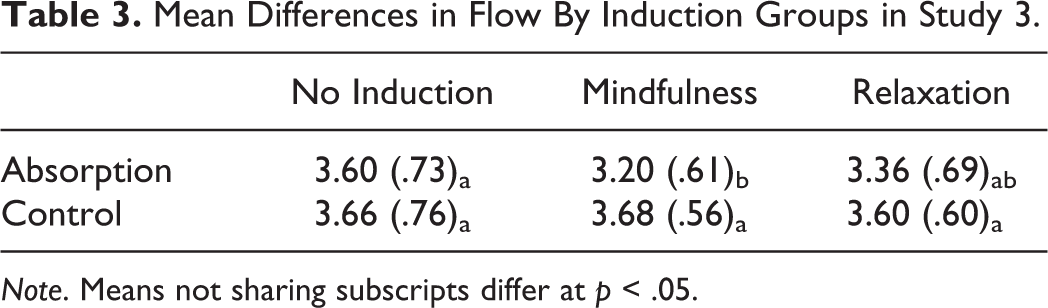
Note. Means not sharing subscripts differ at p < .05.
Brief Discussion
Study 3 extended our consideration of the potentially antagonistic relationship of mindfulness and flow, to an experimental study in which some participants were randomly assigned to engage in a mindfulness induction before playing a potentially flow-inducing game. The mindfulness induction did not affect participants’ feelings of control within the game, but it did reduce these participants’ sense of being absorbed within the game. This effect was most pronounced in relation to the no-induction control group; the muscle relaxation control group had a mean flow absorption score midway between the two extreme groups. This suggests that muscle relaxation may have some but not all of the absorption-quelling characteristics of full-blown mindfulness inductions. It may also be that any technique that turns awareness toward mental or bodily states may preclude full engagement in external activities. Future research is needed to further contrast the effects of mindfulness against mere muscle relaxation inductions.
General Discussion
Intuitively, mindfulness and flow seem to go together. Both involve using the mind in an efficient, high-quality way, and both are seen as signals of good mental hygiene and health. Thus, many researchers have assumed that boosting people’s ability to be mindful should also boost their ability to experience flow (Aherne et al., 2011; Kaufman, Glass, & Arnkoff, 2009; Thienot et al., 2014). We found evidence for the opposite conclusion: that boosting a person’s ability to remain mindful during an activity might actually undermine their ability to get absorbed in that activity. In Study 1, this conclusion was supported concerning both global traits and retrospection on daily goal processes; and in Study 2, it was supported concerning momentary experience. Study 3 also found support at the momentary level, using an experiment with random assignment and a task known to be flow inducing, the game Tetris.
It is important to note, however, that this negative relationship was found only for the absorption facet of flow, that is, the feeling of being carried away by activity, with an altered sense of time and a loss of self-awareness. This was expected since it seems logical that one cannot both stand on the banks of a stream and be washed down that stream at the same time. A different pattern was found for the felt control facet of flow, which was nonassociated or positively associated with mindfulness. Thus, although flow absorption and flow control facet were highly positively correlated with each other, supporting the general practice of combining them into a single flow score, we found that the two facets break apart with respect to mindfulness. These findings provide a more nuanced perspective both upon the flow construct itself and upon the question of how flow relates to mindfulness.
Future research can further test whether mindfulness is really antagonistic to absorption. Maybe not, for example, engaging regularly in mindfulness practice might ultimately increase flow ability, by helping to “sweep out the mental cobwebs” that prevent people from entering flow states, and/or by teaching people to concentrate in single-minded ways that contribute to flow states. As discussed earlier, some research has already found support for the idea that mindfulness training boosts flow (Aherne et al., 2011; Kaufman et al., 2009), although none of that past research used the distinction between flow absorption and flow control that was used in the present research.
It is also possible that mindfulness and flow can come and go in potentially rapid succession, such that although they rarely occur simultaneously, they can both take place quite often within a particular period of time. As one example of how this might happen, hierarchical control theory (Carver & Scheier, 1981, 1998, 2009) proposes that higher levels of control within the action system, associated with greater self-awareness, set the agenda for lower levels of control, which, once activated, can run off without conscious awareness. From a self-regulatory perspective, an optimal sequence might entail first mindfully surveying the situation and one’s reactions to it in order to decide what to do, then going into a flow state in service of one’s selected actions, then going into a mindful state in order to observe the results of those actions, then going into another flow state in order to best accomplish the next actions, and so on. Indeed, Leary, Adams, and Tate (2006) termed such a process “hypo-egoic self-regulation,” in which the person relinquishes control of the stream of consciousness to subconscious processes, to avoid the negative effects of ego-involvement and overcontrol. Leary et al. (2006) identified flow as one such hypo-egoic process.
Further research is also needed to examine the relationships of other aspects of the mindfulness construct with other aspects of the flow construct. Additional mindfulness subscales include curiosity, acceptance, observing, describing, nonjudging, and nonreactivity (Baer et al., 2006; Cardaciotto et al., 2008; Davis et al., 2009). Additional flow subscales include challenge–skill balance, action–awareness merging, clear goals, concentration on the task at hand, time transformation, and autotelic experience (Csikszentmihalyi, 1990; Jackson & Csikszentmihalyi, 1999; Martin & Jackson, 2008). Although we believe reflective awareness (examined herein) is the core of the mindfulness construct, more can be learned by examining these other aspects of mindfulness. We believe that absorption and felt control represent the core features of the flow construct, but again, more can be learned by examining these other aspects of flow.
Limitations of this research include the college student samples from a single region in the United States; the failure to examine long-term or highly skilled mindfulness practitioners, or to examine the effects of extended mindfulness training going beyond the 10-min induction of Study 3; and the failure to examine mediator or moderator processes involved in the basic effects demonstrated herein. However, we have shown that such research will be well worth doing.
Footnotes
Declaration of Conflicting Interests
The author(s) declared no potential conflicts of interest with respect to the research, authorship, and/or publication of this article.
Funding
The author(s) received no financial support for the research, authorship, and/or publication of this article.