



Abstract
Research has shown that mindfulness can positively affect peoples’ lives in a number of ways, including relying less on previously established associations. We focused on the impact of mindfulness on implicit age and racial bias as measured by implicit association tests (IATs). Participants listened to either a mindfulness or a control audio and then completed the race and age IATs. Mindfulness meditation caused an increase in state mindfulness and a decrease in implicit race and age bias. Analyses using the Quad Model showed that this reduction was due to weaker automatically activated associations on the IATs.
We are here to awaken from the illusion of our separateness. —Thich Nhat Hanh
Mindfulness meditation focuses the individual on the present and encourages practitioners to view thoughts and feelings nonjudgmentally as mental events, rather than as part of the self. This allows the individual to understand and reflect on these events as transient moments that are separate from the self, which inhibits the natural tendency toward reaction and automatic evaluation (Bishop et al., 2004). Research regarding this process has demonstrated the unique ability of mindfulness to help assuage a number of problem behaviors. For example, mindfulness reduces food cravings for overweight and obese individuals (Alberts, Mulkens, Smeets, & Thewissen, 2010; Alberts, Thewissen, & Raes, 2012; Paolini et al., 2012), improves psychological and health-related medical symptoms and stress (Baer, Carmody, & Hunsinger, 2012; Carmody, Reed, Kristeller, & Merriam, 2008; Ciesla, Reilly, Dickson, Emanuel, & Updegraff, 2012), and generally promotes well-being and happiness (Brown & Ryan, 2003; Collard, Avny, & Boniwell, 2008; Killingsworth & Gilbert, 2010).
In addition, mindfulness has a number of cognitive benefits, including increased working memory capacity and reduced mind wandering (Mrazek, Franklin, Phillips, Baird, & Schooler, 2013), avoidance of the sunk cost bias (Hafenbrack, Kinias, & Barsade, 2014), and increased compassion (Condon, Desbordes, Miller, & DeSteno, 2013). Mindfulness may also inhibit automatic evaluation (Bishop et al., 2004; Kang, Gruber, & Gray, 2013). For example, mindfulness reduced dieters’ automatic responses to attractive food (Papies, Barsalou, & Custers, 2012), reduced problem solvers’ reliance on automatic solutions (Ostafin & Kassman, 2012), and reduced the correlation between implicit alcohol attitudes and drinking behavior (Ostafin, Bauer, & Myxter, 2012; Ostafin & Marlatt, 2008). These findings suggest that mindfulness meditation minimizes the impact and influence of past experience on the present moment, whether it is an established attraction toward unhealthy food or the tendency to use past information to solve current problems. One mindfulness practitioner stated that mindfulness increases “nonconceptual awareness” that “does not get hung up on ideas…or memories” (Gunaratana, 2002, p. 140). Similarly, Ostafin and Kassman (2012) state that “An aim of mindfulness is to limit the ability of automatically activated verbal-conceptual content derived from past experience to bias thought and behavior” (p. 1032). Thus, by decreasing reliance on past associations in memory, mindfulness is thought to free people to choose actions more thoughtfully and with less bias from those past associations.
The focus of the current research is on the potential for mindfulness to reduce one form of automatic social cognition: implicit out-group bias. Implicit attitudes are based on the automatic association between constructs in memory (Greenwald & Banaji, 1995; Greenwald et al., 2002). A common method for measuring these associations is the implicit association test (IAT). Research has shown that White participants who take the IAT tend to have stronger associations between White and good than between Black and good. This is indicated by quicker response times for words that represent good things when paired with White faces than with Black faces, and for quicker response times for words that represent bad things when paired with Black faces than with White faces (Dasgupta, McGhee, Greenwald, & Banaji, 2000; Greenwald, McGhee, & Schwartz, 1998). Similarly, young people tend to have stronger associations between young and good than between old and good (Dasgupta & Greenwald, 2001; Hummert, Garstka, O’Brien, Greenwald, & Mellott, 2002). Thus, in our sample (i.e., young, White college students), we expected that we would find evidence of both implicit race and implicit age bias.
Exploring whether mindfulness can reduce automatic out-group bias is important because such bias can lead to a number of negative outcomes. First, it is well established that encountering an out-group member or related stimuli activates automatic out-group attitudes (Casper, Rothermund, & Wentura, 2010; Devine, 1989; Payne, 2005; Payne, Lambert, & Jacoby, 2002). Once activated, these automatic evaluations cause a number of behavioral effects. These effects include causing poorer performance on difficult tests (Gibson, Lueke, & Bushman, 2014), being more willing to shoot at a Black suspect in a simulation (Correll, Park, Judd, & Wittenbrink, 2002; Sim, Correll, & Sadler, 2013), or even becoming more aggressive (Yang, Gibson, Lueke, Huesmann, & Bushman, 2014). Implicit out-group attitudes are particularly important to understand because they have been shown to be more predictive of certain types of negative out-group behavior than explicit attitudes. For example, implicit attitudes predict discriminatory hiring decisions better than explicit attitudes (Rudman & Glick, 2001; Ziegert & Hanges, 2005), they predict trust in out-group members better than explicit attitudes (Stanley, Sokol-Hessner, Banaji, & Phelps, 2011), and they are also more predictive of subtle changes in body language toward an out-group individual (McConnell & Leibold, 2001), which in turn leads to more negative evaluations of such interactions (Dovidio, Kawakami, & Gaertner, 2002). Importantly, the automatic association of an out-group with a negative trait can fuel prejudice and discrimination even for individuals who honestly strive to hold egalitarian values (Fazio, Jackson, Dunton, & Williams, 1995; Gaertner & Dovidio, 1986). Note that even though current conceptualizations of implicit attitudes suggest that they are not necessarily unconscious in nature (Gawronski, Hofmann, & Wilbur, 2006), they could still affect people in ways in which they are unaware (Galdi, Arcuri, & Gawronski, 2008). In this way, individuals may be aware of negative implicit attitudes but still be unable to overcome them.
Given the negative consequences of implicit out-group bias, it is important to find ways to reduce it. A variety of studies have shown that implicit attitudes are malleable and that they can shift in response to a variety of processes (Ito, Chiao, Devine, Lorig, & Cacioppo, 2006; Richeson & Ambady, 2003; Sinclair, Lowery, Hardin, & Colangelo, 2005
Given that mindfulness has been shown to reduce different forms of automatic processing and minimize reliance on previously established associations, we hypothesized that mindfulness meditation could reduce implicit out-group bias without such a direct focus on the bias itself. There is some evidence that mindfulness can reduce discrimination. For example, Langer and her colleagues showed that mindfulness training reduced prejudiced behavior toward the elderly (Djikic, Langer, & Stapleton, 2008) and the handicapped (Langer, Bashner, & Chanowitz, 1985). There are a number of differences between these studies and ours, however. For example, neither study measured attitudes, and both used mindfulness training that focused specifically on the out-group of interest. In addition, Langer’s conceptualization of mindfulness is somewhat different than that espoused in the Buddhist tradition of meditation examined in our research. Despite these differences, however, Langer’s research is suggestive of a connection between mindfulness and prejudice that we explore further in our research. Given that mindfulness can reduce automatic processing and responding, and lead to less prejudicial behavior, we hypothesized that mindfulness meditation would reduce implicit out-group bias as measured by the IAT. Recent research has shown that a different form of meditation, lovingkindness meditation, can reduce bias in the IAT (Kang, Gray, & Dovidio, 2014). This reduction in implicit bias, however, was mediated by a reduction in stress, at least for implicit bias toward homeless people.
In contrast to the Kang, Gray, and Dovidio (2014) results, we propose that any reduction in implicit bias in response to mindfulness meditation will be the result of reduced activation of automatic associations. It would, however, be incorrect to assume that any reduction in bias on the IAT is necessarily indicative of changes in such automatic associations. Although the IAT was developed as a means to tap into automatic associations (Greenwald et al., 1998), no measure is process pure, and therefore both automatic and controlled processes may play a role in any bias identified in the IAT (Conrey, Sherman, Gawronski, Hugenberg, & Groom, 2005; Meissner & Rothermund, 2013). One method that has been used to attempt to separate automatic from controlled components of the IAT is a multinomial modeling approach called the Quad model (Conrey et al., 2005; Sherman et al., 2008). The Quad model uses the pattern of error responses on the IAT to separate IAT effects into four distinct components: automatic activation (AC), which is conceptualized as the likelihood that an association or evaluation is automatically activated when a stimulus object is encountered; discriminability (D), which is conceptualized as the likelihood that a correct response can be determined; overcoming bias (OB), which is conceptualized as the likelihood that an initially activated association can be overcome and replaced by a correct response; and Guessing (G), which is conceptualized as either random or systematic bias that influences responding (Sherman et al., 2008).
The Quad model has been used successfully to show that shifts or differences in IAT responses can be the result of different underlying processes. For example, in their initial exploration of the Quad model, Conrey, Sherman, Gawaronski, Hugenberg, and Groom (2005) showed that the addition of a response window constraint requiring faster responses on the IAT reduced the impact of the OB component on IAT performance but did not reduce the impact of the AC component. Thus, a manipulation decreasing the opportunity for participants to engage in more controlled responding limited the effect of a controlled process (OB) on the outcome but did not alter the impact of an automatic process (AC) on the outcome. In a similar vein, Gonsalkorale, Allen, Sherman, and Klauer (2010) showed that exposure to positive Black exemplars and negative White exemplars reduced the AC component of White participant’s responses on the IAT. Finally, Gonsalkorale, Sherman, and Klauer (2014) showed that despite having similarly biased scores on the age IAT, the bias in older and younger adults came from different components of the model. Older adults showed less automatic activation of negative age-related constructs; but in addition, they showed less ability to overcome bias. Younger respondents showed more automatic bias and more ability to overcome the bias. The authors suggest that diminished inhibitory functioning in older adults leads to decreased ability to overcome biased responses on the IAT. In summary, the Quad model provides a method for parsing out automatic and controlled processes contributing to IAT performance. Whereas other research showing a reduction in automaticity following mindfulness meditation has simply measured outcomes assumed to be automatic, and shown a difference in response, the Quad model allows for a direct measurement of both automatic and controlled processing. This direct determination of how mindfulness affects both automatic and controlled components of participants’ implicit attitudes is a unique strength of our method. Given our review of the literature on mindfulness, we hypothesized that mindfulness training will result in a reduced impact of AC on IAT performance but have no effect on the D, OB, or G components.
Method
Participants
Participants were 72 (71% female) White college students from a large Midwestern University. The study was advertised as examining the relationship between listening to an audiotape and reaction time. There was no mention of race or age in the recruitment of participants or during their instruction in the lab. As such, participants of any race were allowed to participate in the experiment. Only White participants were included in the final sample, with the data from 16 participants of other races being eliminated. All participants were traditional college students between the ages of 18 and 23.
Materials and Procedure
The IAT stimuli were drawn from the Project Implicit website. For the race IAT, these included photos of six White and six Black faces and eight positive and eight negative words. Similarly, the age IAT used photos of six old and six young faces and the same eight positive and eight negative words used in the race IAT. The IATs were presented in the traditional seven-block format. In Blocks 1 and 2, participants learned to sort the words separately and the faces separately. Block 3 combined these categories in an initial practice block. After a brief break, Block 4 continued with the same pairings. Block 5 reversed the responses for the faces (e.g., if the initial correct response was “e” for White faces and “i” for Black faces, this was reversed to “i” for White faces and “e” for Black faces). Block 6 was a practice block combining the new response keys for the faces with the old word response keys. Block 7 was a longer block with this same combination. Both type of IAT (i.e., race or age) and response compatibility (i.e., compatible responses first or incompatible responses first) were counterbalanced across participants. Note, however, that the response for positive and negative words remained consistent across trials for each participant. That is, if a participant began with “i” for positive words, and ‘e’ for negative words, that response pattern was maintained across both IATs. Only the response keys for the faces in the IAT varied across trials. The IAT was scored so that higher numbers reflected greater implicit bias against Blacks or older people, meaning a greater association of Black or old with bad.
Participants were run up to three at a time at computer workstations with headphones. Participants completed the Motivation to Respond Without Prejudice Scale (Plant & Devine, 1998; e.g., I am personally motivated by my beliefs to be non-prejudiced toward Black people) and the Mindful Attention Awareness Scale (MAAS; Brown & Ryan, 2003; e.g., I tend to walk quickly to get where I’m going without paying attention to what I experience along the way), which measures trait mindfulness. The Motivation to Respond Without Prejudice Scale was used to ensure that conditions did not differ on this measure initially. Previous research demonstrates that individuals with higher levels of internal motivation to respond without prejudice show higher D and lower AC components in the Quad Model (Gonsalkorale, Sherman, Allen, Klauer, & Amodio, 2011).
Participants then listened to either a 10-min mindfulness recording or a control recording (Cropley, Ussher, & Charitou, 2007). The mindfulness recording instructed participants to become aware of bodily sensations (heartbeat and breath) and fully accept these sensations and any thoughts without restriction, resistance, or judgment. The control recording discussed natural history and was read by the same narrator as the mindfulness recording. Participants next answered a state mindfulness question taken from the MAAS on an 11-point Likert-type scale (“At this moment [right now] I feel like I will rush through activities without being really attentive to them” [reverse scored]; Ostafin & Kassman, 2012). Finally, participants completed the race and age IAT (order was counterbalanced across participants) and then answered 10 questions regarding awareness of any bias they may have shown on the IAT (e.g., It was easier to sort when “Young” was paired with “Good”). Participants were then debriefed and excused.
Results
Preliminary Analysis
The groups did not differ on external motivation to avoid prejudice, t(70) < 1, p = .59, α = .78, internal motivation to avoid prejudice, t(70) = 1.12, p = .27, α = .91, or trait mindfulness before the manipulation, t(70) = 1.25, p = .22, α = .83. In contrast, participants in the experimental group showed significantly more state mindfulness (M = 8.87) than control participants (M = 6.42) following the manipulation, t(70) = 4.04, p < .001, d = .95. Finally, the summed awareness of implicit bias questions (α = .81) did not differ across conditions (F < 1).
Implicit Bias
IAT scores were calculated using the D6 method (Greenwald, Nosek, & Banaji, 2003). Participants had a low overall mean error rate in test trials for both the race (M = 10.1%) and age IATs (M = 10.2%). In each measure, only two participants showed an error rate above 25% (all < 32%). Split half reliability measures were calculated for both the race and age IATs. The first and second half of responses for each IAT were significantly correlated, r(72) = .28, p < .01, for the race IAT; and r(72) = .65, p < .001, for the age IAT. Pearson’s r correlations were calculated to determine the possible relationship between race and age IAT scores. Due to a computer malfunction, six participants had data for either the age or the race IAT only. These participants were not included in the correlational analysis. Race and age IAT scores were not correlated overall, r(66) = .11, p = .19, nor were they correlated for just those in the control group, r(31) = .12, p = .26, or just those in the mindfulness group, r(35) = .04, p = .41.
Separate 2 (Mindfulness vs. Control) × 2 (IAT order) analyses of variance were performed on the race and age IAT. For the race IAT, the main effect for mindfulness was significant, F(1, 68) = 4.21, p = .04, ηp 2 = .06. The mindfulness group showed less implicit racial bias than did the control group (see Figure 1). There was no main effect for IAT order and no interaction (both Fs < 1).
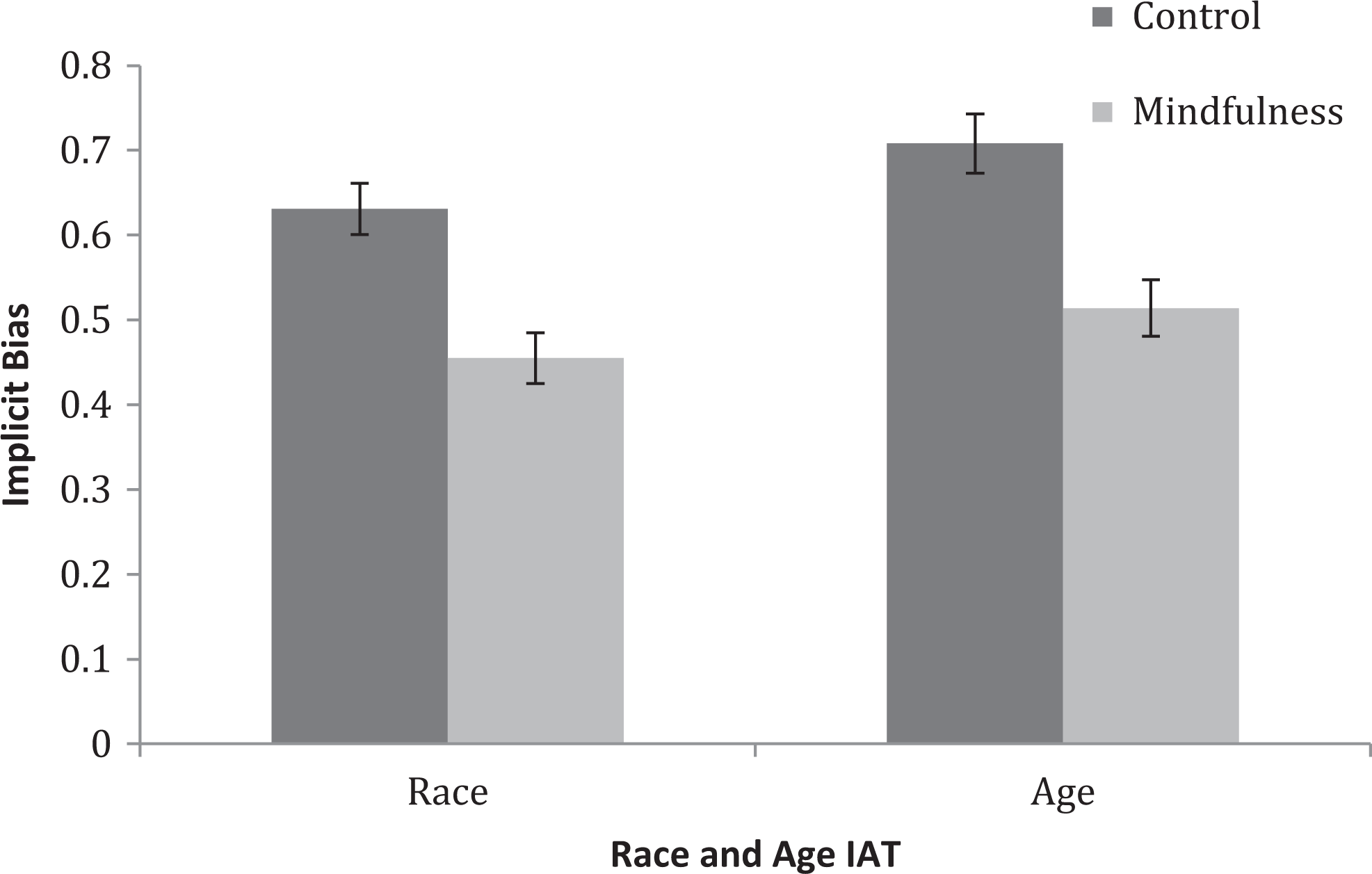
Implicit bias on the race and age IAT for the control and mindfulness conditions.
For the age IAT, the main effect for mindfulness was significant, F(1, 67) = 3.88, p = .05, ηp 2 = .06. The mindfulness group showed less implicit age bias than did the control group (see Figure 1). There was no main effect for IAT order, F(1, 67) = 2.00, p = .16, ηp 2 = .03, and no interaction (F < 1).
Quad Model Analyses
Quad model analyses were calculated to determine whether the mindfulness condition actually reduced automatic associations (AC) of Black and old with bad while leaving the other components (D, G, and OB) unchanged.
For the Race IAT, we modeled two AC parameters (Black/bad and White/good), along with one OB parameter, one D parameter, and one G parameter separately for both the mindfulness and control conditions (see Conrey et al., 2005). This model fit the data, χ2(2) = 4.63, p = .10. Each subsequent parameter comparison was then analyzed individually in order to identify whether the mindfulness and control conditions differed from each other in their responses to each parameter. First, a comparison of the AC parameter values for Black/bad association was made between the control condition (AC = .10) and the mindfulness condition (AC = .04). Results indicated a significantly lower activation of Black/bad automatic associations for the mindfulness group, Δχ2(1) = 5.03, p = .02. Comparisons for the White/good association trended in the same direction (control AC = .10; mindfulness AC = .05) but were not significant, Δχ2(1) = 2.72, p = .10.
The analyses evaluating differences in the other model components between mindfulness and control conditions found no significant effects for overcoming bias (OB), Δχ2(1) = .01, p = .92, or guessing (G), Δχ2(1) = .02, p = .89. However, there was a significant difference in discriminability (D), Δχ2(1) = 14.51, p < .001, showing greater discriminability in the control condition (D = .89) than in the mindfulness condition (D = .81).
For the age IAT, we modeled two AC parameters (young/good and old/bad), along with one OB parameter, one D parameter, and one G parameter separately for both the mindfulness and control conditions. This model fit the data, χ2(2) = 4.72, p = .09. Each subsequent parameter comparison was then analyzed individually for differences between the mindfulness and control conditions. First, a comparison of the AC parameter values for old/bad association was made between the control condition (AC = .07) and the mindfulness condition (AC = .00). Results indicated a significantly lower activation of old/bad automatic associations for the mindfulness group, Δχ2(1) = 15.36, p = .001. Comparisons for the young/good association trended in the same direction (control AC = .04; mindfulness AC = .01) but were not significant, Δχ2(1) = 1.71, p = .19.
The analyses evaluating differences in the other model components between mindfulness and control conditions found no significant effects for overcoming bias (OB), Δχ2(1) = .00, p = 1.00. However, the guessing component was significantly higher for the control condition (G = .58) than for the mindfulness condition (G = .48), Δχ2(1) = 4.43, p = .04. As values greater than .5 represent a right key response bias and values lower than .5 represent a left key response bias, the control group exhibited a right key bias, whereas the mindfulness condition exhibited almost no key bias. In addition, there was a significant difference in discriminability (D), Δχ2(1) = 37.28, p < .001, showing greater discriminability in the control condition (D = .86) than in the mindfulness condition (D = .73).
Discussion
Brief mindfulness meditation reduced implicit race and age bias. Specifically, listening to a 10-min audiotape that focused the individual and made them more aware of their sensations and thoughts in a nonjudgmental way caused them to show less implicit bias against Blacks and old people on the race and age IATs than individuals who listened to a 10-min audiotape describing historical events and geographical landmarks.
Analyses using the Quad model confirmed that for both the race and age IAT, this reduction was the result, in part, of a reduction in the automatic activation of negative associations. Thus, as has been shown in prior research (e.g., Ostafin & Kassman, 2012), mindfulness reduced reliance on automatic associations. This is the first demonstration that such a reduction generalizes to implicit out-group bias. Unexpectedly, the mindfulness and control conditions also differed on the D component for both the race and age IATs. The control group showed a greater ability to discriminate between the stimuli than the mindfulness group. Although it is not entirely clear why these differences emerged, Conrey et al. (2005) provide an interesting possibility in their discussion of the Quad model. They suggest that in some cases, greater automatic activation could be associated with greater discriminability. For example, people who fear snakes may have an automatic fear response when presented with a snake, and in addition, their increased automatic associations may make it easier to detect a snake in the environment. In the case of the race and age IATs, it may be that reducing the automatic activation of Black-bad and old-bad could have made race and age less detectable within the IAT tasks.
Future research should evaluate the effect of mindfulness on other IATs, such as sexual orientation and other relevant biases that contain an automatic component. This would help to create a clearer picture of the generality of the effect we identify here and could also allow for further exploration of what is driving the reduction in implicit bias following a mindfulness experience. Similarly, future research could benefit by examining the effect of a regular mindfulness meditation practice on practitioner’s implicit biases. If such benefits are apparent immediately, as suggested by our results, further reduction may accrue over time. In other words, the novice that briefly undergoes meditation is transformed into a state of awareness of sensations and thoughts and nonjudgmental acceptance of those sensations and thoughts. However, this brief meditation is likely to dissipate into a default state of being—one in which reliance on automatically activated associations reverts to higher levels. In contrast, the experienced practitioner not only engages in meditation more often, which allows nonjudgmental awareness to be experienced more often, but through this consistency creates a new default state of being—an awareness that permeates greater aspects of the self and of everyday experience. In this way, a deeper mindful experience can be cultivated, widening the area of awareness that the individual can attend to. This consistent and widened awareness likely has stronger effects on implicit attitudes and accompanying behavior. Future research should examine how a sustained mindfulness practice could influence implicit attitudes and other forms of automatic cognition.
Most of the benefits of mindfulness identified thus far have focused on intrapersonal outcomes (e.g., stress reduction, reduced mind wandering, weight control). Although the IAT, too, measures an intrapersonal process (i.e., the individual’s automatic associations, their ability to overcome bias, etc.), the results of this study have implications for interpersonal processes as well. Whether the observed reduction in implicit bias translates into a reduction of prejudiced behavior is unknown. Quad model analyses suggest that the reductions in race and age IAT scores demonstrated in our mindfulness group represent a reduction in the automatic activation of associations between the out-group and negative valence. Given the relationship of implicit bias to a variety of behavioral outcomes, this reduced activation of automatic associations should lead to changes in behavior toward the out-group. Research in our lab is currently examining whether the reduced implicit bias resulting from mindfulness actually alters behavior toward the out-group.
A variety of other strategies have been shown to reduce implicit bias. These strategies, however, typically focus on creating new associations between the out-group and positive stimuli (e.g., Dasgupta & Greenwald, 2001; Olson & Fazio, 2006) or more formalized multicultural training (Devine, Forscher, Austin, & Cox, 2012; Rudman et al., 2001). Ours is the first study to show a decrease in implicit bias from brief mindfulness meditation. This meditation was not directed specifically toward the remediation of bias or for any purpose other than to be mindful. For this reason, mindfulness meditation may reduce reactance from people resistant to more direct prejudice reduction strategies.
While it is important to continue to teach tolerance and acceptance of other people, automatic processes still exert tremendous influence in the evaluation and treatment of others. Understanding how mindfulness meditation may reduce these automatic processes would be an important step toward reducing prejudice and discrimination. The mindfulness tradition is one in which everyone and everything are interconnected. Intergroup bias is in direct opposition to this, and the automatic component of this bias leads to behaviors that build boundaries that keep us distant and wary of others. If the practice of mindfulness can help us overcome these automatic biases, then the words “We are here to awaken from the illusion of our separateness” (Thich Nhat Hanh, 2008) can become a reality.
Footnotes
Acknowledgments
Special thanks to Brad Bushman, Judy Gibson, and Kyle Scherr for their insight and critiques on prior versions of this article. Their perspectives all led to a more comprehensive and thoughtful article. Also, thanks to Jacob Ward for single handedly taking care of the entirety of data collection with dedication and enthusiasm.
Declaration of Conflicting Interests
The author(s) declared no potential conflicts of interest with respect to the research, authorship, and/or publication of this article.
Funding
The author(s) received no financial support for the research, authorship, and/or publication of this article.