




Abstract
The ideologically objectionable premise model posits that biased political judgments can emerge across the political spectrum. Previous tests of ideological differences in political judgment biases have utilized between-subjects designs (i.e., separate comparisons). In this study (N = 410), we examined whether these biases also emerge in within-subjects designs (i.e., joint comparisons) and compared the strengths of judgment biases in between-subjects and within-subjects designs. Across designs, both liberals and conservatives favored sympathetic over unsympathetic targets in scenario judgments, but biases were attenuated in the within-subjects design. No ideological differences in bias strength emerged, although liberals reported a stronger internal motivation to respond without prejudice toward ideologically dissimilar others. Further, consistent with the ideological conflict hypothesis, both liberals and conservatives were prejudiced toward ideologically dissimilar targets, although biases in prejudice ratings were stronger among liberals than conservatives. Together, results support the ideological symmetry perspective on political bias and prejudice.
Keywords
People often see what they want to see (Dunning & Balcetis, 2013; Hastorf & Cantril, 1954) and judge belief-congruent information more favorably than belief-incongruent information (Ditto & Lopez, 1992; Taber & Lodge, 2006). One ongoing debate in the literature is whether there are ideological differences in these motivated reasoning tendencies. Some researchers suggest that because people on the political right are more rigid and dogmatic (the “rigidity-of-the-right” hypothesis) and more motivated to reduce uncertainty than political liberals (e.g., Jost, Glaser, Kruglanski, & Sulloway, 2003), they should be more susceptible to motivated reasoning in sociopolitical judgment (Nam, Jost, & van Bavel, 2013). Research consistent with this ideological asymmetry perspective suggests that conservatives are more likely than liberals to reach belief-consistent conclusions, such as judging victims of police violence as responsible for their own deaths (Perkins & Bourgeois, 2006) or ignoring inconsistencies between somewhat contradictory beliefs (e.g., opposing abortion but supporting the death penalty; Critcher, Huber, Ho, & Koleva, 2009).
This ideological asymmetry thesis is well illustrated by Altemeyer’s (1996, 1998) research on double standards in sociopolitical judgment. Altemeyer found that people on the right (specifically, those high in right-wing authoritarianism or RWA) were more likely than those on the left (i.e., people low in RWA) to favor sympathetic over unsympathetic targets. For example, although people high in RWA more strongly supported mandatory Christian over Muslim school prayer, people low in RWA opposed mandatory school prayer equally (Altemeyer, 1996). Altemeyer (1996, 1998) has connected such ideological asymmetry in political judgments to the rigidity-of-the-right hypothesis, claiming that those on the right “speak out of both sides of their mouths from one situation to another” (Altemeyer, 1998, p. 86), a conclusion that has been echoed by others (e.g., Peterson, Duncan, & Pang, 2002).
However, as Taber and Lodge (2006, p. 756) note, “all reasoning is motivated,” and influential theories of motivated reasoning (e.g., Kunda, 1990; Pyszczynski & Greenberg, 1987) do not make exceptions for those on one end of the ideological spectrum or the other. A host of empirical studies show that people on both the left and the right equally favor belief-congruent over incongruent information (Crawford, Jussim, Cain, & Cohen, 2013; Iyengar & Hahn, 2009; Kahan, 2013; Taber & Lodge, 2006) and see their own beliefs as superior to those of their political opponents (Toner, Leary, Asher, & Jongman-Sereno, 2013). This work is consistent with an ideological symmetry perspective, which assumes that motivated reasoning characterizes sociopolitical judgments across the political spectrum.
A recently developed model of sociopolitical judgment seeks to explain the conditions under which such motivated reasoning will or will not emerge. The ideologically objectionable premise model (IOPM; Crawford, 2012) argues that biased judgments will emerge across the political spectrum so long as the judgment premise is not ideologically objectionable to the perceiver. An ideologically objectionable premise is one that a perceiver sees as violating his or her core beliefs and thus rejects outright. According to the IOPM, objectionable premises short-circuit biased judgments that would normally emerge.
As an illustration, Crawford and Xhambazi (2015) examined biases against Occupy Wall Street (OWS) and the Tea Party. They found that although people both low and high in RWA found peaceful political protest ideologically acceptable, people high in RWA found disruptive protest more ideologically objectionable than did people low in RWA. Consistent with the IOPM, symmetrical ideological biases emerged for peaceful protest—people low in RWA more strongly supported OWS than the Tea Party, whereas people high in RWA more strongly supported the Tea Party than OWS. However, asymmetrical left-wing bias emerged for disruptive protest—people low in RWA more strongly supported OWS than the Tea Party, whereas people high in RWA opposed disruptive protest equally. Thus, among people high in RWA, biased judgments that emerged under an acceptable premise (i.e., peaceful protest) were turned off under an objectionable premise (i.e., disruptive protest). These findings directly contradict Altemeyer’s (1996, 1998) conclusions about asymmetries in double standards and instead suggest that the emergence of biased sociopolitical judgments depends not on psychological differences between the left and right (i.e., the asymmetry perspective) but rather on the conditions of the judgment itself. Results from seven unique scenarios support the IOPM’s predictions (see Crawford, 2012; Crawford & Xhambazi, 2015).
This study extends research on biased sociopolitical judgments in three important ways. First, in most extant research, participants evaluate single targets in between-subjects designs, despite the fact both separate (i.e., between-subjects) and joint (i.e., within-subjects) evaluations possess ecological validity (e.g., Hsee, Loewenstein, Blount, & Bazerman, 1999). For example, Crawford and Xhambazi (2015) randomly assigned participants to evaluate either Tea Party or OWS protestors (see also Altemeyer, 1996, 1998; Lindner & Nosek, 2009). Although such designs neatly capture intergroup biases, they do not fully capture the phenomenon of speaking “out of both sides of their mouths” that Altemeyer (1998) originally identified—that is, people’s willingness to unabashedly favor sympathetic over unsympathetic targets in a single and identical comparative context. Thus, one purpose of this study is to employ a within-subjects design to explicitly test Altemeyer’s (1998) contention regarding ideological differences in biased sociopolitical judgments.
There is reason to believe that biases could be attenuated in within-subjects relative to between-subjects designs, as these designs should make the target comparison purposes of the study more apparent to participants, thus potentially increasing the motivation (or at least tendency) to respond without bias. Surprisingly, however, the literature provides few direct comparisons of the effects of within-subjects versus between-subjects designs on intergroup attitudes and judgments. The only relevant work of which we are aware shows that employers utilized gender stereotypes to assess job candidates when they were evaluated separately but eschewed such information when candidates were evaluated jointly (Bohnet, van Geen, & Bazerman, 2012), suggesting that within-subjects designs attenuate bias. Thus, a second purpose of this study is to directly compare the strength of sociopolitical judgment biases in within-subjects and between-subjects designs.
Further, people on the left are typically more motivated to appear unprejudiced than those on the right (Crandall & Eshleman, 2003; Plant & Devine, 1998). Thus, if within-subjects designs make the purpose of assessing bias more apparent to the participant, then they may reduce liberals’ biases more than conservatives’ biases. Therefore, a third purpose of this study is to examine ideological variation in the strength of biases produced in within-subjects relative to between-subjects designs and the role of the motivation to appear unprejudiced in such variation.
We replicated four scenarios tested in past IOPM research (Crawford, 2012; Crawford & Xhambazi, 2015) using both within-subjects and between-subjects designs. Although previous tests of the IOPM have utilized a multidimensional approach to ideological attitudes (i.e., the dual-process motivational [DPM] model; Duckitt, 2001), for simplicity and for consistency with other evidence regarding the ideological symmetry versus asymmetry perspectives, we employed a unidimensional (i.e., left vs. right) approach. Descriptions of and predictions for the four scenarios are as follows.
Mandatory school prayer
Crawford (2012) showed that people high in RWA prefer Christian to Muslim mandatory school prayer (because they find mandatory school prayer ideologically acceptable), whereas people low in RWA oppose mandatory school prayer equally (because they find it ideologically objectionable). In this study, we expected conservatives to favor Christian over Muslim mandatory school prayer and liberals to oppose mandatory school prayer equally.
Peaceful protest
Crawford and Xhambazi (2015) found that peaceful protest is acceptable across the political spectrum and therefore produced symmetrical ideological biases. In this study, we expected liberals to more strongly support OWS than the Tea Party and conservatives to more strongly support the Tea Party than OWS.
Presidential criticism
Crawford (2012) found that people high in RWA find criticizing a sitting President ideologically objectionable, whereas people low in RWA find it acceptable. Consistent with the IOPM, people low in RWA more harshly punished a military general who criticized President Obama than one who criticized President Bush, whereas people high in RWA punished the two generals equally (despite liking Bush more than Obama). It is unclear whether similar findings will emerge using a unidimensional approach or whether the deference to authority that presumably lies at the heart of RWA was responsible for the lack of bias among people high in RWA (Crawford, 2012). If conservatives find Presidential criticism objectionable, then asymmetrical left-wing bias should emerge. If, however, both liberals and conservatives find it acceptable to criticize a sitting President (as the popularity of partisan media suggests; e.g., Olbermann, 2008; Walsh, 2009), then symmetrical ideological biases should emerge.
College admissions
As noted earlier, previous tests of the IOPM have been within the context of the DPM model (Duckitt, 2001), which predicts that political and intergroup attitudes will be differentially influenced by the distinct motives associated with RWA and social dominance orientation (SDO; Sidanius & Pratto, 1999), which emphasizes maintenance of existing societal hierarchies. Crawford (2012) found that both people low and high in SDO believed that college admission policies that favored one group over another (e.g., ethnic minorities or college legacies) were acceptable. People low in SDO more strongly supported policies that favored racial minorities (i.e., hierarchy-attenuating policies) than those that favored legacies (i.e., hierarchy-enhancing policies), whereas people high in SDO more strongly favored legacy-based than race-based policies. In this study, we expected liberals to favor race-based over legacy-based policies and conservatives to favor legacy-based over race-based policies.
Finally, despite claims of a “prejudice gap” between the left and right (e.g., Sibley & Duckitt, 2008), evidence for symmetry in political prejudice has also begun to emerge (Chambers, Schlenker, & Collisson, 2013; Crawford, 2014; Crawford & Pilanski, 2014; Wetherell, Brandt, & Reyna, 2013). Summarizing this work, Brandt, Reyna, Chambers, Crawford, and Wetherell (2014) posited the ideological conflict hypothesis (ICH), which argues that both liberals and conservatives are prejudiced against ideologically dissimilar targets. In this study, we compared the relative strength of liberals’ and conservatives’ prejudices against ideologically dissimilar over similar targets, comparisons which have yet to be tested in the growing ICH literature.
Method
Participants
A total of 410 current U.S. residents (48% female; 77% White; M age = 36 years) were recruited to complete an online survey through Amazon.com’s Mechanical Turk.
Materials and Procedures
Participants were first randomly assigned to either a between-subjects or within-subjects design. People in the between-subjects design received the same experimental materials used in previous IOPM research (Crawford, 2012; Crawford & Xhambazi, 2015) and were randomly assigned to one of the two targets in the mandatory school prayer (Muslim or Christian), peaceful political protest (OWS or Tea Party), Presidential criticism (Bush critic or Obama critic), and college admission (race based or legacy based) scenarios. Scenario order was randomized. Following each scenario, participants completed a 3-item target support measure (1 = strongly disagree and 6 = strongly agree). Items for each scenario were presented in random order and were averaged to form a target support measure for each scenario.
Participants in the within-subjects design were presented with each scenario in random order. Each scenario presented the judgment premise without relating it to any particular target. For example, instead of presenting a scenario about mandatory Christian school prayer, the scenario began “Suppose a law were passed requiring the strenuous teaching of a country’s dominant religion in public schools.” Following each scenario, participants completed 3 target support items per target (1 = strongly disagree and 6 = strongly agree), which were identical across targets with the exception of target name (e.g., “Christian prayer in American schools” or “Muslim prayer in Turkish schools”). These 6 items were presented in random order so that these participants simultaneously evaluated both targets. Average target support measures were computed. The scenario texts and target support items for both designs are available in online supplemental materials.
The remainder of the questionnaire was identical across designs. Participants completed feeling thermometer ratings (0–100) of the targets mentioned in each scenario (Christians, Muslims, The Tea Party, OWS, George W. Bush, Barack Obama, Legacies, and Ethnic minorities), which were reverse scored so that higher scores indicated more prejudice.
To assess each premise’s objectionableness, participants next completed a 3-item scale measuring the extent to which they found each premise (mandatory school prayer in public schools; peaceful political demonstration; members of the military questioning the authority of the President in a time of war; and admission policies that favor one group over another [like for minority groups or children of alumni]) to be (1) “objectionable,” (2) “immoral,” and (3) “disgusting” (1 = not at all and 5 = to a great extent). Premise and item order were both randomized and average objectionableness ratings for each premise were computed. Items were identical to those used in Crawford (2012) and Crawford and Xhambazi (2015).
Next, participants completed modified versions of Plant and Devine’s (1998) internal and external motivations to respond without prejudice scales. References to “Black people” were replaced with “them,” and participants were asked to complete these items in reference to “people who are different from you on social and political issues.” Each scale consisted of 5 items (1 = strongly disagree and 7 = strongly agree), and average scales of external and internal motivations to respond without prejudice toward ideologically dissimilar others were computed.
Finally, we assessed political ideology (1 = extremely liberal, 2 = liberal, 3 = somewhat liberal, 4 = moderate/middle of the road, 5 = somewhat conservative, 6 = conservative, and 7 = extremely conservative), party affiliation (1 = strong democrat and 7 = strong republican), and demographic information such as age, gender, and ethnicity.
Results
Preliminary Analyses
Tests included all participants, regardless of research design condition.
Correlations and descriptive statistics
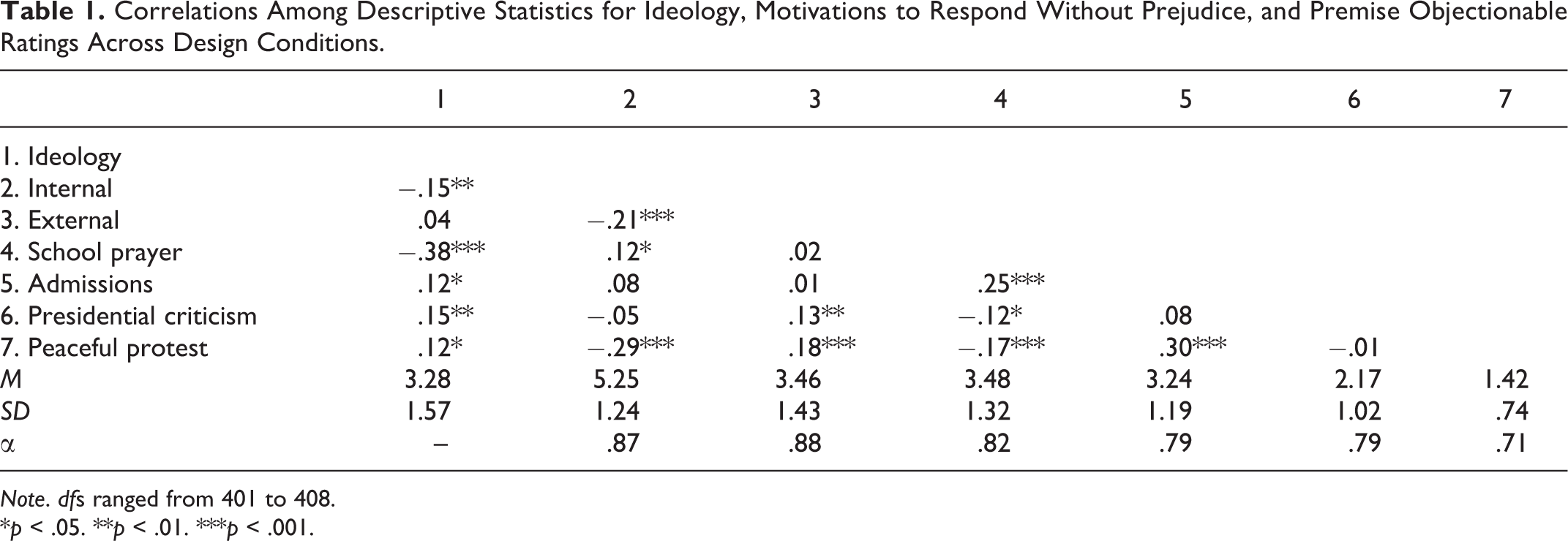
Table 1 reports the correlations among and descriptive statistics for ideology, internal and external motivations, and premise objectionableness ratings. Ideology was negatively correlated with the internal motivation to appear unprejudiced but unrelated to the external motivation. Consistent with prior research (Plant & Devine, 1998), internal and external motivations were negatively correlated with each other. 1
Correlations Among Descriptive Statistics for Ideology, Motivations to Respond Without Prejudice, and Premise Objectionable Ratings Across Design Conditions.
Note. dfs ranged from 401 to 408.
*p < .05. **p < .01. ***p < .001.
Based on IOPM predictions, political ideology should be negatively correlated with mandatory school prayer objectionableness but unrelated to peaceful demonstration objectionableness and college admission objectionableness. Although previous research has shown that RWA predicts Presidential criticism objectionableness (Crawford, 2012, Study 2), it is unclear whether political ideology will be related to Presidential criticism objectionableness.
Bivariate correlations indicated that as expected, ideology was negatively related to mandatory school prayer objectionableness and was positively related to Presidential criticism objectionableness. Contrary to our hypothesis, ideology was weakly positively correlated with college admissions and peaceful demonstration objectionableness.
Supplementary Table 1 in online supplemental materials reports Ms and SDs for target prejudice ratings, along with their correlations with political ideology. Replicating typical ICH effects (e.g., Brandt, Reyna, Chambers, Crawford, & Wetherell, 2014), ideology was positively correlated with prejudice against all left-wing targets and negatively correlated with prejudice against all right-wing targets.
Prejudice ratings
To test the hypothesis that people were more prejudiced against ideologically dissimilar than similar targets, we conducted a series of 2 (Participant ideology: liberal, conservative) × 2 (Target: left-wing, right-wing) mixed-model analyses of variance (ANOVAs) on prejudice ratings, with participant ideology as a between-subjects factor and target as a within-subjects factor. Liberal participants (n = 233) were those who placed themselves below 4 on the 7-point ideology scale, and conservative participants (n = 82) were those who placed themselves above 4 on the ideology scale. Moderates (n = 95) were not included in these analyses.2,3
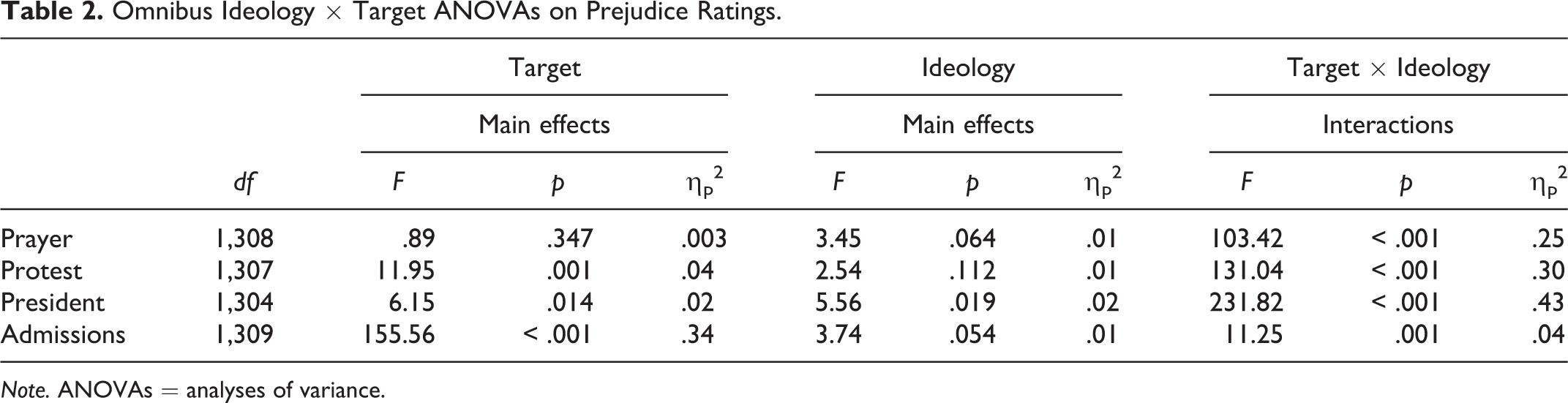
Table 2 shows that as expected, all Ideology × Target interactions were significant. Figure 1 provides the means and associated effect sizes (ηp 2) from simple main effects analyses for each comparison. As predicted, liberals disliked Evangelical Christians more than Muslims, F(1,308) = 80.48, p < .001, whereas conservatives disliked Muslims more than Evangelical Christians, F(1,308) = 41.97, p < .001; liberals disliked the Tea Party more than OWS, F(1,307) = 209.27, p < .001, whereas conservatives disliked OWS more than the Tea Party, F(1,307) = 21.73, p < .001 and liberals disliked Bush more than Obama, F(1,304) = 296.08, p < .001, whereas conservatives disliked Obama more than Bush, F(1,304) = 55.23, p < .001. Liberals disliked legacies more than minorities as expected, F(1,309) = 237.59, p < .001; however, conservatives unexpectedly also disliked legacies more than minorities, F(1,309) = 28.25, p < .001, although not to the same degree as liberals did. These results suggest that biased political judgments in the admissions scenario should be interpreted with caution. We return to this issue in the Discussion section.

Ideology × Target interactions on prejudice ratings.
Omnibus Ideology × Target ANOVAs on Prejudice Ratings.
Note. ANOVAs = analyses of variance.
Excluding the admission scenario targets, the effect sizes for liberals’ greater relative prejudice against right-wing targets were consistently larger than the effect sizes for conservatives’ greater relative prejudice against left-wing targets. Further, the average effect size for biases in prejudice ratings among liberals (.37) was 3.36 times greater than the average effect size for comparable biases among conservatives (.11), although liberalism was associated with stronger internal motivations to appear unprejudiced.
Primary Analyses
Supplementary Table 2 in online supplemental materials reports the Ms and SDs for the target support measures, along with their correlations with political ideology.
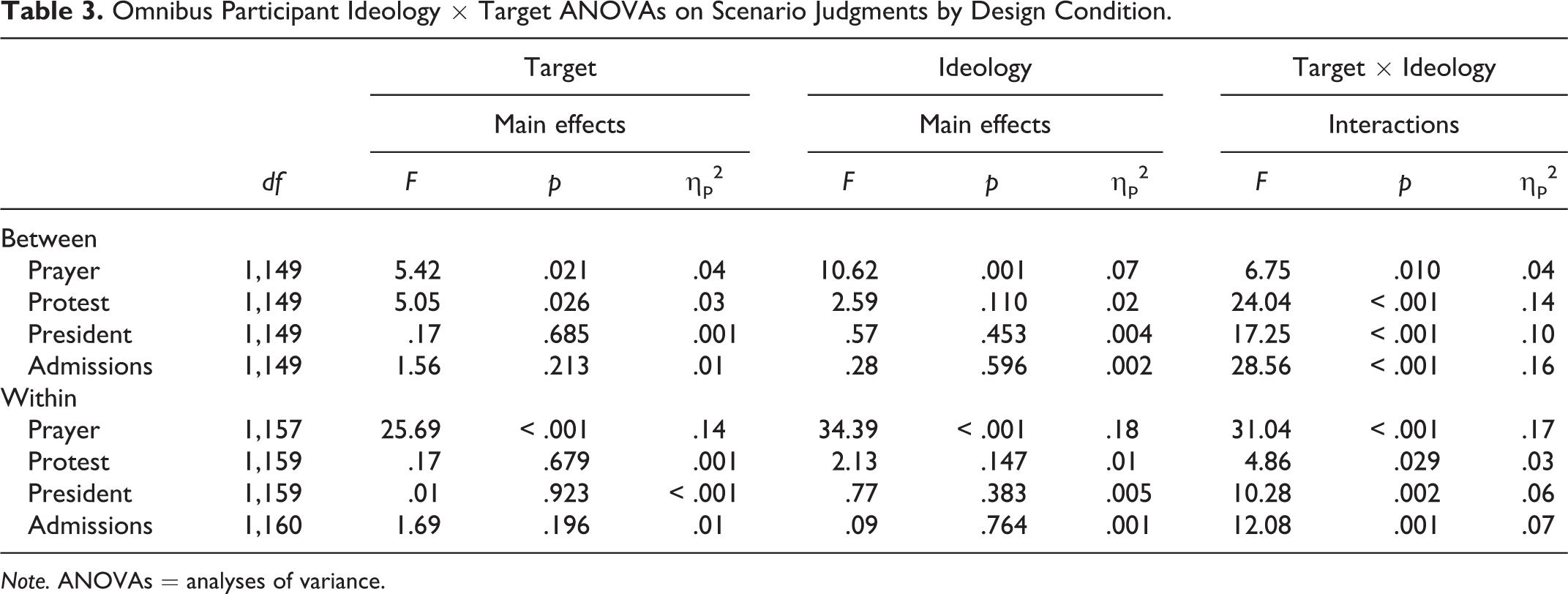
To examine biased political judgments in the between-subjects design, we conducted a 2 (Participant ideology: liberal, conservative) × 2 (Target: left-wing, right-wing) ANOVA on each scenario judgment. In the within-subjects design, we conducted a 2 (Participant ideology: liberal, conservative) × 2 (Target: left-wing, right-wing) mixed-model ANOVA on each scenario judgment. Table 3 reports the results of these omnibus ANOVAs.
Omnibus Participant Ideology × Target ANOVAs on Scenario Judgments by Design Condition.
Note. ANOVAs = analyses of variance.
Figure 2 (Panel A) reports the pattern of findings in the between-subjects design. In the between-subjects design, all Ideology × Target interactions were significant as expected. Simple main effects analyses revealed the predicted asymmetrical conservative bias in the mandatory school prayer scenario: Conservatives were more supportive of Christian than Muslim mandatory school prayer, F(1,149) = 8.30, p = .005, whereas liberals opposed them equally, F(1,149) = .07, p = .794. The other three scenarios revealed symmetrical biases, that is, liberals more strongly supported OWS than Tea Party demonstrators, F(1,149) = 6.59, p = .011, whereas conservatives more strongly supported Tea Party than OWS demonstrators, F(1,149) = 17.46, p < .001; liberals more strongly supported the Bush critic than the Obama critic, F(1,149) = 13.83, p < .001, whereas conservatives more strongly supported the Obama critic than the Bush critic, F(1,149) = 6.96, p = .009; and liberals more strongly supported the race-based than the legacy-based Supreme Court decision, F(1,149) = 15.94, p < .001, whereas conservatives more strongly supported the legacy-based than the race-based Supreme Court decision, F(1,149) = 14.74, p < .001.
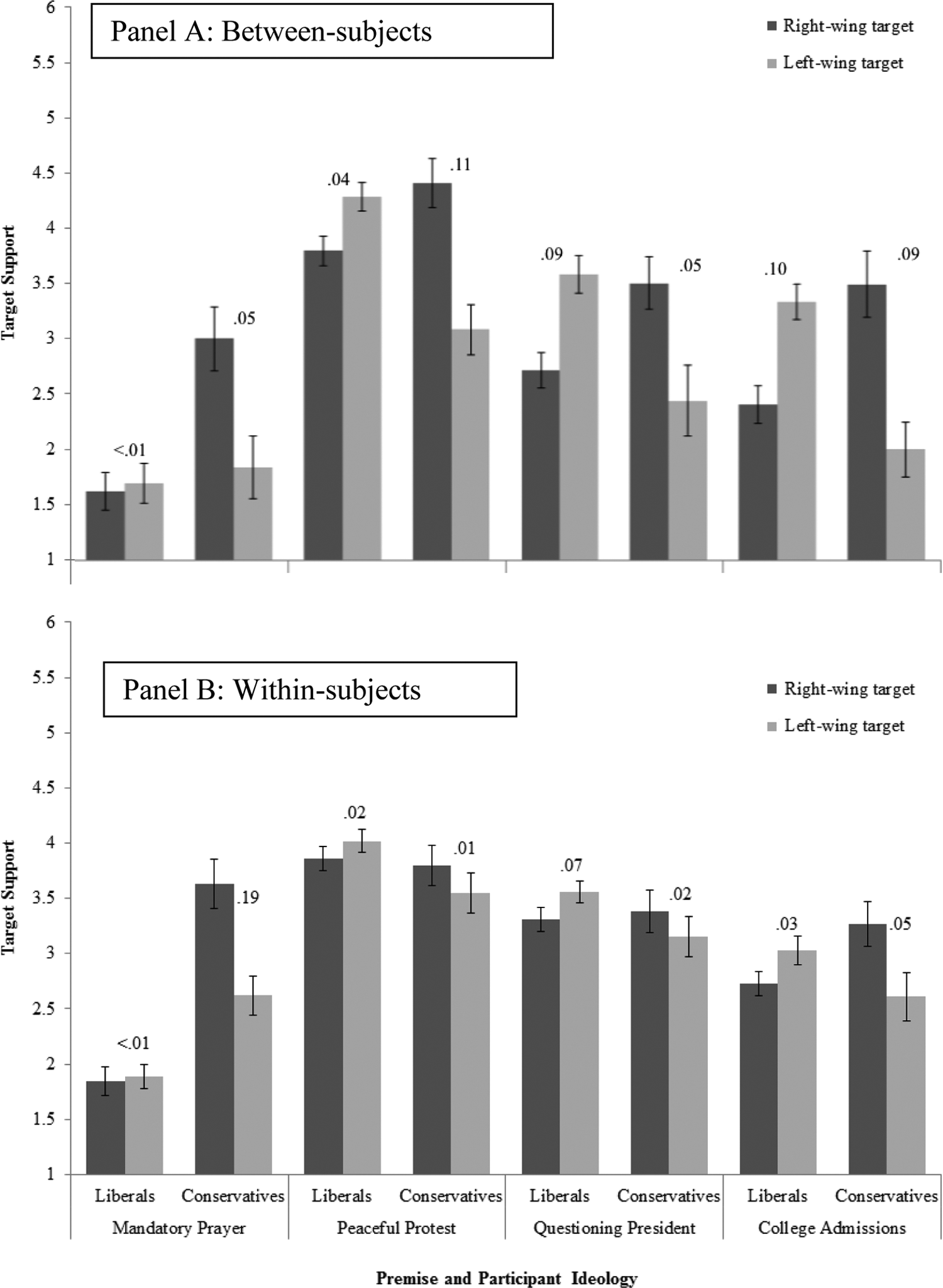
Ideology × Target interactions on scenario judgments.
Figure 2 (Panel B) reports the pattern of findings in the within-subjects design, which mirrored those in the between-subjects design. Again, all Ideology × Target interactions were significant. 4 Simple main effects analyses again revealed that conservatives were more supportive of Christian than Muslim mandatory school prayer, F(1,157) = 37.82, p < .001, whereas liberals opposed them equally, F(1,157) = .25, p = .617. The other three scenarios were more suggestive of symmetrical biases, that is, Liberals were marginally more supportive of OWS than Tea Party demonstrators, F(1,159) = 3.14, p = .078, whereas conservatives were only nonsignificantly more supportive of Tea Party over OWS demonstrators, F(1,159) = 2.30, p = .131; liberals more strongly supported the Bush critic than the Obama critic, F(1,159) = 10.98, p = .001, whereas conservatives were only marginally more supportive of the Obama critic than the Bush critic, F(1,159) = 3.22, p = .075; and liberals more strongly supported the race-based than the legacy-based Supreme Court decision, F(1,160) = 4.68, p = .032, whereas conservatives more strongly supported the legacy-based than the race-based Supreme Court decision, F(1,160) = 7.63, p = .006.
Comparing effect sizes in between-subjects and within-subjects designs
Table 3 displays effect sizes for the Ideology × Target interactions. Effect sizes were larger in the between-subjects than in the within-subjects design for the peaceful protest, Presidential criticism, and college admission scenarios (4.67, 1.67, and 2.29 times greater, respectively), whereas the effect size was larger in the between-subjects than in the within-subjects design only in the mandatory school prayer scenario (4.25 times greater). The average effect size in the between-subjects design (.11) was 1.38 times greater than the average effect size in the within-subjects design (.08).
Figure 2 reports effect sizes for the simple main effects. Among liberals, effect sizes were larger in the between-subjects than in the within-subjects design for the peaceful protest, Presidential criticism, and college admission scenarios (2.00, 1.29, and 3.30 times greater, respectively). There were no biases among liberals in the mandatory school prayer scenario. Among conservatives, biases were also larger in the between-subjects than in the within-subjects design for the peaceful protest, Presidential criticism, and college admissions scenario (11.00, 2.50, and 1.80 times greater, respectively). Only in the mandatory school prayer scenario was the effect size among conservatives larger in the within-subjects than in the between-subjects design (3.80 times greater). Among scenarios expected to produce symmetrical biases, the average effect sizes among liberals and conservatives in the within-subjects design were .04 and .03, respectively, whereas the average effect sizes in the between-subjects design were .08 among both liberals and conservatives. Thus, biases were stronger in the between-subjects than in the within-subjects design, and liberals and conservatives did not differ in the overall strength of their biases, although liberals reported greater internal motivation to appear unprejudiced.
Discussion
In this study, we compared liberals’ and conservatives’ tendencies to express biased political judgments in within-subjects and between-subjects designs (joint and separate evaluations, respectively; Hsee et al., 1999). First, the within-subjects design appeared to enhance people’s tendency to suppress their biases relative to the between-subjects designs: Although expected biases largely emerged under both conditions, effect sizes were typically larger in the between-subjects design. This finding should be particularly surprising because all things being equal, within-subjects designs produce relatively larger effect sizes because there is relatively less variability to be accounted for in such designs. These results therefore support the argument that relative to between-subjects designs, within-subjects designs may increase the tendency (if not the motivation; see Footnote 1) to respond without bias or prejudice (Bohnet et al., 2012).
Second, the strengths of liberals’ and conservatives’ biases were similar to each other across both designs, although (1) liberals reported a stronger internal motivation to respond without prejudice toward ideologically dissimilar targets and (2) joint evaluations attenuated biases, presumably because they make the target comparative purposes more apparent. This makes the results from the within-subjects design an even more impressive test of the ideological symmetry perspective, as conditions that could have disproportionately reduced liberals’ biases did not. Results from the within-subjects design also directly contradict Altemeyer’s (1998) claim that those on right are more likely to “speak out both sides of their mouths” on politically contentious issues.
Together, these results provide further support for the ideological symmetry perspective on politically motivated reasoning (see also Brandt & Crawford, 2013; Kahan, 2013; Taber & Lodge, 2006) and are inconsistent with claims that conservatives are asymmetrically more rigid and dogmatic in their judgments (e.g., Amodio, Jost, Master, & Lee, 2007; Critcher et al., 2009; Lindner & Nosek, 2009; Nam et al., 2013). The IOPM clearly presents a framework with which to understand the conditions under which biases will be turned on and off on the left and right. Future research could explore moderators other than premise objectionableness that may begin to explain why the literature provides a mix of evidence for the symmetry and asymmetry perspectives (e.g., induced threat and cognitive depletion).
These hypotheses were tested within the context of the IOPM (Crawford, 2012), which recognizes the potential for biases across the political spectrum, under the right conditions. Expected patterns of bias were observed across all four scenarios, replicating previous IOPM research (Crawford, 2012; Crawford & Xhambazi, 2015) and extending it both to joint target evaluations and unidimensional conceptualizations of political ideology. There were several minor inconsistencies with the model, however. First, conservatism was weakly related to peaceful protest and college admissions objectionableness, whereas no relationships were expected. Further, conservatives unexpectedly showed a preference for ethnic minorities over legacies. In retrospect, although conservatives might have assumed that ethnic minorities were liberal (cf. Chambers et al., 2013) and therefore ideologically dissimilar, they may have also assumed that legacies were also ideologically dissimilar (e.g., members of a “liberal elite”). Taken together, these results suggest that Crawford’s (2012) finding that SDO does not predict college admissions premise objectionableness is dependent on the hierarchy-attenuating and hierarcy-enhancing nature of the race-based and legacy-based policies, respectively.
Finally, with the exception of the college admission scenario targets, both liberals and conservatives were more prejudiced against ideologically dissimilar than similar targets, consistent with the ICH (Brandt et al., 2014). Interestingly, although liberals expressed greater internal motivation to respond without prejudice against dissimilar targets, the strength of biases among liberals was consistently greater than the biases among conservatives. Together with the findings from the scenario judgments, this study suggests that liberals’ tendency to report greater motivation to appear unprejudiced is more symbolic than practiced. Future work could explore ideological variation in when and why motivations to appear unprejudiced actually influence attitudes and behavior.
Conclusion
Consistent with the ideological symmetry perspective, biased sociopolitical judgments emerged relatively equally across the political spectrum. These results are the first to demonstrate that alterations in the intergroup comparative context (i.e., within-subjects vs. between-subjects designs) can influence target evaluations; specifically, that joint evaluations attenuate these biases but do not necessarily eliminate them. The symmetry perspective is all the more strongly bolstered by the finding that liberals’ and conservatives’ biases in the within-subjects condition were roughly equal, although the within-subjects design increased the tendency to respond without bias, and liberals reported higher motivation to respond without prejudice against ideologically dissimilar targets.
Footnotes
Declaration of Conflicting Interests
The author(s) declared no potential conflicts of interest with respect to the research, authorship, and/or publication of this article.
Funding
The author(s) received no financial support for the research, authorship, and/or publication of this article.
Notes

References
Supplementary Material
Please find the following supplemental material available below.
For Open Access articles published under a Creative Commons License, all supplemental material carries the same license as the article it is associated with.
For non-Open Access articles published, all supplemental material carries a non-exclusive license, and permission requests for re-use of supplemental material or any part of supplemental material shall be sent directly to the copyright owner as specified in the copyright notice associated with the article.
