



Abstract
Across the globe, populations are aging, which presents an unprecedented challenge to individual and societal well-being. We seek to (a) replicate and extend previous work on age-related differences in interpersonal trust and (b) examine associations between trust and well-being across the adult life span. Study 1, a cross-sectional study of 197,888 individuals (aged 14–99) from 83 countries assessed between 1981 and 2007, showed that (a) older versus younger adults showed higher interpersonal trust and (b) higher trust predicted higher well-being, especially for older adults. Study 2, a nationally representative three-wave cohort-sequential longitudinal study (spanning 4 years) of 1,230 individuals in the United States (aged 18–89), showed that (a) interpersonal trust increased longitudinally across age groups and (b) higher trust predicted increases in well-being longitudinally and vice versa. These findings suggest that interpersonal trust may be an important resource for successful development across the life span.
Across the globe, birth rates are declining and life expectancies are increasing. In the United States, over the next two decades alone, the proportion of people over age 65 is predicted to increase from 12.4% to 19% (U.S. Department of Health and Human Services Administration on Aging, 2012). This “graying” of populations worldwide presents an unprecedented challenge to individuals and societies alike, since as individuals grow older, they experience changes in many domains of functioning that are relevant for well-being. Many changes can be considered losses, including losses in cognitive abilities (e.g., Verhaeghen & Salthouse, 1997) and physical health (Rowe & Kahn, 1997). However, pioneering life span developmental theories predict that some age-related changes may actually represent gains in functioning, including increases in prosociality (Carstensen, Isaacowitz, & Charles, 1999) and generativity (Erikson, 1968). Numerous empirical studies have demonstrated such age-related gains for agreeableness (Roberts, Walton, & Viechtbauer, 2006), ego-transcending goals (Brandtstädter, Rothermund, Kranz, & Kühn, 2010), terminal values (vs. instrumental values; Ryff, 1982), generativity (McAdams & De St. Aubin, 1998), preference of positive over negative information (Mather & Carstensen, 2003), positive emotional experiences (Carstensen et al., 2011), emotional well-being in close relationship (Carstensen, 2006), the capacity to solve emotionally salient and interpersonal problems (Blanchard-Fields, 2007), and prosocial behavior toward strangers (Sze, Gyurak, Goodkind, & Levenson, 2012).
Although some age-related changes can be clearly described as gains or losses, the relevance of other changes to well-being is not clear. Included among these are age-related changes in interpersonal trust. A growing body of cross-sectional research provides evidence that levels of interpersonal trust differ in older adults versus younger adults. However, these studies provide conflicting accounts of how trust might change with age, with some studies reporting positive age–trust associations (e.g., Li & Fung, 2013; Poulin & Silver, 2008), while others report U-shaped (Fehr, 2009) or even negative associations (Fehr, Fischbacher, Von Rosenbladt, Schupp, & Wagner, 2003). The most comprehensive of these studies to date (Li & Fung, 2013) analyzed 57 497 individuals from 38 countries using data from the 2005 World Values Survey (WVS) and found that age was positively related to generalized interpersonal trust as well as trust toward four target groups. However, this study shares a crucial limitation with other studies on the same topic in that its design is cross-sectional, with data from just one point in time, which confounds age and cohort effects. Thus, there is a need to replicate the association between age and trust in samples that do not merely span multiple countries (cf. Arnett, 2008) but also multiple cohorts (cf. Putnam, 2000) and to examine whether trust actually increases longitudinally in adulthood.
Importantly, even if trust does indeed increase across the adult life span, it is not clear that this increase represents a gain in terms of well-being. In general, interpersonal trust is thought to be adaptive in that a sense of basic trust in other people allows human beings to derive support, comfort, and pleasure from others (Bowlby, 1969, 1988; Erikson, 1968; Sroufe, Coffino, & Carlson, 2010); facilitates prosocial behavior; and makes such behavior beneficial for well-being (Batson, Eklund, Chermok, Hoyt, & Ortiz, 2007; Helliwell & Wang, 2011; Poulin, 2013). However, trust may also put individuals at higher risk for exploitation and abuse (e.g., Castle et al., 2012), raising the possibility that trust would predict decreases in well-being over time, perhaps especially so for older adults who appear particularly vulnerable to fraud (Castle et al., 2012).
The goal of the present investigation was to (1) replicate and extend previous work on age-related differences in interpersonal trust across the adult life span and (2) examine the association between trust and well-being across the adult life span. Study 1 examined age, trust, and well-being in a worldwide sample of individuals (aged 14–99) from 83 countries (N = 197,888) who had participated in one of five waves of data collection of the WVS (WVS Association, 2012) between 1981 and 2007. Study 1 thus builds directly on Li and Fung (2013) and extends their findings by (a) including data from five waves (instead of one wave) of data collection and 83 (instead of 38) countries, thereby examining generalizability across cohorts and countries and (b) examining cross-sectional associations between well-being and trust across age groups. Study 2 examined age, trust, and well-being in a cohort-sequential longitudinal study of an age-diverse sample of individuals (age 18–89) from the United States (n = 1,230) who had participated in the General Social Survey (GSS) panel study (Smith, Marsden, Hout, & Kim, 2013) in 2006, 2008, and 2010. Study 2 builds on previous studies (including Study 1) by (a) examining within-person associations between aging and trust and (b) examining longitudinal associations between trust and well-being across age groups.
Both studies employed a self-report measure of generalized interpersonal trust (i.e., “most people can be trusted”) that is limited in that (1) it may not converge with behavioral trust measures (e.g., Glaeser, Laibson, Scheinkman, & Soutter, 2000), (2) more sophisticated multi-item measures of generalized interpersonal trust exist (e.g., Rotter, 1967), and (3) trust measures may not always show cross-cultural equivalence (for a review see Freitag & Bauer, 2013). We accepted these shortcomings as (1) the present self-report trust measure has been shown to converge with trust behavior (i.e., money transferred in a social dilemma game; Fehr et al., 2003; see also Knack, 2001; Naef & Schupp, 2009), (2) we were able to augment this measure by other measures of interpersonal trust (e.g., people met for the first time, people of other religions, people from other countries) in Study 1, and (3) this item has been recommended for use across cultural contexts (e.g., Freitag & Bauer, 2013).
Study 1
Method
Participants
We used data from all five currently available waves of the WVS (1981–1984, 1989–1993, 1994–1999, 1999–2004, and 2005–2007; N = 257,597), which consists of individual nationally representative surveys conducted in 97 societies, representing 88% of the world population (WVS Association, 2012). In order for surveys to be included in the overall WVS, they must minimize nonresponse bias either by prohibiting replacements for nonresponders or by making every effort to interview the first contact. For the present study, the sample was restricted to participants for whom age, trust, gender, income, and education data were available, yielding a usable n of 197,888 across 83 countries (aged 14–99).
Measures
Trust
The WVS included several measures of interpersonal trust. The primary measure was a dichotomous item, that is, participants reported whether it was more true that “most people can be trusted” or that one “can’t be too careful” (assessed at all waves in 87 countries, n = 246,796). Several other trust items were assessed at only one or two waves. At various waves, participants reported on their trust (1 = not trust at all, 5 = trust completely) in certain groups, including fellow citizens (Wave 2, 14 countries, n = 19,607), neighbors (Waves 2 and 5, 52 countries, n = 75,116), people known personally (Wave 5, 52 countries, n = 72,793), people met for the first time (Wave 5, 51 countries, n = 71,005), people of other religions (Wave 5, 52 countries, n = 68,284), and people from other countries (Wave 5, 51 countries, n = 67,656).
Well-being
At all waves, participants reported on their overall satisfaction with life (1 = dissatisfied and 10 = satisfied; assessed in 87 countries, n = 252,679), happiness (1 = not at all happy and 4 = very happy; assessed in 87 countries, n = 250,305), and subjective health (1 = very poor and 5 = very good; assessed in 83 countries, n = 246,228).
Covariates
All analyses adjusted for year of data collection, gender, education, and income (for descriptive data, see supplementary material). 1 Data were assessed at five waves (1981–1984, 1989–1993, 1994–1999, 1999–2004, and 2005–2007). Both education and income were assessed as country-specific, relative indicators at all waves and in 86 countries, with interviewers classifying participants as having a low, medium, or high level of education relative to their national peers (n = 237,676) and as ranking in a position from 1 to 10 in relative income (n = 226,003).
Results and Discussion
Age and Trust
A multiple logistic regression showed that older adults worldwide reported higher interpersonal trust, adjusting for year of data collection, gender, education, and income (adjusted odds ratio [ORadj] = 1.01, p < .001; Table 1). While the per-year magnitude of the age–trust association was small (φ = .06), it was very similar to the effect size of important covariates education (φ = .05) and income (φ = .07). Moreover, across the life span, the model predicted notable differences in trust. Although less than a quarter of 20-year-olds (23%) agreed that “most people can be trusted,” over a third of 80-year-olds (35%) agreed (Figure 1). 2
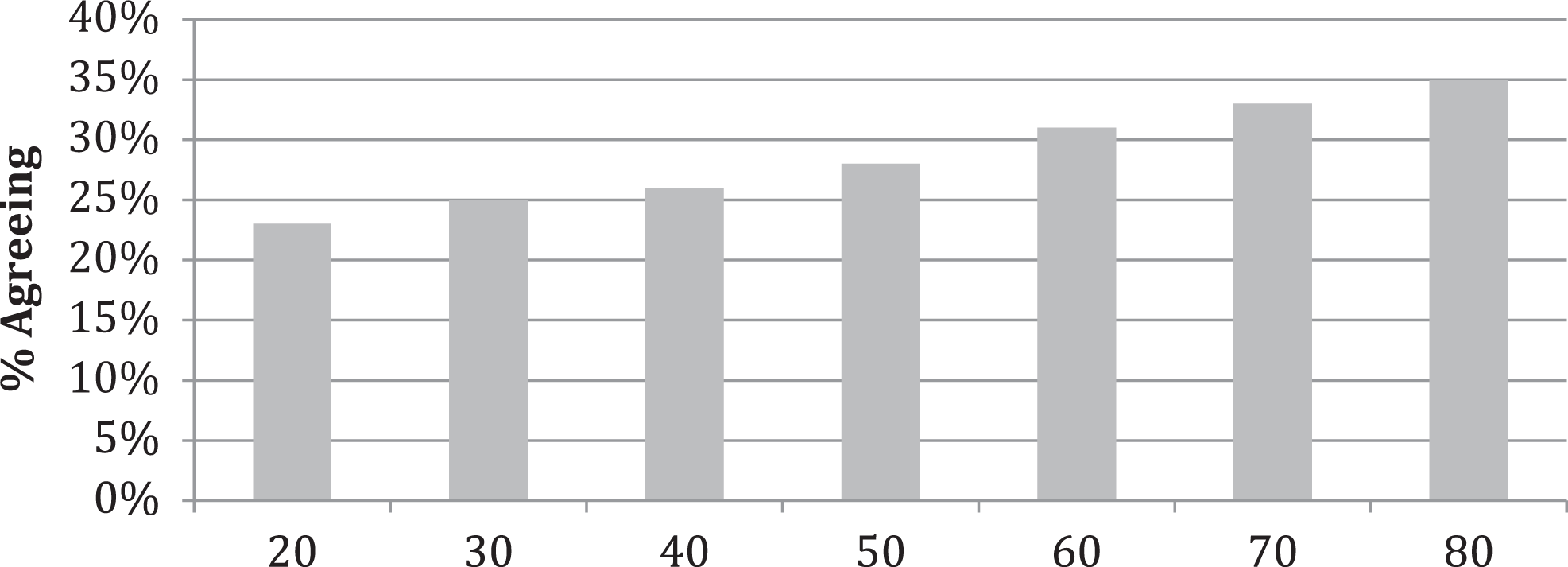
Age and trust in a worldwide cross-sectional study (Study 1, N = 197,888). Note. Predicted probability of agreement with statement that “most others can be trusted” versus one “can’t be too careful” based on participants’ age, adjusting for year of data collection, participant gender, education, and income using data from a worldwide sample of 197,888 individuals (aged 14–99) collected between 1981 and 2007 in 83 countries. To ensure prediction accuracy, predicted probability of trust is displayed for individuals between age 20 and 80.
Study 1: Logistic Regression Model for Primary Measure of Trust Predicted by Age, Adjusting for Year of Data Collection, Gender, Education, and Income.a

Note. The age–trust association generalized across measures of trust (all ps < .003). Model fit: χ2(5, 197,883) = 3,017.78, p < .001.
a N = 197,888.
To determine whether the age–trust association was driven by differences in birth cohorts, a second model examined whether the association between age and trust differed by wave of data collection (1980 to 2008) via the addition of an interaction between wave of data collection and age. Results indicated a significant moderation effect (OR = 1.002, p < .001). This effect was very small (φ = .01) but examining the age–trust associations within each wave indicated that the age–trust association has increased over time. At the first wave of the WVS, in 1980, this association was ORadj = 1.004 (p < .001), with predicted levels of trust for 20-year-olds and 80-year-olds being 25% and 29%, respectively. By contrast, in the 2008 wave, the age–trust association was ORadj = 1.01 (p < .001), with predicted levels of trust for 20-year-olds and 80-year-olds being 21% and 33%, respectively. Additional analyses showed that the age–trust association was linear (no significant quadratic effect: p = .92). The age–trust association was found for both genders, being slightly larger for females (ORadj = 1.011, p < .001) than for males (ORadj = 1.008, p < .001; significant interaction between Age × Gender, p < .001, φ = .009). The age–trust association generalized across measures of interpersonal trust, including trust toward one’s neighbors, people known personally, people met for the first time, people of other religions, and people from other countries (all ps < .003).
Trust and Well-Being
The second set of analyses examined the association between trust and well-being across age groups. Multiple (ordinary least square) regressions showed positive associations between trust and all three well-being outcomes, life satisfaction: B = 0.28, standard error (SE) (B) = 0.01, β = 0.05; happiness: B = 0.08, SE(B) = 0.004, β = 0.05; self-rated health: B = 0.16, SE(B) = 0.004, β = 0.08, all ps < .001. In follow-up analyses, we explored whether age moderated the association between well-being and trust and found significant, albeit very small interaction effects between age and trust for all three well-being outcomes (sr 2s < .01, ps < .001; see Table 2). Probing the simple slopes 2 indicated that trust was more strongly associated with all three well-being outcomes for older adults than for younger adults. Parallel moderation effects for all three well-being variables were found for all other trust measures, all ps < .001.
Study 1: Regression Models for Well-Being Predicted by Age, Primary Measure of Trust, Age × Trust, Adjusting for Year of Data Collection, Gender, Education, and Income.a
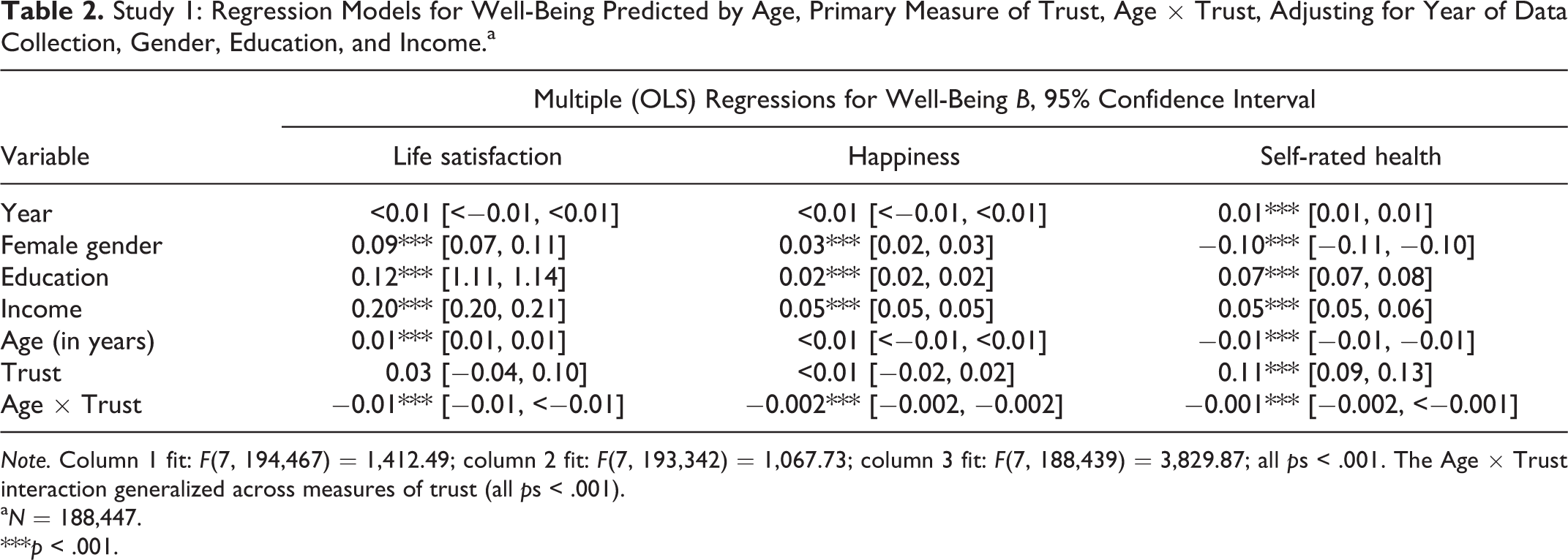
Note. Column 1 fit: F(7, 194,467) = 1,412.49; column 2 fit: F(7, 193,342) = 1,067.73; column 3 fit: F(7, 188,439) = 3,829.87; all ps < .001. The Age × Trust interaction generalized across measures of trust (all ps < .001).
a N = 188,447.
***p < .001.
Study 2
Method
Participants
We used data from all three currently available waves of the General Social Survey panel (GSS panel; T1 = 2006, T2 = 2008, and T3 = 2010; N = 2,000), which is a representative longitudinal study of individuals in the United States (Smith, Marsden, Hout, & Kim, 2013). A logistic regression analysis showed that neither trust, well-being, gender nor income at T1 predicted retention after 4 years (i.e., indicated by whether data on trust were available at T3; ps > .05). Age, Exp(B) = 1.01, p = .024, and education, Exp(B) = 1.07, p = .006, at T1 had small positive effects on retention after 4 years. For this study, the sample was restricted to participants for whom data on trust (for at least 2 out of the 3 waves), age, and gender were available, yielding a usable n of 1,230 (aged 18–89). Inclusion in the study sample was not selective with the exception of education, Exp(B) = 1.06, p = .021; neither trust, age, gender, education nor income at Wave 1 predicted inclusion in the sample (ps > .05).
Measures
Trust
Trust was assessed by asking participants “Generally speaking, would you say that most people can be trusted or that you can’t be too careful in dealing with people?” We recoded the numerical values for the three answer categories assigned by the GSS (1 = Most people can be trusted; 2 = Most people can’t be trusted; and 3 = Depends) so that higher values indicated higher trust (1 = Can’t be too careful; 2 = Depends; and 3 = Most people can be trusted).
Well-being
Well-being was assessed by asking participants “Taken all together, how would you say things are these days—would you say that you are very happy or not too happy?” We again recoded the numerical values so that higher values indicated higher well-being; 1 = Not too happy; 2 = Pretty happy; and 3 = Very happy.
Covariates
Covariates were assessed at Wave 1. Age group was measured in years and recoded into 10-year age brackets for select analyses. Gender was coded as male or female. Education was measured as participants’ highest year of schooling completed. Income was measured as participants’ total income in dollars.
Results and Discussion
Descriptive statistics and intercorrelations of study variables are available in Supplementary Materials.
Age and Trust
Latent growth curve modeling (LGM) showed a linear longitudinal increase in interpersonal trust over the course of 4 years indicated by a significant positive slope mean, M slope = .024, SE(M slope) = .007, p < .001. 3 The linear LGM showed close fit, χ2(1) = .95, p = .330; comparative fit index = 1.00; and root mean square error of approximation = .000 (intercept loadings: 1,1,1; slope loadings: 0,2,4). The size of the slope mean indicated that the average per-year increase in trust was small with .024 on the 1–3 trust scale, but the overall effect across age-groups was sizeable (see Figure 2).

Increases in trust in a U.S. longitudinal study (Study 2; n = 1,230). Note. OBSERVED levels of trust (M; standard errors represent SE(M)) across age groups at T1 (2006), T2 (2008), and T3 (2010) using data from a U.S. panel study of individuals (age 18–89) collected in 2006 (T1), 2008 (T2), and 2010 (T3). Participants were asked “Generally speaking, would you say that most people can be trusted or that you can’t be in dealing with people?” (1 = Can’t be too careful; 2 = Depends; and 3 = Most people can be trusted). Individuals were grouped into 10-year age groups to facilitate presentation of the results (age 18–27: n = 176; age 28–37: n = 231; age 38–47: n = 245; age: 48–57; n = 230; age 58–67: n = 180; age 68–77: n = 110; and age 78–87: n = 52).
In the next set of analyses, we included age as a predictor in the LGM and found that (a) age positively predicted the trust intercept, B = .01, SE(B) = .002, β = .18, p < .001, indicating that older adults had greater baseline levels of trust and (b) age did not predict the trust slope, B = −.001, SE(B) = .000, β = −.08, p = .153, indicating that increases in trust over the 4-year time interval generalized across age. When including both age and age squared as predictors in the LGM to probe possible quadratic effects, all results remained stable and age squared predicted neither the trust intercept nor the slope (ps > .155). 4 Similarly, neither gender, B = .03, SE(B) = .02, β = .10, p = .080, nor education, B = .003, SE(B) = .002, β = .06, p = .255, and income, B = .000, SE(B) = .000, β = .02, p = .811, predicted the trust slopes, when included as predictors in separate LGMs, indicating that increases in trust generalized across these covariates. When we repeated this set of analyses using multigroup modeling, the results remained stable. Increases in trust did not differ across age groups, gender, education, or income (indicated by nonsignificant differences in slope means, ps > .05).
Trust and Well-Being
A cross-lagged model (see Figure 3) showed that trust predicted small longitudinal increases in well-being, B = .05, SE(B) = .03, β = .05, p = .050, whereas well-being did not predict increases in trust, B = .03, SE(B) = .03, β = .03, p = .237. However, when we constrained the cross-lagged paths of trust predicting well-being and the cross-lagged paths of well-being predicting trust to be equal, model fit was not significantly reduced, Δ2(1) = .33, p = .566, indicating that the two paths did not differ significantly from each other, in this model: all Bs = .04, SE(B)s = .02, βs = .04, ps = .023. A follow-up multigroup analysis (categorizing individuals into 10-year age groups but excluding the oldest age group because of the low cell size; see Figure 2) indicated that both of these associations were not moderated by age group for trust predicting well-being, χ2(5) = 3.82, p = .575, nor well-being predicting trust, χ2(5) = 8.89, p = .113. We controlled all these analyses for age, gender, education, and income by regressing each variable on these covariates and saving the residuals for further analysis. When we repeated these analyses using the original (i.e., uncontrolled) variables, the results were largely similar, that is, trust predicted increases in well-being, B = .05, SE(B) = .01, β = .07, p < .001; well-being predicted increases in trust, B = .05, SE(B) = .03, β = .04, p = .047.

Trust and well-being in a U.S. longitudinal study (Study 2; n = 1,230). Note. Results from a cross-lagged model, χ2(4) = 1.00, p = .911; comparative fit index (CFI) = 1.00; root mean square error of approximation (RMSEA) = .000. T1 = 2006, T2 = 2008, and T3 = 2010, controlling for age, gender, education, and income. Four-year stabilities and residual intercorrelations were included in the model but are not shown here. Cross-lagged paths across time points were constrained to be equal (see, e.g., Keijsers, Loeber, Branje, & Meeus, 2011). *p = .05. ***p < .001.
General Discussion
Study 1, a cross-sectional study using data from the WVS (a) replicated and extended a previously shown (Li & Fung, 2013) positive association between age and trust in a worldwide sample spanning five waves of data collection and 83 countries and (b) showed that trust was positively associated with well-being, especially in older adults. Study 2, a nationally representative three-wave cohort-sequential longitudinal study (spanning 4 years) of U.S. individuals showed (a) longitudinal increases in interpersonal trust across age groups and (b) bidirectional longitudinal associations between trust and well-being such that higher trust predicted increases in well-being longitudinally and vice versa. Analyses were controlled for a variety of covariates (Study 1: year of data collection, gender, education, and income; Study 2: age, gender, education, and income). These findings have implications for understanding the adaptiveness of trust in successful development.
Age and Trust
How does trust change across adulthood? Previously, Li and Fung (2013) documented a positive association between age and trust using data from the WVS. However, that study only included data from one point in time, potentially confounding age and cohort effects. In light of this, and also in view of recent replication efforts in psychological research (e.g., Pashler & Wagenmakers, 2012), we sought to replicate this association in a larger WVS sample, spanning multiple waves of data collection and more countries. Results showed a positive association between age and trust across cohorts, which was small in terms of per-year magnitude but sizeable in terms of the overall effect across the life span.
Previous research on age and trust, including Study 1, has been limited by an exclusive use of cross-sectional designs, a crucial limitation that we were able to overcome in Study 2. Results from a nationally representative U.S. sample showed that trust increased longitudinally over 4 years across age-groups, thus, demonstrating a developmental trend, which is consistent with other findings from life-span developmental psychology on basic social–cognitive (Mather & Carstensen, 2003), emotional (Carstensen et al., 2011), and motivational (Haase, Heckhausen, & Wrosch, 2013) changes across the life span. Future research will need to examine whether this developmental trend generalizes to other countries beyond the United States and what sources drive these age-related increases in generalized trust (see, e.g., evidence for specific kinds of experiences that can increase generalized trust; Cao, Galinsky, & Maddux, 2014).
Trust and Well-Being
The fact that trust increases across age groups in adulthood does not necessarily mean that it is adaptive. In fact, given the potential for highly trusting individuals to be targets of fraud and exploitation (e.g., Acierno, Hernandez, Amstadter, Resnick, Steve, Muzzy, & Kilpatrick, 2010; Castle et al., 2012), it is reasonable to speculate that increased trust could lead to poorer, not better, well-being. However, in both studies, trust was positively associated with well-being across age groups, suggesting that greater trust is an important resource for successful development (in Study 1 the association was even stronger for older adults). Moreover, Study 2 showed that trust predicted increases in well-being longitudinally and that, at the same time, well-being predicted increases in trust.
These findings suggest that if there are risks associated with increased levels of trust, they appear to be outweighed in general by the benefits of trust. Thus, a basic sense of trust is not only fundamental in early childhood (Bowlby, 1969, 1988) but also appears to benefit well-being across the adult life span (see also Poulin, 2013). Importantly, there was no indication that these well-being benefits were smaller for older adults (on the contrary, see Study 1). Moreover, the bidirectional association between trust and well-being shows that not only is trust a resource for well-being, but well-being also serves as a resource for adaptive interpersonal functioning (Fredrickson, 2001).
Limitations and Strengths
The present studies have limitations and strengths. First, we examined existing data and focused on widely used 1-item self-report measures of trust (e.g., Li & Fung, 2013) and well-being (e.g., Blanchflower & Oswald, 2004). The use of these 1-item measures may reflect disciplinary preferences and, although we were able to augment our measure of interpersonal trust in Study 1, multi-item scales would have allowed for a stronger test of our hypotheses.
Personality researchers may be curious about links with agreeableness and we agree this will be important to examine further. Whether one views trust as a subfacet of agreeableness (Soto & John, 2009) or as a distinct construct (Evans & Revelle, 2008), we believe there is value in examining age-related changes in trust across cultures and longitudinal links with well-being, given trust’s central role in psychological (e.g., Li & Fung, 2013), economic (e.g., Fehr, 2009; Fukuyama, 1995; Knack & Keefer, 1997), and political science (e.g., Putnam, 2000) research. Our own exploratory analyses suggest that the association between age and trust may not be confounded greatly by agreeableness. 5 On the other hand, behavioral researchers might be curious to what extent the present findings generalize to behavioral measures of trust or not, and we agree this will be an important avenue for future research to pursue in longitudinal studies (for a cross-sectional study see Sutter & Kocher, 2007).
Second, the present studies used cross-sectional and cohort-sequential longitudinal designs to maximize statistical power (Study 1), inclusion of non-WEIRD (Arnett, 2008) participants (Study 1), and ability to track real-world developmental changes in trust in a cohort-sequential longitudinal study of an age-diverse sample (Study 2). Cohort-sequential designs have been widely in developmental research to examine, for example, how self-esteem (e.g., Orth, Trzesniewski, & Robins, 2010), personality (e.g., Mroczek & Spiro, 2003), or life satisfaction (e.g., Baird, Lucas, & Donnellan, 2010) change across adulthood. Future research may examine changes in trust over longer time intervals and use experimental designs to corroborate a causal effect of trust on well-being among individuals of different ages.
Third, in order to analyze cross-lagged associations between trust and well-being, the three-wave longitudinal design of Study 2 allowed us to use manifest cross-lagged modeling (which cannot parse out latent state and trait variance components of trust and well-being). Future research may require more sophisticated models such as latent state-trait models (which require more than three waves of data collection and would allow for differentiating between state and trait components of trust and well-being; e.g., Cole, Martin, & Steiger, 2005).
Conclusion
The present findings suggest that an aging world may become a more trusting world and that heightened trust may represent a resource rather than a threat for well-being throughout the life span. This basic finding suggests multiple opportunities for future research to uncover the adaptive value—and potential costs—of trust for older individuals and for aging societies.
Footnotes
Acknowledgment
The authors gratefully acknowledge the National Opinion Research Center’s General Social Survey (www3.norc.org/gss+website/) and the WVS Association’s World Values Survey ( ) for making data available for analysis. We would also like to thank all study participants.
Declaration of Conflicting Interests
The author(s) declared no potential conflicts of interest with respect to the research, authorship, and/or publication of this article.
Funding
The author(s) received no financial support for the research, authorship, and/or publication of this article.
Notes
References
Supplementary Material
Please find the following supplemental material available below.
For Open Access articles published under a Creative Commons License, all supplemental material carries the same license as the article it is associated with.
For non-Open Access articles published, all supplemental material carries a non-exclusive license, and permission requests for re-use of supplemental material or any part of supplemental material shall be sent directly to the copyright owner as specified in the copyright notice associated with the article.
