




Abstract
How does a sense of control relate to well-being? We consider two distinguishable control strategies, primary and secondary control, and their relationships with two facets of subjective well-being, daily positive/negative affective experience and global life satisfaction. Using undergraduate and online samples, the results suggest that these different control strategies are associated uniquely with distinct facets of well-being. After controlling for shared variance among constructs, primary control (the tendency to achieve mastery over circumstances via goal striving) was associated more consistently with daily affective experience than was secondary control, and secondary control (the tendency to achieve mastery over circumstances via sense-making) was associated more strongly with life satisfaction than primary control, but only within the student sample and community members not in a committed relationship. The results highlight the importance of both control strategies to everyday health and provide insights into the mechanisms underlying the relationship between control and well-being.
There is only one way to happiness and that is to cease worrying about things which are beyond the power of our will.
Many traditions in Western thought have attempted to articulate the relationship between perceived control and well-being. Classical Stoic philosophers such as Epictetus argued that the recipe for the good life consisted of two essential ingredients, namely, an accurate understanding of what was and was not within a person’s control and a cheerful ambivalence toward the latter (Irvine, 2008). To date, most psychological theorists (Bandura, 1997; Deci & Ryan, 1995) contend that well-being relies less upon an accurate understanding of control and more upon a firm sense that one is, in fact, the master of the events and circumstances that comprise one’s life. One recent review article put it thus: “the perception of control is not only desirable, but it is likely a psychological and biological necessity” (Leotti, Iyengar, & Ochsner, 2010, p. 457)—in effect, arguing that a sense of control over the world is essential to not just thriving, but surviving in life.
The view that perceptions of control are essential to well-being accords with intuition, insofar as self-determination is a critical ingredient to most people’s sense of meaning and purpose in life (Seligman, 2006). And, indeed, much empirical evidence documents a link between perceived control and well-being (see Lachman, Neupert, & Agriogoroaei, 2011; Spector, 2002, for reviews). This evidence notwithstanding the Stoic notion that well-being is in part determined by having the wisdom to know and come to terms with the limits of one’s control also resonates with common sense as well as with extant research in clinical psychology (for a review, see Swain, Hancock, Hainsworth, & Bowman, 2013). Thus, the relationship between perceived control and well-being is not straightforward, and there likely exist many different qualifiers to any general conclusions one could reach.
One resolution to this puzzle involves acknowledging that both control and well-being are multidimensional psychological constructs. Just as well-being is an umbrella term that encompasses many different facets of “the good life” (Jayawickreme, Forgeard, & Seligman, 2012), control is a complex psychological phenomenon, likely emerging from different social–psychological sources. In this article, we adopt this perspective to examine the relationship between two strategies for achieving perceived control (primary and secondary control) and two ways of achieving subjective well-being (SWB), positive/negative affect and satisfaction with life.
Distinguishing Between Primary and Secondary Control
Virtually all theoretical traditions recognize a basic human need for control (Baumeister, 2005; Fiske, 2002; Morling & Evered, 2006; Ryan & Deci, 2002). Recognizing the centrality of this need, Rothbaum, Weisz, and Snyder (1982) introduced two different routes by which a person could exert control over the circumstances of his or her life. One route, primary control, satisfies a need for control through a direct means: The agent gains control by engaging in behaviors that directly alter the objective circumstances of his or her world. The other route, secondary control, is a more indirect means: The agent gains control by altering his or her psychology in relation to the world. Since their introduction, these constructs have captured the interest of researchers in clinical, health, and developmental psychology, in particular but have remained in relative obscurity (particularly the notion of secondary control) to researchers in personality/social psychology (but see Thompson et al., 1998).
Rothbaum and colleagues’ (1982) initial formulation of primary control as a strategy that involves behaviors aimed at changing the world to fit the desires or needs of the self is at the core of most conceptual definitions. Viewed this way, primary control matches most Westerners’ intuitive notions of what it means to be “in control,” and when experimentalists study the effects of perceived control, it is usually primary control that they are studying. For example, research that focuses on the consequences of illusions of control (Langer, 1975) or on the effects of control deprivation (Baron & Logan, 1993; Burger & Cooper, 1979; Fast, Bruenfeld, Sivanathan, & Galinisky, 2009; Fennis & Aarts, 2012; Greenberger, Strasser, Cummings, & Dunham, 1989; Inesi, Botti, Dubois, Rucker, & Galinksy, 2011; Whitson & Galinsky, 2008; Zhou, He, Yang, Lao, & Baumeister, 2012) typically asks what happens to a person when they feel that they are unable to bring about intended effects in the external world.
There is considerably more conceptual ambiguity, however, about the nature of secondary control and how it relates to well-being (Morling & Evered, 2006; Skinner, 1996). One common thread across multiple definitions is that it involves regulation of one’s cognitions or reactions to the world, typically in the service of accepting present circumstances and adjusting the self to accommodate those circumstances (Morling & Evered, 2006). The secondary control toolkit can involve a diverse number of strategies, including cognitive restructuring, positive thinking, acceptance, and even distraction from a stressor (Connor-Smith, Compas, Wadsworth, Thomsen, & Saltzman, 2000). What distinguishes secondary control strategies from a broader class of coping responses, however, is that these strategies are engaged in voluntarily (Connor-Smith et al., 2000); that is, the agent chooses to engage with his or her present circumstances in a manner that allows for perceived mastery.
SWB and Its Distinct Components
SWB is similarly multidimensional. Psychologists studying SWB employ both affective (positive and negative emotional state) and cognitive (global evaluation of one’s life satisfaction) measures as overall indicators of the subjective quality of one’s life (Diener, Suh, Lucas, & Smith, 1999). Because these two subjective assessments capture different types of evaluations, researchers have recently advocated for acknowledging these structural differences and studying the affective/experiential and cognitive/global facets of well-being separately, rather than combining into an overall index of SWB (Busseri & Sadava, 2011; Diener, Ng, Harter, & Arora, 2010; Luhmann, Hawkley, Eid, & Cacioppo, 2012). This approach has been useful for resolving certain paradoxes in behavioral science, such as the question of whether money is related to SWB (Jayawickreme et al., 2012). Recent research has shown, for example, that cognitive, global components of well-being increase with income, while affective, experiential components may be less affected (Diener et al., 2010), although intriguingly recent work suggest this may truer of happiness rather than sadness (Kushlev, Dunn, & Lucas, 2015). This theoretical perspective on SWB and its supporting empirical data suggest that different facets of SWB may be related to distinct psychological mechanisms, including, perhaps, different control strategies.
Is Secondary Control Merely Compensatory? A Theoretical Debate
As their labels suggest, some theoretical orientations contend that secondary control is merely a compensatory or “backup” strategy, which is employed when attempts at primary control have failed (e.g., Heckhausen & Schulz, 1995; Thompson et al., 1998). Other theorists have challenged this view, arguing that primary and secondary control serve different human needs (for control and belongingness, respectively) and thus fulfill distinct roles in psychological health (Morling, Kitayama, & Miyamoto, 2002). To date, empirical evidence supporting the former hypothesis includes studies documenting salubrious effects of secondary control only among individuals with low- to mid-range (but not high) primary control (e.g., Thompson et al., 1998) as well as evidence that the importance of secondary control is greatest later in life, when primary control attempts are more likely to fail (Heckhausen & Schulz, 1995; Wrosch, Heckhausen, & Lachman, 2000). Evidence for the latter hypothesis includes cultural differences in the use of control strategies, whereby individuals from Asian cultures, unlike their North American counterparts, report greater reliance upon secondary control than primary control across the life span (Morling et al., 2002).
Another piece of evidence that might lend clarity to this debate is the focus of this article, that is, whether primary and secondary control uniquely relate to different facets of SWB. This question is not readily answered by existing research, in part because the study of secondary control has focused on populations suffering primary control deficits and in part because primary and secondary control are conceptually and empirically overlapping constructs, and little effort has been made to assess how the nonoverlapping (i.e., unique) features of each relate to SWB. If unique relationships do exist, and we expected that they would, it would seem that the latter control strategy is more than compensatory, fulfilling a different niche than the former.
Overview of the Present Studies
To address this hypothesis, we measured primary and secondary control, as well as affective and cognitive SWB, within samples of students and community members. Affective well-being was assessed retrospectively using a modified diary method procedure that served as a gauge of participants’ total positive and negative affect over the course of a randomly chosen day of their life. We believed this method provided a fine-grained measure of positive and negative feelings in direct reference to actual experience, while allowing for a large sample to be collected efficiently (Kushlev et al., 2015). Cognitive well-being was assessed using the most prominent measure of participants’ overall satisfaction with life (SWL; Diener, Emmons, Larsen, & Griffin, 1985).
Primary and secondary control were assessed using a measure that tapped Rothbaum et al.’s (1982) fundamental distinction between changing the world to fit the self (primary control) and changing the self to fit the world (secondary control). Our chosen measure (Wrosch et al., 2000) operationalized primary control as the tendency to achieve mastery over circumstances via goal striving and willful persistence and secondary control as the tendency to achieve mastery over circumstances via learning, reappraisal, and sense making (a strategy consistent with Morling and Evered’s (2006) fit-focused definition of secondary control). It is important to note that individuals high (or low) on primary control tend to also be high (or low) on secondary control using this measure (correlations can exceed r = .50; Wrosch et al., 2000) and that we were interested not in this overlapping territory but in the way that the unique features of primary and secondary control (goal striving and reappraisal, respectively) relate to different facets of SWB.
We expected that due to this overlap, simple (i.e., zero-order) relationships between the two control strategies and SWB would reveal few differences between strategies, and for this reason planned on conducting more fine-grained analyses that controlled for overlap between control strategies and for overlap between different components of SWB (e.g., although they represent distinct states, the correlation between positive affect and SWL is often substantial, around r = .50; Diener et al., 1985). Our predictions then applied a functionalist logic, essentially matching the properties of each control strategy to the different facets of SWB. Researchers have characterized the distinction between affective experience and life satisfaction as reflecting, respectively, recent events/activities and global life circumstances (Luhmann et al., 2012). We predicted that the former states, which are more transient and likely tied to the accomplishment of momentary goals (Moore, Ferguson, & Chartrand, 2011), would be more closely associated with goal striving (primary control) than learning and sense making (secondary control). We also predicted that life satisfaction—which reflects an individual’s global and reflective attitude about the favorability of his or her life (Heller, Watson, & Ilies, 2006)—would be more closely related to a person’s capacity to learn from and make sense of life’s ups and downs (i.e., secondary control) than to a tendency toward goal striving and persistence (primary control).
Method
Participants
One hundred forty-four participants (95 female) were recruited from an undergraduate participant pool in the United States for Study 1. 1 These participants ranged in age from 18 to 22 (Med. = 19), were predominantly (77%) White, and the majority (64%) were not in a dating or committed relationship. For Study 2, U.S. participants were recruited through Amazon’s MTurk and paid US$2.25 for completing a study about “your day yesterday.” Data from 407 participants were included in these analyses (four participants were excluded for failing to complete key measures). The sample was 52% male, 77% White, and ranged in age from 19 to 75 (Med age = 31), and the majority (61%) were in a committed relationship.
Material and Procedure
Measure of primary and secondary control
The 14-item scale is composed of three factors, namely, primary control, secondary control, and lowering expectations (which was collected but omitted from analysis). Participants respond to items such as “When things don’t go according to my plans, my motto is, ‘Where there’s a will, there’s a way’” (primary control) and “I find I usually learn something meaningful from a difficult situation” (secondary control), on a 1 (Not at all) to 4 (A lot) Likert-type scale (Wrosch et al., 2000).
Measure of SWL
Participants completed Diener, Emmons, Larsen, and Griffin’s (1985) SWL Scale, which asks participants to rate their agreement from 1 (Strongly disagree) to 7 (Strongly agree) with 5 Items (e.g., “In many ways my life is close to my ideal”).
Measure of daily positive and negative affect
To sample participants’ daily positive and negative affect, we employed the day reconstruction method (DRM; Kahneman, Krueger, Schkade, Schwarz, & Stone, 2004). In the DRM, participants were asked to think of their day yesterday and to recall each episode 2 that made up their morning, afternoon, and evening. Then, participants were asked specific questions about each episode, namely, when it began and ended, the type of activity that was done (selected from a checklist), where it took place, whom they were with, and how they were feeling during the episode. Participants indicated from 0 (Not at all) to 6 (Very much) the extent to which they were feeling as follows: impatient, frustrated/annoyed, depressed/blue, hassled/pushed around, angry/hostile, worried/anxious, criticized/put down, tired (negative affect) and happy, competent/capable, warm/friendly, enjoying myself, in control, peaceful/relaxed (positive affect). The first 12 states are standard measures in the DRM; the last two states were added by the authors for exploratory purposes.
In addition, participants in Study 2 completed measures of mindfulness and general personality (de Vries, 2013), trait affect (How often do you typically feel … using the same 14 affect states in the DRM) as well as a state version of SWLS (the degree to which their day yesterday was “close to their ideal” as well as state versions of the four other SWL items adapted from Heller et al., 2006). 3
Results
Table 1 shows the zero-order correlations among all measures (descriptive statistics and scale reliabilities for all measures are shown in Table 2). As in past research, primary and secondary control were strongly correlated with one another and both control strategies predicted significantly greater well-being. As expected, within each study, there was no indication that either control strategy out-predicted the other control strategy in predicting any facet of well-being, Zs < 1.37, ps > .16 for Study 1 and Zs < 1.64, ps > .10 for Study 2.
Zero-Order Relationships (Pearson’s R) Between Primary and Secondary Control and SWB Measures (Studies 1 and 2).

Note. Correlations in bold are significant at p < .001.
†p < .10, **p < .01, *p < .05.
Descriptive Statistics for Measures in Studies 1 and 2.

Note. To calculate state PA/NA, participants’ rating for each of the 14 emotions across all reported episodes were averaged and then combined into their respective indices.
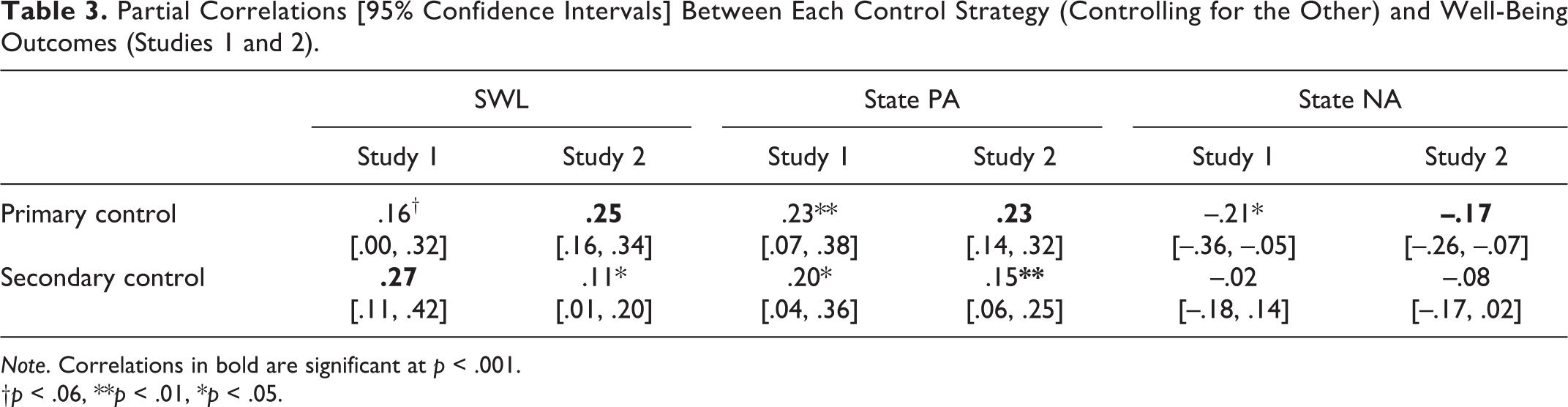
As discussed in the introduction section, the implication of the zero-order correlations is ambiguous due to overlap between control strategies. A clearer view can be gained by looking at partial correlations between each control strategy (controlling for the other strategy) and SWB (Table 3). These analyses test, in essence, whether the unique signatures of each control strategy (goal striving and reappraisal, respectively) explain unique variance in the facets of SWB.
Partial Correlations [95% Confidence Intervals] Between Each Control Strategy (Controlling for the Other) and Well-Being Outcomes (Studies 1 and 2).
Note. Correlations in bold are significant at p < .001.
†p < .06, **p < .01, *p < .05.
In line with our prediction, primary control was more consistently related than secondary control to state affect across studies. Although primary and secondary control both uniquely predicted State Positive Affect (PA), primary, but not secondary, control significantly predicted State Negative Affect (NA). With regard to SWL, the results were mixed: In Study 1, SWL was more strongly associated with secondary than primary control (based upon the significance levels of both correlations), but in Study 2, SWL was more strongly associated with primary than secondary control. Thus, while data from Study 1 supported the predicted relationship between secondary control and SWL, data from Study 2 opposed it.
Disentangling the Facets of SWB
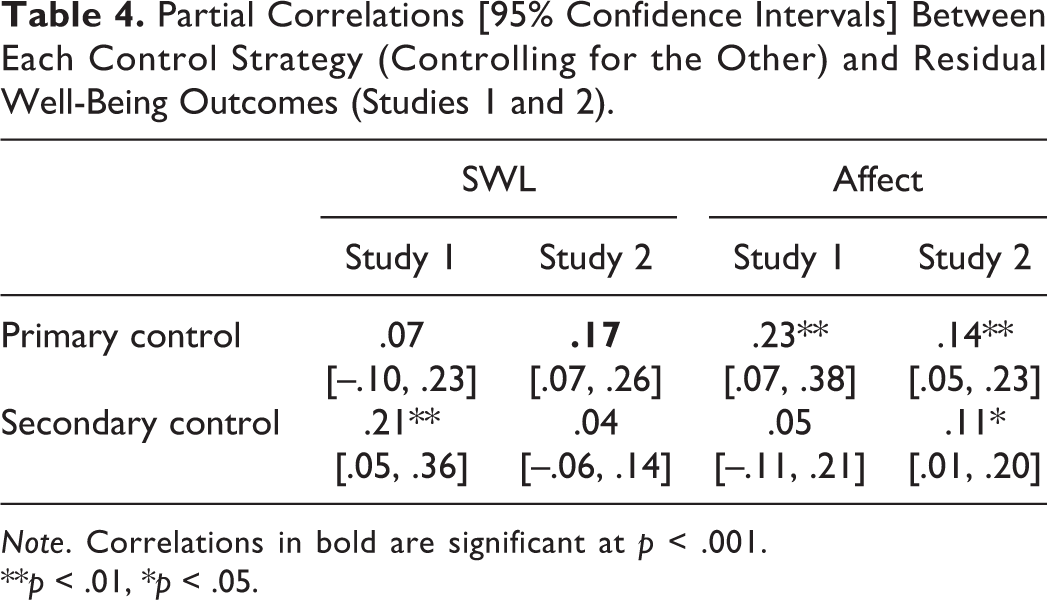
A careful reader will note that while the partial correlations account for, and remove, shared variance between primary and secondary control, they do not account for the fact that affective and cognitive SWB also overlap (see Table 1), particularly State PA and SWL. To account for this, we residualized SWL on PA and NA, resulting in an estimate of participants’ SWL, after accounting for the affective experiences they reported on the day of the study. We also computed a residual affect score. For ease of presentation, we first subtracted State NA from State PA (resulting in participants’ net affective experience that day) and then residualizing that score on SWL.
We then repeated the partial correlations on these residual scores. These results sharpened the story told by the partial correlations (see Table 4). After controlling for overlap among facets of SWB, affective measures were more closely associated with primary than secondary control. The discrepant findings between Studies 1 and 2 for SWL were also magnified by these analyses, such that residual SWL was significantly associated with secondary control only in Study 1 and primary control only in Study 2.
Partial Correlations [95% Confidence Intervals] Between Each Control Strategy (Controlling for the Other) and Residual Well-Being Outcomes (Studies 1 and 2).
Note. Correlations in bold are significant at p < .001.
**p < .01, *p < .05.
Sample Differences
To try to understand these discrepant results, we looked to demographic differences between the two samples. As noted earlier, two differences were apparent: Participants in Study 2 were older than participants in Study 1 and more participants in Study 2 were in a committed relationship than in Study 1. Since both age and close relationships have been studied in relation to control and well-being (Morling & Evered, 2006), we explored (post hoc) whether either of these variables moderated the results of Study 2. We ran two multiple regressions predicting residual SWL from primary control, secondary control, the moderator of interest, and interactions between that moderator and each control strategy. No additional moderators were tested.
Age did not significantly interact with either primary or secondary control to predict residual SWL, ps > .09 and .40, respectively. There was, however, a significant interaction between relationship status and secondary control in predicting residual SWL, t = 2.35, p = .019. More tellingly, the simple effect of secondary control for uncommitted and committed participants mimicked the results of Studies 1 and 2, respectively. Secondary control was a significant predictor of residual SWL for uncommitted participants, b = .24, p < .03, but not for committed participants, b = −.09, p > .26. Although the Relationship Status × Primary Control interaction was not significant, t = 1.25, p > .21, the relationship between primary control and residual SWL was nonsignificant for uncommitted participants, b = 12, p > .25, but significant for committed participants, b = .28, p < .001, which matched the pattern of results from Studies 1 and 2, respectively. Of course, these results cannot establish conclusively that differences in results between Studies 1 and 2 were due to relationship status, but they are suggestive that relationship status is an important moderator of the link between secondary control and SWL and may have been a contributing factor to the discrepant results. 4
General Discussion
The present studies employed a methodology and analytic strategy that allowed us to examine the unique relationships between primary and secondary control and two different facets of SWB—daily positive and negative affective experience and global life satisfaction. The research question and methods build on past research, first, by breaking down both control and SWB into their constituent parts and examining how different parts relate to one another, lending greater precision and nuance to our understanding of each. Second, as one of the few studies that looks at the link between control strategies and SWB in an everyday context, this work advances research on primary and secondary control beyond the realm of clinical outcomes or adjustment to major life stressors (e.g., Affleck, Allen, Tennen, McGrade, & Ratzan, 1985; Grootenhuis, Last, Graaf-Nijkerk, Johanna, & Van Der Wel, 1996; McQuillen, Licht, & Licht, 2003), documenting a role for each in daily life.
The core results (those derived from the most exacting analyses) support a unique role for primary and secondary control as correlates of well-being—a pattern that is inconsistent with the view of secondary control as a merely compensatory psychological mechanism. After accounting for shared variance among measures, secondary control proved to be less involved than primary control in daily affective experience. Daily negative affect, in particular, varied as a function of primary, but not secondary, control in both studies. When considering a more global indicator of SWB, life satisfaction (SWL), however, the results showed a different pattern: Secondary, but not primary, control was uniquely associated with SWL in Study 1 and in Study 2 for participants who were not in a committed relationship. (We will return to this moderator subsequently.)
Implications for Understanding Secondary Control
These data constitute support for our general hypothesis—even while failing to confirm certain specific predictions. Although we cannot infer causality from these data, we speculate that primary control, as an orientation toward goal striving, and secondary control, as an orientation toward sense-making and experiential learning, may be tools for achieving different facets of SWB. In terms of affective experience, both control strategies uniquely explained variance in positive affect, but only primary control accounted for differences between people in negative affect. This asymmetry was unexpected but suggests an interesting role for secondary control in promoting well-being: Perhaps sense making and experiential learning succeed in promoting feelings of daily happiness, warmth, and peace, all the while leaving negative affective experiences untouched (for a similar divergence between PA and NA, see Kushlev et al., 2015).
The fact that the link between secondary control and SWL was moderated by relationship status also raises intriguing possibilities for future research and for understanding secondary control (however, we caution that this interaction was obtained in only one study through exploratory analyses and should be considered speculative until replicated). These results resonate with past theorizing that secondary control, more than primary control, may be uniquely suited to sustaining close personal relationships (Morling & Evered, 2006). And indeed, some researchers operationalize secondary control in terms of social support and close relationships (e.g., Mendola, Tennen, Affleck, McCann, & Fitzgerald, 1990), a tendency that finds support in our data, where those in a committed relationship reported both more secondary control, t study 1(142) = 1.88, p = .06, t study 2(405) = 2.93, p = .003, and higher SWL, t study 1(142) = 2.29, p = .02, t study 2(405) = 5.59, p < .0001, than those outside a relationship.
With future research in mind, we speculate that the link between secondary control, relationship status, and SWL captured by the exploratory interaction in Study 2 may take root in a common psychological mechanism: meaning in life. To the degree that secondary control involves sense making and experiential learning, we would expect it to contribute to a broader sense of meaning. Similarly, meaning has been shown to increase within committed relationships (Emmons, 2003) and is considered an important component of SWB, particularly facets involving reflection, such as SWL (Jayawickreme et al., 2012; Steger, Frazier, Oishi, & Kaler, 2006). Seen this way, secondary control and close relationships may be two (perhaps overlapping) routes to increasing meaning and, ultimately, SWL.
Limitations
As we noted earlier, Morling and Evered (2006, p. 272) have advocated for a fit-focused definition of secondary control which combines both adjustment and acceptance: “People exert secondary control when they adjust some aspect of the self and accept circumstances as they are.” The measure we utilized was fit focused in one regard (self-adjustment), but it is unclear whether it captured acceptance. Thus, our results cannot speak to the role of acceptance in SWB. It is also unclear from our findings what the causal relationship is between primary/secondary control and SWB. Although many studies have shown a causal link between control (particularly deprivation) and aspects of well-being, we cannot assume that individual differences in SWB documented here are due to control strategies. In addition, future work should ideally replicate these findings using more online measures of SWB (such as experience sampling methods). The retrospective nature of our measures (particularly affect) opens the possibility for biases and top-down processes to influence ratings.
Implications for Understanding SWB
The present study contributes to current understanding of the unique predictors of the two facets of SWB, experiencing life (which corresponds with affective measures) and evaluating life (which corresponds with cognitive measures; Busseri & Sadava, 2011; Luhmann et al., 2012). By showing that these facets of SWB are differentially predicted by primary and secondary control, the present results join with work by others (Campbell, 1981; Diener et al., 2010; Graham, 2011; Lucas & Schimmack, 2009) in espousing the value of treating evaluative and experiential components of SWB (as well as their subcomponents, positive and negative affect) as distinct constructs, with different psychological precursors and consequences.
Conclusion
Maintaining a sense of control over the circumstances of one’s life is a central driver of much of psychological life (Leotti et al., 2010). This sense of mastery can be maintained through at least two different strategies: attempting to change the external world to fit one’s liking or attempting to change one’s perspective to fit the external world. Shared cultural wisdom, from the writings of the Stoics to the recitation of the serenity prayer, suggests that both strategies may be important to maintaining a sense of well-being; to date, however, this second strategy has received very little attention within personality and social psychology, and even within clinical psychology, its importance to everyday life has often been overlooked. The present study breaks new ground empirically by suggesting important and unique roles for both primary and secondary control for achieving different facets of “the good life.”
Footnotes
Declaration of Conflicting Interests
The author(s) declared no potential conflicts of interest with respect to the research, authorship, and/or publication of this article.
Funding
The author(s) disclosed receipt of the following financial support for the research, authorship, and/or publication of this article: This research was supported in part by a grant from the John Templeton Foundation, awarded to Jayawickreme.