




Abstract
Across three experiments involving different target behaviors, the trait of impulsivity reduced the effectiveness of persuasive messages framed using injunctive norms. In two of the three experiments, the trait of impulse restraint heightened the effectiveness of these same injunctive norm messages. No evidence was obtained for these traits as moderators when descriptive norms were used to frame messages or when no-norm control conditions were used. Taken together, these results are consistent with past evidence that effortful self-control processes are involved in the process of following injunctive social norms. Results also provide converging support for a theoretical perspective, suggesting that injunctive norms are associated with a specialized set of response tendencies that encourage group-oriented behavior.
The line of life is a ragged diagonal between duty and desire.
Norms of social obligation are a ubiquitous element of the human experience, communicating the rules and standards by which individuals are expected to behave (Campbell, 1982; Krebs & Janicki, 2004; Mead, 1955; Sherif, 1936). Successfully fulfilling obligations conveyed through such injunctive norms (see Cialdini, 2012) can help one avoid punishment and enhance one’s reputation (Bicchieri, 2006; Fehr & Fischbacher, 2004). Despite the long-term reputational advantages of conforming to injunctive norms, momentary impulses to pursue more immediate self-interests can make it difficult for individuals to behave as they recognize they “ought.” For example, while a person is reminded that they should stay late to help team members complete a time-sensitive project, this individual strongly prefers the prospect of leaving work on time to enjoy a relaxing evening at home. Baumeister, DeWall, Ciarocco, and Twenge (2005) have characterized this common form of conflict between interpersonal and intrapersonal goals as the “implicit bargain of social life.”
The present research is based on the theory that the salience of an injunctive norm is associated with response tendencies that help to resolve this implicit bargain (see Jacobson, Mortensen, & Cialdini, 2011). These tendencies (e.g., increased sense of interdependence with others) encourage behaviors likely to yield long-term group and individual benefits. By following injunctive norms, the individual increases the stability, cohesion, and overall effectiveness of their in-group(s) while also reaping important, long-term individual benefits (e.g., threat protection). Thus, considering an injunctive norm is associated with a somewhat unique cognitive, affective, and self-regulatory “signature”—a set of processes that assist the person in evaluating the behavior’s benefits and costs and predisposes them toward group-oriented action.
Effortful self-control is one such process theorized to play a unique role in the influence of injunctive norms. Jacobson, Mortensen, and Cialdini (2011) proposed that following injunctive norms tends to require the restraint of impulses to pursue more immediate, intrapersonal self-interests. Because impulse restraint requires effortful self-control (see Baumeister, Vohs, & Tice, 2007), ego depletion (i.e., temporary reduction in self-control capacity) was predicted to decrease the effectiveness of influence attempts framed using injunctive norms. Lab- and field-based studies supported this prediction (Jacobson et al., 2011). Although yet untested, this theory also leads to the prediction that trait-level self-control tendencies should moderate the effectiveness of persuasive messages emphasizing injunctive norms. If following injunctive norms involves effortful restraint, then it should be difficult for highly impulsive individuals to marshal the self-control resources necessary to conform. Similarly, independent of one’s level of impulsiveness, a chronically low capacity for restraint should also make it difficult to follow injunctive norms.
In addition to providing further tests of Jacobson and colleagues’ theory regarding the role of self-control in following injunctive norms, the present research may be especially beneficial in improving the efficacy of applied “social norms marketing” interventions (e.g., Moreira, Smith, & Foxcroft, 2009) designed to encourage socially desirable behavior. As scholars have suggested, there is still “a paucity of work examining moderators of normative influence” (White & Simpson, 2013, p. 79). Especially little is known regarding dispositional moderators of normative social influence—knowledge that could have important strategic implications for the framing and delivery of norm-based persuasive messages.
The notion that injunctive norms are associated with a unique set of response tendencies has its roots in Cialdini and colleagues’ focus theory of normative conduct (Cialdini, 2012), which states that two types of normative information may influence a given behavior. Whereas the injunctive norm represents the perceived degree of approval for a behavior, the descriptive norm represents the perceived prevalence of the behavior. Because they convey different forms of social information, the norms are suggested to be relevant to different underlying goals, that is, building/maintaining relationships in the case of injunctive norms and making accurate/effective decisions in the case of descriptive norms (Cialdini & Trost, 1998).
The theory also asserts that norms will only affect behavior to the extent that they are subjectively salient. Therefore, a very simple difference in the framing of a persuasive message (e.g., “you should do this” vs. “others typically do this”) can be sufficient to make the norms differentially salient and, therefore, to engage different forms of psychological responding. Numerous field and laboratory studies support these two tenets of focus theory and the distinction between injunctive and descriptive norms has aided in the prediction of an impressively diverse array of behaviors (Cialdini, 2012). However, much has yet to be learned regarding the cognitive, affective, and self-regulatory processes that encourage conformity to each norm type.
As the primary focus of the present research is on the mechanisms underlying the influence of injunctive norms, processes underlying descriptive norms will be discussed only briefly. Consistent with Cialdini’s (2009) notion of social proof, descriptive norms have been suggested to function as a heuristic whereby aggregated social information is used to enhance individual decision making (Cialdini & Trost, 1998). Supporting this idea, the use of descriptive normative information to guide behavior is most prevalent in situations that are novel, ambiguous, or uncertain (Deutsch & Gerard, 1955; Sherif, 1936; Tesser, Campbell, & Mickler, 1983), and this tendency increases in relation to the perceived similarity between oneself and others performing the behavior (Burnkrant & Cousineau, 1975; Carli, Ganley, & Pierce-Otay, 1991).
In contrast, following injunctive norms has been suggested (Jacobson et al., 2011) to help resolve the implicit bargain of social life. While group-oriented behaviors offer significant long-term survival advantages, more individually oriented (i.e., selfish) behaviors can also benefit individuals and their groups by encouraging new ideas, stimulating creative solutions to old problems, and reducing the likelihood of negative group-level phenomena like groupthink (Janis, 1972) and pluralistic ignorance (Latané & Darley, 1968). For the individual, it can be difficult to determine when to perform group-oriented behaviors and when, instead, to “go it alone” and satisfy more intrapersonal drives. A number of theorists have suggested that the socialization of injunctive social norms offers a tool to help resolve this dilemma (e.g., Campbell, 1982; Krebs & Janicki, 2004; Mead, 1955; Sherif, 1936). Over time, a group emphasizes the importance of performing specific behaviors central to its success. Thus, these “shoulds” serve as social signposts that help the individual identify instances in which a behavior may have long-term reputational consequences.
Jacobson et al. (2011) proposed that resolving this dual/dueling goal dilemma is so important to individual and group success that a specialized set of cognitive, affective, and self-regulatory response tendencies are associated with the salience of injunctive norms. These responses assist the individual in evaluating the behavior’s long-term benefits and costs and encourage group-oriented action. In support of this idea, priming individuals with words commonly used to convey injunctive norms (e.g., ought) is associated with the dual activation of interpersonal and intrapersonal goals—a process suggested to enhance the ability to evaluate the behavior’s overall benefits and costs (Jacobson et al., 2011). This research also demonstrated that, in contrast to a descriptive norm, considering an injunctive norm led individuals to view themselves as more interdependent with others and to experience a greater degree of decision-making conflict. Finally, ego depletion reduced the effectiveness of influence attempts framed using injunctive norms. This effect is consistent with the idea that explicit or internalized social standards play a key role in stimulating the need for self-regulation (Heatherton & Vohs, 1998; Polivy, 1998). Because conforming to social standards is often at odds with more immediate self-interests, the individual must exert self-regulatory effort to tip the scales toward group-oriented action. Thus, impairing the ability to restrain impulses via ego depletion reduces the likelihood of conforming to injunctive norms.
Also supporting this perspective, interdependence priming increases the effectiveness of influence attempts employing injunctive norms (Jacobson, 2010; White & Simpson, 2013). The extent to which one carefully considers a persuasive message is positively related to the influence of injunctive norms, which may reflect the more complex consideration of long- versus short-term costs and benefits required for this norm type (Kredentser, Fabrigar, Smith, & Fulton, 2012). Finally, the need to belong enhances the effects of injunctive norm perceptions on the person’s likelihood of performing norm-relevant behaviors in the future (Jacobson, Jacobson, & Hood, in press).
Impulsivity includes various tendencies such as behaving without consideration of consequences and poor delay of gratification (Ainslie, 1975; Barkley, 1997; Barratt & Patton, 1983; Eysenck, 1993) and appears to interfere with a number of behaviors associated with high degrees of social approval. At the extreme, impulsivity has been described as a component of a variety of personality disorders (Moeller, Barratt, Dougherty, Schmitz, & Swann, 2001) and very high levels of impulsivity are associated with substance abuse (DeWit, 2008), adolescent antisocial behavior (McEachern & Snyder, 2012), and criminality (Snoyman & Aicken, 2011). Impulsivity also predicts the likelihood of vandalism and other forms of deviance (Luengo, Carrillo-De-La-Pena, Otero, & Romero, 1994), increases the likelihood of cheating in laboratory-based studies (DeBono, Shmueli, & Muraven, 2011; Nagin & Pogarsky, 2003), and predicts counterproductive workplace behaviors like intentionally wasting time on the job (Douglas & Martinko, 2001; Henle, 2005). We suggest that one reason impulsivity is associated with deviant behaviors is that this trait interferes with the effectiveness of injunctive norms—undermining the role these norms play in regulating social behavior.
Impulse restraint has been conceptualized as somewhat orthogonal to impulsivity, reflecting tendencies toward self-discipline, deliberation over one’s actions, and exerting effortful self-control. One of the primary functions for restraint is to inhibit impulses (Carver, 2005; Hofmann, Friese, & Strack, 2009). From this perspective, impulsivity and restraint are often locked in a struggle for control over behavior, and a failure to effectively restrain impulses may be the result of high levels of impulsivity or low levels of restraint. Although distinct conceptually, research examining the predictive utility of restraint as a unique trait-level self-control tendency—separate from impulsivity—is somewhat sparse (de Ridder, Lensvelt-Mulders, Finkenauer, Stok, & Baumeister, 2012). This has been explained as due in part to a lack of appropriately validated measures of restraint that differentiate it from impulsivity and other aspects of self-regulatory functioning like self-monitoring and general psychological adjustment (Tangney, Baumeister, & Boone, 2004).
Recent research suggests that a commonly used measure of effortful self-control tendencies (Brief Self-Control Scale; Tangney et al., 2004) may in fact have a multifactor structure that includes separate tendencies toward impulsivity and restraint (Friese & Hofmann, 2009; Fulford, Johnson, & Carver, 2008; Maloney, Grawitch, & Barber, 2012). Maloney, Grawitch, and Barber’s (2012) research demonstrated discriminant validity for these two subscales of the measure. Particularly relevant for the present study, impulsivity and restraint subscales served as independent predictors of counterproductive workplace behaviors—behaviors one might expect if injunctive norms are ineffective in producing conformity to social standards. Thus, this evidence is consistent with our prediction that restraint should intensify the effects of injunctive norms while also offering a promising tool to assess our predictions for both impulsivity and restraint as independent moderators.
Importantly, we suggest that the predicted moderating relationships may be obtained simply due to the framing of a behavior as something one should do. Injunctive norm framing may increase the extent to which the traits of impulsivity and restraint are activated in performing a behavior—perhaps even leading these traits to affect behaviors for which they might not naturally be relevant.
Experiment 1
Method
Participants
Participants were 163 psychology undergraduates (77 male, M age = 18.67, SD = 1.35) who participated as part of a course research requirement.
Design, Procedure, and Measures
For this and the two subsequent studies, all instructions, manipulations, and measures were presented via computer. Participants first completed 4-item measures of impulsivity (α = .72) and restraint (α = .67) adapted from Tangney, Baumeister, and Boone (2004), 1 followed by a 10-min distractor video about migrating birds to reduce possible carryover effects of these measures. In the subsequent norm manipulation, participants were informed that the experimental session would end about 20–25 min early and that they would have the option to stay for the full hour to complete extra short (1–2 min) surveys from an unrelated study.
Participants in the injunctive norm condition read the following: “In a survey conducted last semester, most students indicated that, in instances in which study sessions end early, they felt that participants should be willing to stay for the full hour and complete extra surveys.” In the descriptive norm condition participants instead read the following: “In past instances in which study sessions have ended early, most students have chosen to stay for the full hour and complete extra surveys.” All participants then indicated how many surveys they would complete (0–10).
Results and Discussion
Supporting the prediction that the traits of impulsivity (M = 2.90, SD = 0.93) and restraint (M = 3.24, SD = 0.79) would differentially moderate the norms’ effects, the interaction between norm type and impulsivity was significant, B = −1.16, t(159) = −2.04, p = .043, as was the interaction between norm type and restraint, B = 1.39, t(159) = 2.01, p = .046 (Figures 1 and 2). 2 Supporting predictions for the injunctive norm, the simple slope for impulsivity was significant, B = −.88, t(159) = −2.15, p = .033, as was the simple slope for restraint, B = 1.30, t(159) = 3.09, p = .002. As expected, neither simple slope was significant in the descriptive norm condition (ts = .71 and −.16, respectively).

Norm × Impulsivity interaction: Experiment 1.

Norm × Restraint interaction: Experiment 1.
Consistent with the ego depletion effects demonstrated by Jacobson et al. (2011), these data indicate that self-control is involved in the process by which injunctive norms affect behavior. Thus, as we have contended, the traits of impulsivity and restraint moderate the effectiveness of influence attempts highlighting injunctive norms. These traits had no effect on the likelihood of conforming to the descriptive norm message—even though it used only subtly different framing than the injunctive norm message and advocated the same form of behavior.
Experiment 2
One goal of our next experiment was to increase confidence in the generalizability of these effects by focusing on a different form of target behavior. Another goal was to examine with greater precision the extent to which impulses toward immediate intrapersonal rewards are involved in responding to injunctive norms. Although a major component of impulsivity is the inability to delay immediate gratification, the construct also includes a broader array of tendencies including inadequate planning and consideration of consequences (DeYoung, 2010). Thus, we considered it beneficial to include a measure that more precisely targets the desire for immediate rewards. If our dual/dueling goal argument is valid, then this more specific motivational tendency should also attenuate the effectiveness of an injunctive norm message. Due to sample size limitations, we were constrained to using two conditions and chose to contrast an injunctive norm with a no-norm control condition rather than a descriptive norm. Absent a no-norm control in the first experiment, it was difficult for us to determine whether the obtained difference was due to the unique effects of injunctive norm framing or whether the descriptive norm may have in some way interfered with the involvement of impulsivity and restraint in performing the volunteering behavior. In the same way that volunteering might be expected to involve some natural degree of impulse restraint, so might carefully completing a relatively tedious proofreading task. Thus, using a control condition allowed us to examine this possible explanation for the effects of Experiment 1.
Method
Participants
Participants were 110 undergraduate business students (49 female, M age = 23.77, SD = 4.33) who participated as part of a course research requirement.
Design, Procedure, and Measures
Participants first completed a 4-item scale (α = .73) from Carver and White (1994) that measures the willingness to seek out and participate in rewarding experiences. They then completed the same measures of impulsivity (α = .73) and restraint (α = .63) and the same distractor task as used in the previous experiment. Subsequently, participants completed a proofreading task that was described as a project by fellow business students investigating job selection test performance. Participants were told that the test was highly repetitive and that it would be possible to answer the questions rapidly without paying attention to correct answers.
The following additional instructions were given in the injunctive norm condition: “However, the data will only be useful to the students working on this project if you work to avoid potential mistakes. Therefore, they suggest that you should answer the questions slowly and carefully. Doing so will allow the student researchers to examine the possible predictors of performance on this type of task.” The control condition included no additional instructions. The task itself was patterned after widely available clerical aptitude tests used in preemployment screening. Specifically, participants viewed a target alphanumeric string at the top of their screen (e.g., “2U4S26BB”) and their task was to indicate which of the five possible strings matched the target. The time spent completing 16 trials was recorded.
Results
The mean trial response time was used as the dependent variable. Supporting our predictions and replicating previous results for impulsivity (M impulse = 2.81, SD = 0.92) and restraint (M restraint = 2.87, SD = 0.85), the Norm × Impulsivity interaction was significant, B = −9.41, t(106) = −2.21, p = .029, and the Norm × Restraint interaction was marginally significant, B = 8.79, t(106) = 1.92, p = .058 (Figures 3 and 4). As predicted, the simple slope for impulsivity was significant in the injunctive norm condition, B = −9.02, t(106) = −2.84, p = .005, as was the simple slope for restraint, B = 6.54, t(106) = 2.08, p = .040. Neither simple slope was significant in the control condition (ts = .14 and −.68 for impulsivity and restraint, respectively).
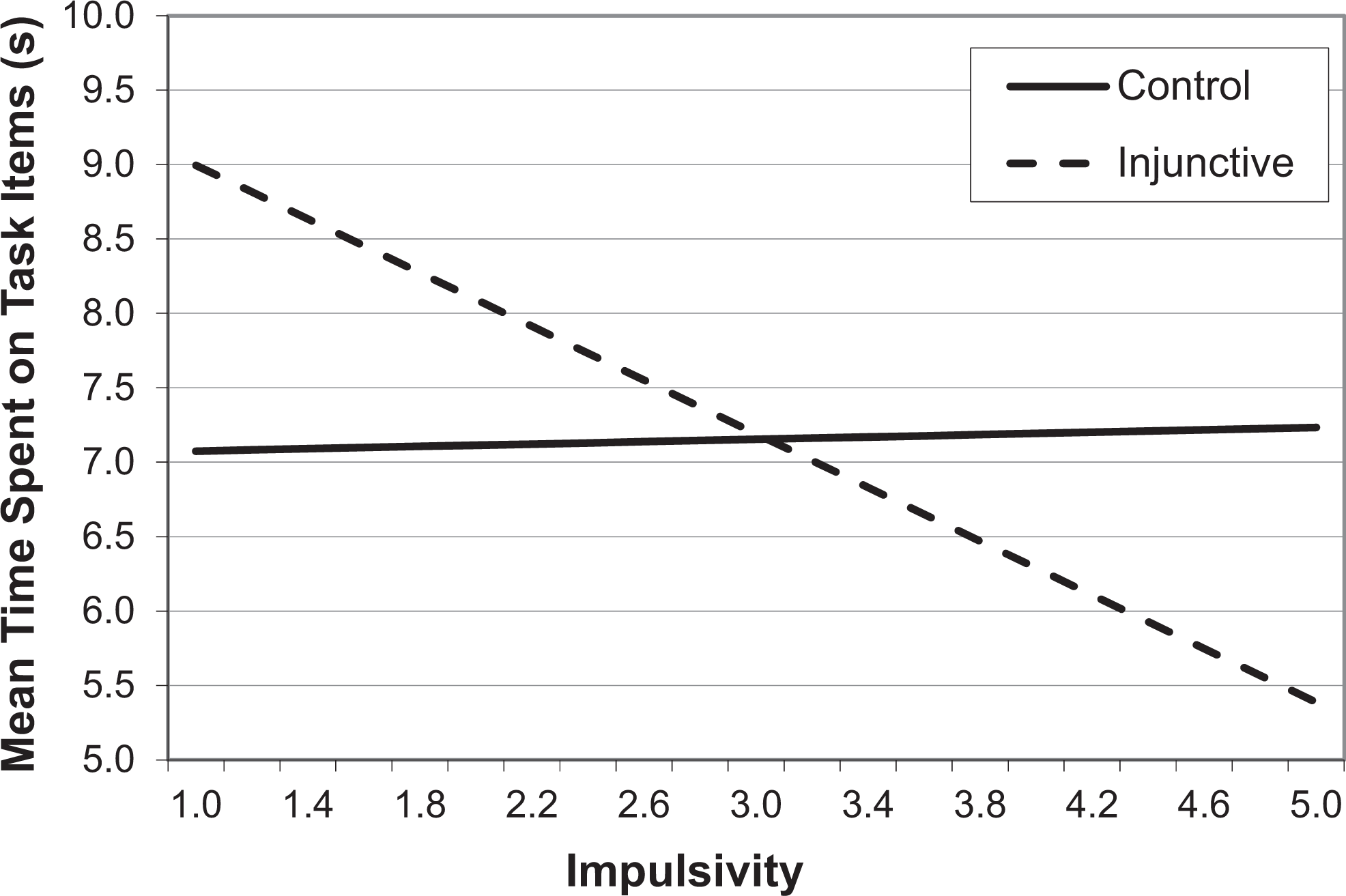
Norm × Impulsivity interaction: Experiment 2.
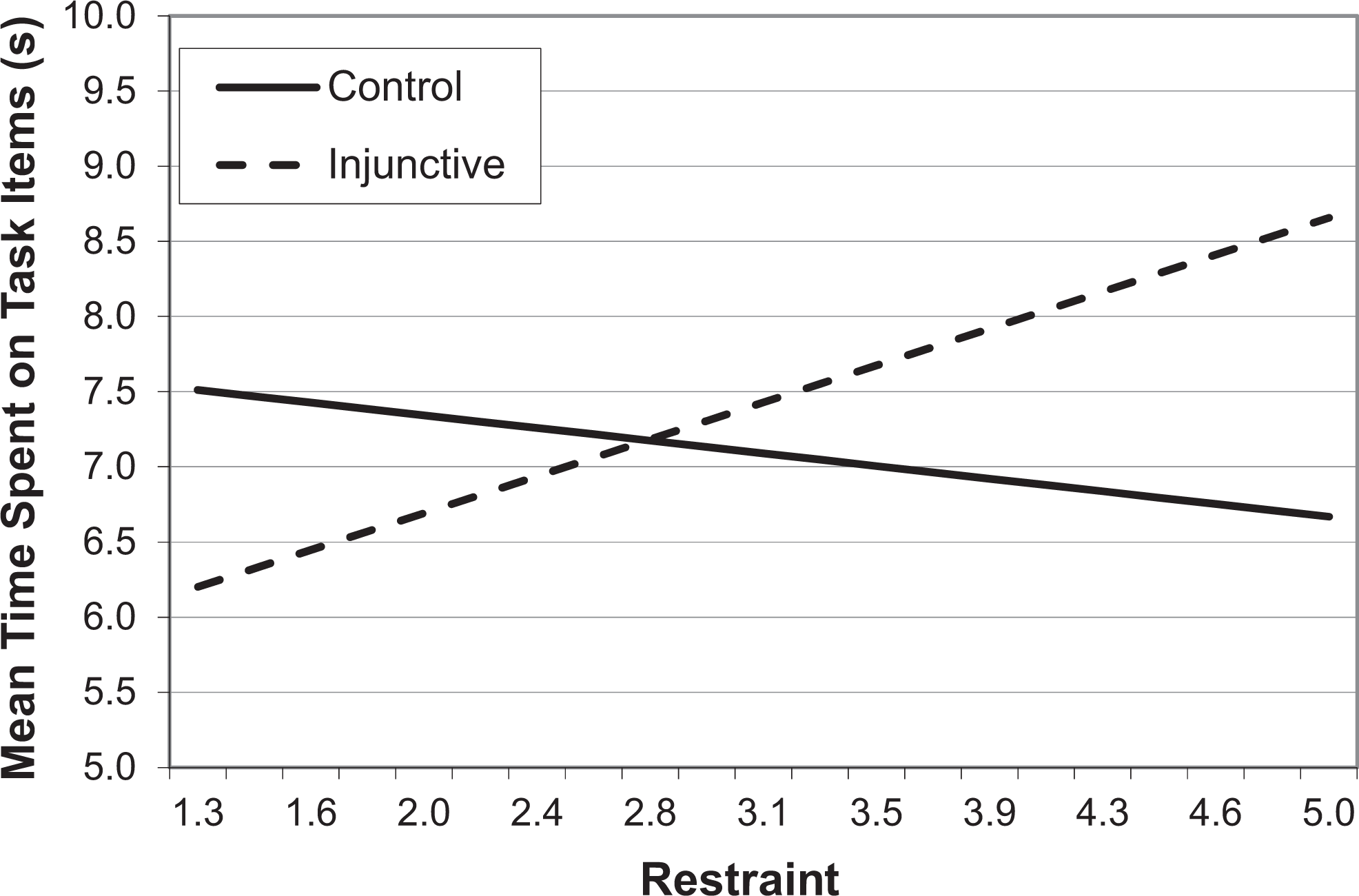
Norm × Restraint interaction: Experiment 2.
The predicted interaction was also significant for the measure of reward motivation (M reward = 3.08, SD = 0.63), B = −14.02, t(106) = −2.25, p = .027 (Figure 5). The simple slope for reward motivation was significant for the injunctive norm, B = −8.98, t(106) = −2.17, p = .033, but not in the control condition (t = 1.08).

Norm × Reward Motivation interaction: Experiment 2.
In addition to enhancing confidence in the generalizability of these effects, these results offer more precise evidence supporting our assertion that impulses to seek immediate rewards reduce the effectiveness of messages framed using injunctive norms. These results also decrease confidence in the possibility that the effects from Experiment 1 were due to descriptive norm framing interfering with the natural roles of impulsivity and restraint in performing an undesirable behavior.
Experiment 3
We examined a third form of behavior in our final experiment—providing job candidate ratings—that we expected would not be relevant to impulsivity or restraint in the absence of an injunctive norm. We have argued that simply making an injunctive norm salient engages a set of unique psychological response tendencies that subsequently affect behavior. However, it is possible that these responses only affect behaviors that naturally require impulse restraint to perform. As we have suggested, one could argue that the behaviors from our first two experiments could be affected by impulsivity or restraint even in the absence of an injunctive norm. Although we did not obtain evidence for this in our first two experiments, it is still possible that these behaviors may be more amenable to the effects of injunctive norm framing than other forms of behavior for which impulse restraint is less commonly required.
Method
Participants
Participants were 182 business undergraduates (87 male, M age = 25.12, SD = 6.36) who participated as part of a course research requirement.
Design, Procedure, and Measures
Participants completed an approximately 30–45 min interactive management simulation in which they were assigned the role of a manager in a fictional manufacturing company. The simulation involved replying to a series of e-mail messages sent by supervisors, subordinates, and colleagues. The purpose of all but the final of these messages was to immerse the participant in their simulated management role. The final message was from a same-status colleague and included the norm manipulation. This message informed the participant that they were to provide hiring recommendations from among a pool of potential applicants for an assembly line position. The message included job applicants’ scores on four criteria, namely, an in-house job aptitude test (the “ZA112”), a human resource (HR) interview, a résumé rating, and a reference check rating.
In the control condition, the message read as follows: “Here’s the applicant data table. You’ll need to rate each of the candidates and forward to Patrick, copying the other production managers.” Two sentences were added in the norm conditions and only the first of these varied between conditions. In the injunctive norm condition, the first additional sentence read as follows: “Most production managers here think you should pretty much ignore everything but the ZA112.” In the descriptive norm condition this first sentence read as follows: “Most production managers here tend to pretty much ignore everything but the ZA112.” Both conditions concluded with the following sentence: “It’s a job aptitude test that was developed in-house based on a set of different vocational skills tests related to productivity on the assembly line.”
The data table was constructed with equivalent mean overall scores across criteria for the four applicants. However, each applicant was assigned the highest score on one of the four evaluation categories (e.g., the first scored highest on the job aptitude test and the second scored highest on the HR interview). Thus, if the participant was to assign equal weights across criteria, suitability ratings for the four job candidates would be equivalent, but if the participant was to emphasize a select criterion, then a specific applicant would clearly stand as most qualified. In this scenario, we focused on ratings for the candidate scoring highest on the job aptitude test, which would be comparatively higher among those influenced by the norm. Participants rated candidate suitability on a 10-point scale. Following the dependent measure, participants completed the same distractor task and then the same measures of impulsivity (α = .62) and restraint (α = .62) as in the first two experiments.
Results and Discussion
We subtracted the mean of the three nonfocal candidate ratings from the focal candidate’s rating to create our dependent measure (higher scores indicate greater normative influence). Supporting predictions, the Norm × Impulsivity (M impulse = 2.21, SD = 0.72) interaction was marginally significant for the injunctive versus descriptive norm contrast, B = .35, t(176) = 1.85, p = .066, and was significant for the control versus injunctive norm contrast, B = .89, t(176) = 2.98, p = .003 (Figure 6). As predicted, the simple slope for the effect of impulsivity was significant for the injunctive norm, B = −.87, t(176) = −2.65, p = .009. The simple slopes for this relationship were not significant for the descriptive norm or the control condition (ts = −.04 and 1.61, respectively). Contrary to predictions, the interaction between norm type and restraint (M restraint = 3.30, SD = 0.80) was not significant for the injunctive versus descriptive norm contrast, B = −.11, t(176) = −.44, p = .662, or for the control versus injunctive norm contrast, B = −.09, t(176) = −.53, p = .592.

Norm × Impulsivity interaction: Experiment 3.
These results add support for our theorized role of impulsivity in people’s responses to influence attempts framed using injunctive norms. Although a very different behavioral context was examined in this study than in Experiment 1 or 2, impulsivity again attenuated the effectiveness of an injunctive norm message. Also as in Experiment 1, impulsivity was unrelated to the effectiveness of the descriptive norm message; and, additionally, as in Experiment 2, impulsivity did not predict responses in the control condition. However, unlike Experiments 1 and 2, restraint did not moderate the effects of the injunctive norm message. This may reflect an important boundary condition on the role of restraint in responding to persuasive messages framed using injunctive norms. Specifically, this experiment investigated a form of behavior for which restraining impulses is not naturally relevant. Demonstrating that, despite this, the trait of impulsivity becomes relevant when the behavior is framed using an injunctive norm provides evidence that this framing effect is relatively robust—at least for the trait of impulsivity. Perhaps the extent to which restraint is engaged by injunctive norm framing is less automatic and involves some degree of controlled cognitive consideration of the relevance of restraint for the behavior advocated by the norm. This represents an interesting question for future research.
General Discussion
The present research examined the moderating roles of impulsivity and restraint in the effects of persuasive messages highlighting injunctive social norms. Across three experiments involving different forms of target behavior, impulsivity attenuated the effectiveness of such messages. Across two of the three experiments, restraint enhanced the effectiveness of these same injunctive norm messages. However, no evidence for these moderating relationships was obtained when requests were framed with descriptive norms or when control conditions were used. These findings support the theory (Jacobson et al., 2011) that injunctive norms are associated with a set of response tendencies that assist in resolving the implicit bargain of social life—the pervasive tension between naturally selfish impulses and more cooperative, group-oriented behaviors that offer significant long-term survival advantages. Consistent with this theory, we suggest that the salience of an injunctive norm frames a behavior as an instance of this implicit bargain—a dual/dueling goal dilemma. This engages cognitive, affective, and self-regulatory responses that help the individual evaluate the behavior’s costs and benefits and tend to encourage group-oriented action.
Past evidence supports this perspective by indicating that salient injunctive norms (a) lead individuals to think about both interpersonal and intrapersonal goals (in contrast with descriptive norms, which tend to activate only intrapersonal goals), (b) stimulate an interpersonally oriented form of self-awareness, (c) lead to decision-making conflict, and (d) become less influential when individuals are depleted of the capacity to exert effortful self-control over behavior (Jacobson et al., 2011). The current research complements these findings and provides additional evidence for this theory. Resolving the perceived dual/dueling goal dilemma activated by injunctive norms requires effortful impulse restraint, which we assert is the reason why ego depletion, high levels of impulsivity, and low levels of restraint tend to reduce the effectiveness of injunctive norm messages.
It is important to note that these results reflect the processes by which norms affect behavior when the norms are made temporarily salient. Nearly any behavior is associated with both injunctive and descriptive norms. For example, while a norm against cheating may have a strong injunctive element (DeBono et al., 2011), it may also have a descriptive component if most people are not cheating. On the other hand, while a norm for politeness may be labeled as descriptive because most people are polite, it also has a prominent injunctive component in that most also approve of politeness. However, according to focus theory, norms affect behavior only when salient. Thus, although some past research (DeBono et al., 2011) has indicated that, in the absence of normative framing, self-control tends to facilitate adherence to behaviors commonly associated with social norms, our research demonstrates that relatively subtle manipulations of norm salience can alter the extent to which impulsivity and restraint affect the individual’s performance of the behavior.
The present research has applied implications for large-scale social norms marketing interventions designed to encourage socially desirable behavior as well as for using norms to influence others in everyday social environments like the modern workplace. Results indicate that injunctive norms may be particularly influential when directed toward individuals with low levels of impulsivity or high levels of restraint. Thus, emphasizing injunctive norms in intervention-based messages or interpersonal communications may yield especially strong results when delivered to individuals who display a capacity for delaying gratification, inhibiting inappropriate behavior, and considering the future consequences of their actions.
These results also support a dual-systems perspective on self-control (see Carver, 2005) in which impulsivity and restraint are viewed as somewhat independent tendencies affecting self-regulatory performance. Impulsivity attenuated the effects of injunctive norms even when controlling for levels of restraint and restraint enhanced the norm’s effects even when controlling for levels of impulsivity. Finally, these studies provide further support for Cialdini and colleagues’ focus theory of normative conduct (see Cialdini, 2012) and highlight the potential value of examining other dispositional moderators of normative social influence as a way of clarifying the unique processes underlying the effects of injunctive and descriptive norms.
Footnotes
Declaration of Conflicting Interests
The author(s) declared no potential conflicts of interest with respect to the research, authorship, and/or publication of this article.
Funding
The author(s) received no financial support for the research, authorship, and/or publication of this article.