



Abstract
Social power elicits an array of psychological tendencies that likely impact processes related to the fundamental need for belonging—including how people respond to social rejection. Across three studies, using multiple methods and instantiations of power and rejection, we hypothesized that power buffers people from the typically adverse emotional and self-esteem consequences of rejection. Supporting this, power buffered participants from increases in negative emotion and/or decreases in self-esteem in response to rejection from a romantic partner (Study 1), an anticipated interaction partner (Study 2), and a hypothetical coworker (Study 3). These findings document a direct link between power and emotional and self-esteem reactions to rejection.
Keywords
Imagine Jane being excluded from a social gathering at work. Is Jane awash in negative emotion? Her self-esteem bruised? What if you learned Jane was the CEO of her company or a low-level employee? Research indicates that social power—the ability to control the resources and outcomes of others (Keltner, Gruenfeld, & Anderson, 2003)—profoundly shapes affect, cognition, and behavior (Galinsky, Rucker, & Magee, 2013), but little work has examined power’s effects on responses to rejection. The current research sought to fill this gap, thereby bridging the power and belonging literatures.
Belonging Needs
Humans possess a fundamental need to belong (Baumeister & Leary, 1995). To regulate this need, people seek out acceptance and are attuned to signs of rejection (Gardner, Pickett, & Brewer, 2000; Maner, DeWall, Baumeister, & Schaller, 2007). This makes sense given the perils of rejection, including negative emotionality and drops in self-esteem (e.g., Leary, 1990), and psychological and neural experiences akin to physical pain (Eisenberger, Lieberman, & Williams, 2003).
Previously documented moderators of responses to rejection include self-esteem (Nezlek, Kowalski, Leary, Blevins, & Holgate, 2007) and rejection sensitivity (Downey & Feldman, 1996). We propose that the power people hold relative to others is another critical moderator, such that higher power buffers people from some negative consequences of rejection—namely, increased negative emotion and reduced self-esteem (e.g., Leary, 1990).
Social Power and Responses to Rejection
High power affords greater resource access and the freedom to pursue rewards, leaving the powerful relatively independent from lower power others. Low power, in contrast, restricts resource access and constrains environments, making low-power people dependent on higher power others (Emerson, 1962; Keltner et al., 2003; Magee & Smith, 2013). Such asymmetric dependence elicits psychological and behavioral differences between the powerful and the powerless that likely bear on how people respond to rejection.
Specifically, compared to lower power individuals, higher power individuals focus more on rewards and less on threats (Galinsky, Gruenfeld, & Magee, 2003). As rejection constitutes a social threat, the powerful should be less attuned to, and therefore less negatively impacted by, rejection. Higher power individuals also tend to experience more positive affect (Langner & Keltner, 2008). Positive affect buffers threats and increases resilience (Cohn, Fredrickson, Brown, Mikels, & Conway, 2009)—once again suggesting that power may buffer rejection’s negative effects. Power also breeds greater social distance (Magee & Smith, 2013), suggesting that the effects of rejection should be attenuated for higher power individuals, given that affective reactivity to distant compared to near objects is diminished (Trope & Liberman, 2010).
Some evidence supports a buffering role for power. Power shields people from stress in a Trier social stress situation where unfavorable evaluation is possible (Carney et al., 2012). Power also attenuates the impact of threatening social comparisons (Johnson & Lammers, 2012) and derogatory ingroup labels (Galinsky et al., 2013). Especially pertinent, power motivates social connection seeking after rejection (Narayanan, Tai, & Kinias, 2013), demonstrating another manifestation of power’s buffering role.
Overall, then, power differences give rise to psychological differences that likely bear on rejection responding. The present three studies bridge the power and belonging literatures by testing the direct link between power and rejection.
The Present Studies
Study 1, a daily diary study, tested whether relative power in a romantic relationship buffers against negative emotional responses to perceived partner hostility. In Study 2, participants assigned to a high- or low-power role received accepting or rejecting feedback and indicated their emotional and self-esteem reactions. In Study 3, we manipulated power and measured emotions and self-esteem following a hypothetical rejection experience.
Because power is defined by asymmetric dependence between two parties (Emerson, 1962; Magee & Smith, 2013), across studies, we deliberately created dyadic-power structures composed of high- and low-power roles and examined responses to rejection from opposite-power counterparts (i.e., within the same asymmetric-power relationship). We also note that, theoretically speaking, our effects could be conceptualized as high power buffering rejection responses, low power amplifying responses, or both. Study 3 included equal-power conditions, allowing an initial look at the locus of our effects. In the literature reviewed earlier, three studies included a control condition (Galinsky et al., 2003, Study 3; Johnson & Lammers, 2012, Study 3; Narayanan et al., 2013, Study 1). Each found that high-power participants differed from both low-power participants and control participants, who did not differ from one another. Thus, we tentatively couch our predictions and findings in terms of high power buffering responses to rejection.
Study 1
Daily for 2 weeks, Study 1 participants reported on their power within their romantic relationship, perceived partner hostility, and negative emotion. Romantic relationships can fulfill belonging needs but also come with potential rejection (Murray, Holmes, & Collins, 2006). Perceptions of partner hostility served as a proxy for rejection, as such hostility connotes rejection (Murray, 2005). We expected greater relative power to buffer participants from negative emotion in response to partner hostility.
Method
Participants and Procedure
Seventy-eight (65 female) individuals in romantic relationships (average length = 20 months) from psychology courses at a West Coast university participated for course credit. As part of a larger study, participants completed background measures online, and then filled out the same online survey for 14 consecutive nights. To ensure diaries captured the entire day’s experience and were completed that evening, diaries completed before 6 p.m. or after 6 a.m. were excluded (results held including these 59 entries). Three participants were excluded for only completing one diary. Of included participants, 57% completed all diaries on time. Our final sample contained 908 diaries, averaging 12.1 per person.
Daily Measures
Perceived power
Two items indexed perceived power in the relationship: “Who had more power in your relationship today?” and “Who made more of the decisions in your relationship today?” using a 100-point sliding scale (1 = My partner did, 50 = Both of us equally, 100 = I did; average within-day α = .81, range = .75–.87).
Perceived partner hostility
The item “My partner behaved and felt in hostile ways towards me” indexed perceived rejection (1 = Not true at all; 5 = Very true).
Negative emotion
A negative emotion index was created by averaging participant reports of feeling “angry,” “anxious,” “sad,” and “ashamed” (embedded among 19 filler items) on a scale from 1 (Not at all) to 5 (A lot); average within-day α = .76, α range = .67–.85.
Results and Discussion
The data, consisting of up to 14 data points nested within each individual, were analyzed using a two-level Hierarchical Linear Model (HLMwin v.6.04; Raudenbush, Bryk, Cheong, Congdon, & du Toit, 2004). Level-1 intercepts were allowed to vary at Level 2. Power and partner hostility were person-centered, thus testing within-person changes relative to each person’s own average (i.e., the effects of feeling more powerful, and seeing more partner hostility, than one usually does). Table 1 contains meta-analytic correlations between measures.
Study 1 Meta-Analytic Correlations Across 14 Days.
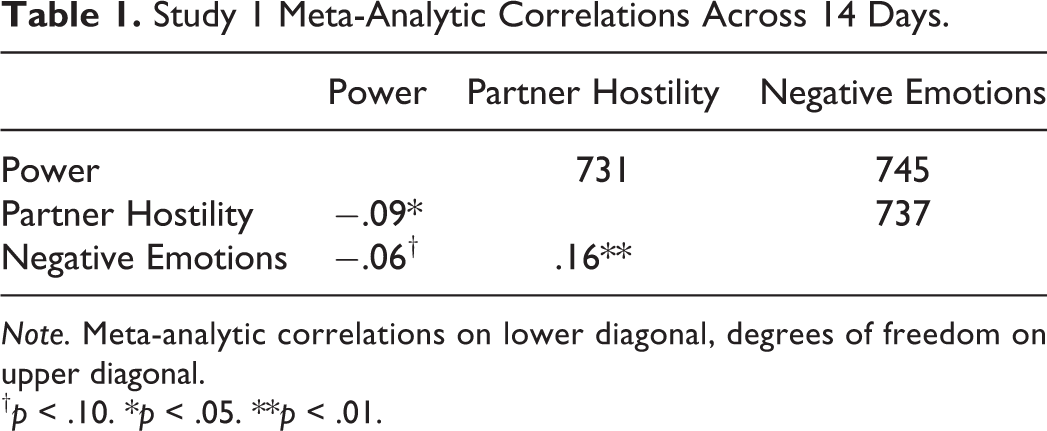
Note. Meta-analytic correlations on lower diagonal, degrees of freedom on upper diagonal.
† p < .10. *p < .05. **p < .01.
To test our hypothesis, we regressed negative emotion onto power, partner hostility, and their interaction. Participants reported less negative emotion on days when they felt more powerful relative to their own average, b = −.03, t(799) = −1.69, p = .09, but more negative emotion when they perceived their partners to be more hostile than typical, b = .15, t(799) = 6.12, p < .001. 1 These effects were qualified by the predicted interaction, b = −.05, t(799) = −2.13, p = .03 (see Figure 1). On days when participants perceived their partners as more hostile than usual (+1SD, i.e., as rejecting), participants reported less negative emotion the more powerful they felt, b = −.09, t(799) = −2.94, p < .01. But when participants perceived their partners as less hostile than usual (−1SD, i.e., as accepting), power and negative emotion were unrelated, b = .01, t < 1. Thus, feeling more powerful relative to a romantic partner buffered people from responding to their partner’s hostility with negative emotion.
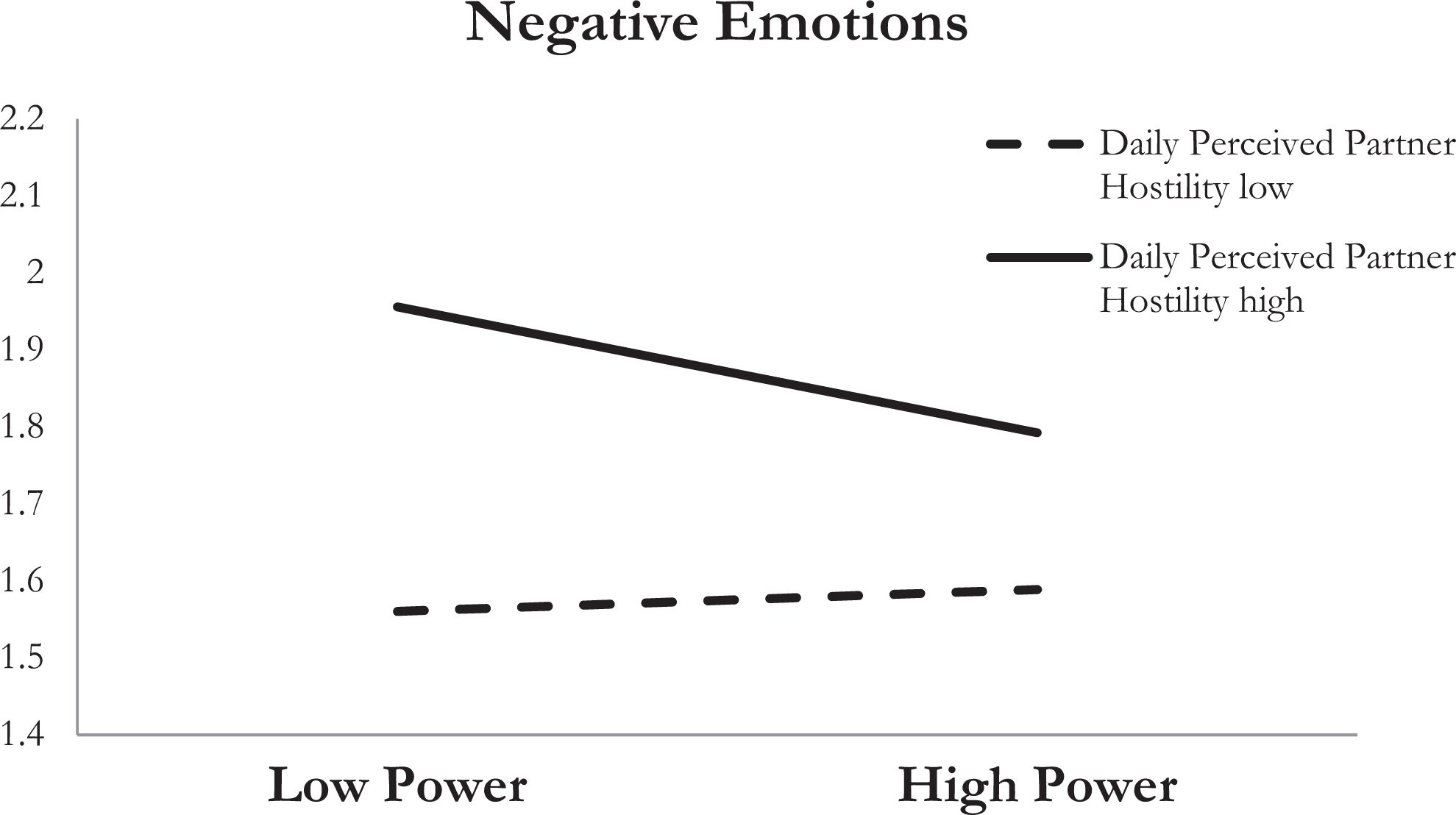
Negative emotion based on daily perceived power and hostility in Study 1. Power and hostility are graphed at ±1 SD.
Study 2
Study 2 participants were placed in a high- or low-power role vis-à-vis an alleged other participant, received rejecting or accepting feedback, and then reported their state emotion and self-esteem. We expected low- but not high-power participants to exhibit greater negative emotion and lower self-esteem after receiving rejecting relative to accepting feedback.
Method
Participants
One hundred thirteen participants (57 female) from psychology courses at a West Coast university participated for course credit.
Procedure
Participants were led to believe they would have an interaction with a gender-matched partner, solving brainteasers together, in the role of either a boss (high power) or an employee (low power). There was no actual partner—all materials from the partner were predetermined.
Power manipulation
Participants were randomly assigned to the high- or low-power role, while their partner was assigned to the other role (see, e.g., Anderson & Berdahl, 2002). The boss role entailed directing the employee, selecting the answers to submit, and dividing up a candy reward after the task. The employee role complemented the boss role. Participants were then given a survey with a column of questions for each role and filled out the column matching their role. Each column asked participants to list a time they were in a similar role, and then indicate how they would divide (high power) or anticipate the boss dividing (low power) the candy reward, and how much they would be making the decisions in the upcoming task (1 = Not at all, 5 = Very much).
Personal information exchange
Participants were next told that before meeting their partner, they would exchange a few surveys to collect unbiased partner impressions. Participants completed a BioSketch, indicating their personal interests, and received a BioSketch ostensibly from their partner.
Rejection/acceptance manipulation
Participants were then asked to fill out a Pre-Task Survey (which their partner would see), which included three questions about working with the partner. These 3 items, which served as our means of delivering rejecting versus accepting feedback, were “Based on the BioSketches that you exchanged, how well do you think you will work together with the other participant on this task?”; “How much are you looking forward to working with the other participant on this task?”; and “Overall, how much do you want to work with the other participant on this team task?” (−4 = Not at all, +4 = Extremely). After participants finished the survey, the experimenter brought it next door.
The experimenter (blind to feedback condition) then returned with the partner’s supposed pre-survey, which was either mildly rejecting or accepting. Specifically, the relevant 3 items were respectively answered with +2, +1, and +1 in the accepting condition, and 0, −1, and 0 in the rejecting condition. We used non-extreme ratings because mildly rejecting and accepting feedback resembles the interpersonal feedback people typically get (e.g., Leary, Haupt, Strausser, & Chokel, 1998). In a pilot sample (N = 20), on a 1 (Extremely rejecting) to 7 (Extremely accepting) scale, the rejecting survey was seen as more rejecting (M = 3.00, SD = 0.54) than the accepting survey (M = 4.67, SD = 0.89), t(18) = 4.74, p < .001.
Note that before receiving their partner’s pre-survey, participants filled out the pre-survey themselves, thus indicating their interest in working together. Because this interest could influence reactions to partner feedback—although it was not moderated by power, feedback, or their interaction, ps > .16—we used average scores on these items as a covariate, α = .85.
Dependent measures
After delivering the manipulated pre-survey, experimenters handed participants a packet of “personality measures” (actually emotion and self-esteem measures) and a Post-Task Survey. The experimenter explained that although the Post-Task Survey was intended for after the task, for expediency, part of it—about partner impressions just before meeting—could be completed now. The remaining questions, about reactions after the task, bolstered the cover story and were never completed.
Emotion and self-esteem measures
The Positive and Negative Affect Schedule (PANAS; Watson, Clark, & Tellegen, 1988; 1 = Very slightly or not at all, 5 = Extremely) assessed emotional reactions. We averaged responses to the 10 negative emotion items (α = .73). Next, participants completed a state version of the Rosenberg Self-Esteem Scale (1 = Disagree strongly, 4 = Agree strongly; α = .87; Rosenberg, 1965).
Rejection/acceptance manipulation check
Two Post-Task Survey items asked how much participants thought their partner was looking forward to working with them and would like them (−4 = Not at all, +4 = Very much; α = .75).
Suspicion probe and debriefing
At this point, the experimenter announced participants were in a control condition in which partners never actually meet. Participants completed demographic and suspicion items before being debriefed.
Results and Discussion
Sixteen participants expressed suspicion, but results were similar excluding them, so they were retained. Seven participants who filled out the role survey incorrectly, and one who was a former research assistant, were excluded (remaining N = 105, 23–29 per condition).
Manipulation Checks
High-power participants indicated they would be making decisions more (M = 3.74, SD = 0.64) than low-power participants (M = 2.32, SD = 0.84), F(1, 100) = 99.66, p < .001,
Dependent Measures
Negative-emotion and self-esteem scores were submitted to 2 (power: high vs. low) × 2 (feedback: accept vs. reject) analyses of covariance (ANCOVAs), with interest in working with the partner as a covariate. 2
Negative emotion
Neither main effect was significant, Fs < 2.47, ps > .12,
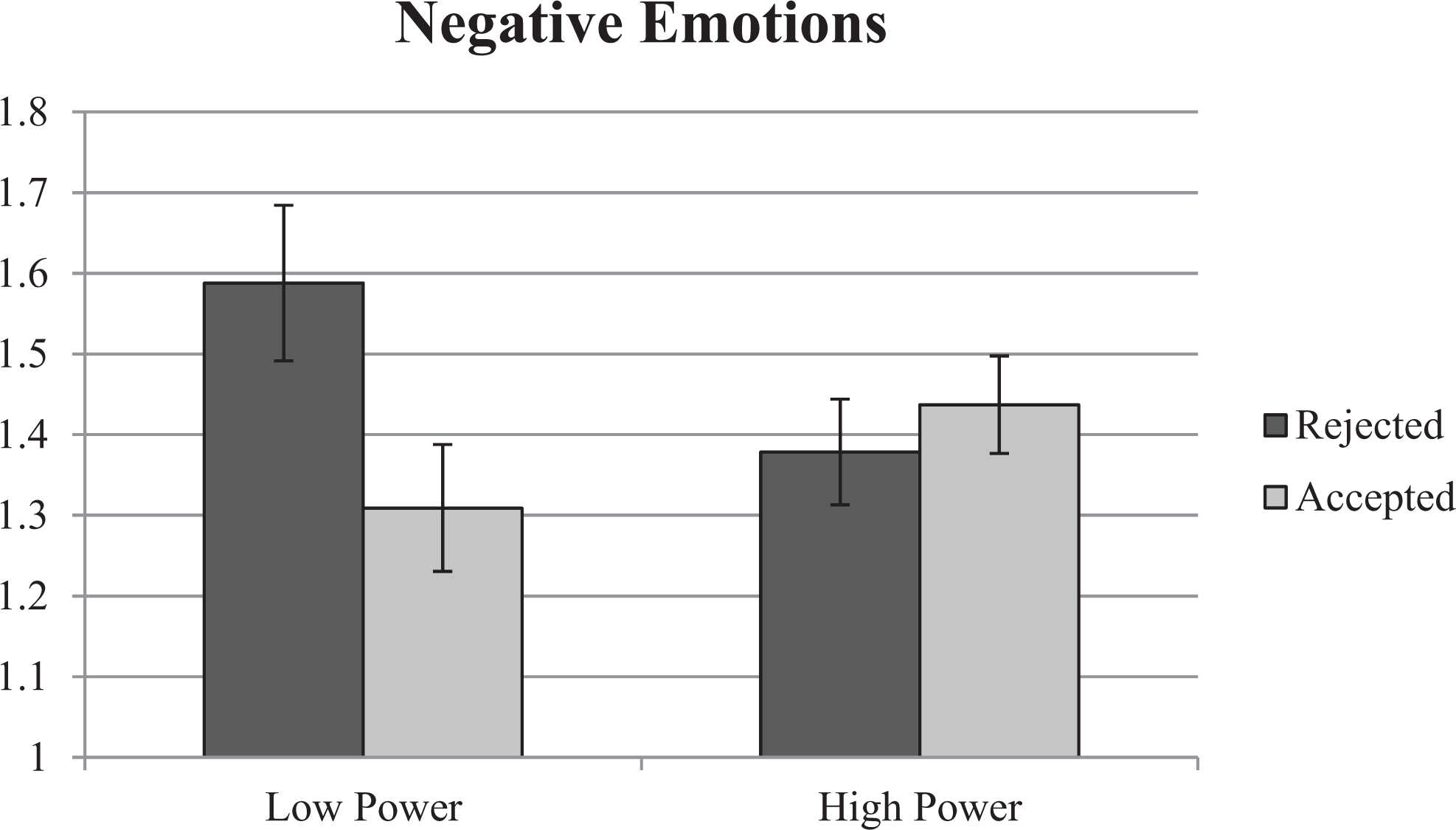
Positive and Negative Affect Schedule (PANAS) negative emotion by feedback type and power role in Study 2. Error bars indicate ±1 standard error.
Self-esteem
There was no power effect, F(1, 99) = 1.32, p = .25,
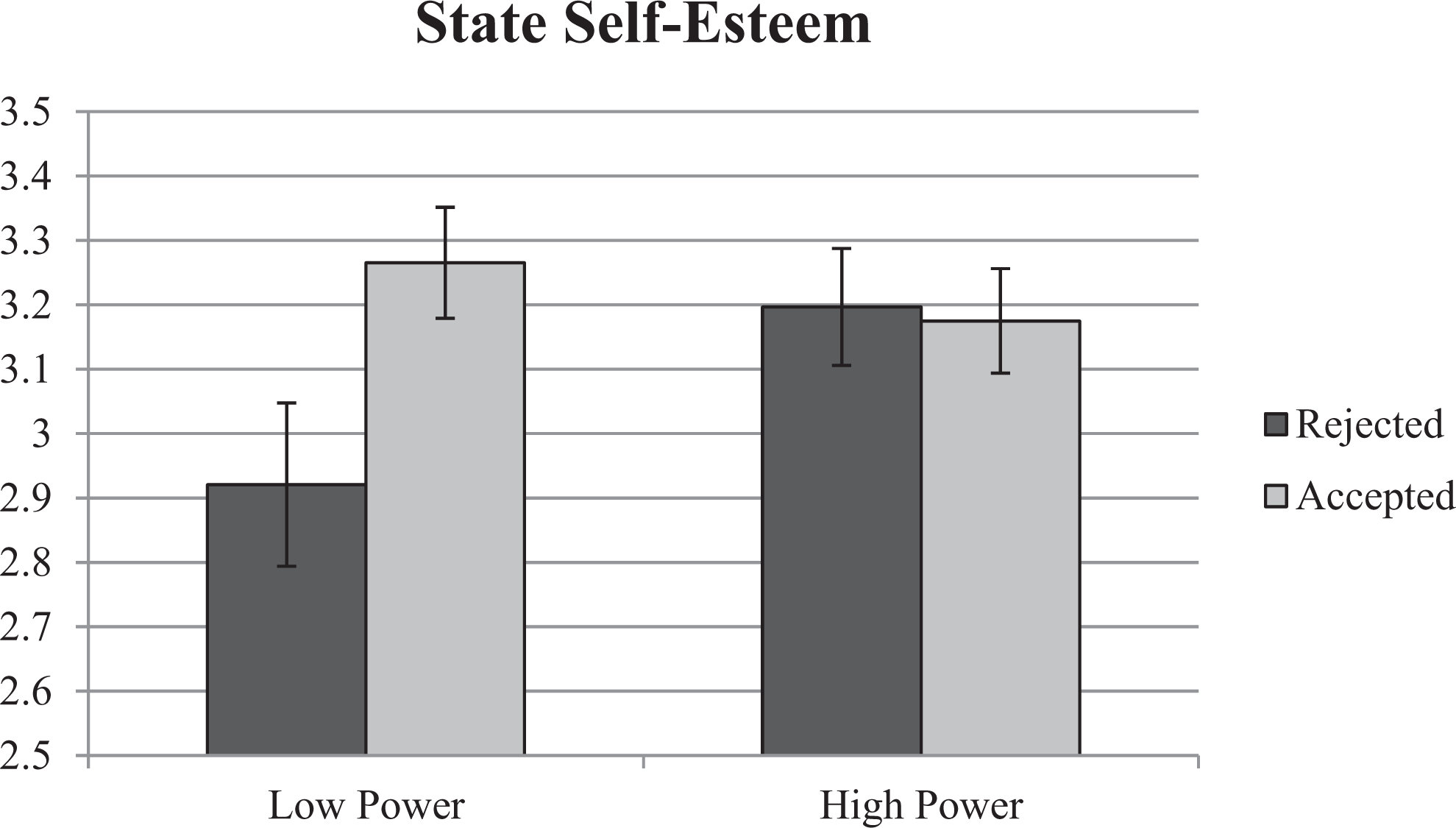
State self-esteem based on feedback type and power role in Study 2. Error bars indicate ±1 standard error.
In sum, high-power participants compared to low-power participants exhibited attenuated negative emotion and self-esteem responses to rejection relative to acceptance, conceptually replicating Study 1.
Study 3
Study 3 participants imagined being rejected by a coworker while in a high- or low-power workplace role. The power of the rejecter was also varied, producing a 2 (participant power: high vs. low) × 2 (rejecter power: high vs. low) design with high- and low-power participants being rejected by high- or low-power coworkers. Thus, two conditions involved traditional power dyads (with one high-power member and one low-power member), whereas the other two were equal in power (high-power participants with a high-power coworker, and low-power participants with a low-power coworker).
Including equal-power dyads allowed an initial examination of the locus of our effects. Although different from many control conditions in the power literature (which tend to be irrelevant to power, e.g., recalling the previous day; Galinsky et al., 2003), we designed our control dyads to be matched on power and embedded in the same workplace context as our high- and low-power conditions, thereby providing a particularly clean test of the locus of our effects.
We hypothesized that, relative to low-power participants rejected by high-power counterparts, high-power participants rejected by low-power counterparts would be buffered from the negative emotional and self-esteem effects of rejection, conceptually replicating the findings in the rejection conditions of Studies 1 and 2. The two equal-power conditions lacked the asymmetric dependence that defines power; thus, we did not expect to see buffering in these conditions. But should the equal-power conditions resemble the low- or high-power condition? Thus far, we have couched things in terms of power buffering rejection responses, suggesting that low- and equal-power participants should respond similarly to rejection. But lower power relative to a rejecter could theoretically amplify responses to rejection, relative to an equal-power rejection. If higher power buffers and lower power amplifies rejection responses, then low-power participants should be most upset by rejection (e.g., highest negative emotion), equal-power participants less upset, and high-power participants the least upset (e.g., lowest negative emotion). We tested this linear trend, and whether the low- and high-power conditions differed from the equal-power conditions.
Method
Participants and Procedure
One hundred and nine participants (70 female), aged 18 to 82 (M = 36.5), were recruited and paid via Mechanical Turk.
Baseline measures
First, participants completed baseline and demographic measures. No condition differences emerged on mood (Self-Assessment Manikin; Bradley & Lang, 1994); trait self-esteem (Single Item Self-Esteem Scale; Robins, Hendin, & Trzesniewski, 2001); or trait power (Personal Sense of Power Scale; Anderson, John, & Keltner, 2012).
Power manipulation
Participants next read a scenario asking them to visualize themselves in either a high-power or a low-power role at a company. High-power participants imagined being a high-ranking employee, without many employees who ranked above them, and with subordinates whom they evaluate. Low-power participants imagined being a low-ranking employee, without many employees below them, and with a supervisor who evaluates them.
The scenario then explained that coworkers from all ranks often socialize at post-work happy hours. Participants read that typically, when they are invited, they enjoy going, but that today, they found out that there was a happy hour to which they were not invited. In the high-power role/low-power rejecter condition (hereafter called the “high-power” condition), a low-power coworker planned the happy hour, and most other high-ranking people were invited. In the low-power role/high-power rejecter condition (hereafter the “low-power” condition), a high-power coworker planned the happy hour, and most other low-ranking people were invited. In the remaining conditions, a coworker of equal power to the participant planned the happy hour, and most same-ranking people were invited. Thus, participants were always excluded, and this exclusion occurred either within a power dyad or within an equal-power relationship.
After reading the scenario, participants indicated their rank at the company (1 = Extremely low-ranking, 3 = Somewhere in the middle of the hierarchy, 5 = Extremely high-ranking) and who excluded them from the happy hour (a supervisor, a subordinate, or someone of equal rank as you).
Dependent Measures
Self-esteem and emotion
Participants rated their responses to being excluded on state versions of the 10-item Rosenberg (1965) Self-Esteem Scale (1 = Strongly disagree, 4 = Strongly agree; α = .91) and the PANAS (Watson et al., 1988; 1 = Very unlikely, 5 = Very likely; negative emotion α = .89).
Investment
Finally, participants reported how much they would care about being excluded from happy hour (1 = Not at all, 5 = Very much).
Results and Discussion
Ten participants were excluded for poor attention (e.g., didn’t correctly identify their rejecter). In our remaining sample (N = 99), high-power role participants reported having a higher rank (M = 4.22, SD = .63) than low-power role participants (M = 1.62, SD = .77), F(1, 95) = 318.02, p < .001,
Dependent Measures
Our two equal-power conditions did not differ on any dependent variable, all Fs < 1, ps > .34, all

Negative emotion and state self-esteem following rejection based on power condition in Study 3. Error bars indicate ±1 standard error.
Means and Analyses, Study 3.

Note. ANOVA = analysis of variance; SD = standard deviation. Means with a common subscript within a row do not differ from one another, ps ≤ .054
aWithin-groups dfs = 95.
Negative emotion and self-esteem
Negative emotion significantly declined with increasing power. The low-power condition differed from the equal-power condition, t(55) = 2.45, p = .02, d = .60, but the high-power condition did not, t < 1, d = .12. Self-esteem significantly increased with increasing relative power. The high-power condition was marginally different from the equal-power condition, t(60) = 1.97, p = .054, d = .47, but the low-power condition was not, t < 1, d = .15.
Investment
Could these effects be due to high-power participants not caring about being rejected by a subordinate? Unlikely, as the linear trend on ratings of how much participants would care about being excluded was not significant, high-power M = 3.32, SD = 1.10; equal-power M = 3.57, SD = 1.19; low-power M = 3.71, SD = 1.04; F(1, 96) = 1.53, p = .22,
Overall, rejection elicited less negative emotion and drops in self-esteem as participants visualized having increasing power relative to a rejecter. That high- and low-power participants did not differ when rejected by a same-power other suggests that power’s effects on rejection responding emerge specifically under asymmetric dependence. Finally, the equal-power conditions fell in between the power-dyad conditions and did not consistently differ from one power condition, tentatively suggesting that our effects are due to both higher power buffering, and lower power amplifying, reactions to rejection.
General Discussion
Using multiple methods and instantiations of power and rejection, we found higher relative power buffered people from the adverse emotional and self-esteem effects of rejection. These findings are among the first to document power’s effects on responses to rejection (see also Narayanan et al., 2013). They also illuminate some of the interpersonal consequences of power, rather than its more intrapersonal effects, which have been emphasized in the power literature. Study 1, in particular, adds to the budding literature on power in close relationships (Simpson, Farrell, Orina, & Rothman, 2014) by documenting how power relative to a romantic partner shapes rejection responses in relationships. The present results also solidify power as a moderator of rejection responses, moving beyond individual difference (e.g., Downey & Feldman, 1996) and interpersonal moderators of rejection responding (e.g., Maner et al., 2007). More broadly, our findings raise new questions, such as whether the relationship between power and rejection is cyclical—such that resilience to rejection helps one gain power—and whether people chronically attuned to rejection would be buffered in a high-power role.
We deliberately had low- and high-power counterparts face rejection from one another. Without asymmetric dependence, we did not expect power to impact responses in the same manner. Indeed, high- and low-power participants in Study 3’s equal-power conditions responded to rejection identically, suggesting that power relative to a counterpart is key to our effects. Relatedly, our effects may not emerge in contexts external to one’s power, such as the context of a workplace power-holder’s marriage. Of course, abundant evidence indicates that power can be primed as a mindset (e.g., Chen, Lee-Chai, & Bargh, 2001), independent of context. But because we were testing power’s effects on responses to rejection—an utterly interpersonal experience—we examined two parties holding asymmetric power.
As noted earlier, we framed our predictions and effects as high power buffering, rather than low-power amplifying, responses to rejection, given suggestive findings in the literature. Studies 1 and 2 lacked the controls needed to test these alternatives. Study 3 had the necessary controls but yielded mixed results (low power drove negative emotion, high-power drove self-esteem), allowing only the tentative suggestion that our phenomenon is due partly to higher power buffering, and partly to lower power amplifying, responses to rejection. More research is clearly needed. Indeed, broader implications may hinge on this issue. For instance, should workplaces be mindful of rejection vulnerability in lower power positions, structuring interactions between bosses and employees accordingly? Or should the focus be on the powerful being shielded from the blows of social life? More broadly, the literature would benefit from including more equal-power control conditions to test the locus of power’s effects.
Regarding limitations, our buffering hypothesis was derived from research linking power to psychological tendencies (e.g., positive emotion, social distance; Langner & Keltner, 2008; Magee & Smith, 2013) that likely attenuate the impact of rejection (e.g., Cohn et al., 2009; Trope & Liberman, 2010), but we did not measure these potential mediators, with the possible exception of positive emotion. Positive emotion-like or emotion items were included but varied across studies, and effects were inconsistent. In Studies 1 and 2, the crucial interaction between power and rejection did not emerge for positive emotion (Study 1 [happy, content] interaction p = .18; Study 2 [PANAS positive, α = .88] ANCOVA interaction p = .38). In contrast, in Study 3, positive emotions (excited, strong, alert, determined, attentive, active, hopeful; α = .83) increased linearly, complementing the pattern for negative emotion, F(1, 93) = 5.94, p = .017,
Thus, research examining the mechanisms underlying our effects is needed. For instance, as power increases optimism (Anderson & Galinsky, 2006), and optimism fosters adaptive attributions for negative events (Buchanan & Seligman, 1995), the powerful may explain rejection in more self-protective ways. Distance may also matter, as the powerful experience greater social distance (Magee & Smith, 2013), and distant events have less emotional impact than near events (Trope & Liberman, 2010). Relatedly, the higher construal level power fosters (Smith & Trope, 2006) may lead the powerful to abstractly construe rejection, thus reducing its emotional impact (e.g., Kross, Ayduk, & Mischel, 2005). Overall, the current findings clearly demonstrate that power shapes belonging-related regulation.
Footnotes
Acknowledgments
We thank Michael Kraus, Anna Luerssen, Danny Heller, the Self, Identity, and Relationships Lab, Leena Bui, Sophia Noor, Aubrey Toole, Polly Chen, and Jessica Berrie.
Declaration of Conflicting Interests
The author(s) declared no potential conflicts of interest with respect to the research, authorship, and/or publication of this article.
Funding
The author(s) received no financial support for the research, authorship, and/or publication of this article.