



Abstract
This research investigated age differences in use and effectiveness of situation selection and situation modification for emotion regulation. Socioemotional selectivity theory suggests stronger emotional well-being goals in older age; emotion regulation may support this goal. Younger and older adults assigned to an emotion regulation or “just view” condition first freely chose to engage with negative, neutral, or positive material (situation selection), then chose to view or skip negative and positive material (situation modification), rating affect after each experience. In both tasks, older adults in both goal conditions demonstrated pro-hedonic emotion regulation, spending less time with negative material compared to younger adults. Younger adults in the regulate condition also engaged in pro-hedonic situation selection, but not modification. Although situation selection was related to affect, modification of negative material was not. This research supports more frequent pro-hedonic motivation in older age, as well as age differences in use of early stage emotion regulation.
This research addressed the question of how older adults are able to maintain relatively high levels of emotional well-being in the face of cognitive and physical declines (see Isaacowitz & Livingstone, 2014). One possible explanation is that emotion regulation skills remain intact with age. On one hand, socioemotional selectivity theory (SST) suggests that older adults prioritize pro-hedonic emotional goals to a greater extent than younger adults (Carstensen, Isaacowitz, & Charles, 1999). On the other hand, theories of aging and emotion regulation suggest that successful emotion regulation in later life requires shifts in strategy use. Specifically, by regulating the situation, older adults can avoid relying on declining cognitive and physical resources that other strategies require (Urry & Gross, 2010). We therefore examined age differences in situation selection—choosing to enter or avoid a situation—and situation modification—changing the situation—as means of regulating emotions.
Motivation to Regulate in Older Adulthood
Although emotional well-being is important for people of all ages (Riediger, Schmiedek, Wagner, & Lindenberger, 2009), SST suggests that younger adults also value future-oriented knowledge and experience acquisition goals, which can result in greater exposure to negative affect (Carstensen et al., 1999). In contrast, older adults, whose experience is greater and future is more limited, focus on enhancing present well-being. In other words, whereas younger adults might be willing to experience negative affect for the sake of pursuing other, nonhedonic goals (Riediger et al., 2009), SST suggests that the goal of maintaining emotional well-being is chronically activated among older adults (Mather & Carstensen, 2005).
One goal of the current research was to disentangle the effects of age and goal on emotion regulation use. If older adults have chronically activated emotion regulation goals, their default behavior should be to avoid negative emotions and pursue positive ones. In contrast, younger adults should prioritize emotion regulation in only some circumstances. To test this, we experimentally manipulated the presence of emotion regulation goals and examined the extent to which younger and older adults engaged in pro-hedonic emotion regulation behavior.
Emotion Regulation Strategies in Older Adulthood
The process model of emotion regulation suggests that antecedent-focused strategies—those that are implemented before the full-blown emotion occurs—are generally more effective because they allow for early intervention in the emotion-generative process (Gross, 1998). Such antecedent strategies include situation selection, in which a person chooses to enter into or avoid a situation, and situation modification, in which a person actively changes the situation in order to influence emotions. The Selection, Optimization, and Compensation theory of Emotion Regulation (SOC-ER) suggests that the advantage of antecedent-focused strategies may be even greater for older adults (Urry & Gross, 2010). First, they allow older adults to avoid intense emotional experiences altogether, which is central to maintaining emotional well-being in older age (see also Charles, 2010). Second, compared to later strategies like reappraisal, they demand fewer cognitive resources, which decline with age, and therefore may be less likely to show age-related declines in effectiveness (see Urry & Gross, 2010).
Most research on emotion regulation derived from the process model has focused on later stages in the emotion generative cycle (see Webb, Miles, & Sheeran, 2012). As a result, we know less about age differences in early process emotion regulation. One previous study of situation selection showed that overall, younger and older adults chose similar amounts of positive and negative stimuli, but that older adults with strong emotion regulation self-efficacy beliefs chose fewer negative items (Rovenpor, Skogsberg, & Isaacowitz, 2013). This study did not examine goals within the situation, so could not draw conclusions about whether goals were motivating situation selection use. Because a key tenet of SST is that that older adults prioritize pro-hedonic goals to a greater extent than younger adults, it is important to understand how age differences in motivation contribute to use of this strategy. Another study showed no age differences in how selections influenced affect (Isaacowitz, Livingstone, Harris, & Marcotte, 2015).
One study of situation regulation in younger adults found that they were more likely to end the viewing period when they were upset by negative images (Vujovic, Opitz, Birk, & Urry, 2014). However, the button pressing paradigm did not clearly distinguish situation selection from modification: Participants changed their situation by taking specific action in their broader situation of viewing images (situation modification), but also attempted to “leave” the more immediate situation (situation selection) by ending their viewing of the particular stimulus. Conceptually speaking, situation selection refers to entering into or avoiding a specific situation, whereas situation modification involves taking direct action to change the situation once in one (Gross, 1998). The distinction between the two is admittedly blurry, and much confusion stems from the definition of “situation” (Gross & Thompson, 2007). In the current research, we attempted to disentangle the two strategies by defining a “situation” as interaction with a specific stimulus (e.g., viewing a video). In the situation selection task, participants made a choice to enter into a situation (by choosing to view it) and could avoid situations (by choosing not to view it). In the situation modification task, participants could not choose to view or avoid the stimulus but could modify the stimulus itself (by determining which content was shown).
To our knowledge, no research has examined age differences in situation modification as an antecedent strategy, although research suggests that older adults are adept at a related construct—problem solving (Blanchard-Fields, 2007). Whereas problem solving, active coping, and problem-focused coping on the one hand and situation modification on the other all involve active attempts to change something about the situation, situation modification can occur before there is any problem to solve or emotion to cope with. In parallel with situation selection, we designed the current study to test situation modification as an antecedent strategy, allowing participants to intervene before an emotion occurs.
The Current Research
The current research investigated how age and motivation influence situation selection and modification in younger and older adults. First, to test whether older adults are more likely to engage in pro-hedonic regulation, as proposed by SST, we experimentally manipulated the presence of emotional goals and measured situation selection and modification behavior. Second, to test whether the situation selection and regulation are differentially effective across age-groups, we examined the relationships between pro-hedonic behaviors and affect.
Although it is important to distinguish between use and effectiveness in emotion regulation, most studies test only one aspect (McRae, 2013). Although many studies of emotion regulation effectiveness manipulate strategy use, this begs the question of whether those people instructed to use a strategy actually use it spontaneously. In this research, we address both use and effectiveness in the same sample using naturally occurring behavior, examining the effectiveness of spontaneously occurring pro-hedonic situation selection and modification, as they naturally unfold.
If older adults have chronically activated pro-hedonic goals, as suggested by SST, they should engage in situation selection and modification in ways that expose them to more positive aspects of the situation and avoid negative aspects of the situation, regardless of instructions. In contrast, if younger adults have more context-dependent goals, they should engage in situation selection and modification when the situation calls for emotion regulation, but not necessarily when they are given no specific instructions regarding affect (in which case information-seeking goals may be a priority). In line with SOC-ER, because these strategies occur early in the emotional process and avoid relying on cognitive resources, they should allow both younger and older adults to effectively manage their emotions
Method
Participants
Seventy younger (ages 17–24, M age = 19.26, SD = 1.45, 70% females; 59% White, 28% Asian) and 76 older adults (ages 60–89, M age = 70.64, SD = 8.11, 55% female; 83% White) participated in the study (see also Table S1 in supplementary materials). One younger adult was missing data from the situation selection task; one older adult was missing data from the situation modification task. Participants were randomly assigned to the just view condition (n = 67) or the regulate condition (n = 78).
Younger adults were recruited from introductory psychology classes and received course credit for their participation. Older adults were recruited from the Boston area and received US$10/hr for their participation.
Situation Selection Materials
The “affective environment” was a medium-sized room with a desk containing three computer screens presenting stimuli of varying emotional content. Each computer contained either positive, neutral, or negative stimuli; assignment of valence to computer was counterbalanced across participants. A rolling chair allowed participants to move back and forth among computers. Stimuli were presented using EPrime 2.0 software (Schneider, Eschman, & Zuccolotto, 2001), which also recorded choices and time spent viewing them. To address possible age differences in computer literacy, maneuvering the computer menus required only using the number keys and the spacebar.
Stimuli for the situation selection task consisted of six videos, six articles, and six slideshows: two each of positive, negative, and neutral. Videos were 0:45–3:58 min in length, articles were text based and 2–4 pages in length (size 18 font, with pictures), and slideshows consisted of 10 images each, with brief captions (see Table S2 in supplementary materials). Six thumbnail pictures, grouped by valence, appeared on each computer screen menu, with information about the media type (article, slideshow, and video) and a brief caption (see supplementary materials). Thumbnails with captions were rated by an independent sample of 16 younger and 16 older adults and were found to be equivalent in valence across age-groups (ps > .13).
Situation Selection Procedure
After giving informed consent, participants completed a demographics questionnaire and measures of fluid intelligence (digit span; Wechsler, 1981) and vocabulary (Shipley, 1940); older adults also completed the Mini Mental State Exam (Folstein, Folstein, & McHugh, 1975). Results of cognitive tests are reported in online supplementary materials (Table S1).
Participants were then told that they would have 15 min to interact with materials on three different computers and led through a practice task using a menu screen with three neutral stimuli not used in the main task. After the practice task, participants in the just view condition were told “While you are in this room, your goal is to choose whatever is interesting to you.” Participants in the regulate condition were told “While you are in this room, your goal is to minimize your negative emotions or feelings.” The researcher answered any remaining questions from the participant and left the room. Participants rated their affect using a 9-point scale from extremely negative to extremely positive, before beginning the task (baseline rating) and after viewing each stimulus. The researcher returned after 15 min had elapsed.
Situation Modification Materials
In keeping parallel to the situation selection task, a “situation” was defined as a single stimulus (in this case, a video) with which the participant was interacting. In contrast with the situation selection task, in which a person could opt into or out of interacting with a stimulus, the situation modification task allowed people to modify their experience within the stimulus, by skipping material they did not wish to view, but did not avoid the situation entirely.
Videos (2–3 min in length) were drawn from Rottenberg, Ray, and Gross (2007) and shown in a fixed order: Alaska’s Wild Denali (neutral), 1 The Lion King, Cry Freedom, Silence of the Lambs (all negative), and a clip of Bill Cosby’s stand-up comedy (positive). All videos were divided into segments of 10–30 s based on content and played continuously unless the participant actively skipped a segment.
Situation Modification Procedure
Participants began the situation modification task after completing the situation selection task. Goal instructions from Part 1 were repeated. Before beginning the videos, participants were told that they could skip any of the video segments by pressing the spacebar, which would bring them ahead to the beginning of the next segment (like a fast-forward function). Complete instructions can be found in the supplementary materials. Participants rated their affect before beginning the task, and after each of the five videos, on the same 9-point scale used in the situation selection task.
Results
Situation Selection Use
Situation selection use was operationally defined as how long participants spent viewing material of each valence (reported in minutes). Descriptive statistics are presented in Table S3 in supplementary materials. A 2 (age) × 2 (goal) × 3 (valence) mixed analysis of variance (ANOVA) showed that the effects of age, F(1, 134) = 1.64, p = .20; and goal, F(1, 134) = 2.51, p = .12, were not significant, nor was the Age × Goal interaction, F(1, 134) = .58, p = .45. Thus, the amount of time spent interacting with material (vs. choosing) did not vary by age or goal. The effect of valence was significant, F(2, 268) = 16.23, p < .001. Follow-up analyses showed that people spent more time viewing neutral (M = 5.12, SD = 2.52) compared to negative (M = 3.29, SD = 2.63), F(1, 138) = 21.48, p < .001, and positive material (M = 4.29, SD = 1.84), F(1, 138) = 8.87, p = .003.
The main hypothesis regarding situation selection use was that older adults would demonstrate pro-hedonic situation selection in both conditions, whereas younger adults would do so only in the regulation condition. The Age × Valence interaction was significant, F(2, 268) = 9.51, p < .001, as was the Goal × Valence interaction, F(2, 268) = 4.04, p = .02. Both of these were qualified by a significant Age × Goal × Valence interaction, F(2, 268) = 31.63, p = .01 (see Figure 1). Follow-up analyses showed that the Age × Goal interaction was significant for the negative material, F(1, 138) = 6.22, p = .01, but not for neutral or positive material. Specifically, younger adults viewed more negative material than older adults in the just view condition, t(64) = 4.78, p < .001, but age-groups did not differ in the regulate condition, t(74) = .84, p = .40.
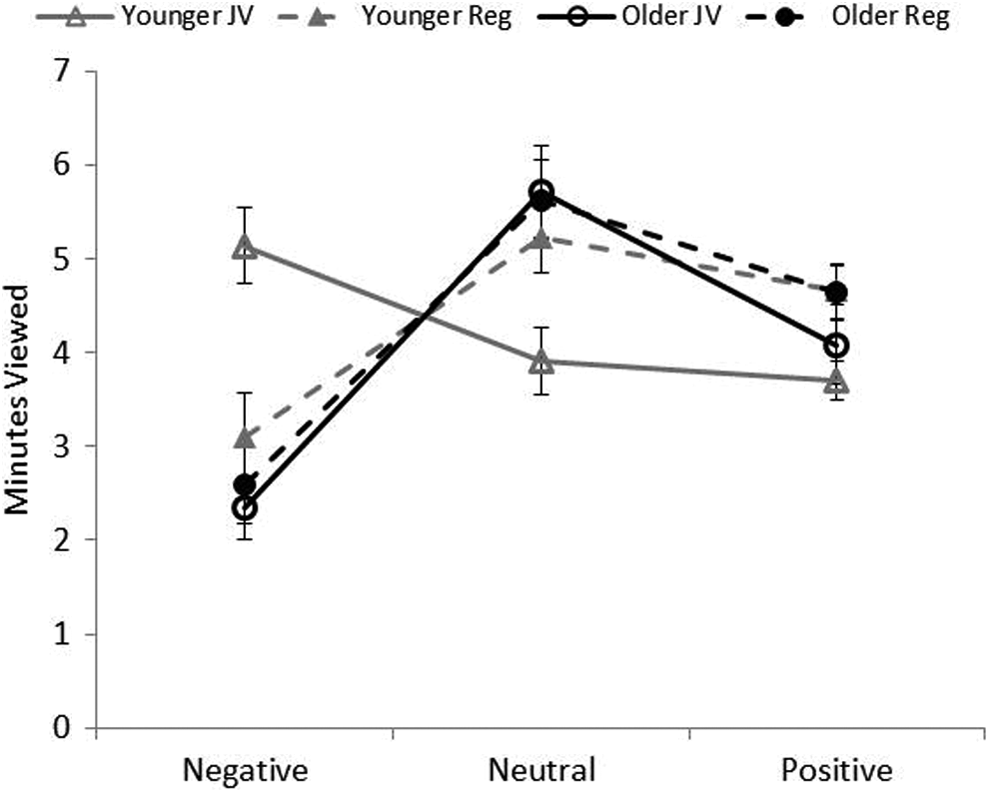
Situation selection use, plotted by age and goal condition. JV = Just view, Reg = Regulate. Error bars represent standard errors.
Situation Selection Effectiveness
To test for effectiveness, we used multilevel modeling in HLM 7 (Raudenbush, Bryk, & Congdon, 2013) to assess relationships with self-reported affect. Post-stimulus affect ratings served as the Level-1 (choice-level) outcome variable. At Level 1, separate dummy codes were created for negative and positive choices; neutral choices served as the reference group. Age (younger = 0, older = 1) and goal (just view = 0, regulate = 1) were treated as dichotomous Level-2 (person-level) variables. All main effects and interactions were included in the model. All predictors were uncentered. All effects were modeled as random. Baseline affect did not differ by age or goal, ps > .15, and so was not included in the model. 2
There was a main effect of goal, with those in the regulate condition having more positive affect than those in the just view condition (γ = .58, SE = .23), t(137) = 2.58, p = .011. Overall, people felt worse after viewing negative items, (γ = −1.91, SE = .23), t(137) = −8.17, p < .001, and better after viewing positive items, (γ = 1.34, SE = .15), t(137) = 9.02, p < .001, compared to after viewing neutral items. There was no effect of age and no significant interactions (see Table 1). This suggests that the relationship between choices and affect did not significantly differ based on age or goal. In addition, people in the regulate condition had more positive affect even when controlling for age and valence of choices.
Fixed Effects Estimates for Predictors of Affect in Situation Selection Task.
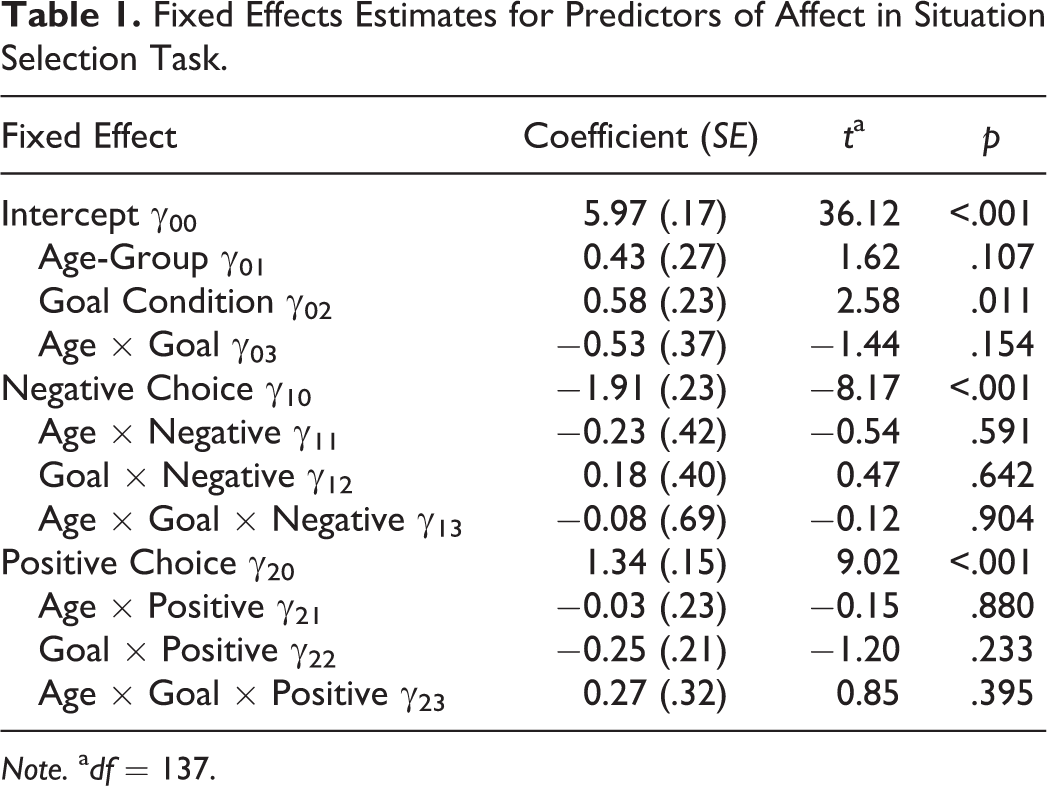
Note. a df = 137.
Situation Modification Use
Situation modification use was operationally defined as the percentage of video skipped. Scores were averaged across videos separately for positive and negative valence. Descriptive statistics are presented in Table S3 in the supplementary materials. A 2 (age) × 2 (goal) × 2 (valence) mixed-model ANOVA showed that the effect of age was not significant, F(1, 141) = 1.30, p = .26, nor was the effect of goal, F(1, 141) = .05, p = .83, or their interaction, F(1, 141) = .69, p = .41. The effect of valence was not significant, F(1, 141) = 2.39, p = .12, suggesting that overall, people skipped similar amounts of positive and negative material.
However, the Valence × Age-group interaction was significant, F(1, 141) = 5.61, p = .019. Follow-up independent t-tests showed an age difference in modification for negative videos, t(143) = −2.10, p = .037, but not for positive, t(143) = .27, p = .79 (see Figure 2). Specifically, older adults skipped a greater proportion of the negative videos (M = 21.92, SD = 23.84) than younger adults (M = 14.47, SD = 18.26). The Goal × Valence interaction was not significant, F(1, 141) = 2.72, p = .10, nor was the Age × Goal × Valence interaction, F(1, 141) = .30, p = .58.
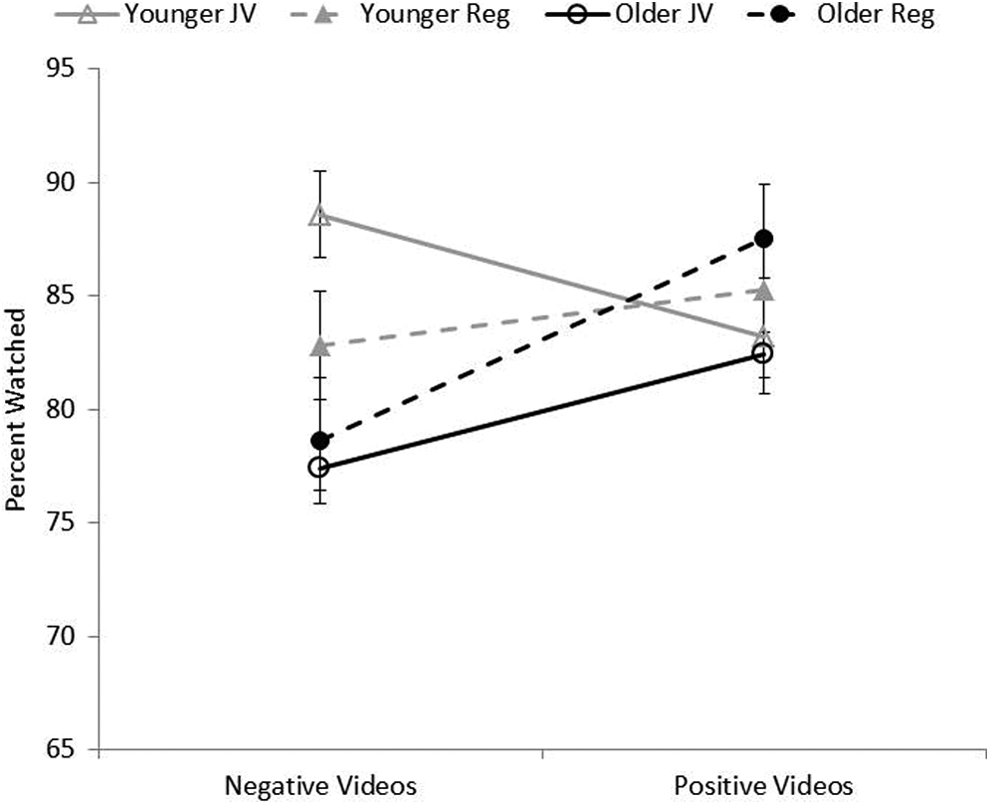
Situation modification use, plotted by age, goal, and video valence. To parallel Figure 1, scores were reverse coded to represent percentage watched; therefore, a higher score indicates more engagement. JV = Just view, Reg = Regulate. Error bars represent standard errors.
Situation Modification Effectiveness
To test for effectiveness of situation modification, we used multilevel modeling to assess relationships with self-reported affect. A 2 (age) × 2 (goal) ANOVA showed that those in the regulate condition (M = 6.95, SD = 1.26) had more positive baseline affect than those in the just view condition (M = 6.40, SD = 1.48), F(1, 141) = 6.00, p = .016. The effect of age on baseline affect was not significant (p = .10), nor was the interaction (p = .11). Therefore, baseline affect was entered (grand mean-centered) as a covariate in all analyses presented below (predicting the intercept of affect but not slopes).
Post-stimulus affect served as the Level-1 (video-level) outcome. Video valence was entered dummy coded as a Level-1 variable (negative = 0, positive = 1). Age (younger = 0, older = 1) and goal (just view = 0, regulate = 1) were dichotomous Level-2 (person-level) variables. Percentage skipped was entered as a grand-mean centered predictor, along with all interactions. All dichotomous predictors were uncentered. All effects were initially modeled as random; variance components were removed if they were not significant at p < .10.
Results are presented in Table 2. Effects of baseline affect and video valence were significant. Percentage skipped was not a significant predictor of affect, t(141) = −.71, p = .48, and it did not interact with age, goal, or age × goal. There was a significant Age × Valence × Situation modification, t(285) = −2.15, p = .03, and a marginally significant Age × Goal × Valence × Situation Modification interaction, t(285) = 1.90, p = .06.
Fixed Effects Estimates for Predictors of Affect in Situation Modification Task.

Note. SE = standard error; df = degrees of freedom.
To investigate these interactions, analyses were conducted separately for negative and positive videos. For negative videos, there were no significant effects (ps > .18), suggesting that skipping negative segments was not related to affect for any of the groups. For positive videos, older adults felt significantly more positive (γ = .68, SE = .25), t(140) = 2.77, p = .006, and those in the regulate condition felt marginally more positive (γ = .39, SE = .21), t(140) = 1.88, p = .06. Skipping more positive material was marginally associated with worse affect (γ = −.014, SE = .007), t(141) = −1.88, p = .06, but this was qualified by a significant Age × Modification interaction (γ = −.035, SE = .014), t(141) = −2.51, p = .013, and a significant Age × Goal × Modification interaction (γ = −.037, SE = .018), t(141) = 2.04, p = .043.
Analyses for positive videos were then conducted for each age-group separately. For younger adults, more skipping was marginally associated with worse affect, (γ = −.013, SE = .007), t(68) = −1.79, p = .08. The relationship between skipping was stronger for older adults (γ = −.05, SE = .013), t(73) = −4.06, p < .001. In other words, older adults felt better when they engaged with more positive material, whereas this was the case to a lesser extent for younger adults.
Discussion
This research examined the roles of age and pro-hedonic motivation in the use and effectiveness of situation selection and situation modification. Both are early stage emotion regulation strategies with the potential to prevent negative emotions in the first place or allow for quick disengagement, and do not require substantial cognitive resources and as such, could be just as effective for older adults. This was the first study to examine both strategies in parallel ways.
Use of Situation Selection and Modification
In this research, we found that older adults were more likely to engage in pro-hedonic behavior than younger adults. In the situation selection task, older adults favored neutral and positive material over negative, regardless of explicit goal instructions, whereas younger adults engaged in such behavior only when explicitly instructed to minimize their negative emotions. In the situation modification task, older adults skipped more negative material than younger adults regardless of goal condition. In sum, older adults were more likely than younger adults to avoid negative material. It is notable that across both tasks, older adults who were told to view what interested them behaved in almost identical ways to those who had been instructed to minimize their negative feelings. In line with SST, what interested older adults seemed to be what made them feel good. This is consistent with SST’s assertion that older adults have chronically activated pro-hedonic goals, whereas younger adults’ goals are more variable (Mather & Carstensen, 2005).
We found mixed evidence for the idea that older adults are more likely to rely on early stage emotion regulation strategies than younger adults. There were no overall age differences in pro-hedonic behavior in the situation selection task, but older adults were more likely to engage in pro-hedonic behavior in the situation modification task. Thus, when asked to regulate, both age-groups engaged in similar degrees of situation selection, but older adults engaged in more situation modification. Because we did not tell participants how to minimize their negative emotions, this left opportunity to engage in any kind of regulation available within the situation. This was intentional—to examine the degree to which people would engage in these specific strategies. In line with SOC-ER, once engaged in a situation, younger adults may have drawn upon their cognitive resources to engage in a later-stage emotion regulation strategy, whereas older adults took the opportunity to disengage (see also Charles, 2010).
Effectiveness of Situation Selection and Modification
There was no evidence of age differences in the effectiveness of situation selection; making more positive choices was associated with more positive affect, and making more negative choices was associated with more negative affect for both age-groups. This suggests that situation selection can be effective for both younger and older adults, which is consistent with SOC-ER and with past research (Isaacowitz et al., 2015). One caveat, however, is that whereas situation selection may be effective in maximizing short-term affect, there may be long-term costs to inflexibly avoiding negative experiences and information. It is therefore important to investigate the boundary conditions under which younger and older adults do and do not use situation selection and how and when it is effective.
One advantage of this paradigm is that by manipulating motivation rather than instructions to regulate, we could assess both naturally occurring emotion regulation (in this case, pro-hedonic behavior) and the effectiveness of that emotion regulation in the same sample, providing more ecological validity. Yet interpretation of effectiveness can be less clear. For example, though older adults in the just view and regulate conditions did not differ in affect, it may not mean that situation selection was not as effective for them. Age and motivation appear to be related, as proposed by SST and as evidenced in this study by similar behaviors across goal conditions. Therefore, we interpret these findings as evidence that older adults are more likely to have default pro-hedonic goals and that the behaviors are equally effective. In all cases, more engagement with positive and neutral over negative material was associated with more positive affect.
As with situation selection, there was no evidence of age differences in the effectiveness of situation modification. Participants did feel better when they chose to engage more with positive material (i.e., when they skipped less), and this effect was stronger for older adults than younger adults. However, the amount of negative material skipped was unrelated to affect, for both age-groups. This could be due to the nature of the task; situation modification in this case involved disengaging from a stimulus by fast-forwarding negative material. It could be that more active modification of the stimulus might have resulted in a more positive experience. For example, the opportunity to change the story line might have been more effective.
Another possibility is that participants might have been waiting for emotions to occur before engaging in situation modification. The process model suggests that strategies are most effective when they occur before the full-blown emotion unfolds. Because we do not have continuous ratings of affect, we cannot disentangle the timeline of emotion and situation modification. However, given the scarcity of research on situation modification, this research still provides insight into age differences in use.
Conclusion
One caveat is worth mentioning: Aging is associated with numerous changes in cognitive, physical, and social domains. Our sample was comprised of relatively high functioning, healthy, and educated older adults (see Table S1), whose behavior and experience may not capture the full range of experiences in older adulthood. Moreover, the age-groups may have differed on any number of third variables that can influence how emotion regulation, at all stages of life. Therefore, future research must seriously consider individual differences (e, g., cognitive functioning, beliefs about emotions, socioeconomic status, and racial and ethnic background) as important possible contributors to emotional regulation and experience.
This research is an important step in identifying the ways that older adults can maintain high levels of well-being as they age. To our knowledge, this is the first research to examine age differences in the use and effectiveness of situation selection and situation modification, two strategies that are theoretically important in managing emotions, especially for older adults. Overall, we found age differences in use of the strategies, but not in their effectiveness. In addition, we found support for chronic activation of pro-hedonic goals in older adults, but not in younger adults. The story of aging and emotion regulation therefore seems to involve age differences in motivation to regulate as well as in tendency to use early stage emotion regulation strategies.
Footnotes
Acknowledgment
The authors wish to thank Molly Sands for assistance in stimuli testing and for comments on earlier drafts of this article.
Declaration of Conflicting Interests
The author(s) declared no potential conflicts of interest with respect to the research, authorship, and/or publication of this article.
Funding
The author(s) disclosed receipt of the following financial support for the research, authorship, and/or publication of this article: R01 AG048731 to the second author.
Notes

References
Supplementary Material
Please find the following supplemental material available below.
For Open Access articles published under a Creative Commons License, all supplemental material carries the same license as the article it is associated with.
For non-Open Access articles published, all supplemental material carries a non-exclusive license, and permission requests for re-use of supplemental material or any part of supplemental material shall be sent directly to the copyright owner as specified in the copyright notice associated with the article.
