



Abstract
Mate poaching refers to efforts to attract people who are already involved in committed relationships. The current dyadic, 5-week prospective study examined mate poaching behaviors in the context of opposite-sex friendships. Actors’ mate poaching behaviors predicted decreases in their friend’s commitment to their romantic partners, increases in their friend’s perceptions of actors’ mate value, and increases in their friend’s romantic desire for actors over time. These results are the first to suggest an interpersonal process in which mate poaching behaviors elicit psychological changes in targets that facilitate actors’ mate poaching goals. Furthermore, these results are the first to demonstrate the effectiveness of mate poaching tactics in friendships.
Mate poaching occurs when people try to establish a romantic or sexual relationship with a person who is already in a romantic relationship with someone else (Schmitt & Buss, 2001). Mate poaching behavior is common. Schmitt and Buss (2001) found that, among undergraduate respondents in the United States, 64% of men and 49% of women have attempted to poach someone for a short-term sexual liaison, approximately 85% of men and women had partners who were the targets of others’ mate poaching attempts, and 50% of men and 35% of women had been successfully poached by someone. Mate poaching has also been reported in older samples (Schmitt & Buss, 2001) and throughout most of the world (Schmitt, 2004). Mate poaching tactics are varied and include attempts to win over the target by derogating the target’s romantic partner, outperforming the target’s romantic partner on important mating criteria, encouraging the target to dissolve his or her romantic relationship, and attempting to initiate sex with the target (Schmitt & Buss, 2001). The behaviors are thought to be adaptive sexual tactics to increase mating success by providing opportunities to mate with desirable partners who may otherwise be unavailable (Schmitt, 2004; Schmitt & Buss, 2001).
The current research examines the effectiveness of these tactics. Research on the effectiveness of mate poaching attempts is limited. Some studies suggest that people believe particular mate poaching tactics are effective (e.g., Davies & Shackelford, 2015; Schmitt & Buss, 2001) or that their relationships were initiated as a result of mate poaching (e.g., Foster et al., 2014; Schmitt, 2004; Schmitt & Buss, 2001). However, people may not have accurate insight into the forces that cause relationship formation, and their memories for prior relationship events may be biased (Eastwick & Finkel, 2008; Lemay & Neal, 2013; McFarland & Ross, 1987; Nisbett & Wilson, 1977; Sanitioso, Kunda, & Fong, 1990). For example, memories of relationship initiation are biased by cultural scripts concerning courtship (Holmberg & Veroff, 1996). Furthermore, these studies do not indicate whether mate poaching tactics are effective in eliciting desired changes in targets because prospective studies investigating change processes have not been conducted. In the absence of such studies, alternative explanations are feasible, such as the possibility that targets of mate poaching wanted a relationship with poachers even before poachers enacted their mate poaching tactics. Other research suggests that frequency of mate poaching attempts is associated with having more sexual and dating partners (Arnocky, Sunderani, & Vaillancourt, 2013). However, these findings do not demonstrate that targets of mate poaching became sexual and dating partners, nor do they suggest prospective effects of poaching tactics. Finally, studies on mate poaching effectiveness examine processes in only one person’s mind, usually only the poacher or the poached target, which may introduce biases. For example, poachers may misperceive the effects of their poaching attempts on targets, and targets may not detect a poaching attempt. To be sure that poaching involves the interpersonal process that is assumed in theorizing on mate poaching, responses from both parties must be examined.
The current research examines the effects of mate poaching behaviors in a dyadic prospective study, which addresses these issues by eliminating reliance on long-term retrospection, incorporating responses from both poachers and their targets, and examining change in important psychological processes over time. The success of mate poaching tactics should depend on their elicitation of psychological change in targets that increases the probability that targets will abandon their existing partners to initiate relations with poachers. These changes have not been examined. Three psychological changes in targets were examined in the current research, including targets’ decline in commitment to their existing romantic partners, increases in perceptions of poachers’ mate value, and increases in targets’ romantic and sexual desire for poachers. All three changes are likely to be important in the mate poaching endeavor. Commitment reflects a desire for a relationship to persist, and high commitment promotes relationship persistence (Le, Dove, Agnew, Korn, & Mutso, 2010; Rusbult, 1983). Therefore, poachers’ ability to weaken targets’ commitment to their romantic partners would constitute an important psychological change in the service of mate poaching. Mate value refers to one’s desirability as a sexual and romantic partner, and it determines success in attracting partners (Gangestad & Simpson, 2000). Poachers’ ability to convince targets that they have high mate value would constitute a second psychological change to promote mate poaching. Finally, increasing targets’ desire to enter into a sexual or romantic relationship with poachers would serve as a straightforward indicator that targets have changed in a manner that would facilitate mate poaching.
The current research examines mate poaching attempts in the context of opposite-sex friendships. Sexual attraction is common in platonic opposite-sex friendships (Bleske-Rechek et al., 2012; Halatsis & Christakis, 2009; Kaplan & Keys, 1997). Furthermore, the existence of friendship between a poacher and target increases the perceived probability of poaching success (Mogilski & Wade, 2013). Hence, people may often employ mate poaching tactics when they want to enter a sexual or romantic relationship with an opposite-sex friend who is already involved in a romantic relationship. The current study examines whether these tactics are successful in eliciting the psychological changes described above.
Method
Participants
Both members of 47 pairs of opposite-sex friends (N = 94) participated in the study (M age = 22.67 years, SD = 2.20). 1 Participants were recruited from introductory psychology courses from a large Mid-Atlantic university to participate in exchange for class credit and also from the surrounding community in exchange for US$20. A large portion of the sample was Caucasian (52%), followed by Asian (35%), African American (13%), and Hispanic (16%).
Procedure
Participants and their opposite-sex friend each completed a questionnaire via a computer in a quiet laboratory. Participants were seated on the opposite side of the room from their friend to ensure confidentiality. Items on each questionnaire were presented in randomized order. After finishing, the computer displayed a message instructing the participant to exit the room quietly. In addition, participants completed a weekly survey posted on the Internet for the next 4 weeks following the initial lab session. The measures described below were identical in the initial and follow-up surveys.
Measures
When describing the measures, we used the term “target” to refer to people who were involved in romantic relationships at the start of the study and may be the target of their friend’s mate poaching. We use the term “actor” to refer to their friends, who may engage in mate poaching. However, when both members of the friend pair were involved in romantic relationships at the start of the study (10 dyads), each member provided data for target and actor roles. Twenty-one males and 16 females were actors only, and their opposite-sex friends were targets only. An additional 10 males and 10 females served as both actors and targets. 2
Targets’ commitment to romantic partner
Targets’ commitment to their romantic partner was assessed with a 6-item scale adapted from the Investment Model Scale (Rusbult, Martz, & Agnew, 1998). Prior to completing the scale, participants were asked to supply the name of their romantic partner. Example items are, “I want my relationship with ___ to last for a very long time” and “I am committed to maintaining my relationship with ___.” The blanks in the example items were automatically replaced with the supplied name. Participants responded to the 6 items on 7-point Likert-type scales (1 = strongly disagree, 7 = strongly agree; Cronbach’s α = .85).
Targets’ and actors’ romantic desire
Targets and actors completed four measures assessing their romantic desire for each other. They completed the short version of the Passionate Love Scale (Hatfield & Sprecher, 2009). To mitigate participant fatigue and reduce the completion time of the follow-up surveys, participants completed only 5 items from the scale (Cronbach’s α = .94). An example item is “I want this person physically, emotionally, mentally.” The Eros Subscale of Hendrick and Hendrick’s (Hendrick & Hendrick, 1986) Love Attitudes Scale also assesses a romantic type of love. Four of the 7 items from the Eros subscale were given to participants (Cronbach’s α = .82). Participants responded to these items using 7-point Likert-type scales (1 = strongly disagree, 7 = strongly agree). Sexual desire was measured using a 4-item scale adapted from Birnbaum and Reis (2012; Cronbach’s α = .91). An example item is, “To what extent would you be interested in having sex with your study partner?” Romantic interest in the friend was assessed with a modified set of 4 items created for this research (Cronbach’s α = .81). An example item is, “To what extent are you interested in dating your study partner?” These items were completed using 5-point Likert-type scales (1 = not at all, 5 = extremely). Scores on these four measures were highly correlated (average r = .66) and so they were standardized and averaged to create a composite index of actors’ and targets’ romantic desire (Cronbach’s α = .88).
Targets’ perception of actors’ mate value
Targets’ perception of actors’ mate value was assessed with an adaptation of the mate-value scale (Edlund & Sagarin, 2014). Example items are “Overall, how do you believe your study partner compares to other people in desirability as a partner?” and “Overall, how would other members of your sex rate your study partner’s level of desirability as a partner?” An additional item was added to the scale to assess the perception of actors’ physical attractiveness. Participants completed 5 items using 7-point response scales (Cronbach’s α = .92).
Actors’ mate poaching
Actors completed a 6-item scale assessing their mate poaching behaviors, which was adapted from prior research on mate poaching (Schmitt & Buss, 2001). Tactics included derogate rival, derogate rival’s attractiveness, manipulate emotional commitment, temporal invasion, and breakup relationship. 3 Prior to completing this scale, participants were asked to supply the name of their friend’s romantic partner (their potential romantic rival). They were then asked to rate how often they engaged in these behaviors each week on a scale from 1 (not at all) to 5 (nearly all the time). Items included “Try to keep your study partner from spending time with___,” “Point out___’s negative qualities to your study partner,” “Put down ____’s physical appearance to your study partner,” “Try to treat your study partner better than ____ treats your study partner,” “Try to keep your study partner from spending time with ____,” and “Try to compete with ____.” The blanks in these items were automatically replaced with the supplied romantic rival’s name (Cronbach’s α = .84).
Results
Analysis Strategy
Hypotheses were tested using the Mplus 7.31 program (L. K. Muthén & Muthén, 2012). The analyses were two-level models that treated the five repeated observations as nested within person. Separate equations were estimated for men and women, and the model estimated the covariance between analogous variables assessed on the man and woman within the same dyad to account for dyadic interdependence in those dyads in which both members were romantically involved. However, to simplify the presentation of results and increase the power of the tests, we pooled model parameters across men and women unless the Wald chi-square test (L. K. Muthén & Muthén, 2012) indicated that they significantly varied across gender. Given that some of the variables were skewed (as described below), the primary analyses used maximum likelihood estimation with robust standard errors to test all predictions. This estimation provides standard errors and significance tests that are robust to violations of the assumption of normally distributed variables. In addition, Bayes credible intervals are provided for each primary effect. These are analogous to 95% confidence intervals, but they provide better estimation with nonnormal distributions and small number of clusters (B. Muthén & Asparouhov, 2012). However, all of the findings replicated using the ordinary standard errors calculated in SPSS Linear Mixed Models. The time-variant predictor variables were centered on each participant’s mean score so that variability in predictor variables reflected within-person and across-time variability (see Enders & Tofighi, 2007). 4 Both unstandardized coefficients (b) and standardized coefficients (β) are reported. Cohen’s f 2 is also presented as an index of standardized local effect size (see Selya, Rose, Dierker, Hedeker, & Mermelstein, 2012). When describing the results, we use the term targets to refer to participants who are involved in a romantic relationship outside of the friendship dyad. We use the term actors to refer to their friends who may be trying to poach targets from their romantic partners. The analyses were based on data collected at all five assessment times.
Descriptive Statistics
Descriptive statistics and correlations for the primary study variables are presented in Table 1. Targets were generally committed to their partners and saw actors as having moderately positive mate value. Actors generally refrained from mate poaching behaviors, and this variable was positively skewed, which is not surprising, given that these friendships were not selected for romantic attraction.
Descriptive Statistics and Correlations.

***p < .001. **p < .01.
Predicting Actors’ Use of Mate Poaching Tactics
The first multilevel analysis provided evidence suggesting that actors’ romantic desire for their friend prompts them to use mate poaching tactics. Actors’ use of mate poaching tactics was regressed on the index of actors’ romantic desire assessed at the same wave. Romantic desire predicted greater use of mate poaching tactics, b = .23, β = .46, z = 1.90, p = .058, 95% CI [.06, .17], f 2 = .27. These results indicate that participants enacted more mate poaching behaviors during weeks when their romantic desire for their friends was especially high (relative to their average romantic desire). The effect of actors’ romantic desire on their mate poaching differed across males and females, Wald χ2(1) = 2.96, p = .09. This effect was stronger for male participants, b = .37, β = .68, z = 2.23, p = .03, than for female participants, b = .08, β = .19, z = 2.06, p = .04. Males also reported more mate poaching (M = 1.28), on average, than females (M = 1.06), Wald χ2(1) = 6.82, p = .009.
Predicting Declines in Targets’ Commitment to Their Romantic Partners
The next analysis demonstrated effects of actors’ mate poaching behavior on targets’ decline in commitment to their romantic partners. A time-lagged regression approach was used to test effects of actors’ use of mate poaching tactics assessed at each wave (e.g., wave t) on targets’ commitment to their romantic partners assessed the following wave (e.g., wave t + 1) while controlling for the lagged assessment of the outcome variable (targets’ commitment to their romantic partners at wave t). This analysis strategy allows for examining the effects of predictors on change in later outcome variables independently of earlier associations between predictors and outcomes. Results are presented in the top model in Figure 1. Actors’ use of mate poaching tactics predicted declines in targets’ commitment to their romantic partners in the following assessment wave, b = −.87, β = −.34, z = −2.74, p = .006, 95% CI [−1.46, −.29], f 2 = .12. This effect did not significantly vary across sex, Wald χ2(1) = .07, p = .79.
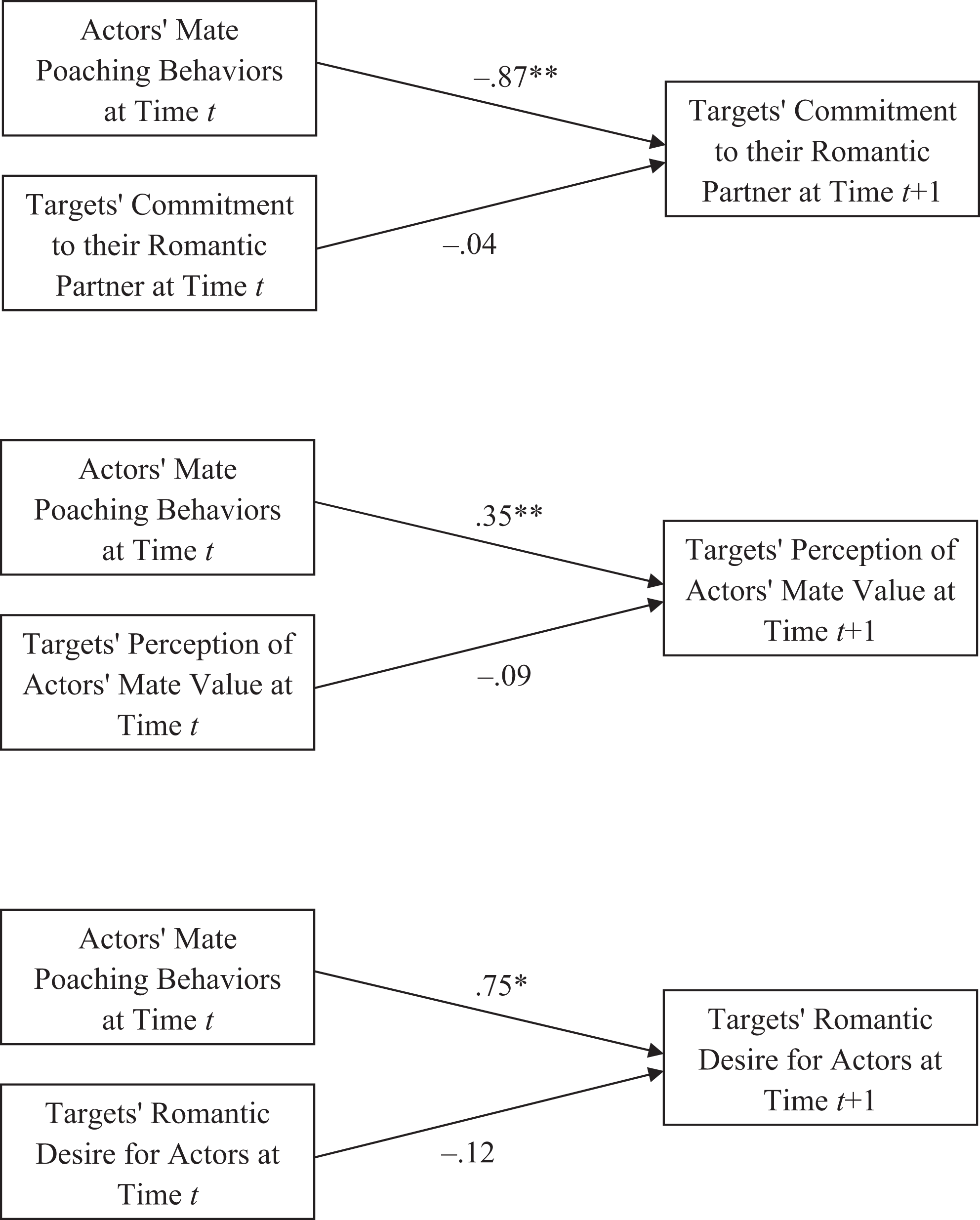
Results of analyses examining effects of actors’ mate poaching on psychological changes in targets. Coefficients are unstandardized. **p < .01. *p < .05.
Predicting Improvement in Targets’ Perceptions of Actors’ Mate Value
The next analysis demonstrated effects of actors’ mate poaching behavior on targets’ perceptions of actors’ mate value. Another time-lagged regression model examined the effects of actors’ use of mate poaching tactics assessed at each wave (i.e., at wave t) on targets’ perceptions of actors’ mate value the following wave (i.e., at wave t + 1) while controlling for the lagged assessment of the outcome variable (targets’ perceptions of actors’ mate value at wave t). Results are presented in the center model in Figure 1. Actors’ mate poaching behavior predicted improvements in targets’ perceptions of actors’ mate value the following wave, b = .35, β = .19, z = 3.33, p < .001, 95% CI [.01, .52], f 2 = .16. This effect did not vary across sex, Wald χ2(1) = 2.72, p = .10.
Predicting Improvement in Targets’ Desire for Actors
The final analysis examined effects of actors’ mate poaching behavior on change in targets’ romantic desire for actors over time. A time-lagged regression approach was used to test effects of actors’ mate poaching at wave t on targets’ later desire for actors at wave t + 1 while controlling for targets’ desire assessed at wave t. Results are presented in the bottom model of Figure 1. Actors’ mate poaching behavior at a given assessment wave predicted improvements in targets’ romantic desire for actors the following assessment wave, independently of their initial desire, b = .75, β = .39, z = 2.40, p = .016, 95% CI [.32, .86], f 2 = .04. This effect did not vary across sex, Wald χ2(1) = .02, p = .89.
Post hoc Power Analysis
We conducted Monte Carlo power simulations for the four primary analyses described above (see Bolger & Laurenceau, 2013). We used the parameter estimates from each of the models described above as population values and drew 1,000 samples of the same size from these population models. Statistical power of an effect is the estimate of the proportion of samples in which the effect was statistically significant (L. K. Muthén & Muthén, 2002). These simulations suggest that study was adequately powered to detect most of the effects described above (M power = .80; power ranged from .40 to 1). The current study had the least power to detect effects of actors’ poaching on targets’ perceptions of mate value (power = .46 for male actors and .40 for female actors). The study had suitable power to detect the remaining effects, with power estimates greater than .75.
Alternative Models
A potential alternative explanation for the effects described above is that actors’ mate poaching behaviors were a proxy for their high romantic desire for targets, and this romantic desire, rather than their poaching behaviors, is what really predicted psychological changes in targets. To test this possibility, additional models tested the effects of actors’ mate poaching on change in targets after controlling for actors’ romantic desire. Actors’ mate poaching continued to predict decreases in targets’ commitment to their romantic partners, b = −1.01, z = −2.68, p < .01, increases in targets’ perception of actors’ mate value, b = .28, z = 2.89, p = .059, and increases in targets’ romantic desire for actors, b = .73, z = 2.17, p < .05. In most of these analyses, actors’ romantic desire did not directly predict changes in targets, ps > .77. The one exception, which was unanticipated, was that male actors’ romantic desire predicted increases in female targets’ commitment to their romantic partners, b = .33, z = 2.63, p < .01, an effect that was in the opposite direction relative to the effect of male actors’ poaching behavior. Nevertheless, these results suggest that effects of actors’ mate poaching behavior are not explained by the effects of actors’ romantic desire.
Discussion
This research is the first to demonstrate that enactment of mate poaching behaviors predicts psychological changes in targets of those behaviors in a manner that would facilitate mate poaching. Furthermore, it is the first to demonstrate the effects of mate poaching in friendships. When participants were the targets of their friend’s mate poaching behaviors, they exhibited temporal declines in their commitment to their romantic partners, improvements in their perceptions of the poacher’s mate value, and greater romantic desire for the poacher over time. All of these effects were independent of targets’ commitment, perceptions, and desire assessed at the same time as the mate poaching, suggesting that they cannot be explained by targets’ preexisting commitment, perceptions, or desires. Furthermore, this dyadic study allowed for actors to report on their mate poaching and targets to report on their psychological responses, thereby reducing the likelihood, often possible in the many studies using only one reporter, that effects of mate poaching can be explained by reporting biases or shared method variance. These results confirm the effectiveness of mate poaching in producing psychological changes that should, over time, result in opportunities to mate with desirable but currently involved partners (Schmitt, 2004; Schmitt & Buss, 2001). Future research should expand this dyadic approach to mate poaching by examining qualities of the poacher that determine the impact of their behaviors on targets. For example, wealthy or attractive poachers may exert a stronger influence on targets’ psychological change (Davies & Shackelford, 2015; Schmitt, 2004; Schmitt & Buss, 2001).
By chipping away at targets’ commitment to romantic rivals, convincing targets to see them as valuable partners, and arousing targets’ romantic desire, actors’ mate poaching attempts may result in actual sexual and romantic opportunities with targets. However, perhaps because of the short study duration, we observed few instances in which participants abandoned their romantic partners. Future prospective research over a more extended duration should examine the psychological changes that mediate between actors’ mate poaching and targets’ relationship dissolution. Targets of mate poaching may eventually abandon their partners or become unfaithful. However, mate poaching may not create new stable relationships between poachers and their targets. Poached targets are less committed, satisfied, and invested in their new romantic relationships with poachers, and they engage in more infidelity (Foster et al., 2014). On the other hand, the existence of friendship between the poacher and the target before poaching may improve the likelihood that a stable romantic relationship will develop (Mogilski & Wade, 2013).
Although mate poaching behavior enacted by male and female actors seemed to be effective in predicting change in targets, male actors reported more poaching attempts than female actors. This finding may reflect the fact that men see more benefits and fewer interpersonal costs to mate poaching relative to women (Davies, Shackelford, & Hass, 2010). For example, women may fear damage to their relationships more than do men, or they may see a successful poach as unwise investment decision. So although their mate poaching behaviors seem effective, they may be reluctant to try them. Future research should account for these perceived benefits and costs and other known predictors of mate poaching behavior, such as high narcissism, psychopathy, and Machiavellianism (Jonason, Li, & Buss, 2010; Kardum, Hudek-Knezevic, Schmitt, & Grundler, 2015) and erotophilic disposition (i.e., sexual obscenity, indecency, and lust; Schmitt, 2004; Schmitt & Buss, 2001). These variables may shape decisions to enact mate poaching behaviors in friendships.
Future research should also compare the effectiveness of the mate poaching behaviors examined in the current research with more general mate-attraction tactics that have been examined in prior research (e.g., Buss, 1988). People may successfully poach a desired target using behaviors that involve direct competition with or derogation of the romantic rival, as examined in the current research, and with tactics that are less competitive and do not directly involve the rival, such as appearance enhancement, trying to be alone with the target, and expressing interest in the target (Buss, 1988). We suspect that a combination of both types may be useful for mate poaching. Tactics involving competition and derogation may more directly convince targets that poachers are more desirable alternatives to their current partners, but tactics such as seeking private time with targets and expressing interest in them may be particularly effective at creating and signaling opportunities for romance. Hence, these tactics could contribute to the success of mate poaching through distinct pathways. Future research should examine the distinct social and psychological mechanisms that account for the differential and unique effectiveness of various mate poaching and mate-attraction tactics.
Of course, the success of mate poaching behaviors also depends on the target’s romantic partner, who was not examined in the current research. Just as poachers may strategically attempt to entice their targets, targets’ romantic partners may be strategically guarding those targets from poachers and fending off their influence (Buss & Shackelford, 1997), and these efforts, if done effectively, could encourage targets to maintain their commitment to their romantic partners (Neal & Lemay, 2014). Targets are sometimes caught in the middle of a veritable duel between a committed partner trying to maintain the fidelity of their relationship and an aspiring lover who is trying to tear it down.
Perhaps the target’s relative commitment to each party declares the victor. People are more resistant to being poached when they are highly committed to their romantic partners (Davies & Shackelford, 2015), possibly because highly committed individuals actively resist temptation by ignoring or derogating potential poachers (Johnson & Rusbult, 1989; Lydon, Meana, Sepinwall, Richards, & Mayman, 1999; Miller, 1997). However, the existence of friendship with poachers may prevent targets from putting up these defenses. People usually have positive sentiments toward their friends, and ignoring or derogating a friend is antithetical to friendship. Perhaps targets who strongly value their friendship with poachers are less willing to employ strategies that protect their romantic relationships at the expense of the friendship. In this way, a close friendship between an aspiring poacher may place a kink in the armor that is usually provided by targets’ romantic commitment. Future research should examine whether the quality of the friendship with a poacher constrains romantic defenses. If it does, it could suggest even more reason for optimism for the downtrodden aspiring lovers who fear they have been relegated to the “friend zone” (Nicholson, 2013).
Footnotes
Declaration of Conflicting Interests
The author(s) declared no potential conflicts of interest with respect to the research, authorship, and/or publication of this article.
Funding
The author(s) disclosed receipt of the following financial support for the research, authorship, and/or publication of this article: This research was supported by National Science Foundation Research Grant BCS 1145349.
Notes

References
Supplementary Material
Please find the following supplemental material available below.
For Open Access articles published under a Creative Commons License, all supplemental material carries the same license as the article it is associated with.
For non-Open Access articles published, all supplemental material carries a non-exclusive license, and permission requests for re-use of supplemental material or any part of supplemental material shall be sent directly to the copyright owner as specified in the copyright notice associated with the article.
