




Abstract
We examined continuity and change in the tendencies to construct a life story (i.e., narrative identity) that was redemptive or contaminated in nature. In Study 1, college freshmen and seniors wrote accounts of several autobiographical key scenes pertinent to narrative identity twice over a 3-year period. In Study 2, midlife adults provided, via a semistructured interview, key scenes twice over a 5-year period and also indicated whether their employment status had changed between assessments. Across studies, the rank-order consistency of redemptive and contaminated stories was moderate and low to moderate, respectively. In Study 1, the frequency of redemptive and contaminated stories increased throughout college. Furthermore, the frequency of contaminated stories decreased following graduation. In Study 2, changes in employment status corresponded with reduced redemptive imagery. These results suggest a possible narrative acculturation of young adults as well as a correspondence between changes in life circumstances and narrative identity.
Keywords
In late adolescence, individuals begin to organize their autobiographical experiences into broader life stories or narrative identities (Singer, 2004). Through these internalized stories, people function like authors, creating a story about their past that provides them with a sense of unity and purpose (McAdams, 1995, 2013). Researchers interested in assessing narrative identity commonly prompt participants for several key autobiographical scenes, such as life high points and low points (McAdams, 2008). These scenes are then coded for various aspects, or themes, including affective tone and complexity. In addition to providing information regarding the narrator’s personality (McAdams, 1995), interindividual differences in the thematic content of these key scenes have been associated with a host of outcome variables (Adler, Lodi-Smith, Phillippe, & Houle, 2015; Dunlop & Tracy, 2013a).
Narrative identity situates the storyteller in time. Aligning with this temporal emphasis, a considerable amount of attention has been allotted to the longitudinal study of this construct (e.g., Habermas & de Silviera, 2008; McAdams et al., 2006). Previous research in this area has established the fact that the thematic content of narrative identity tends to be relatively consistent over time. For example, McAdams et al. (2006) observed that, over a 3-year period, the emotional tone and complexity of young adults’ key autobiographical scenes exhibited a moderate degree of rank-order consistency (with rs ranging between .53 and .60). This does not, however, preclude the possibility that certain factors may impact the development of narrative identity or that certain narrative themes may be sensitive to these factors.
McLean, Pasupathi, and Pals (2007) recognized that narrative identity is strongly influenced by the social and cultural agents in one’s life. Over time, these agents work, implicitly and explicitly, to align narrators’ key scenes with broader socially vetted norms or master narratives (Dunlop & Tracy, 2013a; Hammack, 2011). This suggests that, in late adolescence/early adulthood (i.e., the period in the life span when individuals begin to construct a narrative identity; McAdams, 1995), prevalence of themes reflecting these master narratives may increase.
A second discussion point pertains to the fact that narrative identity aims to keep pace with the many changes occurring in life (Dunlop, 2015). It follows that the occurrence of certain events may impact the thematic content of narrative identity. This possibility is consistent with the notion that narrative identity is both a resource to be drawn upon during times of uncertainty (McAdams, 2013) and a barometer that is responsive to the narrators’ current life conditions (McAdams & Guo, 2015). Redemption and contamination represent two themes that may hold relevance to issues of acculturation in early adulthood and changes in narrative identity corresponding with shifts in life circumstances (McAdams, 2006).
Redemptive and Contaminated Stories
Redemptive stories trace the move from suffering to enhancement. At the beginning of the story, the protagonist experiences a negative state of affairs, but the negative situation eventually gives way to a positive outcome. Models of redemption abound in popular culture, especially among Americans (e.g., American narratives of upward social mobility; McAdams, 2006). Furthermore, the tendency to construct redemptive autobiographical stories has been associated with several noteworthy outcome variables, including well-being, prosocial behavior, and health behavior (Dunlop & Tracy, 2013a; McAdams, Reynolds, Lewis, Patten, & Bowman, 2001).
The antithesis of the redemptive story is the contaminated story, wherein a positive or favorable beginning leads to spoiled or disappointing ending (see McAdams et al., 2001). The tendency to construct contaminated autobiographical stories has been associated with a series of negative or maladaptive outcome variables, such as depression and reduced self-esteem (see Adler & Poulin, 2009; McAdams et al., 2001). Also, in contrast to redemptive stories (which are favorably received by listeners), in storytelling contexts, contaminated stories are met with social awkwardness and lower levels of acceptance (Baddeley & Singer, 2008). Although redemption and contamination represent two sides of the same coin, the former has received far more research attention than the latter (see McAdams, 2006).
Redemptive and Contaminated Stories Through Time
Despite the many important correlates of redemptive and contaminated stories, researchers have yet to consider the manner in which these stories exhibit continuity and change over time, both among late adolescents/early adults and in relation to the occurrence of major life events. This represents an unfortunate oversight on at least three fronts. First, narrative identity is a developmental construct. It follows that in order to understand redemptive and contaminated stories more fully, they must be tracked through time. Second, due to the lack of longitudinal research examining redemptive and contaminated stories, investigators have yet to consider the relation between demographic factors (e.g., age, gender) and the degree of temporal stability in the tendency to produce these types of stories, or any aspect of narrative identity for that matter. Finally, researchers examining the development of narrative identity have yet to incorporate a consideration of the influence of events and life circumstances. For this reason, this area of research is lagging behind other areas in the personality development literature (e.g., the study of personality traits; see, e.g., Roberts & Wood, 2006).
In the current studies, we addressed these as-yet-unexamined issues pertaining to redemption, contamination, and narrative identity. In Study 1, participants who were initially college freshmen or seniors described several key autobiographical scenes twice over a 3-year period. In Study 2, we considered a series of key scenes from a sample of midlife adults who had taken part in a Life Story Interview (LSI; McAdams, 2008) twice over a 5-year term. These participants also indicated whether they had experienced a shift in their employment status between interviews. Collectively, this research allowed us to examine the degree of stability and change in the tendency to construct redemptive and contaminated autobiographical stories throughout young adulthood (Study 1) and midlife (Study 2). Furthermore, Study 2 allowed us to determine whether changes in narrative identity were predicted by shifts in life circumstances.
Study 1
In Study 1, we examined the degree of rank-order consistency and mean-level change in the frequency of redemptive and contaminated scenes described by participants. Individual stability coefficients (see Löckenhoff et al., 2008) were also considered in relation to participants’ demographic characteristics. We predicted that the frequencies of autobiographical redemptive and contaminated stories would exhibit a moderate degree of rank-order consistency. Moreover, we speculated that redemptive stories might increase in mean frequency over time in this sample according to the following rationale. First, emerging adulthood represents the period in the life span when narrative identity develops and becomes psychologically salient (Habermas & de Silviera, 2008). Second, narrative identity construction is shaped by, and in relation to, prevailing cultural norms (Hammack, 2011; McAdams, 2006). And, third, American society privileges themes of redemption (Baddeley & Singer, 2008; McAdams, 2006). Therefore, as young American adults become more acculturated, their narrative identities should become increasingly redemptive. We also predicted that this tendency would be particularly accentuated among our freshmen cohort, due to the relatively new status of these narrators. Drawing from the same logic, as well as the fact that, in contrast to redemptive stories, contaminated stories are not supported within the corresponding cultural context (Baddeley & Singer, 2008; McAdams, 2006), and we anticipated that the frequency of contaminated stories would decrease over time.
Method
A total of 145 college seniors and freshmen were recruited from Northwestern University. We recruited participants during a single semester, attempting to enroll as many individuals as possible. Participants were prompted to write 10 narratives corresponding to five key autobiographical scenes (e.g., life high points, low points), complete measures of personality traits and life satisfaction (described below), and contacted again 3 months and then 3 years later. During these subsequent assessments, participants completed all measures administered during the first assessment, receiving a US$50.00 honorarium during each of these assessments. In the present study, we considered those data collected during the first and last wave of data collection.
Of the initial 145 participants recruited during our first wave of data collection, 88 returned for the final wave. In the first time point, 70% of our participants self-identified as White/Caucasian, 74% were female, and 44% were freshmen (as opposed to seniors). These characteristics remained relatively consistent across data collection. Participants who did and did not return for the final wave of data collection were comparable in terms of levels of narrative redemption and contamination, as assessed during the first assessment period (ps ≥ .29). Although the autobiographical stories considered in Study 1 have been examined previously (see McAdams et al., 2006), the current article is the first to consider themes of redemption and contamination within these stories.
Conceptual Coding of Narratives
Approximately 2,300 personal narratives collected during the first and last waves of data collection were transcribed verbatim. In the interest of blind coding, narratives were entered into a single spreadsheet and their order was randomized. A research assistant, uninformed of the purpose of our study, then coded each narrative for the presence (+1) or absence (0) of redemptive and contaminated sequences following McAdams’ (1998, 1999) coding systems. 1 For reliability purposes, a secondary rater coded a random quarter of this sample. Interrater reliability was substantial for redemption and contamination, with 95% and 96% agreement and κs = .75 and .73, respectively.
We were interested in assessing participants’ general tendencies to construct key scenes that were redemptive or contaminated in nature, rather than to examine this tendency within any one type of key scene. As such, we considered the frequency of redemptive and contaminated stories across each participant’s 10 stories. This focus is consistent with previous research examining narrative identity (e.g., McAdams et al., 2006) and also ensures the most reliable assessment of participants’ narrative proclivities (for further discussion, see Dunlop & Tracy, 2013b).
Nonnarrative Variables
Participants completed the 44-item Big Five Inventory (BFI; John & Srivastava, 1999) and the 5-item Satisfaction With Life Scale (SWLS; Diener, Emmons, Larsen, & Griffin, 1985). The BFI (John & Srivastava, 1999) is a measure in which participants rate items reflecting five personality traits: extroversion, agreeableness, conscientiousness, emotional stability, and openness to experience. In contrast, the SWLS (Diener et al., 1985) tap participants’ life satisfaction.
Data Imputation
Approximately 39% of our sample did not participate in our final assessment. In the interest of accounting for this “missingness,” we used multivariate imputation by chained equations (MICE; van Buuren & Groothuis-Oudshoorn, 2011) via R (R Core Team, 2015) and following the recommendations of Horton and Kleinman (2007) and Azur, Stuart, Frangakis, and Leaf (2011). MICE employs predictive mean matching, such that imputed values are selected randomly from a set of observed values whose predicted values are closest to the predicted values of the cases with missing data (Heitjan & Little, 1991; Schenker & Taylor, 1996). Thus, MICE is a viable alternative to regression methods (which assumes a joint multivariate normal distribution) in situations where normality assumptions may be violated. In the current study, we used participants’ scores on the applicable narrative theme at Time 1, their personality traits (assessed during the first time point), life satisfaction (assessed during the first and last time point), as well as their age (in years), gender (male/female), cohort (freshmen/seniors), and ethnicity (Caucasian/non-Caucasian) to predict the applicable narrative theme during the last time point.
Results
Table 1 provides the descriptive statistics and interrelations among redemptive and contaminated sequences in autobiographical stories and across the waves of data collection. Evident from these relations, the frequency of redemptive and contaminated stories exhibited a significant degree of rank-order consistency. Evident from Table 2, these levels of stability did not vary as a function of participants’ age, gender, or ethnicity.
Descriptive Statistics of, and Intercorrelations Among, Indices of Redemptive and Contaminated Stories (Studies 1 and 2).
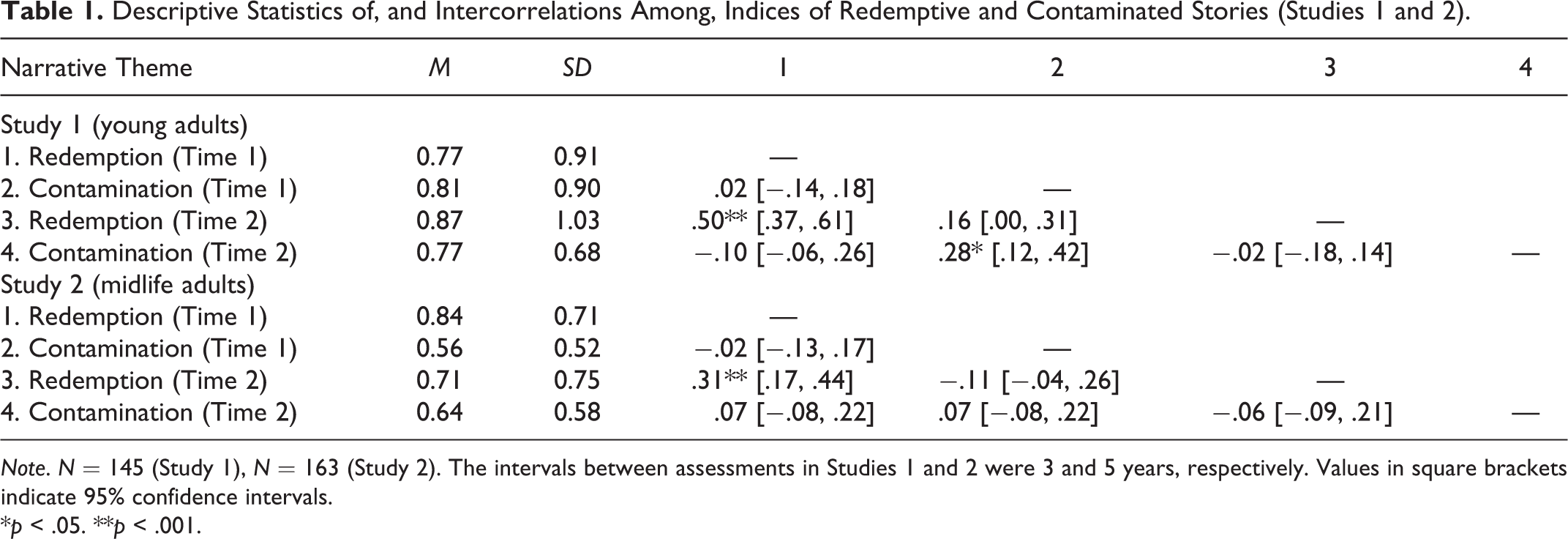
Note. N = 145 (Study 1), N = 163 (Study 2). The intervals between assessments in Studies 1 and 2 were 3 and 5 years, respectively. Values in square brackets indicate 95% confidence intervals.
*p < .05. **p < .001.
Rank-Order Stability Coefficients and Demographic Predictors of Rank-Order Stability for the Frequency of Redemptive and Contaminated Scenes in Participants’ Key Autobiographical Scenes (Studies 1 and 2).

Note. N = 145 (Study 1), N = 163 (Study 2). The intervals between assessments in Studies 1 and 2 were 3 and 5 years, respectively. Values in square brackets indicate the 95% confidence intervals.
To examine the mean-level change of the redemptive stories in participants’ key scenes, we conducted a 2 (cohort: freshmen, seniors) × 2 (time: first year of the study, last year of the study) analysis of variance (ANOVA) wherein frequencies of redemptive stories served as the dependent variable. In this analysis, main effects were not observed for time or cohort, Fs(1, 143) = 2.99 and 0.01, ps = .09 and .92,
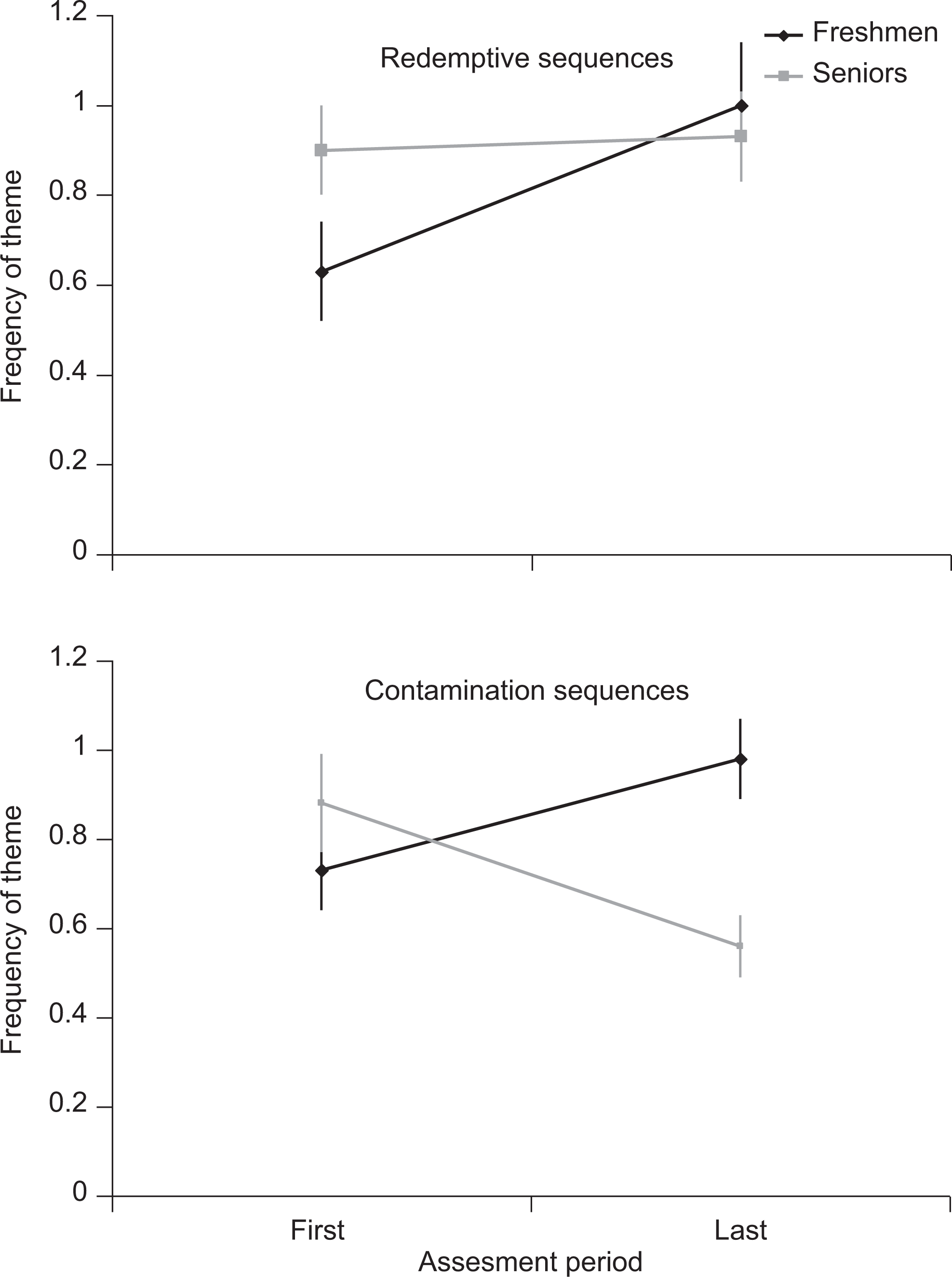
Changes in the frequency of redemptive and contaminated key autobiographical scenes among college freshmen and seniors (Study 1). Error bars denote standard error of the mean.
A parallel analysis was performed when examining changes in the frequencies of contamination stories. In this analysis, main effects were not observed for time or cohort, Fs(1, 143) = 0.05 and 1.41, ps = .82 and .24,
Discussion
There are several noteworthy findings in Study 1. First, consistent with previous research (e.g., McAdams et al., 2006), we noted that themes of redemption and contamination exhibited a moderate degree of rank-order consistency. Second, individual stability coefficients did not vary as a function of participants’ demographic information. Third, the frequency of both redemptive and contaminated scenes changed substantially with time. Freshmen participants increased throughout college in their tendency to construct redemptive stories. Although, contrary to hypotheses, college seniors did not exhibit a comparable increase in this tendency, their initial frequency of redemptive stories was equivalent to the frequency of such stories our college freshmen came to exhibit throughout the course of our study.
The pattern observed with respect to frequencies of contamination stories was somewhat more complex. Throughout college, participants increased in the tendency to construct contaminated stories. After college, however, individuals decreased in this tendency. One explanation for this finding is that fledgling narrators may have a tendency to experiment with identities of various sorts, as they begin engaging with this storied form of self-understanding (see also Habermas & de Silviera, 2008). Once this experimental phase has subsided, and possibly due to the feedback they have received from listeners (cf. Baddeley & Singer, 2008), authors move away from a contaminated self and toward a more socially approved sense of self-understanding.
In any manner, Study 1’s results align with the proposal that, as individuals progress through late adolescence to early adulthood, they begin to more readily engage with the applicable master narratives (Hammack, 2011). It remains an open question whether our findings apply to all young adults within the applicable cultural context or, alternatively, if they pertain solely to those young persons who find themselves in a college (or perhaps a selective private college). More broadly, it remains unclear whether the occurrence of certain events (e.g., attending college, having a child; see Lüdtke, Roberts, Trautwein, & Nagy, 2011; Specht, Egloff, & Schmukle, 2011) corresponds with shifts in narrative identity.
Study 2
In Study 2, we again sought to document the degree of rank-order consistency and mean-level change in, as well as the individual stability of, the redemptive and contaminated imagery in participants’ key autobiographical scenes. We also sought to examine this consistency/change at a different period in the adult life span: midlife. Our primary intent, however, was to determine whether changes in the redemptive content of participants’ narratives could be accounted for by changes in their life circumstances. We chose to focus on redemption in this regard as, relative to contamination, it carries far greater theoretical and empirical weight, particularly within American contexts (McAdams, 2006). In the interest of thoroughness, however, we also considered changes in the degree to which participants’ stories were contaminated in relation to changes in life circumstances.
There exists a wide array of life events that have been examined in relation to the development of other, nonnarrative aspects of personality (e.g., Lüdtke et al., 2011; Specht et al., 2011). In the current study, changes in employment status were considered. These changes take various forms: job loss, retirement, and accepting a promotion. Irrespective of whether the change in employment status pertains to job loss or job advancement, however, destabilization and stress are likely to result (Feldman & Brett, 1983; Gowan, 2014). Narrative identity is meant to keep pace with the many developments and changes in life and, given this inherent destabilization and stress, which contrasts with the optimistic and positive nature of redemptive sequences (McAdams & Guo, 2015), we predicted that changes in the employment status of our participants would correspond with reductions in the frequency of their redemptive stories.
Method
The data for Study 2 were drawn from a larger study, the Foley Longitudinal Study of Adulthood (FLSA; see Manczak, Zapata-Gietl, & McAdams, 2014; McAdams & Guo, 2015). In FLSA, participants (N = 163) complete a battery of questionnaires on a yearly basis and, in Years I, V, and IX, take part in a semistructured LSI (McAdams, 2008). The battery of questionnaires administered during the first assessment contained measures of personality traits and life satisfaction (described in below). In FLSA, we sought to incorporate as many participants as possible within our recruitment timeline. The present study relies upon data collected during Years I–V of FLSA and represents the first to examine the repeated assessment of narrative identity in this data set (i.e., all previous published works have considered measures of narrative identity collected during the first assessment).
Approximately 8% of our sample did not complete the second LSI (occurring during Wave V). Participants who did and did not return to complete this second LSI were comparable in terms of levels of narrative redemption and contamination, as measured during the first assessment period (ps ≥ .12). The LSI administered during Years I and V in turn contained prompts for five key scenes whereas the questionnaire battery in Waves II–V promoted participants to indicate whether their employment status had changed during the previous year. Participants were classified as experiencing a change in employment status if they noted that this status had changed at any point since they completed their LSI during Wave I.
Conceptual Coding of Narratives
In our analyses, we considered participants’ high points, low points, and turning points. These are the most commonly considered key scenes within personality and social psychology (e.g., Cox & McAdams, 2014; McLean & Pratt, 2006). Also, these three key scenes were assessed in Study 1, allowing for a closer comparison between samples. Two independent raters each read the verbatim transcripts of participants’ key scenes and coded them for the presence (+1) or absence (0) of a redemptive and contaminated sequences (90% and 94% agreement, and κs = .75 and .82). Ratings of redemption and contamination made by raters were then averaged (see Table 1 for descriptive statistics). We once again summed these frequencies, resulting in a single score of redemption and contamination for each participant.
Nonnarrative Variables
During the first wave of assessment, participants completed the 60-item NEO Five Factor Inventory (NEO-FFI; Costa & McCrae, 1992), which provides scores on extroversion, agreeableness, conscientiousness, emotional stability, and openness to experience. Participants also completed Diener, Emmons, Larsen, and Griffin’s (1985) measure of life satisfaction.
Data Imputation
We paralleled the data imputation employed in our earlier study, again using MICE (van Buuren & Groothuis-Oudshoorn, 2011), and again using participants’ scores on the applicable narrative theme at Time 1, their personality traits (assessed during the first time point), and life satisfaction (assessed at both time points), as well as their age (in years), gender (male/female), change in employment status (present/absent), and ethnicity (Caucasian/non-Caucasian) to predict the applicable narrative theme during Year V.
Results
Table 1 provides the rank-order consistency in the frequencies of redemptive and contaminated stories (assessed 5 years apart). As was the case in Study 1, the frequency of redemptive sequences in participants’ key autobiographical scenes exhibited a moderate degree of rank-order consistency. In contrast to the results of Study 1, however, the degree of rank-order consistency in the frequency of contamination sequences was not statistical significant. Finally, evident from Table 2, individual stability coefficients did not vary as a function of participants’ age, gender, or ethnicity.
To determine the degree of mean-level change in the frequency of redemptive stories between Waves I and V as well as whether changes in the employment status of our participants between Waves I and V accounted for any observed variability in these stories, we conducted a 2 (time; Wave I, Wave V) × 2 (employment status; changed, constant) ANOVA with the frequency of redemptive stories serving as the dependent variable. We did not observe a main effect for employment status, F(1, 157) = 0.30, p = .86,
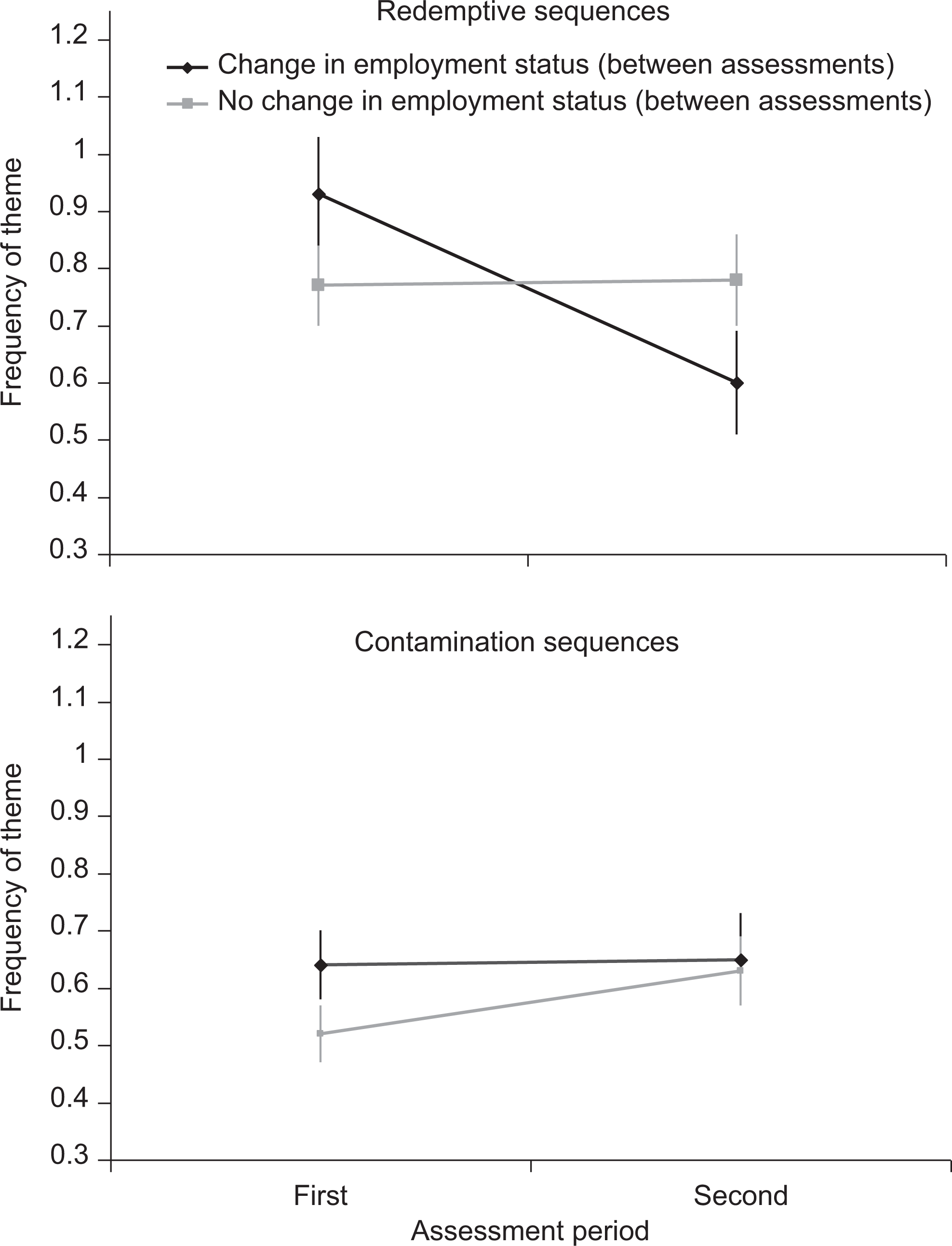
Changes in the frequency of redemptive and contaminated key autobiographical scenes as a function of changes in employment status (Study 2). Error bars denote standard error of the mean.
An equivalent analysis was performed in the interest of examining changes in the frequencies of contamination stories in relation to changes in employment status. As depicted in Figure 2 (Panel B), a main effect was not observed for time or cohort, Fs(1, 157) = 1.01 and 1.16, ps = .38 and .28,
Discussion
This study is the first to examine whether changes in life circumstances correspond with changes in narrative identity. Consistent with our hypothesis, those who experienced shifts in employment status following their first LSI exhibited a reduced frequency of redemptive stories during their 5th-year interview. These results suggest that, in a matter akin to the development of personality traits (e.g., Roberts & Wood, 2006), the development of narrative identity is predicted by the occurrence of certain events and life circumstances. There did, however, exist boundary conditions to this fluidity. Specifically, the frequency of contamination stories did not show a comparable degree of responsiveness to changes in participants’ life circumstances. This may be due to any number of factors, including the fact that redemption is a relatively salient theme within American contexts (contamination is not) as well as the low frequency with which contamination stories were observed. Indeed, the low frequency of contamination stories, and the corresponding restriction of range, may have also played a role in the low degree of rank-order consistency and mean-level change we noted in this sample (see Tabachnick & Fidell, 2007).
General Discussion
Redemptive stories are a mainstay of American culture and American lives (McAdams, 2006) and a complete understanding of redemption requires consideration of contamination, which represents its antithesis. In the current series of studies, we sought to determine the degree of stability and change in the tendency to construct redemptive and contaminated autobiographical stories. We also determined whether changes in the tendency to construct redemptive and contaminated stories could be accounted for by shifts in life circumstances. These issues were explored in two samples drawn from distinct periods in the life span (young and midlife adulthood).
Among our young adults, we noted that the frequency of redemptive stories increased throughout college, ultimately reaching a level comparable to that observed among our college seniors during both time points (i.e., when members in this group were seniors and then 3 years later). This pattern of findings suggests that late adolescence/early adulthood may be the developmental period in which individuals begin to more actively engage with, and in the case of redemption, adopt the master narrative(s) pertinent to the corresponding cultural context.
The aforementioned pattern of findings is made all the more interesting when it is considered in tandem with our examination of contaminated stories. Here, freshmen increased throughout college in their tendency to construct contaminated stories, ultimately reaching a frequency comparable to that observed among our college seniors during the first assessment period. As college seniors progressed, however, their tendency to construct contaminated stories decreased. On a collective whole, the aforementioned findings suggest that acculturation to the rhetoric of redemption may be less protracted than that of the rhetoric of contamination.
An alternative possibility regarding these findings is that undertaking the pursuit of an undergraduate education may contribute to the framing of one’s life as being both redemptive and contaminated. Unfortunately, the data collected in Study 1 did not allow us to directly test this, as our sample contained only those late adolescents/young adults who were pursuing a college career. The broader possibility, however, that life events come to impact the nature of narrative identity was considered in Study 2. We did this by exploring whether, among a sample of midlife adults, shifts in employment status corresponded with variations in the tendency to construct redemptive and contaminated stories. Given that experiencing flux in one’s job prospects and occupational status is known to create lower morale and heightened stress (Feldman, & Brett, 1983; Gowan, 2014), we predicted and found that experiencing a shift in employment status corresponded with a decrease in the redemptive imagery of participants’ stories. This research is the first to document a relation between changes in life experiences on the one hand and, on the other, changes in narrative identity.
In future, researchers should build upon the current studies, by considering the events and life circumstances that may correspond with, and perhaps even predicate, changes in narrative identity. While doing so, these researchers should work to determine the conditions under which narrative identity functions as a barometer of functioning (i.e., when it changes to mirror the timbre of life experiences, as was the case in Study 2) and the conditions under which it functions as a resource to be drawn from in the face of life’s inevitable challenges. For example, it is likely that the occurrence of certain events actually enhance the redemptive nature of an individuals’ story, whereas the occurrence of others works to do the opposite. The incorporation of a greater number and more varied events (e.g., events ranging in valence, chronicity, time of onset in the life span) in the longitudinal study of narrative identity will be required to address this intriguing possibility.
Researchers should also consider the inherent limitations of the current work, including the degree of participant attrition, the limited number (i.e., two) of time points considered in each study and the corresponding possibility that some of the mean-level changes documented here are a product of regression to the mean, and the fact that our method for assessing the presence/absence of a shift in employment status did not allow us to distinguish those individuals who had experienced a loss or reduction in their employment from those individuals who had found employment. Research undertaken in this spirit will provide a platform from which to examine the development of people through time, both as a function of life experiences and as the interrelation among the constructs constituting their personalities.
Footnotes
Declaration of Conflicting Interests
The author(s) declared no potential conflicts of interest with respect to the research, authorship, and/or publication of this article.
Funding
The author(s) disclosed receipt of the following financial support for the research, authorship, and/or publication of this article: Data gathering for this article was supported by a grant to the third author by the Foley Family Foundation.