



Abstract
Eyewitness misidentification is the primary cause of wrongful convictions in North America. Discovering a discernible pattern to these errors is a critical step toward creating procedures that reduce the occurrence of these tragic mistakes. To these ends, we hypothesized that both the victims’ race and the victims’ sex may impact eyewitness identification for perpetrators of certain crime types. In two experiments, we demonstrated that a Black male drive-by shooter’s level of phenotypic stereotypicality is accurately identified by eyewitnesses only when the victims are Black males. Specifically, when eyewitnesses believe the victims are White or female, the drive-by shooter’s level of Black phenotypic stereotypicality is falsely elevated. In contrast, when a Black male perpetrator is suspected of committing a stereotypically non-Black crime (i.e., serial killing), the perpetrator’s level of phenotypic stereotypicality is accurately identified regardless of the victims’ race or sex.
Keywords
Perceived stereotypicality, also known as phenotypic stereotypicality, is the degree to which individuals are seen as possessing the physical features that are prototypical of their group. For example, perceived Black stereotypicality is the degree to which a person is viewed as phenotypically representative of the Black racial group (Blair, Judd, & Chapleau, 2004a; Blair, Judd, & Fallman, 2004b; Blair, Judd, Sadler, & Jenkins, 2002; Eberhardt, Davies, Purdie-Vaughns, & Johnson, 2006; Eberhardt, Goff, Purdie, & Davies, 2004; Livingston & Brewer, 2002; Maddox & Gray, 2002). Individuals high in perceived Black stereotypicality (e.g., broad nose, full lips, and dark complexion), when compared to those considered low, are falsely assumed to have a stronger racial identification, to engage in more racially stereotypic behavior, and to have more racially stereotypic attitudes and interests (Blair et al., 2004b; Hebl, Williams, Sundermann, Kell, & Davies, 2012; Wilkins, Kaiser, & Rieck, 2010). And, of particular interest to the present research, highly stereotypic Black males are perceived as being more dangerous, violent, and criminal than their counterparts who are low in perceived stereotypicality (Eberhardt et al., 2006; Eberhardt et al., 2004; Kahn & Davies, 2011; Kleider, Cavrak, & Knuycky, 2012; Knuycky, Kleider, & Cavrak, 2014; Ma & Correll, 2011). To illustrate, when police officers are primed to think about violent crime, they falsely elevate the perceived stereotypicality of Black male faces they have previously witnessed (Eberhardt et al., 2004).
People have clear stereotypes about who commits what types of crimes (Bull & McAlpine, 2003; Dumas & Testé, 2006; Glaser, 2014; Gordon, Michels, & Nelson, 1996; Jones & Kaplan, 2003; Oliver & Fonash, 2002; Osborne & Davies, 2013). Unfortunately, if a suspect’s appearance matches cultural stereotypes regarding who commits what types of crimes, the suspect is judged to be more culpable and receives a harsher sentence (Berry & Zebrowitz, 1988; Bodenhausen & Lichtenstein, 1987; Glaser, 2014; Glaser, Martin, & Kahn, 2015; Jones & Kaplan, 2003; van Knippenberg, Dijksterhuis, & Vermeulen, 1999). For example, in our previous research examining convicted murderers, Black males high in perceived stereotypicality were more than twice as likely as those low in perceived stereotypicality to receive the death penalty (Eberhardt et al., 2006). This sentencing disparity, however, only emerged when the male victims were White. In other words, the perceived stereotypicality of the perpetrator had no impact on death sentencing when the male victims were Black (Eberhardt et al., 2006).
Williams, Demuth, and Holcomb (2007) also investigated the sentencing of convicted murderers to examine whether the sex of the victim could further impact sentencing disparities. Williams and colleagues confirmed that both the victim’s race (White vs. Black) and the victim’s sex (female vs. male) were independent significant predictors of harsher sentencing. Not surprisingly, those cases involving Black male victims significantly differed from all other victim groups: “This finding is notable in that it seems to set Black male victim cases apart from all others in terms of leniency afforded to their killers” (p. 879).
In short, perpetrators who target females receive harsher sentences than perpetrators who target males (Baumer, Messner, & Felson, 2000; Curry, 2010; Holcomb, Williams, & Demuth, 2004; Stauffer, Smith, Cochran, Fogel, & Bjerregaard, 2006; Williams et al., 2007), and perpetrators who target Whites receive harsher sentences than perpetrators who target Blacks (Baldus, Pulaski, & Woodworth, 1983; Baldus, Woodworth, & Pulaski, Jr., 1984, 1990, 1994; Baldus, Woodworth, Zuckerman, Weiner, & Boffitt, 1997; Eberhardt et al., 2006; Williams et al., 2007). Criminologists have argued that these sentencing disparities may stem from the fact that women and Whites are perceived as less blameworthy for their victimization; consequently, perpetrators who target women or Whites are seen as more culpable than perpetrators who target Black males (Barrett & George, 2005; Steffensmeier, Ulmer, & Kramer, 1998; Williams et al., 2007).
Eyewitness Misidentification
A large body of research has documented the factors that can affect the accuracy of eyewitness memory and identification (Clark & Godfrey, 2009; Deffenbacher, Bornstein, Penrod, & McGorty, 2004; Loftus, Loftus, & Messo, 1987; Meissner & Brigham, 2001; Osborne & Davies, 2014; Steblay, 2015; Wells & Olson, 2003). Wells (1978) was the first to make an important distinction between how estimator and system variables can impact eyewitness accuracy. Estimator variables are factors impacting the eyewitness during the crime itself (e.g., viewing conditions, race of perpetrator, etc.). System variables refer to factors that are controllable by law enforcement once they arrive at the crime scene and subsequently conduct their criminal investigation (e.g., lineup construction, information provided to witnesses, etc.).
Anything that interferes with the perception and encoding of relevant information during a crime can affect the accuracy of eyewitness identification. For example, the amount of time eyewitnesses are able to see a perpetrator positively correlates with identification accuracy (MacLin, MacLin, & Malpass, 2001; Meissner & Brigham, 2001; Memon, Hope, & Bull, 2003; Pezdek & Blandon-Gitlin, 2005). Regardless of exposure time, however, identification accuracy can be impaired if the race of the perpetrator differs from the race of the eyewitness (Behrman & Davey, 2001; MacLin, Van Sickler, MacLin, & Li, 2004; Meissner & Brigham, 2001; Pezdek, Blandon-Gitlin, & Moore, 2003). This cross-race effect is found to be robust across both laboratory and field studies (Brigham, Maass, Snyder, & Spaulding, 1982; Meissner & Brigham, 2001; Platz & Hosch, 1988; Wright, Boyd, & Tredoux, 2001).
Potentially exacerbating the cross-race effect, Knuycky and colleagues (2014) discovered that highly stereotypic Black faces lead to a false sense of familiarity among eyewitnesses. The researchers argue that highly stereotypic Black faces are more likely to be mistakenly perceived as familiar because they are representative of the “Black” prototype. Knuycky and colleagues (2014) also found that this mistaken sense of familiarity led eyewitnesses to falsely accuse highly stereotypic Black individuals as being the perpetrator in perpetrator-absent lineups. As the researchers state, “These facts underscore the real-world significance of the results from the present study that suggest that Black men possessing stereotypical, compared with nonstereotypical, facial features are at an increased risk of being mistakenly identified as the perpetrator of a crime” (p. 45).
Interestingly, past research on eyewitness misidentification has overlooked the possibility that the specific crime type and/or victim type may influence identification accuracy. Our lab has conducted several experiments in an attempt to address this previous oversight (Osborne & Davies, 2013, 2014). Initially, dozens of crime types were evaluated to determine stereotypic links between certain races and certain crimes (Osborne & Davies, 2013). As hypothesized, participants indicated that suspects who appeared more phenotypically Black were more likely to commit stereotypically Black crimes (e.g., drive-by shooter) than stereotypically non-Black crimes (e.g., serial killer). In order to directly measure the distinct impact of crime types on eyewitness identification, we exposed participants to a suspect accused of either a stereotypically Black crime or a stereotypically non-Black crime. To control for several confounds, it was critical to employ a non-Black crime that was perceived to be as serious and violent as the Black crime. The two crimes that met our inclusion criteria were drive-by shooting and serial killing. Not surprisingly, participants evaluated the non-Black crime of serial killing as slightly more serious and violent than the Black crime of drive-by shooting, but these differences were not statistically significant (Osborne & Davies, 2013). Employing these two crime types, we ran an experiment in which participants were randomly assigned to watch a slideshow of a man (i.e., Black male suspect) leaving a building. Participants in both conditions watched the same core slideshow that differed only in the information provided on the first slide. In one condition, the first slide revealed that the man was a suspected drive-by shooter. In the other condition, it revealed he was a suspected serial killer. After watching their randomly assigned slideshow, participants were asked to identify the suspect’s level of perceived Black stereotypicality. Participants who watched the suspected drive-by shooter falsely remembered the suspect as being higher in perceived Black stereotypicality than participants who watched the suspected serial killer (Osborne & Davies, 2013).
Since these initial studies, we have consistently found that participants who are exposed to stereotypically non-Black crimes accurately identify the suspect’s level of perceived stereotypicality as do participants in control conditions who are exposed to Black males who are not criminal suspects (Osborne & Davies, 2013, 2014). It is important to note, however, that our previous research has never provided participants with any information regarding the victims of the crime. Having established that crime types can systematically influence eyewitness identification, the present research sought to examine whether victim type could further impact eyewitness identification. Specifically, we examined whether the race of the victims (i.e., White vs. Black) and the sex of the victims (i.e., female vs. male) could interact with crime types to further influence eyewitness identification.
Study 1
For this first study, we wanted to directly measure the impact of the victims’ race on eyewitness identification for perpetrators of stereotypically Black crimes. We hypothesized that our control condition, where participants are not told the race of the victims, would replicate our previous findings (Osborne & Davies, 2013, 2014). That is, eyewitnesses to a stereotypically Black crime should falsely identify the suspect as being more phenotypically Black in appearance than he is in reality. It was less clear, however, what would happen when participants were informed about the race of the victims. Considering past research (Eberhardt et al., 2006; Williams et al., 2007), we hypothesized that informing participants that the victims were White males may further exaggerate perceived stereotypicality errors, whereas Black male victims may attenuate those errors.
Method
Participants
A total of 143 undergraduate students at the University of British Columbia (UBC) were recruited for this online study and were offered either 0.5 research credit toward their UBC psychology course or CAN$5 in exchange for their participation. Students who volunteered were sent a link to the online site for the study (via Qualtrics, 2015; http://www.qualtrics.com). Our sample consisted of 67 women and 76 men. Participants self-identified as White (106), Asian (16), Black (15), Latino/Latina (1), or “Other” (5). The participants’ mean age was 21.38 years. None of the above-mentioned demographic variables significantly impacted our results, so they will not be discussed further.
Seven participants failed our manipulation check, which required participants to remember the condition to which they had been randomly assigned (i.e., Black victims, White victims, or no-race control condition). As a result of this manipulation-check failure, the data from those seven participants are not included in the above-mentioned demographic information, nor does it appear anywhere else in this article. Our previous eyewitness paradigms have revealed effect sizes ranging from small to medium (Osborne & Davies, 2013, 2014). Power analysis using G*Power software (Version 3.1; Erdfelder, Faul, & Buchner, 1996) indicated that for effects of this size to be detected (80% chance), at a 5% level of significance, approximately 40–50 participants would be required per cell for both Studies 1 and 2.
Design
This experiment was a between-participants design with three conditions. All participants watched a surveillance video of a Black male accused of committing a stereotypically Black crime (i.e., drive-by shooting). Following exposure to the surveillance video, participants were randomly assigned to their victim–race condition (i.e., Black victims, White victims, or no-race control condition). Participants’ identification of the perceived Black stereotypicality of the suspect in the surveillance video was our dependent measure. 1
Procedure and Materials
Following informed consent, all participants were told that they were about to watch a surveillance video of a criminal suspect leaving a building. The surveillance video showed a moderately stereotypical Black male exiting an ambiguous building carrying nothing in his hands. All participants were led to believe that the perpetrator was suspected of committing a stereotypically Black crime (i.e., drive-by shooting). After watching the surveillance video, participants were provided with information about the three alleged victims of the drive-by shooter. Depending on their randomly assigned condition, participants were informed that the three male victims of the drive-by shooter were all Black, all White, or no racial information was provided (i.e., our no-race control condition). Participants in the Black and White victim–race conditions were shown photographs of three male victims of the drive-by shooter, whereas participants in our no-race control condition were simply informed that there were “three male victims of the drive-by shooter.” Pretesting confirmed that the Black and White male victims did not differ in their perceived attractiveness or age (Fs < 1.0).
Following exposure to their randomly assigned conditions, participants were asked to read an article on visual processing for 10 min. This article, How Photons Start Vision by Baylor (1996), served as a cognitive distracter task to conservatively replicate real-world eyewitness identification circumstances (i.e., memory impairment caused by the duration of time between witnessing the event and subsequent recall for that event).
After reading the article, participants were asked to identify the suspect that they witnessed in the surveillance video at the beginning of the study. Specifically, participants were shown a video that morphs the suspect’s face through 100 frames of Black phenotypic stereotypicality. The first frame of the morph (i.e., Frame 1) represents the lowest level of Black phenotypic stereotypicality, whereas the 100th frame of the morph represents the highest level of Black phenotypic stereotypicality. The suspect’s actual level of phenotypic stereotypicality was always at the midpoint of the morph, that is, the 50th frame. Frame 1 was created by determining the lowest level of phenotypic stereotypicality at which the suspect is still universally perceived to be Black. Frame 100 was then created by increasing the suspect’s phenotypic stereotypicality to the same degree that it was decreased in order to create Frame 1. Phenotypic stereotypicality was altered in Photoshop by manipulating the suspect’s nose width, fullness of lips, and skin color (see Osborne & Davies, [2013] for a detailed discussion of the morph’s creation). Participants were asked to stop the morph at the exact moment when the morphed face matched the suspect’s face they recalled from the surveillance video. The morphing software records the exact time at which the participant stops the morph, which serves as our dependent measure. Finally, the participants were asked a series of demographic questions, including their age, gender, and ethnicity. Participants were then thanked for their participation and fully debriefed.
Results
The perceived stereotypicality data were submitted to a one-way analysis of variance (ANOVA). Results from the one-way ANOVA confirmed that the alleged race of the victims had a significant impact on participants’ identification of the perceived Black stereotypicality of the suspect, F(2, 140) = 5.84, p = .004,
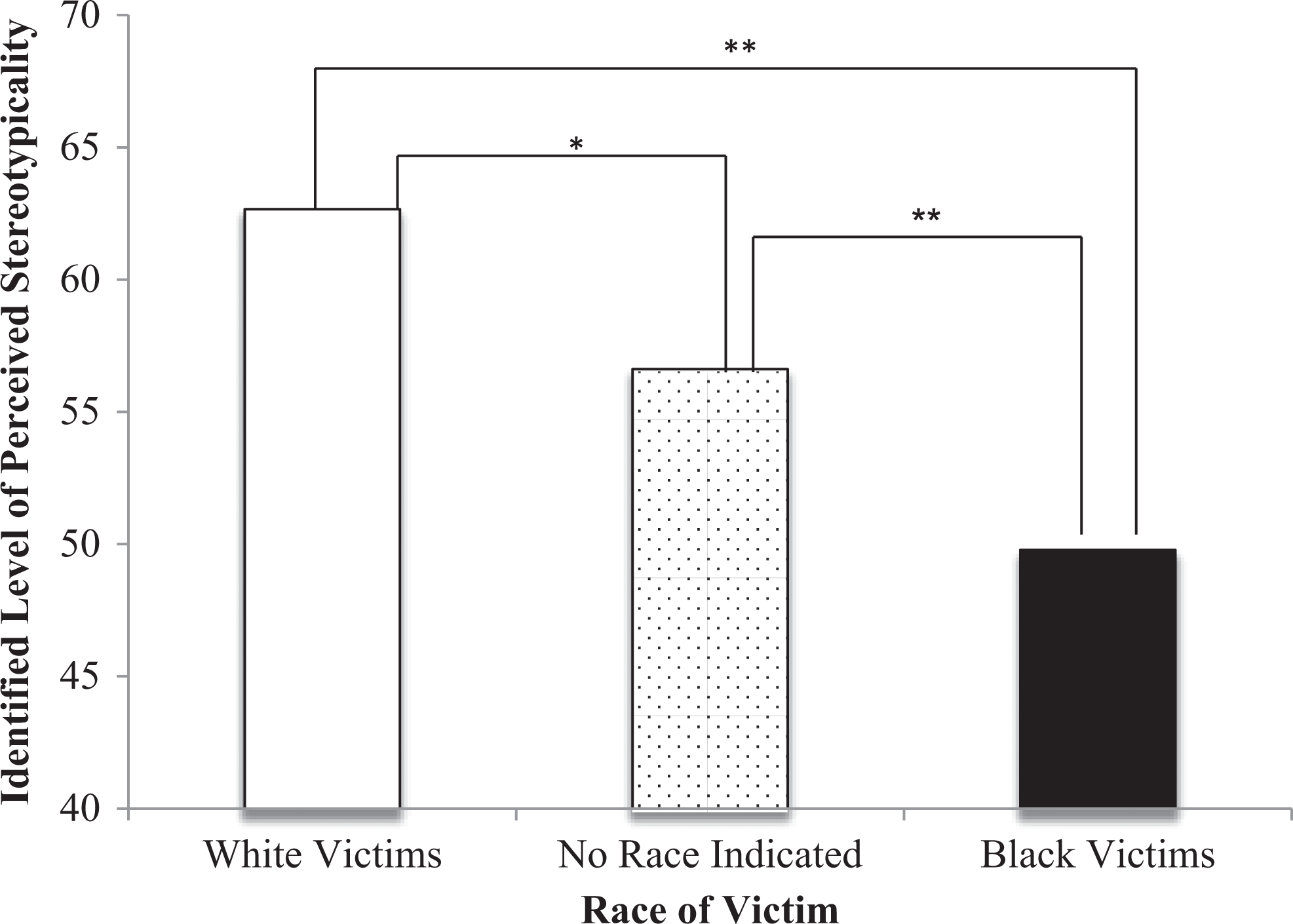
Identified level of perceived stereotypicality. Mean results of the effect of race of the victims on eyewitness identification of a suspected drive-by shooter. Perpetrator’s actual level of perceived stereotypicality is 50.00. *p ≤ .10. **p ≤ .05.
Eyewitnesses who believed the victims of the drive-by shooter were Black (M = 49.78, 95% confidence interval [CI]: [44.56, 55.00]) accurately identified the perceived stereotypicality of the suspect in the surveillance video. A one-sample t-test established that these participants’ identification of the suspect’s level of perceived stereotypicality (M = 49.78) did not differ from reality (M = 50.00), t(45) = −0.08, p = .94, d = 0.02. In contrast, a pair of one-sample t-tests confirmed that participants in both the no-race control condition (M = 56.62, 95% CI [51.76, 61.49]) and the White-victim condition (M = 62.67, CI [57.34, 68.01]) falsely identified the suspect as being more stereotypically Black than he is in reality, t(52) = 2.88, p = .006, d = 0.80 and t(43) = 4.36, p = .000, d = 1.33, respectively. Moreover, a simple effects test revealed that the suspect’s level of perceived stereotypicality identified by participants in the Black-victim condition (M = 49.78) was significantly different from participants in the White-victim condition (M = 62.67), F(1, 88) = 10.86, p = .001,
The above-mentioned findings for our no-race control condition replicates our previous research (Osborne & Davies, 2013), which provided participants with no information regarding the victims of the drive-by shooter. Study 1 also confirmed that informing eyewitnesses that the victims were White can exaggerate those perceived stereotypicality errors, whereas informing eyewitnesses that the victims were Black can attenuate those errors.
Study 2
As discussed earlier, when the victims’ race and sex are not specified, our previous research (Osborne & Davies, 2013, 2014) has consistently found that eyewitnesses accurately identify the level of perceived stereotypicality for Black males suspected of committing stereotypically non-Black crimes (e.g., serial killer). We questioned, however, whether having knowledge that the victims were White or female could impact these previous findings; consequently, we decided to have a control condition for Study 2 in which the perpetrator is a suspected serial killer (i.e., stereotypically non-Black crime). Our primary focus for Study 2, however, was to test whether the victims’ sex would interact with the victims’ race to further impact eyewitness identification of the suspect of a stereotypically Black crime (i.e., drive-by shooter).
Method
Participants
A total of 340 participants (183 females, 157 males) were recruited for this online study via the Amazon Mechanical Turk (M-Turk, 2016) Recruiting System. Only American citizens were recruited to participate in this study. Those who volunteered to participate on M-Turk were sent a link to the online site for the study (via Qualtrics, 2015; http://www.qualtrics.com). Participants who completed the study were awarded US$1.00 on their M-Turk account for their participation. Participants self-identified as White (265), Asian (39), Black (11), Latino/Latina (11), or “Other” (14). The participants’ mean age was 30.34 years, and 42.9% reported having completed at least an undergraduate university degree. The majority of our participants reported living in an urban setting (72%) and earning less than US$20,000 per year (61%). None of the above-mentioned demographic variables significantly impacted our results, so they will not be discussed further. Twenty-nine participants failed our manipulation check, which required the participants to remember the condition to which they had been randomly assigned. As a result of this manipulation-check failure, the data from those 29 participants are not included in the above-mentioned demographic information nor does it appear anywhere else in this article.
Design
Participants were randomly assigned to the Crime Type (serial killer/drive-by shooter) × Victims’ Race (White/Black) × Victims’ Sex (male/female) between-participants design. Participants’ identification of the perceived Black stereotypicality of the suspect in the surveillance video was the dependent measure for this experiment.
Procedure and Materials
The procedures and materials for Study 2 were identical to those outlined in Study 1 with the following exceptions. Depending on their randomly assigned condition, participants were led to believe that the perpetrator depicted in the surveillance video was suspected of committing either a stereotypically Black crime (i.e., drive-by shooting) or a stereotypically non-Black crime (i.e., serial killing). In reality, the two surveillance videos were identical other than the text overlaid on the initial frames of the video, indicating what crime the Black man was suspected of committing. After watching their randomly assigned surveillance video, participants were informed about the three alleged victims. Depending on their randomly assigned condition, participants were informed that the three victims were Black females, Black males, White females, or White males. Participants were then shown photographs of their randomly assigned three victims. Pretesting confirmed that the four groups of victims did not differ in their perceived attractiveness or age (Fs < 1.0). All subsequent procedures and materials for Study 2 were identical to those used in Study 1.
Results
The perceived stereotypicality data were submitted to a Crime Type (serial killer/drive-by shooter) × Victims’ Race (White/Black) × Victims’ Sex (male/female) between-participants ANOVA. Results from the above ANOVA revealed only a significant main effect for crime type, F(1, 332) = 15.77, p = .000,
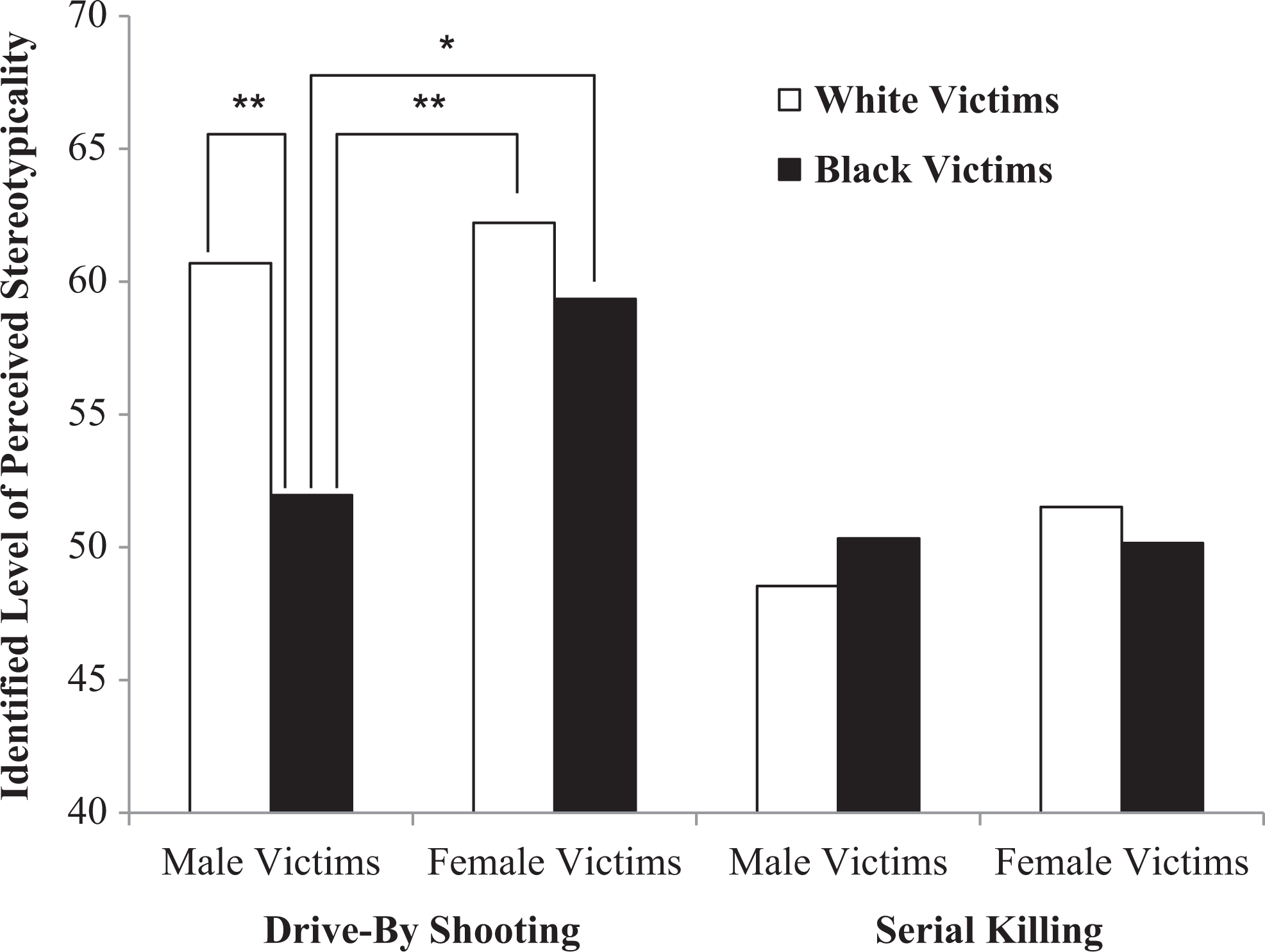
Identified level of perceived stereotypicality. Mean results of the effect of race and gender of the victims on eyewitness identification of a suspected drive-by shooter or serial killer. Perpetrator’s actual level of perceived stereotypicality is 50.00. *p ≤ .10. **p ≤ .05.
Our previous research has consistently found that eyewitnesses accurately identify the level of perceived stereotypicality for Black males suspected of committing stereotypically non-Black crimes (e.g., serial killer); moreover, the current research finds this to be true even when the victims are female or White. Indeed, a series of one-sample t-tests confirmed that participants in the four serial-killer cells (M = 48.54, 95% CI [42.67, 54.40]; M = 50.33, CI [44.47, 56.19]; M = 51.52, CI [45.66, 57.38]; M = 50.16, CI [44.23, 56.09]) accurately identified the suspect’s level of perceived stereotypicality (M = 50.00), t(42) = −0.53, p = .60, d = .16; t(42) = 0.45, p = .65, d = 0.14; t(42) = 0.12, p = .91, d = 0.03; t(41) = 0.05, p = .96, d = 0.02, respectively. In other words, the serial-killer condition served its intended purpose of being a control condition and replicated our previous serial-killer findings (Osborne & Davies, 2013, 2014). As such, we will now turn our attention to the drive-by shooter condition.
A Victims’ Race (White/Black) × Victims’ Sex (male/female) between-participants ANOVA on the drive-by shooter data revealed a significant effect for victims’ race, F(1, 165) = 3.91, p < .05,
Follow-up simple effects tests on the drive-by shooter data revealed that the suspect’s level of perceived stereotypicality identified by participants in the Black male victim condition (M = 51.96) was different from the three other cells: (a) the White male victim condition (M = 60.69, F(1, 85) = 4.92, p = .029,
General Discussion
Past research has assumed that there is no systematic pattern to who is mistakenly identified by eyewitnesses. Contrary to this assumption, our research consistently demonstrates that there are systematic errors in eyewitness identification that can be detected. We believe that these systematic errors may eventually lead to a distinct pattern of eyewitness misidentifications. As our research has documented, eyewitness identification can be impacted by crime types, victim types, and the interaction between the two. Once we fully understand the factors that can lead to errors in eyewitness memory, we can take proactive measures to safeguard against these potentially tragic misidentifications.
One step toward fully understanding these factors is to determine the relative roles played by the encoding and retrieval processes. Our present and previous research (Osborne & Davies, 2013, 2014) has always provided crime-type information to the participants prior to them being exposed to the suspect. While this design constancy has confirmed that we are consistently replicating our findings, this design does not shed any light on whether the eyewitness errors stem from encoding, retrieval, or some combination of those two processes. For example, cultural stereotypes regarding who commits what types of crimes could impact which aspects of the suspect’s appearance eyewitnesses are initially attending to and encoding during the crime (i.e., errors stemming from the encoding process). Alternatively, the suspect’s appearance could be accurately encoded, but those stereotypes regarding who commits what types of crimes could impact what is attended to when recalling the suspect’s appearance after the crime (i.e., errors stemming from the retrieval process). In short, errors during encoding impact what is originally placed into memory, whereas errors during retrieval impact what is subsequently recalled from that memory.
The present research was our first investigation of whether victim-type information could interact with crime-type information to impact eyewitness identification. Rather than providing victim-type information prior to exposure to the suspect, which again would shed no light on whether errors are stemming from encoding or retrieval, we decided to provide the victim-type information following exposure to the suspect. Our finding that postexposure information affects eyewitness identification confirms that the impact of victim-type information in the present research is attributable to the retrieval process. Specifically, we believe that eyewitnesses may reconstruct their original memory of the suspect during the retrieval process to better exemplify their stereotypes about who commits what types of crimes. Consequently, we hypothesize that the more a given suspect embodies those stereotypic expectations, the higher the risk of that suspect being mistakenly identified as the perpetrator of that crime (see also Knuycky et al., 2014).
Despite the current finding that the impact of victim-type information is attributable to the retrieval process, victim-type information could still impact the encoding process when that information is provided prior to perpetrator exposure. Additionally, we do not know whether the crime-type information will impact eyewitness identification via the same mechanisms as the victim-type information. If our goal is to determine the relative contributions that encoding and retrieval processes have on the crime-type and victim-type results, we would have to completely cross when those two separate pieces of information are provided relative to perpetrator exposure. To illustrate, first we would need to contrast providing information about both crime type and victim type prior to perpetrator exposure versus providing information about both crime type and victim type following perpetrator exposure. We would then have to contrast providing information regarding crime type prior to perpetrator exposure and information regarding victim type following perpetrator exposure (which is what we did in Study 2) versus providing information regarding victim type prior to perpetrator exposure and information regarding crime type following perpetrator exposure. All four of these conditions would have to be run, and the resulting data compared and contrasted, prior to being confident that the impact of any given crime-type and victim-type information on eyewitness identification is stemming from encoding, retrieval, or some combination of those two processes. Additionally, the above-mentioned four conditions would have to be run on a variety of crime types and victim types to ensure reliability of the underlying mechanisms. Clearly, there is still a lot of research to be conducted on the mechanisms underlying these effects; the present studies were just the first foray into investigating the potential impact of victim-type information on eyewitness identification.
None of our research to date has involved an eyewitness to a crime who is also the victim of that crime; that is, all of our participants have been bystander eyewitnesses. This is an important factor to note because a lot of the frailties associated with eyewitness memory and identification are exacerbated when the eyewitness is also the victim. For example, one estimator variable that would undermine a victim eyewitness more than a bystander eyewitness is the presence of a weapon during the crime. Research on the weapon-focus effect has confirmed that attention is automatically drawn toward the weapon, which leaves fewer resources for attending to other details—including the perpetrator’s appearance (Pickel, Ross, & Truelove, 2006). Witnessing a perpetrator pointing a gun at another person is a very different experience than having that gun pointed at you.
We have framed this article around the tragedy of misidentifications leading to wrongful convictions. Misidentifications, however, have multiple victims, not only the innocent individual who is wrongfully convicted but also the future victims of the actual perpetrator who was not incarcerated for the original crime. Consequently, we could have framed this article around the tragedy of not correctly identifying the actual perpetrator. Eyewitness misidentifications are egregious errors regardless of whether you are referring to the imprisonment of innocents or the freedom of offenders, which is why continuing to conduct eyewitness research is so essential.
Footnotes
Declaration of Conflicting Interests
The author(s) declared no potential conflicts of interest with respect to the research, authorship, and/or publication of this article.
Funding
The author(s) received no financial support for the research, authorship, and/or publication of this article.