



Abstract
The present longitudinal study used data from 187 newlywed couples to examine the impact of the birth of the first child on self-esteem over the course of the first 5 years of marriage. Results suggest that the birth of the first child is associated with changes in parents’ (especially mothers’) self-esteem. For the average parent, these changes were negative with sudden declines in self-esteem in the year after childbirth and continuing gradual decreases throughout the remaining years of the study. A comparison group of couples who did not have children during the research period showed no changes in self-esteem, suggesting that the results seen in the parent sample may indeed be due to the birth of the first child. Discussion focuses on the implications of the results for theory and research on the development of the self-esteem.
Self-esteem, a person’s subjective evaluation of his or her worth as a person, is considered a highly desirable trait that predicts a variety of important life outcomes, including relationship satisfaction, physical and mental health, educational success, and job satisfaction (Donnellan, Trzesniewski, Robins, Moffitt, & Caspi, 2005; Orth, Robins, Trzesniewski, Maes, & Schmitt, 2009; Sowislo & Orth, 2013; for a review, see Orth & Robins, 2014). In contrast to the broad literature on the consequences of self-esteem, research on the factors that shape self-esteem is relatively scarce.
Theory suggests that major life events can trigger change in self-esteem because such developmental turning points can modify, interrupt, or redirect life trajectories by altering individuals’ behavior, affect, cognition, or context (Orth & Robins, 2014; Pickles & Rutter, 1991). For example, during early adulthood, individuals typically engage in social roles, such as professional, spouse, or parent. A successful mastery of the new demands associated with these roles may convey a sense of mastery and may also lead to increases in self-esteem (Hogan & Roberts, 2004; Robins, Trzesniewski, Tracy, Gosling, & Potter, 2002).
The present research examined the impact of the birth of the first child on self-esteem. The transition to parenthood is a particularly relevant turning point to study change in self-esteem. In contrast to other life transitions, such as entering the first job or a romantic relationship, the transition to parenthood is almost always a nonreversible event. Also, the birth of a child requires sudden and oftentimes drastic changes in new parents’ daily behavior, routines, and relationships, which may have both sudden and continuous effects on their self-esteem (Belsky & Rovine, 1990; Nyström & Öhrling, 2004).
Self-Esteem and Major Life Transitions
Despite its relatively stable nature, self-esteem undergoes systematic developmental changes from young adulthood through old age. Specifically, self-esteem tends to be high in childhood, drops during adolescence, and rises gradually throughout adulthood before it declines in old age (Bleidorn et al., 2015; Chung et al., 2014; Lehnart, Neyer, & Eccles, 2010; Orth, Trzesniewski, & Robins, 2010; Wagner, Luedtke, Jonkmann, & Trautwein, 2013; for reviews see, Orth & Robins, 2014; Robins & Trzesniewski, 2005).
Perhaps surprisingly, few studies have examined whether and how self-esteem changes in response to major life transitions (e.g., Chen, Enright, & Tung, 2015; Wagner, Becker, Luedtke, & Trautwein, 2015). For example, Chung et al. (2014) examined students’ self-esteem development over 4 years of college. They found that self-esteem levels dropped during the first semester, rebounded by the end of the first year, and then gradually increased over the next 3 years, resulting in a significant mean-level increase in self-esteem from the beginning to the end of college. These findings suggested that the impact of a transitional event on self-esteem might be best described by a nonlinear trajectory; people might be adversely affected by the initial transition into a new role but gradually adapt to the new demands as indicated by later self-esteem increases.
Directly related to our research, Chen, Enright, and Tung (2015) examined self-esteem change in a large U.S. sample of youth, as they formed marital unions and had children. They found a positive interaction between parenthood status and age effects on self-esteem, suggesting a positive influence of parenthood on age-graded increases in self-esteem. Yet, the main effect of parenthood on self-esteem was negative, especially in mothers. Chen and colleagues concluded that the negative main effect likely reflects initial declines in self-esteem, which occur in response to the stress associated with the new parent role. After adjusting to the new demands, the authors theorized, the negative impact on self-esteem alleviates, possibly through cumulative parenting experience. However, due to a limited number of repeated measurements per participant, this study was not in the position to explicitly test such a nonlinear change pattern over time.
Based on the findings reviewed earlier, we predicted that during the transition to parenthood, change in self-esteem might be best described by a nonlinear or discontinuous trajectory. Discontinuous change (or piecewise change; Luhman & Eid, 2012) refers to change patterns, where the level of the outcome variable, the shape of change, and/or the rate of change differ between different time periods (e.g., before and after childbirth).
Based on previous research on normative self-esteem development in early adulthood, we predicted that parents’ self-esteem levels would increase over time. Yet, we expected a sudden drop in new parents’ self-esteem levels in response to the initial stress associated with childbirth, followed by a gradual increase as parents adapt to the new role demands.
Previous Research on the Transition to Parenthood
Ample research has examined the impact of the transition to parenthood on parents’ relationship quality (e.g., Belsky & Rovine, 1990; Doss, Rhoades, Stanley, & Markman, 2009) and well-being (e.g., Dyrdal & Lucas, 2013; Yap, Anusic, & Lucas, 2012). In contrast, the question of how this transition affects parents’ personality and self-esteem has received little attention; and the research that exists seems to paint a much more muddled picture than one would expect, given the importance of this event. Whereas some studies pointed to positive changes as indicated by increases in sociability (Jokela, Kivimäki, Elovainio, & Keltikangas-Järvinen, 2009), some suggested negative change as indicated by decreases in emotional stability (Specht, Egloff, & Schmukle, 2011), and others found no change in new parents’ personality traits (van Scheppingen et al., 2016).
The remarkable differences across studies may come down to differences in their research designs. Because experimental designs are not feasible in this research context, the field must rely on designs that use additional pieces of information to establish the nature and shape of change while ruling out potential confounds. A rigorous examination of pre- and postbirth change requires a longitudinal study that takes into account a number of complexities (Bleidorn, 2015; Doss et al., 2009; Luhmann, Orth, Specht, Kandler, & Lucas, 2014).
First, to understand how change in self-esteem unfolds before and after childbirth, longitudinal multiwave data are needed. Most previous studies on the transition to parenthood were restricted by two-wave designs which limit the analyses to linear-change models (van Scheppingen et al., 2016). In the case of childbirth, however, nonlinear or discontinuous change models might be more suited (Luhmann et al., 2014). These models require longitudinal data with more than three measurement occasions.
Second, change in self-esteem may already occur before the birth of the child (Dyrdal & Lucas, 2013). Studies that begin shortly before or at the time of childbirth may mistake prebirth changes for stable preexisting differences. To examine possible prebirth changes, prospective studies are needed that measure the variables of interest more than 1 time before the birth of the child.
Third, longitudinal studies on parents are at risk to mistake age-graded maturation for the effects of childbirth (Doss et al., 2009). To address this concern, studies on parenthood have begun to include nonparents as comparison groups. For example, Yap, Anusic, and Lucas (2012) have found that, although research consistently indicates that life satisfaction decreases in the first years after childbirth, the trajectory of parents following childbirth did not differ significantly from the trajectory of a comparison group of nonparents. Likewise, van Scheppingen et al. (2016) found no differences between the Big Five trajectories of parents and nonparents. These studies illustrate the importance of including comparison groups in the interpretation of change processes.
Fourth, parents can differ in their reaction and adaptation to childbirth (Dyrdal & Lucas, 2013). Not all individuals may experience the same changes in self-esteem over the transition to parenthood. Therefore, it is important to examine variability in change before and after the transition to parenthood.
Fifth, for most people, the transition to parenthood is a dyadic event and it may be that the trajectories of mothers and fathers are related. Hence, when analyzing data from couples of parents, it is important to take into account the nonindependence of dyadic data (Laurencau & Bolger, 2012; Raudenbush, Brennan, & Barnett, 1995).
In summary, a rigorous study of the extent and shape of dispositional change during the transition to parenthood needs to consider several complexities. The present study is the first that aimed to thoroughly address these complexities in the study of self-esteem during the transition to parenthood.
The Present Study
The present research used five-wave longitudinal data from newlywed couples to examine change in self-esteem in first-time parents as compared to couples who did not have children during the research period. Specifically, we used model fitting strategies to identify the model that best estimates the type and shape of change in self-esteem (cf. Doss et al., 2009). Eight potential change models were fitted to each individual’s data to identify the best-fitting model (Figure 1).
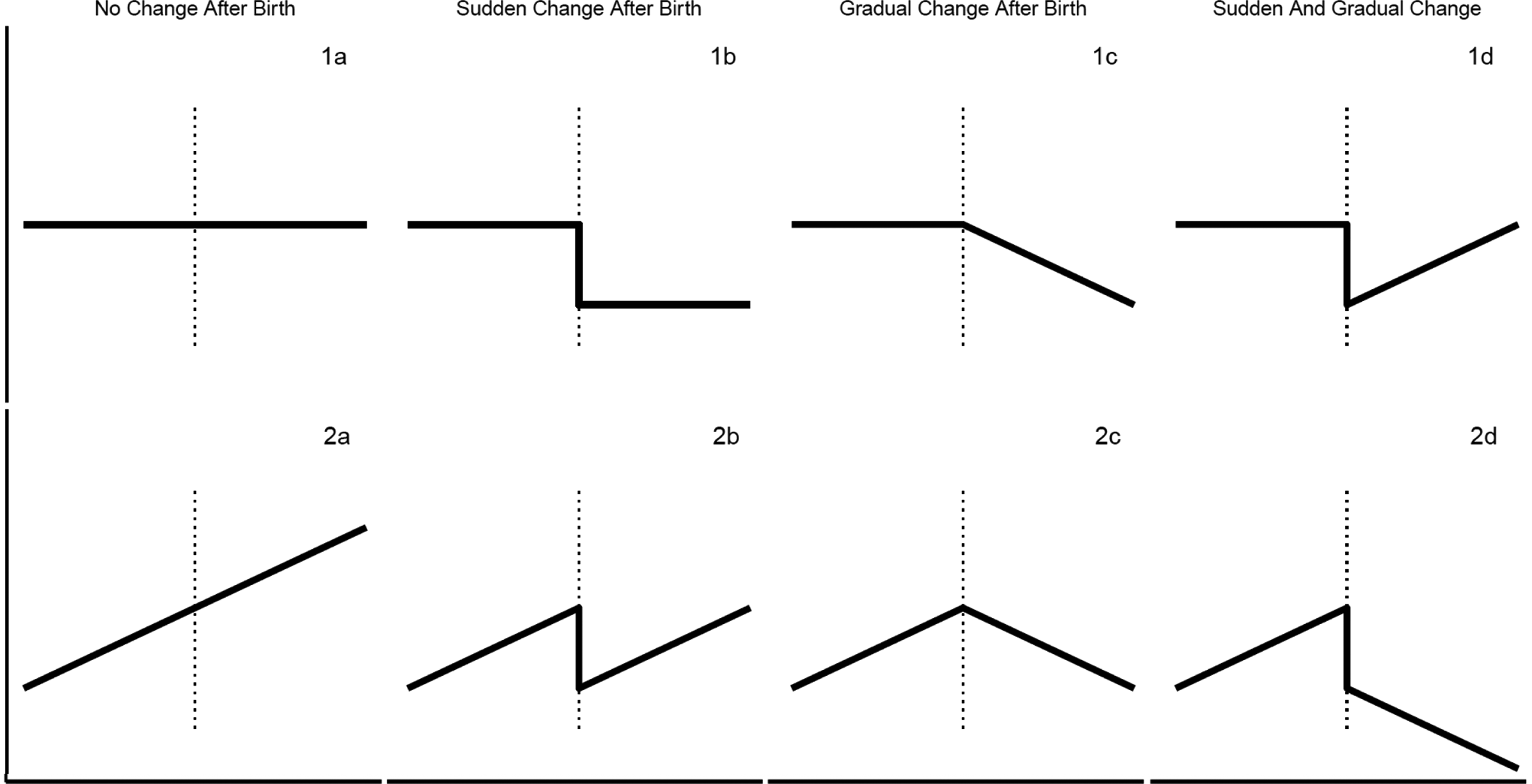
Theoretical models of change over the transition to parenthood. In the fitted models, the pre- and postbirth changes as well as sudden-level changes could have been positive or negative in direction. Dotted lines indicate timing of reported childbirth, and solid lines indicate possible changes in self-esteem (adapted from Doss et al., 2009).
The first two models (1a and 2a) would indicate no effect of childbirth. Model 1a would suggest no change in the construct either before, immediately following, or after the birth of the baby. Model 2a would suggest linear change in the construct both before and after birth; however, this change would not be attributable to childbirth. The remaining six models expand on these two models and would suggest a potential effect of childbirth on self-esteem. Models 1b and 2b would indicate a sudden shift (drop or rise) in self-esteem in the year following childbirth. Models 1c and 2c would indicate a gradual shift (increase or decrease) in self-esteem following birth that differs from the rate of change before childbirth. Models 1d and 2d would indicate both a sudden shift in the year after childbirth and gradual changes in the following years that differ from the rate of change before childbirth.
Based on previous theory and research, we predicted that model 2d would best describe change in self-esteem over the transition to parenthood; that is, we expected parents to show a moderate linear increase in self-esteem before childbirth, a sudden postbirth decline that is associated with the birth of the child, and a more pronounced linear increase during the years after childbirth.
To address possible alternative explanations, such as age-graded maturation, we tested whether changes that appear to be associated with the transition to parenthood were also observed in a comparison group of couples who did not have children during the same period.
In addition to our main research question, we explored whether there were significant between-person differences in the self-esteem trajectories. In case of significant between-person differences, we examined whether these were related to parents’ age at childbirth and their initial self-esteem levels. Finally, capitalizing on our dyadic design, we explored whether spouses’ self-esteem trajectories were related to each other.
Method
Participants and Procedure
We used data from the VU University Panel on Marriage and Well-Being, a five-wave longitudinal study among newlywed couples in the Netherlands. In the five waves, 199, 195, 190, 157, and 140 newlywed couples participated, respectively. On average, couples had been romantically involved for 5.71 years (SD = 3.03) and had been living together for 3.81 years (SD = 2.31); 98.5% of the husbands and 96.4% of the wives were Dutch.
Participants were recruited via the municipalities in which they got married. Selection criteria were that (1) for all participants this was their first marriage, (2) couples had no children at the first data collection, (3) both partners were between 25 and 40 years old, and (4) were heterosexual. Nineteen percent of the couples who were invited agreed to participate. Wave 1 took place in 2005, 1–2 months after marriage; the following waves took place at 1-year intervals (for more information, including ethical board, consent and assent procedures, see Finkenauer, Kerkhof, Righetti, & Branje, 2009; Pollmann & Finkenauer, 2009).
For the present research, we used data from couples who indicated at each assessment whether or not they (or their partners) had given birth to a child since the last assessment. Twelve couples did not provide information on whether they had a child or not; these couples were excluded from the analyses.
Of all couples who participated at least once, 132 couples (N = 264 individuals) reported that they had their first child during the research period (“parents”), 23 couples had their first child at Wave 2, 64 couples at Wave 3, 29 couples at Wave 4, and 16 couples at Wave 5 (Median = Wave 3). At the first wave, the mean age of fathers was 32.65 years (SD = 3.56) and the mean age of mothers was 29.98 years (SD = 3.36).
Fifty-five couples (N= 110 individuals) reported that they had no children before or during the research period (“nonparents”). At the first wave, the mean age of nonparent husbands was 32.81 years (SD = 6.84); the mean age of nonparent wives was 29.43 years (SD = 6.01).
Measures
At each measurement wave, self-esteem was assessed with a Dutch translation of the 10-item Rosenberg Self-Esteem Scale (Rosenberg, 1965), a commonly used and well-validated measure of self-esteem (Robins, Hendin, & Trzesniewski, 2001). Responses were measured with a 5-point Likert-type scale ranging from 1 (strongly disagree) to 5 (strongly agree). In the present study, α reliabilities ranged from .83 to .86 across assessments.
Self-esteem scores were transformed to the T-score metric using the grand mean and standard deviation of the overall sample across measurement waves. T-scores are standard scores with a mean of 50 and standard deviation of 10 and can be used to index effect sizes. According to Cohen (1988), a difference of two T-score points represents a small effect, a difference of five points represents a medium effect, and a difference of eight points represents a large effect.
Analyses
The data had a nested structure with two sources of nonindependence: First, as result of the repeated assessments over time, and second, as a result of the fact that each participant belonged to a couple. To take these dependencies into account, we used multilevel modeling techniques. Specifically, we first established the best-fitting change models for the parent and the nonparent samples separately for each gender. We then tested the best-fitting gender-specific models simultaneously in a dyadic multilevel model, which allowed for a direct comparison of spouses’ change trajectories by estimating a multivariate model with two intercepts, for the female and male partner (Laurenceau & Bolger, 2012). That is, participants’ annually reported self-esteem scores (Level 1) were considered as nested within couples (Level 2). We then combined the best-fitting dyadic multilevel models for parents and nonparents in a multiple group dyadic multilevel model and tested whether parents’ and nonparents’ trajectories were similar or significantly different from each other. All analyses were performed using Mplus (Version 7; Muthén & Muthén, 2012).
Model estimation
Prior to our main analysis, the time (in years) of each parent’s assessment was centered on the year of childbirth, so that the intercept represented the estimated self-esteem level in the year of the reported birth. To test whether nonparents experienced changes similar to parents at the same point in their marriage, the time of each nonparent’s assessment was centered around the median time of childbirth elapsed from the parent sample (i.e., Wave 3; cf. Doss et al., 2009).
Models 1a and 2a were tested using parameterizations of an intercept-only model (1a) and an intercept + linear time model (2a). To test Models 1b and 2b, we added a single variable (“level”) to the initial models that had a value of 0 for all assessments that occurred before the time of childbirth and a value of 1 for all the assessments that occurred after the birth (for nonparents, the median time of childbirth elapsed from the parent data). Models 1c and 2c as well as 1d and 2d were fitted to the data using piecewise models that estimated a linear rate of change before childbirth and a separate linear rate of change after childbirth (Luhmann & Eid, 2012).
Fixed effects at Level 1 were allowed to vary randomly at Level 2 if the difference in log-likelihoods between models with and without the random effect was significant. If there was significant Level-2 variance in the slopes, we tested whether this was related to individual differences in parents’ age at childbirth or initial self-esteem levels. Spouses’ intercepts and slopes were allowed to covary at Level 2 (Laurenceau & Bolger, 2012).
Model fitting
To determine the best-fitting models, we compared the fit of nested models using χ2 difference tests based on log-likelihood values and scaling correction factors using maximum likelihood estimation with robust standard errors (Satorra, 2000). For non-nested models, we used the Bayesian information criterion (Schwarz, 1978).
Results
Preliminary Analyses
Prior to our main analyses, we tested whether parents and nonparents already differed from each other with regard to age or self-esteem levels at the first assessment wave. Independent t-tests indicated that none of these differences were significant. At the first assessment, parent wives and nonparent wives did not differ with regard to their age, t(185) = 0.80, p = .43; d= 0.11, and self-esteem, t(181) = −0.90, p = .37; d = 0.15. Likewise, parent and nonparent husbands did not differ with regard to age, t(185) = −0.22, p = .83; d = 0.03, and initial self-esteem, t(184) = 0.80, p = .94; d = 0.01.
Pre- and Postbirth Change in Self-Esteem
To analyze pre- and postbirth change in self-esteem within the parent sample, we first selected the best-fitting gender-specific models for mothers and fathers. Based on the results of the gender-specific analyses, we then built a dyadic multilevel model, which included the intercepts and all relevant change parameters of the best-fitting models for both mothers and fathers (Table 1; Figure 2).
Results of Best-Fitting Dyadic Multilevel Models for Self-Esteem in Parents.

Note. The data were centered at the time of childbirth. Dashes indicate model components that were not estimated in the best-fitting model for that gender or group. CI = confidence interval; B = unstandardized multilevel regression coefficient; Level-2 VAR = variance of Level-2 random effects.
*p < .05. **p < .01. ***p < .001.
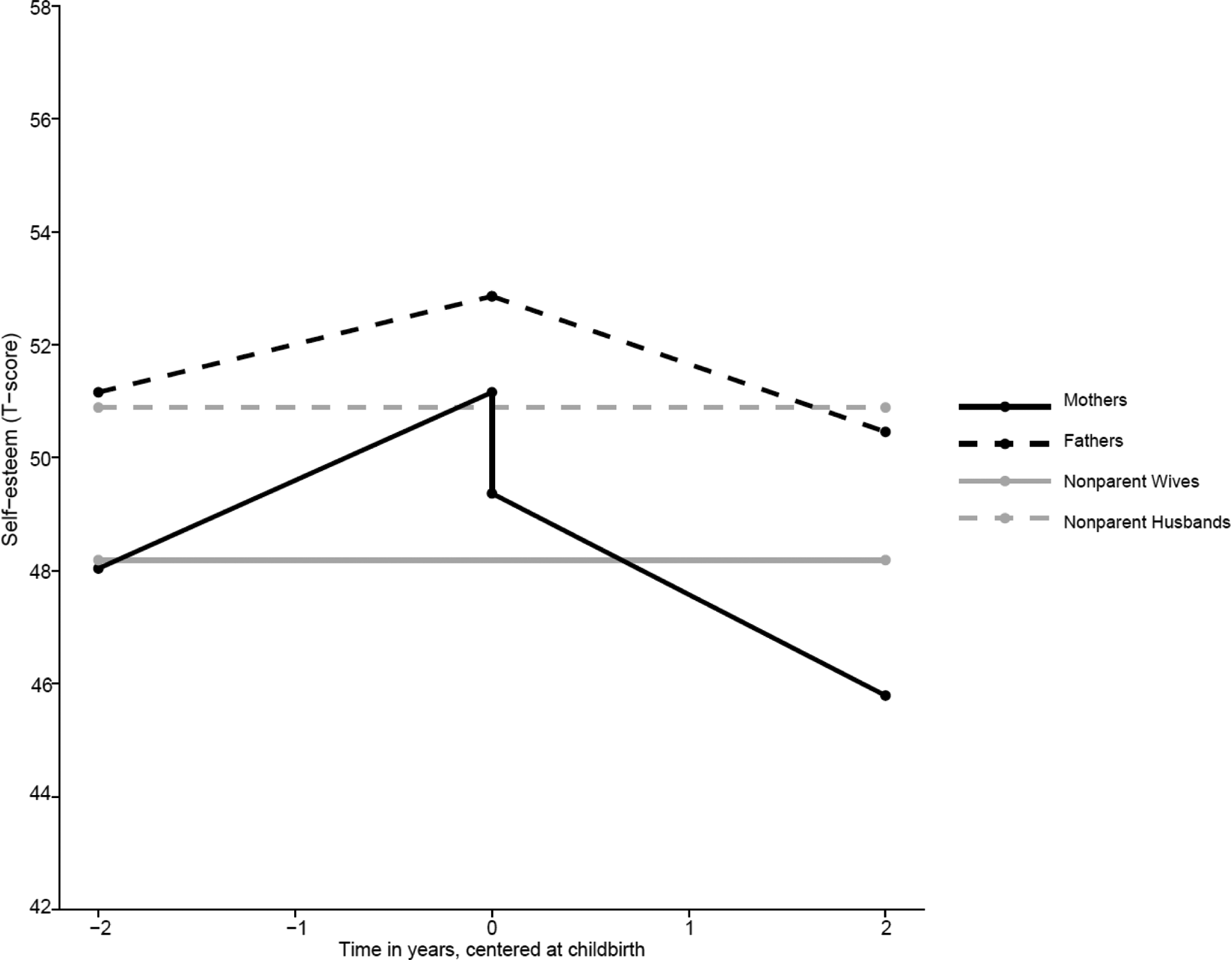
Estimated change in self-esteem for parents and nonparents. The black lines represent the estimated slopes for parents; the gray lines represent the estimated slopes for nonparents. A time of zero on the x axis represents the time of childbirth for parents and 3 years following the first assessment (i.e., the median timing of birth in the parent sample) for nonparents, respectively.
The best-fitting self-esteem model for mothers was Model 2d, indicating a linear increase before childbirth, a sudden decline in the year after childbirth, and a linear decrease during the years following childbirth. The Level-2 variance for all three slopes was not significant, suggesting no significant individual differences in mothers’ self-esteem trajectories.
For fathers, the best-fitting model was Model 2c, indicating a linear prebirth increase in self-esteem and a linear decrease after the birth of the first child. Model comparison tests indicated that there was significant variability in fathers’ prebirth trajectories.
For both mothers and fathers, the absolute rates of change ranged between 0.85 and 1.79 T-score points per year. According to Cohen’s guidelines for interpreting effect sizes (1988), these rates represent small effects per year but medium effects if accumulated over multiple years.
We then examined whether the gender differences held when tested in a dyadic multilevel framework. To this end, we used the Wald test of parameter constraints and tested whether mothers and fathers differed significantly in their self-esteem (1) intercepts, (2) prebirth change, (3) level shifts at time of childbirth, and (4) postbirth change. Results revealed significant differences only between mothers' and fathers' level shifts in the year after childbirth (Wald = 3.91, df = 1, p = .048), suggesting that mothers—but not fathers—showed sudden declines in self-esteem in the year after childbirth. There were no statistical differences between mothers’ and fathers’ self-esteem intercepts, prebirth slopes, and postbirth slopes.
The dyadic model also allowed us to explore whether spouses’ self-esteem levels or trajectories were interrelated. To this end, we examined the correlations between spouses’ self-esteem intercepts, their pre- and postbirth slopes, and their within-person residuals. None of these correlations were significant, indicating that the self-esteem levels and trajectories of mothers and fathers were statistically unrelated, both over time and at each assessment wave.
Finally, given the significant variability in fathers’ prebirth change rates, we explored two potential predictors of this variability: fathers’ age at time of childbirth and their initial self-esteem at the first assessment wave (grand-mean centered). Only initial self-esteem was related to prebirth change in self-esteem, such that higher initial self-esteem levels were related to less pronounced prebirth increases in self-esteem (b = −2.37, SE = 0.56, p = .000).
Nonparent Sample
Within the nonparent sample, the best-fitting model for both wives and husbands was Model 1a, suggesting no change in self-esteem. That is, there was no evidence for change in self-esteem intercepts or slopes at the time when parents were showing such changes (Table 2; Figure 2).
Results of Best-Fitting Dyadic Multilevel Models for Self-Esteem in Nonparents.

Note. The data were centered at measurement Wave 3 (i.e., the median timing of childbirth elapsed from the parent sample). Dashes indicate model components that were not estimated in the best-fitting model for that gender or group. B = unstandardized multilevel regression coefficient; Level-2 VAR = variance of Level-2 random effects. CI = confidence interval.
Wald test of parameter constraints indicated no significant gender differences between nonparent wives’ and husbands’ self-esteem intercepts. Also, comparable to the parent sample, we found that nonparent spouses’ average self-esteem levels were statistically unrelated, both over time and at each assessment wave.
Multiple Group Model
We combined the best-fitting dyadic multilevel models for parents and nonparents and examined whether the differences between their self-esteem trajectories held when tested simultaneously in a multiple group dyadic multilevel model. Model comparison tests indicated that mothers and nonparent wives differed significantly in their self-esteem intercepts, Δχ2(1, n = 132) = 3.95, p < .05, whereas fathers’ and nonparent husbands’ self-esteem levels were not significantly different from each other. That is, only mothers had significantly higher self-esteem levels compared to nonparent wives.
Further, we found significant differences between mothers’ and nonparent wives’ prebirth change, sudden-level change, and postbirth change, Δχ2(3, n = 132) = 13.52, p < .01, whereas fathers’ pre- and postbirth change parameters were not statistically different from the nonsignificant slopes of nonparent husbands.
Discussion
The present research examined whether there is evidence of change in self-esteem following childbirth that is distinct from any change occurring before birth. To address this question, we examined self-esteem before, during, and after the event using five-wave longitudinal data from new parents and a comparison group of couples without children. This design allowed us to investigate the extent and shape of change in new parents’ self-esteem while addressing several of the most prevalent concerns of previous studies on psychological change during the transition to parenthood. In the following, we will summarize the key results of the present study and discuss implications for theory and research on self-esteem.
Self-Esteem Before, During, and After the Transition to Parenthood
The current data provide evidence for an effect of childbirth on new parents’ self-esteem. Consistent with our predictions, both mothers and fathers showed linear increases in self-esteem during the years before the birth of their first child. Although mothers and nonparent wives did not differ in their self-esteem levels shortly after their wedding, mothers—but not fathers—had higher self-esteem than their nonparent counterparts at the time of childbirth. Specifically, mothers’ average self-esteem level was about 3 t-score points higher than nonparent wives’ average self-esteem level at the time of childbirth. This finding of positive prebirth change is also consistent with recent research on life satisfaction during the transition to parenthood (Dyrdal & Lucas, 2013). Comparable to the present results, Dyrdal and Lucas also reported significant increases in parents’ life satisfaction before the birth of their child, with larger increase for women than men.
In line with our hypotheses, the seemingly positive effect of having children was only short lived. In the year after childbirth, mothers showed sudden declines in their self-esteem levels. In contrast to our prediction, however, parents’ self-esteem did not recover in the years following childbirth. Instead, mothers’ self-esteem continued to deteriorate gradually. Even though fathers also evidenced postbirth decreases in self-esteem, their trajectory was not statistically different from the nonsignificant trajectory of our comparison group of nonparent husbands.
Overall, the birth of the first child had a stronger negative effect on mothers’ self-esteem, indicating that they are more sensitive to the impact of having a first baby than fathers are. It may be that mothers, compared to fathers, are more negatively impacted by the initial stress associated with the new parent role (Chen et al., 2015). Even though the birth of a child is generally considered a positive event, it is still associated with numerous potentially taxing challenges, and these tangible negative aspects of parenthood may offset the more abstract positive characteristics of the event (Dyrdal & Lucas, 2013). During the first months (and maybe even years) after childbirth, new parents—and especially mothers—might be overwhelmed by these new stressors. These initial experiences of stress and excessive demand might impede feelings of mastery and, as a result, negatively impact self-esteem.
The negative impact of childbirth on self-esteem is consistent with the literature on relationship quality during the transition to parenthood. Several studies have shown that the average couple experiences decreases in relationship quality after the birth of their first child (e.g., Belsky & Rovine, 1990; Doss et al., 2009). This normative drop in relationship quality might partly contribute to the decline in self-esteem. Leading self-esteem theories posit that self-esteem varies as a function of the extent to which people feel appreciated and included by others (e.g., Leary, 2005). Future research is needed to test whether the drop in self-esteem is related to changes in relationship quality during the transition to parenthood.
The unexpected finding of further gradual decreases in self-esteem in the years following childbirth might be also explained by the fact that we only covered a relatively short period after the transition to parenthood. Because most parents had their child during the third year of marriage and because five waves of data were collected, most parents provided data for only two postbirth years. A successful adaptation to the parent role might take longer than 2 years. Future research focusing on longer postbirth periods is needed to test whether parents’ self-esteem levels recover after longer adaptation periods.
Variability in Self-Esteem Change
In addition to examining change for the average individual, we also explored variability in individuals’ self-esteem trajectories. A lack of variability in individuals’ trajectories over the transition to parenthood would suggest a strong normative influence of childbirth that affects different individuals in highly similar ways. In contrast, significant variability in individuals’ reactions to childbirth would open up avenues for future research into the sources of that variability (Doss et al., 2009).
The lack of significant variability in new mothers’ self-esteem trajectories suggests that the transition to parenthood indeed has a strong and unambiguous influence on women’s self-esteem. In contrast, fathers’ self-esteem trajectories varied significantly, suggesting that, although the average father’s self-esteem levels tended to increase before birth, some fathers reported no change or prebirth decreases. This variability was negatively related to fathers’ self-esteem level at the first measurement wave such that high initial self-esteem went along with less pronounced prebirth increases. This finding may reflect a ceiling effect. Until replicated in future research, these results should therefore be interpreted with caution.
Self-Esteem Change Within Couples
Another novel and perhaps surprising finding of this research was that spouses’ self-esteem scores were statistically unrelated, both over time and at each assessment wave. In other words, a husband’s overall standing on and change in self-esteem was unrelated to his wife’s level or change in self-esteem. This suggests that the transition to parenthood has a unique effect on individuals’ self-esteem that is not necessarily shared between partners. Notably, to the best of our knowledge, the present study was the first that explored the relations between spouses’ self-esteem over the transition to parenthood. Therefore, these results should be interpreted with caution until they are replicated in future research.
Limitations
The present study used an extensive longitudinal database of newlywed couples and a rigorous statistical approach to examine the impact of the transition to parenthood on self-esteem. Nevertheless, the findings must be considered in light of their limitations.
First, the total sample was only moderate in size. Especially the relatively small size of the nonparent comparison group might have compromised the accuracy of this groups’ trajectory estimates. Also, the present sample was restricted in age; all participants were involved in their first marriage, from a Western country with fairly progressive policies about family leave and gender roles, and exclusively heterosexual. Moreover, 95% of the pregnancies were planned. Future research on larger and more diverse samples is needed to test whether the observed effects generalize to parents with different cultural and demographic backgrounds.
Second, the present study was originally designed to track changes in relationship functioning in newlywed couples rather than to examine the impact of the transition to parenthood. Consequently, not only the number but also the timing of assessments before and after birth varied between couples. For some couples, the final prebirth assessment might have happened at a time when the couple was already pregnant. This might have added additional variability to the self-esteem trajectories around birth, which would reduce the power to find normative changes in these constructs.
Third, in the present sample, the average couple had their first child in their third year of marriage. With a total of five waves, we were only able to follow parents over a relatively short period after childbirth. Future studies should follow new parents over longer periods to shine more light on how changes in self-esteem unfold after the transition to parenthood.
Conclusion
Self-esteem predicts a variety of positive life outcomes. A better understanding of the forces that change self-esteem will help to inform self-esteem theory and to design interventions to promote or protect self-esteem. The present research shows that the transition to parenthood has a significant impact on new parents’ (especially mothers’) self-esteem. For the average parent, this impact was negative, with sudden declines and continuing decreases in self-esteem during the first years following childbirth. These findings suggest that self-esteem is particularly responsive to the stressful aspects of the transition to parenthood. Future research focusing on longer posttransitional periods is needed to examine whether parents’ self-esteem levels recover after they adapt to the new role demands.
Footnotes
Acknowledgments
The authors thank Katie Finnigan, Ted Schwaba, Katherine Sorenson, Robert Wilson, Rick Robins, and Simine Vazire for their comments on an earlier draft of this article.
Declaration of Conflicting Interests
The author(s) declared no potential conflicts of interest with respect to the research, authorship, and/or publication of this article.
Funding
The author(s) disclosed receipt of the following financial support for the research, authorship, and/or publication of this article: This research was supported by a grant (425-05-322) to Catrin Finkenauer from the Netherlands Organization of Scientific Research.