



Abstract
Research suggests most people want to change their personality traits. Existing studies have, however, almost exclusively examined college-aged samples. Thus, it remains unclear whether older adults also wish to change their personalities. In the present study, the authors sampled 6,800 adults, aged 18 to 70, and examined the associations between age and change goals. Results indicated change goals were slightly less prevalent among older adults. Moreover, older adults expressed desires for slightly smaller increases in each trait. Nevertheless, these effects were small, and a minimum of 78% of people of any age wanted to increase in each big five dimension. These findings have implications for understanding people’s attempts to change their traits—and personality development more broadly—across adulthood.
A surprisingly large number of people want to change their personality traits (Hudson & Fraley, 2015; Hudson & Roberts, 2014; Robinson, Noftle, Guo, Asadi, & Zhang, 2015). In one study, for example, a minimum of 87% of participants wanted to increase in each big five dimension (Hudson & Roberts, 2014). Moreover, research suggests that these change goals predict actual—albeit modest—growth in people’s traits over several months (Hudson & Fraley, 2015, 2016). Collectively, these findings indicate that people want to change their traits—and to some extent, they are able to do so.
The vast majority of research on change goals has, however, utilized college-aged samples. Thus, it remains unclear whether older adults also wish to change their traits or whether the desire to change is relegated to youth. Indeed, there are several reasons to expect age-based variation in change goals. For one, change goals emerge partially due to dissatisfaction with one’s circumstances (Baumeister, 1994; Kiecolt, 1994), including one’s own lack of desirable traits (Hudson & Roberts, 2014). The specific concerns with which individuals wrestle vary across the lifespan (e.g., Hutteman, Hennecke, Orth, Reitz, & Specht, 2014). Thus, people may desire changes to traits that are most relevant to their current, age-graded struggles (Hennecke, Bleidorn, Denissen, & Wood, 2014; Hudson & Roberts, 2014). Additionally, people normatively increase in desirable traits with age (e.g., Lucas & Donnellan, 2011; Roberts, Walton, & Viechtbauer, 2006), which may satisfy and abate their goals to continue increasing in those traits (Hudson & Fraley, 2015; Hudson & Roberts, 2014). These processes, or others, may lead persons of varying ages to strive to modify different traits. Moreover, if such age-based variation in change goals exists, it may have implications for understanding normative personality development. For example, to the extent that individuals can successfully attain desired changes (Hudson & Fraley, 2015, 2016), understanding which traits people of different ages seek to change may help elucidate the developmental patterns in personality observed in previous studies (e.g., Lucas & Donnellan, 2011; Roberts et al., 2006).
Despite the importance of understanding age-based variation in change goals, no existing research has examined this issue. The purpose of the present study was to fill this gap by investigating whether adults of different ages vary in desires to change specific traits. To do so, we examined the cross-sectional associations between age and change goals in a sample of 6,800 people.
Change Goals
The notion that people want to change aspects of their personalities is not new. Scholars have observed for decades that people want personal qualities that they do not currently possess (e.g., Higgins, 1987; Markus & Nurius, 1986). Additionally, theorists have long argued that these desires result partially from dissatisfaction with one’s circumstances (Baumeister, 1994; Kiecolt, 1994). Historically, however, researchers have typically assessed people’s desires for self-change using open-ended measures. This has made it difficult to understand the (1) latent structure of people’s desires for change and (2) correlates of goals to change specific traits.
To address these issues, Hudson and Roberts (2014) modified the Big Five Inventory (BFI; John & Srivastava, 1999) to assess people’s desires to change their traits. Using factor analysis, they found that people’s change goals are organized by the big five dimensions. For example, individuals who want to become more talkative—an attribute of extraversion—also tend to desire increases in other facets of extraversion, such as assertiveness. Thus, people want to change broad personality dimensions (e.g., conscientiousness) rather than ad hoc qualities (e.g., punctuality). Moreover, the vast majority of people—a minimum of 87%—desire increases in each big five trait (Hudson & Roberts, 2014).
Why do people want to change their traits? There are several possibilities. For one, people may desire trait changes they believe would ameliorate specific sources of discontent in their lives (Baumeister, 1994; Kiecolt, 1994). Indeed, students who are dissatisfied with their collegiate experience tend to want increases in conscientiousness—perhaps because they believe greater diligence, responsibility, and industriousness would improve their academic outcomes (Hudson & Roberts, 2014). Similarly, people who express dissatisfaction with their friendships tend to desire increases in extraversion. These findings are consistent with the idea that, for some domains, laypersons are able to reason which personality traits might assuage specific sources of dissatisfaction, and they consequently desire to change those traits.
Similarly, each big five dimension is socially desirable per se (e.g., Dunlop, Telford, & Morrison, 2012; Hudson & Roberts, 2014); consequently, individuals low in any trait may feel dissatisfied and wish to increase. Supporting this idea, goals to change specific traits are negatively related to existing levels of those traits (Hudson & Roberts, 2014). For example, introverted individuals are the most likely to desire increases in extraversion.
Notably, understanding change goals is particularly important because such desires may contribute to personality development. Specifically, studies have found that change goals predict corresponding trait growth over 4 months (Hudson & Fraley, 2015, 2016). For example, individuals who desire to become more extraverted tend to experience small gains in extraversion over time. Thus, understanding people’s change goals may elucidate how and why their traits are actually changing.
In summary, the majority of people want to change their traits (Hudson & Roberts, 2014). These desires vary as a function of people’s discontent with aspects of their lives—including their existing personalities. Moreover, people’s traits appear to actually change in ways that align with their desires (Hudson & Fraley, 2015, 2016).
Change Goals Across Adulthood
The vast majority of research on change goals has examined only college-aged samples (Hudson & Fraley, 2015, 2016; Robinson et al., 2015). Thus, it remains unclear whether older adults also desire to change their traits. Moreover, even if older adults do possess change goals, the specific traits they wish to change may differ from younger adults. Indeed, there are several reasons to expect that change goals may vary with age.
First, compared to younger individuals, moderately older adults tend to have higher self-esteem (e.g., Robins, Trzesniewski, Tracy, Gosling, & Potter, 2002) and emotional stability (Roberts et al., 2006). Because change goals emerge partially from dissatisfaction with one’s current self and circumstances (Baumeister, 1994; Hudson & Roberts, 2014; Kiecolt, 1994), older adults may generally desire fewer changes to their traits.
Moreover, there may be age differences in the extent to which people wish to change specific traits. In particular, the precise issues with which people wrestle tend to vary with age (e.g., Hutteman et al., 2014). For instance, young adults face the challenge of initializing their careers. As individuals get older, their developmental tasks gravitate toward generativity: providing care to romantic partners, progeny, and aging parents (Erikson, 1974; Hutteman et al., 2014). Consequently, people may most desire changes to traits that they believe would enable them to prosper amidst current life tasks (Hennecke et al., 2014; Hudson & Roberts, 2014). For example, success in a career requires conscientiousness (e.g., Judge, Heller, & Mount, 2002). Thus, the challenges of embarking upon one’s vocation in young adulthood may educe goals for greater conscientiousness. Supporting this logic, conscientiousness is one of the most coveted traits among college-aged adults. Furthermore, the individuals who are most dissatisfied with their academic experience express the greatest desires for conscientiousness—perhaps because they believe its utility value would improve their collegiate experience (Hudson & Roberts, 2014).
Likewise, demands associated with transitioning into generative roles (Erikson, 1974; Hutteman et al., 2014) may evoke goals to increase in nurturance—agreeableness—or emotional stability among older adults. Thus, while college-age adults prioritize conscientiousness (Hudson & Roberts, 2014), older adults may place greater emphasis on traits such as agreeableness.
A second reason change goals may vary with age is that people want increases in desirable traits they lack (Hudson & Roberts, 2014), and, on average, individuals increase in agreeableness, conscientiousness, and emotional stability with age (Roberts et al., 2006). Consequently, older adults—who possess greater levels of each trait—may have lesser desires to change.
To summarize, change goals may vary with age because people of different ages wrestle with different developmental tasks (Hutteman et al., 2014), which may lead them to desire increases in traits most relevant to their current struggles (Hennecke et al., 2014; Hudson & Roberts, 2014). Moreover, adults tend to increase in desirable traits with age (Roberts et al., 2006), which may cause them to want fewer changes to their personalities.
Overview of the Present Study
The present study was designed to investigate age-based variation in change goals. We sampled 6,800 adults and assessed age, personality, and change goals. We used these data to examine cross-sectional associations between age and change goals. What should we expect to find? First, because older adults have higher levels of (1) self-esteem (Robins et al., 2002), and (2) each big five dimension (e.g., Roberts & Mroczek, 2008), older adults may generally express lesser change goals. Second, older adults may prioritize goals to change different traits than younger adults. For example, older adults may desire increases in generativity-related traits (Erikson, 1974; Hutteman et al., 2014), whereas younger adults may prioritize increases in traits that promote prospering in fledgling careers.
Method
Participants
A total of 7,948 participants were recruited on www.PersonalityAssessor.com. Users can find Personality Assessor via searches (e.g., “free personality tests”), social media, or links from other websites. Users complete studies as recreation or to obtain feedback about themselves. This study was advertised as examining “which personality traits [participants] most want for [themselves].”
Prior to analysis, we decided to include data only from individuals aged 18–70, inclusive. A total of 6,800 participants met this criterion. This sample size afforded 98% power to detect associations equivalent to r ≥ .05. The final sample was predominantly (72%) female, with an average age of 28.40 years (SD = 11.11). Racially, the sample was 64% White, 15% Asian, 8% Black, 8% Hispanic, and 3% Indian/Asian.
Measures
Personality traits
Participants rated their existing traits using the 44-item BFI (John & Srivastava, 1999). The BFI contains scales for extraversion (e.g., “I see myself as someone who is talkative”), agreeableness, conscientiousness, emotional stability, and openness. All items were rated from strongly disagree (1) to strongly agree (5) and were averaged to form composites for each dimension.
Change goals
Participants’ change goals were measured using the Change Goals BFI (C-BFI; Hudson & Roberts, 2014). The C-BFI contains the same items as the BFI; however, the item stem and response scale are changed to allow participants to indicate the extent to which they want to change their traits. For example, an item measuring goals to change extraversion is, “I want to be someone who has an assertive personality.” All items are rated from much less than I currently am (−2) to I do not wish to change this trait (0) to much more than I currently am (2). Items were averaged to form composites for goals to change each big five dimension. Positive values for these composites represent goals to increase in the trait; negative values represent goals to decrease; and zero values represent goals to remain the same.
Results
Table 1 contains descriptive statistics and intercorrelations for all study variables. 1 Replicating previous research (Hudson & Roberts, 2014), the average participant in our study wanted to increase in each big five dimension (Ms ranged from M = 0.61, 95% confidence interval [CI]: [0.60, 0.62; agreeableness] to M = 1.06, 95% CI: [1.05, 1.07; emotional stability]). Moreover, change goals were negatively related to existing levels of the relevant trait for extraversion (r = −.38, 95% CI: [−.40, −.36]), agreeableness (r = −.09, 95% CI: [−.11, −.07]), conscientiousness (r = −.42, 95% CI: [−.44, −.40]), and emotional stability (r = −.54, 95% CI: [−.56, −.52]) but not openness (r = .01, 95% CI[−.01, .03]). 2 These associations indicate that introverted individuals, for example, were the most likely to desire increases in extraversion. This may reflect that high levels of each big five trait are desirable (e.g., Dunlop et al., 2012); therefore, individuals lacking desirable traits are the ones who most want increases in those traits (Hudson & Roberts, 2014).
Descriptive Statistics and Intercorrelations for All Study Variables.

Associations Between Age and Personality Traits
For our first series of analyses, we examined the extent to which each big five trait varied with age. Because previous studies suggest nonlinear relationships between age and personality (Lucas & Donnellan, 2011; Roberts et al., 2006), we examined linear and quadratic associations. In all analyses, age was mean-centered and scaled in decades (i.e., age/10). Consequently, the parameter estimates are interpretable as the normative changes in each trait per decade of life.
The parameter estimates from these models are presented in the top half of Table 2. In terms of notation, we use b1 and b2 to refer to linear and quadratic effects, respectively. As seen in Table 2, older individuals reported greater levels of all five traits: extraversion (b1 = 0.040, 95% CI[0.014, 0.066], β 1 = .056), agreeableness (b1 = 0.060, 95% CI[0.034, 0.080], β 1 = .107), conscientiousness (b1 = 0.134, 95% CI[0.112, 0.157], β 1 = .221), emotional stability (b1 = 0.051, 95% CI[0.025, 0.077], β1 = .073), and openness (b1 = 0.055, 95% CI[0.036, 0.074], β 1 =.107). These coefficients suggest, for example, that for each decade of life, people of the sample mean age tend to report 0.040 original-scale units greater extraversion. These linear trajectories were buffered by curvilinear trends for conscientiousness (b2 = −0.015, 95% CI[−0.026, −0.004], β2 = −.050) and openness (b2 = −0.015, 95% CI[−0.024, −0.005], β2 = −.058). As depicted in the left-hand column of Figure 1, these curvilinear effects suggest that age-graded increases in conscientiousness plateau with age. Openness appears to increase early in life, plateau in middle adulthood, and decrease thereafter (Roberts et al., 2006). In contrast, the linear trajectory for emotional stability was exaggerated by a quadratic effect (b2 = 0.013, 95% CI[0.0002, 0.026], β2 = .037) such that increases in emotional stability were sharpest in the lattermost years of life.
Curvilinear Age Trajectories in Personality Traits and Change Goals.

Note. E = extraversion; A = agreeableness; C = conscientiousness; S = emotional stability; O = openness; CI = confidence interval; LB = lower bound; UB = upper bound; rp = partial correlation.
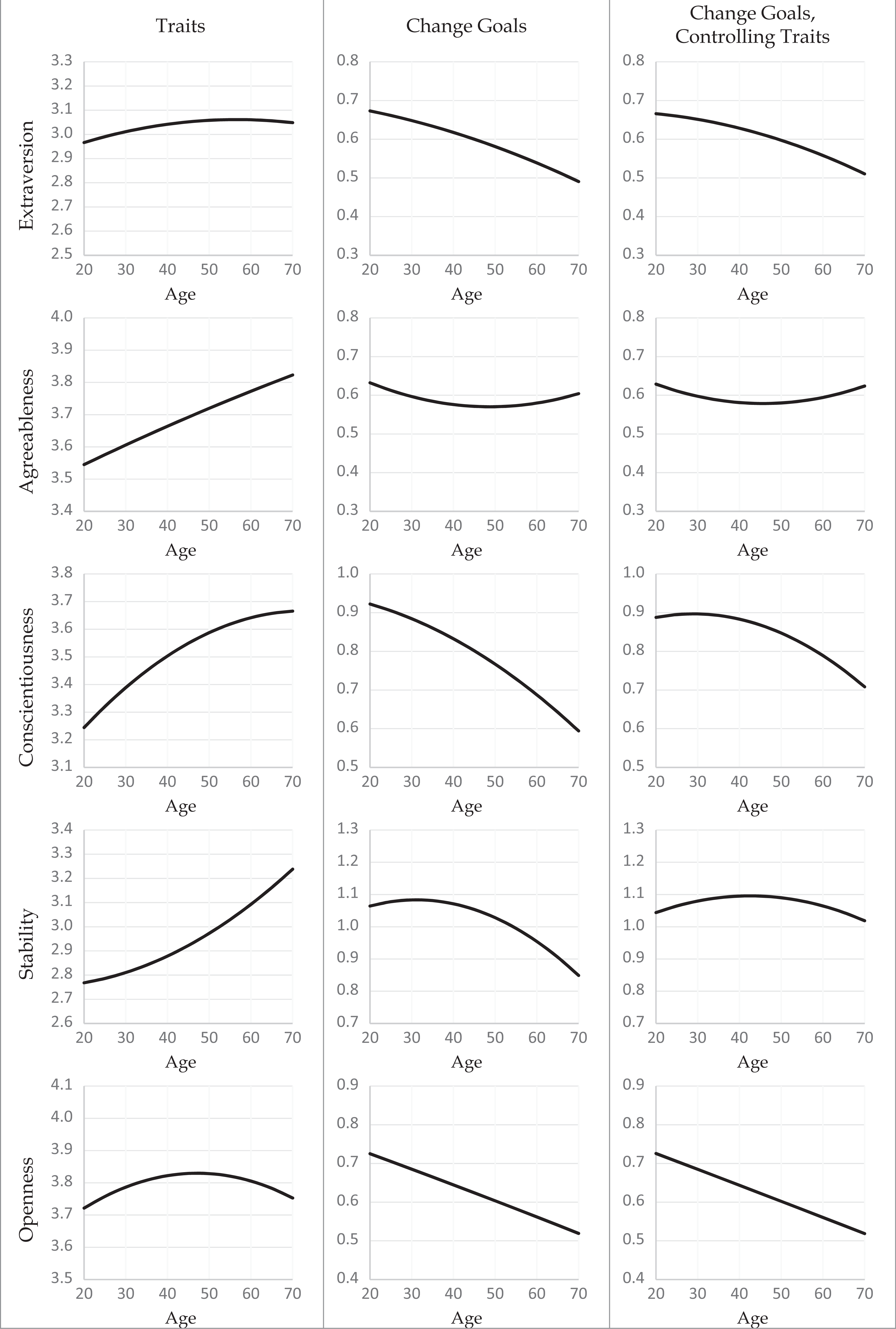
Age trajectories in personality traits and change goals. All vertical axes depict 1 SD in the trait or change goal.
Age Trajectories in Change Goals
Age trajectories in change goals magnitude
For our next series of analyses, we examined the extent to which people’s change goals varied with age. As seen in the lower half of Table 2 and middle column of Figure 1, older individuals reported lesser desires to increase in all five dimensions: extraversion (b1 = −0.027, 95% CI: [−0.044, −0.010], β1 = −.059), agreeableness (b1 = −0.026, 95% CI: [−0.044, −0.009], β1 = −.054), conscientiousness (b1 = −0.042, 95% CI: [−0.061, −0.025], β1 = −.088), emotional stability (b1 = 0.008, 95% CI: [−0.011, 0.027], β1 = .016; b2 = −0.016, 95% CI: [−0.025, −0.006], β2 = −.061), and openness (b1 = −0.040, 95% CI: [−0.057, −0.024], β1 = −.090).
Although people generally desired lesser changes to their traits with age, these effects were small. Consequently, individuals of even the oldest sampled age were predicted to desire increases in all five traits: emotional stability (model-predicted mean at age 70 [M70 ] = 0.85, 95% CI: [0.74, 0.95]), conscientiousness (M70 = 0.60, 95% CI: [0.50, 0.69]), agreeableness (M70 = 0.60, 95% CI: [0.51, 0.70]), openness to experience (M70 = 0.52, 95% CI: [0.43, 0.61]), and extraversion (M70 = 0.49, 95% CI: [0.40, 0.58]).
Notably, because different change goals followed different trajectories across adulthood, the extent to which people prioritized specific traits did, in fact, slightly change with age. Across the gamut, people most wanted increases in emotional stability (M18 = 1.07, 95% CI: [1.05, 1.10]; M70 = 0.85, 95% CI: [0.74, 0.95]). However, young adults clearly prioritized increases in conscientiousness (M18 = 0.84, 95% CI: [0.82, 0.86]) above increases in openness (M18 = 0.65, 95% CI: [0.63, 0.67]) and extraversion (M18 = 0.62, 95% CI: [0.60, 0.64])—and they least desired agreeableness (M18 = 0.58, 95% CI: [0.55, 0.60]). In contrast, the oldest adults expressed approximately equal desires for gains in conscientiousness (M70 = 0.60, 95% CI: [0.50, 0.69]), agreeableness (M70 = 0.60, 95% CI: [0.51, 0.70]), openness (M70 = 0.52, 95% CI: [0.43, 0.61]), and extraversion (M70 = 0.49, 95% CI: [0.40, 0.58]).
Age differences in change goals prevalence
Another way to quantify the extent to which people wish to change their traits is to compute the prevalence of change goals—the percentage of people who desired any magnitude of increase in each dimension (i.e., the magnitude of their change goal was greater than 0 on the original metric; Hudson & Roberts, 2014). Although such prevalence analyses are merely a simpler, dichotomized (thus less powerful; Cohen, 1983) version of our magnitude analyses, they provide a slightly different and potentially more intuitive metric. Averaging across the entire sample, a minimum of 85% of people wanted to increase in each big five dimension (ranging from 85% [agreeableness] to 94% [conscientiousness/emotional stability]).
Using logistic regression (with linear and quadratic age terms), we examined whether the prevalence of change goals varied across adulthood. As can be seen in Table 3, change goal prevalence decreased with age for conscientiousness (odds ratio [OR]1 = 0.785, 95% CI[0.687, 0.897), emotional stability (OR1 = 1.133, 95% CI[0.981, 1.301]; OR2 = 0.878, 95% CI[0.826, 0.933]), and openness (OR1 = 0.819, 95% CI[0.733, 0.914])—but not extraversion (OR1 = 0.981, 95% CI[0.888, 1.084]) or agreeableness (OR1 = 1.003, 95% CI[0.914, 1.101]).
Age Trajectories in Change Goal Prevalence.
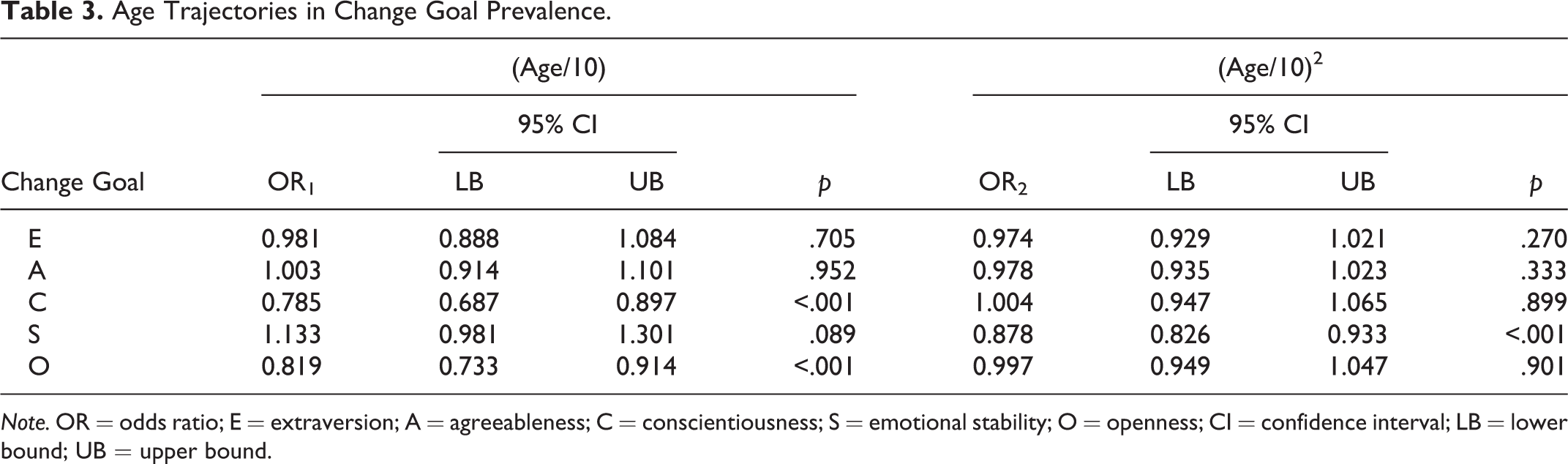
Note. OR = odds ratio; E = extraversion; A = agreeableness; C = conscientiousness; S = emotional stability; O = openness; CI = confidence interval; LB = lower bound; UB = upper bound.
The model-predicted prevalence of goals to change each trait at various ages can be used to explore whether the specific traits people prioritized changed across adulthood. Among the youngest sampled adults, the most prevalent change goals were to increase in emotional stability (95%, 95% CI: [0.94, 0.96]) and conscientiousness (92%, 95% CI: [0.91, 0.93]), followed by openness (88%, 95% CI: [0.87, 0.90]), extraversion (87%, 95% CI: [0.86, 0.89]), and agreeableness (85%, 95% CI: [0.84, 0.86]). In contrast, goals to change each big five dimension were roughly equal in prevalence among the oldest adults sampled: conscientiousness (85%, 95% CI: [0.77, 0.91]), extraversion (81%, 95% CI: [0.72, 0.87]), agreeableness (80%, 95% CI: [0.72, 0.87]), openness (80%, 95% CI: [0.70, 0.87]), and emotional stability (78%, 95% CI: [0.67, 0.87]).
In summary, irrespective of whether change goals were operationalized as magnitude of desired changes (i.e., the original change goals metric), or percent of people who wish to increase in a trait, young adults prioritized conscientiousness, whereas older adults tended to equally value increases in each trait. Notably, there was an interesting discontinuity in our findings with respect to emotional stability. Namely, older adults wanted the largest gains in emotional stability (vs. other dimensions). Yet goals to increase in emotional stability were the least prevalent (vs. other dimensions) among the oldest adults in our sample. This pattern may indicate substantial variance in the magnitude of older adults’ goals to increase in emotional stability: comparatively few elderly adults (78%) want to increase in emotional stability—but those who do desire increases want large gains.
Do change goals vary with age, controlling traits?
Given the negative correlations between change goals and existing traits (e.g., introverted individuals are the ones who most want increases in extraversion), it is possible that the associations between age and change goals are attributable to normative trait growth. Therefore, as follow-up analyses, we examined the associations between age and change goals magnitude, controlling existing traits. As seen in Table 4 and the right-hand column of Figure 1, controlling traits largely did not change the associations between age and change goals. The curvilinear association between age and conscientiousness crossed the threshold into statistical significance, and the age trajectory for emotional stability somewhat flattened. Nevertheless, as is evident by comparing the middle and right-hand columns of Figure 1, the age trajectories in change goals were not conspicuously altered by holding traits constant—except perhaps for emotional stability.
Curvilinear Age Trajectories in Change Goals, Controlling the Relevant Trait.

Note. E = extraversion; A = agreeableness; C = conscientiousness; S = emotional stability; O = openness; CI = confidence interval; LB = lower bound; UB = upper bound; rp = partial correlation.
Discussion
Previous research has found that the vast majority of college-aged adults wish to change their personality traits (Hudson & Fraley, 2015, 2016; Hudson & Roberts, 2014). The present study examined whether this phenomenon is limited to youth—or whether older adults also wish to change their traits. In a sample of 6,800 participants, aged 18–70, we found that older adults wanted slightly smaller increases in all five personality traits, as compared with their younger counterparts. Nevertheless, these effects were small (average linear β = −0.06)—and consequently, even the oldest sampled adults expressed goals to increase in each big five dimension. Moreover, in addition to wanting smaller changes, older adults were also generally less likely to desire changes in any magnitude. Stated differently, change goals were also less prevalent among older adults. But again, these effects were small—with change goals prevalence decreasing an average of only 9% from ages 18 to 70—and thus the vast majority of even elderly people desired increases in each big five dimension.
Therefore, one major implication of the present study is that the vast majority of adults wish to change their personality traits. And although these desires slightly abate with age, they never fully dissipate. To the contrary, across adulthood—from ages 18 to 70—a minimum of 78% of people of any age wanted to increase in each big five trait. Thus, change goals are not limited to youth.
Why Do Change Goals Slightly Ebb With Age?
The fact that change goals slightly decrease across adulthood—both in terms of magnitude and prevalence—is consistent with research that people increase in self-esteem (Robins et al., 2002) and emotional stability (Roberts et al., 2006) with age. Specifically, change goals emerge when people are dissatisfied with aspects of their selves or their circumstances (Baumeister, 1994; Hudson & Roberts, 2014; Kiecolt, 1994). Thus, the greater levels of self-acceptance and resiliency to stress and negative affect (i.e., emotional stability) that accompany age may abate change goals that are driven by discontent with aspects of one’s self or life.
Additionally, older adults may also desire lesser changes to their traits, as compared with younger individuals, partially because the big five traits tend to increase throughout adulthood (Lucas & Donnellan, 2011; Roberts et al., 2006). Specifically, people tend to want desirable traits that they lack (Hudson & Roberts, 2014). Thus, older adults may desire lesser changes to traits because they are likely to already possess higher levels of each trait. Indeed, research suggests that growth in any big five dimension is associated with reductions in individuals’ desire to continue increasing in that trait (Hudson & Fraley, 2015). The present findings, however, seem to suggest that normative developmental patterns in the big five cannot fully explain why older adults have lesser change goals. Specifically, even holding participants’ existing traits constant, older adults still wanted smaller changes to their traits than did younger individuals. In fact, the age trajectories in change goals were not at all conspicuously altered by holding existing traits constant—except perhaps for emotional stability.
What might explain this apparent incongruity between our results and prior theory and findings (Hudson & Fraley, 2015; Hudson & Roberts, 2014)? There are several possibilities. For one, the negative link between existing traits and change goals may be contingent upon age-graded norms. For example, older adults tend to be more conscientious than younger adults (Lucas & Donnellan, 2011; Roberts & Mroczek, 2008; Roberts et al., 2006). However, one consequence of this group-level trend is that it is possible for an individual to increase in conscientiousness over his or her life yet remain substantially lower in conscientiousness than his/her same-aged peers. Stated differently, the “standards” for average/normative levels of conscientiousness increase with age. Thus, individuals’ desires to increase in conscientiousness may vary—not as a function of their relative ranking in conscientiousness when compared to adults of all ages—but rather as a function of their levels of conscientiousness as compared to age-graded norms. If this idea is true, it would imply that rank-order changes in personality (i.e., changes relative to one’s peers) should foster reductions in change goals (Hudson & Fraley, 2015), whereas normative (i.e., mean level) growth might not.
Do the Specific Traits People Prioritize Change With Age?
We also examined whether adults of varying ages prioritized changes to different personality traits. Consistent with previous research (Hudson & Roberts, 2014), young adults prioritized goals to increase in conscientiousness and emotional stability over other traits—and they least valued agreeableness. In contrast, the oldest adults in our sample also prioritized emotional stability but placed approximately equal value upon the other four traits. Notably, there was a slight discontinuity with respect to emotional stability among older adults: Desires to increase in emotional stability were actually the least prevalent goal among elderly adults; yet of any trait, the average elderly individual desired the largest magnitude increases in emotional stability. This may indicate greater variance in goals to increase in emotional stability in the lattermost years of life: comparatively fewer older adults (78%) wish to increase in emotional stability, but those who do wish to increase desire especially large changes.
The fact that young adults prioritized increases in conscientiousness is consistent with the idea that one primary developmental task in young adulthood is initiating one’s career (e.g., Hutteman et al., 2014)—a challenge in which high levels of conscientiousness foster success (e.g., Judge et al., 2002). Thus, younger adults may especially desire increases in conscientiousness over other traits because they believe that conscientiousness has particularly high utility value in their current, most salient life task of embarking upon their careers (Hennecke et al., 2014; Hudson & Roberts, 2014).
In contrast to their younger counterparts, older adults approximately equally valued conscientiousness, extraversion, and agreeableness. Why might older adults desire extraversion and agreeableness to the same degree as conscientiousness? There are several potential explanations. For one, social vitality tends to decline with age (Roberts & Mroczek, 2008; Roberts et al., 2006)—presumably because generative roles, such as investing in family and aging parents, require increasing amounts of time and commitment throughout middle adulthood (Erikson, 1974; Hutteman et al., 2014) at the cost of social/leisure opportunities. Thus, older adults may wish to increase in extraversion partially to assuage dissatisfaction with increasingly restricted social or recreational activities (see also Carstensen, Isaacowitz, & Charles, 1999). Similarly, older adults may value agreeableness due to its utility value in thriving amidst the challenges of generative roles (e.g., Graziano, Habashi, Sheese, & Tobin, 2007). Of course, these explanations are purely speculative and should be explicitly tested in future studies.
Finally, across the life span, emotional stability was the single most coveted trait. This may reflect that emotional stability has utility value across a wide gamut of developmental tasks—including thriving in one’s career, friendships, and family (e.g., Ozer & Benet-Martínez, 2006). Moreover, research suggests that people deeply value simply being happy per se (Diener & Oishi, 2004). Thus, the age-invariant priority of desires to become more emotionally stable may represent people’s unquenchable desire to feel fewer negative emotions and more numerous positive ones.
Implications, Limitations, and Future Directions
The single largest implication of our study is that across adulthood—from teenagers to the elderly—the vast majority of people wish to change their traits. That being said, one major reason to understand change goals is that people tend to actually change in ways that align with their desires—at least over short periods of time (Hudson & Fraley, 2015, 2016). Thus, it may be the case that conscientiousness increases most sharply among young adults before plateauing (Roberts et al., 2006) partially because young adults are the ones who most desire to increase in conscientiousness.
That being said, volitional change—the concept that people can change their own personalities—has only been studied among college-aged adults (Hudson & Fraley, 2015, 2016; Robinson et al., 2015). Thus, it remains unclear whether older adults—whose personalities may be less plastic (e.g., Roberts, Wood, & Caspi, 2008)—would also experience similar levels of success in attaining their change goals. Future research should therefore examine whether change goals predict corresponding trait changes for adults of varying ages (Hudson & Fraley, 2017).
Another implication of our study is that the traits individuals wish to change may vary as a function of their current developmental tasks (Hennecke et al., 2014; Hudson & Roberts, 2014; Hutteman et al., 2014). Specifically, people may desire increases in traits they perceive would foster their ability to thrive in current, age-graded struggles. One limitation of our study, however, is that we did not measure individuals’ current life challenges or their satisfaction with various life domains. Thus, we could not directly test, for example, that younger adults value conscientiousness to a greater degree than do older adults because they perceive it would enable them to thrive in establishing a fledgling career. Future research should explicitly measure individuals’ current life challenges and satisfaction with life domains alongside change goals to formally test these ideas (e.g., Hudson & Roberts, 2014).
A second limitation of our study is that our data were cross sectional. Thus, it remains possible that cohort effects or other confounds partially explain our findings. Future research should use extended longitudinal designs to track how people’s change goals actually change throughout adulthood, rather than relying on cross-sectional designs to infer such changes.
One final limitation of our study is that our sample consisted of internet users who voluntarily completed a personality test as a recreational activity. Such individuals may differ from the general population in a variety of potentially psychologically meaningful ways.
Conclusion
In conclusion, the present study suggests that the vast majority of adults wish to increase in each big five dimension. Although these change goals slightly ebb over adulthood, even elderly adults express substantial desires to increase in each trait. These findings have potentially important implications for understanding people’s attempts to change their personality—and personality development more broadly—across adulthood.
Footnotes
Declaration of Conflicting Interests
The author(s) declared no potential conflicts of interest with respect to the research, authorship, and/or publication of this article.
Funding
The author(s) received no financial support for the research, authorship, and/or publication of this article.
Notes

References
Supplementary Material
Please find the following supplemental material available below.
For Open Access articles published under a Creative Commons License, all supplemental material carries the same license as the article it is associated with.
For non-Open Access articles published, all supplemental material carries a non-exclusive license, and permission requests for re-use of supplemental material or any part of supplemental material shall be sent directly to the copyright owner as specified in the copyright notice associated with the article.
